Paperis Articles
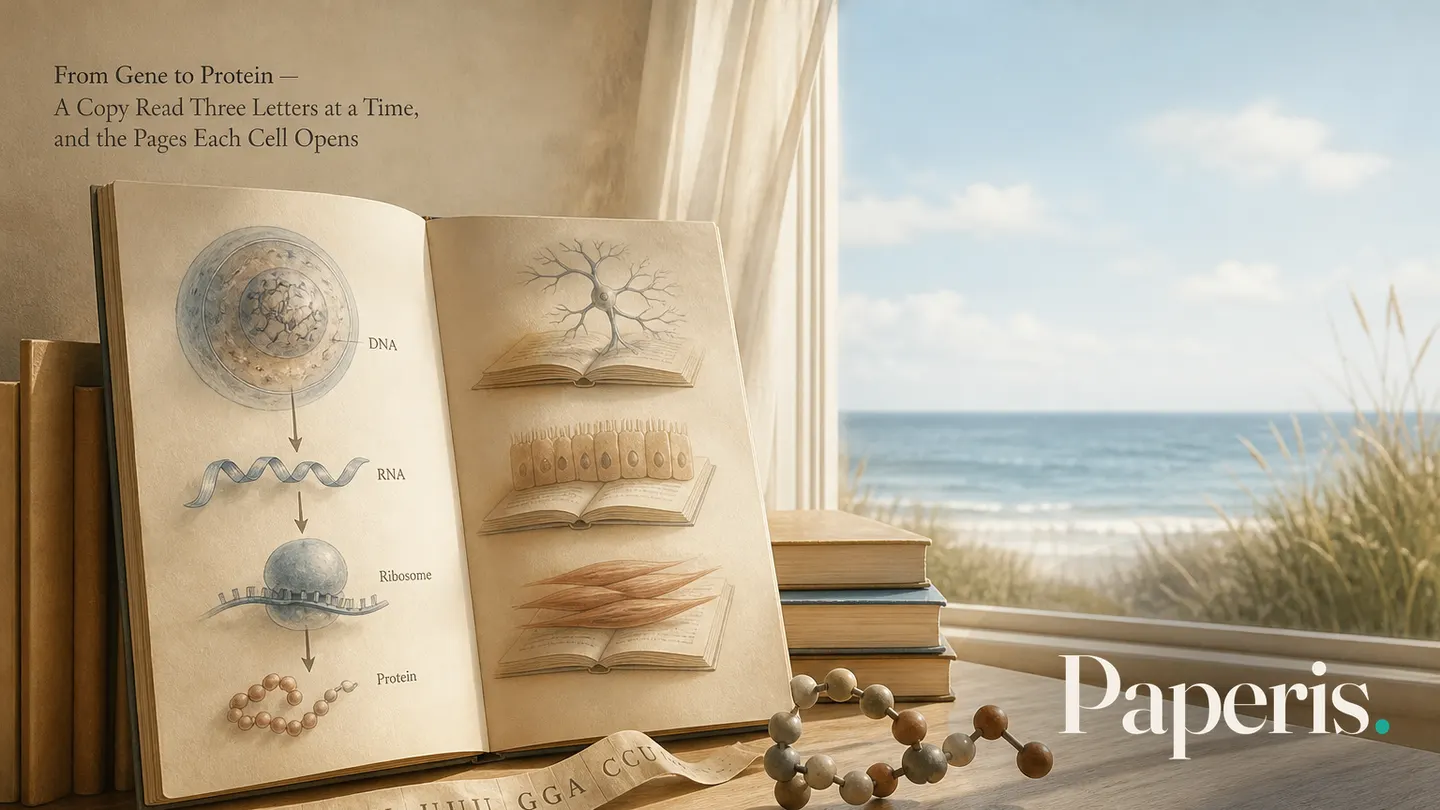
From Gene to Protein — A Copy Read Three Letters at a Time, and the Pages Each Cell Opens
We follow what proteins are and why they do most of the work in a cell, how a gene's information is copied into RNA and read three letters at a time, and why cells carrying largely the same genome end up doing different jobs.
Your field's papers, as audio
Pick your fields and journals — Paperis summarizes the key papers and turns them into audio. Listen on your commute.
Start Paperis free →From Gene to Protein — A Copy Read Three Letters at a Time, and the Pages Each Cell Opens
If You Chew Your Food for a Long Time
If you do not swallow a spoonful of rice right away and chew it for a long time, the inside of your mouth can become a little sweet. During this time, a molecule inside your saliva begins to change starch into a sugar called maltose (OpenStax Biology 2e 34.1). The chemical breakdown of food begins right here in the mouth.
Saliva is water produced and secreted by salivary glands around the mouth (OpenStax Biology 2e 34.1), and the molecules within it are also made by the cells of the salivary glands themselves. Cells write down how to make these molecules somewhere and pull out and read the instructions when needed.
This article follows the path of how those written instructions turn into working molecules. Cells carry around manuals, read a copied excerpt of that manual three letters at a time, and make workers. Then, cells with the exact same manual open up and read different parts.
The Workers Inside the Cell
That molecule in your saliva is a protein. Proteins are molecules made of amino acids linked together in chains and folded up, and they do most of the work inside cells. Amino acids are the small molecules that make up protein chains, and living things commonly use twenty of them. Because each of the twenty has different chemical properties, some are acidic and others do not mix well with water (OpenStax Biology 2e 15.1).
Proteins do a great many different things. They build the cell's skeleton, make muscles contract, carry substances through the blood, and defend the body against pathogens. Insulin is a protein hormone used to control the amount of sugar in the blood (OpenStax Biology 2e 3.4). Hemoglobin's main job is to grab onto oxygen and drop it off in tissues, but that is not the only thing it does (PMID 17981931). A single cell may contain thousands of different proteins (OpenStax Biology 2e 3.4).
Enzymes are molecules that help chemical reactions happen more easily inside cells, and almost all of them are proteins. That molecule in your saliva is also an enzyme that breaks down starch (OpenStax Biology 2e 3.4). Enzymes work by grabbing onto a partner molecule and holding it in a position where its bonds are easy to break or form anew (OpenStax Biology 2e 6.5).
Most of what a cell does is what the proteins made by that cell do.
The Chain Folds into a Shape
A protein chain is about 50 amino acids long at the shortest and over 1,000 at the longest (OpenStax Biology 2e 15.5). The order in which amino acids are placed in the chain is called the amino acid sequence. Depending on the order and number of twenty kinds of beads threaded together, the shape, size, and job of a protein change (OpenStax Biology 2e 3.4).
Most proteins must have their chains folded into unique three-dimensional shapes to do their jobs (PMID 27365453). The process of a single-line chain clumping into a determined three-dimensional shape is called folding, and the shape that results from folding is called the structure of that protein. Chains fold while they are being made and even after they are fully made (OpenStax Biology 2e 15).
The shape of a protein determines the job that protein does. An enzyme has a slot where a counterpart molecule sits, and if the shape of that slot is distorted, the enzyme cannot catch its counterpart. When you put an egg in a frying pan, the transparent liquid of the white hardens into white. The protein in the white has lost its shape to heat. While proteins that have lost their shape often regain their original shape once the cause is gone, there are also cases where they do not return, like a cooked egg (OpenStax Biology 2e 3.4).
The inside of a cell is a place crowded with molecules, so newly made chains easily misfold and clump together. Therefore, cells have proteins that assist newly emerging chains so they fold into their proper shapes. This care weakens as we age, and that decline is linked to neurodegenerative diseases where proteins clump together (PMID 27365453).
The principle that shape determines function also has a wide margin. There are many proteins or sections of proteins that work unfurled without a fixed shape (PMID 12368089). When computers made predictions based on the genetic information of 29 organisms, it turned out that in organisms with a nucleus, generally more than 30% of proteins have unfurled segments of 50 or more consecutive amino acids. This is a predicted value, not a measured one (PMID 11381529).
A protein is an amino acid chain, and the shape folded by that chain usually determines its job.
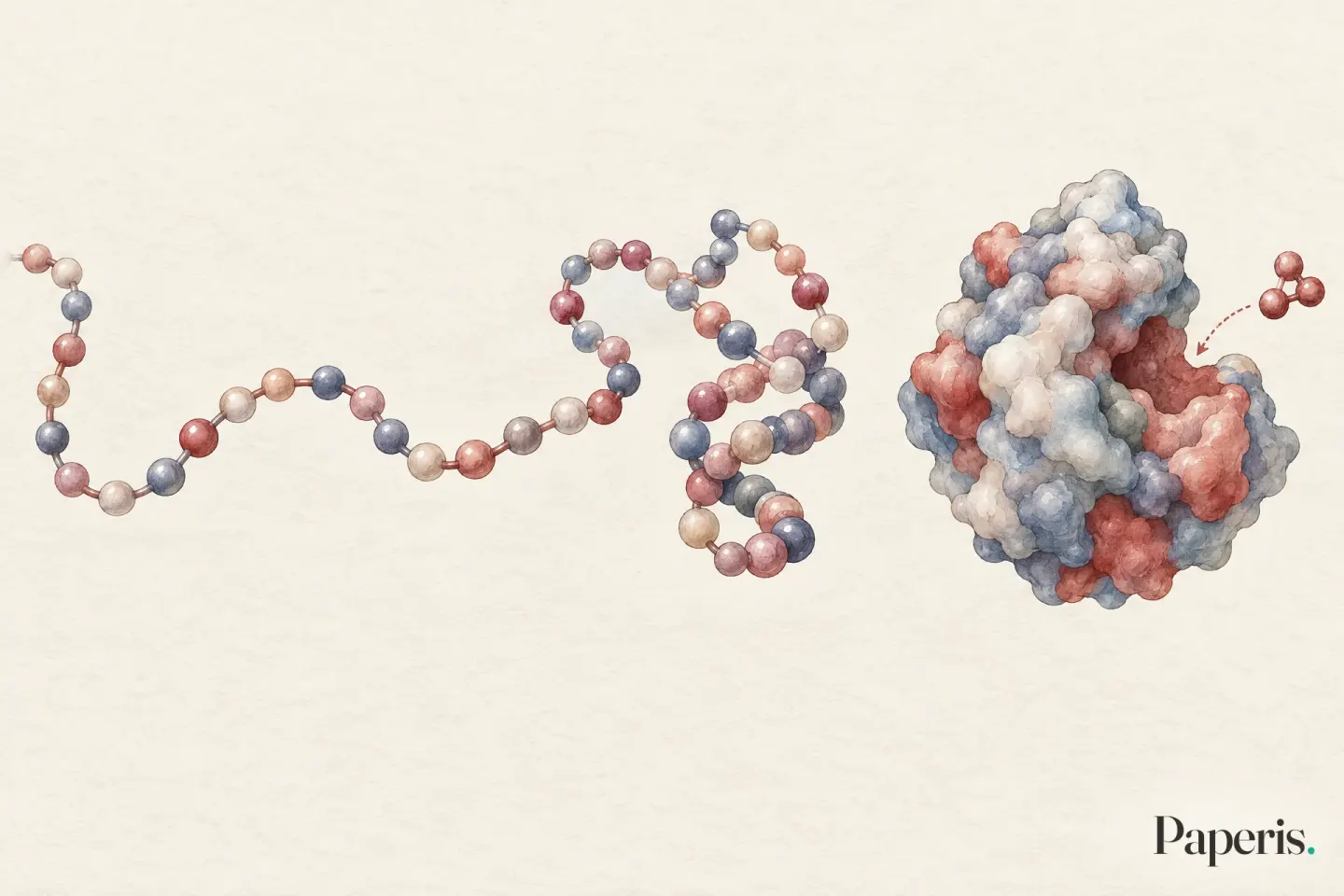
Illustration: Paperis
Keep the Original and Make a Copy
Then what decides the order in which the amino acids are strung together? That order is written in the cell's DNA (OpenStax Biology 2e 3.4). DNA is a long molecule where cells store genetic information, and the sequence of four bases lined up is that information. The four bases are adenine (A), thymine (T), guanine (G), and cytosine (C), and these four letters are the characters of the instruction manual that cells carry around. A gene is a section in DNA where the information for making a protein or a working RNA is written.
RNA is a molecule similar to DNA that is used to copy down DNA's information or read that information. The structure and replication of DNA are covered in detail in "DNA and Genes — An Instruction Manual Written in Four Letters, Two Strands That Are Each Other's Molds".
When salivary gland cells make an enzyme that chops starch, they use a copy transcribed from DNA. They copy out only the necessary part as RNA and leave the DNA untouched (OpenStax Biology 2e 15.1). Transcription is the process by which a cell copies the DNA letter sequence of a gene region, transcribing the same content letter by letter into RNA.
When copying, the two strands of DNA part slightly only at that region, and one of those strands serves as the template. The resulting RNA has almost the same letters as the strand that did not serve as the template. The only difference is that RNA uses uracil (U) in place of DNA's thymine (T) (OpenStax Biology 2e 15.2).
mRNA is an RNA that copies the contents of a gene for making a protein and carries it to the site of protein synthesis, also called messenger RNA. In organisms with a nucleus in their cells, such as humans, the DNA inside the nucleus is transcribed inside the nucleus, and the copy goes out of the nucleus to be turned into protein. In organisms without a nucleus, such as bacteria, the two events happen almost simultaneously (OpenStax Biology 2e 16.1). Mitochondria inside human cells have their own separate DNA, and RNA and proteins are made from that DNA as well (OpenStax Biology 2e 15.4).
In cells with a nucleus, a newly minted copy is not used immediately but is trimmed first. Sections sandwiched between protein-coding information are cut out and the remaining sections are spliced together, and tags that protect the copy and provide signals are attached to both ends (OpenStax Biology 2e 15.4).
The original instruction manual is kept inside the nucleus, and only the necessary parts are copied out and sent out.
Read Three Letters at a Time
The copy meets the ribosome outside the nucleus. A ribosome is a tiny particle inside the cell that reads the copy of the genetic information and links amino acids together one by one to make a protein. A ribosome is made of RNA and several proteins, and consists of two parts: a large subunit and a small subunit. Although the details of the parts differ slightly from organism to organism, the overall structure and function are similar enough to compare between bacteria and human cells (OpenStax Biology 2e 15.5).
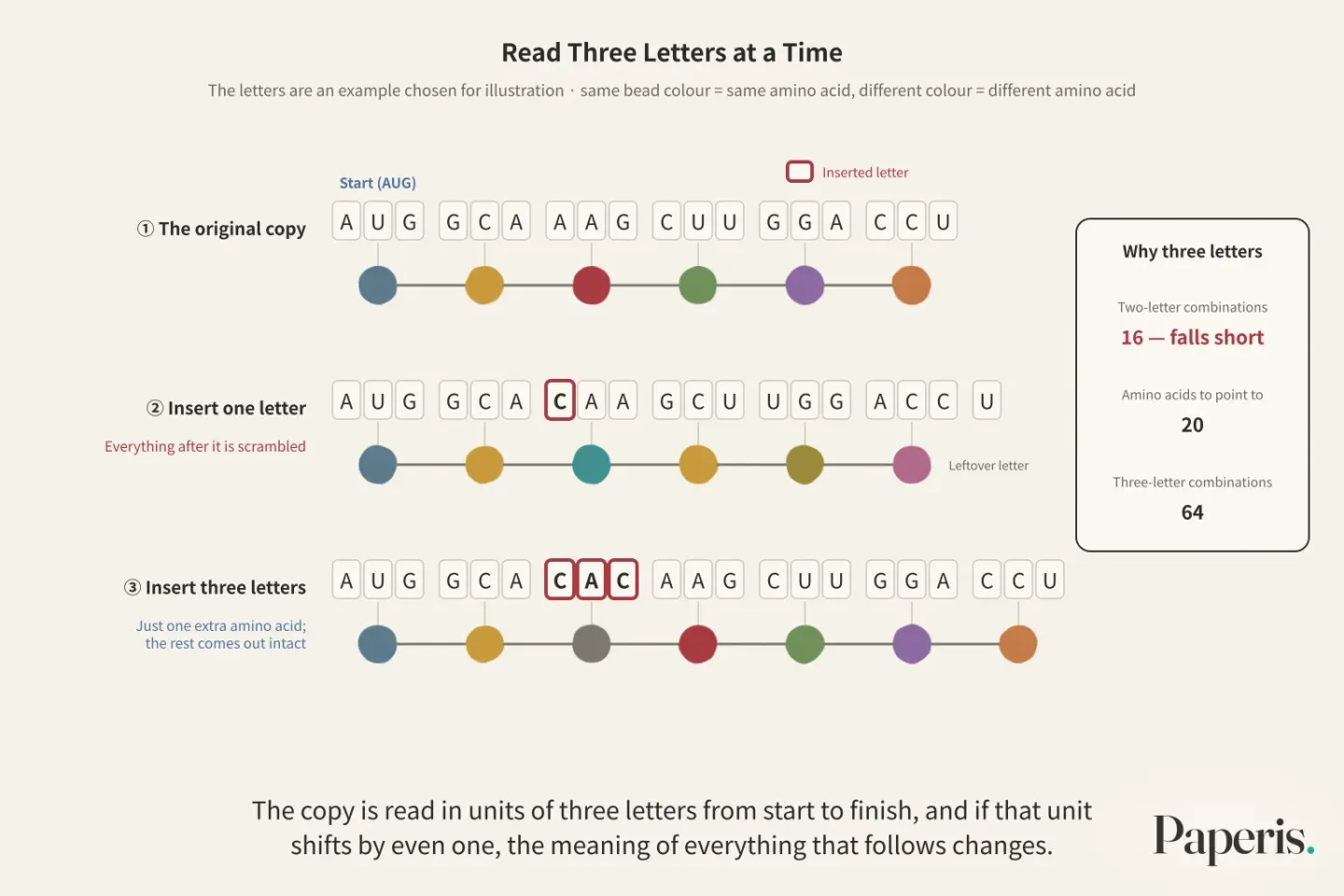
How many letters at a time does the ribosome read from the copy? Two scientists, Francis Crick and Sydney Brenner, tried inserting one, two, or three letters into the gene of a virus. Inserting one or two scrambled the subsequent content entirely, whereas inserting three resulted in the rest of the protein coming out intact with just one extra amino acid added (OpenStax Biology 2e 15.1). The number three also makes sense mathematically. To point to 20 amino acids using four letters, a two-letter combination of 16 falls short, while a three-letter combination gives 64 (OpenStax Biology 2e 15.1). A codon is a bundle of three linked letters in mRNA, representing a single amino acid or a stop signal.
The genetic code is a lookup table that determines which codon means which amino acid. Among the 64 codons, 61 mean amino acids, and three mean "stop here." AUG means the amino acid methionine while also doubling as the signal to start reading (OpenStax Biology 2e 15.5). Most amino acids are pointed to together by multiple similar codons (OpenStax Biology 2e 15). A mutation is a change in the nucleotide sequence of DNA. Because codons that mean the same amino acid usually differ by only a single letter, a change in one letter can still result in the exact same amino acid being inserted. This redundancy is considered a mechanism that reduces the damage of mutations (OpenStax Biology 2e 15.1). Nearly all living things on Earth use the same genetic code (OpenStax Biology 2e 15).
What pairs codons with amino acids is another RNA. Transfer RNA is a small RNA that carries one amino acid on one end and recognizes the codon matching that amino acid on the other end. Depending on the organism, there are 40 to 60 types. For example, when the codon CUA appears on the copy, a transfer RNA that locks into that codon brings in the amino acid leucine (OpenStax Biology 2e 15.5).
Translation is the process inside the cell where a ribosome reads the letters of mRNA three at a time and links amino acids in that order to make a protein chain. This is the step where the copy of the four-letter instruction manual is turned into a string threaded with 20 kinds of beads. After linking the incoming amino acid to the end of the growing chain, the ribosome shifts along the copy by exactly three letters (OpenStax Biology 2e 15.5). This work is costly. Making proteins is the most energy-consuming task for a cell (OpenStax Biology 2e 15.5).
The copy is read in units of three letters from start to finish, and if that unit shifts by even one, the meaning of everything that follows changes.
Following a Single Gene All the Way
Now, connecting the facts we saw earlier, let us follow a single gene in a human cell all the way until it becomes a protein.
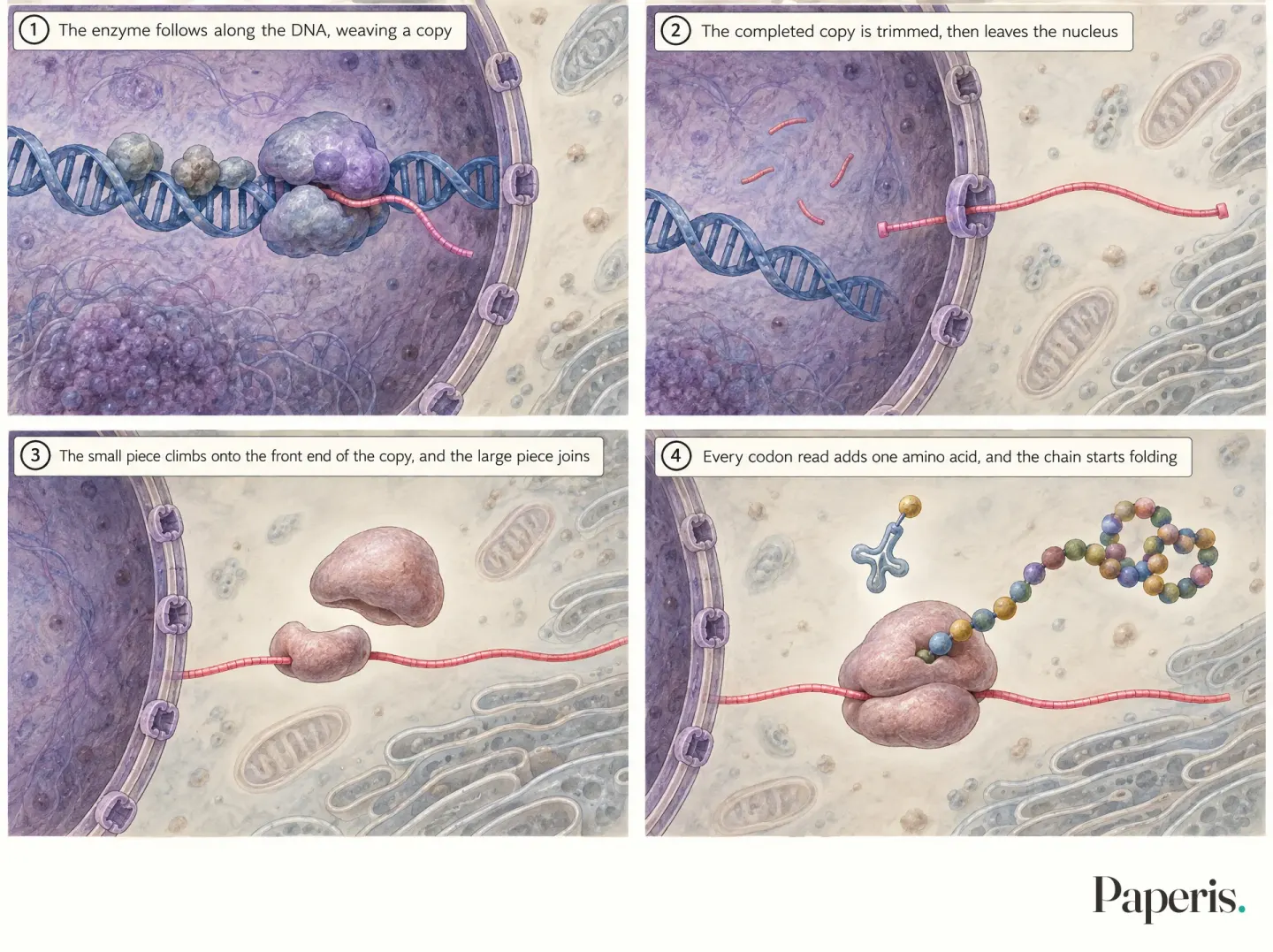
Inside the nucleus, a few proteins first take their places on the DNA right in front of the gene. In human cells, the enzyme that stitches RNA cannot start transcription on its own, and these proteins must attach to the front spot to summon that enzyme before work can begin (OpenStax Biology 2e 16.4). The enzyme follows along the DNA, weaving a copy, and the completed copy has the sections that were sandwiched in between cut out, gets a tag attached to the end, and then leaves the nucleus (OpenStax Biology 2e 15.4).
Outside the nucleus, the small piece of a ribosome climbs onto the front end of the copy (OpenStax Biology 2e 15). The small piece slides along the copy, examining three-letter bundles one by one, and usually stops when it reaches the right AUG (PMID 24499181). When the large piece joins at that spot, reading begins (OpenStax Biology 2e 16.6).
Every time the ribosome reads a codon, it adds the amino acid carried by the corresponding transfer RNA to the chain one by one. Then, when it reaches a stop codon, the ribosome disperses, and the completed chain is released (OpenStax Biology 2e 15). The chain starts folding even while it is being made (OpenStax Biology 2e 15), and usually has to fold into its proper shape to do its job (PMID 27365453).
A passage of the instruction manual becomes a copy, the copy is read three letters at a time to become a chain, and the chain folds to become a worker.
The Name of This Flow, The Central Dogma
The central dogma is the basic picture of molecular biology in which genetic information flows from DNA to RNA to protein. It states that genes determine the letter sequence of mRNA, which in turn determines the amino acid sequence of proteins (OpenStax Biology 2e 15.1). This picture was first proposed in 1958 (PMID 39547208) and is still used today as the primary path along which genetic information flows (PMID 38933289).
While it is the major highway, there are also many side roads branching off from it. Not all genes end in proteins. Some genes do not make proteins, and the RNA itself does the work (OpenStax Biology 2e 3.5). Transfer RNA is one such RNA, and the RNA that makes up ribosomes is another (PMID 39547208).
Over the past forty years or so, RNAs that control when and how much genes are used have been discovered one after another (PMID 39547208). Among them, long RNA groups have various ways of working, and in many cases, those mechanisms have not yet been figured out (PMID 39547208).
It is also rare for the copy itself to be edited. In the mitochondria of the single-celled organism Trypanosoma (one species of which causes sleeping sickness in humans), newly minted copies usually lack a few uracils (U), so they do not yield proper proteins as they are. The cell makes proteins only after adding letters to fix the copy, and textbooks cite this as an interesting exception to the central dogma (OpenStax Biology 2e 15.4).
Even on the major highway, there are parts that have not yet been fully drawn. No matter which codon meaning the same amino acid is used, how long the copy remains can vary depending on which codon is used (PMID 37001134). This means codons carry information beyond amino acids. However, that mechanism is not yet clear (PMID 37001134). The amino acids that go into proteins are commonly said to be twenty, but two rarely used ones are sometimes added to count twenty-two (PMID 38688034).
The central dogma is the main road through which genetic information flows, and that road alone does not explain the cell entirely.
Same Manual, Different Cells
The genome is the complete set of genetic information of an organism, also called the genome. In humans, the number of genes that make proteins is estimated to be just under 20,000 (PMID 37794265). Muscle cells and nerve cells in the same person generally share the same DNA, yet look and act entirely differently. There are even cells, such as mature red blood cells, that lack DNA altogether (OpenStax Biology 2e 16).
Gene expression is the process of turning on a gene to use its information to make RNA and proteins. If a nerve cell constantly made proteins meant to contract muscles, it would waste energy. Cells turn on only the genes they need, right when they need them (OpenStax Biology 2e 16.1). Cells with largely the same genome perform different tasks mostly because they differ in which genes they read, when and how much they read them, and how they process and use those copies. How a cell regulates gene transcription determines what the cell is and what it does (PMID 31462772).
Regulation does not happen at just one place. It can take place at every single step: the stage where coiled DNA is unwound so it can be read, the transcription stage, the stage of processing and exporting copies, the translation stage, and even stages after the protein is fully made (OpenStax Biology 2e 16.1).
The first place is opening the pages. DNA inside the nucleus is tightly folded and wrapped around protein beads, and those beads must slide out of the way along the DNA for that segment to be read (OpenStax Biology 2e 16.3). Which segments are unwound and read differs depending on the cell type (OpenStax Biology 2e 16.3).
The next place is starting the reading. A transcription factor is a protein that binds to the DNA upstream of a gene to start, help, or suppress the transcription of that gene. When vertebrate skeletal muscle is formed, a group of muscle regulatory genes called MyoD goes to work (PMID 1485959). Among this group of proteins, MyoD and myogenin appear to bind directly with other transcription factors, jointly coordinating both the proliferation of cells destined to become muscle and their transition into muscle (PMID 1485959).
Regulation continues even after reading. Translation is primarily regulated at the initiation step (PMID 38052923), and when a chemical marker is attached to a protein that initiates translation, the initiation machinery fails to assemble properly, blocking translation (OpenStax Biology 2e 16.6).
When this regulation, which happens at multiple sites, goes awry, it can lead to various diseases including cancer (OpenStax Biology 2e 16.1).
Holding the same manual, different cells open different pages, and that difference becomes the identity of the cell.
One Gene, Many Proteins
A single passage in the manual does not always lead to just one consistent worker. Cells with a nucleus cut out intervening segments from the copy and stitch the remaining segments back together, and changing how those segments are stitched together also changes the result.
Alternative splicing is the process of choosing different segments to keep from a copy and stitching them together, making different proteins from a single gene. Even though the kept segments change, the order in which they are stitched always follows the original order (OpenStax Biology 2e 16.5). This process can happen haphazardly, but more commonly, the cell regulates it to produce different proteins in different cells or at different developmental stages (OpenStax Biology 2e 16.5).
How common it is depends on the estimate. A textbook cites one estimate stating that 70% of human genes produce multiple proteins through this method (OpenStax Biology 2e 16.5), while a 2017 review states that over 90% of human genes undergo alternative splicing (PMID 28049883). The two sentences differ slightly in their phrasing as well. The textbook notes that they emerge as multiple proteins, whereas the review notes that the splicing patterns change. Just how useful those resulting variants are has not yet been fully uncovered. One review considers that evidence has accumulated showing most of the complexity created by alternative splicing is reflected in proteins (PMID 36229538). Another review considers that, when looking at individual variants, most probably do nothing at all, while still viewing alternative splicing as potentially helping organisms adapt to their environments (PMID 35821097).
Neurons have their own distinct regulatory proteins that guide copy editing in nerve cells (PMID 28049883). Evidence has also accumulated that alternative splicing regulates how tissues and organs grow (PMID 28488700). One enzyme in mice appears in two forms depending on the splicing pattern from the same gene; during early development, only one of those forms appears in all tissues, while in later development, the other form appears depending on the tissue (PMID 7602764).
Therefore, a single gene does not always lead to a single protein. The relationship between genes and inherited traits is carried forward by "Heredity and Variation — One Card from Each Pair, a Hand Shuffled Anew".
The manual analogy is only correct up to this point. Inside the cell, there is neither a person reading the manual nor a director deciding which page to open. Molecules attaching to and detaching from one another pile up, and the result emerges from that.
Depending on how a passage is cut and stitched, different workers emerge from the same gene.
Where to Read More
Much about how long regulatory RNAs work remains unrevealed (PMID 39547208).
The story of how figuring out three-dimensional shapes from amino acid sequences was blocked for a long time can be found in "Why It Took Fifty Years: Protein Structure Prediction and Its Long Trail of Failures", and the story of how that problem was solved is in "From Sequence to Shape: How AlphaFold Cracked a 50-Year Problem". Drawing the desired shape first and finding the sequence that folds into that shape is covered by "From Prediction to Design — After AlphaFold, the Science of Drawing Proteins and Building Them".
Examples of proteins where shape determines how they catch counterparts continue in "What Is an Antibody? — Millions of Keys Cut in Advance, and the Ones That Fit", and the story of proteins used as signals, like insulin, in "How Hormones Work — Letters Only the Addressee Reads, Replies That Say Stop".
The other parts of this series fill in the context around this article. "What Is a Cell? — A Small Village Inside a Wall, a Village That Splits in Two" looks at the cell itself, containing ribosomes and the nucleus; "DNA and Genes — A Manual Written in Four Letters, Two Strands That Are Each Other's Molds" looks at the letters of the manual and their replication; and "Heredity and Variation — One Card from Each Pair, a Hand Shuffled Anew" looks at how the manual changes as it passes from parents to children.
Source Papers
- "Biology 2e — 34.1 Digestive Systems" (2018) — OpenStax Biology 2e 34.1 — Digestion begins in the mouth, and enzymes in saliva start turning starch into maltose.
- "Biology 2e — 15.1 The Genetic Code" (2018) — OpenStax Biology 2e 15.1 — Cells protect DNA while writing mRNA copies, three letters correspond to one amino acid, letter insertion experiments showed reading in three-letter units, and overlapping codons are thought to reduce mutation damage.
- "Biology 2e — 3.4 Proteins" (2018) — OpenStax Biology 2e 3.4 — The diverse jobs of proteins (framework, contraction, transport, defense, hormones, enzymes), thousands per cell, sequence determines shape and function, and losing shape means losing function (egg white).
- "Biology 2e — 6.5 Enzymes" (2018) — OpenStax Biology 2e 6.5 — Almost all enzymes are proteins, holding reacting molecules to make it easier for bonds to break and form.
- "Biology 2e — 15.5 Ribosomes and Protein Synthesis" (2018) — OpenStax Biology 2e 15.5 — Proteins weigh more than water after water and do almost all the work, and synthesis takes the most energy. Ribosome composition, 61 amino acids and 3 stops out of 64 codons, AUG start, 40 to 60 transfer RNAs.
- "Biology 2e — Chapter Summary" (2018) — OpenStax Biology 2e 15 — The genetic code overlaps and almost all organisms use the same code, chains are released at stop codons, and folding happens during and after translation.
- "Biology 2e — 15.2 Prokaryotic Transcription" (2018) — OpenStax Biology 2e 15.2 — During transcription, DNA is partially unwound and one strand serves as a template, mRNA is almost identical to the other strand with U instead of T.
- "Biology 2e — 16.1 Regulation of Gene Expression" (2018) — OpenStax Biology 2e 16.1 — Definition of gene expression, transcription inside the nucleus and translation outside the nucleus, regulation happening at all stages and saving energy, and breakdowns can lead to diseases like cancer.
- "Biology 2e — 15.4 RNA Processing in Eukaryotes" (2018) — OpenStax Biology 2e 15.4 — Copies in cells with a nucleus are trimmed by removing intervening segments and attaching tags at both ends before being translated. Mitochondria express their own DNA, and RNA editing in Trypanosoma mitochondria is an exception to the central dogma.
- "Biology 2e — 16.4 Eukaryotic Transcription Gene Regulation" (2018) — OpenStax Biology 2e 16.4 — RNA polymerase in cells with a nucleus cannot start without transcription factors, and the length of the upstream region dictates how tight regulation is.
- "Biology 2e — 16.6 Eukaryotic Translational and Post-translational Gene Regulation" (2018) — OpenStax Biology 2e 16.6 — The small subunit finds the start codon before the large subunit joins, and phosphorylation of initiation factors blocks translation.
- "Biology 2e — 3.5 Nucleic Acids" (2018) — OpenStax Biology 2e 3.5 — Many genes make proteins, while other genes make RNA products.
- "Biology 2e — 16.3 Eukaryotic Epigenetic Gene Regulation" (2018) — OpenStax Biology 2e 16.3 — DNA is wound around protein beads and beads must move aside for transcription, and different cell types access different segments.
- "Biology 2e — Introduction" (2018) — OpenStax Biology 2e 16 — Somatic cells in the body generally carry the same DNA (with exceptions like mature red blood cells), and different cells turn on different genes.
- "The status of the human gene catalogue." (2023) — PMID 37794265 — The number of protein-coding genes in humans is currently estimated to be under 20,000.
- "Biology 2e — 16.5 Eukaryotic Post-transcriptional Gene Regulation" (2018) — OpenStax Biology 2e 16.5 — Alternative splicing makes multiple proteins from one gene, by one estimate 70% of human genes do, and segment order is conserved.
- "Oxygen-binding haem proteins." (2008) — PMID 17981931 — The primary job of hemoglobin is to grab oxygen and deliver it to tissues, but it is not its only function.
- "In vivo aspects of protein folding and quality control." (2016) — PMID 27365453 — Most proteins must fold into unique three-dimensional structures to work, and in crowded cells chaperones help newly emerged chains fold. This management network weakens with age, aiding aggregation-related diseases such as neurodegeneration.
- "Intrinsically unstructured proteins." (2002) — PMID 12368089 — Proteins that work while intrinsically lacking structure are common across all organisms and essential for basic functions.
- "Intrinsically disordered protein." (2001) — PMID 11381529 — In 29 genome predictions, over 30% of eukaryotic proteins have disordered regions of 50 residues or more (prediction).
- "The scanning mechanism of eukaryotic translation initiation." (2014) — PMID 24499181 — In eukaryotes, the start codon is found by scanning, inspecting the first few letters of mRNA one by one.
- "Small and long non-coding RNAs: Past, present, and future." (2024) — PMID 39547208 — The central dogma was proposed in 1958; alongside mRNA, tRNA, and rRNA, a massive number of regulatory RNAs have been discovered over the past 40 years, and the mechanisms of long non-coding RNAs remain largely unknown.
- "Translation and mRNA Stability Control." (2023) — PMID 37001134 — Codons affect mRNA stability (codon optimality), information beyond amino acids, and mechanisms are still unclear.
- "Engineering tRNAs for the Ribosomal Translation of Non-proteinogenic Monomers." (2024) — PMID 38688034 — The amino acids in proteins made by ribosomes are the standard 20 plus selenocysteine and pyrrolysine, totaling 22.
- "Organization and regulation of gene transcription." (2019) — PMID 31462772 — Regulated transcription determines cell identity and function.
- "Muscle differentiation." (1992) — PMID 1485959 — The MyoD family of muscle regulatory genes in vertebrate skeletal muscle formation, and mouse knockout experiments support functional redundancy within the family.
- "The molecular basis of translation initiation and its regulation in eukaryotes." (2024) — PMID 38052923 — Translation is regulated mainly at the initiation stage, and post-transcriptional regulation can be as important as transcriptional regulation.
- "Neuron-specific splicing." (2017) — PMID 28049883 — Over 90% of human genes undergo alternative splicing, and there are neuron-specific splicing regulators.
- "The physiology of alternative splicing." (2023) — PMID 36229538 — Evidence has accumulated suggesting that most of the complexity created by alternative splicing is reflected at the protein level.
- "Alternative splicing as a source of phenotypic diversity." (2022) — PMID 35821097 — Most splicing variants likely have no function, but alternative splicing is emerging as a process that can contribute to adaptation and speciation.
- "Alternative splicing as a regulator of development and tissue identity." (2017) — PMID 28488700 — Coordinated splicing networks regulate tissue and organ development.
- "[Alteration of isozyme gene expression during cell differentiation and oncogenesis]." (1995) — PMID 7602764 — The M1 and M2 types of rat pyruvate kinase arise from alternative splicing of the PKM gene, expressed universally in all tissues early in development and tissue-specifically later.
Sources (32)
- Biology 2e — 34.1 Digestive Systems
- Biology 2e — 15.1 The Genetic Code
- Biology 2e — 3.4 Proteins
- Biology 2e — 6.5 Enzymes
- Biology 2e — 15.5 Ribosomes and Protein Synthesis
- Biology 2e — Chapter Summary
- Biology 2e — 15.2 Prokaryotic Transcription
- Biology 2e — 16.1 Regulation of Gene Expression
- Biology 2e — 15.4 RNA Processing in Eukaryotes
- Biology 2e — 16.4 Eukaryotic Transcription Gene Regulation
- Biology 2e — 16.6 Eukaryotic Translational and Post-translational Gene Regulation
- Biology 2e — 3.5 Nucleic Acids
- Biology 2e — 16.3 Eukaryotic Epigenetic Gene Regulation
- Biology 2e — Introduction
- The status of the human gene cataloguePMID 37794265
- Biology 2e — 16.5 Eukaryotic Post-transcriptional Gene Regulation
- Oxygen-binding haem proteinsPMID 17981931
- In vivo aspects of protein folding and quality controlPMID 27365453
- Intrinsically unstructured proteinsPMID 12368089
- Intrinsically disordered proteinPMID 11381529
- The scanning mechanism of eukaryotic translation initiationPMID 24499181
- Small and long non-coding RNAs: Past, present, and futurePMID 39547208
- Translation and mRNA Stability ControlPMID 37001134
- Engineering tRNAs for the Ribosomal Translation of Non-proteinogenic MonomersPMID 38688034
- Organization and regulation of gene transcriptionPMID 31462772
- Muscle differentiationPMID 1485959
- The molecular basis of translation initiation and its regulation in eukaryotesPMID 38052923
- Neuron-specific splicingPMID 28049883
- The physiology of alternative splicingPMID 36229538
- Alternative splicing as a source of phenotypic diversityPMID 35821097
- Alternative splicing as a regulator of development and tissue identityPMID 28488700
- [Alteration of isozyme gene expression during cell differentiation and oncogenesis]PMID 7602764