Paperis Articles
Heredity and Variation — One Card from Each Pair, a Hand Shuffled Anew
We follow the chromosome sets received one from each parent, the rules Mendel found in peas, the meiosis that shuffles the hand while making sex cells, the mutations that make new cards, and what the number called heritability does and does not say.
Your field's papers, as audio
Pick your fields and journals — Paperis summarizes the key papers and turns them into audio. Listen on your commute.
Start Paperis free →Heredity and Variation — One Card from Each Pair, a Hand Shuffled Anew
Eyes Like Mom, a Younger Sibling Who Looks Like No One
When a baby is born, adults first examine the face closely. They say the eyes look like Mom's, and the corners of the mouth when smiling look like Dad's.
A few years later, when a younger sibling is born, the story changes a little. Born to the same Mom and Dad, the younger sibling looks quite different from the older brother. No one can say definitively who they resemble.
The process of resembling and the process of differing happen together in one household. This article follows how traits from parents cross over to their children, and why they cross over a little differently every time. The guide is a deck of cards. It is a picture of receiving one deck of cards from each parent and shuffling the hand anew every time it is passed on to a child.
We Receive Two Sets Each
A child starts from a single cell. It is a fertilized egg formed when a mother's egg and a father's sperm meet. A cell is the smallest unit of life, surrounded by a membrane, and new cells are created when existing cells divide.
Heredity is the passing of traits from parents to offspring. Carrying those traits is the DNA inside the cell. DNA is a long molecule in which cells store genetic information, and the order in which four bases are lined up is that very information.
A gene is a section of DNA with instructions for making proteins or working RNA. Long DNA does not just float loose inside the cell. A chromosome is a bundle made of long DNA folded and packed together with proteins. How DNA is shaped and how it gets copied is continued in "DNA and Genes — A Manual Written in Four Letters, Two Strands That Are Each Other's Molds".
A human egg contains one set of 23 chromosomes, and a sperm also contains one set of 23 (OpenStax Biology 2e 11.1). The fertilized egg formed by their union has two sets, and all body cells except those used for reproduction hold these two sets (OpenStax Biology 2e 11.1).
Homologous chromosomes are a pair of chromosomes received one from the mother and one from the father, with the same genes arranged in the same order. Thus, a person has most genes in pairs, one from the maternal side and one from the paternal side (OpenStax Biology 2e 12.2). There are exceptions. Men have one X chromosome and one Y chromosome, so they receive only one copy of genes found only on the X (OpenStax Biology 2e 12).
The two are not always identical. An allele is a different form of the same gene. Alleles for a given gene are located at the same positions on the paired chromosomes (OpenStax Biology 2e 12.2). An individual can have at most two alleles for a single gene, but across an entire population, having three or more is common (OpenStax Biology 2e 12). Human ABO blood types are determined by three alleles (OpenStax Biology 2e 19.1).
To put it in terms of cards, a person holds two cards for each gene. One card came from the mother's deck, one from the father's deck, and the pictures on the two cards may be the same or different.
Peas in the Monastery Garden
In the nineteenth century, the monk Gregor Mendel spent several years experimenting with garden peas at his monastery in what is now Brno, Czech Republic (OpenStax Biology 2e 12.1).
What Mendel chose were features with no in-between. A trait is a characteristic that can vary from one organism to another, such as flower color, seed shape, or height. The traits he examined were seven in number, and each was divided into just two branches, such as flower color being either purple or white (OpenStax Biology 2e 12.1).
Because peas usually set seed with their own pollen, it was easy to establish lines that produced the exact same flower color generation after generation. Mendel selected two such lines and manually transferred pollen from one flower to another (OpenStax Biology 2e 12.1).
When he crossed a purple-flower line with a white-flower line in this way, the next generation had not a single white flower. When he let those purple flowers set seed with their own pollen, the white flowers returned in the generation after that. There were 705 purple plants and 224 white plants, roughly a 3-to-1 ratio (OpenStax Biology 2e 12.1).
Around that time, scholars viewed heredity like mixing paints. Just as you cannot pull the original colors back out of mixed paint, they believed that once mixed, a parent's characteristics could never be recovered (OpenStax Biology 2e 12.1). The return of the white flowers meant that something determining white was sitting inside the purple flowers without being mixed in. Therefore, Mendel concluded that the units of heredity are passed down as discrete pieces rather than blending together (OpenStax Biology 2e 12.3).
Dominance is the property of the side that shows outwardly when two different alleles are present together. For pea flower color, purple is dominant.
Recessive is the property of the side that shows outwardly only when a person has two of the same allele. White is recessive. The recessive allele passes on to offspring in the exact same way as the dominant one, even while it remains hidden (OpenStax Biology 2e 12.3). However, since the genes on the X chromosome we saw earlier are present as only one copy in men, the distinction between dominant and recessive has no meaning for men in such genes (OpenStax Biology 2e 12.2).
Mendel presented the results he obtained from nearly 30,000 pea plants at a local academic society in 1865 and published them as a paper the following year, but the academic world paid almost no attention. It was not until 1900 that other researchers rediscovered his work (OpenStax Biology 2e 12.1). The English word "genetics" did not even appear until 1906 (PMID 27263362).
To put it in terms of cards, Mendel showed that instead of two cards blending together to become a single intermediate image, they are passed back and forth as separate individual cards.
What We See and What We Carry
Mendel confirmed through seed color that even if two things look the same on the outside, they are not the same on the inside. When he grew plants that produced yellow seeds in the second generation again, one-third of them produced only yellow seeds for generations, and two-thirds split into yellow and green again in a 3-to-1 ratio (OpenStax Biology 2e 12.2).
Phenotype is the trait that is outwardly visible or measurable in an organism. Genotype is the combination of two alleles that an organism actually carries for a given gene. Genotype and phenotype are concepts newly introduced by genetics built on Mendel's methods (PMID 27263362).
Let us call the allele that determines purple P, and the one that determines white p. The very first strains were PP and pp, and the first generation produced by crossing them was entirely Pp and looked purple. When Pp plants produce seeds with each other, each parent passes on P or p with equal probability. Then the offspring become 1/4 PP, half Pp, and 1/4 pp, and since both PP and Pp look purple, purple and white appear in a 3-to-1 ratio (OpenStax Biology 2e 12).
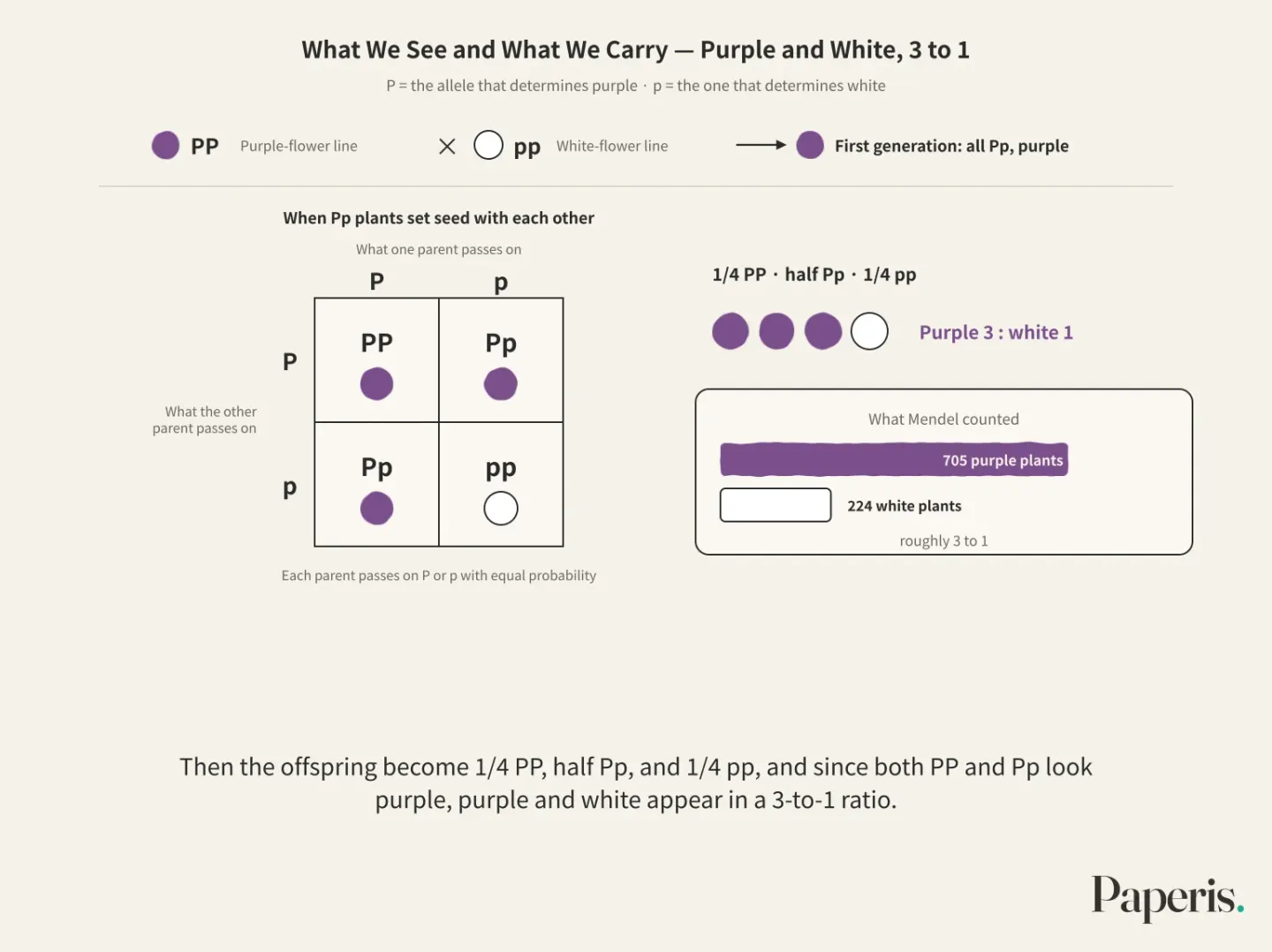
Even for the same purple, the genotype can be either PP or Pp. The split into one-third and two-thirds in seed color follows the same logic: the side that produced only yellow seeds for generations carried two yellow alleles, while the side that split again carried one yellow and one green (OpenStax Biology 2e 12.2). To put it in terms of cards, even if the picture visible on the outside is the same, the two cards held in hand can be different.
The name dominance does not mean something is better. It merely indicates which form appears on the outside when both forms are present together. Among human diseases as well, there are dominant types that appear even with just a single allele (such as Huntington's disease), and recessive types that appear only when both are present (such as cystic fibrosis) (OpenStax Biology 2e 12.2). Understanding why some variants cause harm with just one copy while others require two copies to gather is still an important task in medical genetics today (PMID 36806206).
Dominance does not mean common, either. In genetics, the most common form in nature is taken as the baseline, and other forms can be either dominant or recessive relative to that baseline (OpenStax Biology 2e 12.2).
Mendel's rules do not always fit neatly, either. When white-flowered snapdragons and red-flowered snapdragons are crossed, pink flowers appear, making the offspring an intermediate appearance of both parents (OpenStax Biology 2e 12.2). There are also cases where both alleles are fully expressed together (OpenStax Biology 2e 12). Alleles do not always operate strictly as dominant and recessive (OpenStax Biology 2e 12).
Even if appearances are the same, the combinations carried can be different, and dominance simply means the side that masks the other.
Division That Cuts the Hand in Half
For a fertilized egg to have two sets, the egg and the sperm must each have only one set. Only when germ cells reduce their chromosomes in half can fertilization fill out the two sets for the next generation again (PMID 26694509).
Germ cells are cells like sperm and eggs that carry only a single set of chromosomes into the next generation. Meiosis is the cell division in which a cell with two sets divides twice in succession to make cells with only a single set.
In meiosis, DNA is copied once and then divided twice, usually producing four cells (OpenStax Biology 2e 11). Ordinary cell division, which grows the body, makes cells identical to the original. The four cells produced by meiosis are genetically different from one another (OpenStax Biology 2e 11). Ordinary cell division is covered in "What Is a Cell? — A Small Village Inside a Wall, a Village That Splits in Two".
In the first division, homologous chromosomes pair up and then separate into different cells. This is the real-world appearance of "two sheets separate and each goes to an offspring" as Mendel saw it (OpenStax Biology 2e 12.3). In 1902, the respective observations of biologists Walter Sutton and Theodor Boveri came together to yield the chromosomal theory, which posits that chromosomes carry the units of heredity (OpenStax Biology 2e 13.1).
Which cell gets the maternal-side chromosome from each pair is decided at random. Therefore, a single germ cell can receive any combination of maternal-side and paternal-side chromosomes (OpenStax Biology 2e 12.3). Humans have 23 pairs, so this orientation alone can produce over 8 million genetically distinct germ cells (OpenStax Biology 2e 11.1).
There is one more shuffling method on top of this. Crossing over is the event during meiosis where two paired chromosomes exchange pieces with each other. The number 8 million does not yet include the variation created by crossing over (OpenStax Biology 2e 11.1). Crossing over newly pairs up parental alleles even on a single chromosome (PMID 26511629). Genes linked on the same chromosome tend to travel together, but crossing over occasionally breaks that bundle apart. That is why, even on the same chromosome, genes farther apart are more likely to travel separately (OpenStax Biology 2e 13) (OpenStax Biology 2e 12).
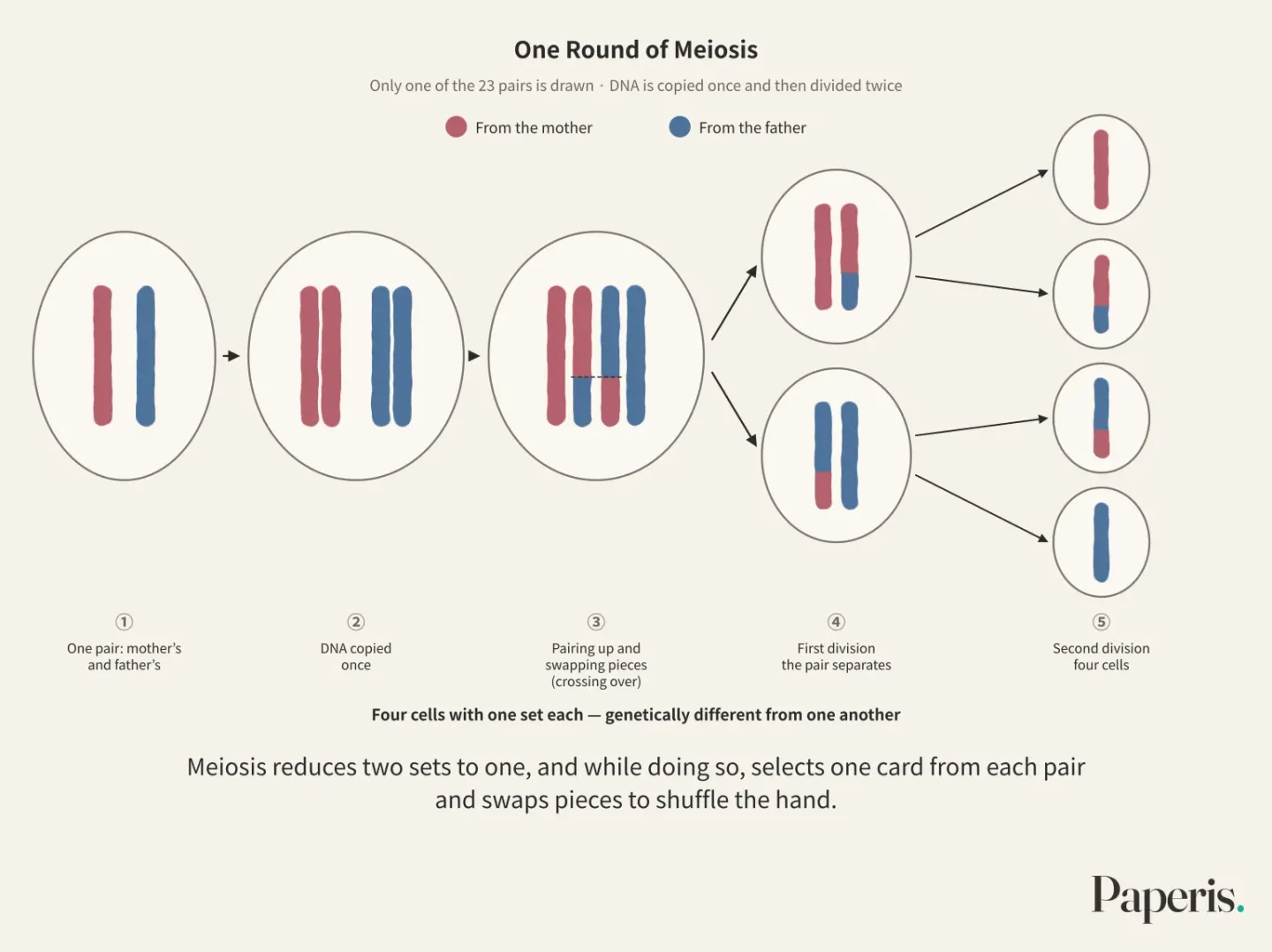
Crossing over does not just shuffle. It holds the two paired chromosomes together, helping them pull apart correctly to opposite sides during the first division (PMID 26694509). Therefore, shuffling the hands and dividing the hands accurately in meiosis are tied together into a single motion. (PMID 26511629)
When the separation goes awry, the chromosome count of the germ cell becomes distorted (OpenStax Biology 2e 13.2). Down syndrome, which has three copies of chromosome 21, is one such example (OpenStax Biology 2e 13.2). Cases with one too many or too few chromosomes appear in at least 5% of clinically confirmed pregnancies, with most failing to develop inside the womb and some developing to full term and birth (PMID 11283700).
Meiosis reduces two sets to one, and while doing so, selects one card from each pair and swaps pieces to shuffle the hand.
Why Siblings Are Different
Let's return to the first two children. Every time an egg is made in the mother's body and a sperm in the father's, meiosis happens anew.
Which side of each of the mother's 23 pairs went into the egg was decided independently for each pair, and the crossover pieces also changed. The sperm from the father's side are the same. The cells produced by meiosis are each genetically different because of the orientation of the pairs and the crossing over (OpenStax Biology 2e 11).
The older brother started from one such egg and one such sperm, and the younger brother started from another single egg and single sperm. The two children gathered the alleles from both parents in new combinations, which is why their appearances can also differ (OpenStax Biology 2e 18.1).
To put it in terms of cards, the older and younger brothers were dealt hands from the same two decks, but the hands they received were not the same. The likeness comes from coming from the same two decks, and the difference comes from the deck being shuffled anew each time. We will look again shortly at how many traits, like facial features, are not determined by just a single card.
Where New Cards Appear, Mutation
The hands of an older and a younger brother differ because they are shuffled. Yet occasionally, a card slips in that was present in neither the mother bee nor the father bee. A mutation is a change in the nucleotide sequence of DNA.
The first question to ask in heredity is in which cell that change occurred. It is mutations that arise in germ cells that pass on to the next generation. Mutations that arise in other cells of the body do not go to offspring, but if many accumulate in a single cell, they can lead to diseases like cancer (OpenStax Biology 2e 14.6).
There are several ways changes occur. Mistakes made while a cell copies DNA are usually corrected, but those that are not corrected remain as they are. They can arise because ultraviolet rays, X-rays, and chemicals damage DNA, or they can arise purely from reactions inside the body without external factors (OpenStax Biology 2e 14.6).
Even when a new card slips in, the game often does not change. There are cases where the nucleotides change but the protein produced remains the same (OpenStax Biology 2e 14.6), and many mutations make no difference to surviving and leaving offspring (OpenStax Biology 2e 18.1). There are also cards that change the game. A protein may be cut short or work differently (OpenStax Biology 2e 14.6), and the result can be harmful or beneficial for surviving and leaving offspring (OpenStax Biology 2e 18.1). The path from genes to proteins continues in "From Gene to Protein — A Copy Read Three Letters at a Time, and the Pages Each Cell Opens".
Viewed as a whole population, mutations that have crossed over to the next generation are the ultimate source of new alleles (OpenStax Biology 2e 18.1). In terms of cards, meiosis shuffles the existing cards, and mutation makes new ones.
Evolution is the change in the genetic makeup of a biological population inherited across generations. How these new cards increase or decrease within a population continues in "What Is Evolution? — Branches Split from One Root, New Shoots Still Sprouting".
Height Is Not Decided by a Single Card
Human height does not fall into two neat buckets like purple or white. It runs continuously from short to tall.
This is why the blending theory we saw earlier seemed plausible. For traits determined by many genes acting together like height, children tend to look intermediate between their parents (OpenStax Biology 2e 12.1).
A polygenic trait is a trait determined by many genes, each contributing a small amount, much like height.
A genome is the entire set of genetic information an organism possesses. When scanning complex traits like height or common diseases across the entire genome, the related signals tend to be scattered across most of the genome rather than concentrated in a few pathways (PMID 28622505). There is now overwhelming evidence that most common adult-onset diseases also share this polygenic structure (PMID 29906445).
Height is not determined by genes alone. Part of the height difference among people comes from better nutrition rather than different genes (OpenStax Biology 2e 18.1). Heredity and environment do not simply add up separately either. Genetic predispositions formed by multiple genes can manifest differently depending on the environment they encounter, and while this entanglement is understood to have a major impact on complex human traits and diseases, researchers also point out the limitation that methods for measuring and reporting it vary widely from study to study (PMID 38806721).
Therefore, it is difficult to accurately predict a polygenic trait by reading a single person's DNA alone. Attempts to identify individuals at high disease risk using a combined score summing the effects of thousands of variants have begun entering clinical practice. However, a review article notes that problems such as insufficient precision and poor transferability across diverse populations must be resolved before they can be widely used (PMID 41073616).
To use the card analogy, height is not the picture on a single card, but the result of numerous cards each making a small contribution, layered with the environment.
The Number We Call Heritability
If you collect data on how similar twins are to one another, you can estimate how much of the variation among people in a certain trait is explained by differences in their genes (PMID 25985137).
Heritability is an estimate of the share of variation in a trait among people within a population that is explained by differences in genes. If you gather nearly every twin study published over 50 years, the reported heritability across 17,804 traits averaged 49%, but the values clustered distinctly and varied by domain of traits (PMID 25985137). The authors of this analysis put it forward as the most comprehensive analysis yet of where individual differences in human traits come from (PMID 25985137).
Applying this number to a single individual is wrong. A heritability of 49% does not mean that 49% of an individual person's trait comes from their genes. By definition, it is a value calculated from differences within a group. Heritability does not tell you how much genes and environment each contributed to the development of a trait, nor does it tell you how reliably that trait is passed down (PMID 27906501). The authors of this review argue against its continued use, stating that this phrasing severely hinders public understanding, particularly in genetics research dealing with human behavior (PMID 27906501).
Falling over to the opposite side is also wrong. The same authors treat it as established fact that genetic factors have a substantial influence on the development of all human traits (PMID 27906501). The debate surrounding heritability is not about whether genes have an effect, but about what this number actually tells us.
Heritability is a number measured in a population, not an individual share or probability.
Genes Are Not a Hand of Fate
The card analogy falls short in two places. One is that a dominant card is not a high hand. Dominance simply means the trait that shows on the outside when paired together, and there are harmful dominant traits as well. The other is that the game does not end once you are dealt your cards. Traits like height are built by countless cards adding a little bit each, with the environment layered on top.
To sum it up: offspring receive one set from each parent, the deck is reshuffled every time germ cells are made, and mutations occasionally add new cards. The idea that genetics determines everything, and the idea that genetics has nothing to do with it at all, are both inconsistent with the evidence.
Where to Look Further
Crossovers occur more evenly than by chance on chromosomes, spaced far apart from each other. This phenomenon was known over 100 years ago, but how distant positions coordinate with one another is not yet fully solved (PMID 37145037). While there is little disagreement that many genes each contribute a small amount, there is debate over whether a few core genes directly entangled with disease sit separately in the middle of it all. One side has proposed a model assuming such core genes (PMID 28622505), whereas the other side considers that model capable of underestimating the complexity of common diseases (PMID 29906445).
What DNA passed down through generations tells us about people of the distant past is covered in "What Genes Can Tell Us — An Old Book Copied Down the Generations".
Other parts of this series follow as well. "What Is a Cell? — A Small Village Inside a Wall, a Village That Splits in Two" covers the cells that make up the body and ordinary cell division, "DNA and Genes — A Manual Written in Four Letters, Two Strands That Are Molds of Each Other" covers the appearance and replication of DNA inside chromosomes, "From Gene to Protein — A Copy Read Three Letters at a Time, and the Pages Each Cell Opens" covers how genes work, and "What Is Evolution? — Branches Split from One Root, New Shoots Still Sprouting" covers the process by which new alleles increase or decrease within a population.
Source Papers
- "Biology 2e — 12.1 Mendel’s Experiments and the Laws of Probability" (2018) — OpenStax Biology 2e 12.1 — Mendel's background and pea experiments (seven traits, purple × white → F1 all purple → F2 705:224), blending inheritance, continuous variation as the result of many genes, 1900 rediscovery.
- "Biology 2e — 12.2 Characteristics and Traits" (2018) — OpenStax Biology 2e 12.2 — Alleles, phenotypes, and genotypes, F2 seed color split into 1/3 and 2/3 (YY and Yy), dominance and recessiveness meaningless in XY males, examples of human dominant and recessive disorders, wild-type convention, incomplete dominance in snapdragons.
- "Biology 2e — 12.3 Laws of Inheritance" (2018) — OpenStax Biology 2e 12.3 — Reappearance of recessive traits implies discrete units of heredity, physical basis of segregation and independent assortment is the first division of meiosis.
- "Biology 2e — Chapter Summary" (2018) — OpenStax Biology 2e 12 — 1:2:1 genotype and 3:1 phenotype ratios, codominance, multiple alleles within a population, X-linkage.
- "Biology 2e — 11.1 The Process of Meiosis" (2018) — OpenStax Biology 2e 11.1 — A set of 23 chromosomes in eggs and sperm, two sets in somatic cells, over 8,000,000 possible gametes from pairing orientation alone (excluding crossing over).
- "Biology 2e — Chapter Summary" (2018) — OpenStax Biology 2e 11 — One duplication plus two divisions → typically four cells, genetic differences created by crossing over and pairing orientation, differences from ordinary division.
- "Biology 2e — 13.1 Chromosomal Theory and Genetic Linkage" (2018) — OpenStax Biology 2e 13.1 — Sutton and Boveri's chromosome theory of 1902.
- "Biology 2e — Chapter Summary" (2018) — OpenStax Biology 2e 13 — Linkage passes alleles on the same chromosome together, while recombination tilts toward independence.
- "Biology 2e — 13.2 Chromosomal Basis of Inherited Disorders" (2018) — OpenStax Biology 2e 13.2 — Nondisjunction during meiosis causes abnormal chromosome numbers, Down syndrome = trisomy 21.
- "Biology 2e — 14.6 DNA Repair" (2018) — OpenStax Biology 2e 14.6 — Replication errors and repair, induced and spontaneous mutations, diverse consequences of point mutations, somatic versus germline mutations.
- "Biology 2e — 18.1 Understanding Evolution" (2018) — OpenStax Biology 2e 18.1 — Mutations as the ultimate source of new alleles, broad effects ranging from disadvantageous to advantageous to neutral, sexual reproduction producing new combinations in each offspring, height differences depending on nutrition.
- "Biology 2e — 19.1 Population Evolution" (2018) — OpenStax Biology 2e 19.1 — ABO blood groups involve three alleles.
- "Meiosis." (2017) — PMID 26694509 — Haploid gametes and the restoration of diploidy by fertilization, one duplication followed by two divisions, crossing over linking homologous chromosomes to aid segregation in the first division.
- "Meiotic Recombination: The Essence of Heredity." (2015) — PMID 26511629 — Crossing over is essential for accurate segregation and creates new combinations of parental alleles, and recombination defects are a major cause of pregnancy loss and congenital disorders in humans.
- "To err (meiotically) is human: the genesis of human aneuploidy." (2001) — PMID 11283700 — Aneuploidy accounts for at least 5% of clinically recognized pregnancies, mostly resulting in intrauterine loss, with some surviving to term.
- "The regulation of meiotic crossover distribution: a coarse solution to a century-old mystery?" (2023) — PMID 37145037 — Crossovers occur more evenly spaced than by chance (crossover interference), a mechanism unresolved for over 100 years.
- "From Mendel to epigenetics: History of genetics." (2016) — PMID 27263362 — The origin of genetics traces back to Mendel's 1865 paper, the coining of the word "genetics" in 1906, and the introduction of the concepts of gene, genotype, and phenotype.
- "Mendelian inheritance revisited: dominance and recessiveness in medical genetics." (2023) — PMID 36806206 — Understanding why some alleles are harmful even when heterozygous (dominant) while others are harmful only when present in two copies (recessive) is particularly important for genetic diagnosis.
- "An Expanded View of Complex Traits: From Polygenic to Omnigenic." (2017) — PMID 28622505 — Association signals for complex traits are spread across most of the genome, leading the authors to propose the "omnigenic" hypothesis.
- "Common Disease Is More Complex Than Implied by the Core Gene Omnigenic Model." (2018) — PMID 29906445 — Evidence that most common adult diseases have a polygenic architecture is overwhelming, with the counterargument that the core-gene model may underestimate complexity.
- "Gene-environment interactions in human health." (2024) — PMID 38806721 — The interaction between genetic variation and environmental factors plays a central role in complex traits and diseases, with polygenic predisposition varying depending on the environment.
- "Clinical use of polygenic risk scores: current status, barriers and future directions." (2026) — PMID 41073616 — Polygenic risk scores are beginning to enter clinical practice, but issues of precision, cross-population portability, and understanding must be resolved before broad adoption.
- "Meta-analysis of the heritability of human traits based on fifty years of twin studies." (2015) — PMID 25985137 — A meta-analysis of twin studies covering 2,748 papers and 17,804 traits, reporting an average heritability of 49%.
- "The heritability fallacy." (2017) — PMID 27906501 — Heritability does not indicate the likelihood of a trait being inherited, its underlying causes, or the relative contributions of genes and environment; it is already known that genetic factors exert a substantial influence on all traits, and continued use of the term is opposed.
Sources (24)
- Biology 2e — 12.1 Mendel’s Experiments and the Laws of Probability
- Biology 2e — 12.2 Characteristics and Traits
- Biology 2e — 12.3 Laws of Inheritance
- Biology 2e — Chapter Summary
- Biology 2e — 11.1 The Process of Meiosis
- Biology 2e — Chapter Summary
- Biology 2e — 13.1 Chromosomal Theory and Genetic Linkage
- Biology 2e — Chapter Summary
- Biology 2e — 13.2 Chromosomal Basis of Inherited Disorders
- Biology 2e — 14.6 DNA Repair
- Biology 2e — 18.1 Understanding Evolution
- Biology 2e — 19.1 Population Evolution
- MeiosisPMID 26694509
- Meiotic Recombination: The Essence of HeredityPMID 26511629
- To err (meiotically) is human: the genesis of human aneuploidyPMID 11283700
- The regulation of meiotic crossover distribution: a coarse solution to a century-old mystery?PMID 37145037
- From Mendel to epigenetics: History of geneticsPMID 27263362
- Mendelian inheritance revisited: dominance and recessiveness in medical geneticsPMID 36806206
- An Expanded View of Complex Traits: From Polygenic to OmnigenicPMID 28622505
- Common Disease Is More Complex Than Implied by the Core Gene Omnigenic ModelPMID 29906445
- Gene-environment interactions in human healthPMID 38806721
- Clinical use of polygenic risk scores: current status, barriers and future directionsPMID 41073616
- Meta-analysis of the heritability of human traits based on fifty years of twin studiesPMID 25985137
- The heritability fallacyPMID 27906501