Paperis Articles
What Is Evolution? — Branches Split from One Root, New Shoots Still Sprouting
Starting from island birds whose beaks changed within a few years, we follow how natural selection and chance reshape populations, how one species splits into two, the common ancestor linking humans and chimpanzees, and the antibiotic resistance unfolding before our eyes today.
Your field's papers, as audio
Pick your fields and journals — Paperis summarizes the key papers and turns them into audio. Listen on your commute.
Start Paperis free →What Is Evolution? — Branches Split from One Root, New Shoots Still Sprouting
Beaks After Heavy Rains
Off the western coast of Ecuador in South America lies the Galápagos Islands. Every year starting in 1976, the married biologists Peter and Rosemary Grant went to one of those islands to measure the beaks of small land-dwelling birds (OpenStax Biology 2e 18.1).
What the couple watched was the average beak size of all the birds on the island. During several rainy years brought by El Niño, small seeds were abundant on the island, and birds with smaller beaks left behind more offspring. The average beak measured afterward had grown smaller (OpenStax Biology 2e 18.1).
The beak size of any single bird stays the same throughout its life. And beak size is a trait passed down from parents. So because parents with smaller beaks left behind more offspring, the average of the next generation shifted toward the smaller side. Around 1987, when large seeds became plentiful again, that shift also stopped (OpenStax Biology 2e 18.1).
Flocks of birds shift in appearance even over the course of a few years, and that shift comes from who—among those with inherited traits—leaves behind more offspring. Biology calls this change evolution.
Evolution Happens in Populations
Evolution is the change in the makeup of inherited genes within a biological population across generations. The place where evolution happens is the population. The process of an individual growing and changing over its lifetime is called development in biology. That is why, when looking at evolution, we look at where the average of the whole population shifts from generation to generation instead of a single individual (OpenStax Biology 2e 18.1).
Information about inherited traits is written in the DNA inside cells. DNA is the long molecule where cells store genetic information, and the order in which four bases are lined up is that information. Among them, genes are the sections of DNA that contain instructions to make proteins or working RNA. This structure is covered in detail in "DNA and Genes — An Instruction Manual Written in Four Letters, Two Strands That Are Each Other's Molds".
The word that carries weight in the definition is "inherited". Just as the child of a person who exercises daily to build muscle does not inherit that muscle, traits acquired during life mostly do not pass down to the next generation (OpenStax Biology 2e 19.2). Differences unrelated to genetics, such as growing tall from good nutrition, cannot change the next generation no matter how large they are (OpenStax Biology 2e 18.1).
The place where new differences within a population first arise is mutation. Mutations are changes in the base sequence of DNA. The process of genes from two parents mixing anew in offspring also increases differences within a population. Many mutations have no effect at all (OpenStax Biology 2e 18.1). What mutations leave behind in the body and how they are passed on to children is the subject of "Heredity and Variation — One Card from Each Pair, a Hand Shuffled Anew".
Evolution happens in populations, using inherited differences as raw material.
What Darwin Saw in the Galápagos
In the 19th century, British naturalist Charles Darwin traveled around the world aboard a ship named the Beagle from 1831 to 1836. At the Galápagos Islands, where the Beagle stopped, he saw birds with slightly different beak shapes on each island. Birds that ate seeds had thick, sturdy beaks, while birds that ate insects had sharp, spear-like beaks. Darwin thought that these birds might be the descendants of a single group that had crossed over from the mainland and changed differently on each island (OpenStax Biology 2e 18.1).
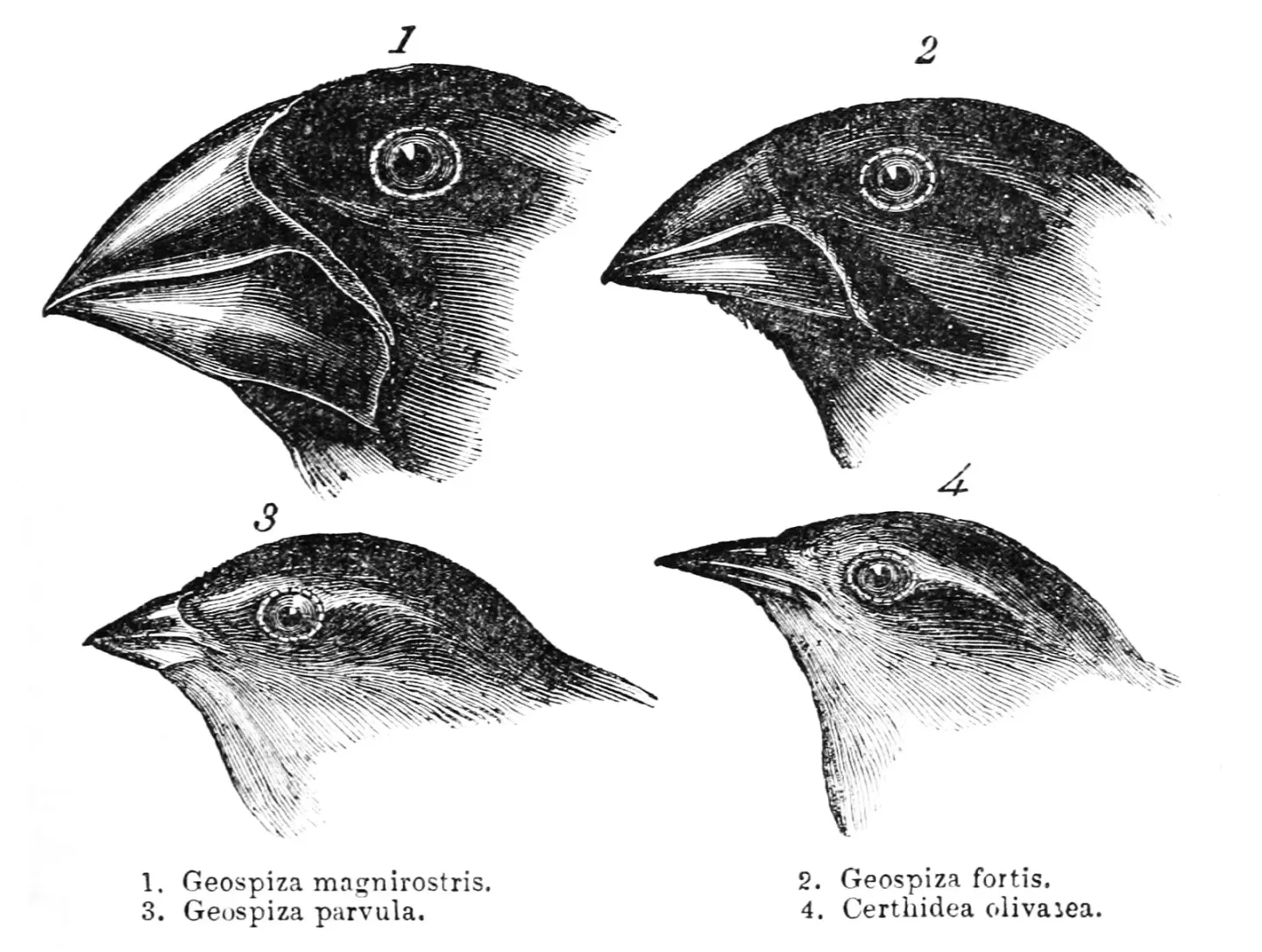
Four Galápagos finches with differently shaped beaks, from Darwin's Journal of Researches · John Gould, in Darwin's Journal of Researches, 2nd ed., 1845 · Wikimedia Commons (public domain)
Around the same time, naturalist Alfred Russel Wallace independently arrived at the same explanation, and the two presented a paper together at a scientific meeting in London in 1858 (OpenStax Biology 2e 18.1).
The observations that Darwin strung together are three. Offspring resemble their parents in most traits. More offspring are born than can possibly survive, leading them to compete for food and space. And even offspring from the same clutch differ slightly from one another, with those differences being passed on to the next generation. When these three are present together, individuals with any advantage that helps them in the competition survive and leave more offspring, and that trait becomes more common in the next generation (OpenStax Biology 2e 18.1). Darwin called this process natural selection.
Natural selection is the process by which heritable traits that make it easier to survive and have offspring increase, while disadvantageous traits decrease. When natural selection piles up over a long time, organisms come to possess traits that fit their living place well. An adaptation is a heritable trait that helps an individual survive and have offspring in its current environment. The snow leopard's thick fur is an adaptation tuned to the cold, and the platypus's webbing is tuned to swimming. Natural selection is known as the only mechanism that crafts adaptations (OpenStax Biology 2e 18.1).
What natural selection counts is offspring rather than strength or lifespan. Fitness is a measure of how many offspring an individual leaves to the next generation compared to other individuals in the same population. Even if an individual dies early after pouring energy into mating, that death has little meaning in natural selection if it has already left offspring (OpenStax Biology 2e 45.2).
Natural selection is often also called "survival of the fittest" (OpenStax Biology 2e 18.1). The "fit" in this phrase refers to the individual that fits that environment and leaves more offspring (OpenStax Biology 2e 19.3). The meaning of being the strongest individual is not contained in this phrase. Strength is advantageous only in environments where it increases offspring. The case where a strong, troop-leading male gorilla fathers more young than other males is one such example (OpenStax Biology 2e 19.2). On an island after heavy rain, the side that left more offspring was the birds with smaller beaks.
Which traits are advantageous is determined by the environment at that time. Where water is plentiful, large leaves that catch a lot of sunlight are advantageous, but as the climate grows dry, small leaves that conserve water become advantageous. When the environment changes, individuals that already possess traits fitting that environment leave more offspring. Organisms do not change by trying hard to fit in (OpenStax Biology 2e 18.1).
Evolution has no goal. Let us think back to the small beaks on the island. The small beaks that benefited during a few years when small seeds were common did not continue to increase once large seeds returned. The small beaks only fit the island for those few years; they did not become a "better" beak. If the environment changes again, the same trait can become a burden (OpenStax Biology 2e 18.1). Humans are not outside this rule either (OpenStax Biology 2e 18.1).
Chance Also Changes Populations
When a major earthquake strikes an animal population on an island, the disaster sweeps through without regard to individual traits. The few survivors are usually just the individuals who were lucky (OpenStax Biology 2e 19.2). What those few individuals carry becomes the starting point for the next generation.
Genetic drift is when the proportion of genes in a population changes because it is a matter of chance which individuals leave offspring. Even without a disaster, drift happens all the time. This is because luck is always involved in who gets to leave young (OpenStax Biology 2e 19.2).
Drift operates more strongly in small populations. In a population of ten, just one individual dying without offspring causes one-tenth of the population's gene copies to vanish all at once (OpenStax Biology 2e 19.2). In a population of limited size, drift steps in and places constraints even on the speed at which natural selection shapes adaptation (PMID 34440541).
Advantage and chance together change populations, and neither direction has a predetermined goal.
When a Population Splits into Two
Darwin’s book On the Origin of Species contains only a single illustration. It is a drawing of a line starting from a single point and branching out repeatedly. Darwin depicted the process by which new groups of organisms arise as this kind of branching of limbs (OpenStax Biology 2e 18.2).
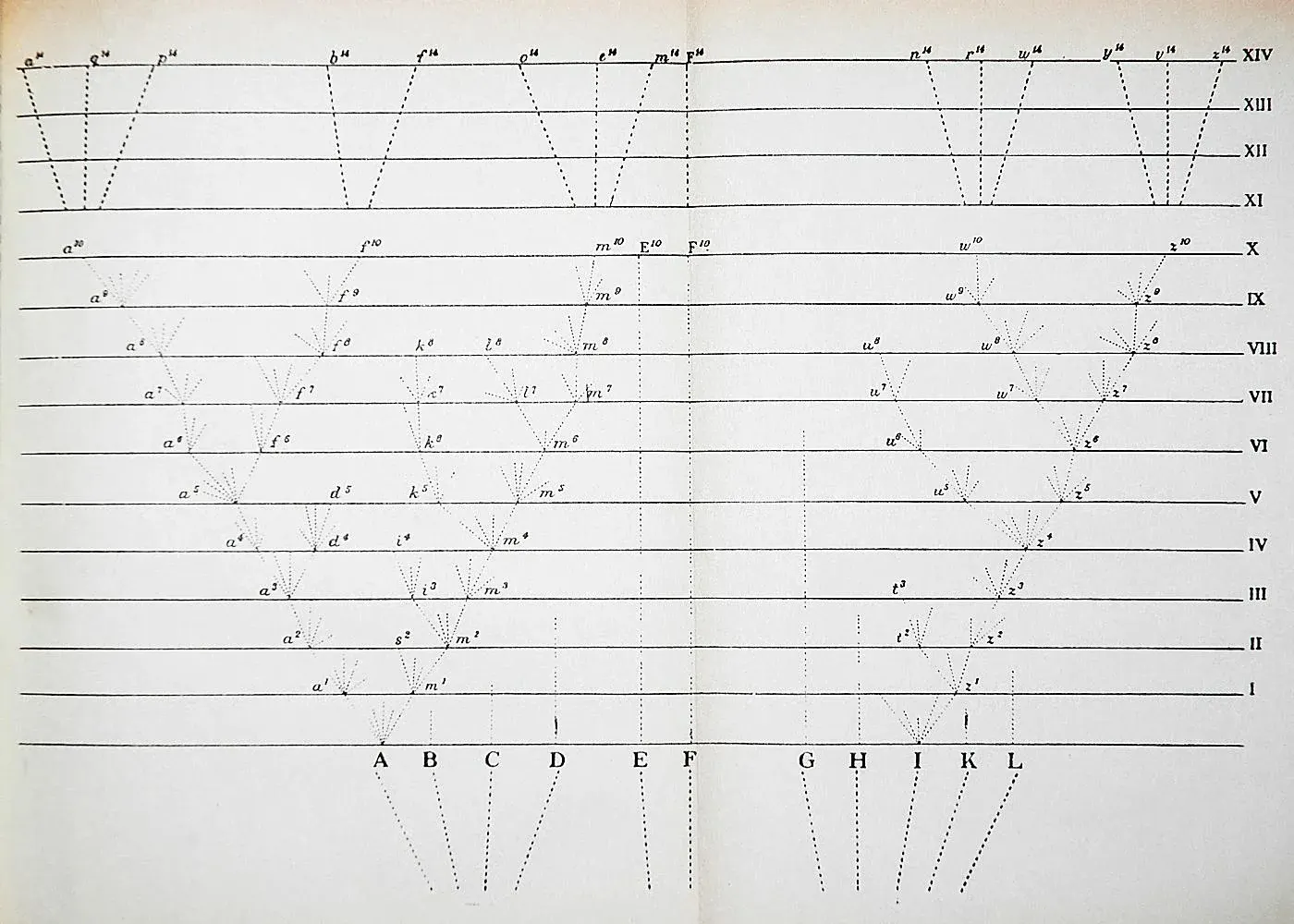
The only diagram in On the Origin of Species, showing lineages branching over time · Charles Darwin, 1859 (page photographed by Alexei Kouprianov) · Wikimedia Commons (public domain)
A species is a group of individuals that can mate with one another and produce fertile offspring. This definition is tailored to organisms that reproduce through the meeting of males and females. Although hybrids sometimes are born between two similar species, if those hybrids cannot themselves have children, the two species remain separate (OpenStax Biology 2e 18.2).
How to define a species has long been a subject of debate among biologists, and microbes, which multiply without mating, are a particularly difficult case. Still, the cohesive species concept concludes that even in microbes, species actually exist as groups that are genetically and ecologically similar (PMID 27030977).
Speciation is the process by which one species splits into two species. For this to happen, a single population must be divided into two, the two populations must change separately, and eventually, fertile offspring must no longer be produced between the two (OpenStax Biology 2e 18.2). This can happen when a mountain range or an ocean separates a population, or it can happen while living in the same area (OpenStax Biology 2e 18.2; PMID 41236164).
Speciation takes place over a long period of time. Two closely related species in the middle of splitting continue to meet and produce hybrids for a while. If the hybrids do not survive as well as their parents, the two species drift further apart, whereas if the hybrids thrive, the two species may merge back into one (OpenStax Biology 2e 18.3).
The birds of the Galápagos are an example of a single group splitting into multiple species, each adapted to the different foods available on different islands (OpenStax Biology 2e 18.2). For the genetic makeup of an entire species to change can take anywhere from thousands to millions of years (OpenStax Biology 2e 18.1).
When small changes accumulate separately in two split populations, one species becomes two.
Common Ancestors and Phylogenetic Trees
Based on estimates comparing fossils and DNA, humans and chimpanzees split from the same ancestor group about 6 million years ago (with genetic evidence suggesting 5,000,000 to 7,000,000 years ago) (OpenStax Biology 2e 29.7). A common ancestor is the ancestral group of both, encountered when tracing the histories of two organism groups back. After splitting from that group, the human line and the chimpanzee line have continued separately on their respective branches.
To show this relationship at a glance, biologists draw tree-like diagrams. A phylogenetic tree is a diagram drawn in the shape of tree branches showing the order in which groups of organisms split from which ancestor. The root is the common ancestor of all groups included in the diagram, and the points where branches divide into two are where one lineage split into two. Unless indicated otherwise, branch lengths do not represent time, but only show the order of the splits (OpenStax Biology 2e 20.1).
Because phylogenetic trees are hypotheses about an un-revisitable past, they are redrawn when new evidence emerges. The information contained remains the same even if the left and right sides are swapped around a branching point as an axis (OpenStax Biology 2e 20.1). The positions where the tip branches line up from left to right do not denote hierarchy or status.
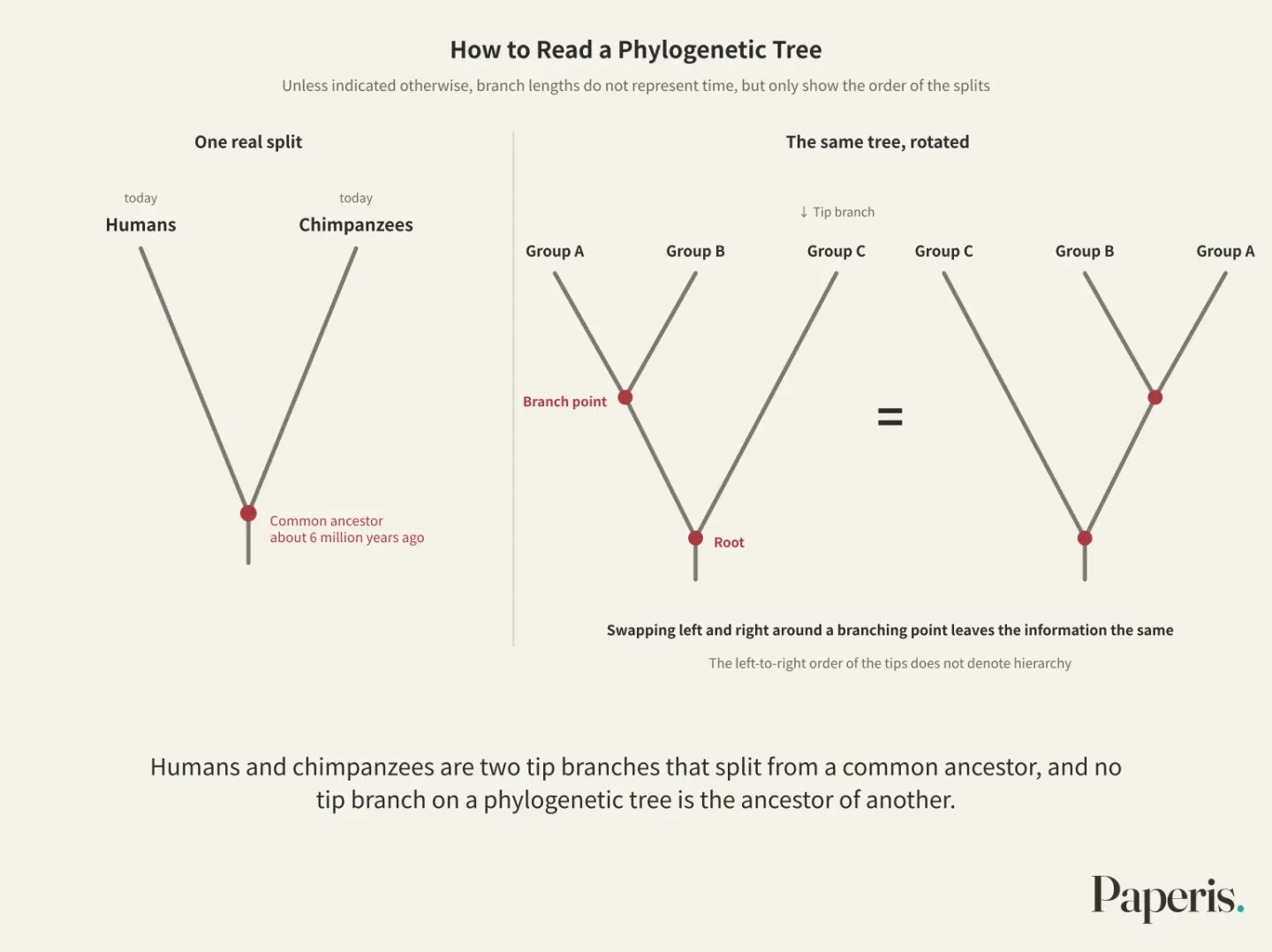
Two branches originating from a single split point merely share a common ancestor, and neither arose from the other (OpenStax Biology 2e 20.1). The idea that humans evolved from monkeys or chimpanzees living today contradicts this diagram. Chimpanzees living today split from the same root as humans and are a different tip branch that has grown alongside us (OpenStax Biology 2e 29.7).
The human-side branch has not stretched out in a single straight line either. There were many times when multiple species lived together during the same periods, and a considerable number of discovered fossils are dead-end side branches that did not lead to modern humans. Only a single human species has survived from those branches to the present day (OpenStax Biology 2e 29.7).
The tree analogy has limits. Real tree branches do not fuse back together once they split, but the branches of life occasionally touch one another. Bacteria are small organisms made of a single cell, some of which cause disease. Not only do bacteria pass genes down to their offspring, but they also hand genes over to other species that are distant relatives (OpenStax Biology 2e 20.3).
Horizontal gene transfer is the movement of genes between different species. It got the name "horizontal" because the direction differs from ordinary inheritance passed down from parents to offspring. This transfer is especially common in single-celled organisms without nuclei, such as bacteria (OpenStax Biology 2e 20.3), and some review papers view this as connecting nearly all living things (PMID 21249334). That is why there are places where phylogenetic trees must be drawn like a net with branches connected to one another.
Hybrids between closely related species also connect branches (PMID 39270765). In modern human populations, genes from ancient human groups such as Neanderthals and Denisovans are also found, which is evidence that the three groups once bore children with one another (OpenStax Biology 2e 29.7). Some review papers argue that including these connections in diagrams makes the history of life clearer (PMID 39270765).
Humans and chimpanzees are two tip branches that split from a common ancestor, and no tip branch on a phylogenetic tree is the ancestor of another.
The Same Tree Pointed to by Fossils, Bones, and DNA
A phylogenetic tree is a hypothesis. So how do we know that tree is right? Different methods independently confirm that tree.
First is body organization. Both bird wings and bat wings fly through the air, but looking at the bones inside the wings tells a different story. Those bones were inherited by both animals from a common ancestor's front legs, while the use as wings was acquired separately by the two lineages (OpenStax Biology 2e 18.1). What reveals the kinship is the arrangement of the inherited bones. We cannot tell whether they are relatives simply because their use is the same.
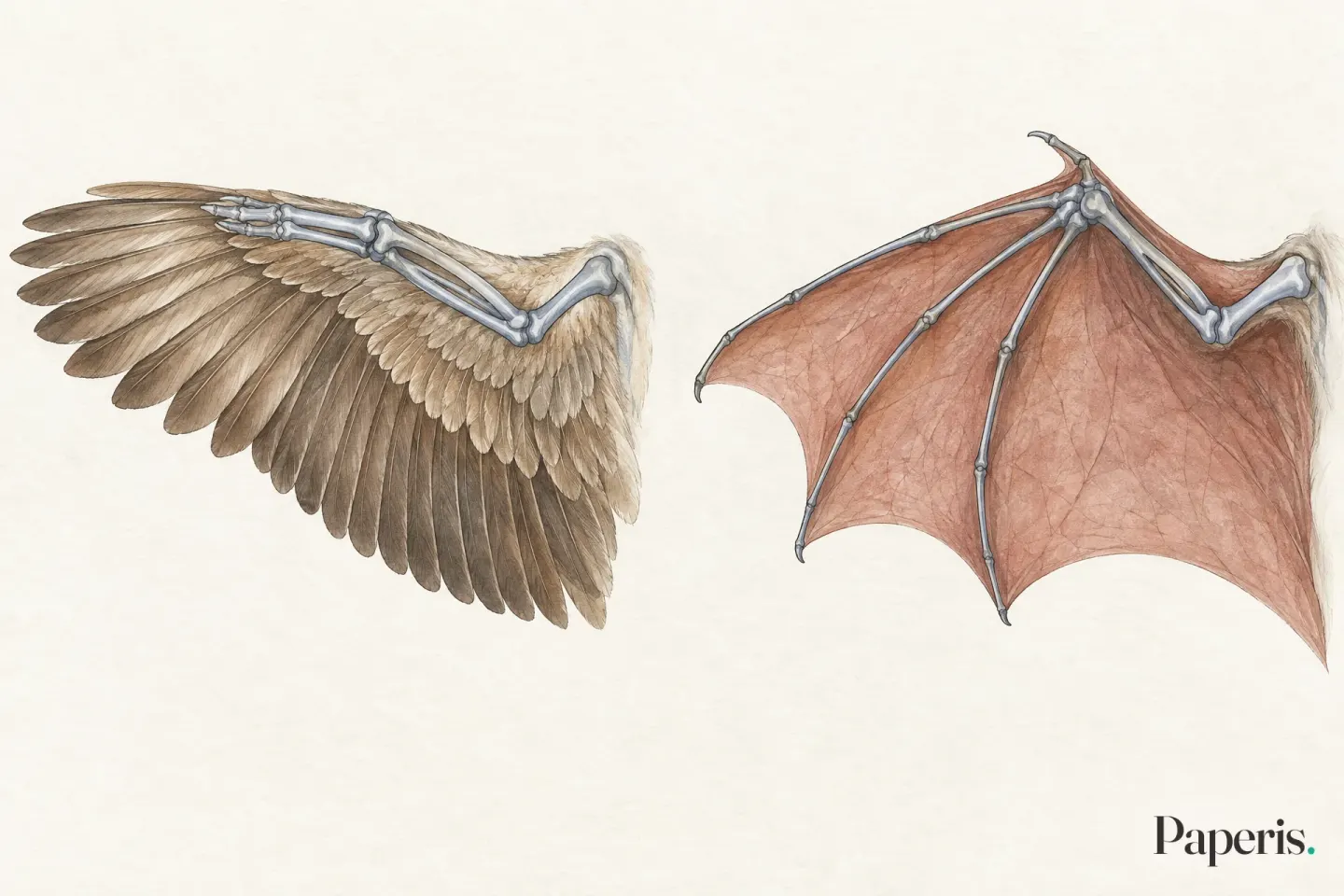
Illustration: Paperis
Structures that remain even though their usefulness has vanished point the same way. Inside the whale's body, hind limb bones remain even though it does not walk (OpenStax Biology 2e 18.1). Fossils show that ancient organisms were different from today's and that forms have gradually changed (OpenStax Biology 2e 18.1).
DNA also draws the same tree. The fact that all living things write genetic information in DNA points to a common ancestor of all life, and groups closer on the phylogenetic tree also have more similar DNA sequences (OpenStax Biology 2e 18.1). DNA sequence data from organisms serve as evidence that life emerged from a single origin and has evolved through mutations and the mixing of genes (PMID 10415480).
Fossils, bones, and DNA are evidence obtained through different methods, yet they point to the same tree.
So calling evolution "just a theory" misses the point of the word. In everyday life, a "theory" is closer to a guess (OpenStax Biology 2e 18.1). A scientific theory explains various observations of nature and is a bundled set of explanations that has withstood repeated testing and verification. It means that observations obtained through different methods—like the beak measurements, bones, fossils, and DNA seen in this article—have repeatedly backed up the same explanation.
What the theory of evolution explains is how populations of organisms change and split apart. How life first originated lies outside the questions this theory deals with (OpenStax Biology 2e 18.1).
Fresh Shoots Still Sprouting: Antibiotic Resistance
Staphylococcus aureus is a common bacterium that can cause infections in the skin, bones, lungs, and bloodstream. A 2020 review notes that infections caused by strains of this bacterium that resist an antibiotic called methicillin have increased worldwide over the past several decades (PMID 32257966).
Antibiotic resistance is the property by which bacteria survive and do not die or stop growing even when they encounter an antibiotic. Antibiotic resistance is one of the few examples of evolution that humans can observe in real time (PMID 24847651). Antibiotic resistance is also a threat to global public health (PMID 38870900).
We follow the scene where antibiotics enter a population of bacteria inside a person's body. Within that population, it is highly likely that bacteria carrying genes to withstand the antibiotic were already sparsely mixed in (OpenStax Biology 2e 18.1). The antibiotic kills the bacteria lacking those genes, and the surviving resistant bacteria divide and multiply (OpenStax Biology 2e 18.1). In the spaces where competing bacteria have drastically decreased, resistant bacteria proliferate more widely (PMID 1649425). Over time, the population shifts into a population of resistant bacteria (OpenStax Biology 2e 18.1).
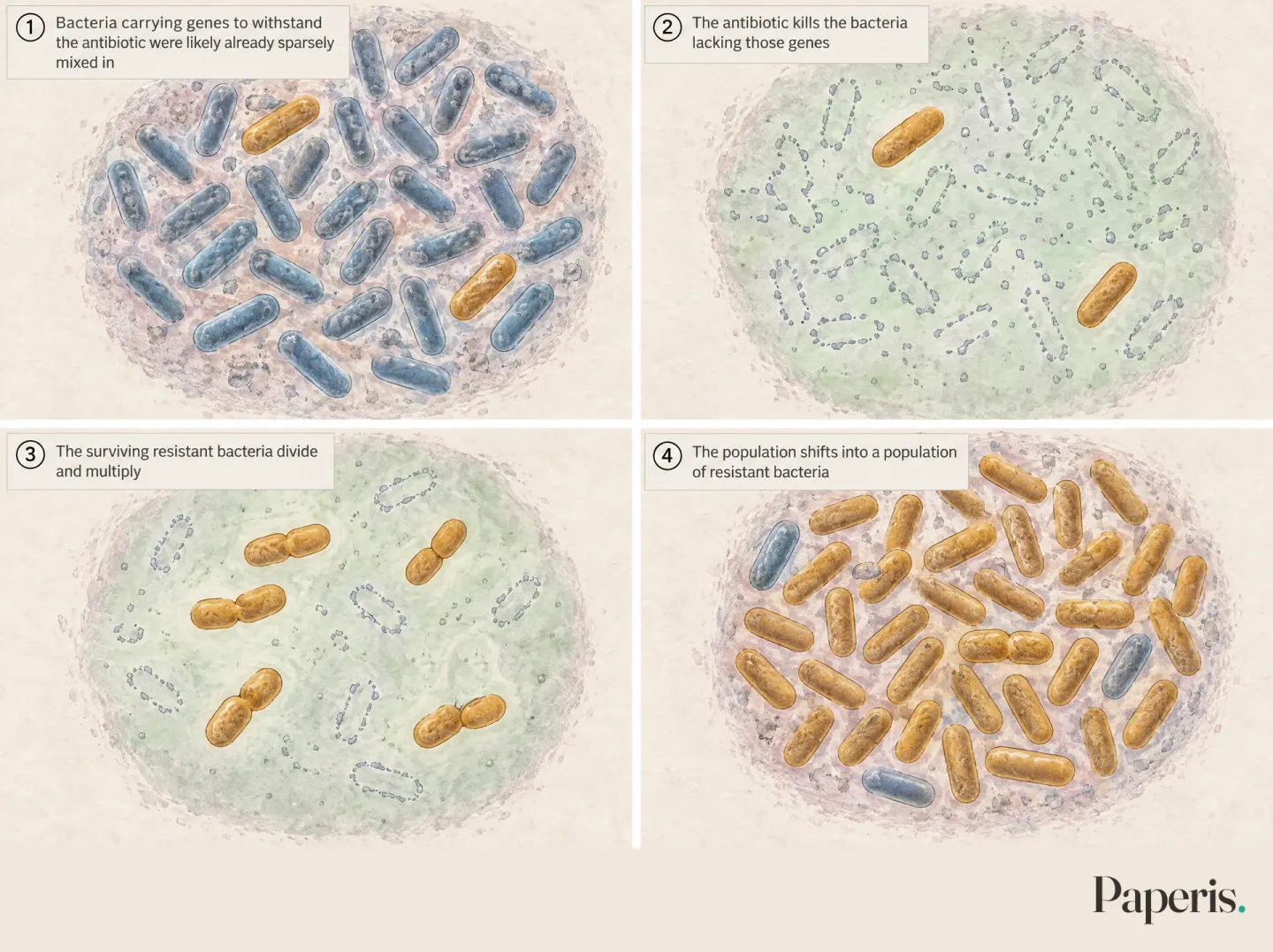
This scene is precisely the three observations connected by Darwin. There were differences within the population, those differences were passed down across generations, and those differences determined who survived in that environment. The differences conferring resistance are usually present in the population before the antibiotic arrives, and the antibiotic selects and leaves behind the bacteria carrying those differences. Textbooks introduce experiments showing that resistance mutations do not arise as a result of using antibiotics (OpenStax Biology 2e 18.1). This means antibiotics do not select for and cause the necessary resistance. However, some reviews note that low concentrations of antibiotics—too low to kill—can increase the frequency at which genetic differences arise within bacteria (PMID 24861036), and other reviews note that mutations can increase in stressed bacteria (PMID 9710666).
Resistance existed long before humans ever used antibiotics. Antibiotics were originally substances produced by microorganisms since hundreds of millions of years ago, and so the resistance to counter them is equally old (PMID 38870900). Tracing back the origins of resistance genes found in today's pathogens leads to microorganisms living in natural environments (PMID 24847651).
Human antibiotic use has added strong selective pressure to this ancient competition. That pressure drives the evolution of new resistance and spreads pre-existing resistance among bacterial populations in the environment, animals, and humans (PMID 38870900). The widespread and sometimes excessive use of antibiotics over the past 80 years aligns with an explosive increase in resistance (PMID 31659373). Even very low concentrations of antibiotics can select for and leave behind resistant bacteria (PMID 24861036, PMID 9710666).
Here, the intersecting branches from the previous section appear again. Bacteria load resistance genes onto small DNA fragments that move between cells, handing them over to other bacteria, and sometimes even to bacteria of different species (PMID 30068738, PMID 1649425). Mutations occurring merely in a bacterium's own chromosome cannot explain how resistance appears and spreads this quickly (PMID 1649425). The gut of humans and animals is a large reservoir where this exchanging happens easily (PMID 1649425).
Resistance usually comes with a cost. Bacteria carrying resistance commonly grow more slowly. Therefore, when the pressure from antibiotics diminishes, non-resistant bacteria can outpace resistant ones. However, based on data so far, the rate at which resistance reverses across society is likely to be slow (PMID 20208551). The same trait becomes a lifeline where antibiotics are present and a burden where they are absent. This is precisely the earlier point that fitness depends on the environment.
One review notes that newly approved antibiotics usually remain safely usable for less than 10 years (PMID 34872345). To prevent this, strategies are being employed to develop new treatments, monitor resistance using artificial intelligence, and discover new drugs (PMID 38870900).
Antibiotic resistance demonstrates that variation, selection, and the exchange of genes are changing the branches of life at this very moment.
Where Else to Look
At the very bottom of the tree drawn by this article, what the last common ancestor of all living creatures today looked like is still under debate (PMID 39158619).
The foundation of this article is filled by other pieces in this series. Cells are covered by "What Is a Cell? — A Small Village Inside a Wall, a Village That Splits in Two", the structure of DNA and genes by "DNA and Genes — A Manual Written in Four Letters, Two Strands That Are Each Other's Molds", the path from genes to proteins by "From Gene to Protein — A Copy Read Three Letters at a Time, and the Pages Each Cell Opens", and how mutations are passed down to children by "Heredity and Variation — One Card from Each Pair, a Hand Shuffled Anew".
The story of reading human population histories using DNA left in ancient bones is continued by "What Genes Can Tell Us — An Old Book Copied Down the Generations". How comparing the sequences of cousin proteins split from the same ancestor was used to guess protein shapes can be seen in "From Sequence to Shape: How AlphaFold Cracked a 50-Year Problem". The community of bacteria inside our guts, which also serves as a reservoir for resistance genes, is handled by "What Do Gut Microbes Do? — Guests Who Eat the Leftovers, Guests Who Hold the Room".
Source Papers
- "Biology 2e — 18.1 Understanding Evolution" (2018) — OpenStax Biology 2e 18.1 — Darwin and Wallace and the three principles of natural selection, beak measurement by the Grants, beak size as an inherited trait, lack of effect in many mutations, adaptation, bones of bird and bat wings as homologous while the wings themselves are separate, vestigial structures, fossils, and DNA evidence, scientific meaning of "theory", individuals do not evolve, evolution has no goal, antibiotics select for pre-existing resistance.
- "Biology 2e — 18.2 Formation of New Species" (2018) — OpenStax Biology 2e 18.2 — Biological species definition (viable offspring), if hybrids are born but sterile the two species remain separate, speciation goes from one species to two, geographic separation versus speciation in the same place, the only figure in On the Origin of Species, adaptive radiation in Galápagos birds.
- "Biology 2e — 18.3 Reconnection and Speciation Rates" (2018) — OpenStax Biology 2e 18.3 — Speciation takes a long time, and depending on hybrid fitness the two species drift further apart or merge back together.
- "Biology 2e — 19.2 Population Genetics" (2018) — OpenStax Biology 2e 19.2 — Acquired traits are mostly not inherited, stronger male gorillas leave more offspring, genetic drift is the effect of chance and is large in small populations, disasters amplify drift.
- "Biology 2e — 19.3 Adaptive Evolution" (2018) — OpenStax Biology 2e 19.3 — Natural selection increases advantageous alleles and decreases harmful ones, fitness is contribution to the next generation's gene pool and is measured relatively.
- "Biology 2e — 45.2 Life Histories and Natural Selection" (2018) — OpenStax Biology 2e 45.2 — Early death after reproduction has already occurred carries little weight in natural selection.
- "Biology 2e — 20.1 Organizing Life on Earth" (2018) — OpenStax Biology 2e 20.1 — Phylogenetic trees are drawings of evolutionary relationships and hypotheses about the past, roots and branch points, branch lengths show only order unless specified otherwise, rotating branches keeps the information the same, sister groups did not descend from each other.
- "Biology 2e — 20.3 Perspectives on the Phylogenetic Tree" (2018) — OpenStax Biology 2e 20.3 — Horizontal gene transfer is more common in prokaryotes and complicates simple tree models.
- "Biology 2e — 29.7 The Evolution of Primates" (2018) — OpenStax Biology 2e 29.7 — Fossil and DNA comparisons estimate that humans and chimpanzees split from a common ancestor about 6 million years ago (genetic evidence points to 5 million to 7 million years ago), multiple species and broken side branches in the human lineage, Neanderthal and Denisovan DNA remain in present-day humans.
- "Antibiotic resistance: A key microbial survival mechanism that threatens public health." (2024) — PMID 38870900 — Antibiotic resistance is a global public health threat, antibiotics are substances made by microbes since hundreds of millions of years ago so resistance is equally old, human use acts as a selection pressure that fuels the evolution of new resistance and the spread of existing resistance, new treatments, AI surveillance, and other strategies.
- "General principles of antibiotic resistance in bacteria." (2014) — PMID 24847651 — Antibiotic resistance is one of the few examples of evolution that can be studied in real time, pathogen resistance genes originate from environmental microbes.
- "Bacterial resistance." (1991) — PMID 1649425 — Chromosomal mutations alone cannot explain the rapid emergence and spread of resistance, plasmids and transposons transfer resistance across species, the guts of humans and animals serve as large reservoirs, elimination of susceptible strains triggers overproliferation of resistant strains.
- "Mobile Genetic Elements Associated with Antimicrobial Resistance." (2018) — PMID 30068738 — Bacteria acquire and spread existing resistance genes through mobile genetic elements that move between cells.
- "Antibiotic resistance and its cost: is it possible to reverse resistance?" (2010) — PMID 20208551 — Resistance typically incurs a fitness cost of reduced growth rate, reducing selection pressure allows susceptible strains to outpace resistant ones, but community-level reversal is slow.
- "Microbiological effects of sublethal levels of antibiotics." (2014) — PMID 24861036 — Concentrations below the lethal dose also select for resistance and increase the generation of genetic and phenotypic variation, accelerating the emergence and spread of resistance.
- "Antibiotic-selective environments." (1998) — PMID 9710666 — Very low concentrations select for low-level resistant strains, and mutation events may increase under stress.
- "Antimicrobial Resistance in Bacteria: Mechanisms, Evolution, and Persistence." (2020) — PMID 31659373 — Widespread use, overuses, and misuse over the past 80 years are linked to the explosion of resistance, while the resistance pathways themselves have existed for a very long time.
- "Why Do Antibiotics Exist?" (2021) — PMID 34872345 — (Introduction) The lifespan during which newly approved antibiotics can be used without restriction is typically under 10 years.
- "Prevalence and Therapies of Antibiotic-Resistance in Staphylococcus aureus." (2020) — PMID 32257966 — Staphylococcus aureus causes skin infections, soft tissue infections, osteomyelitis, bacteremia, and pneumonia, and methicillin-resistant infection rates have increased globally over recent decades.
- "Phylogenetics." (2011) — PMID 21249334 — Modern phylogenetics must account for substantial horizontal gene transfer that connects and shapes almost all organisms.
- "Reticulate evolution: Detection and utility in the phylogenomics era." (2024) — PMID 39270765 — Hybridization, introgression, and horizontal gene transfer create network structures in the tree of life, and these need to be embraced.
- "What Is Speciation?" (2016) — PMID 27030977 — The concept and definition of species remain controversial, and asexual microbes are especially difficult, but species actually exist as genetic and ecological communities.
- "Changing Views on Speciation." (2025) — PMID 41236164 — Speciation can occur even without geographic isolation.
- "Rapid Evolutionary Adaptation in Response to Selection on Quantitative Traits." (2021) — PMID 34440541 — Genetic drift and population dynamics arising from finite population sizes limit the rate of adaptation.
- "Evolution of evolvability." (1999) — PMID 10415480 — Genome sequence data provide evidence of the common origin of life and evolution by mutation and recombination.
- "The Last Universal Common Ancestor of Ribosome-Encoding Organisms: Portrait of LUCA." (2024) — PMID 39158619 — The existence of LUCA is a logical consequence of how cells divide, but its protein composition, metabolism, and phylogenetic position among eukaryotes remain debated.
Sources (26)
- Biology 2e — 18.1 Understanding Evolution
- Biology 2e — 18.2 Formation of New Species
- Biology 2e — 18.3 Reconnection and Speciation Rates
- Biology 2e — 19.2 Population Genetics
- Biology 2e — 19.3 Adaptive Evolution
- Biology 2e — 45.2 Life Histories and Natural Selection
- Biology 2e — 20.1 Organizing Life on Earth
- Biology 2e — 20.3 Perspectives on the Phylogenetic Tree
- Biology 2e — 29.7 The Evolution of Primates
- Antibiotic resistance: A key microbial survival mechanism that threatens public healthPMID 38870900
- General principles of antibiotic resistance in bacteriaPMID 24847651
- Bacterial resistancePMID 1649425
- Mobile Genetic Elements Associated with Antimicrobial ResistancePMID 30068738
- Antibiotic resistance and its cost: is it possible to reverse resistance?PMID 20208551
- Microbiological effects of sublethal levels of antibioticsPMID 24861036
- Antibiotic-selective environmentsPMID 9710666
- Antimicrobial Resistance in Bacteria: Mechanisms, Evolution, and PersistencePMID 31659373
- Why Do Antibiotics Exist?PMID 34872345
- Prevalence and Therapies of Antibiotic-Resistance in Staphylococcus aureusPMID 32257966
- PhylogeneticsPMID 21249334
- Reticulate evolution: Detection and utility in the phylogenomics eraPMID 39270765
- What Is Speciation?PMID 27030977
- Changing Views on SpeciationPMID 41236164
- Rapid Evolutionary Adaptation in Response to Selection on Quantitative TraitsPMID 34440541
- Evolution of evolvabilityPMID 10415480
- The Last Universal Common Ancestor of Ribosome-Encoding Organisms: Portrait of LUCAPMID 39158619