Paperis Articles
Emotion and Motivation — A Dashboard of Swinging Needles, and the Eye That Reads Them
We follow the pull to restore the body's balance and the search for the right level of stimulation, why we reach for a doughnut even when we're not hungry, when rewards dampen or boost interest, the gaps in Maslow's pyramid, the theories that argue over whether the body or interpretation comes first, the limits of reading emotion from faces, two ways of handling emotion, and famous effects that shrank when measured again.
Your field's papers, as audio
Pick your fields and journals — Paperis summarizes the key papers and turns them into audio. Listen on your commute.
Start Paperis free →Emotion and Motivation — A Dashboard of Swinging Needles, and the Eye That Reads Them
The Four o'Clock Pantry
Around three hours after lunch, someone leaves a box of donuts open in the pantry. Even though you are not hungry, your hand reaches for one. Back at your desk, a message arrives pointing out that your report was criticized in the meeting, and your face burns hot. On the way home, even though your legs feel heavy, you head out for the run you have been keeping up since last month.
Three times a day, something moved us. It made a hand reach for a donut, heated up the face, and led tired legs out to the road. This article asks two things: what moves us, and where the feeling that happens at that moment comes from.
If you picture a car dashboard, you will not lose your way. The needle moves from signals coming out of the engine and the fuel tank, and the driver reads that needle to handle the steering wheel and pedals. Our bodies also have a moving needle, and eyes that read that needle. There are limits to this picture, too. There is no little driver sitting apart in the head to read the needle, and the same body and brain do the reading. And the body's needle is not read at the same tick marks every time like a car's needle.
What Moves Us
Motivation is a desire or need that steers behavior toward a goal. Are the force that makes us look for food when we are hungry and the force that makes us look for something to do on a Saturday afternoon driven by the same needle? On the dashboard, the two are different needles. One moves when something is lacking, and the other moves even when nothing is missing.
Let us look at the needle of lack first. A normal range is marked on each needle of the dashboard. Homeostasis is the tendency of the body to hold internal states, like body temperature or blood sugar, within a proper range. In drive theory, when a needle moves out of its range, a need arises in the body, and that need sends a signal toward the mind (OpenStax Psychology 2e 10.1).
A drive is a state produced in the mind by a need born from a broken bodily balance, pushing behavior toward filling that need. The signal lit up when the fuel needle drops is hunger, and when eating returns the needle inside the range, the signal turns off (OpenStax Psychology 2e 10.1). The behavior that turned off the signal becomes the one that comes out first the next time the same signal lights up, and drive theory sees habits as piling up that way (OpenStax Psychology 2e 10.1).
The other needle moves regardless of lack. When a lazy Saturday afternoon drags on, even though we are full and not cold, we look for something to do. Arousal is the degree of how awake and excited the body and mind are. Arousal theory holds that people have a proper level of arousal, so when the needle droops below it, boredom makes us look for stimulation (OpenStax Psychology 2e 10.1; PMID 38354564).
So, are these needles inborn? The answer psychology first brought out was instinct. In the 19th century, American psychologist William James explained behavior with instincts that help survival, but he faced criticism because much of human behavior comes from learning (OpenStax Psychology 2e 10.1). How learning changes behavior is followed by "Learning — The Sound That Comes First, the Taste That Lingers". Motivation contains both the force to fill what is missing and the force to seek proper stimulation, with learned habits piled on top.
The Needle of Hunger
Let us return to the donut in the pantry. What does the fuel needle look at to move? Two hands push the needle from opposite sides. Signals sent by the stomach, digestive tract, and blood sugar say "Fill up" on one side and "Stop" on the other, and the blood sugar signals pass through the pancreas and liver in either direction (OpenStax Psychology 2e 10.2). A hormone is a substance made in one part of the body that travels through the blood to a distant site, changing what the cells there do. Hormones coming from fat cells and the gut also lend strength to these two hands (OpenStax Psychology 2e 10.2; PMID 38511400). These signals ultimately gather in the brain, and whether to eat or not is decided there (OpenStax Psychology 2e 10.2).
Yet on the afternoon you picked up the donut, the fuel needle was already more than half full. The amount we eat is not determined solely by the body's needs; the senses of sight and smell, ingrained habits, and states of mind sway it greatly (PMID 39417406). In studies mostly using rats, the mere signal that food would soon appear rapidly changed the neural circuits responsible for bodily balance (PMID 28817798). In rats at least, this means the needle does not move by looking at the fuel tank alone, but also moves by reading an upcoming meal in advance.
Movements of the mind such as joy, sadness, and anxiety also interfere with eating. Those movements can change what we eat, suppress how much we eat, and conversely soothe the mind through eating (PMID 17707947). Sleep also shakes the needle. Evidence that prolonged sleep deficits alter the secretion of hormones involved in appetite has accumulated in epidemiological data and animal studies (PMID 36558355). The needle of hunger moves by taking in body signals together with the food right in front of us, habits, movements of the mind, and even sleep.
Work Done for Love, Work Done for Reward
This time, it is a run on the way home from work. Some days you go out because running itself is fun, and other days you go out because of a health checkup number or a bet with a friend.
Intrinsic motivation is motivation that arises from the enjoyment or satisfaction that doing the task itself provides. Extrinsic motivation is motivation that arises from results outside the task, such as money, praise, or punishment. Real motivation is usually a mix of both, and the mixed ratio can also change over time (OpenStax Psychology 2e 10.1).
So, does adding a reward to something you do for fun make your motivation greater? Some studies point the other way. The overjustification effect is the phenomenon where, when an outside reward is attached to an activity you used to do for fun, your interest in the activity itself decreases. If the reward stops, the time you spend doing the activity on your own can also decrease (OpenStax Psychology 2e 10.1).
There is an analysis that recalculated this dispute using 128 studies. Rewards promised in advance—just for doing the task, for finishing it, or for doing it well—decreased the extent to which people did the task on their own during free time. Rewards given just for doing the task or for finishing it lowered self-reported interest by a smaller margin. All material rewards and all expected rewards together showed the same direction. Conversely, positive feedback such as praise increased both the extent of self-directed activity and interest, and the detriment of material rewards tended to be greater in children than in college students (PMID 10589297). The authors separately clarified how their methods and results differed from four earlier meta-analyses on the same topic (PMID 10589297). An introductory textbook notes one more thing here: when a reward is given unexpectedly, interest is generally maintained (OpenStax Psychology 2e 10.1). Both "Rewards Kill Motivation" and "Give Rewards and People Do More" are summaries that leave behind only one side of these results.
Regarding where intrinsic motivation grows, a widely used theory states that intrinsic motivation comes alive when three psychological needs are met: the feeling of choosing for oneself, the feeling of being able to accomplish a task, and the feeling of being connected to people (PMID 28222078). In an analysis gathering over 220,000 students, intrinsic motivation went hand in hand with academic achievement and well-being, while motivation to gain rewards or avoid punishment was unrelated to grades or persistence, and went together with lower well-being. What was particularly close to persistence was the motivation of viewing that study as important to oneself (PMID 33593153).
In exercise research, the motivation of self-endorsing that activity as important to oneself tended to better predict starting out, and intrinsic motivation tended to better predict keeping it up for a long time (PMID 22726453). Many of these studies were observational designs that measured motivation and behavior together, and the authors note that similar results came out in experimental designs as well (PMID 22726453). The force that makes you step out the door and the force that keeps you running may be different.
The Blanks in the Pyramid Drawing
One widely known drawing among motivation theories is a pyramid. It was put forward in 1943 by the American psychologist Abraham Maslow (OpenStax Psychology 2e 10.1). The hierarchy of needs is Maslow's theory that human needs form layers running from survival to self-actualization, and that a lower floor must be filled before a higher floor drives behavior. At the very bottom is the survival need to eat and drink, stacked above it are safety, love and belonging, and esteem, and at the peak is self-actualization, where one unfolds one's potential to the fullest. In his later years, Maslow added one more layer on top that pursues a purpose beyond the self (OpenStax Psychology 2e 10.1).
Looking at Maslow's research method reveals the blanks. To see how healthy people grow, Maslow looked at famous figures he considered healthy and creative to find common traits (OpenStax Psychology 2e 11.5), and the research of the humanistic psychology he opened was largely not a method of measuring in numbers (OpenStax Psychology 2e 1.2). Who was chosen to be looked at determines how far those conclusions can be stretched.
Textbooks also record the criticism that this theory is subjective and fails to explain everything that happens in reality (OpenStax Psychology 2e 10.1). The pyramid is useful as a map laying out various motives on a single page. Measurement evidence that the order of the layers is strictly kept among real people is not included in the source of this drawing (OpenStax Psychology 2e 10.1; OpenStax Psychology 2e 1.2).
How Many Layers Do Emotions Have
On the highway, the car in front suddenly slams on the brakes. My foot hits the brake first, my heart thumping, my face tightening, and the thought “That was a close one” flashing through my mind. Only after the car stops does the word “I was scared” come to mind.
Emotion is the subjective state that we commonly call a feeling. The scene with the car already contained multiple layers. They are the pounding heart, the feeling of “being scared”, the judgment that “that was a close one”, and the tightened face. An emotion is a state where these bodily responses, feelings, judgments, and expressions move together, it is not clear in what order these layers come, and some may come simultaneously (OpenStax Psychology 2e 10.4). To put it in terms of a dashboard, an emotion is a bundled name for the movement of the needle, the act of reading that needle, and the lights turning on outside the car.
Does the Body Come First, or the Feeling?
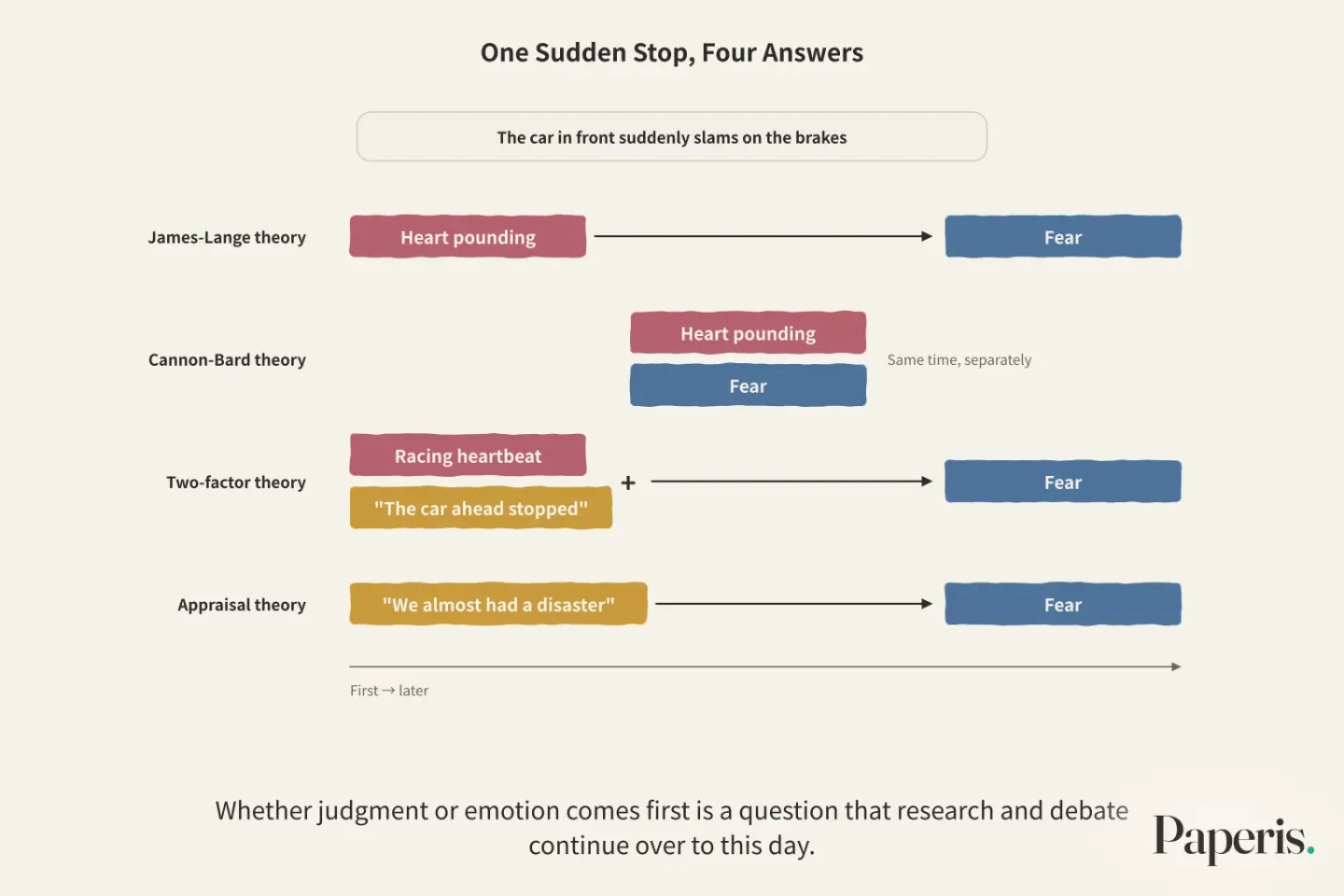
Which came first in the lead car scene? Was it the pounding heart, the feeling of fear, or the judgment that "we almost had a disaster"? Theories have argued over this question since the 19th century (PMID 31125635), and William James, who spoke of instinct earlier, is the starting point.
The James-Lange theory is that the body's reaction happens first, and the emotion arises from that reaction. In this answer, the heart pounds first the moment the car slams on its brakes, and the fear follows right behind that pounding (OpenStax Psychology 2e 10.4).
The Cannon-Bard theory is that the body's reaction and the emotional experience happen at the same time, separately from each other. In this answer, the pounding heart and the fear arrive in the same instant, and neither causes the other (OpenStax Psychology 2e 10.4).
The two-factor theory is that an emotion is formed only when an interpretation of the situation is added to bodily arousal. In this answer, that same racing heartbeat meets the situation where "the car ahead stopped" and gets the name of fear (OpenStax Psychology 2e 10).
Appraisal theory holds that the judgment of what current events mean for oneself—in short, appraisal—comes before emotion. In this answer, the judgment that "we almost had a disaster" comes first, and that appraisal determines the fear (OpenStax Psychology 2e 10.4). Whether judgment or emotion comes first is a question that research and debate continue over to this day (OpenStax Psychology 2e 10.4).
The Current Picture: Needle and Eye Together
There are clues that the body contributes a share to emotion. In a study introduced in textbooks, people with spinal cord injuries who found it hard to feel changes in their bodies still experienced emotions, though those emotions could be less intense (OpenStax Psychology 2e 2.1). This means that even when body signals shrink, emotions remain, and their intensity can differ.
Whether bodily responses differ enough across emotions to tell that many emotions apart was a point of dispute from the start. The Cannon-Bard theory emerged from the side suspecting they were not that different (OpenStax Psychology 2e 10.4), and a review examining 134 research reports concluded that when emotions are broken down finely, differences by emotion are substantial in automatic bodily responses like heart rate or sweat, while noting that the field's stance spans broadly from "undifferentiated arousal" to "distinct patterns per emotion" (PMID 20371374).
Today's explanation uses both directions together. It is a picture where signals rising from the body and the brain predicting and generating those signals give and take with each other to produce emotion (PMID 31125635). Interoception is the brain receiving and reading signals coming from inside the body, like heart rate or gut feelings. These signals influence feelings even when they do not surface into consciousness, and they also come from the hormone, immune, and digestive systems (PMID 31125635). A model where this reading operates like a prediction to build emotions is broadening our understanding of emotions (PMID 28950976).
The constructionist theory put forward by researcher Barrett after 30 years of research across multiple fields stands on the same side. The claim is that emotions are predictions constructed on the spot based on concepts built from experience, which is why different emotions can be built even from the same bodily state (OpenStax Psychology 2e 10.4).
Where in the brain are emotions, then? Many areas in the brain's outer layer and several deep structures underneath participate in emotion together (PMID 34072960). Among them, current theories converge on a deep brain region called the amygdala as the central structure that assigns an emotional value to incoming sensory information. Yet the job of the amygdala is not just that one; it also steps into the body's autonomic responses, hormone regulation, decision-making, and learning, while sending signals to various parts of the brain (PMID 34072960). Meanwhile, in recognizing emotions from other people's facial expressions, brain systems partially divided by emotion were convincingly confirmed only for fear and disgust, while evidence for the rest of the emotions was lacking mostly because such patient cases are rare (PMID 17015095). Because emotions arise from multiple parts of the brain moving together (PMID 34072960), a picture pinning a single emotion to a single brain region—like "anger is here, joy is there"—is not supported by current evidence. How brain regions are divided and connected is traced in "The Map of the Brain — Neighborhoods with Their Own Jobs, a City Joined by Roads".
Emotions are created together by bodily signals and the brain that reads those signals, and cannot be explained by either one alone.
What the Face Tells Us
When your face flushes after a critique in a meeting, a coworker might feel they can read your inner state just by looking at it. The idea that we can read emotions simply from facial movements has seeped into trials, security, education, and even the development of artificial intelligence (PMID 31313636).
One group of researchers has put forward evidence supporting the hypothesis that expressions for a few basic emotions are innate and universal across cultures (PMID 8165273; PMID 1348139). Textbooks also introduce considerable evidence that there are universal expressions for seven emotions (OpenStax Psychology 2e 10.4).
The other side took issue with the methods used to produce that evidence. It was a method of showing pre-selected, staged photographs of faces and having people choose from a set of predetermined options, and when these conditions were changed, the consistency dropped or disappeared. The conclusion of this counterargument is that while expressions and emotion names are probably linked, that connection is culture-dependent and loose (PMID 8202574). The original proponents retorted that this criticism missed the mark (PMID 8165273). Re-examinations since 2008 in more small-scale societies, including in Africa and South America, using methods that do not pre-determine answers, show that the way people read expressions is diverse rather than uniform (PMID 30166776).
The conclusion of a 2019 review captures both sides. While people smile when happy and frown when angry more often than chance, the degree varies widely by culture, situation, and person, and the same facial movement frequently signifies multiple emotions or something other than emotion (PMID 31313636). Cultures also differ in their display rules regarding which emotions are acceptable to show in front of whom and to what extent (OpenStax Psychology 2e 10.4).
There have also been reports that smiles born of genuine amusement can be distinguished from other smiles (PMID 1348139). However, the common belief that "real smiles crinkle the corners of the eyes together" was only weakly supported in a study analyzing 751 smiles made by 136 people. The movement around the eyes provided slight information about the felt joy, but that information overlapped with other features and depended heavily on the situation (PMID 34337430).
For this reason, videos where "body language experts" analyze the expressions of celebrities or trial defendants face criticism for spreading claims that run counter to research findings (PMID 37588916). Polygraphs that measure bodily arousal also face severe doubts about their validity, as there is no evidence of a bodily response pattern that appears only when lying (OpenStax Psychology 2e 10.4). Spoken through a dashboard meter, the face is a light turning on outside the car. It usually has meaning, but it does not simply display the needles on the driver's seat. Facial expressions tell us something about emotions, but they are not consistent enough for us to read a person's inner thoughts just by looking at their face.
Emotions in Judgment
The saying that emotion clouds judgment is an old piece of conventional wisdom. A review summarizing 35 years of research concludes that emotions strongly, broadly, and predictably drive judgments and choices, and that their effects can be both harmful and beneficial (PMID 25251484). The gauge is information that moves the driver, and if misread, it can make them take the wrong road.
Two Roads to Managing Emotion
This is the meeting critique scene again. One person rereads the situation: "Thanks to that critique, I can fix the report." The other person grits their teeth to keep an expressionless face.
Emotion regulation is the act of changing which emotions you experience and express, when, and how strongly. A significant portion of this happens automatically without any effort (OpenStax Psychology 2e 10.4). The two most studied methods are the methods of the two people above (PMID 40234629).
Reappraisal is a method of interpreting the situation that triggered the emotion differently, so that the emotion comes on less strongly. It operates at the front end of the process where emotions are generated (PMID 12212647).
Expressive suppression is a method of holding down the emotion rising inside so that it does not show on the outside. It operates at the back end, after the emotion has already been generated (PMID 12212647).
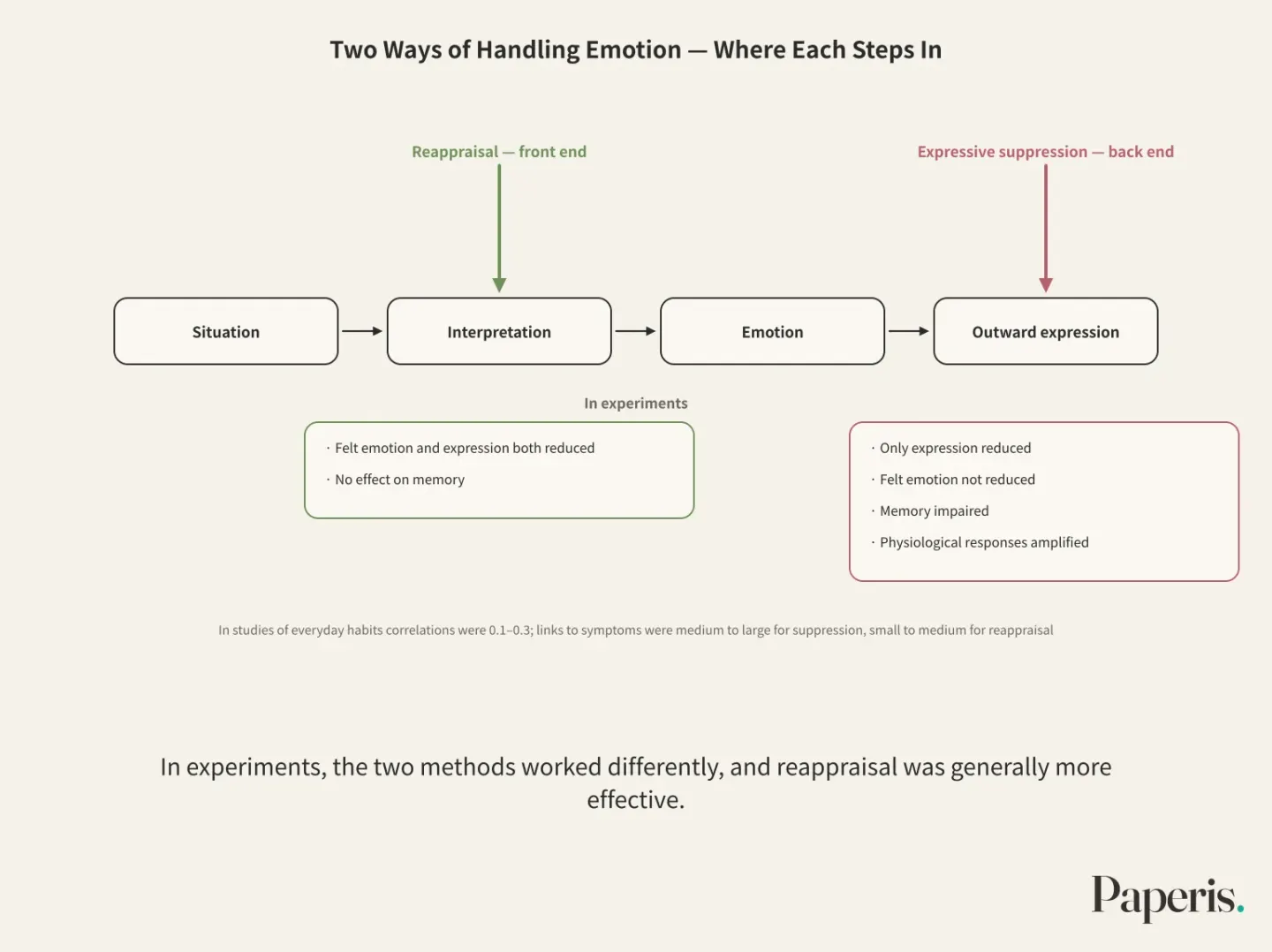
In experiments, the two methods worked differently, and reappraisal was generally more effective. Reappraisal reduced both the felt emotion and the outward expression, and had no effect on memory. Suppression reduced expression but failed to reduce the felt emotion, impaired memory, and actually amplified the physiological responses of both the person suppressing and their partner (PMID 12212647). To use the dashboard analogy, suppression is like putting tape over a warning light. Even if the light is hidden, the engine heat remains the same or rises further.
In studies measuring everyday habits, the direction was the same. In an analysis gathering 21,000-odd people, frequent users of reappraisal tended to go along with good indicators like life satisfaction, while frequent users of suppression tended to go along with bad indicators like depression and anxiety (PMID 24897894). This is a correlation showing that they appear together, and the size of the correlation was between 0.1 and 0.3 (PMID 24897894). In an analysis pooling 114 papers and recalculating the association with four psychiatric symptom types including anxiety and depression, the association with symptoms was medium to large for suppression, but stopped at small to medium for reappraisal. The authors noted this was a surprising result considering the weight reappraisal holds in treatment models, and the relationship varied greatly depending on whether the sample consisted of patients or the general public (PMID 20015584).
Culture alters this relationship. The association between suppression and bad indicators was stronger in Western-value samples and weaker in Eastern-value samples (PMID 24897894). An analysis gathering some 150,000 people across 37 countries and regions also reports that the pros and cons of the two methods vary depending on cultural traits and sample composition such as age and gender (PMID 40234629). There is also evidence that as people grow older, they shift toward increasing reappraisal and decreasing suppression (PMID 15509284). What these pieces of evidence sketch is the fact that the two methods exact different costs, and those costs vary depending on the situation and culture.
Stories That Shrank When Measured Again
The idea that changing your facial expression or posture can also change your mind is widely known. A representative example is a 1988 experiment. People forced to hold a pen in their teeth to make a fake smile rated cartoons as funnier than those who held the pen with their lips to push their mouths out. When the same procedure was repeated separately 17 times, the difference between the two conditions—originally 0.82 points on a 10-point scale—shrank to 0.03 points (PMID 27784749). A classroom demonstration conducted over 9 semesters with more than 400 students yielded an effect size similar to the original (PMID 30475036), leaving a debate over whether experimental conditions changed the results.
A review re-analyzing 51 significant results from 18 studies claiming that posture, expression, and movement change motivation estimated the probability of getting the same result upon repetition at 0.21, concluding that there is little reliable evidence that posture changes motivation (PMID 42771221). A replication trial randomly dividing 92 people also found that a power pose did not change testosterone levels or the feeling of power as originally reported, matching the original results only partially in cortisol and risk-taking (PMID 39633430).
Ego depletion is the claim that after doing something requiring self-control, your self-control drops on the very next task. The initial theory found the reason in the idea that self-control is a limited pool of strength that dwindles when used (PMID 27474142). In large-scale replications with methods pre-registered, gathering 2,141 people across 23 labs and 3,531 people across 36 labs, the effect was close to zero (PMID 27474142; PMID 34520296). A 2024 review by researchers supporting this theory claims that the replication problem has now been resolved, noting that methods have evolved to use longer and stronger manipulations so that fatigue accumulates sufficiently, and the theory has also been refined to emphasize conserving strength rather than running out of it (PMID 39278166). Even in the 36-lab study, exploratory results showed a larger effect in people who reported more fatigue (PMID 34520296), so the debate is not over.
That the body and emotions are intertwined, and that a single posture or expression can bend the mind however you like, are two different stories.
Where to Look Next
Why the effects shaken in this article looked large at first is covered in "Psychology's Replication Crisis — Why the Findings We Believed In Wobbled" and "The Shrinking Effect — Why Textbook Findings Get Smaller When You Measure Them Again". The issue of how the scope of a conclusion is set by who was observed to make a theory—like Maslow's pyramid—leads into "Who Was Being Measured — Who "People" Meant When Psychology Said It".
The hormones that move the needle of hunger are examined by "How Hormones Work — Letters Only the Addressee Reads, Replies That Say Stop", and what accumulates in the body when sleep falls short by "Sleep Loss — A Debt Built Night by Night, Reminders That Lag Behind". How rewards change a person's choices is viewed from the side of economics in "Incentives: How Do People Respond to Prices and Rewards?".
"Learning — The Sound That Comes First, the Taste That Lingers" covers how rewards and punishment alter behavior, "Thinking and Judgment — Familiar Tools, Scratches That Lean One Way" covers the shortcuts of judgment and their traps, and "The Social Mind — A Rope Pulled from Both Ends, the Hands We Don't See" handles behavior that changes when we are with others.
Source Papers
- "Psychology 2e — 10.1 Motivation" (2020) — OpenStax Psychology 2e 10.1 — The definition of motivation, intrinsic and extrinsic motivation and their mix, the overjustification effect and opposing outcomes (depending on praise and expectations), instinct theory and its criticisms, homeostasis, drive, and habit, arousal theory, and Maslow's hierarchy of needs along with its criticisms and the self-transcendence tier.
- "Psychology 2e — 10.2 Hunger and Eating" (2020) — OpenStax Psychology 2e 10.2 — Hunger as a drive, signals from the pancreas and liver during empty stomach contractions and declining blood sugar, satiety signals (blood sugar, digestive tract, and fat cell hormones), and the integration of signals in the brain.
- "Psychology 2e — 10.4 Emotion" (2020) — OpenStax Psychology 2e 10.4 — The definition of emotion and its four components (with an unclear order), James-Lange, Cannon-Bard, appraisal, and constructivist theories, automatic emotion regulation, display rules, the claim of universal facial expressions, and questions regarding lie detector validity.
- "Psychology 2e — Summary" (2020) — OpenStax Psychology 2e 10 — Two-factor theory: physiological arousal receives a context-dependent cognitive label, resulting in an emotional experience.
- "Psychology 2e — 2.1 Why Is Research Important?" (2020) — OpenStax Psychology 2e 2.1 — Individuals who have difficulty feeling bodily arousal due to spinal cord injuries still experience emotions, though they may be less intense.
- "Psychology 2e — 11.5 Humanistic Approaches" (2020) — OpenStax Psychology 2e 11.5 — Maslow studied individuals whom he considered healthy and creative.
- "Psychology 2e — 1.2 History of Psychology" (2020) — OpenStax Psychology 2e 1.2 — Humanistic research programs are largely qualitative (not measurement-based).
- "Theories of motivation: A comprehensive analysis of human behavior drivers." (2024) — PMID 38354564 — An overview of motivation theories, including arousal theory and the idea that organisms strive to maintain an optimal level of activation.
- "Gut hormones and appetite regulation." (2024) — PMID 38511400 — Gut hormones are divided into those that stimulate appetite (ghrelin) and those that suppress it (GLP-1, CCK, PYY, etc.), influenced by environmental factors such as meal timing and sleep deprivation.
- "The gut-brain axis in appetite, satiety, food intake, and eating behavior: Insights from animal models and human studies." (2024) — PMID 39417406 — Food intake is regulated jointly by homeostatic and hedonic processes, with sensory, habit, and psychological factors exerting a major influence.
- "Toward a Wiring Diagram Understanding of Appetite Control." (2017) — PMID 28817798 — Based on genetic research in mice, cues predicting future food intake rapidly modulate homeostatic neurons.
- "How emotions affect eating: a five-way model." (2008) — PMID 17707947 — Five pathways by which emotions affect eating (food choice, suppression of intake, impaired cognitive control, emotional eating, and mood-congruent regulation).
- "Sleep Deprivation and Central Appetite Regulation." (2022) — PMID 36558355 — Changes in appetite-related hormones resulting from chronic sleep deprivation (based on epidemiological and animal studies).
- "Self-Determination Theory: Intrinsic Motivation and Behavioral Change." (2017) — PMID 28222078 — Intrinsic motivation is promoted when the three basic needs of autonomy, competence, and relatedness are met, and is linked to well-being and sustained behavior change.
- "A meta-analytic review of experiments examining the effects of extrinsic rewards on intrinsic motivation." (1999) — PMID 10589297 — Examining 128 studies, promised rewards (under engagement, completion, and performance conditions) lowered free-choice behavior (d −0.40 to −0.28) and self-reported interest (−0.15 to −0.17), while positive feedback raised both (0.33 and 0.31), tangible rewards were more harmful to children, and differences from four prior meta-analyses were identified.
- "Student Motivation and Associated Outcomes: A Meta-Analysis From Self-Determination Theory." (2021) — PMID 33593153 — Covering 344 samples and 223,209 individuals, intrinsic motivation was linked to success and well-being, whereas external regulation was unrelated to performance or persistence and linked to lower well-being.
- "Exercise, physical activity, and self-determination theory: a systematic review." (2012) — PMID 22726453 — Across 66 papers, identified regulation tended to better predict initial adoption, while intrinsic motivation better predicted long-term maintenance, a pattern seen across many correlational designs as well as experimental ones.
- "Physiological feelings." (2019) — PMID 31125635 — Debates since William James in the 19th century, the interaction of bottom-up and top-down signals, and interoception as the reception and representation of actual or virtual bodily changes originating also from the endocrine, immune, and digestive systems.
- "Interoception and emotion." (2017) — PMID 28950976 — The definition of interoception, and how the predictive coding model of interoception broadens our understanding of emotion.
- "Autonomic nervous system activity in emotion: a review." (2010) — PMID 20371374 — Reviewing 134 papers, autonomic response specificity is substantial when emotion subtypes are considered, though scholarly positions range from undifferentiated arousal to specific patterns.
- "Understanding Emotions: Origins and Roles of the Amygdala." (2021) — PMID 34072960 — Emotions arise from the activity of multiple cortical and subcortical regions, and theories converge on the amygdala as the central structure that assigns emotional value to sensory information.
- "Partly dissociable neural substrates for recognizing basic emotions: a critical review." (2006) — PMID 17015095 — Emotion-specific neural systems for facial expression recognition have persuasive evidence only for fear and disgust.
- "Emotional Expressions Reconsidered: Challenges to Inferring Emotion From Human Facial Movements." (2019) — PMID 31313636 — The link between facial expressions and emotions is higher than chance, but varies greatly depending on culture, context, and individuals, with the same movement conveying multiple emotions or non-emotional information.
- "Innate and universal facial expressions: evidence from developmental and cross-cultural research." (1994) — PMID 8165273 — Supporting the innateness and universality of a limited set of emotional expressions, and rebutting Russell's criticisms as missing the mark.
- "Facial expressions of emotion: an old controversy and new findings." (1992) — PMID 1348139 — Evidence for the universality of facial expressions and the debate over their interpretation, distinguishing Duchenne smiles of enjoyment from other smiles.
- "Is there universal recognition of emotion from facial expression? A review of the cross-cultural studies." (1994) — PMID 8202574 — Changing methods, such as forced-choice tasks or posed photographs, weakens or eliminates support, and associations vary across cultures and are loose.
- "Universality Reconsidered: Diversity in Making Meaning of Facial Expressions." (2018) — PMID 30166776 — Exploratory studies in small-scale societies, including those in Africa and South America since 2008, demonstrate diversity in the interpretation of facial expressions.
- "Reconsidering the Duchenne Smile: Formalizing and Testing Hypotheses about Eye Constriction and Positive Emotion." (2021) — PMID 34337430 — Examining 136 people and 751 smiles, eye constriction showed no specificity regarding experienced positive emotion, yielded overlapping information, and was context-dependent.
- "Darwin's illegitimate children: How body language experts undermine Darwin's legacy." (2022) — PMID 37588916 — Body language experts' analyses of celebrities and defendants spread unfounded claims.
- "Emotion and decision making." (2015) — PMID 25251484 — Emotions steer judgments and choices strongly and in widely predictable ways, sometimes to our detriment and sometimes to our benefit.
- "Emotion-regulation strategies across psychopathology: A meta-analytic review." (2010) — PMID 20015584 — Across 114 papers, links to psychopathology were large for rumination, medium to large for avoidance, problem-solving, and suppression, and small to medium for reappraisal and acceptance — a surprising result given the emphasis placed on them in treatment models.
- "Emotion regulation: affective, cognitive, and social consequences." (2002) — PMID 12212647 — Reappraisal operates early, whereas suppression operates late. Suppression reduces only expression, not experience, impairs memory, and amplifies physiological responses in both the self and the interaction partner.
- "Healthy and unhealthy emotion regulation: personality processes, individual differences, and life span development." (2004) — PMID 15509284 — Reappraisal is linked to healthier patterns, alongside a shift toward increased reappraisal and decreased suppression in adulthood.
- "Relation between emotion regulation and mental health: a meta-analysis review." (2014) — PMID 24897894 — Across 48 papers and 21,150 individuals, reappraisal correlated $r = .26$ with positive indicators and $r = −.20$ with negative indicators, while suppression correlated −.12 and .15, with suppression's link to negative indicators being stronger in Western (.19) than in Eastern (.06) samples.
- "Emotion regulation and mental health across cultures: a systematic review and meta-analysis." (2025) — PMID 40234629 — Across 150,474 individuals in 37 countries and regions, the mental health correlates of the two most-studied strategies (reappraisal and suppression) varied by cultural dimensions and sample characteristics.
- "Registered Replication Report: Strack, Martin, & Stepper (1988)." (2016) — PMID 27784749 — Across 17 direct replications, the original 0.82-point difference became 0.03 points (95% CI −0.11 to 0.16).
- "A multi-semester classroom demonstration yields evidence in support of the facial feedback effect." (2019) — PMID 30475036 — Classroom demonstrations with over 400 undergraduates across nine semesters yielded an effect size overlapping with the original.
- "Studies reporting bodily feedback effects on motivation have poor evidentiary value: a critical review and z-curve analysis." (2026) — PMID 42771221 — A z-curve analysis of 18 papers with 51 significant results yielded an estimated replication rate of 0.21, offering little reliable evidence that posture changes motivation.
- "The effects of power posing on neuroendocrine levels and risk-taking." (2024) — PMID 39633430 — In a randomized assignment of 92 people, effects on testosterone and feelings of power failed to replicate, while effects on cortisol and risk-taking received partial support.
- "A Multilab Preregistered Replication of the Ego-Depletion Effect." (2016) — PMID 27474142 — Across 23 laboratories and 2,141 participants, $d = 0.04$ (95% CI −0.07 to 0.15).
- "A Multisite Preregistered Paradigmatic Test of the Ego-Depletion Effect." (2021) — PMID 34520296 — Across 36 laboratories and 3,531 participants, confirmatory analysis yielded $d = 0.06$ (non-significant), and exploratory analyses found larger effects in individuals who reported greater fatigue.
- "Self-control and limited willpower: Current status of ego depletion theory and research." (2024) — PMID 39278166 — A review supporting the theory, arguing that reproducibility issues are now well established and emphasizing longer and stronger manipulations.
Sources (42)
- Psychology 2e — 10.1 Motivation
- Psychology 2e — 10.2 Hunger and Eating
- Psychology 2e — 10.4 Emotion
- Psychology 2e — Summary
- Psychology 2e — 2.1 Why Is Research Important?
- Psychology 2e — 11.5 Humanistic Approaches
- Psychology 2e — 1.2 History of Psychology
- Theories of motivation: A comprehensive analysis of human behavior driversPMID 38354564
- Gut hormones and appetite regulationPMID 38511400
- The gut-brain axis in appetite, satiety, food intake, and eating behavior: Insights from animal models and human studiesPMID 39417406
- Toward a Wiring Diagram Understanding of Appetite ControlPMID 28817798
- How emotions affect eating: a five-way modelPMID 17707947
- Sleep Deprivation and Central Appetite RegulationPMID 36558355
- Self-Determination Theory: Intrinsic Motivation and Behavioral ChangePMID 28222078
- A meta-analytic review of experiments examining the effects of extrinsic rewards on intrinsic motivationPMID 10589297
- Student Motivation and Associated Outcomes: A Meta-Analysis From Self-Determination TheoryPMID 33593153
- Exercise, physical activity, and self-determination theory: a systematic reviewPMID 22726453
- Physiological feelingsPMID 31125635
- Interoception and emotionPMID 28950976
- Autonomic nervous system activity in emotion: a reviewPMID 20371374
- Understanding Emotions: Origins and Roles of the AmygdalaPMID 34072960
- Partly dissociable neural substrates for recognizing basic emotions: a critical reviewPMID 17015095
- Emotional Expressions Reconsidered: Challenges to Inferring Emotion From Human Facial MovementsPMID 31313636
- Innate and universal facial expressions: evidence from developmental and cross-cultural researchPMID 8165273
- Facial expressions of emotion: an old controversy and new findingsPMID 1348139
- Is there universal recognition of emotion from facial expression? A review of the cross-cultural studiesPMID 8202574
- Universality Reconsidered: Diversity in Making Meaning of Facial ExpressionsPMID 30166776
- Reconsidering the Duchenne Smile: Formalizing and Testing Hypotheses about Eye Constriction and Positive EmotionPMID 34337430
- Darwin's illegitimate children: How body language experts undermine Darwin's legacyPMID 37588916
- Emotion and decision makingPMID 25251484
- Emotion-regulation strategies across psychopathology: A meta-analytic reviewPMID 20015584
- Emotion regulation: affective, cognitive, and social consequencesPMID 12212647
- Healthy and unhealthy emotion regulation: personality processes, individual differences, and life span developmentPMID 15509284
- Relation between emotion regulation and mental health: a meta-analysis reviewPMID 24897894
- Emotion regulation and mental health across cultures: a systematic review and meta-analysisPMID 40234629
- Registered Replication Report: Strack, Martin, & Stepper (1988)PMID 27784749
- A multi-semester classroom demonstration yields evidence in support of the facial feedback effectPMID 30475036
- Studies reporting bodily feedback effects on motivation have poor evidentiary value: a critical review and z-curve analysisPMID 42771221
- The effects of power posing on neuroendocrine levels and risk-takingPMID 39633430
- A Multilab Preregistered Replication of the Ego-Depletion EffectPMID 27474142
- A Multisite Preregistered Paradigmatic Test of the Ego-Depletion EffectPMID 34520296
- Self-control and limited willpower: Current status of ego depletion theory and researchPMID 39278166