Paperis Articles
Sensation and Perception — Clues Taken at the Door, a Scene Pieced Together by Guesswork
Eyes and ears do not take pictures of the world. The brain pieces together the clues they hand over — usually correctly, and sometimes wrong in the same direction every time.
Your field's papers, as audio
Pick your fields and journals — Paperis summarizes the key papers and turns them into audio. Listen on your commute.
Start Paperis free →Sensation and Perception — Clues Taken at the Door, a Scene Pieced Together by Guesswork
Holes in the Visual Field
If you close one eye and steadily look at a single point with the other, there is a small hole in your visual field where nothing can be seen. It is a hole that everyone has.
Yet that hole does not look like a black smudge. If the surrounding area is a white wall, a white wall continues to be seen right up to that spot; if it is floral wallpaper, the floral pattern does so. The brightness, color, and pattern of the surroundings seem to be present as if they were inside the hole as well (PMID 17034833). Something that did not enter the eye is being seen.
This article follows that phenomenon by comparing it to a detective. The eyes and ears receive clues at the doorstep and hand them over, translated into a language the detective can read. The brain puts those clues together to build the scene that "something is here right now." The spot where a clue is missing is filled in with clues from the surroundings. That filling-in is precisely what plugs the hole in the visual field.
Changing Words at the Threshold
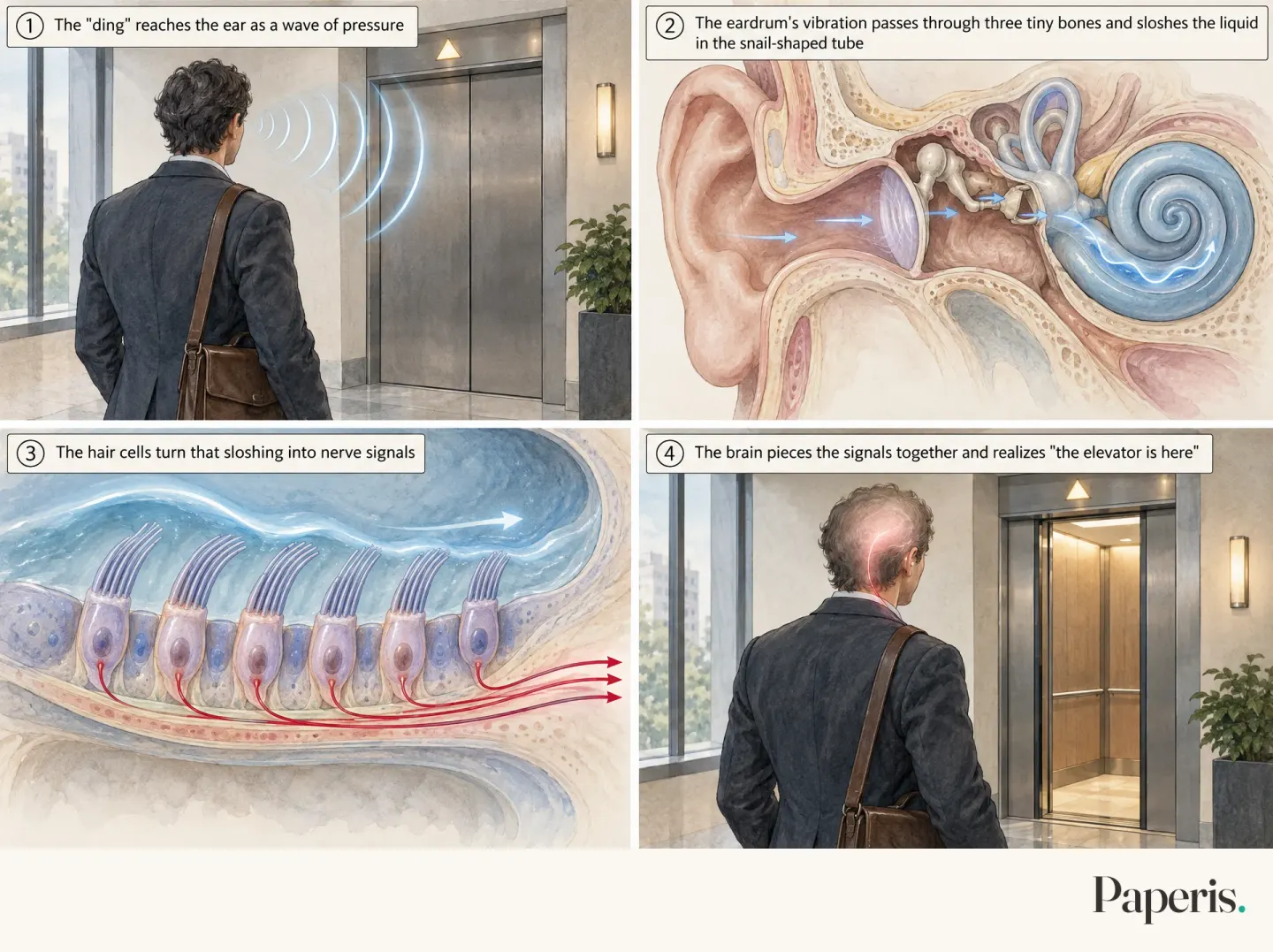
"Ding," goes the sound of the elevator arriving. That sound reaches your ears as a wave of pressure where the air is pressed down and released (OpenStax Psychology 2e 5.4). For this wave to become "the elevator is here," it must go through two steps.
The first step happens at the threshold. Sensation is the process where receptors in sensory organs like the eyes, ears, and skin take in stimuli like light, sound, and pressure. Receptors are cells specialized to respond only to fixed kinds of stimuli, like light, sound, or pressure. The eyes have receptors that respond to light, and the ears have receptors that respond to sound separately (OpenStax Psychology 2e 5.1).
Since what the brain deals with are nerve signals, the stimuli must be translated into that language at the threshold (OpenStax Psychology 2e 5.1). Transduction is the process of converting the energy of the stimulus received by the receptor into a nerve signal. For the elevator sound, it looks like this.
The wave of pressure makes the eardrum vibrate, and that vibration passes through three tiny bones in the middle ear to slosh the liquid inside the snail-shaped tube. When that sloshing touches the hair cells inside the tube, which are the receptors of the ear, the hair cells send out nerve signals (OpenStax Psychology 2e 5.4). The elevator sound is thus translated into the language of signals at the threshold.
Sensation is also knowing that your body tilts slightly when the elevator stops. This is the sense in charge of body balance, which lies outside the five senses commonly counted (OpenStax Psychology 2e 5.1).
The second step happens inside the threshold. Perception is the process where the brain pieces together and interprets the information brought in by sensation to realize what it is. It is in this step that the signal gets the meaning "the elevator is here" (OpenStax Psychology 2e 5.1). If sensation is the clues received at the threshold, perception is the scene the detective builds with those clues. Receiving things and reading things are different steps.
Two Kinds of Cells in the Eye
Small print in a book can only be read by aiming your gaze right at those letters. Letters a couple of lines away are only known to be there, not read.
The retina is a thin layer at the back inside of the eyeball that receives light. The retina has two kinds of receptors that receive light (OpenStax Psychology 2e 5.3). Cones are receptors in the retina that work well in bright light and handle fine shapes and color. Cones are densely packed right in the middle where your gaze lands, which is why only the letters you look directly at are sharp (OpenStax Psychology 2e 5.3).
Rods are receptors in the retina that work well in dim light but cannot distinguish color and fine shape. Rods are spread across the rest of the retina's wide area, and are also used to catch motion at the edges of your vision (OpenStax Psychology 2e 5.3).
It takes a few minutes for your eyes to adjust to the dark in a pitch-black bedroom because it takes time for the responsible cells to switch from cones to rods (OpenStax Psychology 2e 5.3).
The blind spot is the spot where the nerve bundle exits the eye, so there are no receptors, and light focused there cannot be seen. The hole you found by closing one eye at the beginning is this spot (PMID 17034833).
There is a reason the hole only appears when you close an eye. If you keep both eyes open, the hole spot of one eye is seen by the other eye, so the hole does not show (OpenStax Psychology 2e 5.3). Even when only one eye is open, the hole does not look black because the brightness, color, and pattern of the surroundings fill in that spot (PMID 17034833).
The clues used for filling in are very sparse. Even when a very thin border was placed around the edge of the blind spot, that color filled the entire blind spot seamlessly, and when the eye moved so that the border drifted away from the edge, the filling-in became incomplete. This filling-in appears to rely on local processing that occurs right next to the edge of the hole, and the mechanism of filling-in is still debated (PMID 17034833). In monkey experiments, brain cells responsible for the visual field corresponding to the blind spot responded when a large stimulus covered the blind spot and filling-in occurred (PMID 12413651). The detective does not report that there is a blank space, but fills in a plausible pattern using clues from the surroundings.
Thresholds
There is an estimate that on a clear night, the eye's most sensitive cells can catch a candle flame about 48 kilometers away. There is an estimate that in a quiet place, they can catch the ticking of a clock about 6 meters away (OpenStax Psychology 2e 5.1). That means the doorway is that sensitive, but there is still a threshold.
The absolute threshold is the weakest intensity of a stimulus that can be detected half the time. That means even a stimulus of that intensity is not detected every time, but only about half of the time (OpenStax Psychology 2e 5.1).
There is one more threshold. If you put a single tangerine into an empty shopping bag, your hand knows immediately. If you add a tangerine to a shopping bag already holding a watermelon, you cannot easily tell. The difference threshold is the smallest difference needed to notice that two stimuli are different. This threshold grows larger the stronger the initial stimulus is. The rule that the detectable difference is a constant proportion of the initial stimulus is called Weber's law, named after the person who first proposed it in the 1830s (OpenStax Psychology 2e 5.1). This means what senses notice is generally the ratio compared to the initial thing, rather than the increased amount itself.
The story that a message slipped below the threshold moves people like an advertisement has weak evidence. The effect of such messages on behavior outside the laboratory is small (OpenStax Psychology 2e 5.1). While there are reports that information not consciously noticed is processed to some degree inside the laboratory (OpenStax Psychology 2e 5.1), how much that information changes behavior is difficult to gauge with the evidence gathered in this article. How claims of behavioral priming—that showing or reminding someone of something changes subsequent behavior—wobbled when retested is covered in "Thinking and Judgment — Familiar Tools, Scratches That Lean One Way".
What is Always There Disappears
The weight of the glasses worn in the morning is no longer felt by the time one boards the subway for the commute. The hum of the office refrigerator is heard only the moment that sound stops.
Sensory adaptation is when a stimulus that continues without changing for a long time is felt less and less. Even after it is no longer felt, the stimulus may still be coming in, so sensory adaptation is used as an example where the feeling disappears even though the stimulus has not disappeared (OpenStax Psychology 2e 5.1).
There are also models that explain adaptation as calibration at the cellular level. The calculation is that simply with a simple device where each cell adjusts its sensitivity to match the level of the stimulus it currently receives, processing becomes efficient, the same thing looks the same even when the lighting changes, and minute differences are distinguished better. However, it is not yet certain what actual benefits adaptation provides (PMID 25281412).
To put it like a detective, a clue that is in the same place every day is left out of the report.
A Detective Fixated on a Single Event
24 radiologists were asked to find a small nodule in lung CT scans. The final image contained a gorilla drawing 48 times larger than the average nodule. 83% of them failed to see the gorilla. Eye tracking showed that most of those who missed it looked directly at the spot where the gorilla was (PMID 23863753).
Where the gaze lands and what is perceived are different. What divides the two is attention. Attention here refers to the act of selecting a portion of the incoming information and pouring processing power into it. Attention plays a major role in determining what lingers in the senses and what makes it all the way to perception (OpenStax Psychology 2e 5.1). Inattentional blindness is failing to notice something plainly visible right in front of you because you are pouring your attention into something else.
In a 1999 experiment that made this phenomenon widely known, nearly half of the people counting basketball passes failed to see a person in a gorilla suit walk across the screen for 9 seconds (OpenStax Psychology 2e 5.1; PMID 10694957). Dozens of experiments reporting inattentional blindness have piled up since then (PMID 38182856). In a meta-analysis gathering 14 studies comparing experts and novices and totaling 1,153 people, 62% of novices and 56% of experts missed the unexpected object. The authors concluded that there is little evidence that expertise reliably reduces the miss rate, while also noting that the conclusions are weak due to small numbers of studies and samples (PMID 35060780).
It is also difficult to screen in advance who will miss it. In a meta-analysis gathering 74 groups, cognitive ability or personality scores did not reliably separate those who noticed from those who missed. However, the caveat was attached that the samples in most measurements were small, so larger studies are needed (PMID 38182856).
There are clues about what is more easily missed. In two large-scale experiments that divided participants into two groups and showed them plausible and implausible scenes, the group given the implausible scenes missed more (PMID 39447236). One review views errors of this kind—"seeing but not perceiving"—as a byproduct paid by the visual system, a predictive device with a limited capacity for processing. It therefore argues that even in critical tasks like driving or medical image reading, it is nearly impossible to avoid such mistakes (PMID 35872002).
There are still gaps in this connection. It is not clear whether errors in actual medical settings are due to inattentional blindness. This is because most related research has not been designed well enough to sort out whether the mistakes came from inattentional blindness or other causes (PMID 38536589).
Whether a missed object is secretly processed somewhere in the mind is also a matter of debate. A meta-analysis gathering 59 studies found that objects that received no attention and were not noticed are still processed, but also noted that the conclusions can vary depending on how noticing is measured (PMID 33086130). However, when recalculating after correcting for the bias where only studies showing an effect get published, results consistent with the view that there is no hidden processing at all also emerged (PMID 35839986). A detective who pours their attention into a single event does not log even a gorilla standing right in the middle of the room into the report.
Clues from Below, Guesses from Above
Even a scribbled handwritten note reads smoothly once you know your colleague wrote it to announce the "3 o'clock meeting." The reason the same handwriting is easier to read lies in the knowledge the reader holds.
Bottom-up processing is processing led by sensory information coming in from outside stimuli. Top-down processing is processing led by knowledge and expectations you already hold. Perception involves both of these together (OpenStax Psychology 2e 5.1). Speaking as a detective, bottom-up processing is the clues raised from the scene, and top-down processing is the way the world works that the detective already knows.
Knowledge about how the world usually works greatly helps perception, and judgments that lean on perception. There are also theories that determine through probability calculations what ratio to mix knowledge and sensory information in (PMID 30122170). One influential theory goes a step further and views the brain as a prediction machine. It is the idea that the brain constantly predicts incoming senses in advance, and perceives while reducing the mismatch between what actually came in and the prediction (PMID 23663408). This idea is counted as the currently most dominant framework in perception research, but basic questions like what "prediction" precisely means have not yet been solved (PMID 29250827).
If a guess is too strong, something can be perceived even without clues. Even healthy people can experience hallucinations of perceiving stimuli that are not actually there when they hold excessively rigid expectations in a laboratory, and people who experience hallucinations in real life fell prey to these laboratory phenomena more easily (PMID 30583945). The authors of that review see this as evidence that normal perception and abnormal perception are connected in a single line, and also address how to reconcile this with results that guesses are actually weaker in psychosis (PMID 30583945). A detective's knowledge makes them guess a scene quickly when the clues are blurry, and if it goes too far, they invent scenes that do not exist.
Rules for Binding Pieces Together
Six people are standing at a bus stop. If three are clustered tightly and three are standing a bit apart, our eyes see "two groups of three." This happens even though nobody told us to form groups.
There are predictable rules to the way the brain binds pieces like this. Gestalt principles are predictable rules the brain follows when it binds scattered pieces into a lump. Gestalt means form or shape, and it is also the name of the movement that studied this binding in the early 20th century (OpenStax Psychology 2e 5.6). The two groups at the bus stop come from the rule of binding things that are close together.
We can see two more rules at the same bus stop. Two people holding identical long umbrellas look like companions even if they are standing apart from each other. That is the rule of binding similar things. A timetable board half-obscured by a pillar looks like a single rectangular board. That is the rule of finishing empty outlines into closed shapes (OpenStax Psychology 2e 5.6). A detective does not read clues separately one by one; they bind and read them into plausible groups.
Reading Depth from a Flat Picture
Even though a photograph of a long corridor is flat paper, the corridor looks as if it extends deep inward. Since the paper has no depth, the depth is read by the viewer.
Depth perception is the task of figuring out distance relations in a three-dimensional space, namely what is in front and what is behind. What creates depth in the corridor photograph is how the lines of the floor and walls converge toward a single point inside. Because these cues are read even with a single eye, depth is felt even in a flat photograph (OpenStax Psychology 2e 5.3). When standing in a real corridor, the difference between the scenes that the two eyes receive slightly differently adds to this (OpenStax Psychology 2e 5.3).
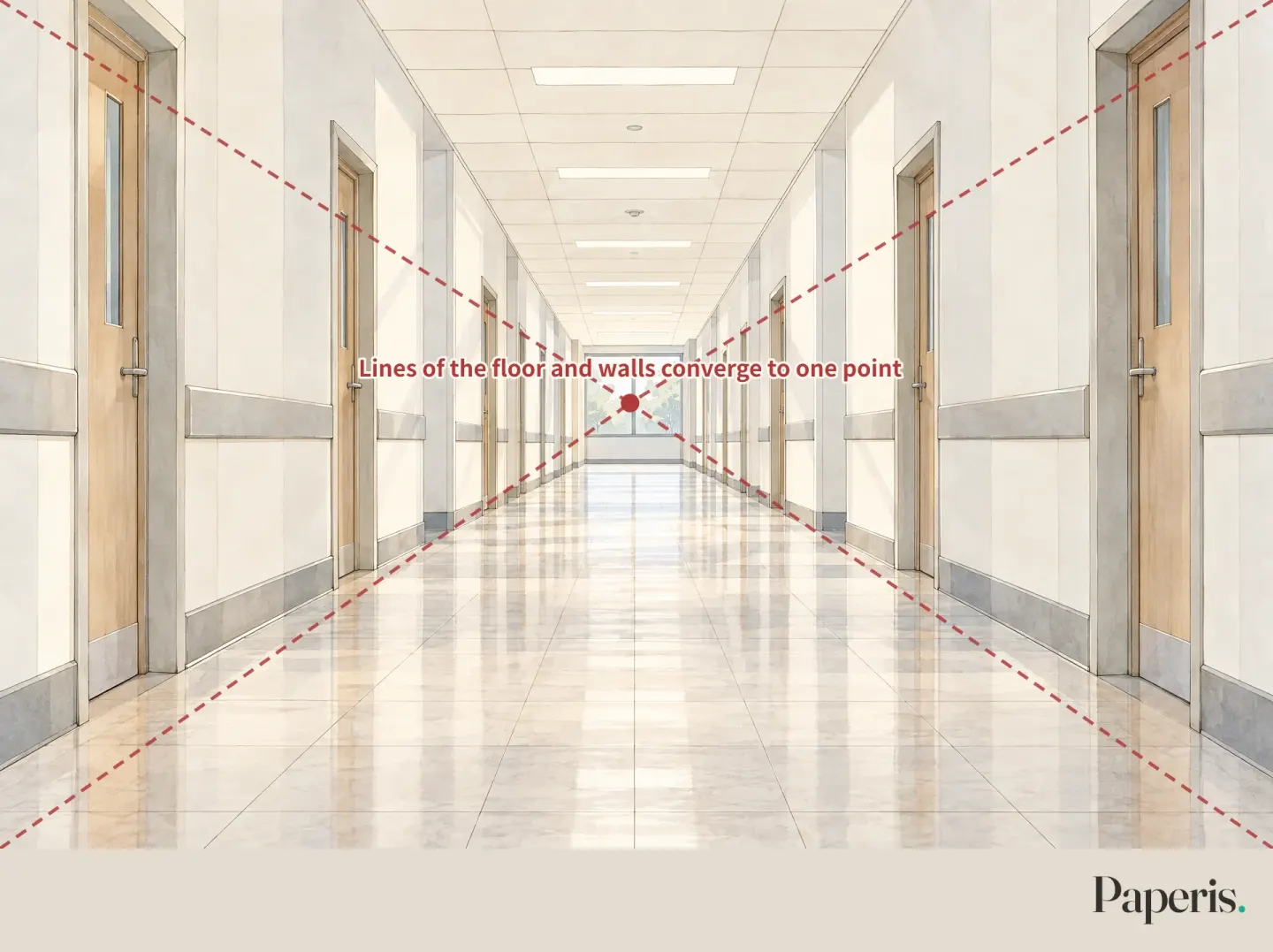
Illustration: Paperis (lines and labels drawn from the article)
A colleague walking toward the end of the corridor does not look like they are shrinking in size, even though the image projected on the retina gets progressively smaller. Perceptual constancy is the act of seeing an object's size or color as remaining the same even when the image entering the eye changes. In the case of size, the brain combines the size of the image projected on the retina with various distance cues to construct a world where the object is always the same size (PMID 26288899).
Take away the cues, and this calculation falters. In an experiment where participants viewed a glowing object in a completely dark room with one eye through a 1-millimeter pinhole, telling them the distance verbally like "20 centimeters" improved size judgments to some extent, but size constancy never fully returned (PMID 38401629).
Still, in the real world, this guesswork usually works out well. A short 1999 review reports that color constancy, which often turned out weak when measured in the laboratory, was almost perfect when remeasured with real objects and scenes, and that multiple perceptual mechanisms work together to accomplish this task (PMID 10469555). Concluding that an object remains the same even as cues change from moment to moment—this is where a detective's guesswork works most usefully.
The Same Gray, Different Grays
Even if you place a sheet of white paper in the sunlight by the window and then move it to the shade of a desk, the paper still looks white. The light hitting our eyes is a jumble of the paper's own properties and the lighting illuminating that paper (PMID 40763251). When we move it to the shade, the lighting changes, but we do not see the paper as having changed.
Vision does not work like a photometer that simply measures a single point of light. It calculates brightness by comparing it to the surroundings. An evenly bright surface appears to be represented from the edges first with the center filled in later, and brightness seems to be calculated slowly based on information from the edges and surroundings (PMID 17027383). One of the jobs handled by this calculation, which relies heavily on the surroundings, is known as lightness constancy—in other words, seeing the brightness of a surface as constant even when the lighting changes.
The same calculation creates the opposite scene as well. If you leave the light of the central piece as it is and change only the brightness of the surroundings, the center appears to grow brighter and darker (PMID 17027383). The optical illusion where a gray on a bright background and a gray on a dark background look different even though they are the exact same gray is a phenomenon of the same lineage.
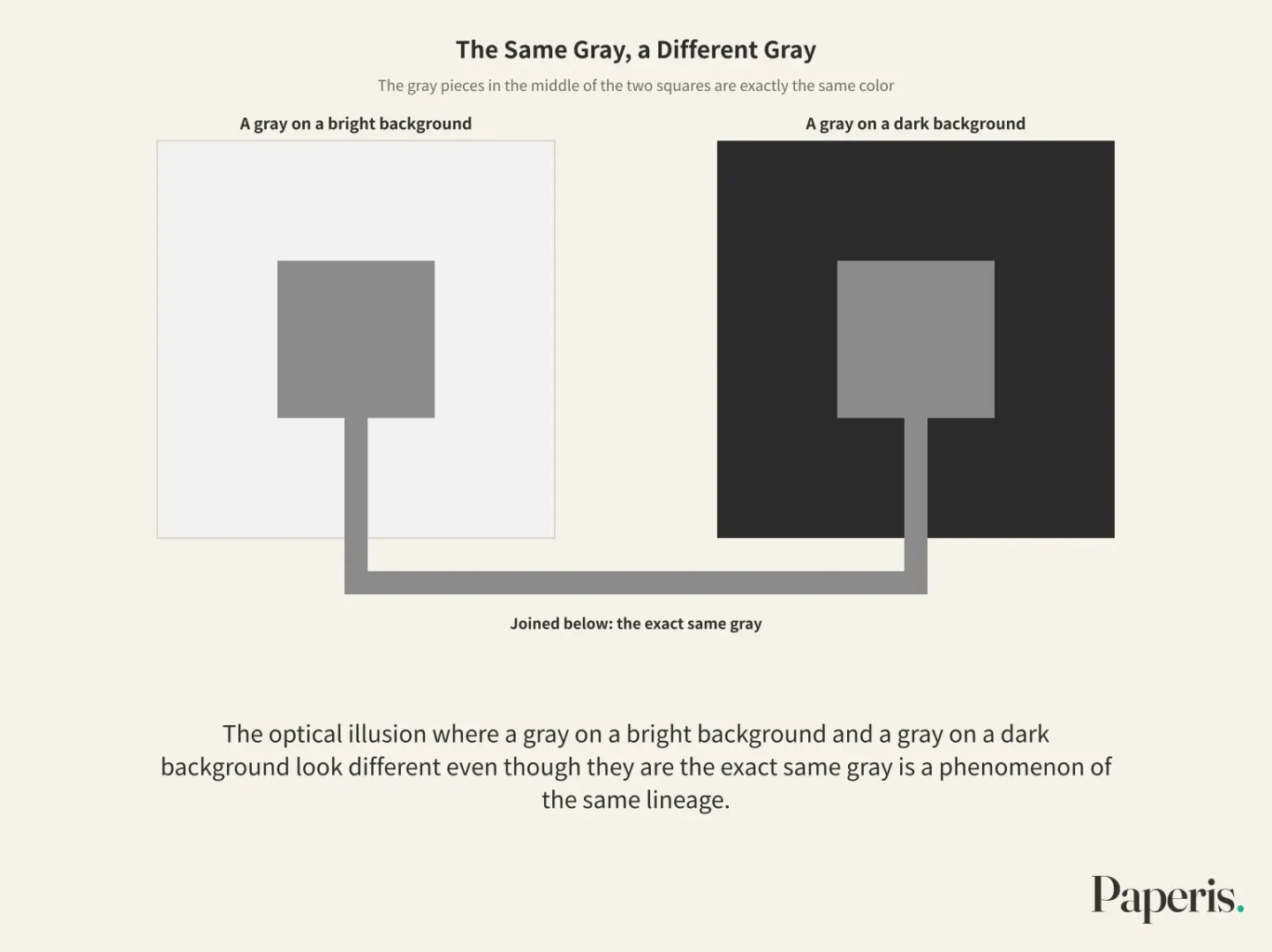
What is wrong in this optical illusion is the conclusion that "the central piece itself is different." The brain determines the brightness of a surface using the surroundings as a clue, but in an image where only the surroundings are changed, that clue yields the wrong answer. The calculation that makes paper in the shade look white and the calculation that makes the same gray look different appear to come from the same method of reading the surroundings to determine brightness. An optical illusion is the spot where a detective used their usual reasoning rules and encountered a scene where those rules did not fit.
Does Culture Change How We See?
A line with arrowheads pointing outward at both ends and a line with them tucked inward look different in length even when they are the same length. This is a drawing called the Müller-Lyer illusion.
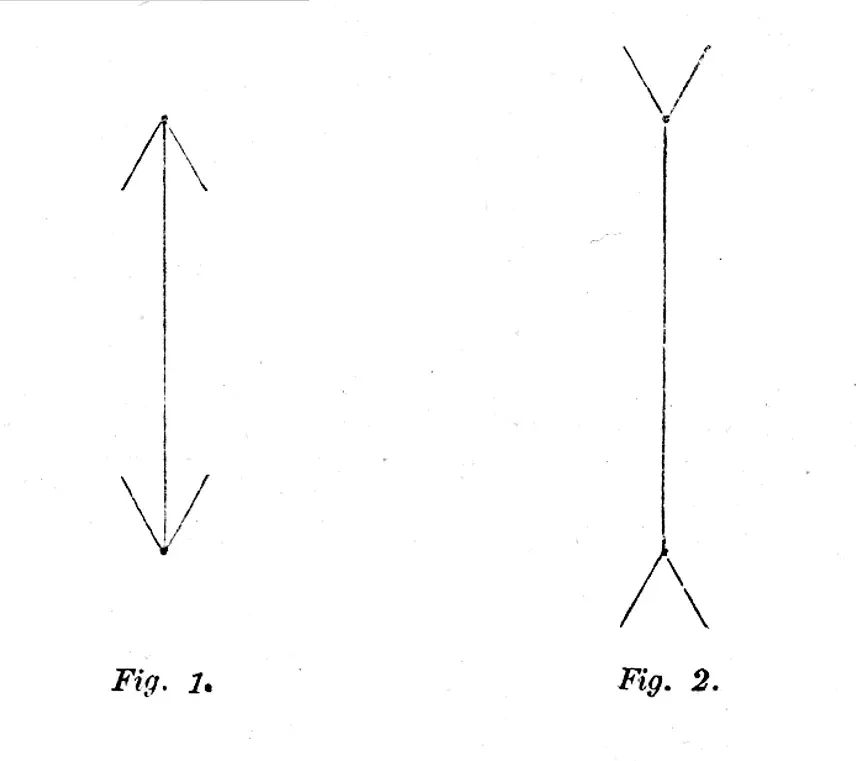
The Müller-Lyer illusion as originally printed · Franz Brentano, 'Über ein optisches Paradoxon', 1892 · Wikimedia Commons (public domain)
A cross-national study from the 1960s reported that Westerners are more easily fooled by this illusion, and explained that the experience of growing up in buildings constructed with straight lines and corners creates that difference. This is an explanation still included in textbooks today (OpenStax Psychology 2e 5.1). A 1978 study in Zambia comparing 8- to 19-year-olds matched for education level found a difference between environments with many straight buildings and those with few, but the same difference appeared even in modified drawings with perspective cues removed, leading to the conclusion that the theory explaining it by perspective alone is insufficient. Because it was a comparison within a single country, it also did not support the hypothesis explaining it by genetic differences (PMID 656735).
A 2026 review argues that this cultural explanation is almost certainly wrong. This illusion appears in non-human animals, in senses other than vision, and in people who have been blind since birth, and it is reproduced by the statistics of natural scenes alone. While noting that the data from the original studies were inconsistent, mixed with questionable research practices, and miscommunicated in later discussions, the authors leave open other pathways by which cultural differences in visual processing might arise (PMID 40388159).
Cultural differences are reported in other places. Results have accumulated showing that which visual information is used when recognizing faces differs according to cultural background, but why that difference arises is not yet known (PMID 33927668). The idea that experience can change perception remains alive, and the illusion long used as its representative case is being re-examined now.
Usually Right Detectives
If we treat the eye as a camera and what we see as a photograph of the world, we cannot explain how holes in our visual field are filled in, nor how paper in the shadow still looks white. Conversely, if we say that "perception is all an illusion," we cannot explain how people correctly recognize the color of an object under changing lighting.
Perception is a guess built by adding experience and expectation to the clues handed over by sensation, and though it is usually right, the way it builds those guesses creates blind spots where it always errs in the same direction. The method of subtracting what is always there, turning up only what caught attention, and filling blanks with surroundings usually builds useful scenes. The optical illusion where the same gray looks different also seems to come from that method, and there are review papers that view the mistake of missing the gorilla as a byproduct of this method (PMID 35872002).
The detective metaphor has limits. There is no separate person sitting inside the brain reading the clues handed to them. And while a detective knows they are reasoning, we do not even notice our blind spots being filled in (OpenStax Psychology 2e 5.3). Exactly what computations the brain uses to pull off this guessing remains a debated question (PMID 29250827).
Where to Look Further
How signals from receptors are transmitted along nerves can be seen in "How Do Nerve Cells Send Signals? — A Burning Fuse, a Gap Crossed by Ferry", and which brain regions those signals go to can be seen in "The Map of the Brain — Neighborhoods with Their Own Jobs, a City Joined by Roads". The first step of how perceived things are stored as memories is covered by "The Three Steps of Memory — Putting It In, Keeping It, Taking It Out".
Why cross-cultural research wobbled, and why famous effects shrink when measured again, connect to "Psychology's Replication Crisis — Why the Findings We Believed In Wobbled" and "Who Was Being Measured — Who "People" Meant When Psychology Said It".
The other parts of this series also look at different sides of the same detective. "Learning — The Sound That Comes First, the Taste That Lingers" follows how experience changes behavior, "Thinking and Judgment — Familiar Tools, Scratches That Lean One Way" follows the shortcuts of thought that get quick answers and the places where those shortcuts go wrong, and "Emotion and Motivation — A Dashboard of Swinging Needles, and the Eye That Reads Them" follows what makes us move.
Source Papers
- "Psychology 2e — 5.1 Sensation versus Perception" (2020) — OpenStax Psychology 2e 5.1 — Sensory receptors and transduction, the vestibular sense, absolute thresholds (50% detection) and sensitivity estimation, the small out-of-lab effects of subliminal messages, difference thresholds and Weber's law, perception and bottom-up/top-down processing, sensory adaptation, attention and inattentional blindness (the 1999 gorilla experiment), and a report on cultural comparisons of the Müller-Lyer illusion.
- "Psychology 2e — 5.3 Vision" (2020) — OpenStax Psychology 2e 5.3 — The retina, cones (concentrated in the center, fine detail, color) and rods (dim light) and dark adaptation, the blind spot where the optic nerve exits and how the blind spots of the two eyes do not overlap, and monocular depth cues and binocular cues readable even in photographs.
- "Psychology 2e — 5.4 Hearing" (2020) — OpenStax Psychology 2e 5.4 — Sound is a wave of pressure that passes through the eardrum, middle ear bones, and cochlear fluid for hair cells to generate neural signals.
- "Psychology 2e — 5.6 Gestalt Principles of Perception" (2020) — OpenStax Psychology 2e 5.6 — Gestalt means form or shape, and grouping principles involve grouping things that are close or similar and seeing empty contours as a closed whole.
- "Perceptual filling-in from the edge of the blind spot." (2006) — PMID 17034833 — When viewed with one eye, the hole of the blind spot is not noticed and the brightness, color, and pattern of the surrounding area are seen, filling in even with very thin borders, becoming incomplete when the eye moves and the border moves away, and filling-in appears to rely on local processing at the edges (the mechanism is debated).
- "Neural responses in the primary visual cortex of the monkey during perceptual filling-in at the blind spot." (2002) — PMID 12413651 — Deep-layer cells in the primary visual cortex of monkeys responsible for the visual field corresponding to the blind spot respond to large stimuli covering the blind spot and to filling-in.
- "Probing the functions of contextual modulation by adapting images rather than observers." (2014) — PMID 25281412 — A model showing that sensitivity adjustments tailored to stimulus levels improve efficiency, perceptual constancy, and discrimination, while the actual benefits of adaptation remain uncertain.
- "The invisible gorilla strikes again: sustained inattentional blindness in expert observers." (2013) — PMID 23863753 — 83% of 24 radiologists missed a gorilla 48 times the size of a nodule, and most of those who missed it looked directly at the spot.
- "Gorillas in our midst: sustained inattentional blindness for dynamic events." (1999) — PMID 10694957 — Objects may not be perceived without attention, and the probability of noticing depends on similarity to other objects and task difficulty.
- "Individual differences in inattentional blindness." (2024) — PMID 38182856 — A meta-analysis pooling 74 groups from dozens of papers on inattentional blindness, finding that cognitive ability and personality do not reliably predict noticing and that sample sizes are small, requiring larger studies.
- "Does Expertise Reduce Rates of Inattentional Blindness? A Meta-Analysis." (2022) — PMID 35060780 — Across 14 papers and 1,153 participants, 62% of novices versus 56% of experts missed the stimulus, supporting little evidence for the effect of expertise, with conclusions weakened by small numbers of studies and samples.
- "Real-world Statistical Regularity Impacts Inattentional Blindness." (2024) — PMID 39447236 — In two large-scale experiments, groups presented with improbable scenes showed higher rates of inattentional blindness.
- "Normal blindness: when we Look But Fail To See." (2022) — PMID 35872002 — The argument that errors of seeing without perceiving are a byproduct of a visual system that functions as a capacity-limited prediction device and are difficult to avoid in driving and medical imaging.
- "Inattentional blindness in medicine." (2024) — PMID 38536589 — Inattentional blindness may be involved in medical errors, but most studies fail to provide clear evidence to distinguish it from other mechanisms.
- "Implicit processing during inattentional blindness: A systematic review and meta-analysis." (2020) — PMID 33086130 — A meta-analysis of 59 experiments showing that unattended and unnoticed stimuli can still be processed, though conclusions may vary depending on how noticing is measured.
- "Publication bias casts doubt on implicit processing in inattentional blindness." (2022) — PMID 35839986 — After correcting for publication bias, earlier meta-analytic estimates were inflated, and the data are also consistent with the absence of hidden processing effects.
- "How Do Expectations Shape Perception?" (2018) — PMID 30122170 — A review of Bayesian theories determining how prior knowledge of the probability structure of the world greatly aids perception and perceptual judgments, and how prior knowledge and sensory information are combined.
- "Whatever next? Predictive brains, situated agents, and the future of cognitive science." (2013) — PMID 23663408 — A review of the approach viewing the brain as a prediction machine that matches sensory inputs with top-down predictions to reduce prediction error, evaluated as the most promising clue.
- "Predictive coding in auditory perception: challenges and unresolved questions." (2020) — PMID 29250827 — Predictive coding is the dominant framework in perception research, but fundamental questions remain, including the meaning of "prediction".
- "Hallucinations and Strong Priors." (2019) — PMID 30583945 — Overly strong prior beliefs induce laboratory hallucinations in healthy individuals, who are more susceptible to real hallucinogenic experiences, discussing harmony with the weak prior belief results of psychosis, and the continuity of normal and abnormal perception.
- "The Mechanisms of Size Constancy." (2015) — PMID 26288899 — The brain combines retinal images with various distance cues to create a perceptual experience of objects maintaining a constant size, with the primary visual cortex serving as a crucial node.
- "The contribution of semantic distance knowledge to size constancy in perception and grasping when visual cues are limited." (2024) — PMID 38401629 — Under dark room, monocular, and pinhole conditions, verbally provided distance knowledge contributed somewhat to size constancy but ultimately failed to fully recover it.
- "Colour vision: Is colour constancy real?" (1999) — PMID 10469555 — Color constancy appears weakly in the laboratory but is nearly perfect when measured with real stimuli, with multiple mechanisms contributing.
- "Seeing the Light: Perception and Discrimination of Illumination Color." (2025) — PMID 40763251 — Light reaching the eyes intertwines surface reflectance and illumination, and the relationship between illumination perception and surface color perception remains an open question.
- "Lightness, filling-in, and the fundamental role of context in visual perception." (2006) — PMID 17027383 — Unlike photometers, vision is defined by spatial interactions, with lightness slowly calculated from edges and context, a possible role of those surround interactions being lightness constancy, where surrounding lightness changes alter central lightness perception.
- "An intra-cultural investigation of susceptibility to 'perspective' and 'non-perspective' spatial illusions." (1978) — PMID 656735 — Among 8- to 19-year-old children in Zambia, differences according to environment emerged even in modified drawings stripped of perspective cues, leading to the conclusion that perspective theory is insufficient and does not support genetic explanations due to within-country differences.
- "Is visual perception WEIRD? The Müller-Lyer illusion and the cultural byproduct hypothesis." (2026) — PMID 40388159 — The argument that the cultural byproduct hypothesis of the Müller-Lyer illusion is almost certainly false (appearing in animals, other senses, and congenitally blind individuals, alongside inconsistencies in original data, questionable practices, and subsequent miscommunications), while leaving open other cultural difference pathways.
- "Cultural Differences in Face Recognition and Potential Underlying Mechanisms." (2021) — PMID 33927668 — Visual information used for face processing varies depending on cultural background, but the underlying mechanisms remain unknown.
Sources (28)
- Psychology 2e — 5.1 Sensation versus Perception
- Psychology 2e — 5.3 Vision
- Psychology 2e — 5.4 Hearing
- Psychology 2e — 5.6 Gestalt Principles of Perception
- Perceptual filling-in from the edge of the blind spotPMID 17034833
- Neural responses in the primary visual cortex of the monkey during perceptual filling-in at the blind spotPMID 12413651
- Probing the functions of contextual modulation by adapting images rather than observersPMID 25281412
- The invisible gorilla strikes again: sustained inattentional blindness in expert observersPMID 23863753
- Gorillas in our midst: sustained inattentional blindness for dynamic eventsPMID 10694957
- Individual differences in inattentional blindnessPMID 38182856
- Does Expertise Reduce Rates of Inattentional Blindness? A Meta-AnalysisPMID 35060780
- Real-world Statistical Regularity Impacts Inattentional BlindnessPMID 39447236
- Normal blindness: when we Look But Fail To SeePMID 35872002
- Inattentional blindness in medicinePMID 38536589
- Implicit processing during inattentional blindness: A systematic review and meta-analysisPMID 33086130
- Publication bias casts doubt on implicit processing in inattentional blindnessPMID 35839986
- How Do Expectations Shape Perception?PMID 30122170
- Whatever next? Predictive brains, situated agents, and the future of cognitive sciencePMID 23663408
- Predictive coding in auditory perception: challenges and unresolved questionsPMID 29250827
- Hallucinations and Strong PriorsPMID 30583945
- The Mechanisms of Size ConstancyPMID 26288899
- The contribution of semantic distance knowledge to size constancy in perception and grasping when visual cues are limitedPMID 38401629
- Colour vision: Is colour constancy real?PMID 10469555
- Seeing the Light: Perception and Discrimination of Illumination ColorPMID 40763251
- Lightness, filling-in, and the fundamental role of context in visual perceptionPMID 17027383
- An intra-cultural investigation of susceptibility to 'perspective' and 'non-perspective' spatial illusionsPMID 656735
- Is visual perception WEIRD? The Müller-Lyer illusion and the cultural byproduct hypothesisPMID 40388159
- Cultural Differences in Face Recognition and Potential Underlying MechanismsPMID 33927668