
Paperis Articles
The Social Mind — A Rope Pulled from Both Ends, the Hands We Don't See
We follow the habit of blaming others' behavior on their character, the discomfort when thoughts and actions clash, Asch's experiment where people repeated a wrong answer and Milgram's experiment at 450 volts, the 'our side' that forms even from meaningless groupings, stereotypes, prejudice and discrimination, and who helps when many people are watching.
Your field's papers, as audio
Pick your fields and journals — Paperis summarizes the key papers and turns them into audio. Listen on your commute.
Start Paperis free →The Social Mind — A Rope Pulled from Both Ends, the Hands We Don't See
The Scans Left at Six in the Evening
A radiology department at an American teaching hospital counted how many abdominal CT scans remained unread every weekday at six in the evening. The daily average was 24, with a low of 3 and a high of 72 on busy days (PMID 26006745).
When they asked the 12 doctors in the department why each day varied like this, 8 of them picked "how hard the doctors tried" as the biggest reason. A year's worth of records pointed the other way. The things that best explained the remaining counts were the number of experienced resident doctors working that day and the volume of work that came in, and the productivity of each individual doctor explained only about 3% of the daily differences (PMID 26006745). Because this is a year of records from one hospital, we cannot move it as-is to other workplaces.
Even so, the scene is familiar. When work backs up, people catch our eye first. The people and workload surrounding that person are hard to see.
This article follows that hard-to-see side. If we draw a person's behavior as a knot tied in the middle of a tug-of-war rope, we will not lose our way. Several hands catch on the rope. That person's own thoughts and values are one hand, and the people nearby, the group, and the person giving orders are each a hand. The hands are divided to pull on both ends, and the spot where the knot stops is the behavior visible to our eyes.
The Habit of Counting Only the Visible Hand
Social psychology is a branch of psychology that studies how the presence of other people and groups changes a person's thoughts, feelings, and actions. When people do not know what to do in an unfamiliar situation, they look to others for clues (OpenStax Psychology 2e 12.1).
Attribution is the act of pointing out and explaining why a behavior or outcome happened. The cause can be placed largely on two sides: the inside of the person, such as personality or temperament, and the situation the person is placed in. Modern social psychology views behavior as coming from both sides and considers them together (OpenStax Psychology 2e 12.1).
When explaining others, we lean toward one side. The fundamental attribution error is the tendency to see the inside causes, like a person's personality, as large and the power of the situation as small when explaining someone else's behavior. Some social psychologists pointed out this bias. One reason cited for this is information. Because the information we have about someone else's behavior is usually just the visible action, it is difficult to factor in the situation surrounding that person (OpenStax Psychology 2e 12.1).
In short, when looking at others, we see only the knot and one person's hand, leaving the hands at the other end out of our field of view. The survey responses from the reading room doctors also pointed to one side of the rope, the faculty's effort. The authors of that study even named this error in their title (PMID 26006745).
The magnitude of this bias is not fixed. People in cultures that prioritize individual achievement and independence show this error the most, while people in cultures that prioritize relationships with family and neighbors show it less (OpenStax Psychology 2e 12.1; PMID 42755197). Some researchers think that this error may not be as strong as commonly depicted. A review introduced by textbooks suggested that how large this error appears depends on various conditions (OpenStax Psychology 2e 12.1). The phrase "That person is just like that" may be a judgment made by looking only at the knot and one hand.
When Thoughts and Actions Misalign
Let's picture someone whose own favored proposal ends in failure at a meeting. The belief that "my judgment is good" and the result right in front of them point in different directions.
An attitude is an evaluation a person makes about an idea, a person, or an object. It usually leans toward either good or bad, and mingles together in emotions, beliefs, and behaviors (OpenStax Psychology 2e 12.3). It is easy to imagine that attitudes lead to behavior. There is also a theory that deals with the opposite direction.
This is a theory introduced by psychologist Leon Festinger in 1957. Cognitive dissonance is the mental discomfort that arises when holding conflicting thoughts or behaviors together. According to this theory, people try to reduce this discomfort, and that path splits into changing thoughts to justify things and changing behavior (OpenStax Psychology 2e 12.3). In the case of the person earlier, they might change their thoughts toward the side that "pushing that proposal taught me a lot."
To put it in terms of a rope, dissonance is the discomfort when a knot stops at a different place than where my hand was pulling. You can move the knot, or you can change the direction your hand is pulling. The theory views the latter path as one where behavior changes attitude. The evidence gathered in this article does not include studies that re-measured this effect. Subsequent research viewed that discomfort as arising from a mismatch that touches upon the thought "I am a good person" (OpenStax Psychology 2e 12.3).
Attitudes also change from the outside. Persuasion is the process by which someone's attitude changes through communication such as speech or writing. Whether persuasion works depends on who is speaking, what is being said, and who is listening (OpenStax Psychology 2e 12.3).
The People Who Spoke the Wrong Answer Along
There is one baseline and three lines of different lengths. Choosing the one among the three that matches the length of the baseline is a problem with an answer so clear that anyone can see it. In the laboratory of psychologist Solomon Asch in the 1950s, several people sat together and answered this problem aloud in turn. There was only one real participant in that room. The rest were people who had been pre-arranged with the researcher, and they called out a line as the answer that was obviously wrong to anyone (OpenStax Psychology 2e 12.4).
Conformity is changing behavior to follow a group even if you do not agree with it. In Asch's experiment, 76% of participants spoke along with the wrong answer at least once. Put the other way around, about a quarter did not follow along even once. Even the people who spoke along did not inwardly accept the wrong answer as correct (OpenStax Psychology 2e 12.4).
This is a scene where multiple hands of a crowd pull on a rope. Yet, if there is even a single person who gives an answer different from the crowd, conformity almost disappears (OpenStax Psychology 2e 12.4).
The hands of a crowd pull in two ways. One is a hand that pulls on the desire to fit in. Normative influence is following the group because you want to fit in with the crowd and be accepted. The other is a hand that pulls on the judgment of what is right. Informational influence is following the group because you believe the group knows better. This hand is stronger the more ambiguous the correct answer is. The hand that caught Asch's participants, who spoke along outwardly while not accepting it inwardly, was the former (OpenStax Psychology 2e 12.4).
There are also analyses that read Asch's experiment through a different lens. Those analyses view that participants tried to uphold two values together—speaking as they saw and fitting in with the crowd—by objecting sometimes and matching sometimes (PMID 16430326). Later studies found that the degree of conformity may have decreased compared to Asch's era, and that it varies depending on age, gender, and the society and culture in which one was raised (OpenStax Psychology 2e 12.4).
The influence of the crowd can be measured outside the laboratory as well. Gathering 60 studies from four continents, the effect of a friend's behavior changing a child's and adolescent's own behavior over time was small but clear, and did not vary by the type of behavior or age (PMID 34855429). The hand of the friend is clearly pulling on the rope, but in this analysis, its strength was small.
Psychologist Janis organized what can happen when groups make decisions together into a concept in 1972. Groupthink is the process by which members of a group align their individual opinions toward the side that everyone believes they agree on. When different thoughts are filtered out, decisions can turn out poor, and textbooks explain that this is more likely to happen in groups where outside opinions are not let in or where the leader states their opinion first (OpenStax Psychology 2e 12.4). Evidence re-verifying this concept through experiments is not present in the materials gathered for this article.
In Front of 450 Volts
In 1961, Nazi war criminal Adolf Eichmann went on trial. Brought before the court for large-scale atrocities, he maintained that he was merely following orders. At the time, most psychologists believed that few people would cause great harm to others based on commands alone. Stanley Milgram, a social psychology professor at Yale University in the U.S., sought to check through an experiment whether that thought was correct (OpenStax Psychology 2e 1.3; OpenStax Psychology 2e 12.4).
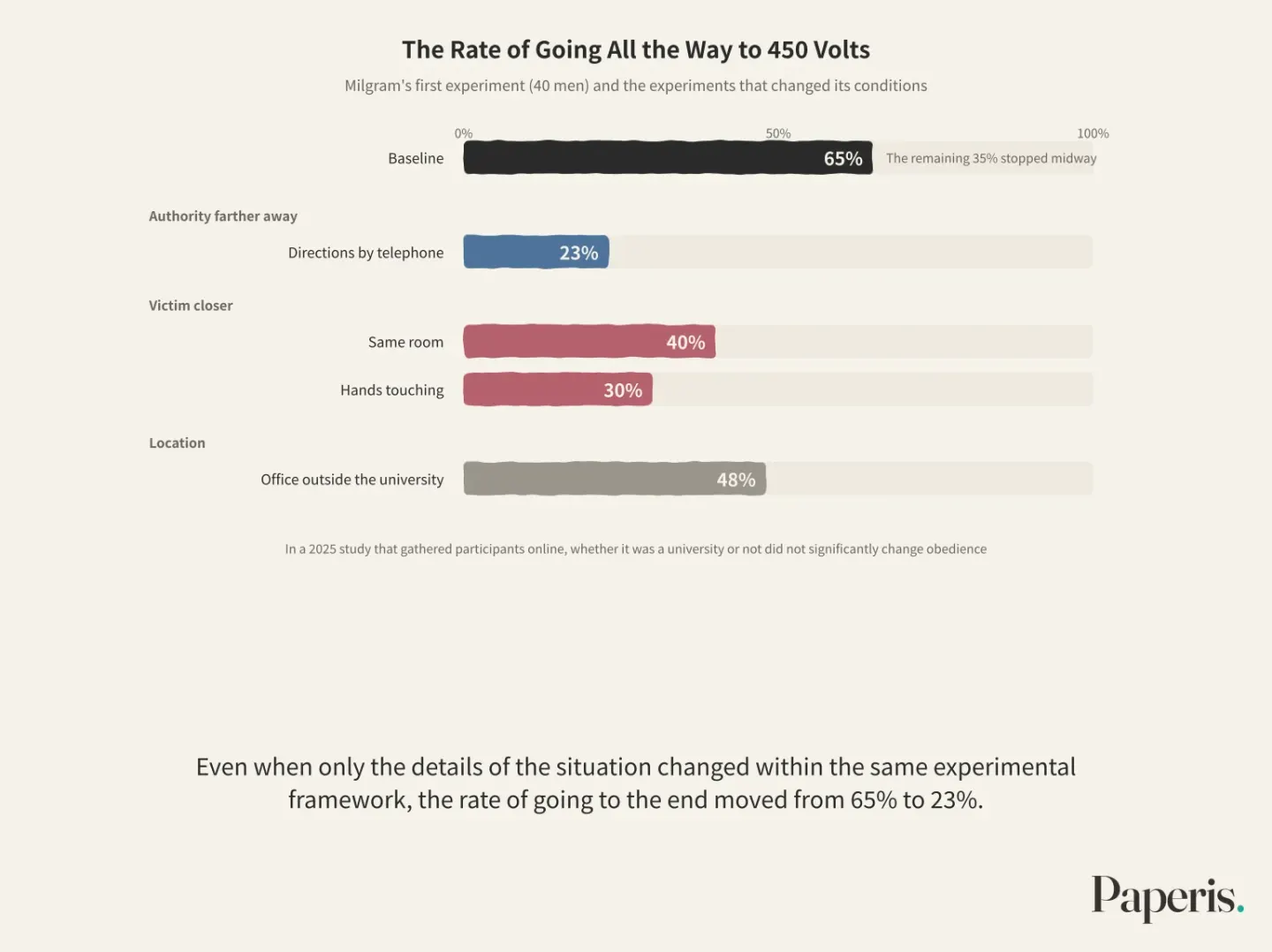
Obedience is changing behavior to match the directions of a person who holds authority. Among the 40 men Milgram first gathered, 65% delivered electrical shocks up to the highest level of 450 volts at the researcher's direction, even while the learner complained of pain. The learner was a person on the researcher's side so there were no actual shocks, and participants only knew it as an experiment helping with learning (OpenStax Psychology 2e 12.4). The remaining 35% rejected directions at some point and stopped midway.
Milgram repeated the experiment while changing the conditions. When the researcher gave directions by telephone, the rate of going all the way dropped to 23%. Making the victim close also dropped it. When their hands touched it was 30%, and when placed in the same room it was 40%. To put it with a rope, the further the hand of authority was, and the closer the victim's side hand was, the more the knot stopped at a different spot. When the location was moved to an office outside the university, it was 48% (OpenStax Psychology 2e 12.4). However, in a 2025 study that gathered participants online, whether it was a university or not did not significantly change obedience (PMID 40640447). Even when only the details of the situation changed within the same experimental framework, the rate of going to the end moved from 65% to 23%.
Milgram's experiment caused stress large enough to participants that it cannot be redone as is today (PMID 40640447). In 2006, psychologist Jerry Burger redid the experiment with 70 adults, but stopped at 150 volts where the learner first protests verbally. This is because 79% of the people who passed this point in Milgram's experiment went all the way. The obedience rate was only slightly lower than 45 years before, and there was no difference between men and women. Some evidence also emerged that an individual's empathy tendency and desire to control influenced the response (PMID 19209958).
Counterarguments were also attached to this partial replication. One researcher who participated in and watched Milgram's original experiment evaluated that this “light obedience” procedure stripped away a significant portion of the high-stress situation that had connected Milgram's results to destructive obedience in the real world. At the same time, this researcher viewed that the procedure opened paths to study the influence of situation and personality more broadly (PMID 19209962). A researcher who re-read Burger's data viewed that men's disobedience increased to nearly double that of the 1960s, and the actual increase might have been larger. However, that researcher also added that the influence of the situation remains strong, and wrote in the title that judgment is still premature (PMID 19209961). In 2025, obedience at a level similar to Milgram's came out even from participants gathered online (PMID 40640447). The hand cast by authority remained strong even decades later, and judgments are still divided on whether it has weakened even a little.
What Did Those Who Complied Believe?
Why did those who went all the way do so? The long-standing explanation is that in front of an authority figure, a person clings solely to their demands and becomes numb to the victim's plight. However, 40 participants who entered the virtual reality Milgram experiment read the correct answer words more forcefully to help the learner than comparison participants, and the authors concluded that this result refutes that explanation (PMID 30596731).
Another explanation focuses on the participants' goals. Looking at Milgram's records archived at Yale, the most prominent reaction in the participants' responses was that they were glad to have participated in the experiment. Researchers who put forward this interpretation argue that the experimenter made participants believe they were contributing to a progressive cause, and participants aligned themselves with that goal and complied (PMID 25196821).
There are counterarguments to that interpretation as well. Researchers who listened to 91 post-experiment interview recordings noted that it was rare for those who complied all the way to explain their behavior through identification with science. They gave various different reasons, such as accepting the situation as uncomfortable but not harmful and trusting the researcher (PMID 28653413). Researchers on both sides exchanged counterarguments even in 2018 (PMID 29527775; PMID 29468707). In a 2026 experiment that actually used weak electric shocks, how much one felt on the same side as the instructor did not change the refusal rate. In exploratory analyses, refusal moved together with several factors, such as how large one perceived one's personal responsibility to be and how one viewed authority (PMID 42174339).
Even though the explanations are divided, there is one commonality. Those who complied also had their hands on the rope. These are hands that interpret what the situation is, trust the researcher, and justify their own behavior.
Social psychologist Philip Zimbardo's Stanford prison experiment (1971), long used as evidence that "roles change people," is also being read anew. It appears that Zimbardo informed college students in the guard role in advance how they were expected to behave, and a study redone without such guidelines yielded different results. It also faced criticisms regarding ethics and generalization (OpenStax Psychology 2e 12.2).
The Line Called "Our Side"
Do sides form simply by dividing people into two groups based on meaningless criteria? An experimental framework published in the early 1970s by social psychologist Henri Tajfel and colleagues addresses this question (the same idea was put forward earlier in the 1960s by another researcher). When people were divided this way and asked to distribute rewards to other participants whose faces and names they did not know, people usually gave more to their own side (PMID 32672993). Although they had never met or quarreled, the moment the sides were split, a line called "our side" was drawn.
Ingroup bias is the tendency to view the group you belong to more favorably than other groups and to lean toward taking better care of it. The group you belong to forms a foundation of who you are and makes you feel good about yourself (OpenStax Psychology 2e 12.5).
This bias appears early. The author of a review gathered evidence that various forms of favoritism toward one's own side emerge from an early age simply by becoming a member of a group, and concludes that humans are strongly inclined toward favoring their own side from childhood (PMID 30119749). In an analysis pooling 20 studies involving 5,268 participants aged 3 to 19, children and adolescents were more cooperative toward their own side, but the difference was small and did not change with age (PMID 34212370).
Its size varies depending on situations and conditions. Children from groups with lower social status showed less favoritism toward their own side than children from groups with higher status (PMID 34744881). In one experiment, favoritism toward one's own side was distinct only when people were made to decide quickly through intuition, and disappeared when they decided while empathizing or reasoning through the matter. This is the result of a single experiment (PMID 33262734). The difference between fast and slow judgment is covered in "Thinking and Judgment — Familiar Tools, Scratches That Lean One Way".
Where Partisanship Hardens
The mind that divides into sides can be stacked in multiple layers. Stereotypes are beliefs held about a person based solely on the group they belong to, regardless of who they actually are. To put it simply, it is looking at the side a person stands on instead of their hands.
Prejudice is a negative attitude and feeling held toward a person based solely on the group they belong to. Discrimination is a negative action taken against a person because of the group they belong to. When the same structure tilts in a positive direction, it becomes the in-group favoritism we saw earlier (OpenStax Psychology 2e 12.5).
Textbooks cite learning from surroundings and the pressure of norms where prejudice is tolerated as reasons why prejudice persists in society (OpenStax Psychology 2e 12.5). The normative influence we saw earlier can operate here as well. However, some review articles note that in-group favoritism arising simply from belonging to a certain group cannot be explained by such rich learning (PMID 30119749). One review addressing gender stereotypes summarizes that gender stereotypes change the ways we pay attention to, interpret, and remember information about ourselves and others (PMID 28961059).
Ways to shrink it have also been researched. Direct encounters and relationships with people from other groups can reduce prejudice, and there are reports that even experiments having people imagine positive encounters improved attitudes toward the out-group (OpenStax Psychology 2e 12.5). In an analysis pooling 12 school programs incorporating encounters with people with disabilities, attitudes improved among children who met them directly, indirectly, or imagined encounters through guidance, whereas contact solely through media showed no evidence of an effect (PMID 27780687). There is also a classic 1961 study showing that when two opposing groups at a camp worked toward shared goals they had to accomplish together, prejudice toward each other decreased (OpenStax Psychology 2e 12.6).
Will No One Help If There Are Many People
When a young woman named Kitty Genovese was murdered in 1964, reports spread that none of the neighbors helped or even called the police. This incident served as a starting point for studying this phenomenon. Later on, it turned out the reports were partly false; that night, there was a neighbor who intervened and a friend who stayed by her side until the end (OpenStax Psychology 2e 12.6).
The bystander effect is the phenomenon where a person who sees an emergency situation steps in less when other people are nearby. In 1968, psychologists Latané and Darley described this phenomenon, and the explanation attached was that when there are many people, responsibility is scattered with the thought, "Someone else probably already did it" (OpenStax Psychology 2e 12.6).
A meta-analysis is a method that gathers the results of multiple studies addressing the same question and calculates them all together. In a meta-analysis gathering studies of over 7,700 participants from the 1960s to 2010, the bystander effect was clearly present. However, the effect grew weaker in situations where the danger was clear or the perpetrator was present, and in some dangerous situations, the effect did not appear at all (PMID 21534650).
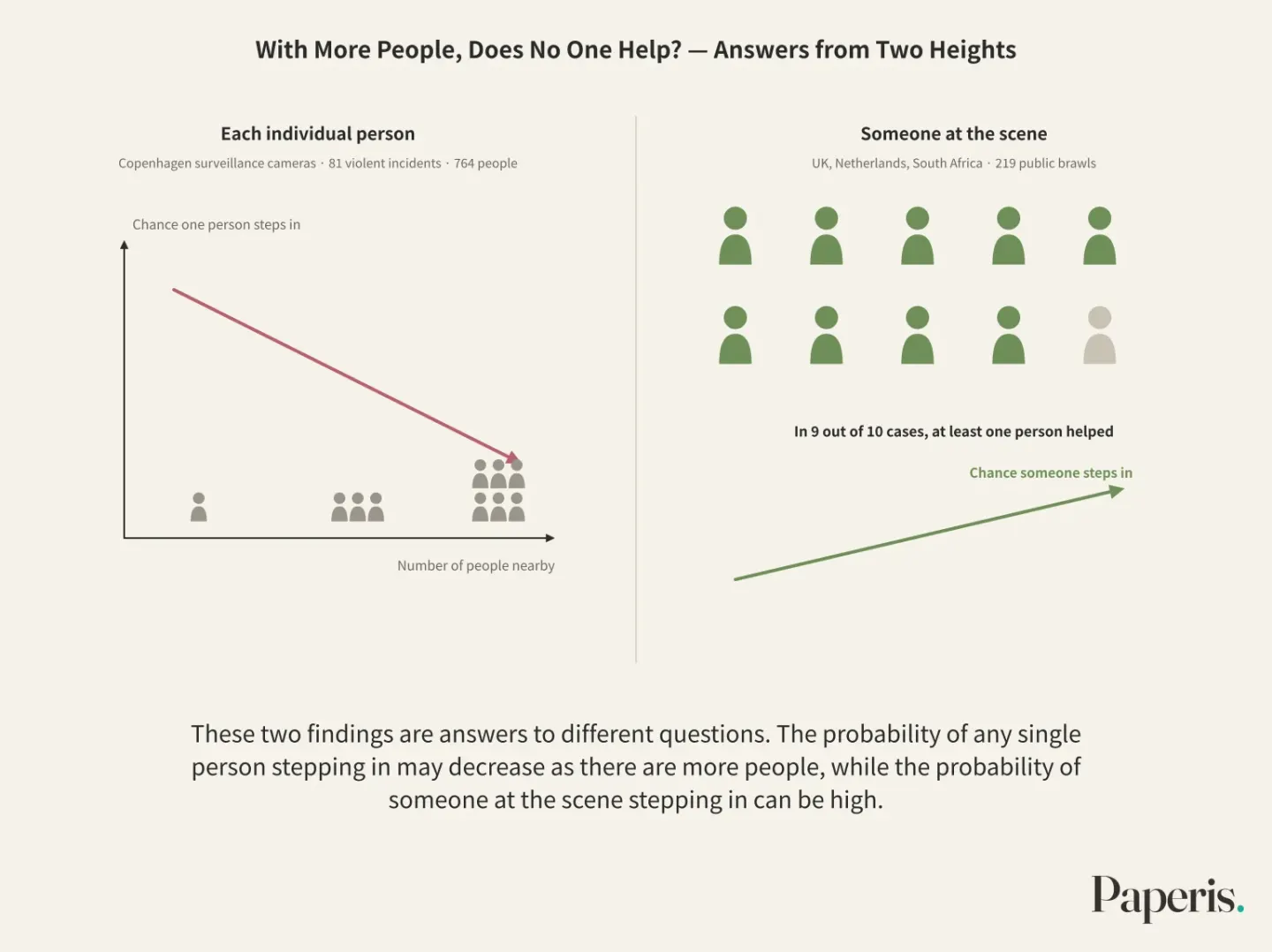
Real-world street footage shows this same phenomenon from two heights. In a study observing the behavior of 764 people across 81 violent incidents captured by surveillance cameras in Copenhagen, Denmark, the more people were nearby, the less each individual person stepped in. This was the opposite of the authors' expectation that the effect would be reversed because they were violent incidents. What had a greater influence than that was whether the person knew the victim or the perpetrator (PMID 31359450). In a study examining 219 public brawls in the UK, the Netherlands, and South Africa, at least one person—and usually multiple people—did something to help in 9 out of 10 cases. The ratios across the three countries were similar, and the more people were nearby, the higher the likelihood that someone would step in (PMID 31157529).
These two findings are answers to different questions. The probability of any single person stepping in may decrease as there are more people, while the probability of someone at the scene stepping in can be high. The authors of the second study wrote that these findings alleviate the widespread fear that help is rare (PMID 31157529).
Prosocial behavior is voluntary behavior intended to help others. Whether the reason people help others stems from empathy or ultimately from the benefits that return to oneself is difficult to tease apart with experiments, so the debate continues (OpenStax Psychology 2e 12.7).
One Person Standing Beside
In the experiments we saw earlier, let us place side by side just the scenes where one more person stands beside the knot.
In Asch's room, when even a single person gave an answer different from the group, conformity almost vanished (OpenStax Psychology 2e 12.4). In Burger's partial replication, the people who saw another participant refuse the instructions followed just as much as the people who did not see that sight (PMID 19209958). However, because the procedures of Milgram and Burger differed from each other in this condition, it is difficult to say clearly why such a result came out (PMID 19209960). In the bystander studies, the bystander effect decreased when the people standing nearby were not strangers (PMID 21534650), and in the street footage too, whether they were acquaintances acted more significantly than the number of people (PMID 31359450).
How much one person standing beside moved the knot differed from situation to situation. Who that one person was and what kind of place that spot was acted together.
Where the Line Drawing Cannot Reach
Line drawings have limits. A person is not a knot. They are the person who placed their hand on the rope, who chooses which hand's pull to follow, and who interprets for themselves what that situation means. One interpretation explained that Asch's participants answered while weighing two values together, and that Milgram's participants accepted the situation as harmless right after the experiment and trusted the researcher (PMID 16430326; PMID 28653413). Nor do the strengths of hands simply add up. Even in Asch's experiment, increasing the number of people in the group did not endlessly increase the people who followed (OpenStax Psychology 2e 12.4). Also, while tug-of-war is a game where two sides oppose each other, real groups sometimes pull on the same side in front of a goal to achieve together (OpenStax Psychology 2e 12.6).
The usefulness of the drawing lies in blocking two mistaken conclusions at once. One is the conclusion that the situation turns people into puppets. In Asch's experiment, about a quarter never followed along once, and in Milgram's experiment, 35% stopped midway. The other is the conclusion that personality is everything. When only the conditions changed within the same experimental framework, obedience moved from 65% to 23%, and what explained the day-to-day differences in the control room were the headcount and the workload.
The picture that nobody helps is also incorrect. In public-place altercations in three countries captured on security cameras, nine out of ten times, someone stepped in. However, the fact that the more people there were at the spot, the higher the likelihood that someone would step in is also the power of the situation.
The power of the situation is large, but even in the same situation, there were always people who did not follow along to the end. Remembering the hand on the unseen side when watching someone else's behavior, and knowing that my own hand is also caught in that rope, are the two perspectives this field gives.
Where to Look Further
Even now, explanations are divided as to why people followed in Milgram's experiment.
The criticisms poured onto the Stanford Prison Experiment are covered in detail by "What Did the Stanford Prison Experiment Show — The Critiques Raised Against the 'Situation Makes the Devil' Narrative". Cases where famous psychology experiments were run again only to find the effects shrank or failed to appear are followed by "Psychology's Replication Crisis — Why the Findings We Believed In Wobbled" and "The Shrinking Effect — Why Textbook Findings Get Smaller When You Measure Them Again". The story that attribution differs by culture connects to the question of who the experiment participants were, and that question is handled by "Who Was Being Measured — Who "People" Meant When Psychology Said It".
"Thinking and Judgment — Familiar Tools, Scratches That Lean One Way" covers the shortcuts of judgment and their biases, while "Learning — The Sound That Comes First, the Taste That Lingers" covers observational learning, where we learn by watching others.
Source Papers
- "Psychology 2e — 12.1 What Is Social Psychology?" (2020) — OpenStax Psychology 2e 12.1 — The scope of social psychology, behavior as the product of both situations and people, fundamental attribution error and informational differences, individualist/collectivist cultural differences, and a review of how some researchers' work is limited and conditional.
- "Psychology 2e — 12.2 Self-presentation" (2020) — OpenStax Psychology 2e 12.2 — Overview and critiques of the Stanford prison experiment (guard instructions, different results in uninstructed replications).
- "Psychology 2e — 12.3 Attitudes and Persuasion" (2020) — OpenStax Psychology 2e 12.3 — Definition of attitudes, cognitive dissonance and ways to reduce it (theory), definition of persuasion and its source, message, and audience.
- "Psychology 2e — 12.4 Conformity, Compliance, and Obedience" (2020) — OpenStax Psychology 2e 12.4 — Asch's experiment 76%, majority size, 1 dissenter, private answers, normative/informational influence, Milgram's 65% and variations (48%, 40%, 30%, 23%), groupthink.
- "Psychology 2e — 12.5 Prejudice and Discrimination" (2020) — OpenStax Psychology 2e 12.5 — Distinguishing stereotypes, prejudice, and discrimination, in-group bias, social learning and norms, contact and imagined contact.
- "Psychology 2e — 12.6 Aggression" (2020) — OpenStax Psychology 2e 12.6 — Bystander effect (1968), inaccuracy of the Genovese reports, diffusion of responsibility, a 1961 study where shared goals reduced intergroup prejudice.
- "Psychology 2e — 12.7 Prosocial Behavior" (2020) — OpenStax Psychology 2e 12.7 — Definition of prosocial behavior, ongoing debate between empathy and self-interest.
- "Psychology 2e — 1.3 Contemporary Psychology" (2020) — OpenStax Psychology 2e 1.3 — Following the Eichmann trial, most psychologists at the time believed few people would inflict great harm simply on command.
- "Human- Versus System-Level Factors and Their Effect on Electronic Work List Variation: Challenging Radiology's Fundamental Attribution Error." (2015) — PMID 26006745 — The number of CT scans awaiting reading is mostly explained by system factors (number of trainees, workload), individual productivity accounts for 3% of the variance, and 8 out of 12 radiologists attribute it to individual effort.
- "The fundamental attribution error as Institutional Stance neglect." (2026) — PMID 42755197 — The bias toward person-centered explanations appears to happen automatically, but cultural factors play a role.
- "A nonconformist account of the Asch experiments: values, pragmatics, and moral dilemmas." (2006) — PMID 16430326 — A value-pragmatic interpretation that Asch participants mixed dissent and agreement to simultaneously fulfill multiple values like truth and social solidarity.
- "A meta-analysis of longitudinal peer influence effects in childhood and adolescence." (2021) — PMID 34855429 — 60 papers and 233 effect sizes: peer influence is small but significant and robust, and does not differ by behavior type or age.
- "Doubting the power of prestige: obedience to authority beyond institutional and research justifications." (2025) — PMID 40640447 — Direct Milgram-style replications are ethically impossible; online recruitment and computer-linked devices show obedience levels similar to Milgram's, with location and framing having no effect.
- "Replicating Milgram: Would people still obey today?" (2009) — PMID 19209958 — Partial replication with 70 people at 150 volts; obedience rates are only slightly lower than 45 years ago, rejection models do not reduce obedience, and there are no sex differences.
- "Obedience lite." (2009) — PMID 19209962 — Commentary by an original experiment participant: the partial replication largely removed the stressful situations that made Milgram's results applicable to actual destructive obedience.
- "Change over time in obedience: The jury's still out, but it might be decreasing." (2009) — PMID 19209961 — In Burger's data, male disobedience has nearly doubled since the 1960s, but a verdict is still premature.
- "Reflections on "Replicating Milgram" (Burger, 2009)." (2009) — PMID 19209960 — The rejection model condition had different procedures than Milgram's, making the results hard to explain clearly.
- "Participant concerns for the Learner in a Virtual Reality replication of the Milgram obedience study." (2018) — PMID 30596731 — Virtual reality with 40 people, participants tried to help the learner, and the authors conclude that the agentic state explanation is refuted.
- "'Happy to have been of service': the Yale archive as a window into the engaged followership of participants in Milgram's 'obedience' experiments." (2015) — PMID 25196821 — A prominent feature of participant responses is joy in participation, interpreted as the product of persuasion that they are contributing to a progressive task.
- "Normalizing trust: Participants' immediately post-hoc explanations of behaviour in Milgram's 'obedience' experiments." (2017) — PMID 28653413 — 91 interview recordings: participants who complied did not explain it through identification with science, but normalized the situation as harmless and gave various reasons.
- "Multiple compliant processes: A reply to Haslam and Reicher on the engaged followership explanation of 'obedience' in Milgram's experiments." (2018) — PMID 29527775 — Counterargument that obedience can be explained in multiple ways, and engaged followership is one of them.
- "A truth that does not always speak its name: How Hollander and Turowetz's findings confirm and extend the engaged followership analysis of harm-doing in the Milgram paradigm." (2018) — PMID 29468707 — Rebuttal that the interview data do not contradict the engaged followership explanation.
- "The effect of experimenter identification on (dis)obedience and its mechanisms." (2026) — PMID 42174339 — In a real low-shock experiment, experimenter identification did not change disobedience rates; disobedience was associated with multiple factors such as responsibility ratings and authority-related values.
- "The origins of the minimal group paradigm." (2020) — PMID 32672993 — Tajfel et al.'s minimal group experiments in the early 1970s: dividing people into meaningless categories still usually leads to in-group favoritism in reward distribution.
- "Mere Membership." (2018) — PMID 30119749 — Evidence that various in-group biases develop from an early age simply through mere group membership, leading the author to conclude that humans have a strong inclination toward in-group favoritism.
- "Does parochial cooperation exist in childhood and adolescence? A meta-analysis." (2021) — PMID 34212370 — 5,268 participants aged 3–19 across 20 papers: greater cooperation with the in-group (d = 0.22, small), with no differences across age.
- "Racial Categorization and Intergroup Relations in Children: The Role of Social Status and Numerical Group Size." (2021) — PMID 34744881 — Children from low-status groups show less in-group favoritism than children from high-status groups.
- "Time Pressure and In-group Favoritism in a Minimal Group Paradigm." (2020) — PMID 33262734 — In minimal groups, in-group favoritism is pronounced only under intuitive conditions, and disappears under empathy and rational deliberation conditions.
- "Gender Stereotypes." (2018) — PMID 28961059 — Gender stereotypes influence attention, interpretation, and memory regarding information about oneself and others.
- "Interventions utilising contact with people with disabilities to improve children's attitudes towards disability: A systematic review and meta-analysis." (2017) — PMID 27780687 — 12 papers: direct contact (d = 0.55) and extended contact (d = 0.61) improve children's attitudes toward disability, while media contact shows no evidence of an effect.
- "The bystander-effect: a meta-analytic review on bystander intervention in dangerous and non-dangerous emergencies." (2011) — PMID 21534650 — 105 effect sizes involving over 7,700 people, bystander effect g = -0.35, which weakens in dangerous situations and when a perpetrator is present, and decreases when bystanders are not strangers.
- "Social relations and presence of others predict bystander intervention: Evidence from violent incidents captured on CCTV." (2019) — PMID 31359450 — 81 incidents and 764 people in Copenhagen: the classic bystander effect is confirmed, but the effect of social relationships is larger than the number of bystanders.
- "Would I be helped? Cross-national CCTV footage shows that intervention is the norm in public conflicts." (2020) — PMID 31157529 — 219 incidents across the UK, Netherlands, and South Africa: at least one person helps in 9 out of 10 cases, similar across all three countries, and a larger number of bystanders increases the likelihood that someone will intervene.
Sources (33)
- Psychology 2e — 12.1 What Is Social Psychology?
- Psychology 2e — 12.2 Self-presentation
- Psychology 2e — 12.3 Attitudes and Persuasion
- Psychology 2e — 12.4 Conformity, Compliance, and Obedience
- Psychology 2e — 12.5 Prejudice and Discrimination
- Psychology 2e — 12.6 Aggression
- Psychology 2e — 12.7 Prosocial Behavior
- Psychology 2e — 1.3 Contemporary Psychology
- Human- Versus System-Level Factors and Their Effect on Electronic Work List Variation: Challenging Radiology's Fundamental Attribution ErrorPMID 26006745
- The fundamental attribution error as Institutional Stance neglectPMID 42755197
- A nonconformist account of the Asch experiments: values, pragmatics, and moral dilemmasPMID 16430326
- A meta-analysis of longitudinal peer influence effects in childhood and adolescencePMID 34855429
- Doubting the power of prestige: obedience to authority beyond institutional and research justificationsPMID 40640447
- Replicating Milgram: Would people still obey today?PMID 19209958
- Obedience litePMID 19209962
- Change over time in obedience: The jury's still out, but it might be decreasingPMID 19209961
- Reflections on \PMID 19209960
- Participant concerns for the Learner in a Virtual Reality replication of the Milgram obedience studyPMID 30596731
- 'Happy to have been of service': the Yale archive as a window into the engaged followership of participants in Milgram's 'obedience' experimentsPMID 25196821
- Normalizing trust: Participants' immediately post-hoc explanations of behaviour in Milgram's 'obedience' experimentsPMID 28653413
- Multiple compliant processes: A reply to Haslam and Reicher on the engaged followership explanation of 'obedience' in Milgram's experimentsPMID 29527775
- A truth that does not always speak its name: How Hollander and Turowetz's findings confirm and extend the engaged followership analysis of harm-doing in the Milgram paradigmPMID 29468707
- The effect of experimenter identification on (dis)obedience and its mechanismsPMID 42174339
- The origins of the minimal group paradigmPMID 32672993
- Mere MembershipPMID 30119749
- Does parochial cooperation exist in childhood and adolescence? A meta-analysisPMID 34212370
- Racial Categorization and Intergroup Relations in Children: The Role of Social Status and Numerical Group SizePMID 34744881
- Time Pressure and In-group Favoritism in a Minimal Group ParadigmPMID 33262734
- Gender StereotypesPMID 28961059
- Interventions utilising contact with people with disabilities to improve children's attitudes towards disability: A systematic review and meta-analysisPMID 27780687
- The bystander-effect: a meta-analytic review on bystander intervention in dangerous and non-dangerous emergenciesPMID 21534650
- Social relations and presence of others predict bystander intervention: Evidence from violent incidents captured on CCTVPMID 31359450
- Would I be helped? Cross-national CCTV footage shows that intervention is the norm in public conflictsPMID 31157529