
Paperis Articles
Thinking and Judgment — Familiar Tools, Scratches That Lean One Way
We follow concepts and schemas that sort what we meet, algorithms that try every step and heuristics that take shortcuts, the environments where shortcuts work and the biases that err in one direction, problem solving stalled by familiar uses, how the format of information changes judgment, and the fast-and-slow picture of thinking along with its replication record.
Your field's papers, as audio
Pick your fields and journals — Paperis summarizes the key papers and turns them into audio. Listen on your commute.
Start Paperis free →Thinking and Judgment — Familiar Tools, Scratches That Lean One Way
Multiplying from Eight, Multiplying from One
Estimate this in five seconds. What is 8×7×6×5×4×3×2×1? You do not have time to multiply all the way to the end, so you multiply a few of the front ones and guess the answer.
If you flip the same multiplication and show it as 1×2×3×4×5×6×7×8, the answer changes. In a 1973 report where people were asked to estimate within a short time, the median answer called out by those who saw the large numbers first was 2,250, while those who saw the small numbers first answered 512. The correct answer is 40,320, so both sides fell far short. To our knowledge, no one had re-measured this result for 50 years, and when it was first re-measured, the same bias appeared in 253 American adults (PMID 39825174).
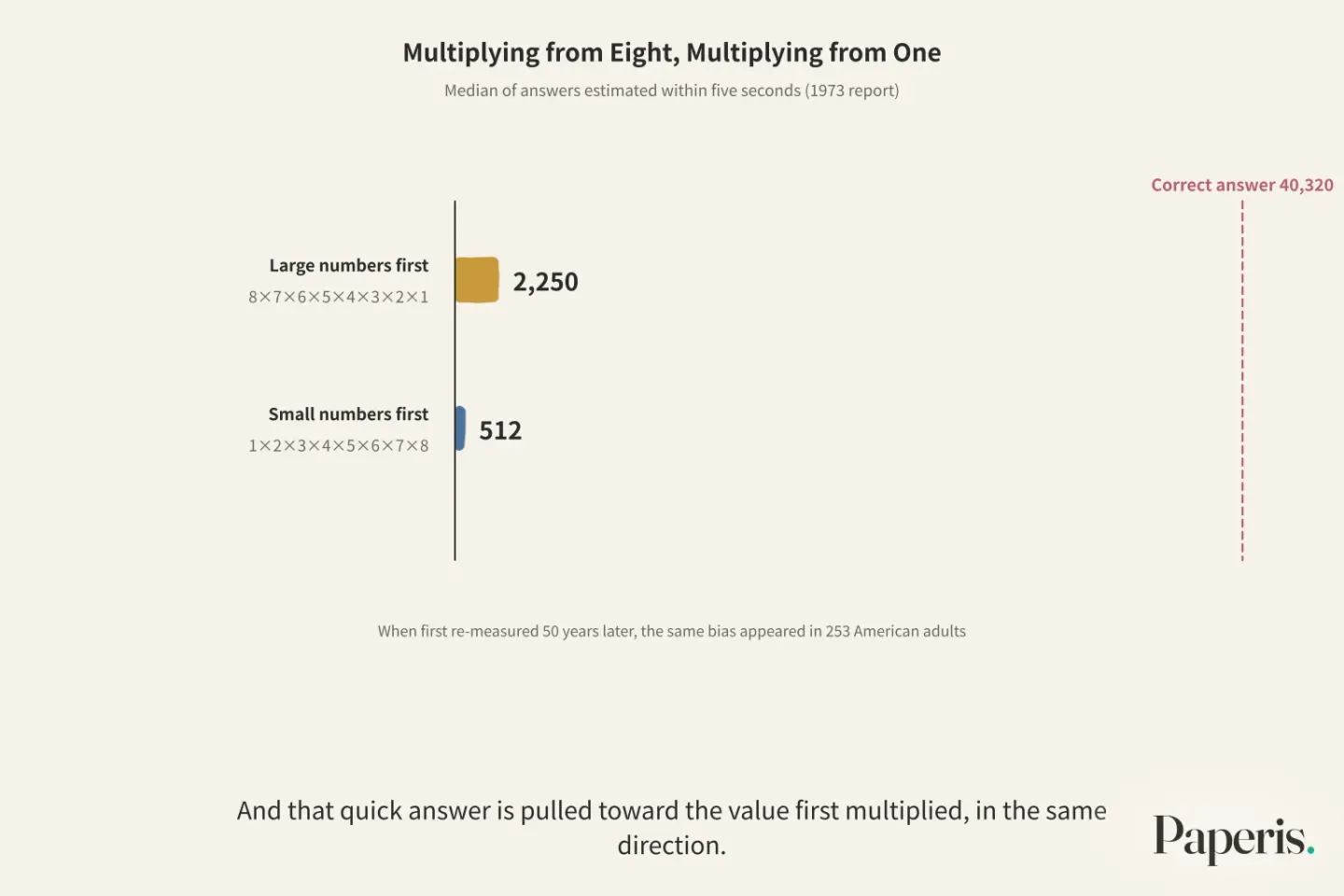
Two facts are contained together here. People manage to produce an answer in a few seconds somehow. And that quick answer is pulled toward the value first multiplied, in the same direction.
This article follows those two. The skill of producing answers quickly, and the consistent bias that skill leaves behind. If we compare thinking to a toolbox, we will not lose our way. It is a toolbox that looks at a task to figure out what it is, pulls out a familiar tool first to knock it out quickly, and occasionally leaves dents on the same side because the tool does not fit the task.
What Kind of Job This Is
Let us suppose you pushed open the door of a noodle shop in a neighborhood you are visiting for the first time. No one tells you how, but you know how to find a seat, look at the menu, place an order, and pay after you finish eating. Quite a lot of things pass through your mind even during these few seconds.
Cognition is the process of thinking that encompasses noticing, knowing, judging, solving problems, using language, and remembering. Much of that process happens without us even noticing it (OpenStax Psychology 2e 7.1).
A concept is what is used the moment you step into the shop and recognize, "This is a restaurant." A concept is a bundle of thoughts that groups different things together by their commonalities under a single name. Even for a shop you are seeing for the first time, if it falls into the group called "restaurant," you can immediately pull out and use what you already know about that group (OpenStax Psychology 2e 7.1). If we compare it to a toolbox, it is the eye that recognizes what kind of job this is before pulling out a tool.
Even within a bundle, there are things that are more representative of that bundle. A prototype is the example that first comes to mind when thinking of a concept and best represents that concept. Just as everyone has a different shop that first comes to mind when they think of a "noodle shop," which example becomes the prototype differs from person to person, and the experiences they have gone through often determine this (OpenStax Psychology 2e 7.1).
At least two ways of putting something into a group have been studied. One is checking whether it fits a set of predetermined rules, and the other is comparing how similar it is to examples or prototypes you already know. The two methods appear to rely on different memory systems as well (PMID 17904637). The skill of grouping by similarity comes up again later as a shortcut in judgment.
Knowing the sequence from looking at the menu to placing an order is thanks to a framework larger than a single concept. A schema is a framework in which related concepts are woven together into a single mass, allowing us to anticipate what is there and what will happen in a given situation. If that noodle shop happens to be a place where you pay first and then sit down, you would sit down and wait for a long time for someone to come take your order. The guess that made things fast by filling in the blanks no one told you about ends up missing the mark when the shop is different (OpenStax Psychology 2e 7.1). Such a sequence framework ingrained in the body at a noodle shop can be difficult to change once it hardens (OpenStax Psychology 2e 7.1).
One reason thinking is fast lies in putting even unfamiliar things into known groups and filling in the blanks with guesses. The places where it misses the mark are those very guesses.
Two Paths to Finding a Solution
Let's say you forgot the three-digit combination for your travel suitcase. Problem-solving is the work of figuring out what the problem is and choosing a way to solve it to find the answer (OpenStax Psychology 2e 7.3). Here, the problem is clear: you need to find the three digits.
The first path is to turn the dial from 000 to 999 in order. Eventually, it will definitely open. An algorithm is a problem-solving method that leads to the same answer every time if you follow set steps in order without missing any (OpenStax Psychology 2e 7.3). Instead of a guaranteed answer, if you are unlucky, you might have to turn it a thousand times.
The second path is to try birthdays or frequently used numbers first. Heuristics are mental shortcuts that let you get an answer quickly without checking every case. They are fast, but they do not guarantee the best answer (OpenStax Psychology 2e 7.3). Heuristics discard part of the information in hand and make decisions using only a few clues (PMID 22577307).
To use a toolbox analogy, an algorithm is trying every single number one by one, and a heuristic is picking up the tool you are most used to first. The reason shortcuts are fast lies in the information they throw away.
When the Short Cut Is the Right Path
Doctors and patients also use simple short cuts when making decisions (PMID 22577307). Rules where you branch down based on a few questions are an example of this. The format goes: if the first question is "yes," go this way; if "no," go to the next question. There are conditions where these simple heuristics predict as well as, and sometimes more accurately than, more complex models (PMID 35778774). In medical diagnosis, heuristics are sometimes better than methods like regression that cram in all the information, and they come with the advantages of being transparent, fast, and inexpensive (PMID 22577307).
A 1974 paper that summarized three short cuts together says the same thing. It noted that the three heuristics are very economical and usually effective, but lead to systematic and predictable errors (PMID 17835457). Short cuts are usually right, and when they are wrong, they err in the same direction.
There is a side that examines when they are right. Ecological rationality is a perspective that views certain environments as uniquely suited for specific short cuts to work well, evaluating the goodness or badness of a judgment together with the environment in which that judgment is placed. From this perspective, experts like athletes and doctors are seen as learning to pick and choose short cuts to fit the situation, thereby making accurate decisions (PMID 26579051). To use the analogy of a toolbox, the value of a tool can only be assessed by pairing it with the job at hand.
Flaws Made in the Same Direction
We return to the multiplication story. Both groups' answers were wrong, but the wrong direction was fixed. Bias is the tendency for judgments to lean and go wrong in the same direction under the same conditions. The 1974 paper pointed to three shortcuts that produce such leaning: adjusting from an anchor, how easily things come to mind, and similarity (PMID 17835457).
The first is what we saw in multiplication. The anchoring effect is a phenomenon where estimates following an initially encountered baseline value are pulled excessively. In the multiplication problem, the value obtained by multiplying the first few numbers serves as that baseline. Even when the same people were shown both orders, the leaning remained relatively solid. When the value of multiplying 1 through 6 was shown first, the leaning decreased, and when the value of multiplying 1 through 10 was shown, it disappeared. People with good estimation skills tended to be less swayed by some of the leaning (PMID 39825174). The effect of high anchors producing high estimates appeared identically in people just woken up in the middle of the night and people during the day, and a half-asleep state did not increase the leaning (randomly assigned 104 people) (PMID 36255063).
The second is how easily things come to mind. The availability heuristic is a shortcut that gauges how common or likely an event is based on how easily examples of it come to mind (PMID 17835457). When 13 male names and 13 female names were played mixed together, but famous people's names were put on only one side, people estimated that there were more names on the side containing the famous people. In this experiment measuring Canadian college students, the magnitude of the leaning was medium to large (PMID 9121143). The faster past events came to mind, the higher people rated the probability of similar events happening in the future (PMID 1460558).
When 5,783 people in Germany in the spring of 2020 were asked about the probability that they would fall ill enough to endanger their lives from COVID-19 within the next 12 months, the average answer was 26%, vastly exceeding the actual risk (PMID 37099172). A review analyzing this gap lists the nature of the risk—being new, unfamiliar, and hard to control—along with reporting skewed toward individual stories, together with the availability and anchoring heuristics as causes, and views that these may have played a part in the overestimation (PMID 37099172).
The third is similarity. The representativeness heuristic is a shortcut that gauges the probability that a target belongs to a category based on how much it resembles the typical appearance of that category. When eyes go to similarity, statistical information such as how large the sample is gets glossed over (PMID 38752479). This can be seen as the skill of comparing against a prototype, which we saw earlier, crossing over into the seat of judging probabilities. When nine classic problems from 1972 were re-administered with pre-registered plans to 623 online participants, eight replicated (PMID 38752479).
The leaning left by anchoring and similarity appeared again even when measured anew. The leaning from how easily things come to mind was confirmed in a smaller number of experiments—namely, the name experiment and recall experiment from earlier. Flaws that occur when a tool does not fit the job usually gather in the same place.
Scratches Outside the Laboratory
There is a business case problem modeled after the launch decision of the U.S. space shuttle Challenger. We had 290 professional graduate students solve this problem without advance notice, and secretly observed whether they chose the inferior solution on the side that merely confirmed hypotheses (PMID 31347444).
This pull toward that solution also has a name. Confirmation bias is the tendency to notice information that supports what we already believe and to pay less attention to information that contradicts it (OpenStax Psychology 2e 7.3; OpenStax Psychology 2e 2.3). Applied to the Challenger case, it means forming a hypothesis and then picking the review on the side that will confirm it first (PMID 31347444).
People who received a brief training to reduce this bias in that business case beforehand were 19% less likely to choose the confirmatory-only solution than those who had not yet received it (PMID 31347444). The authors view these results as promising evidence that training effects transfer outside the laboratory (PMID 31347444). In an experiment measuring most of the national risk analysts in a European country, the analysts showed less confirmation bias than master's students they were compared with, and both groups showed reductions after a single training session (PMID 41286330).
The same blemishes are reported in clinics. In a systematic review pooling 20 studies involving 6,810 physicians, traits such as overconfidence, anchoring, framing and availability bias, and intolerance of ambiguity were associated with diagnostic inaccuracy in 36.5 to 77% of case scenarios. However, most of the studies (60%) were of low quality (PMID 27809908). Another review scanning heuristics in medicine notes that while heuristics are generally positive, it concludes that we still do not know whether the gains or losses are greater in medical practice (PMID 32409947).
In the nursing field, such evidence is still thin. Among 77 papers addressing nurses' judgment biases, only 5 studies tested interventions, and 61 relied on hypothetical cases, questionnaires, or recall instead of actual practice (PMID 35696809). Biases are visible outside the laboratory as well, and studies measuring methods to reduce them in the field are only just beginning to accumulate.
Blocked Solutions
You are given a candle, a box of thumbtacks, and a book of matches, and asked to attach the candle to the wall. The problem is solved by emptying the box of thumbtacks and using it as a holder. When the box is given full of thumbtacks, people fail to use the box as a holder or take longer to do so, whereas they solve it better when given an empty box (PMID 11206213).

Illustration: Paperis
Functional fixedness is the inability to see an object for anything other than its usual use, failing to think of other uses (OpenStax Psychology 2e 7.3). To put it in terms of a toolbox, the name tag attached to a tool ties your hands. This blockage appears to stem from knowledge about the object's use. In a mechanical puzzle experiment, misleading knowledge of use appeared as the core of functional fixedness (PMID 29986207). In a similar candle task, 6- to 7-year-old children who first saw the box used for holding took longer to use it as a holder, but 5-year-old children showed no such difference, and in the condition where they first saw the holding use, they actually solved it better than the 6- to 7-year-old children (PMID 11206213). Even in chimpanzees, after using a tool for one use, they solved problems requiring a different use less efficiently, and that effect remained even 9 months later (PMID 38802445).
Limits to the magnitude of this blockage are also reported. In the same mechanical puzzle experiment, functional fixedness created a dead end for easy puzzles but played no role in difficult puzzles, and the authors concluded that its impact is more limited than previously thought (PMID 29986207).
Functional fixedness is a branch of a broader blockage. A mental set is continuing to cling to a problem-solving approach that worked before even when it no longer works now (OpenStax Psychology 2e 7.3). After having people solve multiple practice problems that are solved in the same way and then giving them a problem where that method does not work, people get stuck. In an experiment that measured brainwaves, when a new problem resembled the practice problems, even the signal of experiencing conflict was not distinct, and it was closer to repeatedly confirming the ineffective method (PMID 35751854). A familiar tool reaches your hand first even in front of a job it does not fit.
Same Problem, Different Shape
111 medical students looked at four common medical situations and calculated the actual probability of having a disease when a test is positive. The study changed whether the same information was given as a probability (%) or as a frequency ("how many out of how many"), and whether it was given only in text or as a branching tree diagram (PMID 33599875).
The median time taken for one correct answer was 2 minutes 55 seconds with the frequency tree diagram, 5 minutes 47 seconds with the probability tree diagram, 4 minutes 13 seconds in the text-only frequency version, and 9 minutes 59 seconds in the text-only probability version (PMID 33599875). Only the shape changed for the same problem, but the speed and accuracy of judgment changed together.
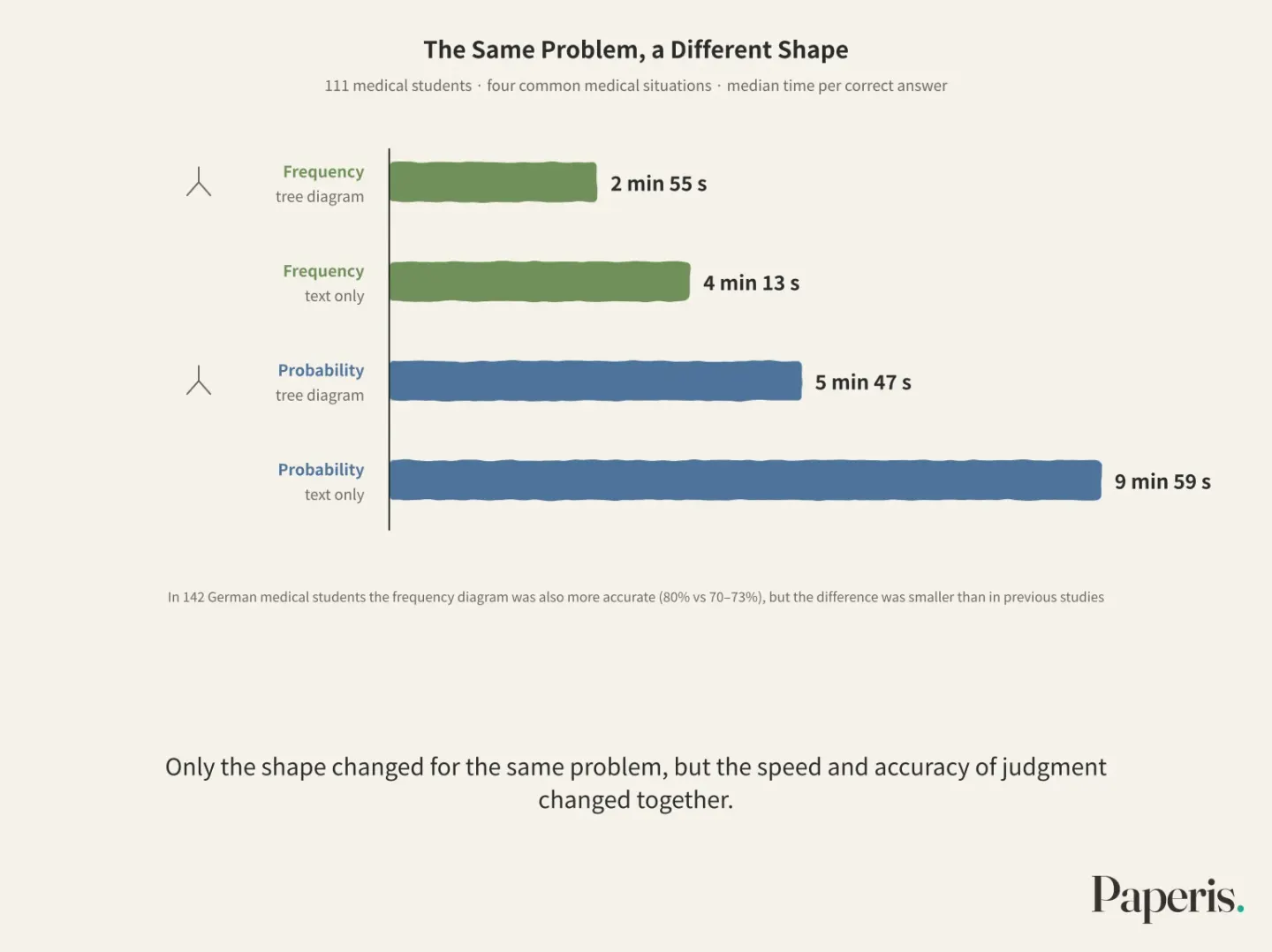
A frequency-drawn diagram was also more accurate and faster for 142 students from several German medical schools (accuracy for the frequency diagram was 80%, and for the probability diagram, 70–73%). However, the difference between probability and frequency was smaller than in previous studies, and the authors note that these students solved problems quite well even with the probability diagram (PMID 35321028).
There are also conditions under which the effect appears. Working memory is the memory temporarily held in mind to use right now. One experiment found that the help of the frequency format appeared only in people with sufficient working memory capacity (PMID 32477216), and another experiment showed that while the frequency format reduced overestimation in young participants, participants aged 60 and older did not seem to be affected by the format, nor did the format reduce the error of missing base rates (PMID 27410053). A recent review sees the frequency format as one of the scaffolding supports that helps beginners easily grab the right tool, noting that people who are trained or numerate can be accurate even with the probability format (PMID 42608634).
To use an analogy of lingering muscle aches, this is a scene where changing the shape of the task made a familiar tool fit right in. How accurate a judgment is does not reside only inside a person, but also depends on what shape the information arrives in.
The Picture of Fast and Slow Thinking
Educators who teach clinical reasoning in intensive care units use a two-pronged framework of fast intuition and slow analysis (PMID 32450242). This framework also has a name. Dual-process theory is a theory that explains thinking by dividing it into two tracks: a fast, automatic process and a slow, effortful process (PMID 18154502).
A review on diagnostic errors reports that the fast side works well in most cases but can also become a door through which bias enters, and cites fatigue, sleep deprivation, and cognitive overload as important conditions (PMID 23882089). However, in the experiment we saw earlier, waking up in the middle of the night did not amplify the anchoring effect (PMID 36255063). Fast thinking is usually correct. If you boil it down to "intuition is bad and deliberation is good," this half disappears.
There are also criticisms of this picture. A review surveying these theories points out that unconscious processes are not of a single type, and that the proposed characteristics do not neatly divide into two systems (PMID 18154502). A 2025 review examining dual-process accounts of moral judgment concluded that the evidence relies on untested assumptions, producing experiments that cannot falsify the theory, and that the evidence is meager or ambiguous (PMID 41594961). The frequency experiment earlier also failed to support the explanation that frequency formats summon slow thinking (PMID 27410053).
The two-track picture is a picture that divides the toolkit into two compartments: a fast compartment and a slow compartment. While it is useful for explaining thought, whether the actual toolkit is divided into just those two compartments is still under debate.
Measured Again
The anchoring effect and the representativeness heuristic we saw earlier showed up again when measured anew. Not all "effects" do. Behavioral priming research, which suggests that stimuli like colors, smells, sounds, and words touch thoughts in the mind and change subsequent behavior, is one such example. It was once counted as one of the core forces shaping automatic behavior, but soon several representative findings failed to replication (PMID 28769846).
A meta-analysis is a method that gathers the results of multiple studies tackling the same question and calculates them all together. In a meta-analysis gathering 246 experiments that looked at whether thoughts, emotions, and behaviors change after showing money-related stimuli, the overall effect came out significant, but there was a strong possibility of publication bias where only studies finding an effect got published. The largest effect was in laboratory studies where participants directly touched money, and the authors wrote that pre-registered replication studies with sufficiently large scales were needed (PMID 30973262). An experiment that looked at how people react to a partner's hypothetical betrayal after reminding them of commitment to the partner showed almost no effect in the results when repeated 16 times using the same pre-registered procedure. However, because the manipulation of reminding them of commitment itself did not work as intended, this replication could not judge whether the original claim was right (PMID 27694468).
There are counterarguments as well. The claim is that since priming effects naturally vary depending on the details of the original experiment and the participants, and with no theory yet to explain those conditions, failures to replicate do not tell us much right now. The same author also wrote that priming researchers have not fulfilled their responsibility to replicate and show their own effects themselves (PMID 26173239).
The skews left by the first two shortcuts are on the side that shows up again when measured anew, while the behavioral priming claim that manipulations like showing or touching money and reminding people of something change subsequent behavior is on the side that wobbled as several representative findings failed replication and publication bias was suspected. Bundling the two together to say "People are easily manipulated by small stimuli" mixes solid evidence with wobbled evidence. Even for the replicated side, the people measured were mostly Canadian university students, online participants, and American adults (PMID 9121143; PMID 38752479; PMID 39825174).
Are People Irrational?
Two sides have long argued over this question. After reviewing counterarguments that the task was inappropriate or that participant answers were misinterpreted, a 2002 review found that those counterarguments did not significantly shake the conclusion that "people frequently violate the principles of rationality in undesirable ways" (PMID 11752494).
The other side consists of researchers advocating for ecological rationality. Viewing the mind as a toolbox fitted to the structure of the environment, they argue that many of the things called biases and errors are the result of narrow criteria and artificial experimental setups. A 2015 review found that this counterargument also has flaws. The fact that a shortcut was evolutionarily useful and the fact that this current judgment is correct are different stories, but there are cases where the two are mixed (PMID 25467781).
Neither side alone captures all the evidence examined in this article. The anchoring and representativeness skews appear again when measured again, and biases are visible in the clinic as well. The same shortcuts are usually correct, and skews are reduced depending on the shape of information and training. Shortcuts take little effort and are usually effective, but they can also lead to systematic errors (PMID 17835457), and under certain conditions they are as accurate as more complex methods with less effort (PMID 35778774). The ecological rationality side looks for that divide in the environment where the shortcut is placed (PMID 26579051). Not only did training reduce the skews, but results also appeared to vary depending on individual differences such as heuristic ability, working memory, and age.
Does Language Shape Thought?
Earlier, we grouped a store we were seeing for the first time under the name "restaurant." So does the language we use entirely determine our thoughts? This strong claim became known alongside the names of Sapir and Whorf, but it has been criticized as excessively absolute and lacking empirical evidence (OpenStax Psychology 2e 7.2).
There is also research supporting the weaker version. One research team gathered results from their neurolinguistic studies showing that linguistic distinctions are connected to perceptual and conceptual processing, arguing that language shapes thought (PMID 27642191). Many hold the view that geographical concepts like mountains or cities are divided much more differently depending on language and culture than concepts in other fields, while task load, a person's expertise, and their living environment also influence them together (PMID 39055988). This means that the boundaries of the "bundles" we saw earlier can vary depending on language and culture.
This question returns to the research itself. There is a review article noting that because many of the people studied in cognitive science and the people doing the research are English speakers, the tendency arises to extrapolate the characteristics of English to the characteristics of all people (PMID 36253221). The evidence that language "determines" thought is weak, and there is research showing that language "can influence" thought.
Where the Toolbox Analogy Does Not Reach
The toolbox analogy has limits. It is not a scene where tools sit separately in your head and someone looks at a job and picks one out. Much of thinking happens before we notice (OpenStax Psychology 2e 7.1), so the act of choosing is usually not a conscious choice either. The boundary between the fast box and the slow box is also not as sharp as the picture suggests. Moreover, the toolbox is a metaphor used by researchers on the side of ecological rationality when explaining the mind (PMID 25467781), so we cannot judge whether "are people irrational?" based on this analogy alone. We must not read intuition as a "bad tool."
To sum it up: thinking groups even unfamiliar things into concepts to recognize them, and fills in blanks beforehand with schemas. When faced with a problem, rather than treading every single case, it uses shortcuts, and those shortcuts are usually right—and in the right environment, they are as accurate as complex calculations. When they are wrong, they lean in the same direction, and that tilt depends on the shape of the information and training.
Where to Look Further
Whether fast and slow thinking are truly two separate tracks, and how long training to reduce biases lasts in real-world settings, remain open questions.
How replicated effects and wobbled effects split apart is covered next in "Psychology's Replication Crisis — Why the Findings We Believed In Wobbled" and "The Shrinking Effect — Why Textbook Findings Get Smaller When You Measure Them Again". The fact that most experiments in this article measured North American college students and online participants can be explored more broadly in "Who Was Being Measured — Who "People" Meant When Psychology Said It". The memories that concepts and schemas rely on continue into "The Three Steps of Memory — Putting It In, Keeping It, Taking It Out", and the judgments people make in front of values and rewards into "Incentives: How Do People Respond to Prices and Rewards?". How well nudges — designing the way options are set out in order to shift judgments — actually work is covered in "Do Nudges Really Work? — The Power of Defaults and the Fight over the Average Effect".
Other pieces in this series are also worth reading. Where knowing changes what is seen is covered by "Sensation and Perception — Clues Taken at the Door, a Scene Pieced Together by Guesswork". What stereotypes and prejudices are, and the in-group bias where people lean toward their own group, are covered by "The Social Mind — A Rope Pulled from Both Ends, the Hands We Don't See".
Source Papers
- "Psychology 2e — 7.1 What Is Cognition?" (2020) — OpenStax Psychology 2e 7.1 — Cognition is thinking encompassing perception, knowledge, problem-solving, judgment, language, and memory, and is not entirely conscious; definitions of concepts, prototypes, and schemata; schemata make immediate assumptions, fill in gaps, and can be wrong; event schemata can be hard to change and can vary greatly across cultures.
- "Psychology 2e — 7.2 Language" (2020) — OpenStax Psychology 2e 7.2 — Sapir and Whorf's linguistic determinism was criticized as too absolute and lacking empirical evidence, and the relationship between language and thought remains debated today.
- "Psychology 2e — 7.3 Problem Solving" (2020) — OpenStax Psychology 2e 7.3 — Identifying a problem and then applying a strategy; definitions of algorithms (step-by-step, same result) and heuristics (shortcuts, saving time and energy, not always best), mental set, functional fixedness, and confirmation bias.
- "Psychology 2e — 2.3 Analyzing Findings" (2020) — OpenStax Psychology 2e 2.3 — Confirmation bias is searching for evidence that supports one's guesses while ignoring contrary evidence.
- "Judgment under Uncertainty: Heuristics and Biases." (1974) — PMID 17835457 — The three heuristics of representativeness, availability, and adjustment from an anchor are very economical and usually effective, but lead to systematic and predictable errors.
- "Estimation of factorial expressions and its improvement through calibration: A replication and extension of Tversky and Kahneman (1973)." (2025) — PMID 39825174 — The difference in estimation when showing 8! starting from large numbers versus small numbers (original study median 2,250 vs 512, correct answer 40,320) was replicated for the first time in 253 US adults, relatively solid even in a within-participant design, reduced when calibrated with 6! and vanished with 10!; higher estimation ability makes people less swayed by certain anchoring effects.
- "Anchoring and Sleep Inertia." (2022) — PMID 36255063 — 104 participants randomly assigned; the effect of high anchors producing high estimates was replicated; sleep inertia had no significant effect on the anchoring effect (Bayesian analysis also supported the null result).
- "The availability heuristic: effects of fame and gender on the estimated frequency of male and female names." (1997) — PMID 9121143 — Canadian university students estimated the frequency of gendered names containing celebrities to be higher (d = 0.78), confirming the fame availability effect.
- "Memory accessibility and probability judgments: an experimental evaluation of the availability heuristic." (1992) — PMID 1460558 — The faster past events are recalled, the higher people judge the future probability of similar events to be.
- "On the gap between objective and perceived risks of COVID-19." (2023) — PMID 37099172 — In the spring of 2020 in Germany, the average subjective probability of a life-threatening infection among 5,783 people was 26%, a large overestimation of actual risk; the qualitative nature of the risk, media coverage, and availability/anchoring heuristics may have contributed.
- "Revisiting representativeness heuristic classic paradigms: Replication and extensions of nine experiments in Kahneman and Tversky (1972)." (2025) — PMID 38752479 — The representativeness heuristic judges probability by similarity to typical cases while ignoring statistical information such as sample size; 8 out of 9 problems were replicated in a pre-registered experiment (N = 623, MTurk).
- "Heuristic decision making in medicine." (2012) — PMID 22577307 — Heuristics are simple strategies that ignore some information and make decisions based on a few predictive variables; in medical diagnosis, they can be better than information-greedy methods like regression, and are transparent, low-cost, and rapid.
- "Modeling fast-and-frugal heuristics." (2022) — PMID 35778774 — There are conditions under which simple heuristics like Take the Best or fast-and-frugal trees predict as accurately as or more accurately than complex models with less effort.
- "The power of simplicity: a fast-and-frugal heuristics approach to performance science." (2015) — PMID 26579051 — Experts learn to use heuristics adaptively to make accurate decisions, and ecological rationality defines the situations in which a given heuristic works.
- "Debiasing Training Improves Decision Making in the Field." (2019) — PMID 31347444 — Among 290 professional graduate students, those who received a single training session on a case modeled after the Challenger disaster were 19% less likely to choose hypothesis-confirming inferior solutions.
- "Debiasing training reduces confirmation bias in national risk analysts." (2025) — PMID 41286330 — Comparing a large number of national risk analysts from a European country with master's students, analysts showed less confirmation bias, and a single training session reduced confirmation bias in both groups.
- "Cognitive biases associated with medical decisions: a systematic review." (2016) — PMID 27809908 — Across 20 studies of 6,810 doctors, overconfidence, anchoring, and information and availability biases were associated with diagnostic inaccuracy in 36.5% to 77% of case scenarios; most studies (60%) were of low quality, and more comprehensive research is needed.
- "Medicine and heuristics: cognitive biases and medical decision-making." (2020) — PMID 32409947 — The most common shortcuts in medicine are availability, anchoring, and confirmation; heuristics are generally positive, though it is still unknown whether the pros or cons dominate in conclusions.
- "Cognitive and implicit biases in nurses' judgment and decision-making: A scoping review." (2022) — PMID 35696809 — Out of 77 papers, there were 5 intervention trials, while 61 relied on hypothetical cases, questionnaires, or recall, failing to capture real-world clinical context.
- "Immunity to functional fixedness in young children." (2000) — PMID 11206213 — Functional fixedness in the candle problem; people solve it better when the box is empty; 6- to 7-year-olds slow down if they first see its function as a container, but 5-year-olds are unaffected and do better.
- "Functional fixedness in chimpanzees." (2024) — PMID 38802445 — Chimpanzees also solve problems less efficiently when they have used a tool for one function and then need it for another, and the effect persists 9 months later.
- "Functional fixedness in tool use: Learning modality, limitations and individual differences." (2018) — PMID 29986207 — Functional fixedness creates blocks in easy puzzles but plays no role in difficult problems; the effect is more limited than thought.
- "Cognitive control of invalid predominant ideas in insight-like problem solving." (2022) — PMID 35751854 — After practice problems with the same solution, people get blocked on problems where that solution does not work; on problems similar to the practice problems, there are no conflict-related brainwave components, leading to continued confirmation of invalid ideas.
- "Natural frequency trees improve diagnostic efficiency in Bayesian reasoning." (2021) — PMID 33599875 — Among 111 medical students, the median time per correct answer was 2 minutes 55 seconds for frequency trees, 5 minutes 47 seconds for probability trees, 4 minutes 13 seconds for frequency text, and 9 minutes 59 seconds for probability text.
- "Improving Diagnostic Efficiency with Frequency Double-Trees and Frequency Nets in Bayesian Reasoning." (2022) — PMID 35321028 — Among 142 medical students, frequency visualizations were more accurate (80% vs 70-73%) and faster, but the format effect was smaller than in previous studies.
- "The Effects of Working Memory and Probability Format on Bayesian Reasoning." (2020) — PMID 32477216 — Natural frequency formats enhance performance, but this facilitation occurs only in participants with sufficient working memory resources.
- "Measures of Bayesian Reasoning Performance on 'Normal' and 'Natural' Frequency Tasks." (2016) — PMID 27410053 — Frequency formats reduce overestimation, but those aged 60 and older are not affected by the format; the theory that frequency formats engage System 2 is not supported.
- "Explaining success in Bayesian reasoning with the adaptive toolbox and expertise." (2026) — PMID 42608634 — Bayesian reasoning accuracy depends on training, visualization, numeracy, and domain knowledge, with natural frequencies serving as scaffolding that helps novices access tools.
- "Teaching Clinical Reasoning and Critical Thinking: From Cognitive Theory to Practical Application." (2020) — PMID 32450242 — Intensive care clinical reasoning education utilizes intuitive (System 1) and analytical (System 2) frameworks.
- "Dual-processing accounts of reasoning, judgment, and social cognition." (2008) — PMID 18154502 — Common ground in dual-process theories is the distinction between fast, automatic processes and slow, deliberative processes; however, implicit processes are of various types, and the proposed characteristics do not cleanly map onto two systems.
- "Cognitive debiasing 1: origins of bias and theory of debiasing." (2013) — PMID 23882089 — Type 1 processes mostly work well but can open the door to bias, with fatigue, sleep deprivation, and cognitive overload being major determinants of decisions.
- "Untested Assumptions and Tenuous Evidence: A Critique of the Dual-Process Account of Moral Judgment." (2025) — PMID 41594961 — Dual-process explanations of moral judgment rely on untested assumptions yielding unfalsifiable experiments, and the evidence is meager or ambiguous.
- "Behavioral Priming 2.0: Enter a Dynamical Systems Perspective." (2017) — PMID 28769846 — Behavioral priming was considered a core driver of automatic behavior roughly 20 years ago, followed by failures to replicate key findings.
- "A comprehensive meta-analysis of money priming." (2019) — PMID 30973262 — Across 246 money priming experiments, the overall effect g = .31 was significant but with a high likelihood of publication bias, requiring well-powered pre-registered replications.
- "Registered Replication Report: Study 1 From Finkel, Rusbult, Kumashiro, & Hannon (2002)." (2016) — PMID 27694468 — In 16 direct replications, commitment priming had almost no effect on forgiveness responses, and the manipulation itself failed to change subjective commitment.
- "Priming, Replication, and the Hardest Science." (2014) — PMID 26173239 — Priming effects should be expected to vary depending on experimental features and participants, and current replication failures are hard to interpret, while priming researchers have failed to fulfill their responsibility for direct replications.
- "Rationality." (2002) — PMID 11752494 — After reviewing objections to studies on reasoning, judgment, and choice, the conclusion that people frequently violate rationality principles in undesirable ways remains largely unshaken.
- "Can evolution get us off the hook? Evaluating the ecological defence of human rationality." (2015) — PMID 25467781 — The ecological rationality view holds that many biases are artifacts of narrow norms and artificial settings, but some of its arguments are criticized for conflating the adaptive rationale of heuristics with the correctness of our judgments.
- "Neurolinguistic Relativity: How Language Flexes Human Perception and Cognition." (2016) — PMID 27642191 — Reviews neurolinguistic evidence connecting language distinctions to perceptual and conceptual processing, arguing for the approach that language shapes thought.
- "The geo domain: a review on the conceptualization of geographical and geopolitical entities." (2024) — PMID 39055988 — A review of 50 papers showing that geographical and geopolitical concepts vary more across languages and cultures than other semantic domains.
- "Over-reliance on English hinders cognitive science." (2022) — PMID 36253221 — The subjects and researchers of cognitive science are predominantly English speakers, creating a distortion that overgeneralizes the characteristics of English to the entire species.
- "Multiple systems of category learning." (2008) — PMID 17904637 — Categorization relying on rule application and categorization relying on similarity to stored instances or prototypes depend on different memory systems.
🏛️ Landmark papers behind this article
Source papers that made it into 'Shoulders of Giants' — the foundational works. Now that you have the concept, go to the origin.
It demonstrated that human economic rationality is bounded due to cognitive shortcuts and biases.
More in this field →
Sources (42)
- Psychology 2e — 7.1 What Is Cognition?
- Psychology 2e — 7.2 Language
- Psychology 2e — 7.3 Problem Solving
- Psychology 2e — 2.3 Analyzing Findings
- Judgment under Uncertainty: Heuristics and BiasesPMID 17835457
- Estimation of factorial expressions and its improvement through calibration: A replication and extension of Tversky and Kahneman (1973)PMID 39825174
- Anchoring and Sleep InertiaPMID 36255063
- The availability heuristic: effects of fame and gender on the estimated frequency of male and female namesPMID 9121143
- Memory accessibility and probability judgments: an experimental evaluation of the availability heuristicPMID 1460558
- On the gap between objective and perceived risks of COVID-19PMID 37099172
- Revisiting representativeness heuristic classic paradigms: Replication and extensions of nine experiments in Kahneman and Tversky (1972)PMID 38752479
- Heuristic decision making in medicinePMID 22577307
- Modeling fast-and-frugal heuristicsPMID 35778774
- The power of simplicity: a fast-and-frugal heuristics approach to performance sciencePMID 26579051
- Debiasing Training Improves Decision Making in the FieldPMID 31347444
- Debiasing training reduces confirmation bias in national risk analystsPMID 41286330
- Cognitive biases associated with medical decisions: a systematic reviewPMID 27809908
- Medicine and heuristics: cognitive biases and medical decision-makingPMID 32409947
- Cognitive and implicit biases in nurses' judgment and decision-making: A scoping reviewPMID 35696809
- Immunity to functional fixedness in young childrenPMID 11206213
- Functional fixedness in chimpanzeesPMID 38802445
- Functional fixedness in tool use: Learning modality, limitations and individual differencesPMID 29986207
- Cognitive control of invalid predominant ideas in insight-like problem solvingPMID 35751854
- Natural frequency trees improve diagnostic efficiency in Bayesian reasoningPMID 33599875
- Improving Diagnostic Efficiency with Frequency Double-Trees and Frequency Nets in Bayesian ReasoningPMID 35321028
- The Effects of Working Memory and Probability Format on Bayesian ReasoningPMID 32477216
- Measures of Bayesian Reasoning Performance on 'Normal' and 'Natural' Frequency TasksPMID 27410053
- Explaining success in Bayesian reasoning with the adaptive toolbox and expertisePMID 42608634
- Teaching Clinical Reasoning and Critical Thinking: From Cognitive Theory to Practical ApplicationPMID 32450242
- Dual-processing accounts of reasoning, judgment, and social cognitionPMID 18154502
- Cognitive debiasing 1: origins of bias and theory of debiasingPMID 23882089
- Untested Assumptions and Tenuous Evidence: A Critique of the Dual-Process Account of Moral JudgmentPMID 41594961
- Behavioral Priming 2.0: Enter a Dynamical Systems PerspectivePMID 28769846
- A comprehensive meta-analysis of money primingPMID 30973262
- Registered Replication Report: Study 1 From Finkel, Rusbult, Kumashiro, & Hannon (2002)PMID 27694468
- Priming, Replication, and the Hardest SciencePMID 26173239
- RationalityPMID 11752494
- Can evolution get us off the hook? Evaluating the ecological defence of human rationalityPMID 25467781
- Neurolinguistic Relativity: How Language Flexes Human Perception and CognitionPMID 27642191
- The geo domain: a review on the conceptualization of geographical and geopolitical entitiesPMID 39055988
- Over-reliance on English hinders cognitive sciencePMID 36253221
- Multiple systems of category learningPMID 17904637