
Paperis Articles
Learning — The Sound That Comes First, the Taste That Lingers
Three ways we learn — reading signals, living with consequences, and watching others — and why people are not just conditioned-reflex machines
Your field's papers, as audio
Pick your fields and journals — Paperis summarizes the key papers and turns them into audio. Listen on your commute.
Start Paperis free →Learning — The Sound That Comes First, the Taste That Lingers
The Hand Reaching for the Dishcloth First
When a kettle boils and its lid rattles, people look for a dishcloth before grabbing the handle. No one was born doing that. Somewhere, there is a memory of grabbing it barehanded once, being startled, and pulling the hand away.
That the hand pulled away back then is not something anyone taught. When you touch something hot, your hand pulls back before you think. The change that happens from then on—namely, reaching for a dishcloth just at the sound of rattling—is something created through experience.
This article follows how that change happens in two ways. One is a sound that rings out before something arrives, and the other is the aftertaste left behind what I did. People and animals read these two to correct their behavior.
Things You Do Not Need to Learn
That hand that involuntarily pulled back earlier is a reflex. A reflex is an innate response where a part of the body automatically reacts to a specific stimulus. These responses are handled by lower centers of the nervous system, such as the spinal cord (OpenStax Psychology 2e 6.1). Among innate things, there are also more complex behavioral frameworks in which the whole body moves, which are called instincts (OpenStax Psychology 2e 6.1).
Then where did the hand reaching for a dish towel at the sound of a kettle come from? It is what things experienced within a single lifetime leave behind. Learning is a relatively enduring change in behavior or knowledge resulting from experience. A hand reaching for a dish towel several years after getting burned once is that change.
Learning is commonly divided into three branches (OpenStax Psychology 2e 6.1): connecting two things that happen together, connecting one's behavior with its consequences, and learning by watching others.
The Sound That Rings First
Dogs salivate when food enters their mouths. While studying digestion in dogs, Russian physiologist Ivan Pavlov measured how much they salivated (OpenStax Psychology 2e 6.2), and in doing so, he noticed something strange. Even before putting food in their mouths, the dogs drooled just hearing the footsteps of the lab assistant who brought the food (OpenStax Psychology 2e 6.2). In terms of the illustration in this article, the footsteps were the sound that rings first before the food.
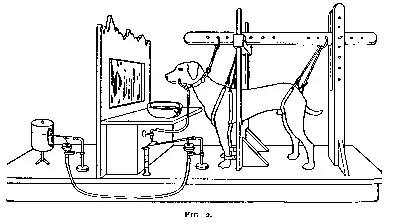
Pavlov's apparatus for measuring a dog's salivation · Yerkes & Morgulis, Psychological Bulletin, 1909 · Wikimedia Commons (public domain)
Pavlov moved this into an experiment: after repeatedly playing a sound that had nothing to do with saliva and then immediately giving food, the dogs later drooled just upon hearing the sound (OpenStax Psychology 2e 6.2). Classical conditioning is learning in which a signal that originally meant nothing becomes repeatedly paired with an event, so that the signal alone triggers the response that the event used to cause.
A conditioned stimulus is a signal that has come to trigger a response through such pairing. For Pavlov's dogs, the sound is the conditioned stimulus, and in the illustration for this article, the sound that rings first is the conditioned stimulus. A conditioned response is the learned response triggered by a conditioned stimulus. The saliva drooled at the sound is the conditioned response.
Pairings do not form just any which way. If the gap between the signal and the event widens, pairing does not form well, so a short interval of typically a few seconds is necessary (OpenStax Psychology 2e 6.2). Taste is an exception. Here, unlike the illustration in this article, taste is on the side of the signal that comes first. If you eat a certain food and fall severely ill several hours later, that taste can become aversive after just a single time rather than repeated pairings (OpenStax Psychology 2e 6.2). In rat experiments, the pairing of taste and a stomachache was learned, but the pairing of light or sound and a stomachache was not (OpenStax Psychology 2e 6.2). This means that at least for rats, there are separate pairings that the body is pre-inclined toward.
The strength of a pairing also depends on how reliably the signal predicts that event (OpenStax Psychology 2e 6.2). Thus, the sound that rings first goes beyond simply being a sound that precedes; it becomes a notice telling what is about to come. There is also the argument that this learning does not remain confined to the saliva stories of the laboratory. In a review paper, one researcher proposes redefining classical conditioning as an everyday mechanism across life that helps organisms recognize biologically crucial targets—such as food, mates, predators, and toxins—and react to them immediately (PMID 42140477).
When a Sound Becomes Empty Words
If you repeatedly play a sound and fail to give food afterward, the saliva gradually decreases and then stops (OpenStax Psychology 2e 6.2). Extinction is when the conditioned response gradually weakens when only the conditioned stimulus arrives and what used to follow it no longer comes.
The reduced response has not been erased. Even an extinguished dog drooled when it heard the sound again after resting for a few hours (OpenStax Psychology 2e 6.2). Spontaneous recovery is when an extinguished conditioned response reappears after a period of rest. This phenomenon is one of the most fundamental phenomena in conditioning, but there are not many research results on what determines its magnitude, the findings are mixed, and the causes appear to be multiple (PMID 15466300).
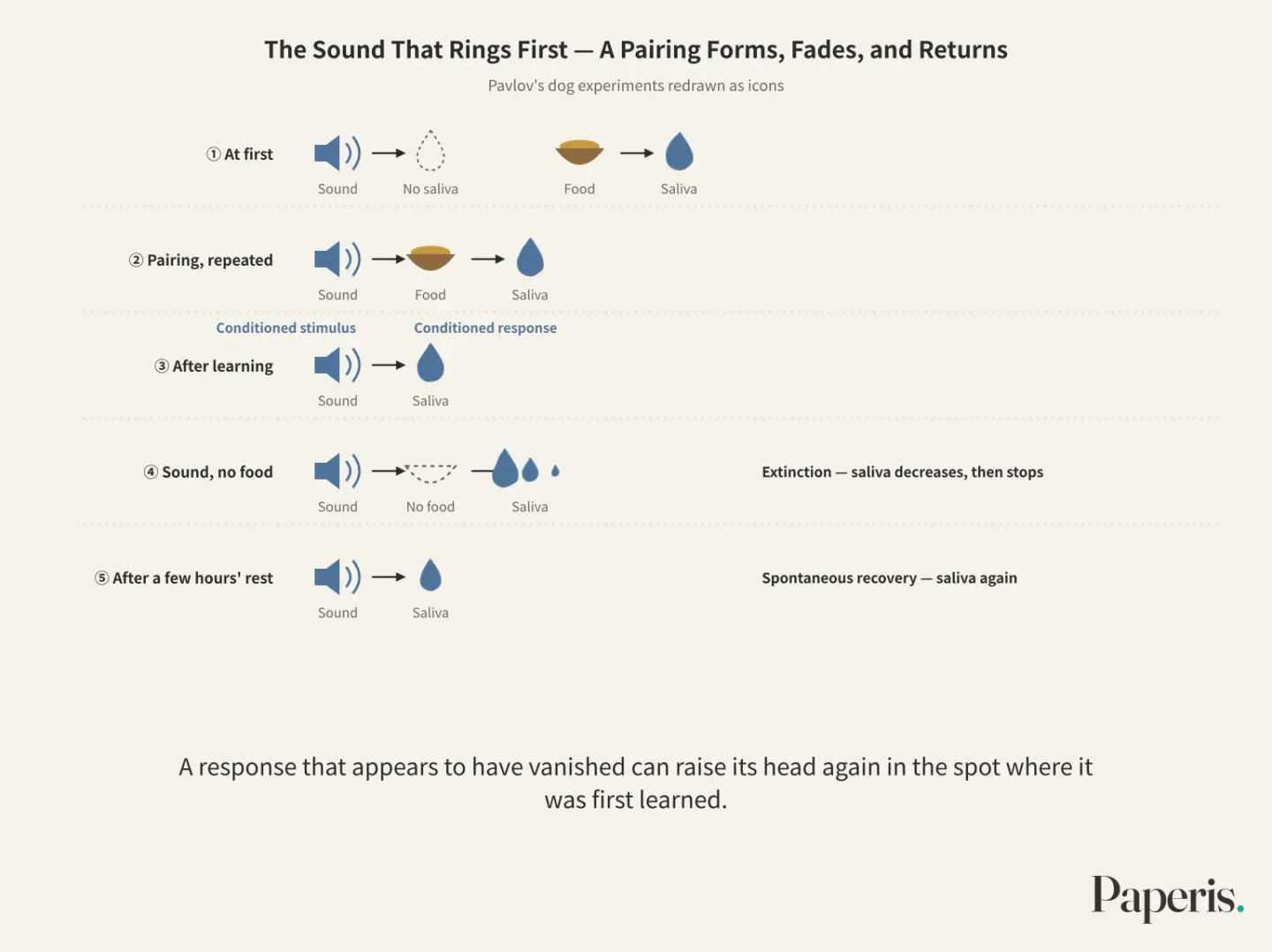
One reason it comes back to life is that extinction leaves what was first learned almost intact. Rather than erasing the original pairing, extinction is the act of layering a new learning on top of it—"nothing comes after this sound anymore"—and this new learning mainly exerts its force in the place where it was learned (PMID 32970967). Therefore, when the location changes, the old response easily returns. As a result of meta-analyzing human fear conditioning studies, fear revived most clearly when tested by returning to the place where it was first learned, and revived less when extinguished in multiple places (PMID 38431150). A response that appears to have vanished can raise its head again in the spot where it was first learned.
Responses also spread to similar things. Stimulus generalization is when a conditioned response appears even to stimuli that resemble the conditioned stimulus. The more similar they are, the better it spreads, and even if they are similar, if what follows them is different, one learns to discriminate and respond to the two (OpenStax Psychology 2e 6.2). The property of spreading is useful, but it can go too far. It is the view of fear conditioning researchers that when fear is greater than the actual threat, spreads too widely, remains even after the danger has disappeared, or leads to excessive avoidance, it can lead to anxiety problems (PMID 36811021).
One White Rat and a Baby
An experiment frequently cited as applying this principle to human emotion is the 1920 experiment by John Watson, a psychologist at Johns Hopkins University in the United States, and his graduate student Rosalie Rayner (OpenStax Psychology 2e 6.2). The baby nicknamed "Little Albert" was not initially afraid of white rats. Each time the baby touched the rat, a steel bar behind his head was struck with a hammer to make a loud noise, causing the baby to become afraid just at the sight of the rat and, a few days later, to fear other furry things as well (OpenStax Psychology 2e 6.2).
This experiment is widely cited as an example that emotions can also arise through conditioning. However, the subject was a single baby, there is no evidence that the child grew up to suffer from a phobia, and by today's standards, it is an unethical experiment (OpenStax Psychology 2e 6.2). It is difficult to establish a general law that "human fear forms this way" based on the reaction of just one baby.
The Taste Left Behind
Now let's flip the order and look at what remains after what I did. Psychologist Edward Thorndike summarized that actions followed by satisfying outcomes become more likely to happen again, while actions followed by unpleasant outcomes become less likely (OpenStax Psychology 2e 6.3). Building on this idea, American psychologist B. F. Skinner built a box where food came out when a rat pressed a lever or a pigeon pecked a disk, and measured how behavior changed depending on its consequences (OpenStax Psychology 2e 6.3).
Operant conditioning is learning that links a behavior to the consequence that follows it, increasing or decreasing that behavior based on the outcome. Skinner believed that classical conditioning only attached existing reflexes to new signals and could not explain how new behaviors arose, so he filled that vacancy with the consequences of behavior (OpenStax Psychology 2e 6.3).
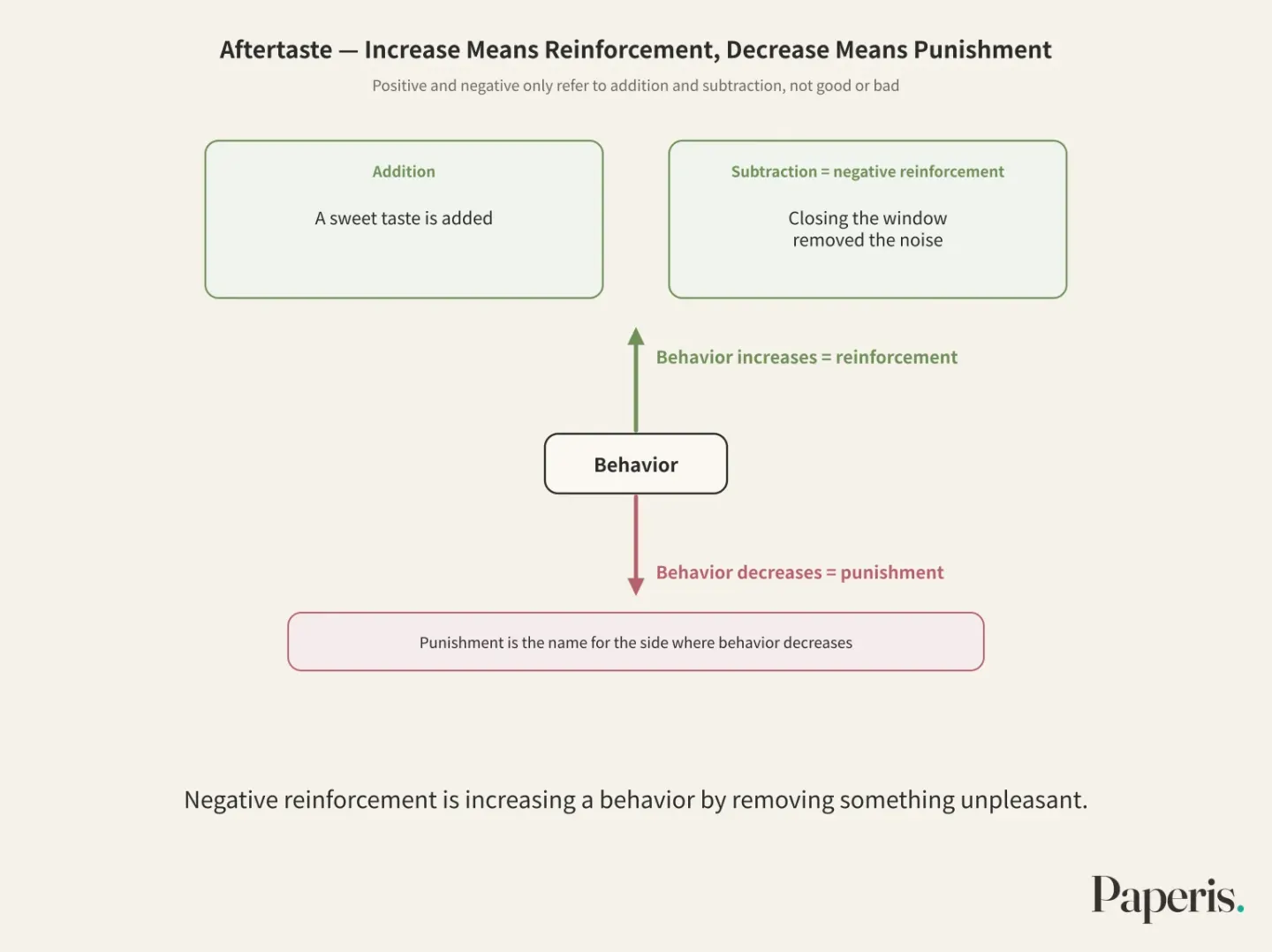
Consequences work in two directions. Reinforcement is a consequence following a behavior that makes that behavior increase. Punishment is a consequence following a behavior that makes that behavior decrease.
If you closed the window because of construction noise outside and it got quiet, your behavior of closing the window when it's noisy increases. Since the behavior increased, this is also reinforcement. But this time nothing was given and only the noise was removed, so the word "negative" is attached to this case. In this field, positive and negative only refer to addition and subtraction, and do not carry meanings of good or bad (OpenStax Psychology 2e 6.3). Negative reinforcement is increasing a behavior by removing something unpleasant. Even though the name "negative" sounds like punishment, the behavior of closing the window actually increased, so this scene is on the opposite side of punishment. Punishment is a name attached to the side where behavior decreases. In terms of this article's illustration, both adding a sweet taste and removing a bitter taste are the aftertastes that make you do that behavior again.
Long actions do not come out all at once just by waiting, and you cannot attach an aftertaste to a behavior that has not appeared (OpenStax Psychology 2e 6.3). That is why the path to the goal is broken down into small pieces. Shaping is a method of reinforcing each step that gets a little closer to the target behavior, finally leading to the target behavior.
A Taste That Might Arrive at Any Time
There are cases where a behavior continues even if the aftereffect does not arrive every single time. A schedule of reinforcement is a rule that determines when and after how many times reinforcement will be given following a behavior. When reinforcement is given only occasionally, it is divided into four types by combining whether the number of times it is given or the elapsed time is fixed versus changing each time (OpenStax Psychology 2e 6.3). Among them, a schedule where the number of times it appears varies each time draws out behavior the most and most steadily, and makes it disappear the slowest even after reinforcement is cut off (OpenStax Psychology 2e 6.3). The side reinforced every time is the fastest at introducing a new behavior (OpenStax Psychology 2e 6.3), but it disappears more quickly once reinforcement is cut off (PMID 37261748).
The phenomenon where an occasionally reinforced response fades out later than a continuously reinforced response is one of the best-known phenomena in this field (PMID 37930638). In an experiment where humans were taught a task of responding to a signal, the group rewarded only occasionally also stopped more slowly after the reward was cut off (PMID 37261748). However, while this phenomenon appears almost everywhere in learning that connects behavior and consequences, it sometimes appears and sometimes does not in classical conditioning that connects signals and events (PMID 28649917). Even in rat experiments where food came after a signal, it appeared only in the group trained to have long sequences of unrewarded trials, and the authors pointed to the uncertainty of whether reinforcement might arrive as one of the core factors (PMID 37930638).
If you picture a person sitting in front of an electronic gambling machine, these principles come together in one place. Among people with problem gambling, an unusually large number appear to use electronic gambling machines, and such machines contain rewards that are uncertain as to how many tries will trigger them, outcomes that narrowly miss, staging that makes winning less than the bet feel like a victory, and the illusion that one can control the outcome (PMID 26116634). Even so, it is not considered that this design alone causes gambling problems. The same review paper views gambling problems as arising from the interplay between vulnerabilities in the person's brain and tendencies and the design on the game's side (PMID 26116634).
Constantly checking cellphone notifications also shares a similar structure in that you never know when new news will arrive. However, since studies directly measuring notification-checking with this framework do not exist within the evidence covered in this article, we can only go as far as saying they are similar.
The Limits of Bitter Taste, the Limits of Sweet Taste
Corporal punishment, commonly called punishment in everyday life, remains a heavily debated topic today (PMID 27055181). In such research, following children over time to measure whether corporal punishment and subsequent outcomes go together, and how much cause can be read from that association, is always an issue of contention (PMID 29797703).
On one side, harmful results have repeatedly emerged. A 2016 meta-analysis pooling studies that looked solely at spanking reported from data on roughly 160,000 children that spanking went together with an elevated risk of various bad outcomes, and its magnitude was not very different from physical abuse (PMID 27055181). A 2025 meta-analysis gathering 189 studies across 92 low- and middle-income countries likewise reported that corporal punishment went together with harmful results such as mental health problems and a worsened parent-child relationship, and this association did not appear with other non-violent discipline methods, showing up only with corporal punishment and psychological aggression (PMID 40325199). An analysis of data from 130,000 children aged 3 to 4 across 49 countries published in 2021 found that children who received corporal punishment had about a 24% lower likelihood of being on track in their development, and in no country did corporal punishment link to good developmental outcomes (PMID 34298261). The authors of this study concluded that all forms of corporal punishment, including spanking, are likely harmful to young children's development (PMID 34298261).
The other side reads its magnitude and interpretation differently. There is a meta-analysis concluding that when you adjust for the child's initially measured state, the association becomes very small, making the effect of corporal punishment trivial (PMID 23274727). There are also analyses showing that depending on the adjustment method, the very same data can yield either a small risk or a small benefit (PMID 29797703). A 2005 meta-analysis reported that spanking used only under specific conditions was better at reducing non-compliance or antisocial behavior than 10 out of 13 other discipline methods, that routine corporal punishment was similar to other methods, and that it was worse than other methods only when excessively harsh or used as the primary method (PMID 15898303). While across multiple large-scale meta-analyses corporal punishment has repeatedly appeared together with bad outcomes, disputes remain among researchers regarding how large a causal effect that association represents and whether even mild corporal punishment is the same.
Sweet taste also has its limits. In a meta-analysis gathering 128 studies, tangible rewards promised in advance generally decreased the extent to which people voluntarily performed those tasks during their free time, whereas positive feedback such as verbal praise increased it (PMID 10589297). The authors note that their methods and results differed from four earlier meta-analyses that addressed the same question (PMID 10589297). This detriments of tangible rewards tended to appear larger in children than in college students (PMID 10589297). This means the power of rewards to increase behavior and the intrinsic desire to do that task on one's own can move separately. The story of that desire continues in "Emotions and Motivation — The Dashboard Where the Needle Swings, the Eye That Reads It".
Looking at Someone Else's Plate
You do not necessarily have to taste something with your tongue to learn about it. Because you can learn by watching others go through things, the range of what you can learn is wider than the first two paths where you must experience things directly (OpenStax Psychology 2e 6.1). Observational learning is learning by watching what someone else does, which leads you to either imitate that behavior or avoid doing it.
One of the cases frequently cited as bringing this kind of learning into the laboratory is the experiments conducted by psychologist Albert Bobo using a Bobo doll. In one of them, children watched an adult treat a large balloon doll roughly. Children who saw that adult go unpunished treated the doll roughly in the same way, while children who even saw the adult get punished did so less (OpenStax Psychology 2e 6.4). What this experiment showed is simply that the children imitated the behavior they had just seen in the lab on the doll.
Bandura explained why some children did not imitate the behavior even after seeing the same scene as follows. If they did not pay attention in the first place, could not remember what they saw, or could not pull it off with their bodies, they could not imitate it, and the aftertaste experienced by the person I watched acts on the side of wanting to imitate it among those factors (OpenStax Psychology 2e 6.4). The taste left on someone else's plate moves my spoon. Because this kind of learning happens even without rewards given from the outside, Bandura viewed that it cannot be fully solved by behaviors and outcomes alone, and that internal mental states must be looked at together (OpenStax Psychology 2e 6.4).
Bandura's research addressing whether thoughts act as causes in learning played a major role in the establishment of psychotherapy that deals with thoughts and behaviors together during the 1970s (PMID 38548474).
Maps Drawn Even Without Taste
Behaviorist psychologist Edward Tolman let hungry rats wander around a maze without food. After doing so about ten times, when food was placed at the end of the maze, these rats found the path as quickly as rats that had roamed while receiving food from the beginning (OpenStax Psychology 2e 6.3). Latent learning is learning that has already taken place, but is not shown in behavior until a reason to reveal it arises. Tolman interpreted that the rats drew the layout of the maze as a map in their heads even while there was no food (OpenStax Psychology 2e 6.3).
This experiment is often introduced as evidence that "learning happens without reward," but that interpretation comes with a caveat. One review examining 48 introductory textbooks published between 1948 and 2004 points out that writing this experiment shows beyond a doubt that reinforcement is unnecessary for learning, or that a mental map is the only explanation, is an error (PMID 22478463). The same review considers it wrong to portray Skinner as someone who claimed that "learning happens only when there is reinforcement" (PMID 22478463).
As for what drives this kind of learning when there is no reward, then, there is a suggestion that curiosity is that engine (PMID 33842677). The idea is that the mindset to figure out one's surroundings even if they seem useless right away creates a map capturing the structure of that environment, and that map later leads to flexible behavior (PMID 33842677). Even if no taste is left behind, the map is drawn.
Why You Cannot See It Only as a Machine
Looking only up to this point, people might seem like machines pulled around by sounds and tastes. The evidence shows both directions together.
Conditioning definitely happens in humans. Human fear conditioning has been a primary experimental tool for understanding the psychology of fear and brain mechanisms over the past decades (PMID 36811021). One theoretical model explains that when an action repeated in the same place pairs with that location and becomes a habit, simply recognizing the place triggers the action without going through a goal (PMID 17907866).
At the same time, a person changes that pairing with a single word. In an experiment that taught fear by having an unpleasant stimulus follow a picture, when participants were told in advance "that stimulus is no longer coming," the fear attached to pictures of snakes and spiders as well as pictures of a pointed gun decreased, and there was no difference between the two (PMID 31828815). The authors of this study saw this as evidence that the phenomenon where fear attaches easily to snakes and spiders is explained more by social and cultural learning acquired through life than by an innate gradient (PMID 31828815). In another experiment, pictures of snakes and spiders made fear be learned faster, but when informed with words, the electrical response of the skin reversed immediately just like for people who saw other pictures (PMID 29339561). Some pairings attach faster, but information heard through words changes even those pairings.
Evidence that people learn fear without realizing the pairing is also not solid. A comprehensive analysis reviewing 41 studies addressing this question concluded that most studies had methodological limitations and that higher-quality studies were less likely to conclude that learning occurs without awareness, meaning there is no persuasive evidence to support such conditioning (PMID 31747553).
Habits are not as hard as iron chains either. A paper reviewing studies that separately isolated and examined habits finds that there is surprisingly little evidence that habits last longer than goal-directed actions or are permanent once formed, and that habits are instead tied more to specific locations (PMID 38149526). This review paper suggests that the usefulness of a habit may lie in making something happen automatically and effortlessly in a specific location rather than in making an action stronger (PMID 38149526).
Textbooks record the same flow. Observational learning adds social and cognitive layers on top of associative learning, and even within behaviorism, the role of thought has grown increasingly larger (OpenStax Psychology 2e 6.1).
The sound and taste illustrations in this article only show what gets paired with what, but they fail to show how a person interprets those pairings and rewrites them with a single word. Because human learning moves by resting expectations and understanding on top of conditioning, it is fully explained neither by a "stimulus-response machine" nor by the idea that "conditioning is just an animal story."
Where to Look Further
How what you learned is stored in the head and pulled back out is covered by "The Three Steps of Memory — Putting It In, Keeping It, Taking It Out". Study methods that make learning stick longer are found in "Retrieval Practice — The More You Pull It Out, the More It Stays" and "The Spacing Effect — Spread It Out and It Lasts".
How classic experiments turn out when measured again is addressed by "Psychology's Replication Crisis — Why the Findings We Believed In Wobbled" and "The Shrinking Effect — Why Textbook Findings Get Smaller When You Measure Them Again", while "Who Was Being Measured — Who "People" Meant When Psychology Said It" points out how far results obtained from a single rat, pigeon, or baby can be broadened to anyone. The piece that views responses to rewards through the eyes of economics is "Incentives: How Do People Respond to Prices and Rewards?".
Other parts of this series follow. The relationship between rewards and the desire to do things on one's own is covered by "Emotion and Motivation — A Dashboard of Swinging Needles, and the Eye That Reads Them", the way people interpret and judge information by "Thinking and Judgment — Familiar Tools, Scratches That Lean One Way", and how the mind of following others moves within a group by "The Social Mind — A Rope Pulled from Both Ends, the Hands We Don't See".
Source Papers
- "Psychology 2e — 6.1 What Is Learning?" (2020) — OpenStax Psychology 2e 6.1 — Reflexes and instincts are innate behaviors, while learning is a relatively enduring change arising from experience, the three branches of learning and the expanded scope of observational learning, and the trend of a growing role for cognition.
- "Psychology 2e — 6.2 Classical Conditioning" (2020) — OpenStax Psychology 2e 6.2 — Pavlov's observations and experiments, time intervals in pairing, taste aversion and biological constraints, predictive power, extinction, spontaneous recovery, generalization, and discrimination, along with Watson and Rayner's Little Albert experiment and its limitations.
- "Psychology 2e — 6.3 Operant Conditioning" (2020) — OpenStax Psychology 2e 6.3 — The law of effect and the Skinner box, reinforcement and punishment along with the meanings of positive and negative, shaping, continuous and partial reinforcement and the four reinforcement schedules, and Tolman's latent learning.
- "Psychology 2e — 6.4 Observational Learning (Modeling)" (2020) — OpenStax Psychology 2e 6.4 — Observational learning and Bandura's four conditions, the effects of outcomes received by the model, the Bobo doll experiment, learning without external reinforcement, and internal mental states.
- "Redefining Pavlovian conditioning." (2026) — PMID 42140477 — A proposal to redefine classical conditioning as a universal mechanism for recognizing biologically important targets and producing immediate adaptive behavior.
- "Spontaneous recovery." (2004) — PMID 15466300 — Spontaneous recovery is one of the most fundamental phenomena of conditioning, but empirical literature on its determinants is scarce and mixed, and its causes are likely multiple.
- "BEHAVIORAL AND NEUROBIOLOGICAL MECHANISMS OF PAVLOVIAN AND INSTRUMENTAL EXTINCTION LEARNING." (2021) — PMID 32970967 — Extinction is not the erasure of original learning, but a new inhibitory learning that is primarily expressed within the learned context.
- "Renewal in human fear conditioning: A systematic review and meta-analysis." (2024) — PMID 38431150 — In human fear conditioning, renewal in the ABA design is the strongest, and extinction across multiple contexts reduces renewal.
- "Understanding clinical fear and anxiety through the lens of human fear conditioning." (2023) — PMID 36811021 — Fear becomes maladaptive when it generalizes more widely or intensely than the threat or persists after the danger has passed, and fear conditioning has been the primary research tool.
- "The sequencing of trials during partial reinforcement affects subsequent extinction." (2024) — PMID 37930638 — The partial reinforcement extinction effect is one of the best-known phenomena in associative learning, and in rat experiments, the authors conclude that the uncertainty of reinforcement is the key factor.
- "Partial reinforcement extinction and omission effects in the elimination and recovery of discriminated operant behavior." (2023) — PMID 37261748 — In human operant behavior as well, extinction is slower after partial reinforcement, and responses revive upon returning to the original context.
- "Partial reinforcement and conditioned taste aversion: No evidence for resistance to extinction." (2019) — PMID 28649917 — The partial reinforcement extinction effect is nearly universal in instrumental conditioning, but inconsistent in Pavlovian conditioning.
- "Games in the Brain: Neural Substrates of Gambling Addiction." (2016) — PMID 26116634 — Electronic gambling machines are overrepresented among problem gamblers and utilize variable ratio schedules, near misses, losses disguised as wins, and illusions of control, with the problem being the interaction between individual predisposition and the game.
- "Improving Causal Inferences in Meta-analyses of Longitudinal Studies: Spanking as an Illustration." (2018) — PMID 29797703 — Causal inference problems in meta-analyses of longitudinal studies, where the effect of spanking ranges from a small risk to a small benefit depending on the adjustment method.
- "Spanking and child outcomes: Old controversies and new meta-analyses." (2016) — PMID 27055181 — In data from roughly 160,000 individuals, spanking is associated with an increased risk of harmful outcomes, with an effect size not significantly different from physical abuse.
- "Physical punishment and lifelong outcomes in low‑ and middle‑income countries: a systematic review and multilevel meta-analysis." (2025) — PMID 40325199 — Across 189 papers from 92 low- and middle-income countries, corporal punishment is associated with harmful outcomes, whereas other non-violent disciplinary methods are not, showing specificity to corporal punishment and psychological aggression.
- "Corporal punishment and early childhood development in 49 low- and middle-income countries." (2021) — PMID 34298261 — Among roughly 130,000 children aged 3 to 4, those exposed to corporal punishment are about 24% less likely to be on track for normal development and show no association with positive outcomes in any country, leading the authors to conclude that all forms of corporal punishment are likely harmful.
- "Spanking, corporal punishment and negative long-term outcomes: a meta-analytic review of longitudinal studies." (2013) — PMID 23274727 — In partial correlations controlling for initial status, the association is negligible, and the authors conclude that the impact is minimal and recommend more nuanced discussion.
- "Comparing child outcomes of physical punishment and alternative disciplinary tactics: a meta-analysis." (2005) — PMID 15898303 — Conditional spanking is superior to 10 out of 13 alternatives in reducing noncompliance and antisocial behavior, with only overly severe or predominantly used corporal punishment being disadvantageous.
- "A meta-analytic review of experiments examining the effects of extrinsic rewards on intrinsic motivation." (1999) — PMID 10589297 — Across 128 studies, expected tangible rewards decreased free-choice intrinsic motivation while positive feedback increased it, with the detrimental effect of tangible rewards tending to be larger in children.
- "The social-cognitive clinician: On the implications of social cognitive theory for psychotherapy and assessment." (2024) — PMID 38548474 — Research into the causal role of cognitive processes in Bandura's social learning was a major factor in the emergence of cognitive behavioral therapy in the 1970s.
- "Behaviorism, latent learning, and cognitive maps: needed revisions in introductory psychology textbooks." (2006) — PMID 22478463 — Reviewing 48 introductory textbooks, using latent learning experiments as definitive proof of reinforcement being unnecessary and cognitive maps as the sole explanation, alongside portraying Skinner as a strict proponent of required reinforcement, are errors.
- "Latent learning, cognitive maps, and curiosity." (2021) — PMID 33842677 — A proposal that latent learning does not operate via standard reinforcement, but rather curiosity motivates it to build cognitive maps and guide flexible behavior.
- "A new look at habits and the habit-goal interface." (2007) — PMID 17907866 — Habits arise from the gradual accumulation of associations between a response and the performance context, after which the perception of the context triggers the response without a goal.
- ""Prepared" fear or socio-cultural learning? Fear conditioned to guns, snakes, and spiders is eliminated by instructed extinction in a within-participant differential fear conditioning paradigm." (2020) — PMID 31828815 — Instructed extinction reduced fear conditioned to snakes, spiders, and aimed guns without differences, and the authors conclude that this supports a socio-cultural explanation of the "preparedness" effect.
- "Prepared stimuli enhance aversive learning without weakening the impact of verbal instructions." (2018) — PMID 29339561 — Snake and spider stimuli accelerated learning, but skin conductance reversals following instructions were immediate in both groups.
- "A systematic review and meta-analysis of the evidence for unaware fear conditioning." (2020) — PMID 31747553 — Reviewing 41 papers, most have methodological limitations, and higher quality is associated with fewer conclusions of unawareness and publication bias, providing no persuasive evidence for fear conditioning without awareness.
- "Habit and persistence." (2024) — PMID 38149526 — There is little evidence that habits are permanent or more persistent; instead, habits are more context-specific, and their function may be automaticity and efficiency.
Sources (28)
- Psychology 2e — 6.1 What Is Learning?
- Psychology 2e — 6.2 Classical Conditioning
- Psychology 2e — 6.3 Operant Conditioning
- Psychology 2e — 6.4 Observational Learning (Modeling)
- Redefining Pavlovian conditioningPMID 42140477
- Spontaneous recoveryPMID 15466300
- BEHAVIORAL AND NEUROBIOLOGICAL MECHANISMS OF PAVLOVIAN AND INSTRUMENTAL EXTINCTION LEARNINGPMID 32970967
- Renewal in human fear conditioning: A systematic review and meta-analysisPMID 38431150
- Understanding clinical fear and anxiety through the lens of human fear conditioningPMID 36811021
- The sequencing of trials during partial reinforcement affects subsequent extinctionPMID 37930638
- Partial reinforcement extinction and omission effects in the elimination and recovery of discriminated operant behaviorPMID 37261748
- Partial reinforcement and conditioned taste aversion: No evidence for resistance to extinctionPMID 28649917
- Games in the Brain: Neural Substrates of Gambling AddictionPMID 26116634
- Improving Causal Inferences in Meta-analyses of Longitudinal Studies: Spanking as an IllustrationPMID 29797703
- Spanking and child outcomes: Old controversies and new meta-analysesPMID 27055181
- Physical punishment and lifelong outcomes in low‑ and middle‑income countries: a systematic review and multilevel meta-analysisPMID 40325199
- Corporal punishment and early childhood development in 49 low- and middle-income countriesPMID 34298261
- Spanking, corporal punishment and negative long-term outcomes: a meta-analytic review of longitudinal studiesPMID 23274727
- Comparing child outcomes of physical punishment and alternative disciplinary tactics: a meta-analysisPMID 15898303
- A meta-analytic review of experiments examining the effects of extrinsic rewards on intrinsic motivationPMID 10589297
- The social-cognitive clinician: On the implications of social cognitive theory for psychotherapy and assessmentPMID 38548474
- Behaviorism, latent learning, and cognitive maps: needed revisions in introductory psychology textbooksPMID 22478463
- Latent learning, cognitive maps, and curiosityPMID 33842677
- A new look at habits and the habit-goal interfacePMID 17907866
- Prepared\PMID 31828815
- Prepared stimuli enhance aversive learning without weakening the impact of verbal instructionsPMID 29339561
- A systematic review and meta-analysis of the evidence for unaware fear conditioningPMID 31747553
- Habit and persistencePMID 38149526