
Paperis Articles
Energy — Money That Doesn't Shrink When Exchanged, Odd Coins Scattered in Your Pockets
Energy only changes form; it is never created or destroyed. But each time it changes, part of it scatters as thermal energy that is hard to put to use.
Your field's papers, as audio
Pick your fields and journals — Paperis summarizes the key papers and turns them into audio. Listen on your commute.
Start Paperis free →Energy — Money That Doesn't Shrink When Exchanged, Odd Coins Scattered in Your Pockets
Up to the First Hill
When a roller coaster starts, it slowly climbs a big hill at the very beginning. At this time, a machine pulls the car up. Once it passes the peak, the machine no longer pulls the car, but the car races down the slope and climbs the next hill again.
Where does the reason the car can run on its own lie? What was put into the car when it was first pulled up stays in it, and changes its shape all the while it runs. The name of that "thing put in" is energy.
This article follows energy by comparing it to money being exchanged during a trip. Let us say we hand the car a bundle of money at the first hill. While running, the car changes that money from won to dollars, and from dollars back to won. Even though the currency of the money changes, its value is the same. However, every time it is exchanged, leftover coins are created and scatter here and there into pockets and bags. The coins remain right in my pocket, so if you count them all up the sum is the same as at first, but places that exchange them back are rare, making them hard to gather and use. Money can be earned and newly increased, but energy cannot be earned and newly created anywhere. In this article, the wallet is always a single object, and the won and dollars are the shapes of the energy held inside it.
Work in Physics
If you pushed against a wall with all your might for a long time and the wall didn't budge an inch, you might have worked up a sweat, but in physics, you did no work on the wall. "Work" in physics has a narrow, precise definition of its own.
Force is a push or a pull on an object. Work is using force to move an object in the direction of that force. Since the wall didn't move, no work was done. If you lift a grocery basket from the floor onto the dining table, the basket moved upward—the direction you applied the force—so you did work (OpenStax Physics 9.1).
What if you walk across the room holding that same basket at a steady pace? Your arms keep exerting force, but that force is upward, supporting the basket. As long as the sum of all forces acting on an object moving at a constant speed in a straight line is zero, there is no force applied in the direction of moving the basket forward. Therefore, no work is done on the basket while you walk forward (OpenStax Physics 9.1). Where our intuition that "you have to keep pushing to keep something moving" goes wrong is covered in "Force and Motion — A Swinging Strap, a Body That Keeps Going".
The amount of work is calculated by multiplying the applied force by the distance moved (W = Fd) (OpenStax Physics 9.1). If you lift the same basket twice as high, you have done twice as much work.
Now we can bring in energy. Energy is the ability to do work. Doing work on an object changes its energy, and for something to do work, it must give up some of the energy it has (OpenStax Physics 9.1). The joule (J) is the unit used to measure both work and energy. Measuring both quantities in the same unit supports the idea that work and energy are an interchangeable pair (OpenStax Physics 9.1). In the money analogy, energy is the cash sitting in an object's wallet, and work is the act of handing that cash over to another object's wallet.
Energy in Motion, Energy in Height
Let us say we do not have a hammer to drive a nail, so we use a rock. We lift the rock high above the nail and let it drop. The rock strikes the nail and drives it into the wood (OpenStax Physics 18.4). This short scene shows both forms of energy.
While lifting the rock, we did work on the rock. That work does not disappear; it is stored in the high-lifted rock. Potential energy is energy stored because of the position where an object is placed. Potential energy has several forms, and the one covered in this article is the potential energy that comes from being raised high above the ground. The work done to lift the rock is equal to the potential energy the rock gains (OpenStax Physics 9.1).
When we let go, the rock falls and speeds up more and more. The energy stored in height has transferred into motion (OpenStax Physics 18.4). Kinetic energy is the energy possessed by a moving object. Kinetic energy is determined by the object's mass and speed (OpenStax Physics 9.1). Mass is a measure of the amount of matter inside an object. Speed plays a bigger role, so if the same object goes twice as fast, its kinetic energy becomes four times as great (OpenStax Physics 11.1). With that kinetic energy, the rock does the work of driving the nail (OpenStax Physics 18.4).
Mechanical energy is the sum of kinetic energy and potential energy. These two forms can change into each other, and as long as none leaks to the outside, their sum stays constant (OpenStax Physics 9.2). You can think of it as the total money split between won and dollars inside a single wallet.
Potential energy exists even in an object that is not moving. A cup sitting still on a table also has potential energy thanks to its position higher than the floor (OpenStax Physics 9.1). In a study that examined 36 high school students through diagnostic tests and interviews, some students believed that "if there is no movement, there is no potential energy," and it was also common to view kinetic energy as the same thing as force (DOI: 10.30862/kpej.v8i2.1045). Energy is a different quantity from force. Force is a push or pull action, and energy is the capacity to do work.
While Going Up and Down Hills
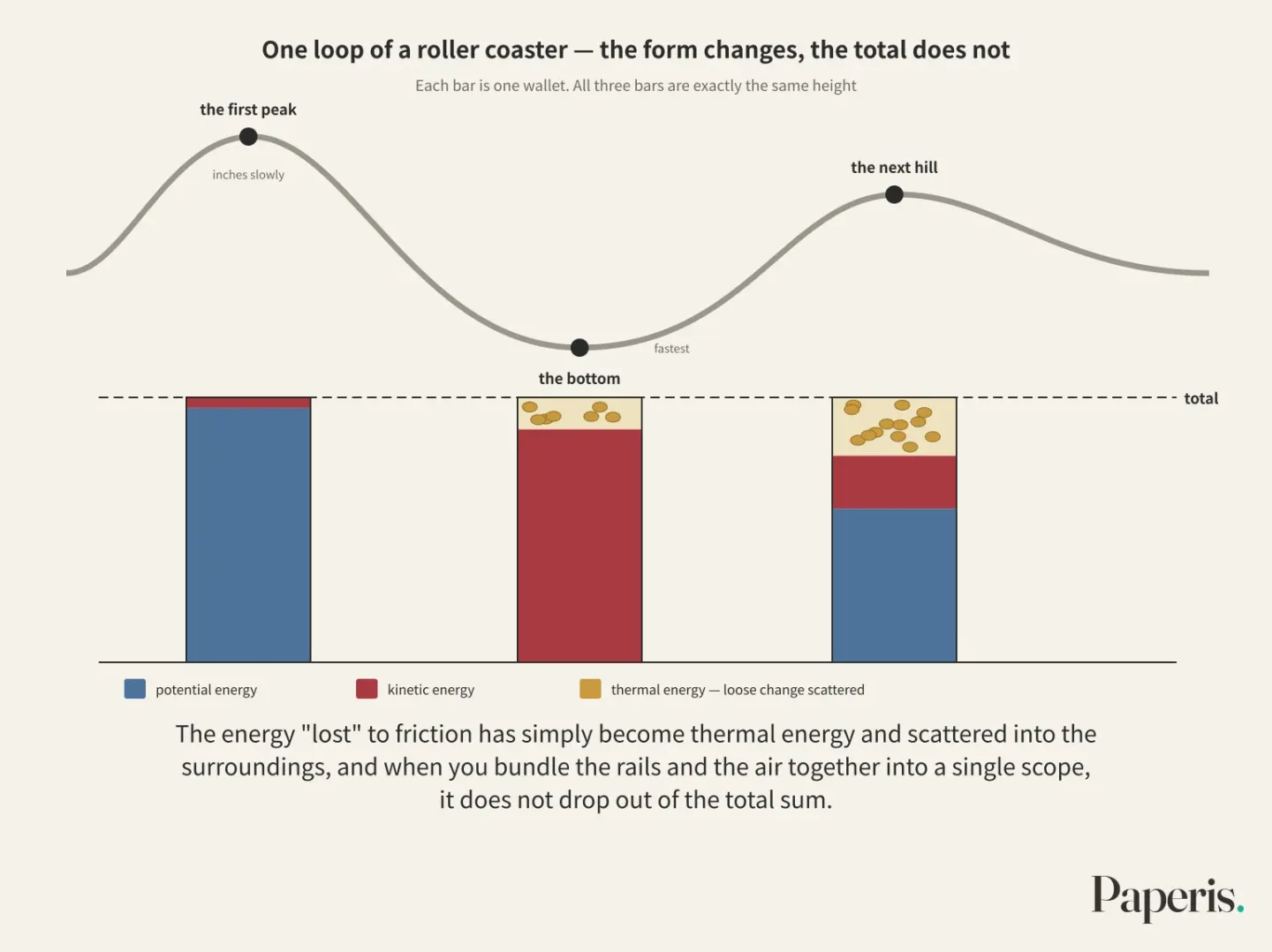
Now we sit in a rollercoaster and take a full loop. At the first peak, the car inches slowly over. On the descent, it gets faster and faster, reaching its peak speed at the bottom, and slows down again as it climbs the next hill. At the slow peak, the share packed into height is large, and at the fast bottom, the share packed into motion is large. The potential energy that the machine put in by pulling the car up to the first hill turns into kinetic energy on the descent, and some of it returns to potential energy on the ascent (OpenStax Physics 9.2).
Energy conversion is when energy changes from one form into another. Every time it clears a hill, this conversion happens once back and forth. Using the money analogy, it is currency exchange inside the car's wallet, turning won into dollars and dollars back into won.
If there is no friction, the value of adding the two shares together—whether at the peak or the bottom—is the same as at the initial peak (OpenStax Physics 9.2). Writing this behavior down in a single sentence is the law of conservation of energy. The law of conservation of energy is the rule that within a boundary where energy is not exchanged with the outside, the sum of energy always remains the same even if its form changes. Textbooks write this law as "the total energy in a closed system is constant," and explain the "closed system" with the assumption that no energy is lost to the surroundings through friction and air resistance (OpenStax Physics 9.2).
Energy only changes its form; it is neither newly created nor destroyed. The fact that energy is conserved was introduced as a novel discovery even in the mid-19th century. The scientist Hermann von Helmholtz gave a lecture in 1854 explaining this "recent discovery" in plain terms to a general audience (DOI: 10.33225/balticste/2023.38).
Where Do the Scattered Scraps Go
A real roller coaster cannot avoid friction. The conversion between potential energy and kinetic energy is never perfect, and friction causes some of the useful energy to be lost (OpenStax Physics 9.2). What the word "lost" points to here is loose change scattered here and there in pockets. The coins are still in my pocket.
The word heat follows this process. Heat is energy transferred between two objects with different temperatures. Because heat transfers energy just like work does, it is measured in the same unit, the joule (OpenStax Physics 11.1). Since heat is energy in the middle of transferring, the part remaining inside an object goes by a different name.
The atoms and molecules making up matter are always moving around and colliding with each other, and the faster they move, the hotter that substance is (OpenStax Physics 11.1). Thermal energy is the energy spent on the individual movements of the particles making up matter. The rails and wheels getting warmed up by friction means that part of the visible car movement has turned into the movement of these invisible particles, namely thermal energy (OpenStax Physics 9.3).
The shapes of energy are not just movement, height, and thermal energy. Energy is also stored inside matter (OpenStax Physics 11.1). Chemical energy is energy stored inside matter that is released during a chemical reaction, such as when fuel burns. When fuel burns inside a car engine, chemical energy is released and heats the gas, and the heated gas pushes a piston to do work (OpenStax Physics 12.4). This is the chain where chemical energy turns into movement via heat.
One of the places where students frequently trip up is precisely these scattered spare coins. In the study of 36 high school students seen earlier, students often considered energy to be used up and gone if it occurred in a process with friction, and some students even believed that energy could vanish forever. The research team noted that this gap remained even after formal instruction (DOI: 10.30862/kpej.v8i2.1045). When a descriptive test asking about the conservation of mechanical energy was given to 46 physics education students at University of Bengkulu, 38% answered correctly. What thoughts these incorrect answers stemmed from is not stated in the abstract (DOI: 10.18510/hssr.2020.8381). Both studies are small studies with samples of several dozen people.
The energy "lost" to friction has simply become thermal energy and scattered into the surroundings, and when you bundle the rails and the air together into a single scope, it does not drop out of the total sum.
A Lever Does Not Reduce the Work
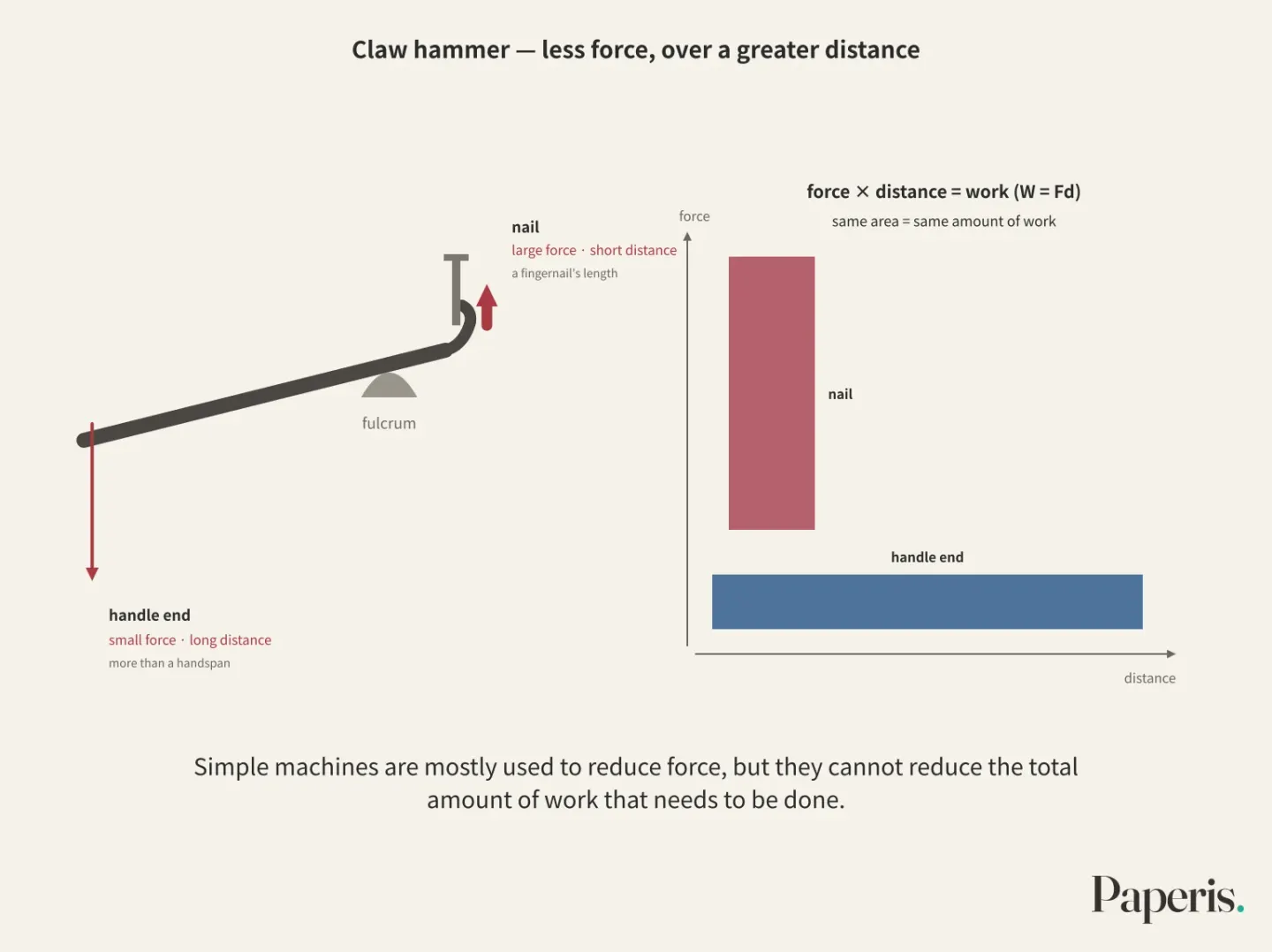
It is hard to pull a nail out of a wall with your bare hands. Hook the end of a claw hammer under the nail head and press the long handle, and it comes out easily. The end of the handle goes down more than a handspan, but the nail rises only a fingernail's length. Instead, a large force is packed into that short distance (OpenStax Physics 9.3).
A simple machine is a basic device, like a lever, an inclined plane, or a pulley, that makes work easier by changing the size of the force a person puts in and the distance over which that force is applied. A lever is a bar that pivots on a fulcrum, a simple machine that trades the input force for the distance that force moves. A claw hammer is a lever used to trade a small force over a long distance for a large force over a short distance. Conversely, there are also levers like a swinging baseball bat, where a large force is put in over a short distance to make the opposite end move a long way (OpenStax Physics 9.3).
Even though the nail comes out easily, the total amount of work done is the same. This is because a machine cannot increase the energy we put into it. Simple machines are mostly used to reduce force, but they cannot reduce the total amount of work that needs to be done. By as much as the force is reduced, the force must be applied over a greater distance (OpenStax Physics 9.3). Pushing a cart up a gentle slope instead of stairs takes less effort, but you walk for longer.
To use a money analogy, it is like paying the same 10,000 won either as a single bill all at once or split into ten 1,000-won bills; the total amount is identical. A claw hammer simply allows you to pay a force that would otherwise need to be large all at once by splitting it into many smaller amounts.
Two people carry the same shopping basket up to the second floor; one runs up the stairs quickly, while the other walks up slowly. The work both did on the shopping basket is the same, and the only difference is the speed (OpenStax Physics 9.1). Power is how fast work is done, in other words, the work divided by the time taken. The person who finishes the same work in a shorter time has a greater power. How electricity calls this speed and how it counts it is explained separately in "Watts and Watt-Hours — Reading Electricity's Two Numbers Like a Speedometer and an Odometer".
Why It Is Never 100%
When you put energy into a machine, only a portion of it comes back out as the work we want. Efficiency is the ratio of the energy that comes out as the desired usefulness to the energy put in. It is the value of what we get divided by what we use, and is usually written as a percentage (OpenStax Physics 12.4).
Real machines, whether simple or complex, turn part of the work put into them into useless thermal energy because of friction between moving parts (OpenStax Physics 9.3). Therefore, the efficiency of a real machine is always less than 100%. In terms of currency exchange, there is no exchange where not even a fraction of a leftover is created.
Machines that burn fuel and do work with that heat, like the car engine we saw earlier, cannot convert the received energy entirely into work, and they always send some—usually a significant share—out into the surroundings as heat (OpenStax Physics 12.4). The reason why is covered in "Heat and Temperature — Water That Only Flows Downhill, a Pump That Lifts It Back Up".
A perpetual motion machine is a machine claimed to move and do work forever even without energy supplied from the outside. The 12th-century Indian astronomer and mathematician Bhaskara II is counted as the first person to write down a perpetual motion machine, and new proposals did not stop for hundreds of years afterward. The law of conservation of energy clearly shows that such a machine cannot be built (DOI: 10.1119/1.3703542). The painter and inventor Leonardo da Vinci drew pictures in his notebook of handed-down perpetual motion machines using a linked waterwheel and pump, a tilting hammer, and rolling balls, but he knew very well that those designs did not work and could not work (DOI: 10.1162/leon.2008.41.1.39).
Looking at a perpetual motion machine through the analogy of money makes it easy to see. Every time you make an exchange, leftovers scatter, and for the usable money not to shrink, someone must top it up from the outside. A machine without someone topping it up from the outside slows down by as much as it scattered until it stops. In front of a device that "makes electricity without fuel," the first question is where that money is being topped up from.
The money analogy has limits beyond what was stated at the beginning. Currency exchange has exchange rates, so if you exchange Korean won for dollars and then back again, your money might luckily increase, but energy of any shape is measured in the same unit of joules, and changing it back and forth does not make it increase. Also, leftover coins sound like a small share, but the share scattered by a machine that burns fuel to do work is usually substantial (OpenStax Physics 12.4). And while energy is defined as the ability to do work, once thermal energy is evenly scattered, that ability is left in a form that can hardly be used (OpenStax Physics 12.3). The scattered thermal energy remains intact in the total sum, but you cannot gather it all back together to make it do work.
What Saving Means
If energy is always conserved, the phrase "let's save energy" sounds strange. It does not disappear anyway. The clue lies in scattered loose change. Every time we turn energy into work, we get back less than we put in, and the difference usually escapes into the surroundings as a significant amount of heat (OpenStax Physics 12.4). Even though the total stays the same, the share shaped well for making work happen shrinks. The phrase "save energy" means saving the part of energy shaped well for making work happen.
The phrase "making electricity" can be read with the same view. A generator is a device that turns motion energy into electrical energy. Hydroelectric power plants spin generators using the kinetic energy of falling water, and they are also spun using wind or steam made by burning fuel (OpenStax Physics 20.2). What a power plant does is transfer other shapes of energy into the useful shape called electricity. What the word "make" points to is the shape called electricity. An electric motor does the opposite, turning electrical energy into motion (OpenStax Physics 20.2).
The human body also goes into the same ledger. A person who carries a load up stairs did work not only on the load but also on their own body (OpenStax Physics 9.1). However, putting motion energy and the body's internal energy into a single ledger and calculating them is not easy. A study examining problem-solving by teachers and students noted that because mechanics and heat are taught separately in different chapters, it is difficult to explain processes where two types of energy work together, especially the process involving the energy of a living body (sample size is not in the abstract). In the same study, students who gained experience tracing scenes where thermal energy subtly slips in were able to apply that understanding to unfamiliar scenes (DOI: 10.3390/educsci13090857).
Let us return to the roller coaster. The money handed over at the first hill was exchanged time and again between height and motion while going up and down the hill, and with every exchange, it scattered like loose change into the rails, wheels, and air. Even after the car stops, if you count even the scattered loose change, the value is the same as at first. However, you cannot send the car back up to the first hill with that loose change. That is why the machine pulls it back up at the next departure.
Where Else to Look
Among the other parts of this series, "Force and Motion — A Swinging Strap, a Body That Keeps Going" covers the intuition that "to keep moving you have to keep pushing" and friction, while "Heat and Temperature — Water That Only Flows Downhill, a Pump That Lifts It Back Up" covers why scattered thermal energy cannot fully do work again and heat engines.
Energy transferred to electricity connects to our previous pieces. "Watts and Watt-Hours — Reading Electricity's Two Numbers Like a Speedometer and an Odometer" separates the rate of using electricity (watts) and the amount used (watt-hours), while "Voltage, Current, Power — What Goes All the Way Around Undiminished" covers voltage, current, and power together. The story on the side of the spinning generator continues in "Alternating Current and Frequency — A Giant Merry-Go-Round the Whole Country Pushes Together" and "The Few Seconds a Generator's Spinning Mass Gave Away for Free — What Gets Harder as Grid Inertia Falls". Where the heat produced by machines must be sent leads to "When Air Is No Longer Enough — Where the Heat from Computing Goes".
Source Papers
- "Physics — 9.1 Work, Power, and the Work–Energy Theorem" (2020) — OpenStax Physics 9.1 — In physics, work is applying a force to move an object in that direction (W = fd); maintaining a constant speed requires no net force; energy is the ability to do work; measured in joules; kinetic and potential energy; power = work div time; a person walking up stairs does work on their own body as well.
- "Physics — 9.2 Mechanical Energy and Conservation of Energy" (2020) — OpenStax Physics 9.2 — Roller coaster potential ↔ kinetic energy conversion; total energy conservation in a closed system (assuming nothing is lost to the surroundings); conversion is imperfect due to friction.
- "Physics — 9.3 Simple Machines" (2020) — OpenStax Physics 9.3 — Simple machines do not reduce work and usually trade increased distance for reduced force; a nail-puller lever works the opposite way of a regular lever; in real machines, friction turns a portion into useless thermal energy.
- "Physics — 11.1 Temperature and Thermal Energy" (2020) — OpenStax Physics 11.1 — Kinetic energy is proportional to the square of speed; atoms and molecules are always moving, and faster means hotter; heat is energy transferred by a temperature difference and measured in joules; chemical energy is a branch of internal energy.
- "Physics — 12.3 Second Law of Thermodynamics: Entropy" (2020) — OpenStax Physics 12.3 — Every form of energy can do work, but not all of the contained energy can be used for work; evenly scattered energy cannot be used to do work even if it remains present.
- "Physics — 12.4 Applications of Thermodynamics: Heat Engines, Heat Pumps, and Refrigerators" (2020) — OpenStax Physics 12.4 — Chemical energy released by burning fuel pushes a piston to do work; efficiency is what is gained div what is spent; turning energy into work always lets part—and usually a substantial amount—escape as heat; energy that cannot be used to do work.
- "Physics — 18.4 Electric Potential" (2020) — OpenStax Physics 18.4 — Potential energy → kinetic energy → work, seen through the example of lifting a rock and dropping it to drive a nail.
- "Physics — 20.2 Motors, Generators, and Transformers" (2020) — OpenStax Physics 20.2 — Generators turn mechanical energy into electrical energy, and motors do the reverse; water power, wind, and steam turn generators.
- "Qualitative Analysis of Students' Misconceptions on Energy Conservation in Mechanical Systems" (2025) — DOI: 10.30862/kpej.v8i2.1045 — 36 high school students (diagnostic test + interviews): frequently view energy as a consumable that disappears due to friction or treat kinetic energy as identical to force, and believe that without movement there is no potential energy. Gaps remain even after formal instruction.
- "Analysis of Students' Answer about the Conservation of Mechanical Energy Concept in Physics Education Bengkulu University" (2020) — DOI: 10.18510/hssr.2020.8381 — 46 physics education students answered 5 essay questions on the conservation of mechanical energy, with 38% answering correctly.
- "Introducing the Concept of Energy: Educational and Conceptual Considerations Based on the History of Physics" (2023) — DOI: 10.33225/balticste/2023.38 — Helmholtz explained the modern discovery of energy conservation in an 1854 public lecture, proposed here as a guide for teaching.
- "Using Phun to Study 'Perpetual Motion' Machines" (2012) — DOI: 10.1119/1.3703542 — Perpetual motion machines were first described in the 12th century by Bhaskara II, and countless proposals followed, but the law of conservation of energy clearly establishes their impossibility.
- "Leonardo da Vinci and Perpetual Motion" (2008) — DOI: 10.1162/leon.2008.41.1.39 — Da Vinci drew previously passed-down perpetual motion machine designs and knew they could not work.
- "How Crosscutting Is the Energy Concept within Physics Teaching and Learning" (2023) — DOI: 10.3390/educsci13090857 — Teaching mechanics and heat as separate chapters creates a disconnect that fails to explain processes where both energies act together, especially involving biological internal energy, whereas students who analyzed such scenes could apply the concept to new ones.
Sources (14)
- Physics — 9.1 Work, Power, and the Work–Energy Theorem
- Physics — 9.2 Mechanical Energy and Conservation of Energy
- Physics — 9.3 Simple Machines
- Physics — 11.1 Temperature and Thermal Energy
- Physics — 12.3 Second Law of Thermodynamics: Entropy
- Physics — 12.4 Applications of Thermodynamics: Heat Engines, Heat Pumps, and Refrigerators
- Physics — 18.4 Electric Potential
- Physics — 20.2 Motors, Generators, and Transformers
- Qualitative Analysis of Students' Misconceptions on Energy Conservation in Mechanical SystemsDOI 10.30862/kpej.v8i2.1045
- Analysis of Students' Answer about the Conservation of Mechanical Energy Concept in Physics Education Bengkulu UniversityDOI 10.18510/hssr.2020.8381
- Introducing the Concept of Energy: Educational and Conceptual Considerations Based on the History of PhysicsDOI 10.33225/balticste/2023.38
- Using Phun to Study 'Perpetual Motion' MachinesDOI 10.1119/1.3703542
- Leonardo da Vinci and Perpetual MotionDOI 10.1162/leon.2008.41.1.39
- How Crosscutting Is the Energy Concept within Physics Teaching and LearningDOI 10.3390/educsci13090857