
Paperis Articles
Force and Motion — A Swinging Strap, a Body That Keeps Going
A bus strap swings when the bus speeds up, slows down, or turns, and hangs straight while the bus runs steadily. Most of inertia and Newton's three laws can be read in those three moments.
Your field's papers, as audio
Pick your fields and journals — Paperis summarizes the key papers and turns them into audio. Listen on your commute.
Start Paperis free →Force and Motion — A Swinging Strap, a Body That Keeps Going
The Bus Strap
When a morning bus starts moving after a green light, the straps hanging from the ceiling all lean backward at once. Once it begins running smoothly down a straight road, the straps hang straight again. When the driver hits the brakes hard in front of a bus stop, the strap swings forward sharply, and the body of a standing passenger also lurches forward. When turning a corner, both the strap and the body lean outward together.
There are three times when the strap swings. It is when the bus speeds up, slows down, and changes direction. The strap while running smoothly at 60 kilometers per hour is as quiet as when standing at a bus stop.
The 17th-century astronomer Galileo Galilei also imagined a similar scene. Inside a windowless ship moving on calm seas at the same speed and in the same direction, can a person figure out whether the ship is moving? Galileo's conclusion was that it cannot be known without looking outside (OpenStax Physics 2.1).
This article follows a single bus strap. Why an object moves and why it stops, those basic rules are contained in almost all three moments when the strap swings.
From Where to Where, and How Fast
Let's say a local shuttle bus that loops around the neighborhood drives 12 kilometers and returns to the stop it started from. How much did this bus move? The answer splits into two depending on what you are measuring.
If you add up all the lengths of the path driven, it is 12 kilometers. Physics places one more value besides this here. Displacement is a value representing how far and in which direction an object has moved from its initial position to its final position. The displacement of the shuttle bus that returned to its starting spot is 0 (OpenStax Physics 2.1).
The same distinction exists for quickness. Speed is a value representing the quickness with which an object changes its position, in other words, how fast it moves. Speed has no direction (OpenStax Physics 2.2). Velocity is a value representing both how fast an object moves and in which direction it moves. Two buses driving toward each other on the same road at 40 kilometers per hour have the same speed, but different velocities (OpenStax Physics 2.2).
The shuttle bus that made a full loop and came back to its spot drove the whole time, so its average speed is greater than 0. However, average velocity is the value of displacement divided by the time taken, so it is 0 (OpenStax Physics 2.2). This means that when talking about motion in physics, direction always follows along. Because of this direction, grab handles sway even on a bus turning a corner with its speed unchanged.
The Measure of Change
A bus starting from a bus stop gets faster within a few seconds. There is a separate value that measures this "getting faster." Acceleration is the value that shows how much velocity changes over time. It is measured by how many meters per second the speed changes every second, and is written as m/s² (OpenStax Physics 3.1).
Acceleration occurs even if only one of three things happens: when it gets faster, when it slows down, and when the speed stays the same but only the direction changes. Slowing down is also acceleration in physics (OpenStax Physics 4.3). A bus going around a roundabout while maintaining 30 kilometers per hour is also accelerating without stopping. This is because even if the speed stays the same, the direction keeps changing, so the velocity changes (OpenStax Physics 6.2).
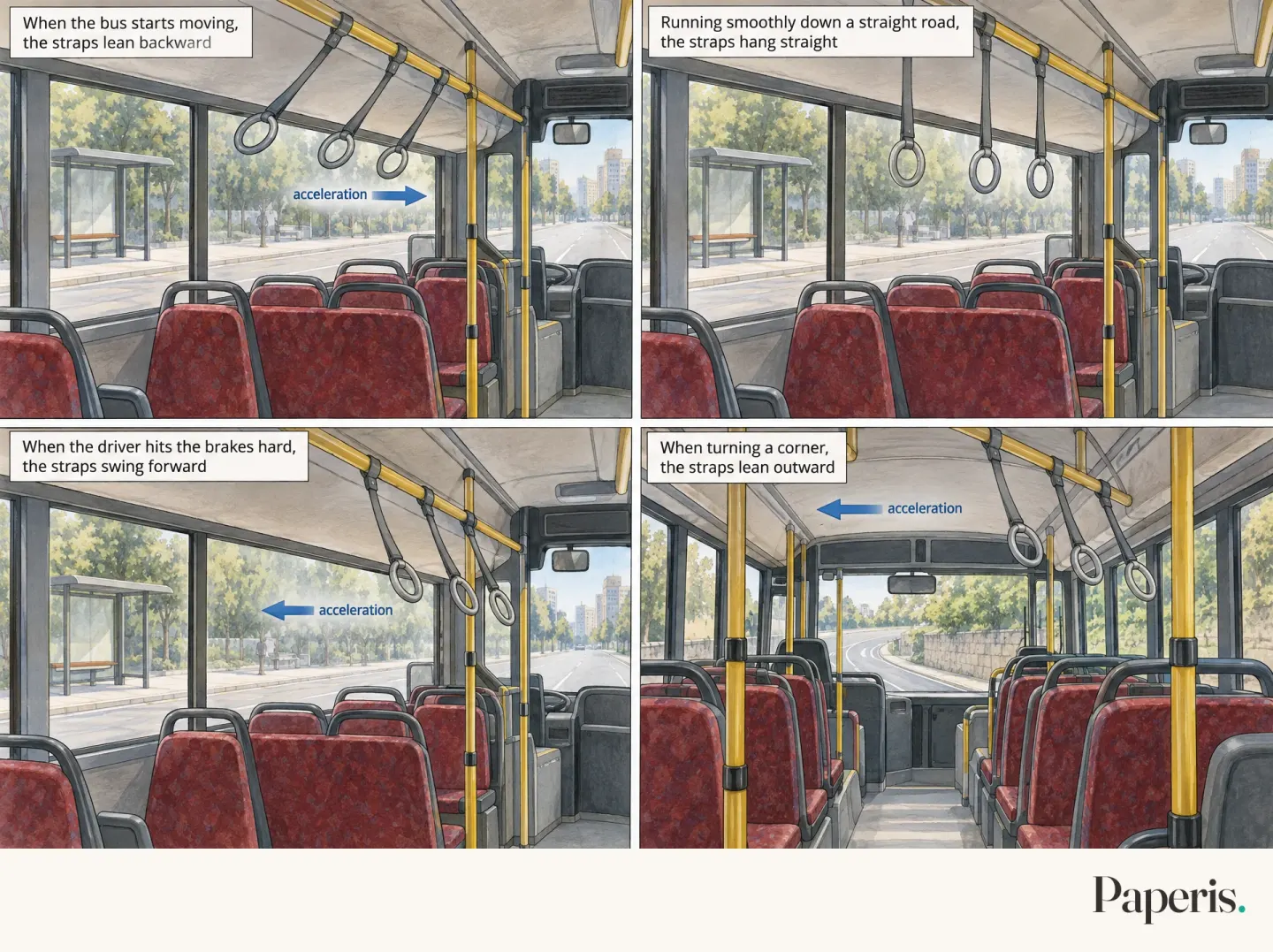
Now, looking back at the three moments from the first section, a common thread is revealed. The three moments when the handle swings are all moments when acceleration is present. A bus running straight at 60 kilometers per hour is fast, but its acceleration is zero, and that is why the handle is quiet.
What Changes Speed
To start a bus, stop it, and make it turn a corner, something must push or pull the bus. This thing that changes speed is force. A force is a push or a pull on an object. A person pushing a cart, and the Earth pulling an object downward, are both forces. Just like when a magnet pulls on a piece of iron or the Earth pulls on an object, there are also forces that act without touching (OpenStax Physics 4.1).
A force has both a magnitude and a direction, and when multiple forces act on a single object together, they combine with one another. The net force is the sum of all the forces acting on an object, taking their directions into account. When forces of the same magnitude act in opposite directions, they oppose each other and the net force becomes zero (OpenStax Physics 4.1).
The strap handle on the ceiling of a bus is an example of this. The string suspending the handle pulls the handle upward, and the Earth pulls the handle downward. Because the magnitudes of the two forces are equal and the net force is zero, the handle stays still while hanging (OpenStax Physics 4.1). The handle starts to swing when this balance is broken.
A Body That Wants to Keep Going
If you push an empty shopping cart hard at the grocery store and let go, the cart rolls a little and stops. Our everyday experience is that a moving object usually slows down and stops unless someone keeps trying to move it (OpenStax Physics 4.2). That is why the idea that "you have to keep pushing to make something move" naturally takes root.
Physics education research has recorded what forms this belief leaves behind. One of them is the belief that the energy given by a push stays inside the object and wears out over time. One study of 30 high school students categorized these beliefs into four types and reported that after inquiry-based classes, this misconception decreased from 76.7% to 33.4% (DOI: 10.24042/tadris.v10i1.28135).
What stopped the cart is the friction between the floor and the wheels. Friction is a force that opposes the sliding motion between two touching surfaces, or holds them so they do not slide. Air resistance, which slows down the movement of an object, is also a form of friction (OpenStax Physics 4.2). On a smooth surface with almost no friction, an object given a single push slides along while losing almost none of its speed (OpenStax Physics 4.2). Walking is also difficult on an ice rink because the friction between your feet and the ground is small (OpenStax Physics 5.4).
What remains when you strip away friction is a simple rule. Newton's first law is the law that when the net force is zero, an object at rest stays at rest and a moving object keeps moving straight at the same speed. The property of the object underlying that also has a name. Inertia is the tendency of a stopped object to stay stopped, and a moving object to keep going straight at the same speed. Textbooks credit Galileo as the first person to explain inertia, and the scientist Isaac Newton made this the first of his laws of motion. That is why the first law is also called the law of inertia (OpenStax Physics 4.2).
This also solves why you must keep pushing while moving a luggage cart at the same speed. The pushing force from you and the friction from the floor have the same strength and opposite directions, so the net force is zero, and the cart therefore maintains its speed (OpenStax Physics 4.2). Pushing is the work of making up for friction.
The feeling of your body being pushed outward when a bus turns a corner is read through the same rule. Viewed from outside the bus, there is no actual force pushing your body outward. Your body tries to keep going straight according to inertia, and the bus strays from that straight path and curves, so it simply looks inside the bus as if your body is being pushed outward (OpenStax Physics 6.2). Your body leaning forward during a sudden stop is because while the bus slows down, your body tries to keep going as it was doing (OpenStax Physics 4.2). Seen from the ground, there is no force pushing your body forward at this time. It just feels like you are being pushed forward inside the bus, and it is the same principle as the feeling of being pushed outward at a corner (OpenStax Physics 6.2). The car seatbelt prevents a person from flying toward the windshield during a collision (OpenStax Physics 8.1).
Same Force, Different Response
If you push an empty cart and a cart loaded with a pack of bottled water with the same force, the empty cart speeds up easily and the full cart speeds up much more slowly.
The value that creates this difference is mass. Mass is a measure of the amount of matter in an object. An object's inertia is proportional to its mass. The larger the mass, the stronger the tendency to keep doing what it was doing (OpenStax Physics 4.2).
Force, mass, and acceleration are bound together in a single sentence. Newton's second law is the law that an object's acceleration increases as the net force increases, and decreases as the mass increases. Acceleration occurs in the same direction as the net force. Written as an equation, force is mass multiplied by acceleration (F = ma) (OpenStax Physics 4.3).
The unit of force also comes from this equation. A force that makes an object with a mass of 1 kilogram speed up by 1 meter per second every second is called 1 newton (N) (OpenStax Physics 4.3). Even when pushed with the same force, an object with twice the mass has half the acceleration. This is why the full cart speeds up slowly. If you stack several packs of bottled water taken off the cart on the floor and push them, they might not budge at first. This is a different story from mass. This is because the friction with which the floor holds onto the packs of bottled water grows to match the pushing force, leaving the net force at zero (OpenStax Physics 5.4).
The Kilogram in the Weight Box
The weight box on a health checkup report lists kilograms. But in physics, weight is a force, and the unit of force is the newton. Medical records that list weight in newtons are hard to find (OpenStax Physics 4.3). Two terms that we mix together in daily life diverge in physics.
Let us look first at the force that creates weight. Gravity is the force that objects with mass pull each other with. (OpenStax Physics 23.1) Gravity was also what pulled down the handle on the ceiling. Weight is the magnitude of the gravitational force acting on an object, which on Earth is the force with which the Earth pulls that object. (OpenStax Physics 4.3)
The place where the two diverge is the moon. The moon's gravity is weaker than the Earth's, so the weight of an object with a mass of 1 kilogram is 9.8 newtons on Earth but about 1.7 newtons on the moon (OpenStax Physics 4.3). It is about one-sixth. Yet the mass of that object is the same on Earth, inside a spaceship orbiting the Earth, and on the lunar surface (OpenStax Physics 4.2). Weight changes together when gravity changes, while mass stays the same everywhere.
The reason we confuse the two words is that we live only on the Earth. No matter where on Earth it is measured, the weight of the same object is nearly the same, so there is rarely an occasion to tell weight and mass apart (OpenStax Physics 4.3). Therefore, when we ask "how much does it weigh" in daily life, what we are actually asking is usually mass.
Will the Heavier Object Fall First?
If you drop a bowling ball and a ping-pong ball from the same height at the same time, which one hits the ground first? In a survey diagnosing the concepts of physics education students—soon-to-be teachers—who had taken or were taking a mechanics course at a university, the prevalence of the misconception that "heavy objects fall faster than light ones" was found to be 89.3%. That was the second-highest misconception in the survey, and the sample size is not stated in the abstract (DOI: 10.24815/jpsi.v6i2.11897).
The answer, if air resistance can be ignored, is "they hit at the same time." The heavier bowling ball is pulled harder by the Earth because weight is proportional to mass. However, the bowling ball is also just as hard to speed up because of its large mass. According to the second law, acceleration is produced by force divided by mass, and the stronger force and larger mass lock into place at the exact same ratio. Therefore, objects falling under gravity alone accelerate at 9.8 meters per second every second on Earth, regardless of their weight (OpenStax Physics 4.3).
In reality, a feather or an unfolded piece of paper falls far behind a pebble. The culprit is air resistance. Objects falling near the ground are always acted upon by an upward resisting force from the air, so they never fall under the influence of gravity alone (OpenStax Physics 4.3). A feather is light yet spread out wide, so it experiences a large amount of air resistance.
Apples and Moon
Does the force that dragged the bowling ball and the ping-pong ball to the floor, the force that pulled the ceiling handle down, work only on the ground? Newton was the first to show with precise mathematics that an object falling to the ground and a celestial body in the sky can be explained by the exact same single force (OpenStax Physics 7.2). It is precisely that gravity which holds the Moon in orbit around the Earth (OpenStax Physics 7). Every object in the universe attracts every other object, and that force is proportional to the product of the two objects' masses and inversely proportional to the square of the distance between them. When the distance becomes twice as far, the pulling force becomes one-fourth. Meaning that it acts between all objects in the universe, this gravity is also called universal gravitation (OpenStax Physics 7.2).
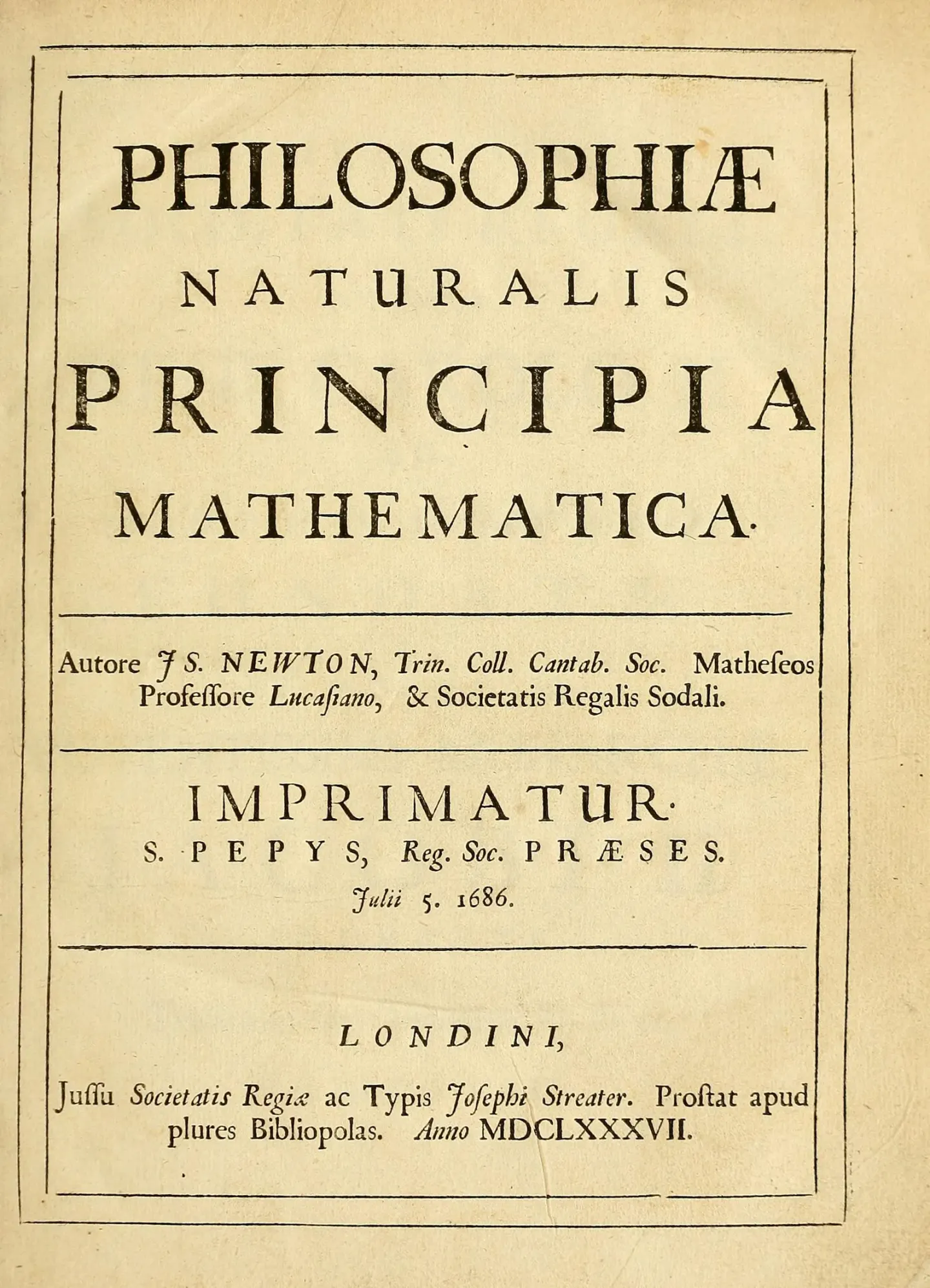
Title page of the first edition of Newton's Principia, 1687 · Isaac Newton, 1687 (Burndy/Dibner copy) · Wikimedia Commons (public domain)
Then why doesn't the Moon fall to the Earth like an apple? Thinking back to the bus going around a traffic circle solves it. For a bus to turn in a circle, the friction between the road and the tires must keep pulling the bus toward the inside of the circle. On the Moon, the Earth's gravity does that job (OpenStax Physics 6.2). The Moon tries to go straight according to inertia, and the Earth's gravity keeps bending that path inward. The result is the Moon's near-circular path.
Even though it is a force that reaches all the way to the Moon, gravity is the weakest among the fundamental forces of nature (OpenStax Physics 23.1). Even so, we constantly feel gravity because we live on top of a massive mass called the Earth.
Forces Come in Pairs
When a bus starts moving, what pushes the bus forward? The wheels push the road backward, and the road pushes the wheels forward in reaction. When we walk, our feet push the ground backward, and the ground pushes us forward (OpenStax Physics 4.4).
Newton's third law states that when one object exerts a force on another object, that object simultaneously exerts a force of the same magnitude in the opposite direction. Forces always arise in pairs, and that pair is called action and reaction. Which one is called the action depends on who is looking (OpenStax Physics 4.4).
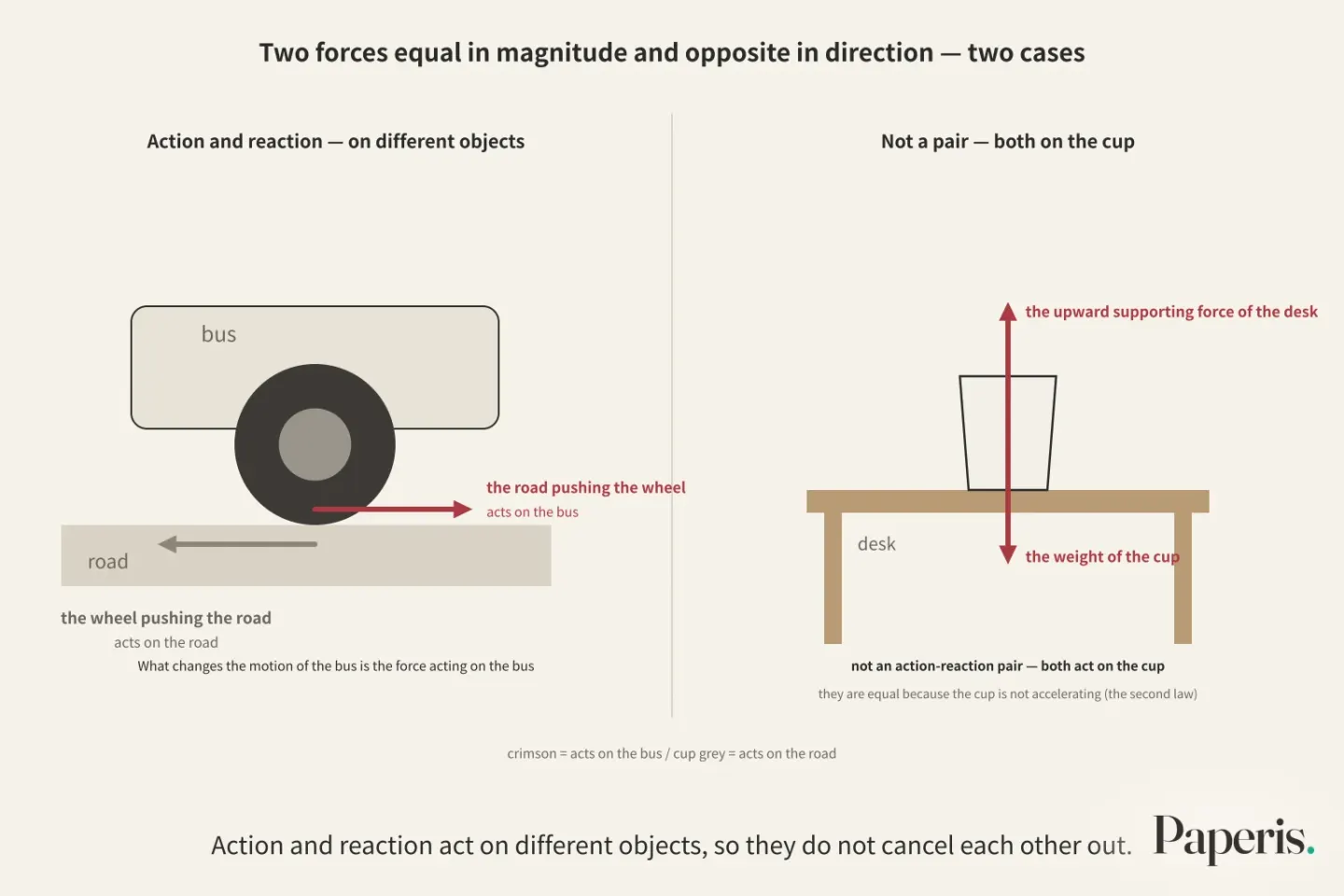
A common question arises here: if two forces are equal in magnitude and opposite in direction, shouldn't they cancel each other out so that nothing moves? Action and reaction act on different objects, so they do not cancel each other out. The force of the road pushing the wheel acts on the bus, and the force of the wheel pushing the road acts on the road. What changes the motion of the bus is the force acting on the bus (OpenStax Physics 4.4).
This pair also exists between an apple and the Earth. The force with which the Earth pulls the apple and the force with which the apple pulls the Earth are equal in magnitude (OpenStax Physics 7.2). However, because the Earth has a massive amount of mass, its movement is not noticeable even when it receives a force of the same magnitude (OpenStax Physics 8.2). The second law comes into play here again.
There is also a counterexample that is easy to confuse. A cup on a desk is acted upon by both the weight of the cup and the upward supporting force of the desk. The two forces are equal in magnitude and opposite in direction, but they are not an action-reaction pair. Both act on a single object—the cup—and the reason they are equal is because the cup is not accelerating, in other words, because of the second law (OpenStax Physics 4.4).
Many people find this section difficult. In one study surveying two groups of students, 95% of the students got questions asking about the concept that action and reaction have equal magnitudes wrong, and 93% failed to accurately draw the location where the supporting force acts. Which group and which point in time these figures belong to is not stated in the abstract (DOI: 10.1088/1742-6596/1572/1/012046). It is not easy even for those majoring in physics; in a study surveying 97 prospective physics teachers in Jordan, the percentage who answered third law questions correctly was 20% (DOI: 10.36681/tused.2020.43).
One Sudden Stop All the Way to the End
Now let's bring everything we've learned together into a single bus. A morning commute bus is cruising smoothly down a straight road. The strap handles are hanging straight down. The net force is zero and the acceleration is zero, too.
In front of a bus stop, the driver hits the brakes. Friction between the tires and the road exerts a backward force on the bus (OpenStax Physics 4.2). Because a backward net force has appeared on the bus, the bus gets an acceleration in that same direction—namely, backward—and slows down (OpenStax Physics 4.3).
The ceiling slows down along with the bus, but the strap handle hanging below tries to keep its original speed according to inertia. Therefore, the strap handle swings forward. A standing passenger's body does the same thing. The feet slow down with the floor, but the body tries to keep going as it was, so it pitches forward. Seen from outside the bus, there is no force pushing the body forward even now.
When the passenger grips the strap handle tightly, the handle pulls the body backward through the hand, and the body slows down along with the bus. As a pair, the body pulls the strap handle forward with a force of the same size (OpenStax Physics 4.4). If you are wearing a heavy backpack on your back, it is harder to stop the backpack and your body together with the same force. This is because when mass grows larger, the acceleration produced by the same force becomes smaller (OpenStax Physics 4.3). When the bus comes to a complete stop, the net force becomes zero again, and the strap handle hangs straight down once more.
In a passenger car, the seatbelt does the job of the hand gripping the strap handle (OpenStax Physics 8.1). To see what an airbag does, we need one more value. Momentum is the value obtained by multiplying mass by velocity, which Newton called the "quantity of motion." Because a person inside a crashed car has to stop no matter what, the momentum that needs to be reduced is fixed whether there is an airbag or not. Instead of wiping out that momentum in a single instant, the airbag reduces it over a much longer time, making the force that stops the person much smaller (OpenStax Physics 8.1).
What the Strap Does Not Tell You
The strap analogy has limits. Because the strap reacts when the bus's speed changes forward, backward, or to the side, it does not tell you what kilometer-per-hour speed the bus is traveling at right now. Like people inside a windowless ship, the strap also cannot tell smooth motion and stopping apart. And our bodies, tilting along with the strap, feel that tilt as a "force pushing forward." That interpretation, where we think something is pushing the body, is the illusion this article has tried to correct the whole way through.
That illusion does not vanish easily. In a study where 341 university students took a concepts-of-force-and-motion test before and after class, their overall scores improved a little, but very stubborn misconceptions that even class could not change remained (DOI: 10.1088/1361-6552/52/1/014003). Even in conditions resembling everyday life, such misconceptions often remain, and a review paper suggests that a significant portion of them stem from overly broad application of the experience of seeing and handling objects (DOI: 10.3390/jintelligence11100187).
They can be fixed. In a study targeting 396 high school students across 18 classes, the side that received classes called "conceptual change discussions" for 8 weeks saw the number of misconceptions about force and motion decrease and achievement rise (DOI: 10.1002/tea.10054). However, whether the intuitive physics in our heads is a single woven system or a collection of pieces we pull out depending on the situation remains a debated question (DOI: 10.1088/1361-6404/aa940f).
Objects tend to keep doing what they were doing, force changes that motion, and force always arises in pairs between two objects. The next time a bus strap sways, you can read whether the bus is speeding up, slowing down, or changing direction.
Where to Look Next
What inertia does outside of a bus can be seen in the power grid. The property of a spinning object to keep spinning is also called inertia. "The Few Seconds a Generator's Spinning Mass Gave Away for Free — What Gets Harder as Grid Inertia Falls" covers how the inertia of large, fast-spinning generators helps the power grid hold its ground during sudden failures. The rhythm at which those generators spin together continues in "Alternating Current and Frequency — A Giant Merry-Go-Round the Whole Country Pushes Together".
"Energy — Money That Doesn't Shrink When Exchanged, Odd Coins Scattered in Your Pockets" covers the energy possessed by moving objects and the process by which that energy changes into other forms. If you are curious about where the movement of a cart stopped by friction went, you can continue to that piece. "Heat and Temperature — Water That Only Flows Downhill, a Pump That Lifts It Back Up" explains what the temperature and heat of an object warmed that way are.
Source Papers
- "Physics — 2.1 Relative Motion, Distance, and Displacement" (2020) — OpenStax Physics 2.1 — Distinction between distance and displacement (round trip yields zero displacement), Galileo's windowless ship thought experiment.
- "Physics — 2.2 Speed and Velocity" (2020) — OpenStax Physics 2.2 — Speed is the rate of changing position (no direction), velocity has magnitude and direction, average velocity = displacement ÷ time so a round trip's average velocity is zero.
- "Physics — 3.1 Acceleration" (2020) — OpenStax Physics 3.1 — Acceleration is the change in velocity divided by the elapsed time, unit m/s².
- "Physics — 4.1 Force" (2020) — OpenStax Physics 4.1 — Force is a push or pull, with magnitude and direction, forces acting without contact, net force and the balance of suspended objects.
- "Physics — 4.2 Newton's First Law of Motion: Inertia" (2020) — OpenStax Physics 4.2 — Collision between the first law and everyday experience, friction (including air resistance), zero net force when pushing at constant speed, inertia (Galileo → Newton), mass is the amount of matter and is the same everywhere.
- "Physics — 4.3 Newton's Second Law of Motion" (2020) — OpenStax Physics 4.3 — Acceleration is proportional to net force and inversely proportional to mass, F = ma, newton units, weight = gravity, acceleration due to gravity 9.8 m/s², weight of 1 kg on the moon about 1.7 N, air resistance, kilograms in medical records.
- "Physics — 4.4 Newton's Third Law of Motion" (2020) — OpenStax Physics 4.4 — Forces come in pairs and act on different objects so they do not cancel out, wheels and roads/walking, weight and the supporting force are not a third-law pair.
- "Physics — 5.4 Inclined Planes" (2020) — OpenStax Physics 5.4 — Friction is required to walk (on ice), static friction grows as much as the pushing force and heavy loads are harder to get started.
- "Physics — 6.2 Uniform Circular Motion" (2020) — OpenStax Physics 6.2 — Uniform circular motion is also acceleration, the feeling of being pushed outward on a curve is not a real force, Earth's gravity pulls the moon and road friction pulls the car toward the center of the circle.
- "Physics — Introduction" (2020) — OpenStax Physics 7 — The falling apple and the moon's orbit are due to the same gravity.
- "Physics — 7.2 Newton's Law of Universal Gravitation and Einstein's Theory of General Relativity" (2020) — OpenStax Physics 7.2 — Newton was the first to accurately explain falling objects and celestial motion with the same force, universal gravitation (proportional to the product of masses and inversely proportional to the square of the distance), the magnitude of the force experienced by two objects is the same.
- "Physics — 8.1 Linear Momentum, Force, and Impulse" (2020) — OpenStax Physics 8.1 — Momentum = mass × velocity (Newton's "quantity of motion"), seatbelts and airbags increase stopping time to reduce force.
- "Physics — 8.2 Conservation of Momentum" (2020) — OpenStax Physics 8.2 — When a player hits the goalpost the Earth recoils along with them but its large mass makes it unnoticeable.
- "Physics — 23.1 The Four Fundamental Forces" (2020) — OpenStax Physics 23.1 — Gravity is the weakest fundamental force acting between all objects with mass.
- "Guided Inquiry with Formative Assessment to Reduce Naive Impetus in Learning Newton's First Law" (2025) — DOI: 10.24042/tadris.v10i1.28135 — 30 high school students, four directions of naive impetus misconceptions (such as wearing out over time), 76.7% → 33.4% after intervention.
- "Analisis Miskonsepsi Materi Mekanika pada Mahasiswa Calon Guru Melalui Force Concept Inventory dan Certainty of Response Index" (2018) — DOI: 10.24815/jpsi.v6i2.11897 — Preservice physics education teachers at a university (taking or having completed mechanics), FCI+CRI, misconception level of "heavy objects fall faster" at 89.3% (second highest), sample size not in abstract.
- "Misconception of weights, normal forces and Newton third law" (2020) — DOI: 10.1088/1742-6596/1572/1/012046 — Two student groups, 93% incorrect on the location of the supporting force, 95% incorrect on action and reaction.
- "Jordanian pre-service physics teacher's misconceptions about force and motion" (2020) — DOI: 10.36681/tused.2020.43 — 97 Jordanian preservice physics teachers, 20% correct on third law questions.
- "How persistent are the misconceptions about force and motion held by college students?" (2016) — DOI: 10.1088/1361-6552/52/1/014003 — 341 college students, comparing before and after instruction showing overall slight improvement but leaving stubborn misconceptions unchanged by instruction.
- "Grounding Intuitive Physics in Perceptual Experience" (2023) — DOI: 10.3390/jintelligence11100187 — Review showing that misconceptions persist even in conditions resembling everyday life, and many stem from overgeneralization of perceptual and motor experience.
- "Effects of conceptual assignments and conceptual change discussions on students' misconceptions and achievement regarding force and motion" (2002) — DOI: 10.1002/tea.10054 — 396 high school students in 18 classes, conceptual change discussions reduce the number of misconceptions and raise achievement.
- "Evidence on the coherence–pieces debate from the force concept inventory" (2017) — DOI: 10.1088/1361-6404/aa940f — Results supporting both sides depending on analytical methods regarding whether commonsense physics is a coherent system or fragmented pieces.
Sources (22)
- Physics — 2.1 Relative Motion, Distance, and Displacement
- Physics — 2.2 Speed and Velocity
- Physics — 3.1 Acceleration
- Physics — 4.1 Force
- Physics — 4.2 Newton's First Law of Motion: Inertia
- Physics — 4.3 Newton's Second Law of Motion
- Physics — 4.4 Newton's Third Law of Motion
- Physics — 5.4 Inclined Planes
- Physics — 6.2 Uniform Circular Motion
- Physics — Introduction
- Physics — 7.2 Newton's Law of Universal Gravitation and Einstein's Theory of General Relativity
- Physics — 8.1 Linear Momentum, Force, and Impulse
- Physics — 8.2 Conservation of Momentum
- Physics — 23.1 The Four Fundamental Forces
- Guided Inquiry with Formative Assessment to Reduce Naive Impetus in Learning Newton's First LawDOI 10.24042/tadris.v10i1.28135
- Analisis Miskonsepsi Materi Mekanika pada Mahasiswa Calon Guru Melalui Force Concept Inventory dan Certainty of Response IndexDOI 10.24815/jpsi.v6i2.11897
- Misconception of weights, normal forces and Newton third lawDOI 10.1088/1742-6596/1572/1/012046
- Jordanian pre-service physics teacher's misconceptions about force and motionDOI 10.36681/tused.2020.43
- How persistent are the misconceptions about force and motion held by college students?DOI 10.1088/1361-6552/52/1/014003
- Grounding Intuitive Physics in Perceptual ExperienceDOI 10.3390/jintelligence11100187
- Effects of conceptual assignments and conceptual change discussions on students' misconceptions and achievement regarding force and motionDOI 10.1002/tea.10054
- Evidence on the coherence–pieces debate from the force concept inventoryDOI 10.1088/1361-6404/aa940f