
Paperis Articles
Waves — Fans Rising in Their Seats, a Wave Circling the Stadium
Sound, light and ripples need not carry matter along. Things that stay in place pass the shaking and its energy on — and light alone travels with nothing to pass it on.
Your field's papers, as audio
Pick your fields and journals — Paperis summarizes the key papers and turns them into audio. Listen on your commute.
Start Paperis free →Waves — Fans Rising in Their Seats, a Wave Circling the Stadium
The Wave Going Around the Stadium
At one end of a baseball stadium's stands, people stand up and sit down in turn. A few seconds later, that wave crosses over to the opposite stands, and before long it goes all the way around the stadium. Not a single person has moved from their seat during that time. Each person has simply stood up and sat down in their own spot.
A similar thing happens on top of water. While a wave passes underneath, an object floating on the water's surface mostly just goes up and down in that same spot (OpenStax Physics 13.2). What moves forward is that very motion of the water going up and down.
Sound and light spread in this way too. This article takes a single stadium wave and follows how sound and light spread.
Holding Position While Passing the Sway
That wave circling the stands has a name. A wave is a sway that spreads out from where it first began. Waves carry energy from one place to another, but they do not have to carry matter along with them as well (OpenStax Physics 13.1). Energy is the ability to do work. Put in terms of doing the wave, what goes around the stadium is the movement of "standing up," while the spectators stay behind. Matter usually stays in place, while the sway and the energy go far.
There is just one point where the analogy differs. Spectators look at the person next to them and stand up using their own strength, but air carrying sound directly pushes and releases neighboring air using the energy received from the swaying object (OpenStax Physics 14.1; OpenStax Physics 13.1). In doing the wave, energy does not pass to the person next to you, but in a wave, it does.
Vibration is a movement that goes back and forth repeatedly along the same path around a single spot. One person repeatedly standing up and sitting down is a vibration, and that vibration passing down the line in turn to circle the stadium is a wave. When a wave continues without stopping, individual water particles repeat a vibration going back and forth in the same spot (OpenStax Physics 13.1).
The Scale That Measures Waves
There are several things to ask even about a single wave at a stadium. How far apart are the group that just stood up and the group next in line? How many times does a single seat stand up in one second? How high do the people rise? How fast does the wave travel around?
We call the highest point of a wave a crest, and the lowest point a trough (OpenStax Physics 13.2). Wavelength is the distance between two places where the exact same shape repeats in a wave, like from one crest to the next. In a stadium wave, it is the distance between the group that stood up and the group coming next.
Frequency is the number of shakes that repeat in one second, measured in a unit called Hertz. For a passing wave, it is equal to the number of waves passing a single point in one second; if three waves pass in front of a seat in one second, it is 3 Hertz (OpenStax Physics 13.2).
Amplitude is the distance the shake strays farthest from its resting position. How high you rise from your seated position is the amplitude. Amplitude depends on how much energy is carried in that wave, so it tells you how strong the wave is (OpenStax Physics 13.2).
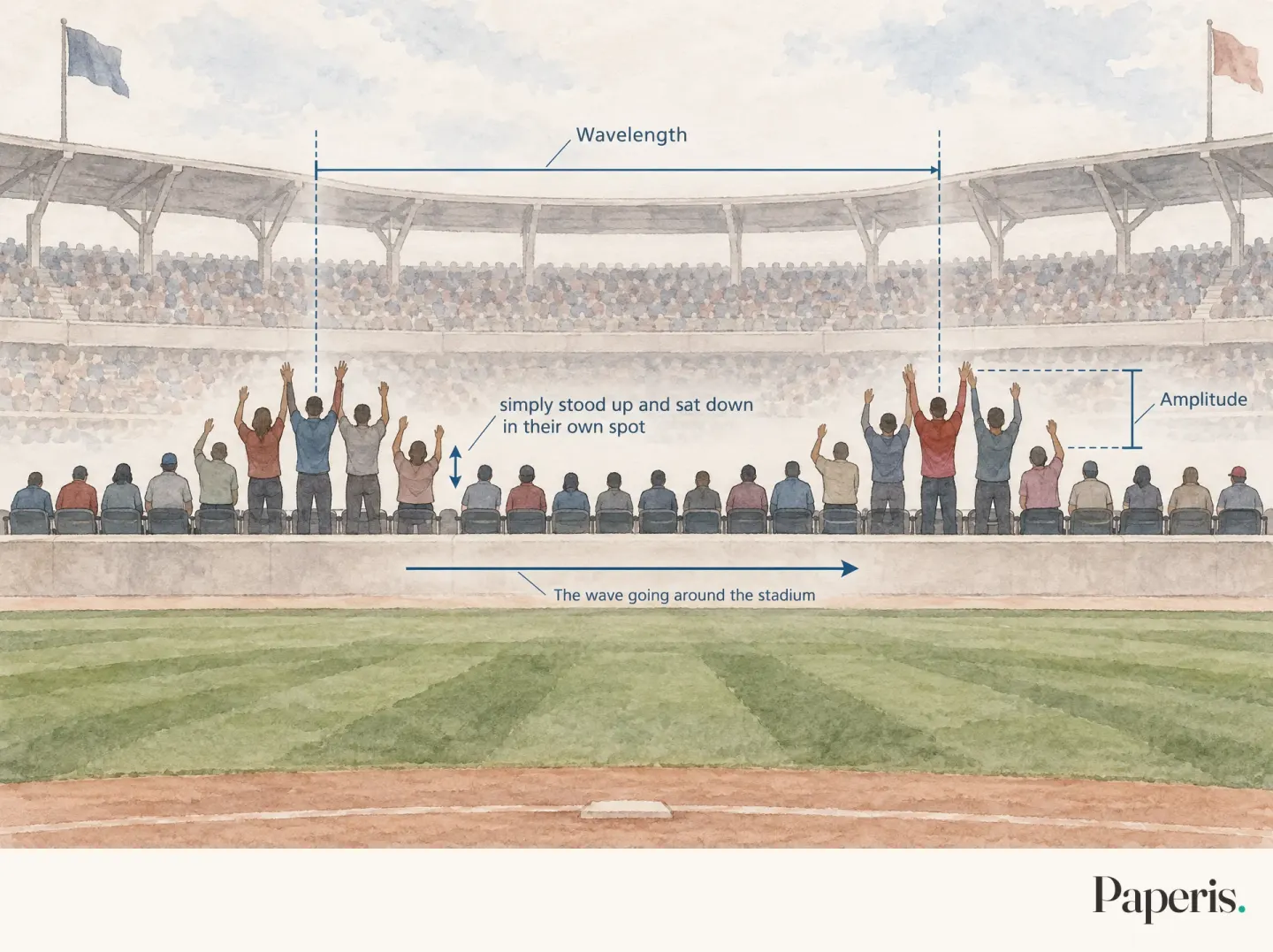
These scales are tied together. The distance a wave travels in one second, in other words its speed, is the frequency multiplied by the wavelength (speed = frequency × wavelength, v = fλ). In the same air, the speed of sound is constant regardless of frequency. Therefore, the higher the frequency of a sound, the shorter its wavelength (OpenStax Physics 14.1).
The misconception tying the speed of sound to frequency is common. In a study examining 36 high school sophomores, the most frequent misconception was that "the speed of sound depends on its frequency" (DOI: 10.52434/jpif.v6i1.43944). High-pitched sounds arrive at the same speed, but their crests are simply closer together.
Waves That Shake Up and Down, Waves That Push and Pull
In a stadium wave, the crowd rises and falls, while the wave travels sideways. The oscillation and the direction of travel are at right angles. A transverse wave is a wave in which the direction of disturbance is perpendicular to the direction the wave travels. A disturbance moving along a guitar string is a transverse wave, and light is also a transverse wave (OpenStax Physics 13.1).
Now, instead of standing up, imagine the crowd leaning toward the person next to them and then returning. Places where people are crowded together and places where they are sparse are created, and this crowding shifts sideways. A longitudinal wave is a wave in which the direction of disturbance is parallel to the direction the wave travels. Sound passing through air and water is a longitudinal wave, and its disturbance is a repeating cycle of higher and lower pressure (OpenStax Physics 13.1). In a longitudinal wave, the compressed regions correspond to the crests of a transverse wave, and the rarefied regions correspond to the troughs (OpenStax Physics 14.1).
Sound — A Ripple Traveling by Pushing and Pulling Air
A cheer song rings out from the stadium speaker. The cone inside the speaker vibrates back and forth, pressing and releasing the air in front of it, and that wave of pressure spreads toward the stands (OpenStax Physics 13.1). Sound is precisely this: a ripple created by something vibrating, spreading outward through matter (OpenStax Physics 14.1).
Because there must be matter to ripple, sound needs matter like air, water, or iron to travel (OpenStax Physics 13.1). Its speed varies depending on the matter. In air at 0 degrees, it is 331 meters per second; in fresh water, 1,480 meters; in steel, 5,960 meters. The harder a substance is to compress, the faster sound travels through it, and when the hardness is the same, the denser the substance, the slower it goes (OpenStax Physics 14.1).
The ear perceives two scales of sound separately. Frequency is heard as pitch, and intensity is heard as loudness. The frequencies a human can hear range roughly from 20 hertz to 20,000 hertz (OpenStax Physics 14.2).
Decibel — A Scale for Sound Intensity
The quiet stands before a match and the roar of a sudden goal differ immensely in intensity. The ear does not feel this wide range as the raw intensity itself, but rather closer to how many times over the intensity grows. The scale tailored to that method is the decibel (OpenStax Physics 14.2).
The decibel is a scale that sets the faintest sound a person with normal hearing can barely hear to 0, and goes up by 10 every time the sound's intensity increases tenfold. So a 90-decibel sound has an intensity 1,000 times greater than a 60-decibel sound. However, the loudness felt by the ear is closer to the decibel number side than this intensity (OpenStax Physics 14.2).
Sound gets softer the farther away it goes. This is because the energy of the sound spreads over an increasingly wide area, and some of it turns into heat that warms the air (OpenStax Physics 14.1).
Prolonged exposure to loud sounds can damage the ear. Auditory fatigue, where the ears feel muffled in a noisy place, gradually recovers once you get away from the noise, but staying in such an environment for a long time permanently damages hearing (PMID 31498679). Noise accounts for one-third of global hearing loss, and hearing loss caused by noise is considered irreversible (PMID 37441605). Workplace noise remains a common cause, and cases caused by everyday noise such as personal music devices are also increasing, a 2014 review notes (PMID 24183105).
The Approaching Siren
When an ambulance approaches with its siren wailing and then passes by, the sound drops from a high pitch to a low pitch the moment it goes past. The faster the ambulance, the greater the shift in pitch (OpenStax Physics 14.3). The Doppler effect is a phenomenon where the frequency received changes when the source and the observer of a wave move closer together or farther apart. In sound, that change is heard as pitch.
The reason lies in the spacing between wave crests. As the ambulance moves while making sound, the spots where the air is compressed crowd closer together in front of where it is heading and spread apart behind it. The speed of sound is set by the air, so it stays the same even when the ambulance moves, which is why a person in front receives shortened wavelengths and hears a high frequency, while a person in back receives lengthened wavelengths and hears a low frequency (OpenStax Physics 14.3).
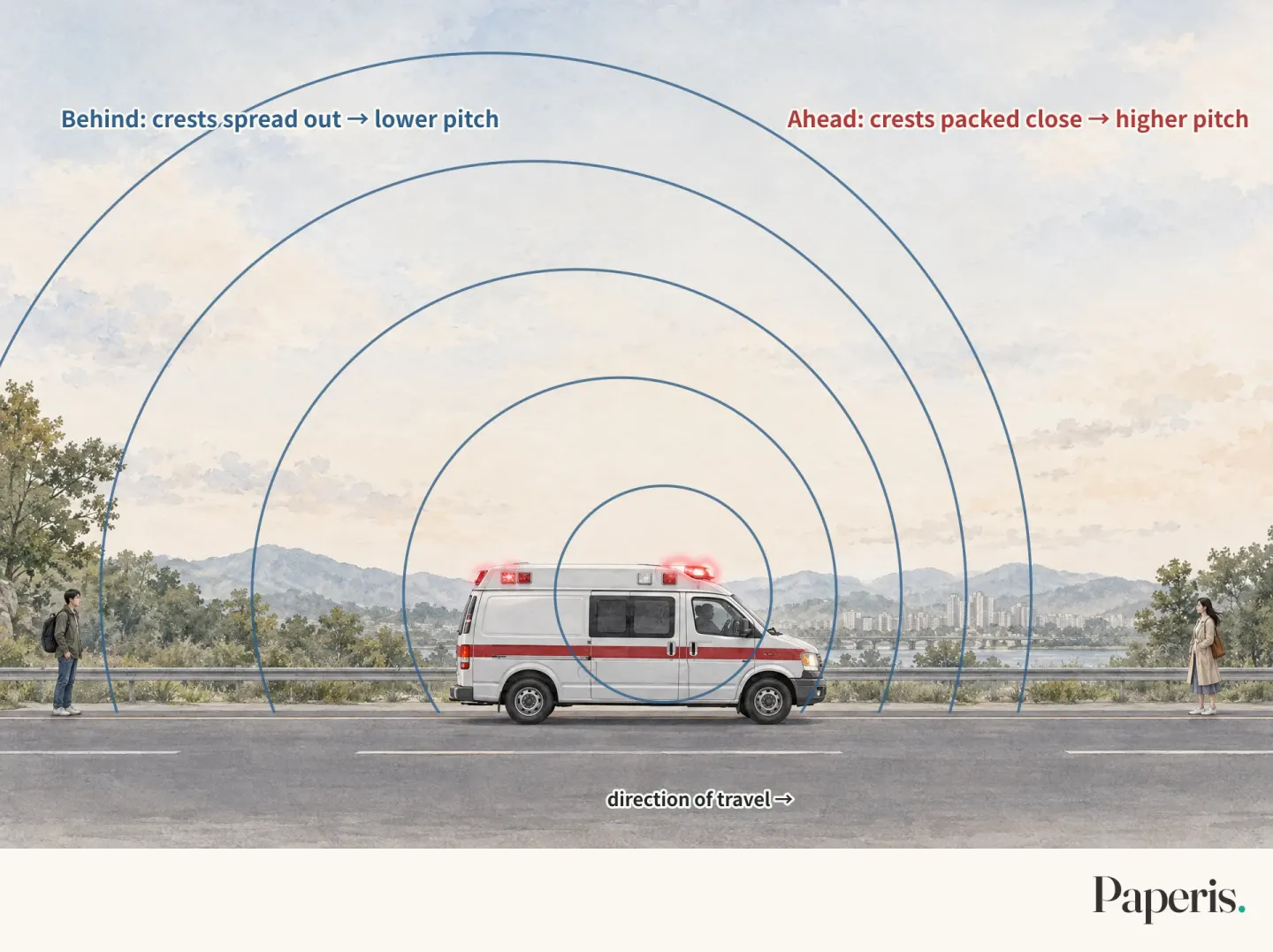
Illustration: Paperis (lines and labels drawn from the article)
It is the same even if only the observer moves. When you ride in a car heading to a stadium and pass by a stationary ambulance parked by the road wailing its siren, it sounds high while you are approaching and low once you move away (OpenStax Physics 14.3). Light and radio waves behave similarly: waves coming from an approaching object have a higher frequency, and those from a receding object have a lower frequency (OpenStax Physics 15.1). The Doppler effect is widely used in medical imaging and speed measurement, and satellite navigation receivers use it to measure a car's speed much more accurately than the speedometer on the dashboard (DOI: 10.1088/0031-9120/52/1/015002).
Overlapping Waves
When two waves meet in one place, their oscillations overlap. Interference is the phenomenon where two waves meet at the same time and place, and their oscillations add up or cancel out. If the crests and crests, and troughs and troughs, of two identical waves match up precisely, they become a wave with twice the amplitude, and if the crests and troughs mesh precisely, they cancel each other out and the amplitude becomes zero. Waves seen in nature are usually a mix of these two (OpenStax Physics 13.3).
Certain headphones use this cancellation. They quickly analyze incoming noise and emit one more sound with its crests and troughs exactly reversed to erase the noise (OpenStax Physics 14.4). Interference is also a marker for recognizing what a wave is. Interference is visible in water waves, in sound, and in light. When light is passed through two very narrow slits, bright and dark bands alternate, which is the interference of light (OpenStax Physics 17.1).
Every object has a frequency it likes to oscillate at on its own. If you shake it in time with that frequency, the oscillation grows larger and larger, and if the timing is off, it does not grow much. Instrument strings also have strings with the same frequency as the incoming sound pushed by that sound to resonate the loudest (OpenStax Physics 14.4). Resonance is the phenomenon where oscillations grow large when an object is shaken with the same tempo as its natural oscillation frequency.
Waves Bouncing and Bending at Boundaries
Reflection is the phenomenon where a wave hits a boundary, bounces back, and changes direction. A wave reaching the end of a musical instrument string with a tied end and coming back is also reflection (OpenStax Physics 13.3). A face reflected in a mirror is reflection too, and the rule for reflection off a smooth surface applies equally to all waves, including light (OpenStax Physics 16.1). Sonar, which sends sound into water and catches the returned sound, also uses reflection (DOI: 10.1093/actrade/9780198803782.003.0003).
Refraction is the phenomenon where the traveling direction of a wave bends as it diagonally passes the boundary between materials with different speeds. Light is fastest in a vacuum and slows down when it enters materials like air or water, and the extent of that slowing differs by material. That is why light coming out of water into air diagonally turns its direction at the boundary. Bending at a boundary where speed changes is a property not just of light but of waves in general, and lenses focusing light is also thanks to this bending (OpenStax Physics 16.2).
The Wave That Travels Without Spectators
Sound and water are waves that need a medium to shake them along. Light is different. Light also passes through a vacuum with no matter, like empty space in the universe (OpenStax Physics 13.1). The stadium wave analogy stops here. Light is a wave that travels even without spectators to shake it along.
An electromagnetic wave is a wave created when charged particles shake or speed up and slow down, spreading outward through oscillations of electricity and magnetism. When an electric charge shakes back and forth like alternating current, electromagnetic waves spread outward (OpenStax Physics 15.1). Alternating current, where the direction of electricity changes without rest, was covered in "Alternating Current and Frequency — A Giant Merry-Go-Round the Whole Country Pushes Together".
Regardless of their type, electromagnetic waves all travel through a vacuum at the same speed, about 300,000 kilometers per second. This is called the speed of light. Electromagnetic waves starting from the Sun, no matter their wavelength, arrive at Earth together a little over 8 minutes later (OpenStax Physics 15.2).
Light Lined Up in a Row
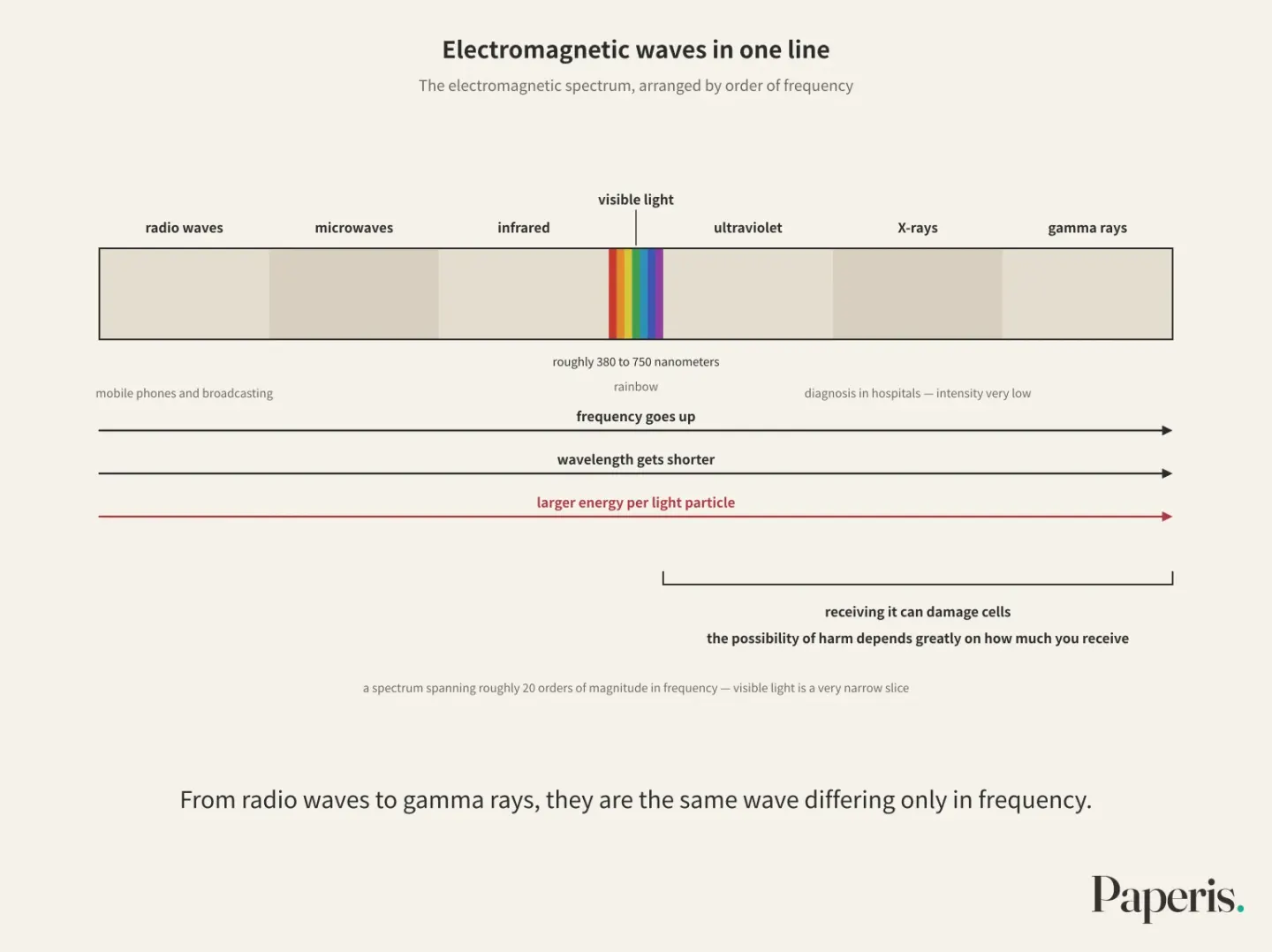
A rainbow is the appearance of various colors mixed in sunlight spread out in a row (OpenStax Physics 15.1). That line continues beyond both ends visible to the eye. The electromagnetic spectrum is an arrangement of electromagnetic waves in a line by order of frequency. Starting from the lowest frequency, radio waves, microwaves, infrared, visible light which is the light we can see, ultraviolet light, X-rays, and gamma rays are placed in order (OpenStax Physics 15.1).
They are all the same kind of wave. They all pass through empty space and travel at the same speed in a vacuum. The difference between them is their frequency, and as the frequency goes up, the wavelength gets shorter (OpenStax Physics 15.1). From radio waves to gamma rays, they are the same wave differing only in frequency. Visible light is a narrow band with wavelengths roughly 380 to 750 nanometers (OpenStax Physics 17.1), making up a very narrow slice across the entire spectrum spanning roughly 20 orders of magnitude in frequency (OpenStax Physics 15.1).
There is one more thing that changes as you go up the band. The higher the frequency of the light, the larger the lump of energy a single light particle hands over at once (OpenStax Physics 21.1). This is a scale different from how strong the entire wave is, and the strength of the wave is determined by the amplitude we saw earlier (OpenStax Physics 13.2). The side with a higher frequency than visible light has larger energy per light particle and penetrates deeply, so receiving it can damage cells. The possibility of suffering harm depends greatly on how much you receive (OpenStax Physics 15.1). X-rays used for diagnosis in hospitals are on this side, and the intensity used for diagnosis is very low (OpenStax Physics 15.1).
The Single Word "Electromagnetic Waves"
In the news, "electromagnetic waves" are usually referred to as a single lump, and the misleading delivery by media outlets is pointed out as one of the causes of misunderstandings about electromagnetic radiation. A 2024 review gathering these misconceptions points out that common misconceptions include bundling ionizing radiation and non-ionizing radiation together, and believing that all radiation is harmful (DOI: 10.30935/ejsee/15719).
Ionizing radiation is radiation with energy large enough to knock electrons off the atoms it hits. On the electromagnetic spectrum, the end with the highest frequency is the ionizing side, and passing down that band of light brings us to the radio wave side (DOI: 10.23749/mdl.v113i2.12636). The radio waves used by mobile phones and broadcasting belong to the non-ionizing side (PMID 38151370; PMID 42462234). Because ionizing radiation includes things that are not electromagnetic waves, that story is continued in "Atoms and Radiation — A Drizzle That Never Stops, a Rain Gauge for How Wet We Get" in this series.
The "radio waves" referred to by the studies below range from 100 kilohertz to 300 gigahertz, a term that together covers radio waves and microwaves from the preceding band (PMID 42462234). The health effects of this range were examined by 13 large-scale reviews commissioned by the World Health Organization (WHO). In epidemiological studies involving humans and some volunteer experiments, there was no increase in risk for most health effects, and the certainty reached up to "moderate," the highest grade in observational studies. There were also results showing changes in cognitive performance and reduced sperm vitality, but the certainty was "very low" (PMID 42462234).
In animal studies, it was reported with high certainty that one type of brain tumor and one type of heart tumor increased in male rats, and what this result means for humans remains a core question (PMID 42462234). Tumors did not increase in most organs, but those two tumors that increased with high certainty are the same types of tumors that the International Agency for Research on Cancer (IARC) working group considered to have limited evidence in humans. However, the same review noted that translating animal results into human risks is particularly complex for radio waves (PMID 40339346).
The link between mobile phones and tumors in the head was examined separately by a 2024 WHO-commissioned review (63 papers from 22 countries). It evaluated the evidence that mobile phone use does not increase the risk of various head tumors in adults and brain tumors in children as "moderate certainty" (PMID 39241333). There are other results. In a 2018 meta-analysis gathering 10 papers, simply having used a wireless phone did not increase the risk of a brain tumor called glioma (1.03-fold), and this combined value varied greatly in results from study to study. In a subgroup analysis looking separately at people who used them for 10 years or more, the risk rose to 1.33-fold, leading the authors to conclude that the risk may increase in long-term users (PMID 29709736).
That same 2024 review gathered only studies with a low risk of bias to examine people who used mobile phones for 10 years or more, and the glioma risk was 0.95-fold, close to 1. Because the gathered studies and phone types differed from the 2018 meta-analysis, this was not a remeasurement of the exact same value (PMID 39241333).
An earlier 2009 review summarized that use within about 10 years did not show an increased risk of head tumors, but also noted that for slow-growing tumors and gliomas in long-term users, the observation period was too short, making the result of "no association" still less certain (PMID 19593153).
There are also people who feel that their heads hurt because of radio waves. In a 2024 review gathering 41 experiments (2,874 participants), short-term exposure below regulatory standards did not cause symptoms, and participants could not guess whether the radio waves were turned on any better than by chance. The review noted that the experiments focused on short-term exposure and young, healthy volunteers, and while the possibility that the actual effects of sensitive individuals were masked among insensitive people cannot be ruled out, it also found no evidence that particularly vulnerable individuals exist separately (PMID 38640611). Results showing that symptoms were linked to believing one was exposed rather than actual exposure were repeated (PMID 38640611; PMID 19681059). There is a contrasting view. A 2022 narrative review argues that the provocation experiments to date are of low quality and can neither prove nor disprove causality, and proposes new studies measuring the body's molecular responses, along with the authors' view that it is logical to consider that people sensitive to electromagnetic fields exist (PMID 34229366).
A review gathering 56 studies that measured the intensity of radio waves people actually receive summarizes that the measured values were far lower than the maximum limits set by international guidelines (ICNIRP) (PMID 36460078). Meanwhile, regarding 5G, there are reviews criticizing that the duration of exposure is still short, lacking sufficiently large health studies, and that current safety standards only consider thermal heating effects (PMID 38151370).
The upper end of the band can damage cells and that possibility depends heavily on how much you receive, whereas on the radio wave side, most human studies to date have shown no increased risk, but the meaning of long-term use and animal results remains an open question. When asking about "electromagnetic waves," answers diverge only when you ask together which position on the band it occupies and how much you receive.
The Stadium on Fireworks Night
On the night a match ends, the wave that swept once around the stands dies down, and the fireworks begin. When fireworks burst in the sky, the flash is seen first, and the boom arrives a little later (OpenStax Physics 14.1). The flash is an electromagnetic wave that even travels through a vacuum at roughly 300,000 kilometers per second (OpenStax Physics 15.2), and the boom comes at a little over 300 meters per second by pressing and releasing the air (OpenStax Physics 14.1).
The air that carried that boom merely pressed and released its surroundings between the sky and the stands. This is because a wave can carry energy without having to carry matter itself (OpenStax Physics 13.1). It is just like the spectators doing the wave a moment ago, standing up and sitting back down in their seats.
An ambulance drives past on the road outside the stadium. The siren that was high as it approached drops the moment it passes by (OpenStax Physics 14.3). A spectator sends a photo of the fireworks using their mobile phone. The radio wave carrying the photo and the flash that reached the eye sit in different places on the same electromagnetic spectrum, differing only in frequency (OpenStax Physics 15.1).
The sound and light of this night are both waves. Sound needs spectators called air to cross over, while light crosses over without any spectators. Both have their strength measured by amplitude, and repeating waves like sirens or radio waves are also measured by wavelength and frequency.
Where to Look Further
Electricity swaying back and forth that creates electromagnetic waves can be seen in "Alternating Current and Frequency — A Giant Merry-Go-Round the Whole Country Pushes Together". Drawing semiconductor circuits with short-wavelength light is covered by "Lithography — Painting Circuits with a Brush of Light", and checkups taking pictures inside the body with X-rays to read small spots are covered by "Lung Cancer and Low-Dose CT Screening — Reading a Small Spot in the Picture Over Time". The path where waves of sound reaching the ear turn into nerve signals leads to "Sensation and Perception — Clues Taken at the Door, a Scene Pieced Together by Guesswork".
Other pieces in this series follow as well. "Atoms and Radiation — A Drizzle That Never Stops, a Rain Gauge for How Wet We Get" covers ionizing radiation and dose, "Energy — Money That Doesn't Shrink When Exchanged, Odd Coins Scattered in Your Pockets" covers the principle that the total amount of energy is conserved even when it changes form, and "Heat and Temperature — Water That Only Flows Downhill, a Pump That Lifts It Back Up" covers the path by which heat transfers via radiation.
Source Papers
- "Physics — 13.1 Types of Waves" (2020) — OpenStax Physics 13.1 — Waves transfer energy through a disturbance that spreads from where it is created without necessarily moving matter itself; sound and water waves require a medium, whereas light can also travel through a vacuum. The distinction and examples of transverse and longitudinal waves (guitar strings, electromagnetic waves, sound in air, seismic waves).
- "Physics — 13.2 Wave Properties: Speed, Amplitude, Frequency, and Period" (2020) — OpenStax Physics 13.2 — Definitions of amplitude, frequency (1 Hz = one cycle per second), and wavelength, along with crests and troughs. Amplitude depends on the amount of energy carried by the wave, and in a simplified model, something on a water wave bobs up and down in place.
- "Physics — 13.3 Wave Interaction: Superposition and Interference" (2020) — OpenStax Physics 13.3 — When crests meet crests, the amplitude doubles; when a crest and a trough align, they cancel out to zero. Waves in nature typically undergo mixed interference, and reflection is the change in direction of a wave when it hits a boundary.
- "Physics — 14.1 Speed of Sound, Frequency, and Wavelength" (2020) — OpenStax Physics 14.1 — The definition of sound, where speed equals frequency multiplied by wavelength, the speed of sound in different materials, and the effects of stiffness and density. Speed is nearly independent of frequency, a flash of light arrives before sound, the energy of a vibrating string pushes and then releases the air, and why sound diminishes with distance.
- "Physics — 14.2 Sound Intensity and Sound Level" (2020) — OpenStax Physics 14.2 — Frequency is perceived as pitch and intensity as loudness, with human perception of intensity roughly following a logarithmic scale. The decibel scale (0 dB being the threshold of normal hearing, with every 10 dB representing a tenfold increase), and the human hearing range of roughly 20 to 20,000 Hz.
- "Physics — 14.3 Doppler Effect and Sonic Booms" (2020) — OpenStax Physics 14.3 — The changing pitch of a siren, the principle by which crests crowd together in front of a moving sound source, and the same effect occurring when the listener moves.
- "Physics — 14.4 Sound Interference and Resonance" (2020) — OpenStax Physics 14.4 — Objects vibrate most easily at their natural frequency and resonate when driven at that frequency, strings of the same frequency sympathetically vibrate, and noise-canceling headphones utilize destructive interference.
- "Physics — 15.1 The Electromagnetic Spectrum" (2020) — OpenStax Physics 15.1 — Accelerating electric charges produce electromagnetic waves, which span from radio waves to gamma rays as the same type of radiation differing only in frequency, and a rainbow is a combination of visible light colors. Radiation with frequencies higher than visible light carries the risk of cellular damage, with the potential for harm depending heavily on the dose received, and diagnostic X-ray intensities are very low. The Doppler effect for electromagnetic waves spans a range of roughly 20 orders of magnitude.
- "Physics — 15.2 The Behavior of Electromagnetic Radiation" (2020) — OpenStax Physics 15.2 — All electromagnetic waves travel at the same speed of 3.00×10⁸ m/s in a vacuum, and sunlight takes 8.3 minutes to arrive.
- "Physics — 16.1 Reflection" (2020) — OpenStax Physics 16.1 — Reflection in mirrors and the law of reflection for smooth surfaces apply to all waves.
- "Physics — 21.1 Planck and Quantum Nature of Light" (2020) — OpenStax Physics 21.1 — Each frequency of light delivers a fixed packet of energy, and light with higher frequencies (shorter wavelengths) has larger energy packets.
- "Physics — 16.2 Refraction" (2020) — OpenStax Physics 16.2 — Refraction is the change in the direction of light at the boundary between materials. Light travels slower in matter than in a vacuum, with the speed varying by material, and changes in speed are the cause of bending (applying to all waves), as seen in lenses.
- "Physics — 17.1 Understanding Diffraction and Interference" (2020) — OpenStax Physics 17.1 — Visible light has a wavelength of roughly 380 to 750 nm, and the bright and dark bands produced by light passing through two slits are interference patterns, which serve as a hallmark of waves.
- "Profil Pemahaman Konsep dan Miskonsepsi Peserta Didik pada Materi Gelombang Bunyi melalui LKPD Berbasis Simulasi PhET Sound Waves" (2026) — DOI: 10.52434/jpif.v6i1.43944 — Among 36 Indonesian 11th-grade students, the most common misconception was that "the speed of sound depends on its frequency."
- "Analysing simple motions using the Doppler effect—'seeing' sound" (2016) — DOI: 10.1088/0031-9120/52/1/015002 — The Doppler effect is used in medical imaging and speed measurement, and GPS receivers use it to measure car speeds more accurately than a dashboard speedometer.
- "3. Sound waves" (2018) — DOI: 10.1093/actrade/9780198803782.003.0003 — Active sonar transmits sound and captures the reflected echoes.
- "What is noise-induced hearing loss?" (2019) — PMID 31498679 — Auditory fatigue recovers after leaving a noisy environment, but staying too long leads to permanent damage, and no treatment completely reverses it.
- "Intrinsic mechanism and pharmacologic treatments of noise-induced hearing loss." (2023) — PMID 37441605 — Noise accounts for one-third of global hearing loss, and noise-induced hearing loss is considered irreversible.
- "Auditory and non-auditory effects of noise on health." (2014) — PMID 24183105 — Noise-induced hearing loss remains common in the workplace and is increasing due to everyday noise sources such as personal audio devices, while noise also causes non-auditory effects including sleep disturbance, high blood pressure, and increased cardiovascular disease.
- "Health risks of radiofrequency electromagnetic fields, and the World Health Organization's programme." (2026) — PMID 42462234 — Radio waves (100 kHz to 300 GHz) are used in mobile phones and broadcasting. Based on 13 extensive reviews commissioned by the WHO, human studies show mostly no increased risk (at most moderate certainty), effects on cognition and sperm show very low certainty, glioma and cardiac schwannoma in male rats show high certainty, and the applicability to humans remains a key issue.
- "Effects of radiofrequency electromagnetic field exposure on cancer in laboratory animal studies, a systematic review." (2025) — PMID 40339346 — Across 52 animal studies, most organs show no evidence of effects, while the increases in glioma and cardiac schwannoma in male rats are of high certainty, aligning with tumors considered by the IARC to have limited evidence in humans, making extrapolation to humans particularly complex.
- "The effect of exposure to radiofrequency fields on cancer risk in the general and working population: A systematic review of human observational studies - Part I: Most researched outcomes." (2024) — PMID 39241333 — Across 63 studies from 22 countries, mobile phone use likely does not increase the risk of adult head tumors or childhood brain tumors (moderate certainty), and low-bias studies report a relative risk of 0.95 for glioma among users of 10 years or more.
- "Wireless Phone Use and Risk of Adult Glioma: Evidence from a Meta-Analysis." (2018) — PMID 29709736 — Across 10 studies, regular mobile phone use itself is unrelated to adult glioma (1.03, with a heterogeneity I² of 54.2% for this pooled estimate), though a subgroup of users of 10 years or more shows 1.33 (1.05–1.67), leading the authors to conclude that "there may be an increased risk in long-term users."
- "Epidemiologic evidence on mobile phones and tumor risk: a review." (2009) — PMID 19593153 — Use within roughly 10 years shows no increased risk of head tumors, while the lack of association between slow-growing tumors and long-term users remains less definitive due to short follow-up periods.
- "The effects of radiofrequency electromagnetic fields exposure on human self-reported symptoms: A systematic review of human experimental studies." (2024) — PMID 38640611 — Across 41 studies involving 2,874 participants, acute exposure below regulatory limits does not cause symptoms, and individuals cannot detect exposure at rates better than chance. These studies focus primarily on young, healthy volunteers under acute exposure; while the possibility that effects on sensitive groups were masked cannot be ruled out, there is also no evidence that particularly vulnerable individuals exist.
- "Idiopathic environmental intolerance attributed to electromagnetic fields (formerly 'electromagnetic hypersensitivity'): An updated systematic review of provocation studies." (2010) — PMID 19681059 — Across 46 blind provocation studies involving 1,175 participants, there is no solid evidence that electromagnetic fields cause symptoms, supporting the role of the nocebo effect.
- "Measurement studies of personal exposure to radiofrequency electromagnetic fields: A systematic review." (2023) — PMID 36460078 — Across 56 personal exposure measurement studies, measured values are far below the maximum ICNIRP guidelines.
- "Is the sustainability of exposure to non-ionizing electromagnetic radiation possible?" (2024) — PMID 38151370 — Reviewing the impacts of non-ionizing radiation (primarily radio waves), the authors argue that 5G health research still lacks statistical power and safety standards consider only thermal effects.
- "Electromagnetic radiation: A comprehensive review of misconceptions" (2024) — DOI: 10.30935/ejsee/15719 — Common misconceptions include confusing ionizing and non-ionizing radiation, believing that all radiation is harmful, and confusing irradiation with contamination, driven by causes such as a lack of education and miscommunication by the media.
- "Occupational electromagnetic spectrum hazards and the significance of artificial optical radiation: country report for Greece" (2022) — DOI: 10.23749/mdl.v113i2.12636 — The electromagnetic spectrum spans from zero to deep ionizing regions exceeding 10²⁰ Hz, with the optical radiation region situated between the ionizing and electromagnetic field (EMF) regions.
- "Review of the scientific evidence on the individual sensitivity to electromagnetic fields (EHS)." (2022) — PMID 34229366 — A narrative review concluding that past provocation studies are of low quality and thus can neither prove nor disprove causality, while expressing the authors' view that considering individual sensitivity plausible is logical and proposing new molecular-level research.
Sources (31)
- Physics — 13.1 Types of Waves
- Physics — 13.2 Wave Properties: Speed, Amplitude, Frequency, and Period
- Physics — 13.3 Wave Interaction: Superposition and Interference
- Physics — 14.1 Speed of Sound, Frequency, and Wavelength
- Physics — 14.2 Sound Intensity and Sound Level
- Physics — 14.3 Doppler Effect and Sonic Booms
- Physics — 14.4 Sound Interference and Resonance
- Physics — 15.1 The Electromagnetic Spectrum
- Physics — 15.2 The Behavior of Electromagnetic Radiation
- Physics — 16.1 Reflection
- Physics — 21.1 Planck and Quantum Nature of Light
- Physics — 16.2 Refraction
- Physics — 17.1 Understanding Diffraction and Interference
- Profil Pemahaman Konsep dan Miskonsepsi Peserta Didik pada Materi Gelombang Bunyi melalui LKPD Berbasis Simulasi PhET Sound WavesDOI 10.52434/jpif.v6i1.43944
- Analysing simple motions using the Doppler effect—'seeing' soundDOI 10.1088/0031-9120/52/1/015002
- 3. Sound wavesDOI 10.1093/actrade/9780198803782.003.0003
- What is noise-induced hearing loss?PMID 31498679
- Intrinsic mechanism and pharmacologic treatments of noise-induced hearing lossPMID 37441605
- Auditory and non-auditory effects of noise on healthPMID 24183105
- Health risks of radiofrequency electromagnetic fields, and the World Health Organization's programmePMID 42462234
- Effects of radiofrequency electromagnetic field exposure on cancer in laboratory animal studies, a systematic reviewPMID 40339346
- The effect of exposure to radiofrequency fields on cancer risk in the general and working population: A systematic review of human observational studies - Part I: Most researched outcomesPMID 39241333
- Wireless Phone Use and Risk of Adult Glioma: Evidence from a Meta-AnalysisPMID 29709736
- Epidemiologic evidence on mobile phones and tumor risk: a reviewPMID 19593153
- The effects of radiofrequency electromagnetic fields exposure on human self-reported symptoms: A systematic review of human experimental studiesPMID 38640611
- Idiopathic environmental intolerance attributed to electromagnetic fields (formerly 'electromagnetic hypersensitivity'): An updated systematic review of provocation studiesPMID 19681059
- Measurement studies of personal exposure to radiofrequency electromagnetic fields: A systematic reviewPMID 36460078
- Is the sustainability of exposure to non-ionizing electromagnetic radiation possible?PMID 38151370
- Electromagnetic radiation: A comprehensive review of misconceptionsDOI 10.30935/ejsee/15719
- Occupational electromagnetic spectrum hazards and the significance of artificial optical radiation: country report for GreeceDOI 10.23749/mdl.v113i2.12636
- Review of the scientific evidence on the individual sensitivity to electromagnetic fields (EHS)PMID 34229366