
Paperis Articles
Heat and Temperature — Water That Only Flows Downhill, a Pump That Lifts It Back Up
Temperature is how lively the particles are on average; heat is energy that moves along a temperature difference. On its own heat only goes from hot to cold, and a refrigerator spends work to pump it the other way.
Your field's papers, as audio
Pick your fields and journals — Paperis summarizes the key papers and turns them into audio. Listen on your commute.
Start Paperis free →Heat and Temperature — Water That Only Flows Downhill, a Pump That Lifts It Back Up
The Same Room, Different Coldness
All through a winter night, a metal spoon and a wooden cutting board sat side by side in a dark kitchen. In the morning, if you touch them one after the other with bare hands, the spoon feels much colder. Yet if you put a thermometer on them, their readings are the same. Having spent the same night in the same room, they have reached the same temperature.
What the hand measured and what the thermometer measured are different. Starting from that difference, this article follows in turn what temperature and heat are, along which paths heat moves, and how a refrigerator makes its interior cold.
As a guide, we take only water. Water flows only from high to low, and when the water levels of two containers become equal, the flow stops. In this article, the water level is temperature, and the water flowing between the containers is heat. To raise water from a low place to a high place, a pump must do work, and the refrigerator is precisely that pump.
Temperature and Heat Mean Different Things
When we touch a child's forehead and say "they have a fever," what we actually want to know is the exact temperature in degrees. While everyday speech mixes up heat and temperature like this, in physics the two point to different things (OpenStax Physics 11.1).
First is temperature. The tiny particles making up a substance never stop moving here and there and crashing into each other. Temperature is a value showing how actively, on average, the particles making up a substance are moving. The faster the particles move, the higher the temperature (OpenStax Physics 11.1).
If motion is temperature, there is a floor below which it cannot drop any further. Absolute zero is the lowest possible temperature that cannot be lowered further, the theoretical spot where particle motion stops. This floor exists only in theory and cannot be reached in reality (OpenStax Physics 11.1). Absolute temperature is a temperature measured by setting absolute zero as 0, and its unit is the kelvin (K). Absolute zero is minus 273.15 degrees Celsius, and one step on the kelvin scale is the same size as one degree Celsius. Therefore, the freezing point of water is 273.15K, and the boiling point is 373.15K (OpenStax Physics 1.3). Because all temperatures are written as positive numbers, science likes to use this scale (OpenStax Physics 11.1).
Now comes heat. To talk about heat, the word energy is needed first. Energy is the ability to do work. Work here means putting force into moving an object in the direction of that force. Heat is energy that moves between two objects with different temperatures. Therefore, heat is measured in joules (J), which is the same unit as work (OpenStax Physics 11.1). Heat and work are both energy in transit, so they do not pile up inside an object in the form of "heat" (OpenStax Physics 12.2). Compared to a water bucket, the water stored in the bucket is the energy inside the object, and only the water while it is flowing is called heat. One share of the energy inside an object has a separate name (OpenStax Physics 11.1). Thermal energy is the energy spent on the individual movements of the particles making up a substance.
The moment a cup of coffee is poured into two cups, the temperature of each cup is the same as the start. Temperature is how actively the particles move on average, so even if the number of particles is cut in half, the average stays the same (OpenStax Physics 11). In a study surveying 101 eighth-grade middle school students, misconceptions about heat and temperature were low at an average of 12.56%, but the most common one was the idea that "if you divide an object, its temperature is also divided" at 36.6% (DOI: 10.57092/ijetz.v5i1.617). On the other hand, the heat it takes to warm or cool something by the same amount depends on the quantity, so half a cup takes less heat than a full cup (OpenStax Physics 11.2). Temperature is how active, and heat is how much moved.
When Water Levels Equalize
If you leave a hot bowl of soup on the table, the soup cools down and the surrounding air warms up a bit, until eventually the soup and the room reach the same temperature. When two objects of different temperatures are in contact, energy moves from the hotter side to the colder one, and this flow continues until the two temperatures become equal (OpenStax Physics 11.2).
Thermal equilibrium is the state in which two objects that can exchange heat reach the same temperature and their temperatures no longer change. The two objects change because their temperatures are different, and the change stops once their temperatures become equal. Two objects that cannot exchange energy with each other do not reach thermal equilibrium (OpenStax Physics 12.1). In terms of water containers, it is a state where the water levels have equalized and the stream of water has grown quiet.
Through Contact: The Riddle of the Iron Spoon
We return to the spoon and the cutting board from the beginning. Your hand is warmer than either, so whichever one you hold, heat goes from your hand to that object. There are three paths by which heat travels (OpenStax Physics 11), and what happens in the hand holding an object is the first of them.
Conduction is the transfer of heat between two touching objects as their particles bump into each other. The particles on the palm side move more actively on average than the particles on the spoon's surface. Every time they collide at the touching point, the faster side hands over a bit of energy to the slower side, and countless such collisions pile up so that heat flows from your hand to the spoon (OpenStax Physics 11.2).
Then why is the spoon colder? Because the speed at which they receive heat differs from material to material. In general, metals like iron conduct heat well, while wood does not. Even at the same temperature, an object that takes heat away from your hand faster feels colder (OpenStax Physics 11.2). This is because our bodies are more sensitive to the flow of heat than to temperature itself (OpenStax Physics 11.1).
There is no such thing as "coldness" moving from the spoon to your hand. The only thing that moves is heat, and its direction is from your hand to the spoon. To put it in terms of water containers, iron is a wide waterway and wood is a narrow waterway. Even if the difference in water height is the same, water drains faster through a wide waterway.
This section is difficult even for people who have studied it. In a study examining 60 third-year high school students in Bandung, Indonesia, the sensation of temperature and the way heat is transferred ranked among the most difficult concepts, and the students persistently confused heat, temperature, and thermal energy (DOI: 10.23960/jpmipa.v27i2.pp867-886).
Flowing, Flying
When you put a pot on the fire, only the bottom touches the flame, yet a little later even the water near the top warms up. How does the energy entering through the bottom travel all the way to the water at the top? The water that is warmed first expands. Thermal expansion is when the size or volume of an object increases or decreases due to a change in temperature. This happens because when the temperature rises, the movement of the particles grows larger (OpenStax Physics 12.2).
Compared by the same volume, the expanded water is lighter than the surrounding water and rises to the top, while the cooled water at the top descends to be warmed again at the bottom. Warmed air rising to the top is the same phenomenon (OpenStax Physics 11.2). Water directly circulates, carrying heat upward. Convection is when a warmed liquid or gas moves directly, carrying heat along with it.
However, between the sun and the Earth, there is nothing to touch and nothing to flow. That space in between is almost empty, yet the Earth is warmed by sunlight (OpenStax Physics 11.2). Radiation is when heat is carried by waves of the same family as light, crossing over even when there is nothing in between. The reason a black pot placed in the sunlight by a window at noon in summer gets hot faster than a white pot is that black absorbs radiation the best and white absorbs it the least (OpenStax Physics 11.2). What these waves are is covered in "Waves — Fans Rising in Their Seats, a Wave Circling the Stadium".
Because radiation exists, two objects do not need to touch each other to exchange heat. What is required for thermal equilibrium is a path through which heat can move between the two (OpenStax Physics 12.1). In a study of 39 physics education students in Yogyakarta, 61.5% thought that "thermal equilibrium is achieved only when two objects are in direct contact" (DOI: 10.1088/1742-6596/1470/1/012055).
Same Heat, Different Rise
It takes 4,186 joules of heat to warm 1 kilogram of water by 1 degree, while the same mass of iron needs only 452 joules (OpenStax Physics 11.2).
Specific heat is the heat required to raise the temperature of 1 kilogram of a given substance by 1 degree. While the state does not change, the heat needed to warm an object is the product of that object's mass, its specific heat, and the temperature change (Q = mcΔT) (OpenStax Physics 11.2). Here, mass is a value measuring the amount of matter contained in an object. Earlier, the reason why half a cup of coffee required less heat than a full cup lies in this calculation.
Put in terms of water tanks, a substance with a large specific heat is a water tank with a wide bottom. Even if you pour the same amount of water in, the water level in a wide tank rises only a little. Water is just that kind of tank. For the same mass, water must receive more than nine times the heat of iron and five times the heat of glass to warm by the same amount (OpenStax Physics 11.2).
The Zones Where Temperature Stops
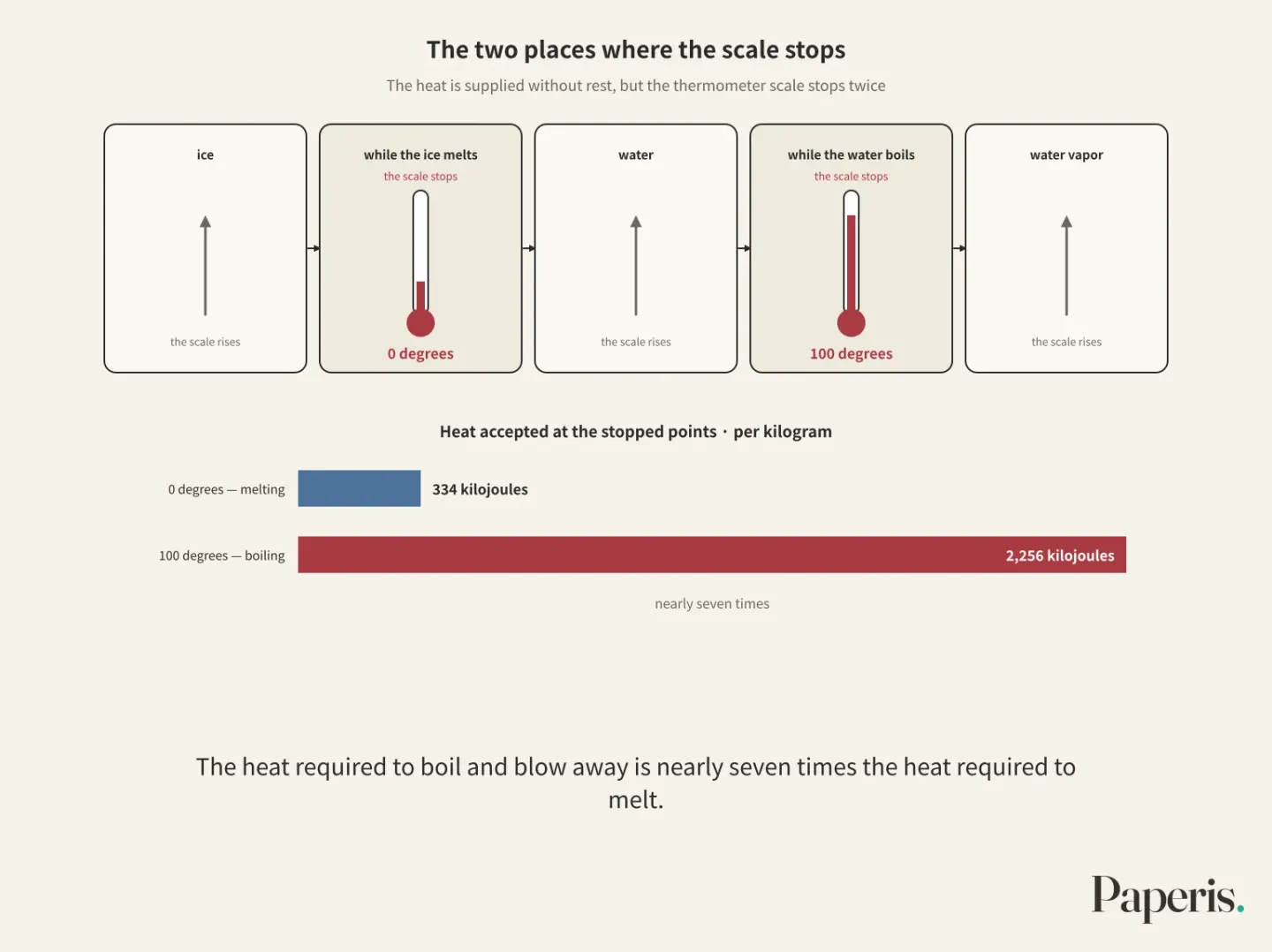
Water in a kettle, once it starts to boil, does not rise above 100 degrees even if you keep supplying heat (OpenStax Physics 11.3). Where the added heat went becomes visible if you follow the path once from ice to water vapor.
Put ice taken from the freezer into a pot, put it on the stove, and stick a thermometer in it. The heat is supplied without rest, but the scale stops twice. One stop is at 0 degrees while the ice melts, and the other is at 100 degrees while the water boils. The heat accepted at the stopped points is 334 kilojoules per kilogram at 0 degrees and 2,256 kilojoules per kilogram at 100 degrees. The scale rises only before and after and between those two places (OpenStax Physics 11.3).
In these flat zones, water is melting or boiling. A phase change is when a substance changes from one state to another, such as from solid to liquid, or from liquid to gas. The energy that goes in at this time is used to loosen or break the bonds holding the particles together rather than speeding up the movement of the particles, so the temperature does not rise (OpenStax Physics 11.3). Latent heat is heat that enters or leaves while a state is changing without changing the temperature. "Latent" means hidden (OpenStax Physics 11.3). The heat required to boil and blow away is nearly seven times the heat required to melt.
This zone is a place where learners often trip and fall. In a study surveying 224 university first-year students in various regions of Indonesia, 63% thought that "the temperature of boiling water keeps rising as long as the heat is left on," which was the most common misconception found (DOI: 10.20527/jipf.v8i3.13278).
If you go in reverse, the same amount of heat comes out into the surroundings. When water freezes and when water vapor condenses into water, latent heat is released into the surroundings and warms them (OpenStax Physics 11). Water droplets forming on the outside of a cold cup are also water vapor in the air changing into water while giving heat to the cold surface (OpenStax Physics 11.3).
Sweat cooling the body is also the work of latent heat. For a liquid to turn into a gas, it must receive heat from the surroundings (OpenStax Physics 11.3), and sweat on the skin evaporates and takes that heat away, cooling the body. On humid summer days, sweat does not evaporate as well as on dry days, making it easier to feel hotter (OpenStax Physics 11.1).
Automatically Only Goes One Way
Rubbing your palms together firmly makes them warm. Cupping a hot bowl of soup also warms your hands. The former is a case where sliding your pressed palms together through effort turned friction into thermal energy in your hands, and the latter is heat that entered following a temperature difference. Heat and work are two ways to put energy into an object and take it out, raising the temperature either way, and once it is raised, you cannot tell which way it came from (OpenStax Physics 12.2).
The first law of thermodynamics is the law that the increase in energy inside an object is equal to the heat that entered minus the work the object did on the outside. It is the principle that energy is neither newly created nor destroyed, written in terms of heat and work (OpenStax Physics 12.2). That principle itself is covered in "Energy — Money That Doesn't Shrink When Exchanged, Odd Coins Scattered in Your Pockets".
Mixing equal amounts of hot water and cold water gives you warm water. Even if you wait, that water does not separate back into hot water and cold water (OpenStax Physics 12.3). Nature does not take the reverse path, which is mathematically valid.
The second law of thermodynamics is the law that heat naturally moves only from the hot side to the cold side, and never the other way around. The key word is "naturally". If you put in work, you can move heat from the cold side to the hot side, and a refrigerator does that work (OpenStax Physics 12.3).
Physics also writes this law in terms of a value called entropy. Entropy is a value that indicates how large the share of an object's energy has become that can no longer be used for work. In naturally occurring processes, the total entropy only increases or stays the same, and never decreases (OpenStax Physics 12.3).
Let us return to the mixed water. The entropy of the mixed water has become greater than before it was mixed. Energy remains the same even in the mixed water, but because the temperature difference has disappeared, that water alone can no longer do work with that energy (OpenStax Physics 12.3). What remains in the water here is the thermal energy we saw earlier. Energy is defined as the ability to do work, but thermal energy that has once been evenly scattered remains in a form where that ability can hardly be used (OpenStax Physics 12.3). Speaking in terms of water tanks, two tanks whose water levels have become equal cannot turn a water wheel even though they still hold the water.
The entropy of one place can decrease. That is the case when you pick up scattered beads and put them in a cup, or when plants make nutrients using sunlight. However, energy goes into that work, and in return, the entropy of the outside world increases even more, so the total increases (OpenStax Physics 12.3). When living things build orderly bodies, they scatter usable energy to create entropy, as one paper summarizes it as an exceptionless fact (DOI: 10.3390/e22060648).
Textbooks describe entropy as the size of the energy unusable for work and as a measure of disorder (OpenStax Physics 12.3). There are differing views on this word "disorder". A short review from 2013 picks "entropy is a measure of disorder" as a long-standing misconception (DOI: 10.3390/e15041152), and another paper from 2020 uses the word disorder but narrows it down to disorder regarding heat (DOI: 10.3390/e22060648). Textbooks and the two papers use this term differently.
Water Wheels and Pumps
When fuel burns inside the cylinder of a car engine, the gas gets hot, and the pressure rises to push the piston out (OpenStax Physics 12.4). This is the moment heat becomes work.
A heat engine is a device that turns part of the heat flowing from a hot side to a cold side into work. Gasoline and diesel engines, jet engines, and steam turbines that make electricity are all heat engines. For the piston to return to its starting position, the gas must release heat to its surroundings to lower the pressure, and a heat engine repeats this cycle (OpenStax Physics 12.4). A heat engine cannot turn all the heat it receives into work, and a portion is always thrown away to the cold side. The second law dictates this (OpenStax Physics 12.4). The share of the received energy that comes out as work is the heat engine's efficiency, and the more heat that is thrown away, the less work comes out (OpenStax Physics 12). A water wheel also spins only by letting fallen water flow downward.
A pump is the reverse. A heat pump is a device that uses work to move heat from a cold side to a hot side. Refrigerators and air conditioners are also heat pumps. A refrigerator pulls heat from the inside and moves it to the kitchen air outside, and an air conditioner moves heat from inside the house to the outside (OpenStax Physics 12.4). What a refrigerator does is scoop heat out from the inside, and there is no “coldness” being put in (OpenStax Physics 12). In heat pump heating, what we want to get is that scooped heat, whereas in a refrigerator that same heat becomes waste heat (OpenStax Physics 12.4).
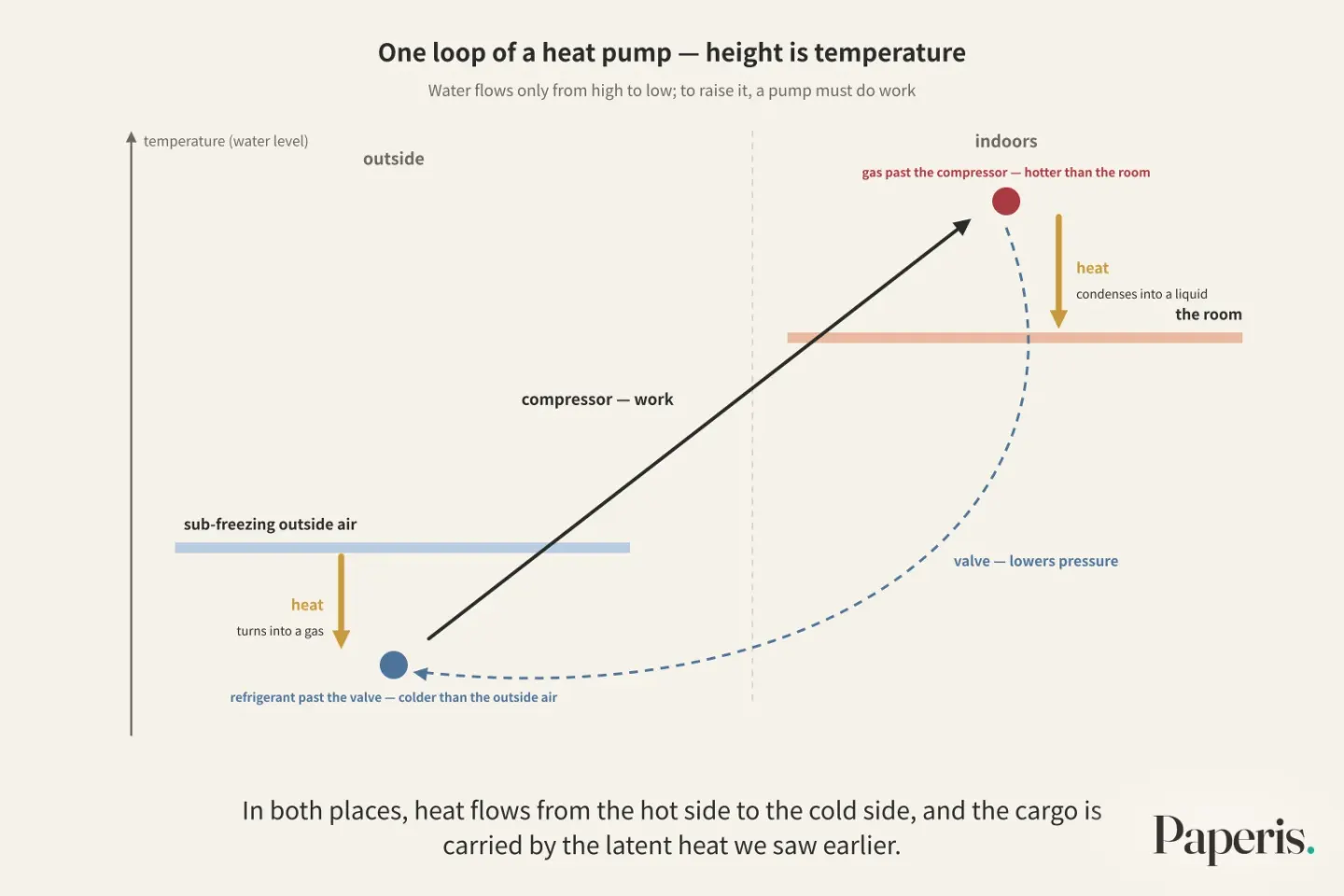
Suppose we heat a house with a heat pump in winter. The first question that comes up is how heat enters from sub-freezing outside air. Since heat naturally goes only toward the colder side, we can just make the refrigerant circulating in the pipes colder than the outside air. Passing through a valve that lowers pressure, the refrigerant cools down by that much, absorbs heat from the outside air in the pipes placed outside, and turns into a gas. The refrigerant is a liquid that turns into gas even by taking heat from cold outside air (OpenStax Physics 12.4).
The next question is how to give that heat to a warmer room. This time, we can make the refrigerant hotter than the room. An electrically driven compressor spends work to squeeze the gas and raise its temperature and pressure, and the gas, having become hotter than the room, releases heat from the indoor pipes into the room and condenses back into liquid (OpenStax Physics 12.4). In both places, heat flows from the hot side to the cold side, and the cargo is carried by the latent heat we saw earlier. The refrigerant receives heat outside as it turns into a gas, and releases heat into the room as it condenses into a liquid (OpenStax Physics 11.3).
In a heat pump, the only thing we pay for is the work to run the compressor, and the heat scooped from the outside air is a bonus. Even when it is freezing outside, it scoops heat, and in many cases brings more than twice the energy of the invested work into the room (OpenStax Physics 12.4). Because the energy that entered the room is the sum of the invested work and the heat scooped from the outside, a heat pump does not create new energy either (OpenStax Physics 12.4). There are downsides too. The invested work is sometimes more expensive than simply burning fuel, especially when electricity supplies the work (OpenStax Physics 12.4). A 2024 review notes that switching home heating to electricity via heat pumps can be among the most efficient ways to cut heating carbon, while also pointing to grid capacity, reducing heating demand itself, equipment and operating costs, and heat storage as challenges that must be solved together (PMID 39703672).
Back in Front of the Iron Spoon
The water analogy diverges from reality in two places. First, while a water tank contains water, heat is not contained inside an object. What an object has is energy, and heat is the name for that energy while it is being transferred. Second, while water tanks with the same water level are still, between two objects that have reached thermal equilibrium, particles continue to exchange energy back and forth. Just as much crosses over from one side as returns from the other, so there is simply no net heat transferred (OpenStax Physics 11.2).
Even after reading this article, the iron spoon will still feel cold. A review paper summarizes that intuitive ideas in physics do not get replaced and disappear by scientific concepts even after taking classes, but instead remain side by side alongside them, reappearing before unfamiliar problems or the prompt to "explain" (DOI: 10.65150/ep-gjefm/v2e6/2026-02). You can leave the sensation in your hand as it is, and simply read that sensation as a signal of the speed at which heat is escaping.
Where to Look Next
The principle that energy is neither created nor destroyed, and the word efficiency, are covered in "Energy — Money That Doesn't Shrink When Exchanged, Odd Coins Scattered in Your Pockets". What the waves are that carry heat through radiation is continued in "Waves — Fans Rising in Their Seats, a Wave Circling the Stadium".
How to remove the heat generated by computing machines is handled in "When Air Is No Longer Enough — Where the Heat from Computing Goes", and the process by which a battery grows hotter from its own heat in "Thermal Runaway — A Staircase Climbed on Its Own Heat". How to read the amount of electricity a heat pump uses leads to "Watts and Watt-Hours — Reading Electricity's Two Numbers Like a Speedometer and an Odometer".
Source Papers
- "Physics — 11.1 Temperature and Thermal Energy" (2020) — OpenStax Physics 11.1 — Heat and temperature are frequently confused, and we are more sensitive to the flow of heat than to temperature, thermal energy is a branch of internal energy, the faster the particles, the higher the temperature, absolute zero is theoretically a point of no motion and is actually unreachable, the unit of heat is the joule, the evaporation of sweat cools the body and evaporation is less on humid days.
- "Physics — 11.2 Heat, Specific Heat, and Heat Transfer" (2020) — OpenStax Physics 11.2 — Heat moves from the hot side to the cold side until temperatures become equal, definition and values of specific heat (water 4186 and iron 452 J/kg·°C, water is 5 times that of glass), conduction, convection, and radiation, an object feels colder even at the same temperature if it strips heat from the skin faster, metals generally conduct well while wood does not, black color absorbs radiation well.
- "Physics — 11.3 Phase Change and Latent Heat" (2020) — OpenStax Physics 11.3 — Energy put in during a phase change is used to loosen bonds so the temperature does not rise (latent heat, latent = hidden), ice 334kJ/kg and water 2256kJ/kg, vaporization requires surrounding heat while condensation releases heat on cold surfaces.
- "Physics — Section Summary" (2020) — OpenStax Physics 11 — Temperature is related to the average kinetic energy of particles, heat is energy transferred by a temperature difference, three paths of heat, latent heat is released during condensation and freezing.
- "Physics — 12.1 Zeroth Law of Thermodynamics: Thermal Equilibrium" (2020) — OpenStax Physics 12.1 — Thermal equilibrium is when change stops once temperatures become equal, thermal equilibrium cannot be reached if energy cannot be exchanged.
- "Physics — 12.2 First law of Thermodynamics: Thermal Energy and Work" (2020) — OpenStax Physics 12.2 — The cause of thermal expansion is an increase in particle kinetic energy, heat and work are two ways to put in and take out energy and are not stored in a system, the first law conserves energy expressed as heat and work.
- "Physics — 12.3 Second Law of Thermodynamics: Entropy" (2020) — OpenStax Physics 12.3 — Entropy is the magnitude of energy unusable for work and a measure of disorder, total entropy does not decrease in spontaneous processes, heat does not spontaneously go from cold to hot but is possible with work put in, the energy of mixed water cannot be used for work, local decrease is possible at the cost of total increase.
- "Physics — 12.4 Applications of Thermodynamics: Heat Engines, Heat Pumps, and Refrigerators" (2020) — OpenStax Physics 12.4 — Heat engines do work with a portion of the heat received and cannot convert all of it, heat pumps, air conditioners, and refrigerators move heat from cold to hot by putting in work, components of a heat pump (evaporator, compressor, condenser, expansion valve), they often put in more than twice the work put in but work can be more expensive than fuel.
- "Physics — Section Summary" (2020) — OpenStax Physics 12 — Heat spontaneously goes only from high temperature to low temperature, the efficiency of a heat engine is the ratio of work to input energy, the more heat thrown away, the less work, a refrigerator is a heat pump moving heat inside to the outside.
- "Physics — 1.3 The Language of Physics: Physical Quantities and Units" (2020) — OpenStax Physics 1.3 — The Kelvin scale starts from absolute zero with 0K=−273.15°C, one Kelvin division is equal to 1 degree Celsius.
- "Developing and Validating a Web-Based Five-Tier DiagnosticInstrument to Identify Student Misconceptions on Temperature and Heat" (2026) — DOI: 10.57092/ijetz.v5i1.617 — 101 eighth-grade students at a middle school, overall low with an average misconception rate of 12.56%, but the most common misconception is "if you divide an object, the temperature is also divided" (36.6%).
- "Mapping Misconceptions in Heat and Temperature: Rasch Analysis of Four-Tier Diagnostic Responses" (2026) — DOI: 10.23960/jpmipa.v27i2.pp867-886 — 60 twelfth-grade students in Bandung, Indonesia, continually confusing heat, temperature, and thermal energy, with the most difficult concepts being convection, thermal expansion, temperature feeling, and heat transfer methods.
- "Unveiling Heat and Temperature Misconceptions: A Multilocation Study on First-Year College Students in Indonesia" (2024) — DOI: 10.20527/jipf.v8i3.13278 — 224 first-year university students across multiple regions in Indonesia, "as long as the fire is left on, the temperature of boiling water continues to rise" being the highest at 63%.
- "Identification of misconceptions on heat and temperature among physics education students using four-tier diagnostic test" (2020) — DOI: 10.1088/1742-6596/1470/1/012055 — 39 physics education students in Yogyakarta, "thermal equilibrium requires direct contact" being the largest misconception at 61.5% (not in our abstract, city only).
- "Entropy and Entropy Production: Old Misconceptions and New Breakthroughs" (2013) — DOI: 10.3390/e15041152 — A short review pointing out "entropy is a measure of disorder" as an old and common misunderstanding.
- "The Second Law and Entropy Misconceptions Demystified" (2020) — DOI: 10.3390/e22060648 — An argument that thermodynamic entropy is only a measure of thermal disorder and not other disorder, and that the creation of ordered structures or organisms also creates entropy without exception.
- "Misconceptions in Physics Education from Childhood to Teacher Preparation: Evidence, Pedagogical Strategies, And Research Gaps" (2026) — DOI: 10.65150/ep-gjefm/v2e6/2026-02 — A descriptive review stating that intuitive thoughts in physics do not get replaced by instruction but coexist with scientific concepts, revealing themselves in unfamiliar problems or demands for explanation.
- "Electrification of Heating-Requirements for Successful Wide-Scale Deployment." (2024) — PMID 39703672 — Heat pump electrification may be the most efficient method for heating decarbonization, but grid capacity, cost, and heat storage are challenges (UK and Ireland perspective).
Sources (18)
- Physics — 11.1 Temperature and Thermal Energy
- Physics — 11.2 Heat, Specific Heat, and Heat Transfer
- Physics — 11.3 Phase Change and Latent Heat
- Physics — Section Summary
- Physics — 12.1 Zeroth Law of Thermodynamics: Thermal Equilibrium
- Physics — 12.2 First law of Thermodynamics: Thermal Energy and Work
- Physics — 12.3 Second Law of Thermodynamics: Entropy
- Physics — 12.4 Applications of Thermodynamics: Heat Engines, Heat Pumps, and Refrigerators
- Physics — Section Summary
- Physics — 1.3 The Language of Physics: Physical Quantities and Units
- Developing and Validating a Web-Based Five-Tier DiagnosticInstrument to Identify Student Misconceptions on Temperature and HeatDOI 10.57092/ijetz.v5i1.617
- Mapping Misconceptions in Heat and Temperature: Rasch Analysis of Four-Tier Diagnostic ResponsesDOI 10.23960/jpmipa.v27i2.pp867-886
- Unveiling Heat and Temperature Misconceptions: A Multilocation Study on First-Year College Students in IndonesiaDOI 10.20527/jipf.v8i3.13278
- Identification of misconceptions on heat and temperature among physics education students using four-tier diagnostic testDOI 10.1088/1742-6596/1470/1/012055
- Entropy and Entropy Production: Old Misconceptions and New BreakthroughsDOI 10.3390/e15041152
- The Second Law and Entropy Misconceptions DemystifiedDOI 10.3390/e22060648
- Misconceptions in Physics Education from Childhood to Teacher Preparation: Evidence, Pedagogical Strategies, And Research GapsDOI 10.65150/ep-gjefm/v2e6/2026-02
- Electrification of Heating-Requirements for Successful Wide-Scale DeploymentPMID 39703672