
Paperis Articles
Exchange Rates and Trade — A Seesaw Where One End Rises as the Other Sinks, and the People Riding Each End
"The won-dollar exchange rate rose" means the won got cheaper. The same news makes some people smile and others wince, and part of the change seeps into prices through imported goods.
Your field's papers, as audio
Pick your fields and journals — Paperis summarizes the key papers and turns them into audio. Listen on your commute.
Start Paperis free →Exchange Rates and Trade — A Seesaw Where One End Rises as the Other Sinks, and the People Riding Each End
The Same $100, Different Price
Ahead of a trip abroad, you exchange 100 dollars at a bank window. It is the exact same 100 dollars as your last trip, but the Korean won you have to pay is different. For example, last time it was 1,300 won per dollar so you paid 130,000 won, and this time if it is 1,400 won per dollar you pay 140,000 won. To get the same 100 dollars, you pay 10,000 won more.
The morning news saying "the exchange rate has risen" refers to precisely this. This article follows how to read that single sentence. The examples are taken from Korean news, and the concepts apply to any country.
Let us place a single seesaw as a guide. The number mentioned by the news sits on one end of the seesaw, and the value of the won sits on the opposite end. When one side goes up, the other sinks down. Sitting together on the number end are exporting companies that earn dollars and convert them into won, while sitting together on the won end are importing companies, travelers, and people in debt with dollars who pay won to buy dollars.
When the Number Goes Up, the Korean Won Sinks
The exchange rate is the rate at which one country's currency can be exchanged for another's. An exchange rate is also the price attached to money. This is because it shows how many units of another country's currency you can buy with one unit of your own country's currency (OpenStax Principles Macroeconomics 3e 16.1).
The won-dollar exchange rate is the amount of Korean won it takes to buy 1 U.S. dollar. For example, if the won-dollar exchange rate is 1,300 won, it means you have to pay 1,300 won to buy 1 dollar. Korean news usually reports the exchange rate as "how many won per 1 dollar."
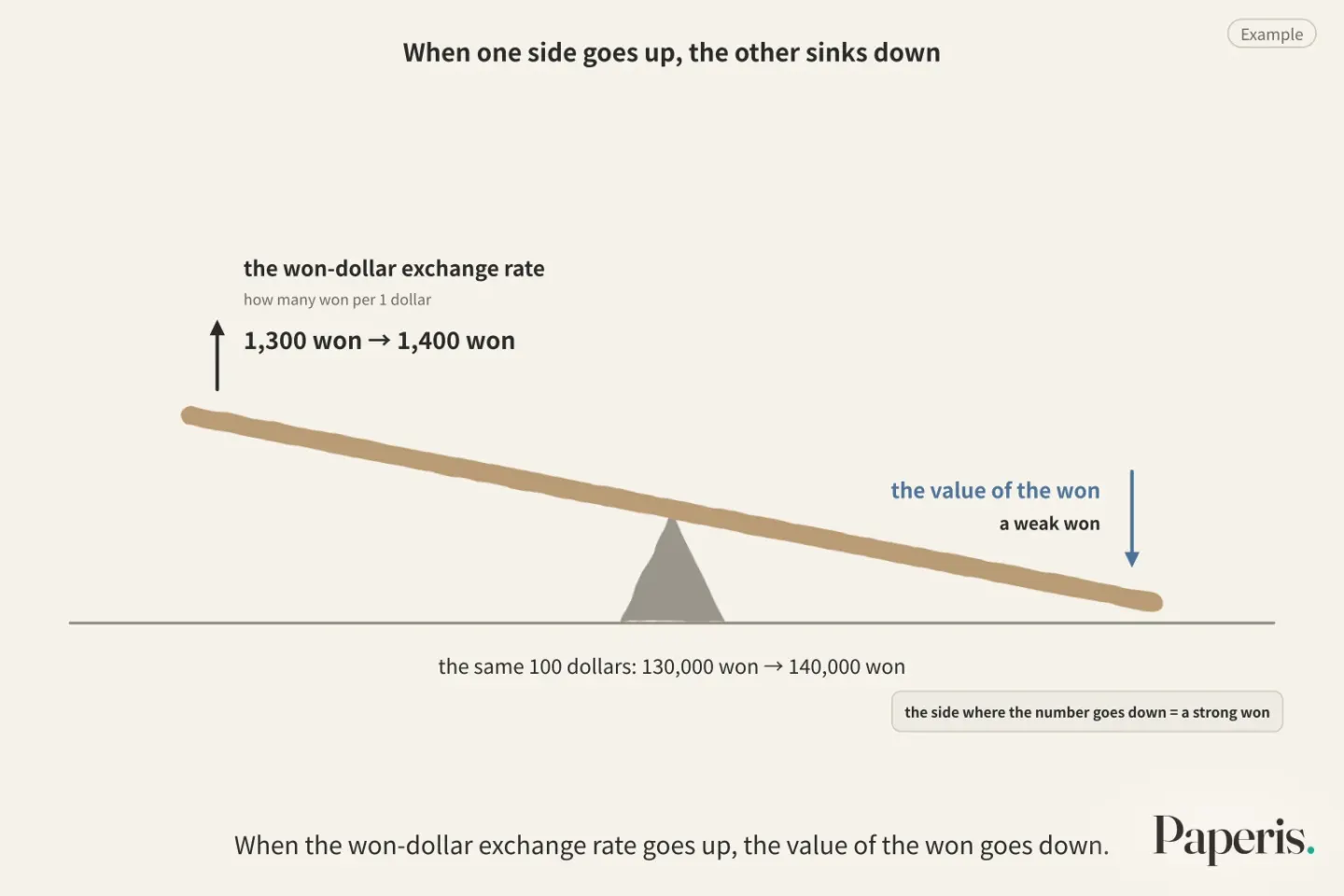
When this number rises from 1,300 won to 1,400 won, it costs 100 more won to buy that same 1 dollar. The amount of dollars you can buy with 10,000 won has decreased, and the value of the won compared to the dollar has gone down. When the won-dollar exchange rate goes up, the value of the won goes down. Because of the word "rose," it is easy to hear it as the won getting stronger, but it is the exact opposite for the won.
These two directions have names. A weak won means the value of the Korean won goes down compared to other countries' currencies. In terms of the won-dollar exchange rate, this is the side where the number goes up. A strong won means the value of the Korean won goes up compared to other countries' currencies. This is the side where the number goes down. How to check at the exchange counter is simple. If the dollars you can get for 10,000 won have decreased, the won has weakened, and if they have increased, it has strengthened (OpenStax Principles Macroeconomics 3e 16.1).
In economic articles and papers, the same directions are also called "depreciation" and "appreciation." One study on Korean import prices also pairs times when the exchange rate rises as the depreciation of the won's value, and times when it falls as appreciation (KCI ART002752632). There are also studies that examine periods when the won's value falls and periods when it rises separately (KCI ART001835516).
If you look at it like a seesaw, the moment the end with the number goes up, the end with the Korean won sinks. If you look at the same thing from the dollar's side, when the won has weakened against the dollar, the dollar has strengthened against the won. It is the same thing viewed from both ends (OpenStax Principles Macroeconomics 3e 16.1).
The same exchange rate can also be written in reverse. If you write it as "how many dollars per 1 won," the number becomes very small, and when the won weakens, this number goes down. This is because the two notations are reciprocal values of each other (OpenStax Principles Macroeconomics 3e 16.2). When you hear that "the exchange rate has risen," the direction becomes clear if you first check whose currency unit the number represents. If the number written as "how many won per 1 dollar" goes up, the won has weakened.
Those Buying Dollars and Those Selling Them
When a traveler hands over Korean won at a currency exchange counter and receives dollars in return, that traveler is someone buying dollars. There is a collective name for trades that exchange one money for another in this way. The foreign exchange market is a market where one country's money is bought and sold for another country's money.
Where did the dollars received at the counter come from? An export company that has earned dollars by selling goods abroad must pay employee salaries and parts costs in won, so it releases those dollars. Foreign investors who want to buy Korean companies or stocks also give up dollars and receive won. On the side buying dollars, alongside travelers, there are import companies that must pay for foreign goods in dollars and domestic investors who want to put money abroad (OpenStax Principles Macroeconomics 3e 16.1).
When the force trying to buy dollars becomes stronger than the force trying to sell them, the price of dollars—in other words, the won-dollar exchange rate—rises. This is the side where the won weakens. When the selling force becomes stronger, the exchange rate falls. The exchange rate, just like the prices of other goods, is determined by a tug-of-war between those trying to buy and those trying to sell (OpenStax Principles Macroeconomics 3e 16.1).
A floating exchange rate system is a system where the exchange rate is determined by leaving it up to buying and selling in the foreign exchange market. In this system, the exchange rate can move significantly in a short period of time (OpenStax Principles Macroeconomics 3e 16.4). Korea is also a country that has adopted a freely floating exchange rate system (KCI ART001305664).
Why do foreign investors put money into Korea? It is because they look for places where the same money can be entrusted to grow more. The interest rate is the price of borrowing money, and it is the ratio of interest attached to borrowed money. If Korea's interest rate becomes higher than that of other countries, the number of people who want to exchange it for won and put money into Korea increases, tipping the seesaw toward the side where the won gains strength (OpenStax Principles Macroeconomics 3e 16.2). Even if the interest rate is high, if prices rise faster than that, what can be bought with the grown money decreases. Therefore, the money of a country whose prices rise faster than other countries has fewer people wanting to buy it, tipping it toward the weakening side (OpenStax Principles Macroeconomics 3e 16.2).
However, there is a working paper showing that whether a country's money value rises together when interest rates rise or rather falls varies depending on the country and the market's risk atmosphere in actual data, and that even that difference has rules. What this research measured is how interest rates and money value moved together at the same time, and it is not causation where one moved the other (working paper, DOI: 10.2139/ssrn.4214580). In data from nine Asian countries including Korea, interest rates and exchange rates clearly moved together over the long run, and the authors read this to mean that interest rates still matter for exchange rates (DOI: 10.66674/cvyq3e61). Even so, it is difficult to read it in a single line like "when interest rates rise, the won immediately strengthens." Interest rates themselves are covered in "Interest Rates and Central Banks — A Brake in the Engine Room, a Train That Slows Long After".
When the seesaw begins to tilt to one side, that tilt sometimes grows on its own. In the short term, if rumors circulate that a certain money will grow stronger, the number of people wanting to buy it in advance increases, making that money actually stronger, and that movement triggers the same expectations again, causing it to lean in one direction for a while (OpenStax Principles Macroeconomics 3e 16.2).
A central bank is a bank tasked with influencing the entire national economy by raising or lowering interest rates. In Korea, the Bank of Korea takes on that job. Some countries generally leave exchange rates to the market, while employing a method where the central bank enters the foreign exchange market to buy and sell, especially when it moves too fast in one direction. Under this approach, the market sometimes moves merely on rumors that an intervention might happen (OpenStax Principles Macroeconomics 3e 16.4).
To directly prop up its own country's money in the foreign exchange market, the central bank releases accumulated foreign money and buys up its own country's money. There is also a way to prop it up by raising interest rates (OpenStax Principles Macroeconomics 3e 16.4). Foreign exchange reserves are foreign money like dollars that the central bank accumulates to use at times like this. This money has an end. To hold up its own country's money higher than the value the market has set requires continuously using reserves, and that it cannot hold out that long is the summary of one policy commentary (DOI: 10.30541/v60i3pp.359-365).
The exchange rate is a value newly determined each day in the tug-of-war where countless people buy and sell dollars, and the central bank also sometimes jumps into that tug-of-war.
The Two Ends of the Seesaw
For example, let's say a company sells an item overseas for 100 dollars. When 1 dollar is 1,300 won, the money this company holds in its hands in won is 130,000 won, and when it becomes 1,400 won, it is 140,000 won. Salaries and domestic component costs go out in won and sales come in in dollars, so even selling the exact same item, the won left over for the company increases (OpenStax Principles Macroeconomics 3e 16.3).
Sitting at the opposite end is the side that pays out won and settles the price in dollars. A company that buys crude oil or components in dollars pays more won to bring in the same quantity, and an overseas traveler at the counter mentioned at the beginning also pays more won for the exact same 100 dollars. When the won strengthens, the positions flip. Imports and overseas travel become cheaper, and the won that export companies get by exchanging the same dollars decreases. When the value of money changes, every market participant is affected differently (OpenStax Principles Macroeconomics 3e 16.1).
Therefore, saying "it is good when the exchange rate rises" or "it is bad when the exchange rate rises" leaves out who it is good for and who it is bad for. If the value of money shifts rapidly from weak to strong, export industries can be hurt, and if it shifts rapidly from strong to weak, banks can be hurt, so no matter which side you put the exchange rate on, there are trade-offs (OpenStax Principles Macroeconomics 3e 16.3).
The gains on the export side may also not be as large as you might think. Weaker home currencies boosted exports as expected in most of eight Asian countries, but the share they added to export growth was weak. The risk of the exchange rate fluctuating wildly reduced exports in six countries, and the net effect combining both effects was zero in South Korea and Thailand (DOI: 10.1002/j.2325-8012.2006.tb00723.x). Conversely, there are estimates where exports reacted significantly to the exchange rate. A 10% strengthening of the yen reduces Japan's consumer goods exports by 9%, which is an estimate from a working paper looking at exports going to 17 countries from 1988 to 2009 (DOI: 10.2139/ssrn.1895275). How much the exchange rate moves exports varies by country and goods.
Those who borrowed in dollars are hurt more severely by a weaker won. Money borrowed in dollars must be repaid in dollars, so when the won weakens, it takes more won to repay the same debt. Banks that borrowed in dollars and lent out in their home currency can fail to repay their dollar debts if their home currency weakens sharply. In 1997–1998, East Asian countries such as South Korea, Thailand, Malaysia, and Indonesia saw the value of their money plummet, and at that time, the banking systems of these countries collapsed (OpenStax Principles Macroeconomics 3e 16.3).
The same shock hits different situations differently. When the Romanian leu depreciated sharply in 2008–2009, that depreciation significantly reduced employment and the value generated by firms over the following several years through the foreign currency debt held by companies. In exporting firms, that shock was cushioned thanks to sales coming in in foreign currency and enhanced price competitiveness, and depending on the analytical method, no distinct impact was captured (working paper, DOI: 10.2139/ssrn.6426999).
A weaker won is favorable to one end of the seesaw and unfavorable to the other end. The meaning of the exact same news depends on which end of the seesaw you are sitting on.
The Path Traveled by Import Prices
We look first at goods with many raw materials brought in from across the sea, such as the flour used for bread and the gasoline at the gas station. Import prices are the costs of goods bought from other countries, measured in our currency. When the won weakens, the price of imports measured in won goes up even if the price tagged in dollars stays the same (DOI: 10.65525/prabandhan.v1i1.5). The costs for the company bringing in crude oil and the company bringing in wheat go up.
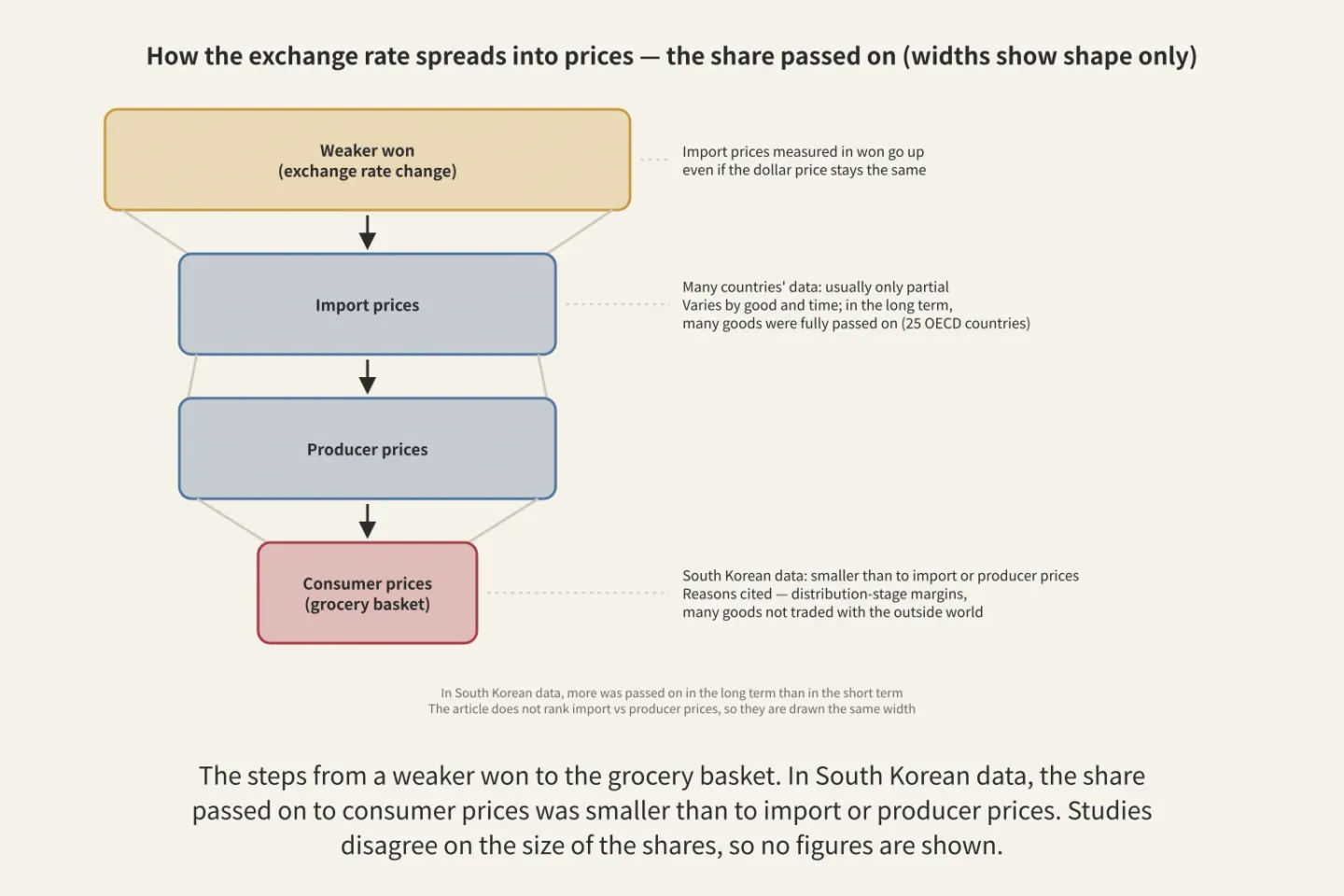
Figure: a diagram Paperis drew using only what the article says
However, the price of imports does not move by the exact amount that the exchange rate moves. Data from various countries show that the share of an exchange rate change passed on to import prices is usually only partial, and larger than the share passed on to export prices (IMF Working Paper, DOI: 10.5089/9781475510232.001). A common explanation offered for this is that the selling side reduces its own margin and raises prices less in order not to lose market share (DOI: 10.65525/prabandhan.v1i1.5). The same IMF Working Paper puts forward a different explanation, which is that the currencies in which prices are invoiced are mixed.
The share passed on varies depending on the good and the time. In the import prices of 25 OECD countries, exchange rates were passed on only partially in the short term, but for many goods, they were fully passed on in the long term. The biggest factor in how that share changes is what kinds of goods a country mainly brings in (Working Paper, DOI: 10.2139/ssrn.920835). In South Korea's import and export prices as well, industries differed in how they reacted to exchange rates (Working Paper, DOI: 10.2139/ssrn.2345422). There is research stating that the share passed on to South Korea's import prices has decreased since the 2000s (KCI ART002032233), and research stating that it has grown instead (KCI ART002123396). There is also research stating that it has grown in most industries after the adoption of a free-floating exchange rate system (KCI ART001305664). The results vary across South Korean studies.
The share passed on can also differ between when prices go up and when they go down. In one Working Paper looking at data from 33 countries between 1980 and 2010, changes were passed on more strongly to import prices when a country's own currency weakened than when it strengthened in the long run. This slope was larger in countries that rely heavily on imports, and was tempered in countries with free trade (Working Paper, DOI: 10.2139/ssrn.2365275). In studies using South Korean data, the directions were mixed. There is research stating that the direction split by item category (KCI ART001648683), and research stating that in the long run, changes were actually passed on more heavily to import prices when the won strengthened (KCI ART001404905). There is also research stating that the difference was not large (KCI ART001835516). Which direction is passed on more strongly appears differently depending on the country, the period, and the good.
There is one more step from import prices to grocery basket prices. In a Working Paper looking at data from several advanced economies, the impact of exchange rates on domestic prices was not large, the impact of import prices was larger than that, and the share passed on was larger the greater a country's import proportion (Working Paper, DOI: 10.2139/ssrn.249576). In South Korean data too, more was passed on in the long term than in the short term, and the share passed on to consumer prices was smaller than to import prices or producer prices (KCI ART002123396). The reasons cited for this were that the margins added at the distribution stage are large, and that many of the things consumers buy are not traded with the outside world (KCI ART001703808). What price indexes measure is covered in "Prices and Inflation — The Same Shopping Basket, Height Marks Drawn Every Year".
A weaker won spreads to prices riding on import prices, but it usually spreads only partially, and differently depending on the good and the country.
Trade Balance and Current Account
The news reports that "this month's trade balance turned a surplus" or "swung into a deficit." The trade balance is the value of a country's exports minus the value of its imports.
A trade surplus is a state where the value of exports is greater than the value of imports. A trade deficit is a state where the value of imports is greater than the value of exports.
The current account is calculated by adding income earned or paid out through foreign investments and money that moved without any exchange to the buying and selling of goods and services. Even though their names sound similar, the trade balance and the current account count different scopes (OpenStax Principles Macroeconomics 3e 10.1).
The word deficit sounds like a loss. Yet if what was bought from outside is greater than what was sold, money to fill that gap must flow in from the outside. So to economists, a trade deficit means the same thing as money flowing in from the outside, and a trade surplus means the same thing as money flowing out to the outside. The money that comes in includes borrowed money, as well as money used by foreigners to buy companies, stocks, and real estate in this country (OpenStax Principles Macroeconomics 3e 10.3).
Depending on what the incoming money was used to build or grow, the same deficit can mean different things (OpenStax Principles Macroeconomics 3e 10.3). Whether it is a trade surplus or a trade deficit, we cannot say it is good or bad by itself. Through the eyes of economists, neither a surplus nor a deficit is inherently good or bad; it depends entirely on the situation (OpenStax Principles Macroeconomics 3e 10.3).
The size of trade and the trade balance are also different stories. There are countries where the share of exports compared to the size of the economy is very large while the balance is nearly even, and there are countries where that share is small yet the deficit is large (OpenStax Principles Macroeconomics 3e 10.6). South Korea is counted among the countries that turned their economies heavily toward trade over the past few decades and grew rapidly (OpenStax Principles Macroeconomics 3e 20.1). That is why exchange rates and trade news are frequently used to read the South Korean economy.
Why Even a Country That Makes Everything Better Trade
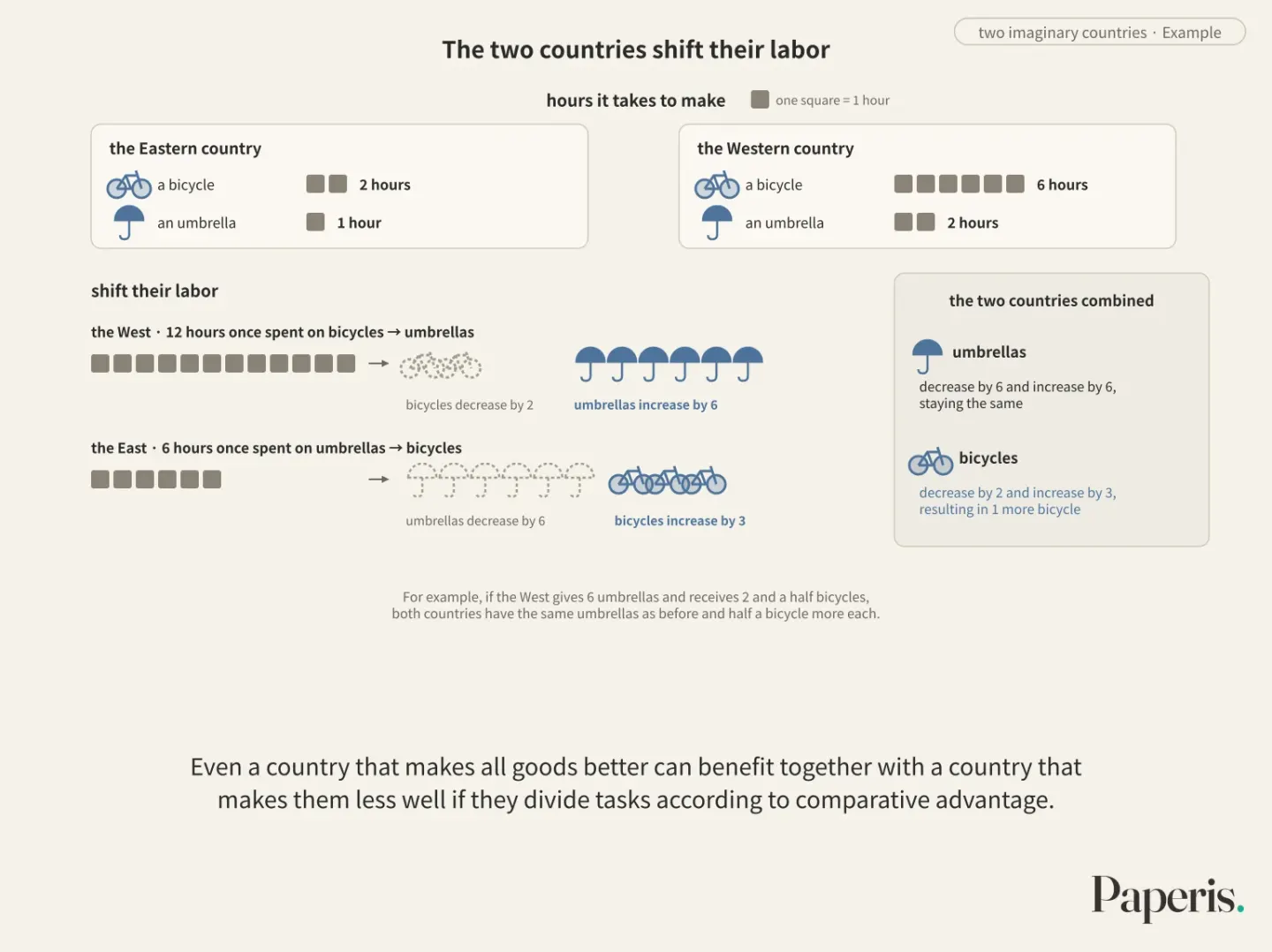
Why can trade between countries be beneficial to both sides? We follow along with two imaginary countries. The Eastern country takes 2 hours to make a bicycle and 1 hour for an umbrella. The Western country takes 6 hours for a bicycle and 2 hours for an umbrella. The Eastern country makes both faster. Absolute advantage is being able to make more of the same good with the same resources than another country can. The Eastern country has an absolute advantage in both goods (OpenStax Principles Macroeconomics 3e 20.1). Then the Eastern country seems to have no reason to trade with the Western country.
The value of the best alternative given up because of a choice—this is called opportunity cost. Since the 2 hours the Eastern country spends on a bicycle could make 2 umbrellas, the opportunity cost of a bicycle in the Eastern country is 2 umbrellas. Since the 6 hours the Western country spends on a bicycle could make 3 umbrellas, the opportunity cost of a bicycle in the Western country is 3 umbrellas. Bicycles are made with less sacrifice in the Eastern country, and umbrellas in the Western country.
Having a lower opportunity cost of doing something than someone else does—this is called comparative advantage. It is the same between countries. The Eastern country has a comparative advantage in bicycles, and the Western country in umbrellas. If each makes more of the good in which it has a comparative advantage and trades, the total amount made by the two countries increases, and both sides can gain (OpenStax Principles Macroeconomics 3e 2.2).
Let us suppose the two countries are currently making both goods. One day, the two countries shift their labor together. The West switches 12 hours once spent on bicycles to umbrellas, and the East switches 6 hours once spent on umbrellas to bicycles. Looking at the two countries combined that day, umbrellas decrease by 6 and increase by 6, staying the same, while bicycles decrease by 2 and increase by 3, resulting in 1 more bicycle. For example, if the West gives 6 umbrellas and receives 2 and a half bicycles, both countries have the same umbrellas as before and half a bicycle more each. Even a country that makes all goods better can benefit together with a country that makes them less well if they divide tasks according to comparative advantage (OpenStax Principles Macroeconomics 3e 20.2).
Economists often defend free trade with this idea. One explainer note summarizes the basis of that defense as the belief that the gains from trade can make all sides better off, "at least in principle, and in the long run." The same note also records that questions have been raised about whether trade increases income inequality, harms the environment, or lowers labor standards (DOI: 10.2139/ssrn.1583765). The phrase "all sides can be better off" is different from meaning that everyone in that country has already gotten better off.
Reading a One-Sentence News Report
We read the news report that "The won-dollar exchange rate has risen significantly" using the sequence we have followed so far. The numbers are examples. Let's say the exchange rate went from 1,300 won per dollar to 1,400 won.
First is the direction. Since it costs 100 more won to buy a dollar, the won has weakened. The dollar end of the seesaw has gone up, and the won end has sunk down.
Next are the people at both ends of the seesaw. Overseas travelers pay 10,000 more won for the same 100 dollars. A company selling 100-dollar goods abroad pockets 10,000 more won in Korean currency. Companies that buy crude oil with dollars and companies with debts in dollars must pay more won. However, there is no guarantee that exports will increase by that much. One study using Korean data found that the net effect—combining the benefit of the weak currency and the risk of a fluctuating exchange rate—came out to zero (DOI: 10.1002/j.2325-8012.2006.tb00723.x).
After that is inflation. The price of imports in won terms goes up, and some of that can spread to grocery cart prices. A study looking at Korean data also showed that the pass-through was larger in the long run than in the short run, and the share passed on to consumer prices was smaller than that to import prices (KCI ART002123396).
Finally, this single news piece does not determine whether the country as a whole has gained or lost. Depending on which end of the seesaw you sit on, the same news hits differently.
The seesaw has limits. A playground seesaw has the other side go down by the exact amount the one side goes up, but exports do not increase or prices rise by the exact amount the exchange rate moves. The share passed on to import prices is usually only partial, and the extent to which exports grow varies by country and period. A single company can also sit on both ends at once. An export company that earns dollars by selling goods while buying raw materials in dollars does just that. And unlike a seesaw, trade is not a game where what one side gains, the other loses. Furthermore, onto the foreign exchange market's seesaw climb countless people at once, not just two. The seesaw shows one thing accurately: the fact that the number of the won-dollar exchange rate and the value of the won move in opposite directions.
Where to Look Next
The principle that exchange rates are determined by a tug-of-war between buyers and sellers is explored in more detail in "Supply and Demand: Who Sets the Price?". Opportunity cost, which forms the basis of comparative advantage, is covered by "Scarcity and Opportunity Cost: What Do You Give Up When You Choose?".
The story after import prices spill over into consumer prices continues in "Prices and Inflation — The Same Shopping Basket, Height Marks Drawn Every Year", and the debate surrounding the causes of rising prices is covered by "The Real Cause of Inflation — Money Supply, Expectations, or Supply Chains?". Interest rates and central banks are covered by "Interest Rates and Central Banks — A Brake in the Engine Room, a Train That Slows Long After". How the value of exports minus imports enters the calculation measuring the size of the national economy is covered under the name of net exports in "GDP and the Business Cycle — The Last Receipt, and the Day No Receipt Records". Why financial crises repeat is followed up in the published edition dealing with financial crises, "Why Financial Crises Keep Coming Back — Fat Tails, Black Swans, and Systemic Risk".
Source Papers
- "Principles of Macroeconomics 3e — 16.1 How the Foreign Exchange Market Works" (2022) — OpenStax Principles Macroeconomics 3e 16.1 — The exchange rate is the price of one currency expressed in terms of another, and in the foreign exchange market, trade companies, travelers, and investors buy and sell currencies, meaning that the strength of one currency is the weakness of the other, and the impact varies for each participant.
- "Principles of Macroeconomics 3e — 16.2 Demand and Supply Shifts in Foreign Exchange Markets" (2022) — OpenStax Principles Macroeconomics 3e 16.2 — Two notations for the same exchange rate are reciprocals of each other, the currency of a country with a relatively high interest rate becomes stronger and that of a country with high inflation becomes weaker, and expectations can reinforce themselves for a while.
- "Principles of Macroeconomics 3e — 16.3 Macroeconomic Effects of Exchange Rates" (2022) — OpenStax Principles Macroeconomics 3e 16.3 — Because the currencies of production costs and sales differ, exchange rates alter export and import incentives, banks that borrowed in foreign currency can collapse when their domestic currency weakens (1997–98 East Asia), and trade-offs accompany any choice regarding exchange rates.
- "Principles of Macroeconomics 3e — 16.4 Exchange Rate Policies" (2022) — OpenStax Principles Macroeconomics 3e 16.4 — Floating exchange rates can move significantly in a short time, the approach of leaving things mostly to the market while intervening in emergencies (soft peg) is shaken even by rumors of intervention, and central banks can use foreign exchange reserves or raise interest rates to prop up their domestic currency.
- "Principles of Macroeconomics 3e — 10.1 Measuring Trade Balances" (2022) — OpenStax Principles Macroeconomics 3e 10.1 — Distinguishes between the trade balance and the current account, which also includes services, investment income, and transfers.
- "Principles of Macroeconomics 3e — 10.3 Trade Balances and Flows of Financial Capital" (2022) — OpenStax Principles Macroeconomics 3e 10.3 — A trade deficit means an inflow of financial capital, a surplus means an outflow, those flows include investments in real estate, companies, and stocks rather than just debt, and surpluses and deficits can be good or bad depending on the situation.
- "Principles of Macroeconomics 3e — 10.6 The Difference between Level of Trade and the Trade Balance" (2022) — OpenStax Principles Macroeconomics 3e 10.6 — The level of trade relative to GDP and the trade balance are separate things.
- "Principles of Macroeconomics 3e — 20.1 Absolute and Comparative Advantage" (2022) — OpenStax Principles Macroeconomics 3e 20.1 — Fast-growing countries such as South Korea pivoted their economies toward trade, and absolute advantage is producing more using the same resources.
- "Principles of Macroeconomics 3e — 20.2 What Happens When a Country Has an Absolute Advantage in All Goods" (2022) — OpenStax Principles Macroeconomics 3e 20.2 — Through specialization based on comparative advantage, both sides can gain even with a country that has an absolute advantage in all goods.
- "Principles of Macroeconomics 3e — 2.2 The Production Possibilities Frontier and Social Choices" (2022) — OpenStax Principles Macroeconomics 3e 2.2 — If they specialize according to comparative advantage and trade, total production increases and both sides benefit.
- "우리나라 수입물가의 비대칭적 비선형적 환율전가 연구" (2021) — KCI ART002752632 — Korean import prices show an asymmetry where pass-through is greater when the exchange rate falls (depreciation pass-through was larger before the foreign exchange crisis, appreciation pass-through after), and the rise in the exchange rate is paired with devaluation.
- "패널자료를 이용한 수입물가로의 환율전가도 추정" (2013) — KCI ART001835516 — Across 29 industries from 1990 to 2012, pass-through was incomplete, and when divided into appreciation and depreciation periods, the pass-through degree was greater in appreciation periods, though the difference was not large.
- "수입물가의 환율전가 결정요인 분석" (2008) — KCI ART001305664 — Since the introduction of South Korea's free-floating exchange rate system, exchange rate pass-through to import prices has risen in most industries.
- "환율변동의 낮은 소비자물가의 전가요인 분석" (2012) — KCI ART001703808 — Exchange rate pass-through to consumer prices is lower than to import prices, with high distribution margins and the share of non-tradeable goods as the main reasons, which holds implications for the Bank of Korea's price stabilization policy.
- "수입물가, 생산자물가, 소비자물가 단계별 장·단기환율전가에관한 연구" (2016) — KCI ART002123396 — In South Korea from 1985 to 2015, long-term pass-through was greater than short-term pass-through, and pass-through to consumer prices was smaller than to import and producer prices.
- "원화환율 변동에 따른 수입물가 전가율 분석과 시사점" (2015) — KCI ART002032233 — The exchange rate pass-through rate to Korean import prices has been on a downward trend since the 2000s.
- "우리나라 수입물가에 대한 비대칭 환율전가" (2012) — KCI ART001648683 — From 2000 to 2010 in South Korean import prices, some items reacted differently to appreciation and depreciation, and in two items the direction was reversed.
- "수입 및 국내물가에 대한 환율전가효과" (2009) — KCI ART001404905 — Exchange rate pass-through is greater in the long run than in the short run, and import price pass-through is greater in the long run when the exchange rate falls than when it rises.
- "Catching the Elusive Exchange Rate-Interest Rate Correlation" (2022) — DOI: 10.2139/ssrn.4214580 — The simultaneous correlation between exchange rates and interest rates varies predictably in sign and magnitude depending on the country and risk regime (working paper).
- "Does Interest Rate Still Matter in Determining Exchange Rate?" (2017) — DOI: 10.66674/cvyq3e61 — In 9 Asian countries including South Korea, the real effective interest rate has a significant long-term relationship with the exchange rate, so interest rates still matter in determining exchange rates.
- "Don’t Fall in Love with Parity: Understanding Exchange Rate Depreciation" (2021) — DOI: 10.30541/v60i3pp.359-365 — Artificially pegged exchange rates are maintained only through reserve losses, and reserves are finite (policy commentary).
- "Export Promotion through Exchange Rate Changes: Exchange Rate Depreciation or Stabilization?" (2006) — DOI: 10.1002/j.2325-8012.2006.tb00723.x — In 8 Asian countries, depreciation mostly boosted exports but the contribution was weak, exchange rate risk had a negative effect in 6 countries, and the net effect was zero for South Korea and Thailand.
- "The Effect of Exchange Rate Changes on Japanese Consumption Exports" (2011) — DOI: 10.2139/ssrn.1895275 — Targeting 17 countries from 1988 to 2009, Japanese consumer goods exports decreased by 9% in response to a 10% appreciation of the yen (working paper).
- "The Impact of Exchange Rate Depreciation on the Performance of Non-financial Companies in Romania" (2026) — DOI: 10.2139/ssrn.6426999 — The large depreciation of 2008/09 significantly reduced employment and gross value added via foreign currency debt, while the effect was dampened or insignificant in exporting companies (working paper).
- "Sectoral Impact of Exchange Rate Pass-through on Import Prices in India" (2025) — DOI: 10.65525/prabandhan.v1i1.5 — Domestic currency depreciation raises import prices measured in domestic currency, but pass-through is incomplete due to exporters' margin adjustments.
- "The Exchange Rate Pass -Through to Import and Export Prices" (2012) — DOI: 10.5089/9781475510232.001 — In many countries, import price pass-through is incomplete and greater than export price pass-through, which can be explained by a mix of producer and local currency pricing (IMF working paper).
- "Exchange Rate Pass-Through into Import Prices: A Macro or Micro Phenomenon?" (2006) — DOI: 10.2139/ssrn.920835 — Across 25 OECD countries, short-term pass-through is partial while full pass-through is dominant for many goods in the long run, and the primary determinant of changes in pass-through is the composition of imported goods (working paper).
- "Exchange Rate Pass-Through into Export and Import Prices: A Bounds Testing Analysis on the Case of Korea" (2013) — DOI: 10.2139/ssrn.2345422 — South Korea's import and export price pass-through exhibits varying industry responses, and the raw materials sector shows different short- and long-term effects (working paper).
- "Heads I Win, Tails You Lose: Asymmetry in Exchange Rate Pass-Through Into Import Prices" (2013) — DOI: 10.2139/ssrn.2365275 — Across 33 countries from 1980 to 2010, depreciation is passed through more strongly to import prices than appreciation in the long run, stronger in countries with high import dependence, and tempered by trade openness (working paper).
- "Pass-Through of Exchange Rates and Import Prices to Domestic Inflation in Some Industrialized Economies" (2000) — DOI: 10.2139/ssrn.249576 — The effect of exchange rates on domestic inflation is not large while the effect of import prices is greater, and pass-through is larger in countries with a larger share of imports (working paper).
- "Why Countries Trade: The Theory of Comparative Advantage" (2010) — DOI: 10.2139/ssrn.1583765 — Economists advocate free trade through comparative advantage, at the heart of which lies the belief that at least in principle and in the long run, all parties can be made better off, though questions regarding inequality, the environment, and labor standards have also been raised (explanatory note).
Sources (23)
- Principles of Macroeconomics 3e — 16.1 How the Foreign Exchange Market Works
- Principles of Macroeconomics 3e — 16.2 Demand and Supply Shifts in Foreign Exchange Markets
- Principles of Macroeconomics 3e — 16.3 Macroeconomic Effects of Exchange Rates
- Principles of Macroeconomics 3e — 16.4 Exchange Rate Policies
- Principles of Macroeconomics 3e — 10.1 Measuring Trade Balances
- Principles of Macroeconomics 3e — 10.3 Trade Balances and Flows of Financial Capital
- Principles of Macroeconomics 3e — 10.6 The Difference between Level of Trade and the Trade Balance
- Principles of Macroeconomics 3e — 20.1 Absolute and Comparative Advantage
- Principles of Macroeconomics 3e — 20.2 What Happens When a Country Has an Absolute Advantage in All Goods
- Principles of Macroeconomics 3e — 2.2 The Production Possibilities Frontier and Social Choices
- Catching the Elusive Exchange Rate-Interest Rate CorrelationDOI 10.2139/ssrn.4214580
- Does Interest Rate Still Matter in Determining Exchange Rate?DOI 10.66674/cvyq3e61
- Don’t Fall in Love with Parity: Understanding Exchange Rate DepreciationDOI 10.30541/v60i3pp.359-365
- Export Promotion through Exchange Rate Changes: Exchange Rate Depreciation or Stabilization?DOI 10.1002/j.2325-8012.2006.tb00723.x
- The Effect of Exchange Rate Changes on Japanese Consumption ExportsDOI 10.2139/ssrn.1895275
- The Impact of Exchange Rate Depreciation on the Performance of Non-financial Companies in RomaniaDOI 10.2139/ssrn.6426999
- Sectoral Impact of Exchange Rate Pass-through on Import Prices in IndiaDOI 10.65525/prabandhan.v1i1.5
- The Exchange Rate Pass -Through to Import and Export PricesDOI 10.5089/9781475510232.001
- Exchange Rate Pass-Through into Import Prices: A Macro or Micro Phenomenon?DOI 10.2139/ssrn.920835
- Exchange Rate Pass-Through into Export and Import Prices: A Bounds Testing Analysis on the Case of KoreaDOI 10.2139/ssrn.2345422
- Heads I Win, Tails You Lose: Asymmetry in Exchange Rate Pass-Through Into Import PricesDOI 10.2139/ssrn.2365275
- Pass-Through of Exchange Rates and Import Prices to Domestic Inflation in Some Industrialized EconomiesDOI 10.2139/ssrn.249576
- Why Countries Trade: The Theory of Comparative AdvantageDOI 10.2139/ssrn.1583765