
Paperis Articles
Interest Rates and Central Banks — A Brake in the Engine Room, a Train That Slows Long After
A policy rate hike reaches prices only after passing through bank rates and spending, often more than a year later. Each step takes time, and the weight of the braking also falls on jobs and indebted households.
Your field's papers, as audio
Pick your fields and journals — Paperis summarizes the key papers and turns them into audio. Listen on your commute.
Start Paperis free →Interest Rates and Central Banks — A Brake in the Engine Room, a Train That Slows Long After
A Bill Where the Interest Has Changed
There is someone who bought a house and borrowed a large sum of money from a bank. The bill that arrives every month lists the money to be repaid this month and the interest. Opening the bill one month, the remaining debt is the same, but the interest has increased compared to last month. As set when the contract was made, it was a loan where the interest rate is recalculated every few months to match the conditions at that time.
I remember hearing on the morning news a few months ago that "the Bank of Korea has raised interest rates." At the time, it sounded like a story just among banks. That news and the number on this month's bill are connected. However, they are not connected all at once; they connect step by step, taking time.
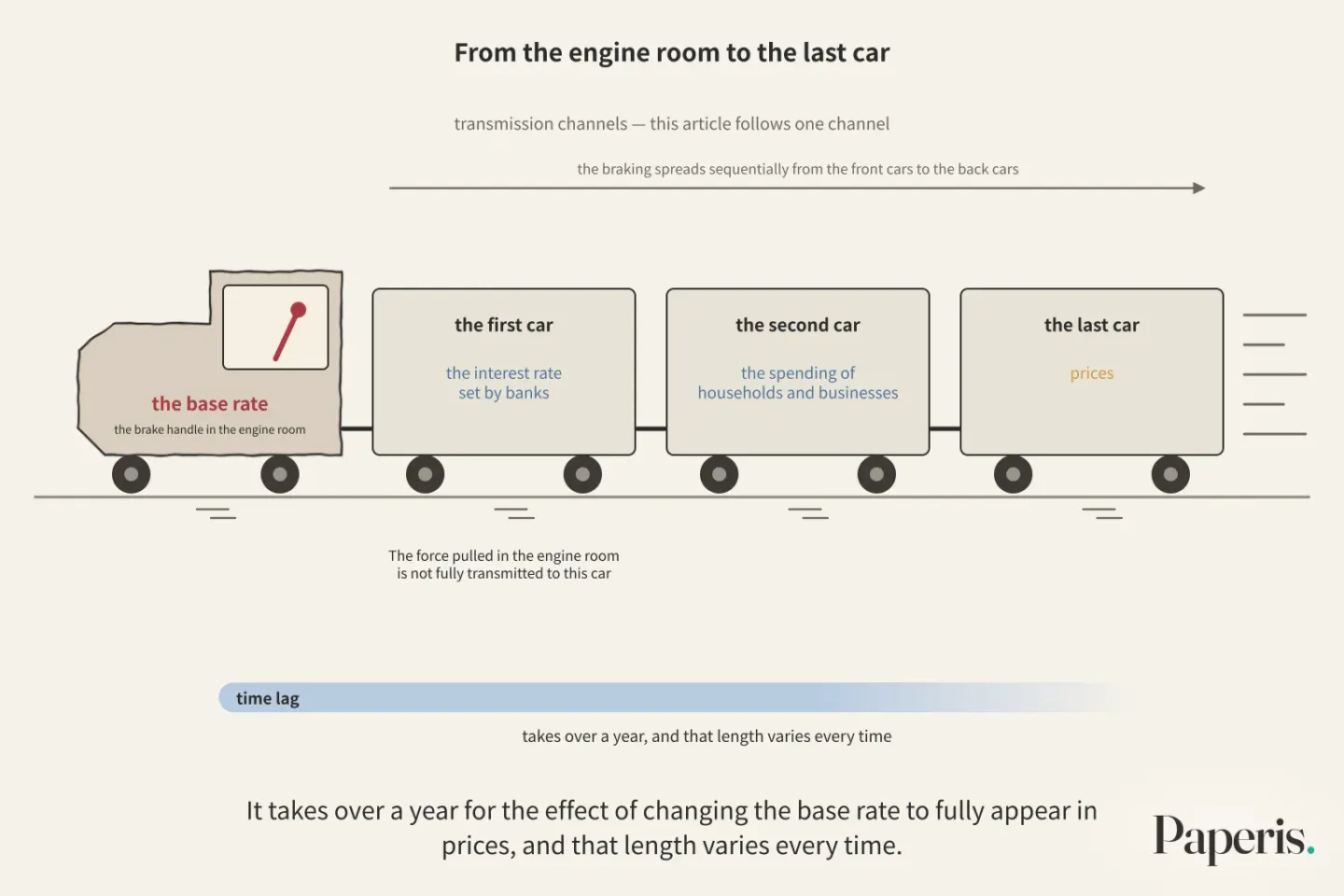
This article follows those steps by comparing them to a long freight train. Even if the engineer pulls the brake in the locomotive, a train with dozens of cars does not slow down immediately. The braking spreads sequentially from the front cars to the back cars, and the train only begins to slow down after traveling a good distance further. The examples in this article are taken from Korean news, but the concepts apply in any country.
The Price of Borrowing Money
For example, let's say you borrow 100 million won for a year, and agree to pay back that 100 million won plus an extra 4 million won a year later. The 4 million won is the price of using someone else's money for a year.
The interest rate is the price of borrowing money, which is the percentage of interest attached to the borrowed money. The interest rate in this example is 4 percent per year, which is 4 million won divided by 100 million won. The party receiving the 4 million won is the lender, and the party paying it is the borrower (OpenStax Principles Macroeconomics 3e 4.2).
Even the same person, when making a deposit at a bank, becomes the party providing money to the bank this time and receives interest. The deposit interest rate is the percentage of interest received by a person who deposits money in a bank. The lending interest rate is the percentage of interest paid by a person who borrows money from a bank.
That is why the phrase "interest rates have gone up" sounds different to different people. To someone with a lot of savings, it means the interest they receive may increase, and to someone with a lot of debt, it means the interest they pay may increase. Interest rates matter both to the person holding a bankbook and the person receiving a bill.
Rates Reset, Rates Held
Let us return to the bill at the beginning. The reason the interest on that loan increased was because it was a contract where the interest rate was reset every few months.
A variable rate is an interest rate that is reset according to the market rate at that time, at set intervals. A fixed rate is an interest rate set when borrowing that does not change for the agreed-upon period. The bill for someone who borrowed at a fixed rate lists the exact same interest even in the month news announces a rate hike.
Changes in interest rates reach the variable-rate side first and more heavily. In a working paper using U.S. data, 1-year adjustable-rate mortgage rates moved noticeably within the week an unexpected rate decision was announced, while 30-year fixed mortgage rates moved a week later. The 1-year variable-rate side moved more and followed faster (DOI: 10.2139/ssrn.1717012). To use a train as an analogy, the variable rate is the carriage directly behind the locomotive.
Even in countries with many fixed-rate loans, changes in interest rates eventually reach household budgets. In a study comparing the U.S., where fixed rates are mainly used, and Spain, where loans with annual rate resets are common, changes in mortgage rates clearly spread to household spending in both countries, and the extent of the spread was smaller in the U.S., which has many fixed rates. Also, on the fixed-rate side, the impact received by each household was more uneven, and it was largest among households able to refinance their loans at the new rates (DOI: 10.1017/s1365100525100667). According to another working paper using U.S. data, regardless of rate decisions, households that happened to be buying homes or refinancing around that time received the new rates and accounted for more than half of the transmission, with the effect accumulating over time (DOI: 10.2139/ssrn.4734233). The fixed rate is the rear carriage where the brakes arrive late.
The Bank Sitting in the Engine Room
Morning economic news often features the name "Bank of Korea Monetary Policy Committee." We break down this name and the terms that follow it one by one.
A central bank is a bank tasked with influencing the entire national economy by raising or lowering interest rates. Many countries have central banks, and central banks are also responsible for regulating some or all of the banking system in their countries (OpenStax Principles Macroeconomics 3e 15.1). Korea's central bank is the Bank of Korea, and the place within it that sets and announces interest rate targets is the Monetary Policy Committee. Covered by a Korean study from 1999 to 2007, the Monetary Policy Committee set and announced targets for the call rate, the interest rate at which banks lend and borrow money among themselves (KCI ART001309457). A central bank is also a bank for banks. Commercial banks each keep accounts at the central bank (OpenStax Principles Macroeconomics 3e 15.3).
Monetary policy is the work of influencing the economy by shifting interest rates and the ease of borrowing money. Lowering interest rates and making it easier to borrow money increases corporate investment and various expenditures, moving in the direction of increasing national production and jobs overall (OpenStax Principles Macroeconomics 3e 15).
The base rate is the interest rate set and announced by the central bank, acting as the benchmark guiding the very short-term borrowing and lending rates among banks. American textbooks explain the rate targeted by the US central bank as the overnight interbank lending rate, and note that when this rate rises or falls, most other interest rates eventually follow it (OpenStax Principles Macroeconomics 3e 15.3).
A freeze is a decision to leave the base rate unchanged. Tightening is monetary policy in the direction of making borrowing difficult by raising interest rates. The opposite side, which lowers rates to encourage borrowing, is commonly called expansion or easing (OpenStax Principles Macroeconomics 3e 15.4). Compared to a train, the base rate is the brake handle in the engine room, tightening is pulling that handle harder, and a freeze is keeping it at the current strength.
From the Engine Room to the Last Car
From the day the base rate goes up to the month the first bill changes, we trace step-by-step what happens in between.
Transmission channels are the paths through which a change in the base rate ripples across various branches all the way to prices. A study using South Korean data from the 1980s and 1990s estimated that the channel where interest rates go through the exchange rate to prices had the largest effect (KCI ART000963006). This article follows the channel that passes through bank interest rates and the spending of households and businesses, while the exchange rate channel connects to "Exchange Rates and Trade — A Seesaw Where One End Rises as the Other Sinks, and the People Riding Each End".
The first car is the interest rate set by banks. The force pulled in the engine room is not fully transmitted to this car. Even in the month the base rate rises by 1 percentage point, the interest rate on a loan repaid over several years usually rises by less than 1 percentage point. The circumstances of both those looking to borrow that loan and those looking to lend it are loaded together into the lending rate (OpenStax Principles Macroeconomics 3e 15.4). A study using South Korean call market data from 1999 to 2007 showed that evidence of the target rate leading other market rates (excluding certificates of deposit rates) was weak, and instead showed that market rates led the target rate. However, after the trend of lowering rates around 2005 changed to a trend of raising them, that tendency was greatly subdued (KCI ART001309457).
Times when rates go up and times when they go down may also not move identically. There is an observation that when the base rate rises, bank lending rates follow upward quite quickly and by almost the same margin, while when it falls, they fall more slowly and do not drop all the way. One working paper explains this asymmetry with capital and liquidity regulations imposed on banks, and confirmed that explanation with US bank data (DOI: 10.2139/ssrn.2143451). Deposit rates may also not rise as quickly as lending rates. During the rate-hiking cycle started by the European Central Bank in July 2022, deposit rates in the euro area followed less than in previous hiking cycles, and in Greece, the interest rate on deposits that households can withdraw at any time hardly rose (DOI: 10.52903/econbull20235803). Spain's time deposit rates also followed more slowly than in previous hiking cycles (DOI: 10.53479/34572).
The second car is the spending of households and businesses. When interest rates rise, activities done by borrowing decrease. Businesses postpone investments made with borrowed money, and households postpone large expenditures made through borrowing (OpenStax Principles Macroeconomics 3e 15.4). The last car is prices. When spending decreases and the money trying to buy goods and services shrinks, the force pushing up prices weakens (OpenStax Principles Macroeconomics 3e 15.4).
None of the three cars we traced above—bank interest rates, spending, and prices—change overnight. The time lag is the gap between when a decision is made and when its effect appears in the economy. Textbooks note that monetary policy has small effects right away, that the main effects probably appear 1 to 3 years later, and that the length also varies every time (OpenStax Principles Macroeconomics 3e 15.5).
The lengths measured also differ by country and data. In one working paper using US data, it took more than 3 years for the overall price index to drop clearly after tightening, and the prices of several items actually rose at first (DOI: 10.2139/ssrn.4881202). A study measured with Australian data up to the 1990s estimated that it takes an average of 5 to 6 quarters for the effect to reach the growth rate of output, writing that there is considerable uncertainty in that estimate (DOI: 10.1111/j.1475-4932.1999.tb02456.x). It takes over a year for the effect of changing the base rate to fully appear in prices, and that length varies every time.
Why Raising Interest Rates Is Used to Control Inflation
When prices of goods rise quickly, news about central banks raising interest rates is often heard. This is the same logic as applying the brakes when a train runs too fast.
When the national economy overheats by producing more than it can steadily produce on its own, pressure arises for prices to climb. Raising interest rates at this time reduces borrowing for investment and buying, which eases the pressure driving up prices (OpenStax Principles Macroeconomics 3e 15.4). Textbooks note that controlling inflation is what central bankers would most often cite as the primary task of monetary policy (OpenStax Principles Macroeconomics 3e 15.5).
Because this chain of links takes time at every step, inflation is not controlled in the very month interest rates are raised. Even prices like housing costs, which the news frequently links in a single line with interest rates, do not move in only one direction. In one working paper using U.S. data, housing prices fell after tightening, but mortgage rates rose alongside them, so the monthly payments for people not locked into fixed rates actually increased. The same study noted that housing costs included in the consumer price index did not clearly fall and in some cases even rose, and that tightening also worked to push up housing prices in the long run by reducing home building (DOI: 10.2139/ssrn.7595138). There is also a working paper result showing that countries with more adjustable-rate mortgages saw housing prices react more strongly to interest rates (DOI: 10.2139/ssrn.5317326). Because the structure of loans differs from country to country, the same braking action works differently in each nation.
The side of lowering interest rates usually takes effect with a time lag, but it may not work well in a very deep recession. This is because banks may hesitate to expand loans, and households and businesses with insecure jobs may hesitate to borrow, while the central bank cannot force banks to lend (OpenStax Principles Macroeconomics 3e 15.5). This is similar to how releasing the brakes on an uphill slope does not make the train move well.
What Happens When You Hit the Brakes
In a working paper using Korean data, after the Bank of Korea's base interest rate rose, the employment rate of young men—meaning the proportion of working-age people who are working—decreased noticeably. According to the Korean abstract, young women moved in the same direction, but not as clearly as men, and there was generally no clear reaction among middle-aged and older adults. The authors interpret the results for middle-aged and older adults in the Korean abstract not as meaning there was no impact, but as the result of real assets like houses and household debt also moving the number of people willing to work (DOI: 10.2139/ssrn.2759709). What the employment rate counts is untangled in "Unemployment and Employment — Those in Line, Those Who Left It".
Inside businesses, plans change first. In a working paper using a survey of German firms, when a stronger-than-expected tightening announcement came out, firms immediately lowered their hiring plans and kept those lowered plans for a long time. What shrank first was hiring plans, layoffs increased later, and eventually the rate of employment growth slowed down (DOI: 10.2139/ssrn.7262679).
The burden also reaches indebted households. In a working paper examining variable-rate mortgages in Europe, the effect of rate cuts on arrears was small, but rate hikes clearly increased the likelihood of arrears. That risk was concentrated among people who took out loans when interest rates were very low (DOI: 10.2139/ssrn.5497014).
That is why central banks weigh their options. The goals a central bank aims at with interest rates are low inflation and low unemployment (OpenStax Principles Macroeconomics 3e 15.1), and some countries are required by law to put more weight on inflation (seen later). When you raise interest rates, the force pushing up prices weakens, but borrowing-driven investment and spending shrink together, cooling the economy, and if it goes too far, it can trigger a recession (OpenStax Principles Macroeconomics 3e 15.4). Conversely, if the easing meant to end a recession goes too far, it can push prices back up (OpenStax Principles Macroeconomics 3e 15.4). Pull too hard, and the train does not just slow down—it grinds to a halt.
The train metaphor has limits. The cars of a train only slow down when braked, but the cars of the economy carry jobs and debt, and the braking does not reach every car with the same force. Moreover, inflation and the economy move together under the influence of many forces besides interest rates (OpenStax Principles Macroeconomics 3e 15.4). Lowering interest rates does not stop at releasing the brakes, but also encourages borrowing-driven spending, which a train's brakes cannot picture (OpenStax Principles Macroeconomics 3e 15). You cannot determine the train's entire speed with a single handle in the engine room.
The Interest Rate on the Passbook, Minus Inflation
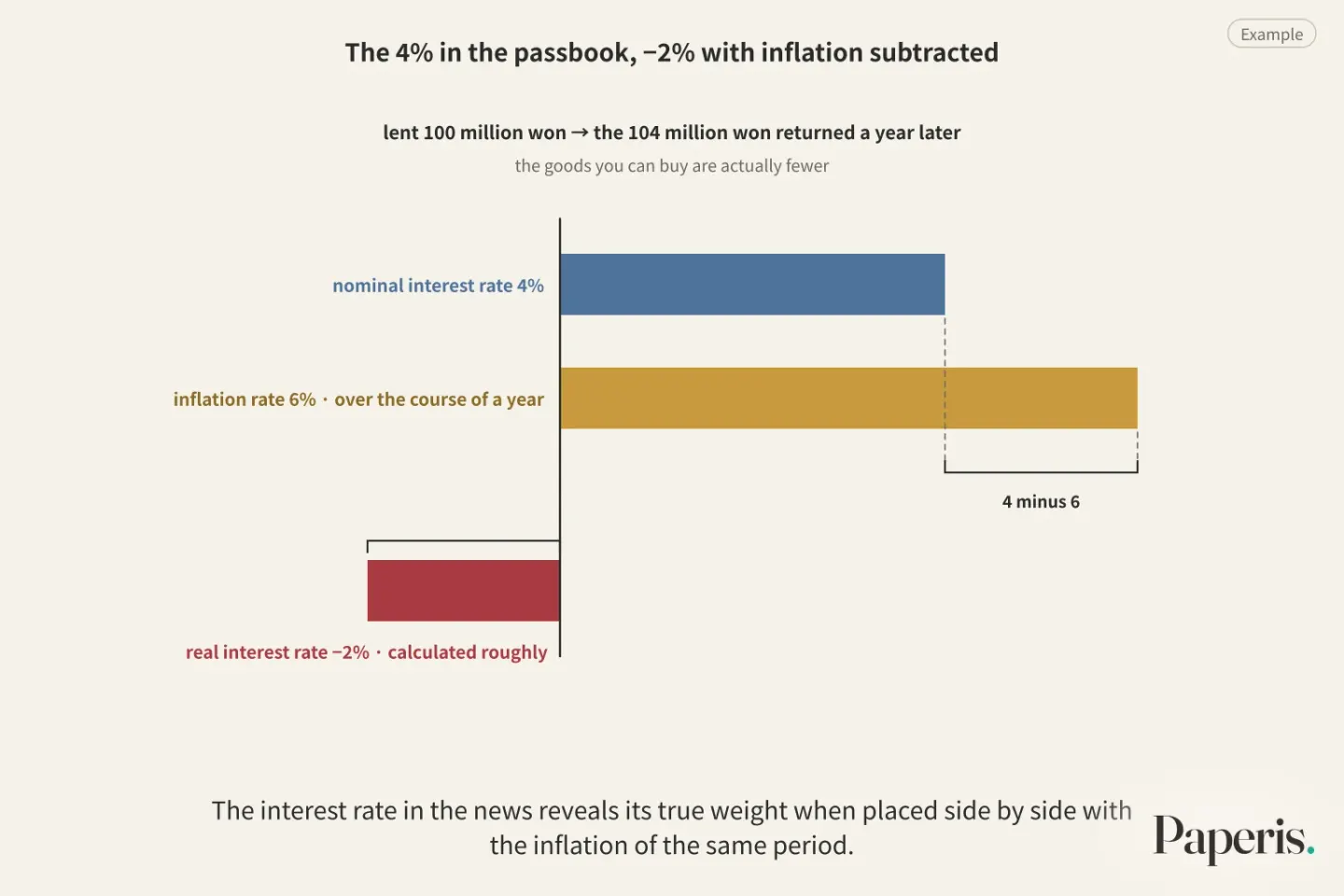
Let us imagine a year in which you lent 100 million won at an annual rate of 4% and inflation rose by 6% (example). The goods you can buy with the 104 million won returned a year later are actually fewer than what you could buy when you lent the 100 million won.
The nominal interest rate is the interest rate exactly as written on the passbook or loan contract. The 4% in this example is the nominal interest rate. The inflation rate is the value representing by what percentage prices rose over a certain period. The inflation rate in the news is usually the change over a span of one year (OpenStax Principles Macroeconomics 3e 9.3), and in this example it is 6% over the course of a year.
The real interest rate is the value obtained by subtracting the inflation rate from the nominal interest rate, viewed with the portion by which prices rose subtracted. Calculated roughly by subtraction, the real interest rate in this example is 4 minus 6, which is −2%. If you fail to keep up with inflation even after receiving interest, what you can buy with the returned money shrinks (OpenStax Principles Macroeconomics 3e 9.4). From the perspective of the borrower, the same thing appears as a lighter burden (OpenStax Principles Macroeconomics 3e 9.4). Who gains and who loses is explained in detail in "Prices and Inflation — The Same Shopping Basket, Height Marks Drawn Every Year". The interest rate in the news reveals its true weight when placed side by side with the inflation of the same period.
A Promise with Inflation Set as the Target
Inflation targeting is a system where the law requires the central bank to focus primarily on keeping inflation low. As of 2014, 28 countries had established this legal obligation for their central banks, and South Korea was one of them (OpenStax Principles Macroeconomics 3e 15.5). Textbooks note that economists have not reached a consensus on whether to force central banks to look only at inflation or to grant them broader discretion (OpenStax Principles Macroeconomics 3e 15.5).
The results of South Korean studies examining the period after the introduction of this system are mixed. One study using South Korean city- and provincial-level price data found that after the system was introduced, the persistence of inflation shocks decreased and disparities among regions narrowed, and the authors attribute these changes to the role of monetary policy (DOI: 10.1111/1468-0106.12016). Another study using South Korean data from after 2000 showed that industrial production dropped clearly after policy interest rates were raised, but consumer prices did not show a clear response (DOI: 10.22841/kjes.2020.68.2.002).
Imagine a scene where a train is already running at its proper speed while people outside urge the release of the brakes. This is the kind of scenario that supporters of inflation targeting worry about. Textbooks note that in countries where political pressure to lower interest rates enters even when the economy is already producing at its full capacity, and the central bank yields to that pressure, unemployment may not decrease in the long run while inflation alone can rise (OpenStax Principles Macroeconomics 3e 15.5).
Central bank independence is the degree to which a central bank can set interest rates by looking solely at economic conditions, kept apart from political pressure. In the case of the United States, giving central bank board members long terms in office is also explained as a device to maintain this distance (OpenStax Principles Macroeconomics 3e 15.1). A chapter in a macroeconomic policy textbook covers an independent central bank and inflation targeting as methods to solve the problem where discretionary policy chosen case-by-case tilts toward raising inflation (DOI: 10.1093/oso/9780198825371.003.0007).
Once Again, Before the Morning News
Now, let us take a single sentence from the morning news: "The Bank of Korea's Monetary Policy Board has frozen the base rate."
What this sentence says is that the brake in the engine room is being left at its current pressure. The economy does not stop during a month when the rate is frozen. Because the main effect of a previously changed rate likely appears 1 to 3 years later, the braking applied earlier may still be rippling through to the rear cars (OpenStax Principles Macroeconomics 3e 15.5).
There is also what this sentence does not say. When and by how much your bill will change depends on whether your loan is variable-rate or fixed-rate, and on how much and how quickly banks pass changes in the base rate on to loan and deposit rates. U.S. data showed that the degree to which mortgage rates are passed through was uneven between rate hikes and rate cuts (DOI: 10.2139/ssrn.1717012), and European data showed that deposit rates lagged behind the previous tightening cycle (DOI: 10.53479/34572). How much inflation will ease cannot be known from this single sentence either.
If the news had been an "increase," you would read it like this: because the brake has been pulled harder, interest on variable-rate loans may rise first, and deposit interest may follow later and to a lesser degree. The effect of taming inflation appears past the turn of the year, and in the meantime, jobs and indebted households share the weight of the braking. The bill at the start was a signal received in the front car of that long chain.
Where to Look Next
How money is created as banks issue loans is covered in "Where Money Comes From — Do Banks Lend Deposits, or Create Them?". The debate over why prices rise continues in "The Real Cause of Inflation — Money Supply, Expectations, or Supply Chains?". The moments when the entire financial system shakes as interest rates go up and down are followed by "Why Financial Crises Keep Coming Back — Fat Tails, Black Swans, and Systemic Risk". The perspective of viewing interest rates as the price of money starts from "Supply and Demand: Who Sets the Price?".
Other parts of this series also connect with this article. "Prices and Inflation — The Same Shopping Basket, Height Marks Drawn Every Year" explains how the inflation rate is measured, "Unemployment and Employment — Those in Line, Those Who Left It" explains what employment and unemployment rates count, and "Exchange Rates and Trade — A Seesaw Where One End Rises as the Other Sinks, and the People Riding Each End" breaks down the path by which exchange rates spread into prices.
Source Papers
- "Principles of Macroeconomics 3e — 4.2 Demand and Supply in Financial Markets" (2022) — OpenStax Principles Macroeconomics 3e 4.2 — In financial markets, those who supply money receive a return and those who borrow pay it, with the simplest return being the interest rate.
- "Principles of Macroeconomics 3e — 15.1 The Federal Reserve Banking System and Central Banks" (2022) — OpenStax Principles Macroeconomics 3e 15.1 — Central banks raise and lower interest rates to target low unemployment and low inflation while supervising the banking system, and the United States staggers long board terms to insulate them from political pressure.
- "Principles of Macroeconomics 3e — 15.3 How a Central Bank Executes Monetary Policy" (2022) — OpenStax Principles Macroeconomics 3e 15.3 — The central bank is the bank for banks, the interest rate targeted by the U.S. central bank is the rate banks charge each other for overnight loans, and when this rate moves, most other interest rates eventually follow.
- "Principles of Macroeconomics 3e — 15.4 Monetary Policy and Economic Outcomes" (2022) — OpenStax Principles Macroeconomics 3e 15.4 — Tightening raises interest rates to reduce investment and borrowing for big-ticket items and dampens inflation pressure, but going too far can trigger a recession, and long-term lending rates move less than overnight rates.
- "Principles of Macroeconomics 3e — 15.5 Pitfalls for Monetary Policy" (2022) — OpenStax Principles Macroeconomics 3e 15.5 — The effects of monetary policy appear after long and variable lags (roughly 1 to 3 years), rate cuts may not work well in a deep recession, and by 2014, 28 countries including South Korea had adopted inflation targeting by law.
- "Principles of Macroeconomics 3e — Introduction to Monetary Policy and Bank Regulation" (2022) — OpenStax Principles Macroeconomics 3e 15 — Monetary policy is how a central bank moves interest rates and credit conditions, and lowering rates and making credit easy increases investment and spending, which boosts output and employment.
- "Principles of Macroeconomics 3e — 9.3 How the U.S. and Other Countries Experience Inflation" (2022) — OpenStax Principles Macroeconomics 3e 9.3 — The inflation rate is commonly reported as the annual percentage change in the Consumer Price Index.
- "Principles of Macroeconomics 3e — 9.4 The Confusion Over Inflation" (2022) — OpenStax Principles Macroeconomics 3e 9.4 — If interest rates fail to keep pace with inflation, real returns turn negative, and if inflation rises after borrowing at a fixed rate, the borrower's real burden decreases while the lender loses.
- "U.S. Monetary Policy Surprises and Mortgage Rates" (2010) — DOI: 10.2139/ssrn.1717012 — Working paper (U.S.): To unexpected policy changes, 1-year adjustable mortgage rates reacted within the announcement week and 30-year fixed rates reacted a week later, with the transmission to 1-year adjustable rates being larger and faster.
- "The mortgage rate channel of monetary policy transmission: A tale of two countries" (2025) — DOI: 10.1017/s1365100525100667 — In both the U.S., where fixed rates predominate, and Spain, where variable rates reset annually, changes in mortgage rates transmitted clearly to spending (with a smaller propensity to consume in the U.S.), and fixed-rate impacts were uneven across households, largest among households able to refinance.
- "Inframarginal Borrowers and the Mortgage Payment Channel of Monetary Policy" (2024) — DOI: 10.2139/ssrn.4734233 — Working paper (U.S.): Even with many fixed rates, monetary policy transmits through mortgage payments via households that would buy homes or refinance anyway regardless of rate decisions (over half), and the effects accumulate over time to create a lag.
- "Asymmetric Interest Rate Pass-Through from Monetary Policy: The Role of Bank Regulation" (2012) — DOI: 10.2139/ssrn.2143451 — Working paper (U.S. bank holding companies 2001–2012): When policy rates rise, lending rates rise quickly by nearly the same magnitude, but when they fall, they drop more slowly and imperfectly, confirming with U.S. data the predictions of a model explaining this through capital and liquidity regulations.
- "The pass-through of market interest rates to bank interest rates" (2023) — DOI: 10.53479/34572 — In the euro area and Spain during this rate-hiking cycle, time deposit rate pass-through was slower than in previous hiking cycles, with large differences across countries.
- "Interest rate pass-through to deposit rates in Greece" (2023) — DOI: 10.52903/econbull20235803 — During the European Central Bank hiking cycle starting in July 2022, the rise in Greek deposit rates was limited, and household overnight deposit rates barely rose.
- "The Long and Variable Lags of Monetary Policy: Evidence from Disaggregated Price Indices" (2024) — DOI: 10.2139/ssrn.4881202 — Working paper (U.S.): Following tightening, the response of the aggregate price index turned clearly negative only after more than 3 years, and some items initially rose instead.
- "The Lags of Monetary Policy" (1999) — DOI: 10.1111/j.1475-4932.1999.tb02456.x — Australian data: Following a 1-percentage-point rise in short-term real interest rates, the average lag of the effect on output growth is estimated at 5 to 6 quarters, but with considerable uncertainty.
- "Monetary Policy and Mortgage Payments" (2026) — DOI: 10.2139/ssrn.7595138 — Working paper (U.S.): Tightening lowers house prices but raises mortgage rates, increasing payments for those not locked into fixed rates, did not significantly lower housing costs in consumer prices or even raised them, and over the long run raises house prices through reduced housing investment.
- "Mortgage Market Structure and the Transmission of Monetary Policy During the Great Inflation" (2025) — DOI: 10.2139/ssrn.5317326 — Working paper: Economies with a larger share of adjustable-rate mortgages saw house prices react more strongly to monetary policy shocks.
- "정책금리 변동이 성별‧세대별 고용률에 미치는 영향(Gender and Age Group Differences in Employment Responses to Monetary Policy Shocks)" (2016) — DOI: 10.2139/ssrn.2759709 — Working paper (South Korea): Bank of Korea base rate hikes lowered the employment rate of young men (Korean abstract: young women in the same direction but less clearly), while middle-aged and older groups showed generally insignificant effects, which the author interprets as results overlapping with other channels.
- "Monetary policy and the rigidity of firm employment expectations" (2026) — DOI: 10.2139/ssrn.7262679 — Working paper (German firm survey): Following tightening shocks, firms immediately and persistently lower their employment plans, with hiring plans shrinking first and layoffs increasing later, ultimately reducing employment growth.
- "Mortgage Loan Rates and the Defaults of Variable Rate Mortgages" (2025) — DOI: 10.2139/ssrn.5497014 — Working paper (euro area variable-rate loans 2014–2019): The delinquency effect of rate cuts is small, while rate hikes clearly raise default probability, and risks concentrated among borrowers who took out loans during ultra-low interest rate periods.
- "Inflation Targeting and Regional Inflation Persistence: Evidence from Korea" (2013) — DOI: 10.1111/1468-0106.12016 — South Korean city and provincial data: Following the introduction of inflation targeting, regional inflation persistence declined and disparities across regions narrowed.
- "Monetary Policy" (2020) — DOI: 10.1093/oso/9780198825371.003.0007 — A chapter from a macroeconomic policy textbook: covers time inconsistency and inflation bias in discretionary policy, along with independent central banks and inflation targeting as solutions.
- "통화정책 파급경로로서의 콜시장" (2008) — KCI ART001309457 — In data from May 1999 to 2007 when the Monetary Policy Committee published call rate operating targets, target rates failed to lead other market rates and instead moved backward, but after shifting to a tightening stance in April 2005, that tendency eased significantly.
- "우리나라 통화정책의 파급효과 분석:파급경로별 상대적 중요성을 중심으로" (2002) — KCI ART000963006 — In South Korean data from 1982 to 2001, the effect of interest rate shocks on inflation was most prominent through the exchange rate channel, while the effect of the interest rate channel grew larger and faster in the 1990s.
- "금리중시 물가안정목표제는 유효한가?" (2020) — DOI: 10.22841/kjes.2020.68.2.002 — In South Korea since 2000, industrial production declined clearly in response to policy rate hikes, but consumer price responses were unclear.
Sources (24)
- Principles of Macroeconomics 3e — 4.2 Demand and Supply in Financial Markets
- Principles of Macroeconomics 3e — 15.1 The Federal Reserve Banking System and Central Banks
- Principles of Macroeconomics 3e — 15.3 How a Central Bank Executes Monetary Policy
- Principles of Macroeconomics 3e — 15.4 Monetary Policy and Economic Outcomes
- Principles of Macroeconomics 3e — 15.5 Pitfalls for Monetary Policy
- Principles of Macroeconomics 3e — Introduction to Monetary Policy and Bank Regulation
- Principles of Macroeconomics 3e — 9.3 How the U.S. and Other Countries Experience Inflation
- Principles of Macroeconomics 3e — 9.4 The Confusion Over Inflation
- U.S. Monetary Policy Surprises and Mortgage RatesDOI 10.2139/ssrn.1717012
- The mortgage rate channel of monetary policy transmission: A tale of two countriesDOI 10.1017/s1365100525100667
- Inframarginal Borrowers and the Mortgage Payment Channel of Monetary PolicyDOI 10.2139/ssrn.4734233
- Asymmetric Interest Rate Pass-Through from Monetary Policy: The Role of Bank RegulationDOI 10.2139/ssrn.2143451
- The pass-through of market interest rates to bank interest ratesDOI 10.53479/34572
- Interest rate pass-through to deposit rates in GreeceDOI 10.52903/econbull20235803
- The Long and Variable Lags of Monetary Policy: Evidence from Disaggregated Price IndicesDOI 10.2139/ssrn.4881202
- The Lags of Monetary PolicyDOI 10.1111/j.1475-4932.1999.tb02456.x
- Monetary Policy and Mortgage PaymentsDOI 10.2139/ssrn.7595138
- Mortgage Market Structure and the Transmission of Monetary Policy During the Great InflationDOI 10.2139/ssrn.5317326
- 정책금리 변동이 성별‧세대별 고용률에 미치는 영향(Gender and Age Group Differences in Employment Responses to Monetary Policy Shocks)DOI 10.2139/ssrn.2759709
- Monetary policy and the rigidity of firm employment expectationsDOI 10.2139/ssrn.7262679
- Mortgage Loan Rates and the Defaults of Variable Rate MortgagesDOI 10.2139/ssrn.5497014
- Inflation Targeting and Regional Inflation Persistence: Evidence from KoreaDOI 10.1111/1468-0106.12016
- Monetary PolicyDOI 10.1093/oso/9780198825371.003.0007
- 금리중시 물가안정목표제는 유효한가?DOI 10.22841/kjes.2020.68.2.002