
Paperis Articles
Genius and Madness — The Thin Sheet Between Them
The idea that genius and madness are separated by a thin sheet is old. In studies linking Swedish and Danish hospital and occupational records, the most consistent link with creative occupations appeared among the unaffected relatives of people with bipolar disorder, while results for people with the illness themselves varied by country and occupation. In one Swedish study, genetic risk scored from relatives' records was also elevated in religious, helping and teaching occupations, and creativity test scores were lower in schizophrenia overall (more so when chronic) and during depressive episodes of bipolar disorder. Lists of famous artists' diagnoses are posthumous estimates drawn from biographies.
Your field's papers, as audio
Pick your fields and journals — Paperis summarizes the key papers and turns them into audio. Listen on your commute.
Start Paperis free →Genius and Madness — The Thin Sheet Between Them
The Old Story of the "Mad Genius"
There is a saying that "there is a thin sheet of paper between genius and madness." The idea connecting mental illness and creativity dates back to ancient Greece (DOI: 10.3390/ijerph20136264), and ever since the 1800s, when Italian physician Cesare Lombroso investigated genius and madness side by side, this link has been a long-standing subject of debate (PMID 30166672). The "mad genius" remains a recurring stereotype in popular culture today (PMID 30166672).
This picture also remains in people's minds. When a 2016 survey asked 1,029 German adults how they picture someone with exceptional talent, respondents who portrayed such a person as somewhat disjointed in their emotions and interpersonal relationships outnumbered those who portrayed someone with both well-rounded abilities and a sound mind by a factor of two (PMID 27047409). The same paper notes that most studies looking at exceptionally talented individuals have reported their social and emotional aspects to be average or slightly better. For talented people in general, the picture in people's heads and the picture painted by research did not match. However, this survey and those studies did not look at artists separately, nor are they studies that diagnosed mental illness. Answers about artists and mental illness must be sought separately below.
This article asks a single question: Were great artists truly mad? In other words, how thin is the sheet of paper between creativity and mental illness?
First, let us define two illness names that will appear repeatedly in this article. Bipolar disorder is a condition in which a person experiences mania—an abnormally persistent, excessively elated, or irritable mood—at least once. A deeply sinking, depressed period often accompanies it, it can last a lifetime, and it is a disease that greatly disrupts daily life and work (PMID 32040337). Schizophrenia is a condition that causes major impairments in thought, perception, emotion, and behavior, and can involve symptoms such as beliefs disconnected from reality or auditory hallucinations. Depression (unipolar depression in this article) refers to cases where only sinking periods arrive, without elated periods.
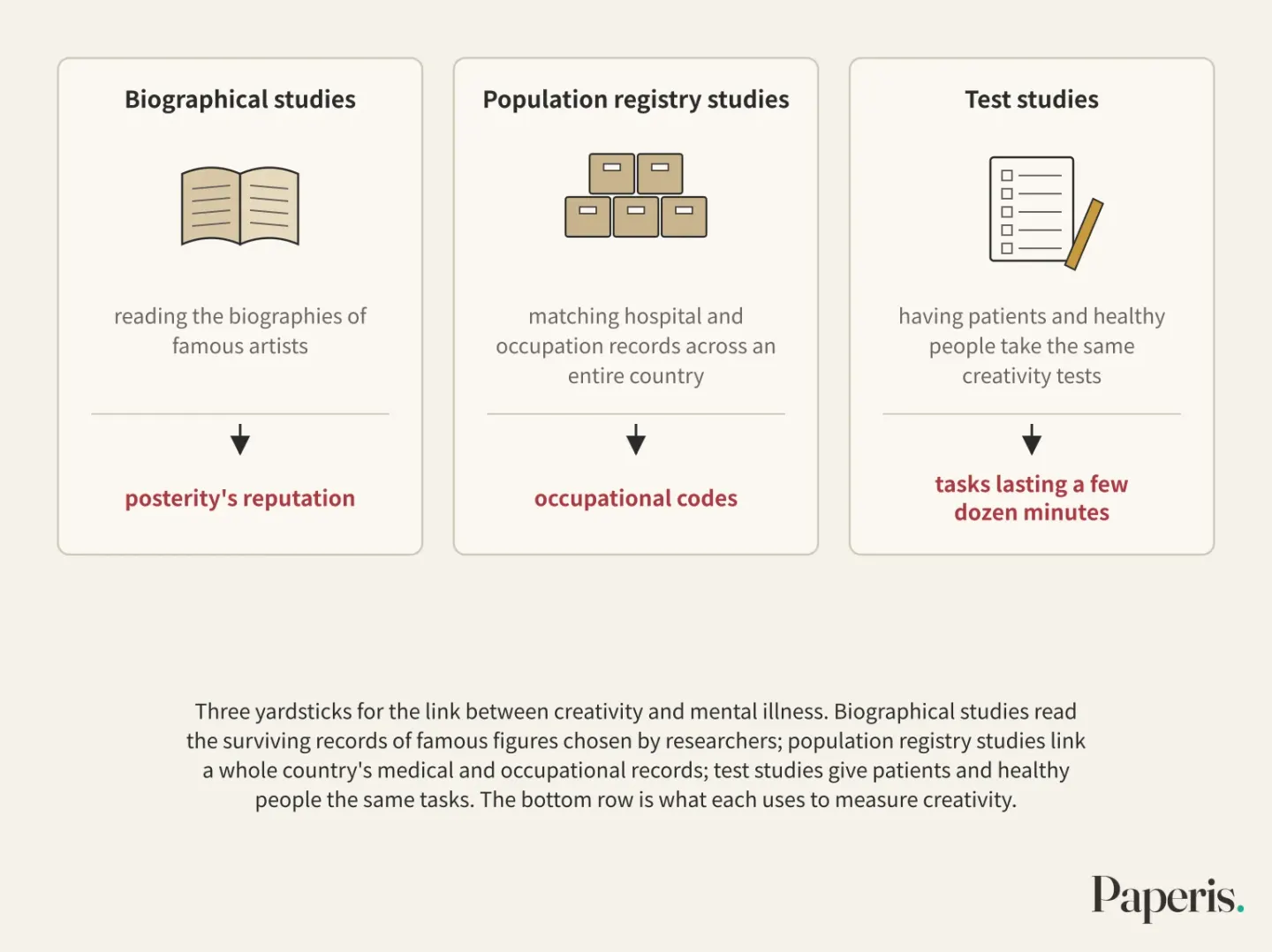
Decades of research have measured the thickness of this paper using three yardsticks: reading the biographies of famous artists, matching hospital and occupation records across an entire country, and having patients and healthy people take the same creativity tests. The three yielded different answers. Knowing what each yardstick measured also reveals why those answers diverge.
Measuring Thickness by Reading Biographies
The oldest yardstick is biography. Early research in this field read historical records such as biographies to find connections, and the results pointed toward a link between creativity and mood disorders (PMID 24590850). According to one critical review, the biographies of high-achieving individuals such as poets and musicians frequently recorded traces that could be read as bipolar disorder, and a significant portion of thinking about this connection came from such biographies (PMID 22088366).
What this method produces is retrodiagnosis. Retrodiagnosis is the process of estimating a diagnosis for a deceased person without directly examining them, using only remaining records such as letters, biographies, and works of art. A 2004 review summarizing studies that read backward through the biographies of famous figures listed fifteen writers, painters, and musicians—including Dutch painter Vincent van Gogh and Spanish painter Francisco Goya—in its abstract as figures "most likely to have shown manic-depressive symptoms" (PMID 15462476). This list was compiled by that review and is a retrospective estimation from remaining records. There are no records of those individuals being examined. The same review concluded that bipolar disorder is much more frequent among writers and artists than in the general population, and that bipolar mood traits may contribute to high artistic achievement. This conclusion is the judgment of a review that gathered biographies and existing studies.
The biographical yardstick has two weaknesses. One is that researchers choose whose biographies to read, and the other is that behaviors from records a century ago must be read to fit today's diagnostic criteria. As the limitations of such studies reading backward through past records became apparent, researchers shifted toward systematic surveys (PMID 24590850).
There is also an example where the answer changed depending on which field and which people were chosen. One research team read the biographies of ten figures who forged new paths in medical history, and the connection between madness and genius did not hold true for them (PMID 27876134). In the same sentence, the authors left open the possibility that the connection could hold for renowned figures in the fine arts. They then hypothesized that personality traits such as agreeableness, conscientiousness, and openness to new experience could foster creativity while protecting against mental illness. This study did not refute the list of artists, but showed through the biographies of ten figures that changing the field produces a different picture.
A systematic literature review gathering biographies, tests, and population studies from 1950 onward summarizes the state of the entire field as follows: study designs and results are disparate, and how to measure creativity remains a fundamental problem even beyond psychopathology (DOI: 10.1159/000357822). At the same time, it noted that when results are pooled, a tentative link between creativity and bipolar disorder, as well as mild personality tendencies leaning toward schizophrenia, is cautiously confirmed, while adding that the results must be interpreted with caution.
Paper measured by biographies looked thin. Yet that thinness cannot be read apart from who was chosen as the sample.
When the Records of an Entire Country Are Matched
To avoid choosing a sample, you can just look at every single person. Nordic countries have the records to make that possible. Population-based register research is a study that links a country's hospital visit, occupation, and family relationship records accumulated for its entire population, comparing hundreds of thousands to millions of people all at once. It differs from past research in that everyone in the records becomes the sample, instead of famous people chosen by the researchers.
In 2011, a Swedish research team compared records from 1973 to 2003 for about 300,000 people who had been hospitalized for schizophrenia, bipolar disorder, or depression, alongside records for their unaffected relatives and a general population control group (DOI: 10.1192/bjp.bp.110.085316). When comparing the proportions of people with creative occupations, individuals with bipolar disorder and the unaffected siblings of those with schizophrenia or bipolar disorder were more frequently found in creative occupations. For individuals with schizophrenia, there was no overall difference in creative occupations compared to the control group, though the proportion was higher when looking exclusively at artistic occupations. Individuals with depression and their siblings did not differ from the control group. The authors concluded this suggests schizophrenia, bipolar disorder, and creativity tend to run in the same families.
In 2013, the same team expanded the sample to 1,173,763 patients and checked the results again (PMID 23063328). Looking broadly at creative occupations, which combined scientific and artistic professions, there was no more frequent association with any of the diagnoses studied, except for bipolar disorder. The exception was writers. The occupation of writer was specifically linked to schizophrenia, bipolar disorder, depression, anxiety disorders, and substance abuse. And family ties showed up once again. The closest family members (parents, siblings, children) of individuals with schizophrenia, bipolar disorder, or anorexia, as well as the siblings of individuals with autism, were linked to creative occupations.
A 2024 study using diagnosis and occupation records for the entire population of Denmark breaks the picture down further (PMID 38730233). Individuals with bipolar disorder were more likely to become musicians than the general population, but were actually less represented in other creative occupations. Unaffected siblings were statistically significantly more prevalent across creative occupations overall. Family financial background was also a variable. Those from wealthy backgrounds consistently held more creative occupations, and family wealth increased the likelihood that a sibling of someone with bipolar disorder would choose a creative occupation. However, the share explained by wealth accounted for only a small portion of the association between bipolar disorder and creative occupations.
Across the records of both countries, the association appeared most consistently in the unaffected family members of individuals with bipolar disorder. The findings were mixed for the affected individuals themselves. In Sweden, individuals with bipolar disorder were more prevalent in creative occupations, whereas in Denmark, only musicians were more prevalent while other creative occupations were less so. The first implication of this result is that the area where the paper thinness appeared was right beside the patient rather than the patient themselves.
Some studies have also connected arts education with subsequent hospitalization. In a case-control study linking records for 4,454,763 people in Sweden, individuals who studied arts fields at university were more likely to be hospitalized for schizophrenia, bipolar disorder, or depression in adulthood than the general population. Expressed as a comparative metric called the odds ratio, these were 1.90, 1.62, and 1.39, respectively (PMID 29697041). Because 1 means no difference, all three leaned higher than the general population. The results remained even after adjusting for other factors such as intelligence. In these records, about 20,000 people were hospitalized for schizophrenia, making up less than 0.5% of the total. What this study measured was hospitalization; it did not measure when symptoms began or what caused what.
A study questioning whether the association is unique to creative occupations came out of Sweden in 2023 (PMID 35674100). Examining 1,137,354 people engaged in 59 managerial and highly educated professions, the researchers scored the familial genetic risk for ten major mental disorders using diagnosis records from first- to fifth-degree relatives. These were scores assigned based on the diagnoses of relatives, not the individuals themselves. Visual artists like painters, actors, and writers landed on the higher end of these scores. However, the highest elevations appeared in depression, anxiety disorders, and obsessive-compulsive disorder, whereas bipolar disorder and schizophrenia ranked lower. Similar or even greater elevations also appeared in religious occupations like clergy, caring occupations like psychologists and social workers, and educational and academic occupations like professors. The authors concluded that the high genetic risk of creative occupations is not exclusive to creative occupations, and is stronger in internalizing disorders like depression and anxiety than in psychotic disorders.
An association between creative occupations and mental illness does emerge in reality, but it varies by diagnosis. Looking solely at familial genetic risk scored from relatives' records, this single Swedish study showed equal or greater elevations in occupations such as clergy, psychologists, and professors. Looking at the families of painters, the area where the paper was thin leaned toward depression and anxiety rather than bipolar disorder.
When looking at the individuals themselves, there are also results pointing in the opposite direction. In a study matching 11,803 tenured faculty members from three Danish universities, a control group, and their relatives totaling 588,532 people, academics themselves were distinctly less likely to be diagnosed with any mental illness than the control group (odds ratio 0.44). Bipolar disorder was also lower (odds ratio 0.43), and schizophrenia was lower as well (DOI: 10.1002/wps.20682). Conversely, the siblings, children, and nieces and nephews of academics had more diagnoses of schizophrenia, while parents, grandparents, and nieces and nephews had more bipolar disorder. This result is a short research letter published in an academic journal, and the authors acknowledged that this association could stem from various other factors.
Studies directly examining genes reveal the magnitude of the signal. 2,953 people with creative occupations carried more genetic variants associated with both schizophrenia risk and better verbal test scores than 164,622 individuals from the general population (PMID 36624241). However, a systematic review combining 2009–2016 studies that looked at bipolar disorder and depression using risk scores aggregating multiple genetic variants concluded that those scores explained less than 2% of most outcomes, including creative occupations (PMID 29529547). This means the signal exists, but is faint.
Right in the Middle of Illness
Occupational records know only whether someone holds a creative profession. They do not know how creative that person is, nor what they were able to make while living with an illness. So the third yardstick has patients and healthy people take the same tests. The ability these tests measure most is divergent thinking. Divergent thinking is the ability to generate multiple answers to a single question, such as thinking of as many uses for a single brick as possible.
In schizophrenia, the direction of the result is clear. In a 2018 result combining 42 studies and 200 effects through a meta-analysis—which pools multiple studies together and recalculates them—the relationship between schizophrenia and creativity was in the negative direction (correlation coefficient of -0.32; 0 means no relationship, and a negative number means that when one side is high, the other is low). And the relationship was lower the more chronic the condition, the more institutionalized the patient, and the more verbal the task (PMID 28867517). A 2026 meta-analysis also selected only tasks designed to elicit creative output and pooled 13 studies; schizophrenia patients scored lower than the control group across all five analyses including overall creativity, with the difference being largest in overall creativity, fluency, and originality (PMID 41858475). These authors noted at the same time that the very consistency of this direction of results forces us to ask whether standardized tests properly measure real-life creativity. The gap between the observation that a few patients produce astonishing art and their test scores remains a question yet to be bridged.
In bipolar disorder, the difference is much smaller. A 2023 meta-analysis gathering 13 studies and 1,857 participants on divergent thinking and bipolar disorder reported a positive direction, but a "very small" effect (DOI: 10.3390/ijerph20136264). When divided by mood state, a small positive effect appeared during periods of stable mood and mild states falling short of diagnostic criteria, while a distinct negative effect appeared during depressive periods. The effect during elevated periods was not statistically confirmed. The authors noted that these sub-analyses are intertwined and should be read with caution.
A 2022 systematic literature review examining 12 studies that gathered 10 or more bipolar disorder patients and tested their creativity is even more cautious (PMID 34374271). Results compared with the control group varied, and bipolar disorder did not show higher creativity than other psychiatric disorders. Depressive periods showed poor creativity test scores, and elevated periods were indistinguishable from stable mood periods. Concluding that they could not confirm the hypothesis that "people with bipolar disorder are more creative," the authors cited as a possible reason the fact that nearly all studies used a single-timepoint design. Even in an online survey self-reported by 397 people diagnosed with bipolar disorder, those with distinct depressive symptoms in the past week had lower creativity scores, and those with elevated symptoms showed no difference from those without symptoms (PMID 31078791).
There are also instances where the answer changes depending on what the test measures. In one test where participants picked which shapes they liked and disliked among several, 49 stable bipolar disorder patients and 32 creative-field controls scored higher than 47 healthy controls. That higher score came mainly from the "dislike" side of the score, and there were no differences on other creativity tests between the bipolar disorder patients and the healthy controls (PMID 17126406). A study using the same test on parents and children with bipolar disorder interpreted this difference as a tendency to feel and express dislike for simple, symmetrical shapes (PMID 16157163). How much an experiment asking about picture preferences is shaken by the way it is asked was covered separately in "The Golden Ratio — Answers That Moved with the Question, a Different Rectangle for Each Person".
During depressive periods, and when schizophrenia is long-lasting or hospitalized, creativity test scores were generally low. Scores during elevated periods were indistinguishable from stable periods. Right there, the paper grows thicker.
Why They Split Like This
A paper that looks thin in population records and thick in the laboratory. There are a few ideas trying to explain this discrepancy. They are all hypotheses, and the evidence below consists of results that fit those hypotheses.
First is the difference in degree. The authors of the schizophrenia meta-analysis interpreted that, when placed alongside previous meta-analyses looking at the traits of healthy individuals rather than patients, creativity and psychopathology appear as an inverted U-shaped relationship (PMID 28867517). The interpretation is that a mild degree of symptom expression can go together with creativity, but once symptoms are fully expressed, creativity drops. A meta-analysis gathering unaffected general population samples even split the direction. Tendencies leaning toward bipolar disorder had a positive relationship with creativity (28 studies, correlation coefficient 0.22), while depressed mood had a weak negative relationship (39 studies, correlation coefficient -0.06) (PMID 26950008).
Second is shared vulnerability. Shared vulnerability is the hypothesis that when some of the predispositions that can cause a disease are present only to a degree that does not manifest as the disease, they overlap with traits related to creativity. A review covering bipolar disorder depicts this as follows. Having many risk variants results in illness, but having them to a mild or moderate degree can rather be an advantage, and that advantage may have kept this disease within the population (PMID 32040337). A study that examined Swedish twin records by finding twins where only one side had bipolar disorder matches this picture. The twin who did not suffer from the disease had higher positive temperament scores and performed better on verbal learning and fluency tests than the control group, whereas the side suffering from the disease had lower scores across all cognitive domains (PMID 25124743). This difference did not appear in schizophrenia twins.
The shared vulnerability hypothesis attempts to explain why the paper looks thin on the family side. One review pointed out active divergent thinking and a weak tendency to filter out familiar stimuli as factors shared by people vulnerable to mental illness and creative people (DOI: 10.1080/10400419.2015.1030305). At the same time, it noted that the power to flexibly switch thoughts, motivation, and openness to experience are related to actual creative achievement but not to mental illness. In this review's picture, the factors placed on the side of translating potential into actual achievement are traits unrelated to illness.
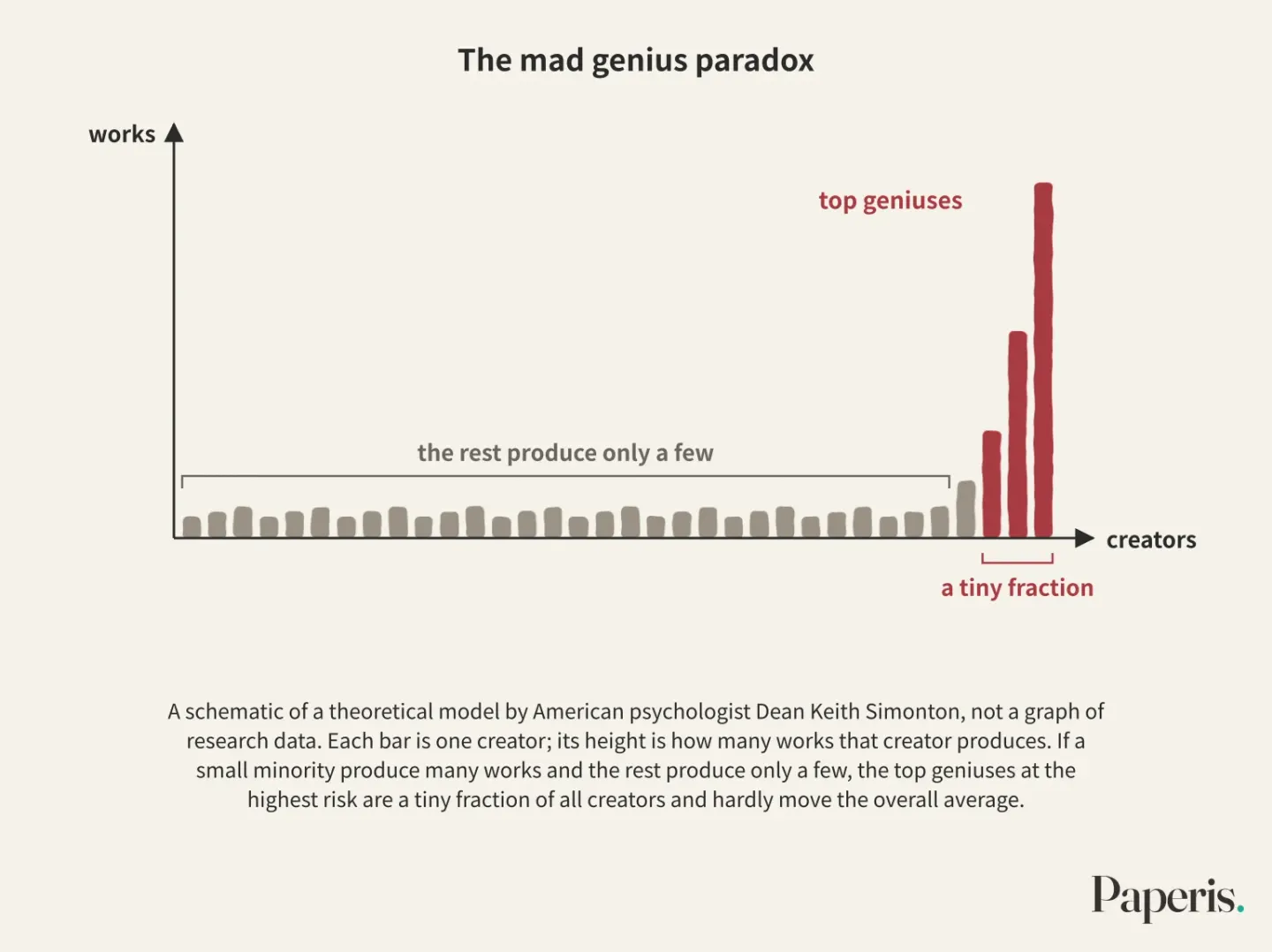
Third is the shape of numbers. American psychologist Dean Keith Simonton pointed out that this longstanding debate has mixed two different propositions (PMID 26186754). Among creators, the most creative people may have a higher risk of mental illness than less creative people, while at the same time, among all people, creators may have better mental health than non-creators. Assuming that most works in a field follow a distribution where a small minority produce many works and the rest produce only a few, the top geniuses at the highest risk are a tiny fraction of all creators and thus hardly move the overall average. Simonton named this the "mad genius paradox." This paper is a theoretical paper showing that the two propositions can logically be true together, and the results confirmed by data are not yet here.
This paradox can be read alongside the results of the Danish scholar study. The scholar himself suffered less, and his relatives suffered more (DOI: 10.1002/wps.20682). The authors also interpreted these results as fitting an inverted U-shaped picture mediated by vulnerability that does not manifest as illness in the scholar himself.
Still Debated
The biggest debate is how creativity is measured. Population registry studies use occupational codes, test studies use tasks lasting a few dozen minutes, and biographical studies use posterity's reputation. The authors of the Danish scholar study pointed out that creativity measured by self-reported occupation or psychological tests may be measuring inclinations or aspirations rather than actual achievement (DOI: 10.1002/wps.20682). Therefore, they chose tenured professorship as a "somewhat objective achievement" yardstick, but the assumption that the profession of professor stands in for creativity is also an assumption.
The second debate is direction. Illness may have changed occupational choice, the lifestyle of a creative profession may have influenced illness, or family circumstances or other factors may have driven both. A 2023 Swedish study separately controlled for individuals who developed illness first, and the pathway where familial genetic risk led to occupation via illness explained only a part of the signal (PMID 35674100). The share explained by family wealth in the Danish study was also small (PMID 38730233). These do not tell us what explains the remaining share.
The third debate is time. Almost all studies testing patients used single-timepoint designs (PMID 34374271), and studies following people forward are still small. In a multi-center study following 1,105 individuals aged 15 to 35 for over two years, people at high risk for bipolar disorder had higher questionnaire scores asking about actual creative achievement from the start, while there was no difference in shape preference tests (PMID 41469505). However, only 25 people transitioned to bipolar disorder during the follow-up period, and it was not statistically confirmed whether creativity scores predict this transition. Although the likelihood of transition appeared higher in the group with both high risk and high creativity, the authors stated this is a preliminary result that must be reconfirmed with larger and longer studies. They also added that creativity should not be viewed as a signal of illness, but as a resource and a factor that can change the pathway of risk.
The remaining questions remain open on both sides until these three are resolved.
So What Did We Learn
If we translate the average of the Danish records into a portrait of a single family, it looks like this: people with bipolar disorder were more often musicians than the general population but less often in other creative professions, their unaffected siblings were more often in creative professions, and this tendency was greater the more well-off the family was (PMID 38730233). This is an average combining countless families and does not predict any single person's profession. What this study tested was family wealth, and wealth explained only a small fraction of that tendency. Whether the rest comes from shared vulnerability, family atmosphere, or something else remains a question. Studies separating the two are not among the evidence gathered in this article.
When we hold the saying "there is a thin sheet of paper between genius and madness" up against the records of millions and dozens of test studies, that sheet of paper is uneven. It looks thin between unaffected family members of people with bipolar disorder and creative professions. The family genetic risk scored from relatives' records was higher for depression and anxiety among painters, actors, and writers, but it was just as high among clergy, social workers, and professors in a Swedish study. During depressive episodes, and in schizophrenia overall, especially when long-lasting, creativity test scores were lower, and there the sheet of paper is thick.
The studies gathered in this article reported associations, and none of them confirmed a causality where illness creates creativity. Lists of famous artists' diagnoses are mostly retrospective estimates from reading biographies, and the answer varied depending on who and which fields were chosen.
When we move this question from famous artists to ordinary people, the picture changes again. Everyday creativity is the creativity of ordinary people who solve everyday problems in flexible ways different from others, instead of leaving behind famous works. A 1990 paper pointed out that openness, flexibility, autonomy, humor, and persistence—traits characteristic of everyday creativity—are the same traits emphasized by models depicting healthy personality development (DOI: 10.1080/10400419009534351). In a 2016 meta-analysis combining 89 studies and 35,271 people, the average relationship between three common mental disorders—attention-deficit/hyperactivity disorder, anxiety, and depression—and everyday creativity was not distinguished from zero (DOI: 10.1177/0016986216630600). However, the differences in results across studies were large, and those differences depended on how illness and creativity were measured and on the participants' intelligence.
Most people with mental illness are neither artists nor geniuses, and not all artists suffer from mental illness. A conference abstract restarts the question from this simple fact (DOI: 10.1192/j.eurpsy.2025.1870). This question has shifted from "Are artists crazy?" to "Which person's which state moves together with which kind of creativity measured by which yardstick, in which direction and by how much?" The answer differs for each of those conditions. That it can be summarized neither as "completely unrelated" nor as "madness is the source of creativity" is what the records of millions have told us so far about a sheet of paper.
Source Papers
- "The Mad Genius Stereotype: Still Alive and Well." (2016) — PMID 27047409 — Survey of 1,029 German adults; respondents portraying talented people with "disharmony" outnumbered those with "harmony" two to one. Past studies generally show similarity or slight superiority.
- "The Manic Idea Creator? A Review and Meta-Analysis of the Relationship between Bipolar Disorder and Creative Cognitive Potential" (2023) — DOI: 10.3390/ijerph20136264 — 1,857 individuals across 13 studies; very small positive effect between divergent thinking and bipolar disorder at d=0.11, d=-0.51 during depression, caution needed for subgroup analyses of confounders.
- "Creativity and psychopathology: Two sides of the same coin?" (2018) — PMID 30166672 — Mad genius stereotype, debate starting with Lombroso in the 1800s, not fully settled either way.
- "Creativity and Bipolar Disorder: A Shared Genetic Vulnerability." (2020) — PMID 32040337 — Bipolar disorder is a lifelong mood disorder oscillating between mania and depression with considerable impairment. Model where many risk variants mean illness, while mild-to-moderate levels are an advantage (review).
- "[Creativity and bipolar disorder]." (2014) — PMID 24590850 — Early studies based on biographical texts, shifted to systematic research due to limitations of retrospective studies.
- "Creativity and bipolar disorder: touched by fire or burning with questions?" (2012) — PMID 22088366 — Much of the thought on the link comes from biographies of poets and musicians. Critical review.
- "[Artistic creativity and bipolar mood disorder]." (2004) — PMID 15462476 — Based on English abstracts (original text non-English). Review collecting biography-based studies, naming 15 figures including Van Gogh and Goya as likely having had manic-depressive symptoms (posthumous estimation). Conclusion that bipolar disorder is overrepresented in writers and artists, and that bipolar traits can contribute to achievement.
- "Geniuses of medical science: Friendly, open and responsible, not mad." (2016) — PMID 27876134 — Madness-genius link does not fit biographies of 10 medical innovators; personality trait hypothesis. Left room for the possibility to hold in the arts.
- "Creativity and Psychopathology: A Systematic Review" (2014) — DOI: 10.1159/000357822 — Studies from 1950 onward, methodological issues and creativity measurement as fundamental challenges, cautiously confirming links with bipolar disorder and schizotypal traits.
- "Creativity and mental disorder: Family study of 300 000 people with severe mental disorder" (2011) — DOI: 10.1192/bjp.bp.110.085316 — Swedish registry records; people with bipolar disorder and healthy siblings of schizophrenia/bipolar disorder patients are overrepresented in creative professions. Schizophrenia only for the arts subgroup, no difference for depression.
- "Mental illness, suicide and creativity: 40-year prospective total population study." (2013) — PMID 23063328 — 1,173,763 patients; creative professions as a whole have no link to anything other than bipolar disorder. Writers are linked to multiple diagnoses. Link present in closest family members (parents, siblings, children).
- "Artistic creativity and risk for schizophrenia, bipolar disorder and unipolar depression: a Swedish population-based case-control study and sib-pair analysis." (2018) — PMID 29697041 — 4.45 million people; odds ratios for hospitalization after higher education in arts fields: schizophrenia 1.90, bipolar 1.62, depression 1.39, maintained even after controlling for IQ.
- "The role of bipolar disorder and family wealth in choosing creative occupations." (2024) — PMID 38730233 — Danish population; bipolar disorder associated with musicians↑ and other creative occupations↓, healthy siblings in creative occupations↑, family wealth amplifies this but accounts for a small share.
- "Is an elevated family-genetic risk for major psychiatric disorders specific to creative occupations?" (2023) — PMID 35674100 — 1.13 million people; elevated family genetic risk in visual artists, actors, and writers (depression, anxiety, and OCD highest), equal or greater in religious, caregiving, and educational occupations. Not unique to creative occupations.
- "Mental illness among relatives of successful academics: implications for psychopathology‐creativity research" (2019) — DOI: 10.1002/wps.20682 — Research letter. 11,803 Danish educators, personal mental illness odds ratio 0.44, relatives show higher schizophrenia and bipolar disorder↑. Acknowledges possibility of other factors.
- "Genome-wide association study of school grades identifies genetic overlap between language ability, psychopathology and creativity." (2023) — PMID 36624241 — Schizophrenia risk and language grade-related variants overrepresented in 2,953 people in creative occupations.
- "The use of polygenic risk scores to identify phenotypes associated with genetic risk of bipolar disorder and depression: A systematic review." (2018) — PMID 29529547 — Polygenic risk scores are associated with creative occupations and others, but explained variance is mostly under 2%.
- "Schizophrenia and creativity: A meta-analytic review." (2018) — PMID 28867517 — 42 studies r=-0.324, more negative in chronic, hospitalized, and verbal tasks. Authors: inverted U-shape, mild symptoms may help, full symptoms harm.
- "A meta-analysis and systematic review of creativity in schizophrenia..." (2026) — PMID 41858475 — 13 studies, general creativity d=-0.79 and other deficits. Questions ecological validity of standardized tests, calls for new assessment tools.
- "Creativity in bipolar disorder: a systematic review." (2022) — PMID 34374271 — 12 studies, results heterogeneous, not higher than other disorders, performance during depression periods↓. Hypothesis cannot be confirmed, cross-sectional design limitations.
- "Depression, mania and self-reported creativity in bipolar disorder." (2019) — PMID 31078791 — 397 online self-reports, depressive symptom group creativity scores↓, hypomanic group no different from asymptomatic group.
- "Creativity in familial bipolar disorder." (2005) — PMID 16157163 — BWAS on parents and children with bipolar disorder, "dislike" subscale↑, interpreted as a tendency to dislike simple and symmetrical figures.
- "Enhanced creativity in bipolar disorder patients: a controlled study." (2007) — PMID 17126406 — 49 euthymic bipolar disorder patients and creative controls score higher on the Revised Art Judgment Test (BWAS), mainly on the "dislike" subscale. No differences on other tests.
- "Mad genius revisited: Vulnerability to psychopathology, biobehavioral approach-avoidance, and creativity." (2016) — PMID 26950008 — Non-clinical sample meta-analysis, bipolar disorder risk r=.224 (k=28), depressed mood r=-.064 (k=39).
- "Enhanced neurocognitive functioning and positive temperament in twins discordant for bipolar disorder." (2014) — PMID 25124743 — Swedish twins, unaffected twin shows positive temperament, verbal learning, and fluency↑, patient shows deficits across all domains. Not applicable to schizophrenia.
- "Creative Cognition and Psychosis Vulnerability: What's the Difference?" (2016) — DOI: 10.1080/10400419.2015.1030305 — Common factors (divergent thinking, weak filtering) versus factors distinguishing achievement (flexibility, motivation, openness).
- "The Mad-Genius Paradox: Can Creative People Be More Mentally Healthy But Highly Creative People More Mentally Ill?" (2014) — PMID 26186754 — Theoretical paper, assuming Lotka's law distribution allows both propositions to be true simultaneously.
- "Creativity and transition to bipolar disorder: a prospective analysis from the early-bipolife study." (2025) — PMID 41469505 — 1,105 people followed for 2 years, 25 transitions, no link confirmed via regression, preliminary results. Do not pathologize creativity.
- "Creativity and mental health in everyday life" (1990) — DOI: 10.1080/10400419009534351 — Characteristics of everyday creativity overlap with normal personality growth models.
- "A Meta-Analysis of the Relationship Between Three Common Psychopathologies—ADHD, Anxiety, and Depression—and Indicators of Little-c Creativity" (2016) — DOI: 10.1177/0016986216630600 — 89 studies, 35,271 individuals, average r=-.06 not different from 0, large heterogeneity.
- "Art and Madness: The role of psychopathology in creativity" (2025) — DOI: 10.1192/j.eurpsy.2025.1870 — Conference abstract (literature review). Most people with mental illness are neither artists nor geniuses, the relationship is complex.
Sources (31)
- The Mad Genius Stereotype: Still Alive and WellPMID 27047409
- The Manic Idea Creator? A Review and Meta-Analysis of the Relationship between Bipolar Disorder and Creative Cognitive PotentialDOI 10.3390/ijerph20136264
- Creativity and psychopathology: Two sides of the same coin?PMID 30166672
- Creativity and Bipolar Disorder: A Shared Genetic VulnerabilityPMID 32040337
- [Creativity and bipolar disorder]PMID 24590850
- Creativity and bipolar disorder: touched by fire or burning with questions?PMID 22088366
- [Artistic creativity and bipolar mood disorder]PMID 15462476
- Geniuses of medical science: Friendly, open and responsible, not madPMID 27876134
- Creativity and Psychopathology: A Systematic ReviewDOI 10.1159/000357822
- Creativity and mental disorder: Family study of 300 000 people with severe mental disorderDOI 10.1192/bjp.bp.110.085316
- Mental illness, suicide and creativity: 40-year prospective total population studyPMID 23063328
- Artistic creativity and risk for schizophrenia, bipolar disorder and unipolar depression: a Swedish population-based case-control study and sib-pair analysisPMID 29697041
- The role of bipolar disorder and family wealth in choosing creative occupationsPMID 38730233
- Is an elevated family-genetic risk for major psychiatric disorders specific to creative occupations?PMID 35674100
- Mental illness among relatives of successful academics: implications for psychopathology‐creativity researchDOI 10.1002/wps.20682
- Genome-wide association study of school grades identifies genetic overlap between language ability, psychopathology and creativityPMID 36624241
- The use of polygenic risk scores to identify phenotypes associated with genetic risk of bipolar disorder and depression: A systematic reviewPMID 29529547
- Schizophrenia and creativity: A meta-analytic reviewPMID 28867517
- A meta-analysis and systematic review of creativity in schizophreniaPMID 41858475
- Creativity in bipolar disorder: a systematic reviewPMID 34374271
- Depression, mania and self-reported creativity in bipolar disorderPMID 31078791
- Creativity in familial bipolar disorderPMID 16157163
- Enhanced creativity in bipolar disorder patients: a controlled studyPMID 17126406
- Mad genius revisited: Vulnerability to psychopathology, biobehavioral approach-avoidance, and creativityPMID 26950008
- Enhanced neurocognitive functioning and positive temperament in twins discordant for bipolar disorderPMID 25124743
- Creative Cognition and Psychosis Vulnerability: What's the Difference?DOI 10.1080/10400419.2015.1030305
- The Mad-Genius Paradox: Can Creative People Be More Mentally Healthy But Highly Creative People More Mentally Ill?PMID 26186754
- Creativity and transition to bipolar disorder: a prospective analysis from the early-bipolife studyPMID 41469505
- Creativity and mental health in everyday lifeDOI 10.1080/10400419009534351
- A Meta-Analysis of the Relationship Between Three Common Psychopathologies—ADHD, Anxiety, and Depression—and Indicators of Little-c CreativityDOI 10.1177/0016986216630600
- Art and Madness: The role of psychopathology in creativityDOI 10.1192/j.eurpsy.2025.1870