Paperis Articles
Abstract Art and Children's Paintings — Between the Fridge Door and the Gallery Wall
"My kid could have painted that" — in experiments with look-alike pairs, one paper reports that adults picked out the professional's painting with about 64% accuracy. What changes with art training, or with a label?
Your field's papers, as audio
Pick your fields and journals — Paperis summarizes the key papers and turns them into audio. Listen on your commute.
Start Paperis free →Abstract Art and Children's Paintings — Between the Fridge Door and the Gallery Wall
"My kid could paint that" is a claim we can test
A child's drawing is held to the kitchen refrigerator door by a magnet. Even if the paint is smudged and the lines are tangled, no one is going to take it down. A painting that looks vaguely similar hangs on the wall of the art museum you visited on the weekend. There are no recognizable shapes, and paint is splattered and layered over. Someone standing next to you says quietly, "My kid could paint that."
This remark is not rare at art museums. Visitors who scoff that a child could have painted an expensive Abstract Expressionist work are common, and there has actually been a case where chimpanzee paintings were mistaken for works by professional artists (DOI: 10.1177/0956797611400915). Abstract Expressionism is a movement in painting that expresses emotions through color, composition, and brushwork without recognizable shapes of what is being depicted. The paintings of the abstract painter Jackson Pollock belong to this movement.
"My kid could paint that" overlaps two claims. One is that "that painting and a child's drawing cannot be distinguished just by looking," and the other is that "therefore, that painting is nothing special." The latter asks about the value of a painting, so an experiment cannot answer it in its place. The former is different. It can be checked by placing an artist's painting and a child's or animal's painting side by side without name tags and having people try to pick them out. Researchers actually did that, and added one more question: Do people trained in art make this distinction better?
The first part of "My kid could paint that" is a claim that can be examined through experiments.
Removing the Nametags and Placing Two Pieces Side by Side
The idea that "my kid could paint that" was tested almost as is in 2011. A research team led by Hawley-Dolan and Winner showed pairs of paintings to art majors and non-majors. One painting in each pair was by an abstract expressionist artist, and the other was by a child, chimpanzee, monkey, or elephant. The pairs were chosen because they looked very similar on the surface (DOI: 10.1177/0956797611400915).
The skeleton of the experiment is a forced-choice experiment. A forced-choice experiment is an experiment where two options are shown side by side and participants must pick one without being allowed to say "I don't know." Because participants would get half right even if they guessed blindly without any basis, the results are always read in comparison to this fifty-percent baseline. Participants answered two questions for each pair: which one they liked more, and which one was the better painting (DOI: 10.1177/0956797611400915).
Nametags were also included as a condition. The earlier pairs were shown without nametags, while the later pairs were given nametags like "artist" or "child." Some of those nametags were accurate, while others were swapped on purpose. Participants liked the professional artists' paintings more and chose them as better paintings, and they did so even when the nametags were swapped (DOI: 10.1177/0956797611400915). The fact that the artist's side was chosen more often even when the nametag pointed to the other side means that these college students' choices were not determined by the nametags alone.
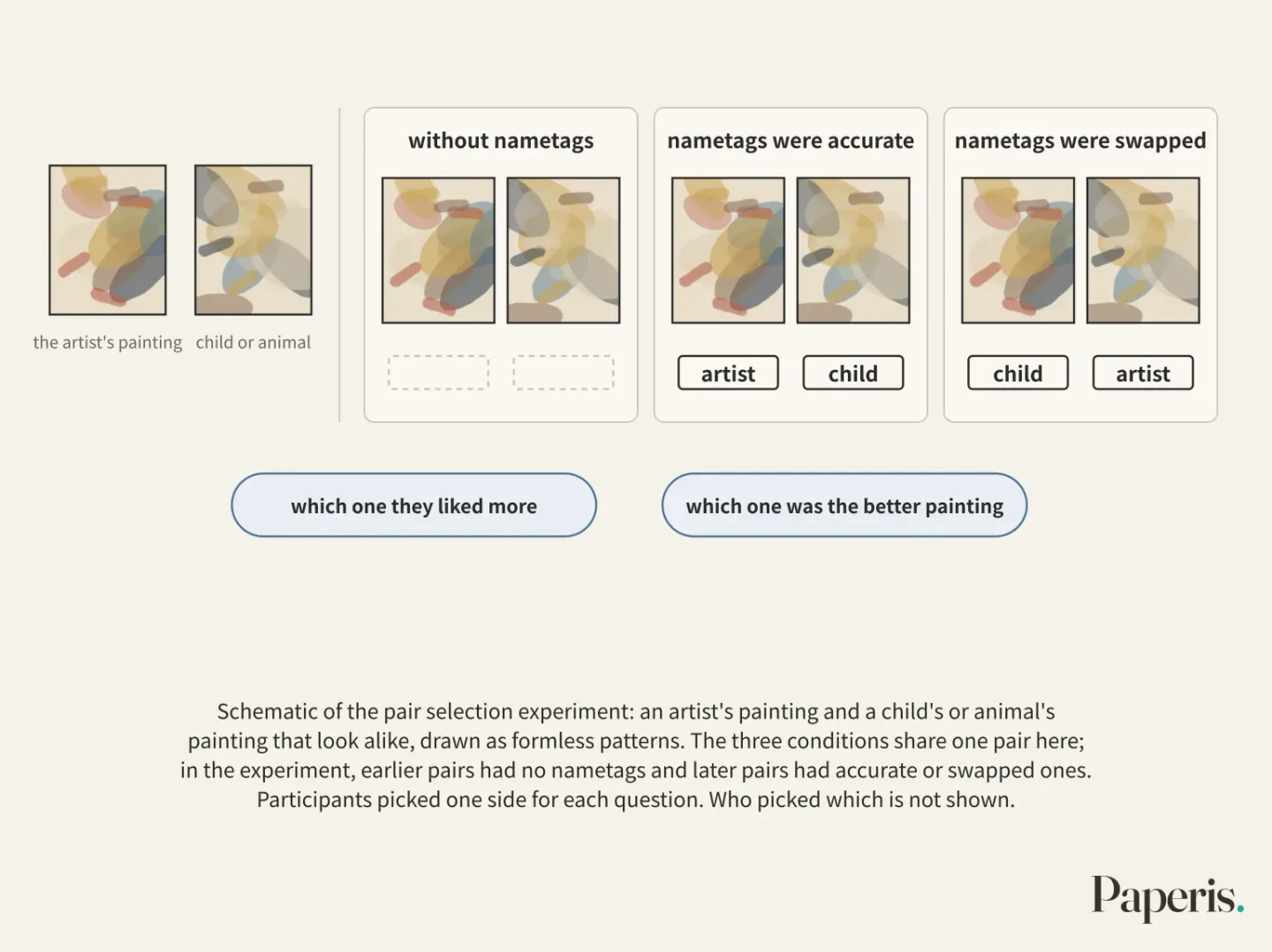
Imagine sitting in the experimental setup. Two paintings are placed in front of you. Neither has a recognizable shape, and colors bleed and brushstrokes overlap. There are no nametags. Since there is no "I don't know" option, you must pick one of the two—once choosing the one you like more, and once choosing the one that is better done. After a few pairs, labels like "artist" or "child" begin to appear under the paintings, and for some of those pairs, the nametags are reversed. In this experiment, participants reached for the artist's painting more often both in the pairs without nametags and in the pairs with reversed nametags.
The same framework was applied to children as well. In this experiment, 18 pairs of such paintings were shown to children aged 4–7 and 8–10, and they were asked which one they liked better and which one was better done. The first third of the paintings were shown without nametags, while the rest were shown with accurate or swapped nametags (DOI: 10.1080/15248372.2015.1014488). The results were something the researchers did not expect. Even 4- to 7-year-old children distinguished the artists' paintings from those of children and animals when there were no nametags (DOI: 10.1080/15248372.2015.1014488). Under the condition without nametags, the very age group associated with saying "my kid could paint that" made this distinction. The sample size and accuracy are not provided in the abstract. The results after nametags were attached did not follow the same direction as the adults, and that story continues in the section dealing with nametags.
Without nametags, both college students and 4- to 7-year-old children picked out the artist's paintings, and the college students chose the artist's paintings more often even when the nametags were reversed.
Around Six Out of Ten Times
Then how well did they pick? The abstract of the 2011 experiment does not give an accuracy rate. The number is in a 2016 paper. This paper, introducing earlier studies, noted that adults make this distinction with an accuracy of about 64%, which is statistically significantly higher than the probability of getting it right by guessing (DOI: 10.1145/2912125). It does not appear in the abstract which experiment, which question, or which label condition this value came from. Read within that range, it means that out of ten pairs, you get about six pairs right and get three or four pairs wrong. And this line of research used pairs of paintings chosen to look very similar on the outside.
Some people have compared the magnitude of this difference to chess. One researcher, in a short manuscript that has not undergone peer review (a preprint), compared the 67% rate at which art majors chose paintings by renowned artists as better in the Holly-Doland and Winner experiment to the win rate among chess players. And they concluded that "Masters of abstract painting score like class D amateurs when it comes to chess" (DOI: 10.48550/arxiv.1106.1915). However, the "score" here is the proportion in which viewers chose the artist's side. If you read this as a value measuring the artist's skill, you will misinterpret the analogy.
The accuracy of adults noted by one paper is about 64%, which is higher than chance and at a level where you miss three or four out of ten.
What is Read Behind the Brush
Participants were also asked why they chose that painting. When they chose a professional artist's painting rather than a child's or animal's painting, participants were more likely to explain their choice by citing the creator's intention, regardless of whether they majored in art (DOI: 10.1177/0956797611400915). The phrase the researchers attached to the paper title is "seeing the mind behind the painting."
This phenomenon has a name. Intent perception is the feeling that a painting shows the result of the creator planning and aiming ahead. Then, does the difference that humans read remain on the canvas? A 2016 study entrusted the same paintings to a computer algorithm. The algorithm distinguished between the professional artists' abstract paintings and the children's and animals' paintings in about 68% of cases (DOI: 10.1145/2912125). The degree of "artwork-ness" that people felt in the paintings moved significantly together with the visual content of the paintings, and the property of the canvas that best predicted the correct answer was the painting's fractals (DOI: 10.1145/2912125). A fractal is a property where patterns resembling the whole repeatedly appear even when a small part is magnified. The algorithm even predicted the degree of intention people felt for each painting (DOI: 10.1145/2912125).
What this result tells us is correlation. This study cannot claim that there were professional artists' paintings because there were many fractals; it only goes so far as to show that the intention felt by humans and the properties of the canvas measured by the machine moved together. Within that range, the authors report that this result confirms there are visually perceptible differences between abstract expressionist paintings and seemingly similar drawings by untrained individuals, concluding that "people see more when viewing abstract expressionism than they think they see" (DOI: 10.1145/2912125). The impression of intention that people read sits side by side with the measurable differences left on the canvas.
Even formless paintings have an up and down. In an experiment where eye movements were measured while abstract paintings were hung and shown in various directions (a study published in conference proceedings), paintings hung in the direction intended by the artist generally received higher aesthetic evaluations (DOI: 10.1145/3331453.3361299). The number of participants does not appear in the abstract. Even in paintings where what is depicted cannot be recognized, viewers respond to the orientation in which the canvas is placed. How the eye chooses a path within a painting was covered in "Composition and Gaze — Stepping Stones the Painting Lays, a Path the Eye Chooses".
Combining human judgment and machine analysis, the 2016 study found that there are visually perceptible differences between professional artists' paintings and children's and animals' paintings, and the college students in the 2011 experiment more frequently cited intention as the reason when choosing professional artists' paintings.
What Changes When You Learn Art
Holly-Doland and Winner’s experiment included both art-major and non-major students. Artistic expertise is the degree of experience and knowledge gained from learning and looking at art. Studies measure this by dividing people based on whether they majored in the subject, their occupation, or questionnaire scores. In that experiment, art-major students chose a painter's work as “more to my liking” more often than non-major students, but the two groups did not differ in their judgments when picking “which is a better-executed painting” (DOI: 10.1177/0956797611400915). Under the conditions of that experiment, what learning moved was not “what is better done”, but “what is good”.
There is also research that measured the effects of short-term education. Sixty participants in total—40 art novices and 20 art experts—evaluated 150 abstract and portrait paintings once in a laboratory and once in an art museum. Before the second evaluation, half of the novices were given a short lesson on the styles and art history of abstract and portrait paintings (DOI: 10.1371/journal.pone.0134241). Experts rated beauty and “how much they wanted to own it” higher than novices, but the two groups did not differ in the positive or negative emotions elicited by the paintings or in their levels of arousal. The short-term education had a small effect on preference evaluations (DOI: 10.1371/journal.pone.0134241). The authors summarized that this result aligns with the idea that emotional responses are largely similar among viewers, while more cognitive judgments vary depending on individual traits like expertise. Evidence that a single round of education greatly changes the eye that looks at art did not come out of this study.
There are also results showing that the layer changed by learning and the layer left untouched are split. In a study that showed symmetric and asymmetric patterns to art history majors and psychology majors, an implicit preference test measuring response time showed that artistic expertise did not change the tendency to like symmetry. When directly asked “how beautiful is it”, higher expertise raised the scores for asymmetric patterns, but participants still liked the symmetric side more (DOI: 10.1177/2041669518761464). The authors interpreted that when experts are asked direct questions, they tend to bring in different criteria and emphasize the beauty of asymmetry.
The effects of expertise are not the same everywhere. In two experiments that gathered art experts and non-experts from the West and India, with hypotheses and analysis methods preregistered and sample sizes calculated, there was a tendency to prefer representational art over abstract art in paintings. Representational art refers to paintings where you can recognize the shapes of what was drawn, such as people, landscapes, or objects. This tendency was weaker in art experts, but that attenuation appeared only among Western participants (DOI: 10.1038/s41598-022-14128-7). The authors wrote that one must be cautious in expanding models of aesthetic appreciation derived mainly from Western samples to other groups and other art forms. Many of the experiments seen here also gathered college students or children and showed them predetermined paintings.
There are also results showing that knowing is intertwined with the method of judgment. In two experiments dealing with the judgment of art pieces, the “middle layer”—those with fair experience but not much systematic knowledge—made better judgments when leaving it to intuition rather than after deliberating carefully, whereas experts and novices did not change their judgments even when their judgment method was altered (DOI: 10.1002/bdm.1759). The research team had predicted in advance that the middle group lacked the formal knowledge to understand the reasons for their preferences and would thus lose out the more they deliberated, and the results matched that prediction. This is the result of a single research cluster, and the criteria for judging the quality of the judgments were set by the research team.
When you learn art, “what you like and value highly” moves, but that change depended on what was asked and who was asked, and the effect of a single short-term education session was small.
What Name Tags Do
Children parted ways from adults in a different place. Once name tags were attached, children frequently chose pictures labeled "child" or "animal" regardless of whether those name tags were correct, and sometimes cited the effort the child or animal put in as their reason for choosing. It was phrasing along the lines of “They did really well for an elephant” (DOI: 10.1080/15248372.2015.1014488). The children's choices frequently leaned toward the side with the name tag. The language of their reasoning resembled the calculus people recall when sticking drawings on the refrigerator door. Even so, when asked "which one turned out better" rather than "which one is good" like adults do, the children chose the artist's paintings more often. The research team interpreted this to mean that children also distinguish between intuitive preference and more deliberative judgment of quality (DOI: 10.1080/15248372.2015.1014488).
There is a name for this phenomenon where information outside the painting changes judgments. The name tag effect is the phenomenon where information attached next to a work, such as the artist, technique, or title, changes judgments about the same painting. This effect exists for adults as well. In an experiment where Pollock's abstract paintings were shown with artist and technique information attached and detached, participants liked the paintings more and found them more interesting when both pieces of information were given together. This effect was larger for people with less art experience and those open to new experiences (DOI: 10.1038/s41598-023-30768-9). The authors wrote that for works unfamiliar to the viewer, more information may be needed for contextual information to exert an influence.
How easily one can grasp meaning is also entangled in feeling that abstract art is beautiful. In an experiment that divided abstract paintings into complex and simple ones, and showed them after pre-surveying how easy it was to grasp their meaning across five levels, people evaluated complex paintings as more beautiful, but only when their meaning was comparatively easy to grasp. Creativity ratings came out strangely evenly without this difference (DOI: 10.1080/10926488.2018.1481255).
Stories about the artist also operate like name tags. Across five sets of experiments, Vincent van Gogh's “Sunflowers” was evaluated more favorably when given alongside information that he cut off his left earlobe, and participants liked works more when the artist was eccentric. This “eccentricity effect” did not appear in conventional works, but only in works that broke from convention (DOI: 10.1002/ejsp.1999). In an experiment using music by the singer Lady Gaga, the effect only occurred when the eccentric persona appeared genuine. The authors concluded that part of the evaluation of a work is rooted in how eccentric the artist is perceived to be, and whether they appear authentic and skillful matters (DOI: 10.1002/ejsp.1999). The common notions surrounding artists and mental health themselves are pursued separately in "Genius and Madness — The Thin Sheet Between Them".
In the college student experiment, name tags did not reverse the tendency to choose the artist's side, but children frequently chose the side with the name tag, artist information tipped the scales of judgment for adults too, and the effect was larger for people with less art experience.
Still Debating
Name tags that reveal the artist's nationality yield mixed results. In an experiment where hundreds of Americans and Italians were introduced to two abstract paintings and two figurative paintings as the work of fictional American or Italian painters, the tendency to rate art from one's own country more favorably—especially for abstract art—appeared only in American participants (DOI: 10.1037/aca0000272). The researchers noted that American participants had less art experience than Italians and were less confident in their aesthetic judgments. When Americans looked at the work of an American painter, their tendency to prefer figurative art over abstract art even disappeared (DOI: 10.1037/aca0000272).
On the other hand, in three pre-registered experiments involving North American and Indian participants, attaching fictional names of American, Indian, Chinese, or Turkish painters to American abstract art showed no tendency to favor one's own country. A slight tendency to favor one's own side appeared only when the painting was figurative, depicting content from one's own culture (DOI: 10.1037/aca0000569). The authors suggested that what drives the appreciation of a painting may be closer to the cultural content depicted in the work rather than the framing of a name. The two studies differ in their participant groups (Italians versus Indians), the former study found an effect only in groups with less art experience, and the latter study yielded the same results even when controlling for art experience. Which side is correct has not yet been settled.
There are also studies that replaced comparison subjects with computer-generated paintings instead of children or animals, and these results are mixed as well. In a 2015 study published as a conference abstract, participants distinguished between computer-generated and human-made works (DOI: 10.1167/15.12.112). In a 2021 study confirmed only as an abstract, 260 online recruits evaluated 80 paintings; while they rated human-made paintings as more beautiful in various aspects, the proportion of correct guesses about who painted them was 49.7%, no different from random guessing (DOI: 10.1167/jov.21.9.2923). The authors interpreted that the aesthetic perception of a painting is judged by factors different from surface elements such as the straightness of lines or the brightness of colors. Both studies are reports at the abstract level, representing lower-tier evidence than full peer-reviewed papers, and the compared paintings differ from experiments pitting adult painters against children. They cannot be read as providing opposite answers to the same question.
Regarding how humans read intentions, there are also explanations at the hypothesis stage. A 2025 paper re-examined previous studies—without conducting new experiments—showing that brain regions related to movement react in the viewer's brain when looking at brushstrokes. While there is research showing that brainwave analysis of people looking at thick brushstroke abstractions by painter Franz Kline revealed motor-related activity, there is also research showing that similar reactions appear when looking at scribbles. The authors proposed the hypothesis that reactions to Kline's paintings may respond not just to the brushmarks themselves, but also to the fact that they are traces drawn with the intention to create a work (DOI: 10.3389/fnhum.2025.1643718). The authors' central claim is that this reaction is an experience specific to action painting, a subset of abstraction, rather than abstract art in general. Because it is an argument re-reading existing results, it does not go so far as to tell us that "the brain recognizes the artist's intention."
While multiple experiments point in the same direction regarding the fact that name tags bias judgment, there is still debate over which name tags exert influence and when, and what the exact clues to "intention" are.
So What Did We Learn?
In two experiments where student participants evaluated 20 figurative paintings and 20 abstract paintings, evaluations of figurative paintings were more similar among people, while evaluations of abstract paintings were more varied. Whether the associations and meanings brought to mind by looking at the paintings were good or bad was also better agreed upon in the case of figurative paintings (DOI: 10.1167/15.5.11). The authors summarized that tastes in figurative paintings are shared among people, whereas tastes in abstract paintings are more personal. However, this study had participants evaluate general abstract works, which differs from experiments pairing a painter's and a child's paintings. How well people agree on sorting them and how well they agree on taste are two different questions.
Let us gather the results so far in front of a pair of paintings. A painter's abstract painting and a painting made by an elephant sit side by side, and an art major student, a non-major student, and a six-year-old child stand before them in turn. When there is no name tag, viewed as a group, all three tend to lean toward the painter's painting. In “Which One Is Better Done” the two students' judgments did not differ, and in “Which One Do You Like More” the major student chose the painter's painting more often. Students who chose the painter's painting easily give reasons by bringing up the creator's intention. Now, name tags are placed beneath the two paintings. The two students choose the painter's side more often even if the name tags are placed backward. The child frequently leans toward the side marked “Elephant” regardless of whether the name tag is correct or wrong, and sometimes gives the reason that the elephant tried hard. Even so, when asked “Which One Is Better Done” rather than “Which One Do You Like More” the child chooses the painter's painting side more often. The “intention” the students use is the language of the museum wall, and the “effort” the child sometimes uses is the language of the refrigerator door.
The researchers of the 2011 experiment concluded that “the world of abstract art is more accessible than people think” (DOI: 10.1177/0956797611400915), and the researchers of the child experiment wrote that the result showing even preschool children can tell them apart reveals what is wrong with the phrase “even my kid could draw that” (DOI: 10.1080/15248372.2015.1014488). Both conclusions are correct within the scope shown by those experiments. That scope is pairs of paintings chosen to look alike on the surface, experiments gathering college students and children, and the approximately 64% accuracy recorded by one paper for adults. The children told them apart when there was no name tag, and were swayed by the name tags once they were attached. The saying “anyone can recognize abstract art” is larger than this scope.
The adults in the experiments, and 4-to-7-year-old children without name tags, distinguished the painter's abstract paintings from children's and animals' paintings more often than by chance, but the accuracy of adults noted in one paper was about 64%, and being able to tell them apart does not mean judging the value of those paintings. What the experiments measured was which of the two pieces was liked more and considered better done, and with what the choices were explained. It is a collection of viewers' judgments, and the experiments do not determine how excellent a painting is.
Going back to the kitchen, the drawing on the refrigerator door and the painting on the museum wall are answering different questions. The refrigerator door asks who drew it and with how much effort, and the children in the experiments sometimes explained their choices with those words. In the question on the museum wall side, according to what one paper noted, the eyes of the adults in the experiment sorted the paintings on the two walls a little over six times out of ten.
Source Papers
- "Seeing the Mind Behind the Art: People Can Distinguish Abstract Expressionist Paintings From Highly Similar Paintings by Children, Chimps, Monkeys, and Elephants" (2011) — DOI: 10.1177/0956797611400915 — Art and non-art students paired choices, without/with/swapped name tags where they still preferred the artist's painting and judged it better done, majors only differed in preference, explained the artist-side choice by intent.
- "Can Young Children Distinguish Abstract Expressionist Art From Superficially Similar Works by Preschoolers and Animals?" (2015) — DOI: 10.1080/15248372.2015.1014488 — 18 pairs of 4–7 and 8–10 year olds, without name tags even 4–7 year olds distinguish them, when name tags are attached they pick the child/animal side and praise the effort, but judge the artist side for quality.
- "Distinguishing between Abstract Art by Artists vs. Children and Animals: Comparison between Human and Machine Perception" (2016) — DOI: 10.1145/2912125 — In introductory literature review adults roughly 64% (which experiment/condition not in abstract), algorithm roughly 68%, fractals are the strongest predictor, predicts perceived intent.
- "Abstract art grandmasters score like class D amateurs" (2011, arXiv preprint) — DOI: 10.48550/arxiv.1106.1915 — Compared 67% of majors to chess win rates, class D amateur level.
- "What is the Correct Hanging Orientation for Abstract Painting? Orientation Judgment and Detection" (2019, conference proceedings) — DOI: 10.1145/3331453.3361299 — Eye movement experiments, abstract paintings hung in the correct orientation generally receive higher ratings.
- "The Influence of Art Expertise and Training on Emotion and Preference Ratings for Representational and Abstract Artworks" (2015) — DOI: 10.1371/journal.pone.0134241 — 40 novices and 20 experts, experts have higher aesthetic ratings only while emotion ratings are the same, short training has small effects.
- "Implicit and Explicit Evaluation of Visual Symmetry as a Function of Art Expertise" (2018) — DOI: 10.1177/2041669518761464 — No expertise effect in implicit tests, increased asymmetry scores in explicit evaluation, still prefer symmetry.
- "The role of expertise and culture in visual art appreciation" (2022) — DOI: 10.1038/s41598-022-14128-7 — Two pre-registered experiments, representational art preference is weaker in experts but only in Western participants, caution regarding Western model generalization.
- "Deliberation Versus Intuition: Decomposing the Role of Expertise in Judgment and Decision Making" (2012) — DOI: 10.1002/bdm.1759 — In art judgment the middle tier does better with intuition than deliberation, experts and novices show no difference.
- "The impact of contextual information on aesthetic engagement of artworks" (2023) — DOI: 10.1038/s41598-023-30768-9 — Pollock abstract art with artist+technique information increases preference and interest, larger effect with less art experience.
- "From Van Gogh to Lady Gaga: Artist eccentricity increases perceived artistic skill and art appreciation" (2014) — DOI: 10.1002/ejsp.1999 — Eccentric artist information raises evaluations, only in works breaking conventions, only when appearing authentic.
- "Liking for abstract and representational art: National identity as an art appreciation heuristic." (2019) — DOI: 10.1037/aca0000272 — Hundreds of Americans and Italians (sample size notation in abstract is corrupted), domestic artist bias is found only in Americans.
- "Does the frame of an artwork matter? Cultural framing and aesthetic judgments for abstract and representational art." (2023) — DOI: 10.1037/aca0000569 — Three pre-registered experiments, no nationality label effect in abstract art, small preference in self-culture content representational art.
- "The artistic Turing test: An exploration of perceptions of computer-generated and man-made art" (2015, conference abstract) — DOI: 10.1167/15.12.112 — Participants distinguish computer-generated and human works.
- "Tell the difference between pictures made by artists and computers: Categorization and evaluation" (2021, abstract-level report) — DOI: 10.1167/jov.21.9.2923 — 260 people, 80 items, evaluate human paintings as more beautiful yet 49.7% source identification accuracy.
- "Shared liking and association valence for representational art but not abstract art" (2015) — DOI: 10.1167/15.5.11 — Representational art evaluations are more consistent between people, abstract art tastes are more individual.
- "The effects of stimulus complexity and conceptual fluency on aesthetic judgments of abstract art: Evidence for a default–interventionist account" (2018) — DOI: 10.1080/10926488.2018.1481255 — Complex abstract art is judged more beautiful only when meaning is easy to grasp, creativity evaluations show an even shape.
- "From abstract painting to action painting: rethinking embodied simulation in aesthetic experience" (2025) — DOI: 10.3389/fnhum.2025.1643718 — Re-examining motor-related response research on Klein paintings and scribbles, hypothesis that responses may also be to the intent to create the work.
Sources (18)
- Seeing the Mind Behind the Art: People Can Distinguish Abstract Expressionist Paintings From Highly Similar Paintings by Children, Chimps, Monkeys, and ElephantsDOI 10.1177/0956797611400915
- Can Young Children Distinguish Abstract Expressionist Art From Superficially Similar Works by Preschoolers and Animals?DOI 10.1080/15248372.2015.1014488
- Distinguishing between Abstract Art by Artists vs. Children and Animals: Comparison between Human and Machine PerceptionDOI 10.1145/2912125
- Abstract art grandmasters score like class D amateursDOI 10.48550/arxiv.1106.1915
- What is the Correct Hanging Orientation for Abstract Painting? Orientation Judgment and DetectionDOI 10.1145/3331453.3361299
- The Influence of Art Expertise and Training on Emotion and Preference Ratings for Representational and Abstract ArtworksDOI 10.1371/journal.pone.0134241
- Implicit and Explicit Evaluation of Visual Symmetry as a Function of Art ExpertiseDOI 10.1177/2041669518761464
- The role of expertise and culture in visual art appreciationDOI 10.1038/s41598-022-14128-7
- Deliberation Versus Intuition: Decomposing the Role of Expertise in Judgment and Decision MakingDOI 10.1002/bdm.1759
- The impact of contextual information on aesthetic engagement of artworksDOI 10.1038/s41598-023-30768-9
- From Van Gogh to Lady Gaga: Artist eccentricity increases perceived artistic skill and art appreciationDOI 10.1002/ejsp.1999
- Liking for abstract and representational art: National identity as an art appreciation heuristicDOI 10.1037/aca0000272
- Does the frame of an artwork matter? Cultural framing and aesthetic judgments for abstract and representational artDOI 10.1037/aca0000569
- The artistic Turing test: An exploration of perceptions of computer-generated and man-made artDOI 10.1167/15.12.112
- Tell the difference between pictures made by artists and computers: Categorization and evaluationDOI 10.1167/jov.21.9.2923
- Shared liking and association valence for representational art but not abstract artDOI 10.1167/15.5.11
- The effects of stimulus complexity and conceptual fluency on aesthetic judgments of abstract art: Evidence for a default–interventionist accountDOI 10.1080/10926488.2018.1481255
- From abstract painting to action painting: rethinking embodied simulation in aesthetic experienceDOI 10.3389/fnhum.2025.1643718