
Paperis Articles
The Forgery Label — The Weight of One Small Card Beside a Painting
Does a painting look less beautiful once you hear the word "forgery"? Experiments that changed only the source card—including one where identical replicas rated lower when labeled "copy"—show that judgments shift, but brain responses do not mean the brain recognizes the genuine article, and where the value of an original comes from is still disputed.
Your field's papers, as audio
Pick your fields and journals — Paperis summarizes the key papers and turns them into audio. Listen on your commute.
Start Paperis free →The Forgery Label — The Weight of One Small Card Beside a Painting
In 1937, a Masterpiece Seen by an Authority
In 1937, The Burlington Magazine, considered the most authoritative art history journal of the time, published an article praising a painting. The author was Professor Abraham Bredius, an elder of the Dutch art history community and considered the top authority on 17th-century Dutch painting. He wrote that looking at this painting of Christ blessing bread, without needing to see a signature or the pointillism on the bread, he would go so far as to say this was a masterpiece by the Delft painter Johannes Vermeer. He stated that while completely different from Vermeer's other paintings, it was "every inch a Vermeer," and that no other work of his showed such a deep understanding of biblical stories. That painting was not painted by Vermeer. It was a painting made by the 20th-century Dutch painter Han van Meegeren (DOI: 10.1353/jae.2005.0032). Another painting by Vermeer was examined separately in "Girl with a Pearl Earring — Light Built in Layers, a Name Not Asked".
A forgery is a painting that deceives the viewer by being presented as the work of another artist. Han van Meegeren's Vermeer forgery is the forgery case that philosophers have grabbed onto and wrestled with the most (DOI: 10.4324/9781003312727-50). The question left by that case is simple. If it is a painting that could not be weeded out even by the eyes of the top experts of the time, what changes about the beauty of that painting after the fact that it is a forgery is revealed? This question has been a heated debate in aesthetics since the late 1960s, and momentum was added to the debate when American philosopher Nelson Goodman's book Languages of Art came out. Goodman wrote that an art philosopher who cannot answer why there is an aesthetic difference between a forgery sophisticated enough to deceive and an original is in as much of a predicament as the curator who mistook van Meegeren for Vermeer (DOI: 10.1353/jae.2005.0032).
Authenticity is the property that a work came from that artist's hand just as it is said to. Many people who look at art, whether experts or not, are convinced that to fully appreciate a work, there must be a guarantee that the work is authentic (PMID 22164139). If we shift this conviction to the side of the person appreciating it, it becomes the conventional wisdom of this article. It is the idea that even for the same painting, after hearing the word "forgery," it looks less appealing. An aesthetic judgment is a judgment that looks at a given target and evaluates whether it is beautiful or pleasing. The conventional wisdom is ultimately the claim that information about authenticity changes aesthetic judgments.
This conventional wisdom has a long-standing opposition. According to a 1983 sociology paper analyzing the cases of three forgers—van Meegeren, Elmyr de Hory (a Hungarian-born forger of modern French art), and Tom Keating from London (who forged works by English painter Samuel Palmer)—forgers generally emphasized detaching a work's beauty from the circumstances from which the work emerged, arguing that a work's value has nothing to do with its history. Meanwhile, art critics tried to view works within their social and historical contexts, defining forgeries as "works that deceived history" (DOI: 10.2190/42jq-447r-hhwa-jwn1). If the forgers are to be believed, nothing about the painting changes even if the forgery is exposed, but if the critics are to be believed, something does change. An experiment can measure one thing between those two: whether people's judgments actually change.
Experiments That Changed Only the Label
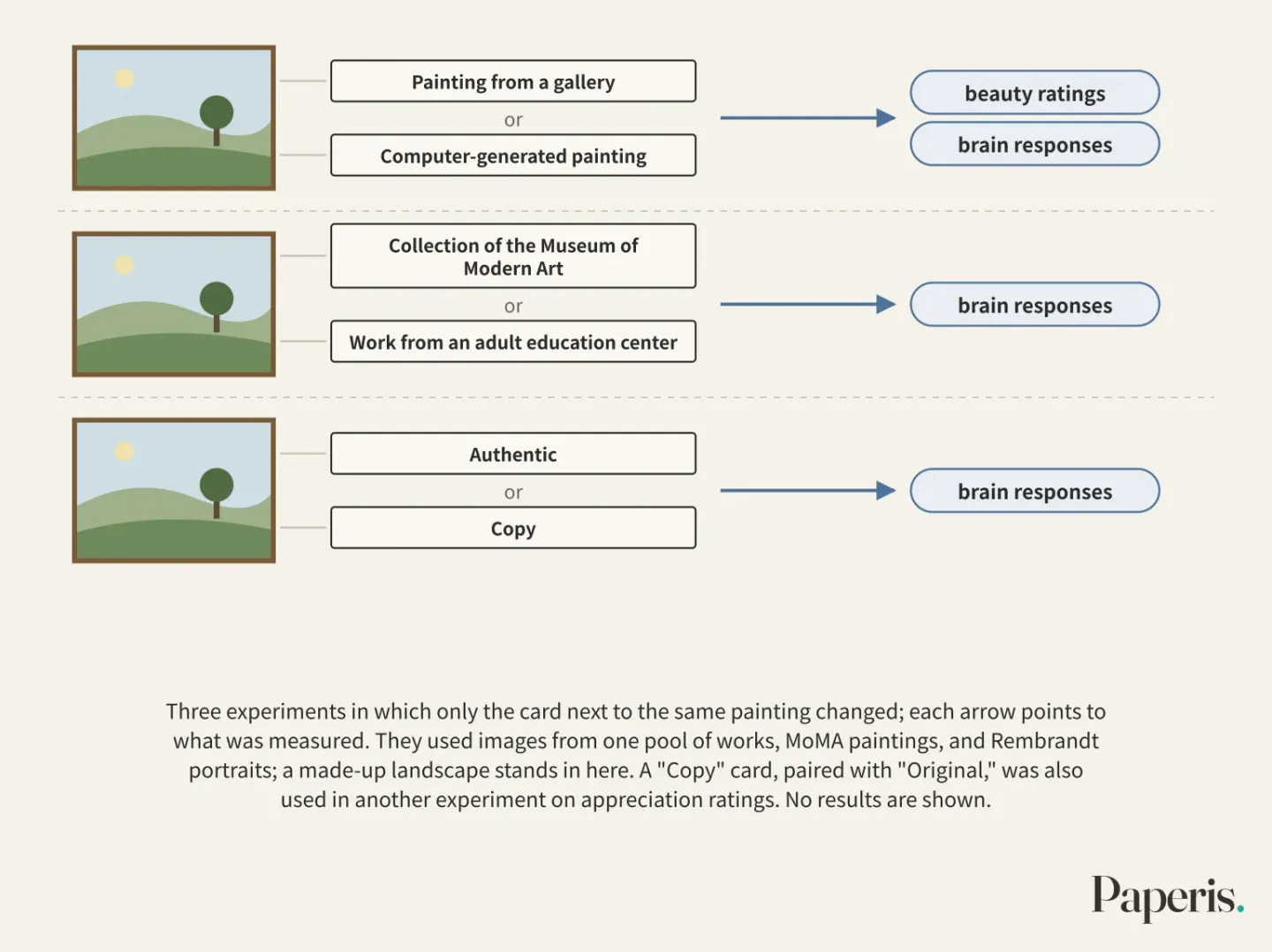
Participants lie inside a brain scanner, viewing a sequence of artworks and rating how beautiful they find them. This is the scene from an experiment published in 2009. The images all came from the same pool of works, and the researchers randomly attached information to each image: either "Painting from a gallery" or "Computer-generated painting." When the "gallery" label was attached, participants gave the images from the same pool statistically significantly higher ratings (PMID 19010423). The abstract does not report how much the ratings increased or how many participants there were. Even so, the direction is clear. Changing just a single line of source information next to the image moved the beauty ratings.
The context effect is a phenomenon where judgment of the same object changes depending on accompanying information or the setting in which it is placed. What this experiment measured is the context effect. The researchers also measured brain responses alongside the ratings. Functional magnetic resonance imaging measures changes in blood flow across different brain regions, showing which areas work harder while performing a task. The degree to which the "gallery" label boosted ratings tracked with activity in a middle region on the lower front surface of the brain just above the eyes, as well as an inner frontal region just ahead of it. Separate from the ratings, sites where activity varied purely according to the information itself sat at the anterior tips and inner sides of both temporal lobes. The authors concluded from this that the frontal regions used in aesthetic judgments lean statistically significantly on people's prior expectations about where the image came from—specifically, expectations about how much pleasure the image will provide (PMID 19010423).
A different brain-scanning experiment in 2015 applied the weight of information differently. Showing paintings from the collection of the Museum of Modern Art (MoMA) in New York, they attached information to the same paintings: either "Collection of the Museum of Modern Art" or "Work from an adult education center." Regardless of how much participants liked the paintings, when the "Museum of Modern Art" label was attached, activity in several parietal regions was greater; when differing preferences for each painting were accounted for together, other regions became more involved, such as deep within the inner frontal cortex and the junction of the temporal and parietal lobes. The authors concluded that information carrying social value alters both the cognitive and emotional aspects of the process handling sensory information (DOI: 10.3389/fnhum.2015.00528). This abstract does not report score differences. What this experiment showed was the difference in brain responses.
There is also research that changed the location instead of the label. In a 2014 study, two groups of participants viewed the same art exhibition, with one group viewing it in a museum and the other in a laboratory. A wearable eye tracker recorded the time spent lingering in front of each work, and after viewing concluded, participants rated how good, interesting, understandable, and ambiguous each work was. People who viewed the works in the museum liked them more, found them more interesting, and looked at them longer (DOI: 10.1371/journal.pone.0099019). How the gaze moves across a painting was covered in "Composition and Gaze — Stepping Stones the Painting Lays, a Path the Eye Chooses". This study also measured the time spent lingering in front of the descriptive label next to the artwork. Appreciation scores, understanding, and ambiguity predicted time spent in front of the descriptive label as well as time spent in front of the artwork, and the strength and direction of that relationship differed depending on the location. Appreciation scores tended to predict lingering time better in the laboratory than in the museum, and the more ambiguous a work was perceived to be, the longer people looked at it in the museum and the shorter in the laboratory. The authors concluded that museums encourage sustained, focused contemplation (DOI: 10.1371/journal.pone.0099019).
Placing the three studies side by side leaves a single takeaway. Even for the same painting, the source information attached next to it and the place where it is displayed sway evaluations and brain responses. However, not a single one of the cards in the three studies contained the word "forgery." "Gallery" and "computer" changed whether the work was made by a person, "Museum of Modern Art" and "adult education center" changed where the work was validated, and the museum and laboratory changed the setting. While the existence of the context effect is supported by these three studies, how much a "forgery" label drops beauty scores is not what these three studies measured.
The "Reproduction" Card and Viewing Scores
Participants with no art knowledge look at reproductions of works by famous painters. The same reproduction is sometimes tagged with "Original" and sometimes with "Reproduction." The 2014 experiment measured this question—the one closest to conventional wisdom among the studies this article relies on—using scores. The authors introduce this experiment as testing the effect of art "forgeries," but the cards actually attached said "Original" and "Reproduction." Rather than asking just a single viewing evaluation, the researchers broke it down into various aspects of cognition and emotion, asking about both how good the painting's quality appeared to be and evaluations of the artist, such as the artist's talent. When the "Reproduction" tag was attached, all of these evaluations were lower than for the exact same painting tagged with "Original," and the abstract notes that authenticity information had a major effect on the perceived quality of the painting (DOI: 10.1162/leon_a_00869). This abstract does not state the number of participants or the numerical values of the effects.
The paintings in this experiment were all reproductions. What the participants saw was the exact same reproduction with different cards attached, and there were no actual originals or actual forgeries. Therefore, what this result tells us is limited to "the information that something is a reproduction lowered evaluations of the same painting," and it cannot be broadened to "forgeries are actually less beautiful." The authors concluded that these results show symbolic value and personal value modulate art appreciation (DOI: 10.1162/leon_a_00869). Even with the exact same reproduction, participants with no art knowledge gave lower evaluations for appreciation, painting quality, and the artist's talent whenever the "Reproduction" card was attached. The first part of the conventional wisdom—namely, that information changes judgment—is supported by this single experiment. The participants were people without art knowledge, and the abstract does not address whether the same results would appear in an art museum setting or from art experts.
Rembrandt Portraits and the "Copy" Card
There is a 2011 experiment that measured brain responses to a different layer than scores, namely, authenticity cards. The researchers selected portraits by the 17th-century Dutch painter Rembrandt. Rembrandt has a large number of portraits, and recent research has revealed that quite a few among them are forgeries and copies. Thanks to this, whether a painting was actually authentic and the authenticity information attached to the painting could be separated and compared. The setup was designed so that a real Rembrandt could have a "Copy" card attached, or a portrait not painted by Rembrandt could have an "Authentic" card attached. This was necessary to separate whether the brain responds to the actual origin of the painting or to the card. Participants viewed portrait images inside a brain scanner, and each image was accompanied by the label "Authentic" or "Copy." The researchers treated this card as outside advice on the painting's authenticity, specifically the social influence provided by someone else's expertise (PMID 22164139).
When viewing paintings with the "Copy" label rather than the "Authentic" label, the very front part of the brain just behind the forehead and a deep area inside the right crown of the head reacted more strongly. This difference appeared regardless of whether the portrait was actually authentic or not. Authenticity information did not directly affect the visual areas responding to the painting. However, a meaningful interaction appeared between the front-most region and the visual area in the back of the head that responds to object shapes, and the authors noted that this suggests the visual areas can be modulated by the front-most region (PMID 22164139).
What this study measured was brain responses. The abstract does not report whether participants evaluated the paintings as less beautiful when the "Copy" card was attached. The word "copy" is also not the same as a "forgery." Only paintings put forward to deceive others become forgeries, whereas a copy might be reproduced without such an intention. The result that scores drop was shown separately by the 2014 behavioral experiment in the previous section, and this experiment is a separate layer that measured only brain responses with different participants and different paintings. There is no basis to connect the two results and weave them into "the brain is disappointed by the copy card, so the scores drop." The authors' proposal also stays within that scope. They suggested that the fact that a network of multiple regions rather than a single region was activated supports the view of art researchers that aesthetic judgment has multiple aspects and multiple dimensions (PMID 22164139).
What Brain Scans Do Not Tell You
If you take the results of the Rembrandt experiment apart sentence by sentence, the boundary between what a brain scan tells you and what it does not tells you becomes clear in four places.
First, the response followed the cards. Because the difference according to the card appeared regardless of whether it was actually authentic, this difference cannot be read as a response in which the brain filtered out the real thing. The abstract also contains no result showing that the brain distinguished between actual authenticity and actual forgery (PMID 22164139). The result that the brain response changed based on a single card does not mean that “the brain recognizes the real thing”.
Second, “more activated” only means that that region worked harder. In the Rembrandt experiment, the side that reacted more strongly was the “copy” card, and whether that response was disappointment, suspicion, or looking more closely is not stated by the abstract. In the gallery experiment, too, the activity of the region near the forehead merely moved together with the degree to which scores went up, and the authors interpreted this as “judgment leaning toward preconceptions” (PMID 19010423). This interpretation is the conclusion of the authors.
Third, there is no direct evidence that the cards changed the way the paintings themselves were seen. In the Rembrandt experiment, authenticity information did not directly change the visual areas reacting to the painting, and the idea that visual areas can be modulated is a possibility the authors drew from the interaction results (PMID 22164139).
Fourth, all three brain-scanning experiments were tests where participants lay inside scanning devices and viewed paintings as images, and neither the number of participants nor the effect size appears in the abstracts. There is no basis within these results to translate this and say that the same thing happens to a visitor standing in front of a museum wall with the same magnitude. A 2014 study that changed locations showed that the viewing itself differed between the museum and the laboratory (DOI: 10.1371/journal.pone.0099019).
The conclusion that “people look at the nameplate, not the painting” also does not come from these studies. What these studies showed is only up to the point where cards and locations moved evaluations and brain responses, and results showing that judgments were determined solely by cards do not exist in any abstract. In the location experiment, the evaluations given by participants moved together with the time spent lingering in front of the artwork, and that relationship tended to be more distinct in the laboratory (DOI: 10.1371/journal.pone.0099019). Conversely, one cannot say that “labels do nothing either”. A single piece of “gallery” information changed beauty scores (PMID 19010423), and even identical reproductions were evaluated lower when a “copy” card was attached (DOI: 10.1162/leon_a_00869).
Why the Original Is More Valuable
If cards sway judgment, why do people put weight on the information of an original? Five experiments published in 2011 asked this question in a different way. Participants did not look at the paintings directly. Instead, they read hypothetical stories about an original object being copied and judged the value of the original and the replica. Each experiment changed the type of item from a painting to furniture and altered the circumstances under which the original and the replica were made (DOI: 10.1037/a0026035). The starting point was why an original is considered more valuable than an identically looking replica.
The researchers tested two explanations. One is that the original is valued as a one-of-a-kind creative act. The other is contact. Contagion is the intuition that weighs how physically close the object originally was to the creator. The results supported the idea that both explanations are key factors upholding the value of the original. The authors wrote that the value gap between the original and a perfect replica aligns with the conclusion that it comes from people's thoughts about the domain of art rather than from associations arising from a specific type of art or specific forgery cases (DOI: 10.1037/a0026035).
This result offers an explanation for conventional wisdom. If even an identically looking replica drops in value, that difference does not come from the surface of the painting. It comes from the story of who made it through what act and whether that hand touched the object. However, what these experiments asked about was "value," not "beauty." People considering an original more valuable and an original looking more beautiful are two different judgments.
Still Debated
Experiments measure whether judgments change, and philosophy asks whether such changes are right. Philosophical debates are old and still ongoing. In a 2005 paper, philosopher Tomáš Kulka roughly divided the answers up to that point into three. Formalism is the stance that only what is seen on the surface—such as lines, colors, composition, and texture—determines a work's aesthetic value, and the first answer stems from here. It is the answer that there is no aesthetic difference between a sophisticated fake and the original. Monroe Beardsley, a prominent American aesthetician holding this view, considered that two objects with entirely identical observable properties cannot differ in aesthetic value either. The second is the answer that a difference exists, and that difference comes from very small physical differences between the original and the copy. The third is the answer that a difference exists, and that difference comes from the different histories the two objects have passed through (DOI: 10.1353/jae.2005.0032).
Whether information even changes how something looks is also divided among philosophers. In the essay "Categories of Art," American philosopher Kendall Walton argued that placing a work in a certain category changes which aesthetic properties that work appears to have. Some later philosophers attached to this the explanation that belief immediately seeps into perception. What you believe you are looking at determines your aesthetic response. A 2020 philosophy paper considers this reading to diverge from Walton. Walton himself wrote that simply knowing the correct category does not allow one to decide to react to a work that way, and this paper proposes that the eye recognizing categories is cultivated through the experience of viewing many works repeatedly, namely perceptual learning. The same paper adds that art history knowledge plays an indirect but major role in that learning, remaining central to building perceptual expertise (DOI: 10.1111/jaac.12685). Whether a single line of information written on a card changes a painting's appearance or merely changes judgment remains an open question within philosophy as well.
Whether authenticity is a property worth appreciating in itself is also a matter of dispute. In a 2019 book, philosopher Carolyn Korsmeyer argued that the property of being authentic is an aesthetically prominent, valuable property that draws attention in its own right. A 2023 philosophy paper directly refutes this claim. To borrow the words of aesthetician Denis Dutton, Han van Meegeren's fake Vermeer is a fake Vermeer while simultaneously being a real van Meegeren, and thus authenticity itself distinguishes nothing. According to this paper, what distinguishes value is the history of the painting, such as who painted it, and the reason an authentic Vermeer receives attention is because it is a Vermeer (DOI: 10.1093/jaac/kpad016). This paper also acknowledges that history affects value. The point of contention is whether to place that weight on a separate property called "authenticity."
Whether fakes are less beautiful and whether fakes are wrong are also distinct questions. A chapter in a 2023 philosophy handbook groups the wrongs philosophers have found in fakes broadly into three: failures of authenticity (integrity), harms done to someone, and violations of rights or obligations. The same chapter notes that discussions of fakes have primarily focused on painting and sculpture. This is because literary or musical works, when perfectly copied, typically become another real instance of that work. According to the same chapter, all arts can be equally exposed to faking that invents new works, and the reason visual arts like painting and sculpture appear particularly vulnerable is a problem of fakes pointing to specific pre-existing works (DOI: 10.4324/9781003312727-50). These wrongs identified by philosophers can be considered separately from whether a painting looks less beautiful.
There are also many remaining questions on the psychology side. The creative acts and contact supporting the value of originals have been verified through fictional stories (DOI: 10.1037/a0026035), and brain responses to authenticity cards have been verified using images inside scanning devices (PMID 22164139). How much the label "fake" actually changes real visitors' judgments of beauty in front of museum walls, and how that magnitude varies depending on the type of work or the viewer, cannot be answered by the results gathered here.
The Weight of a Single Card
Imagine walking through an art museum gallery and stopping in front of a portrait. After staring at it for a long time, you move your eyes to the small card next to the painting. The studies seen so far have shown this moment divided into several branches.
One thing changes alongside the fact that this moment happens in a museum. People who saw the same exhibition in a museum liked the artwork more and looked at it longer than those who saw it in a laboratory (DOI: 10.1371/journal.pone.0099019). The source written on the card also moves judgments. A single line of information saying "gallery" raised the beauty score of the same image (PMID 19010423), and participants without art knowledge rated appreciation, painting quality, and the painter's talent lower when a "reproduction" card was attached to the exact same replica (DOI: 10.1162/leon_a_00869). If the card said "reproduction," in an experiment inside a scanning device, the very front region right behind the forehead reacted more strongly than with an "original" card. That reaction followed the card regardless of whether the painting was actually original, and it did not directly change the visual areas reacting to the painting (PMID 22164139). And if a card telling you something is an "original work" makes that painting feel more valuable, the reason pointed out by psychological experiments is that the unique act of creation and the contact of the artist's hand are what matter (DOI: 10.1037/a0026035).
The answers these studies give are narrower than conventional wisdom, and narrower even than the counter-wisdom that overturns it. Regarding whether Bredius's emotion in 1937 in front of van Meegeren's painting became false just because of the fact that it was a forgery, experiments have shown that judgments can waver, and philosophy is still debating whether that wavering is justified. A single card moves evaluations and brain responses, but that does not mean the brain recognizes the original, and where the value of an original work comes from remains an ongoing debate.
Source Papers
- "Modulation of aesthetic value by semantic context: an fMRI study." (2009) — PMID 19010423 — When identical artwork images were randomly labeled with "gallery" or "computer-generated" information, ratings were significantly higher for the gallery side, and that change correlated with ventromedial orbitofrontal and prefrontal activity; the authors concluded that judgments are biased by prior expectations based on provenance.
- "Is it the picture or is it the frame? An fMRI study on the neurobiology of framing effects" (2015) — DOI: 10.3389/fnhum.2015.00528 — An fMRI experiment attaching MoMA or adult education center information to paintings in the MoMA collection; parietal activation was greater in the MoMA condition regardless of preference, leading to the conclusion that social value information alters cognitive and emotional processing together.
- "Art in Time and Space: Context Modulates the Relation between Art Experience and Viewing Time" (2014) — DOI: 10.1371/journal.pone.0099019 — Eye tracking of two groups who viewed the same exhibition in a museum versus a laboratory; the museum group liked it more and looked at it longer, showing that context changes the relationship between appreciation and viewing behavior.
- "What’s Wrong with an Art Fake?" (2014) — DOI: 10.1162/leon_a_00869 — A behavioral experiment showing reproductions of works by famous painters to participants without art knowledge, using "original" or "copy" labels; evaluations of perceived quality and painter talent were both lower under the "copy" label, leading to the conclusion that symbolic and personal values moderate appreciation.
- "Human cortical activity evoked by the assignment of authenticity when viewing works of art." (2011) — PMID 22164139 — An fMRI experiment attaching "authentic" or "copy" information to a Rembrandt portrait; responses in the frontopolar cortex and right precuneus were greater on the "copy" side regardless of actual authenticity, with no direct effect on visual areas.
- "Art and authenticity: The importance of originals in judgments of value." (2011) — DOI: 10.1037/a0026035 — Five hypothetical scenario experiments; supporting evaluation of the creative act and contact with the artist (contagion) as core factors of original value, concluding that value differences stem from the general public's conceptions of art.
- "Forgeries and Art Evaluation: An Argument for Dualism in Aesthetics" (2005) — DOI: 10.1353/jae.2005.0032 — A philosophy paper introducing Bredius's 1937 high praise for van Meegeren's forgeries and Goodman's questions, dividing answers to the forgery problem into three categories: formalism, reductionism, and historicism.
- "Cheating History: The Rhetorics of Art Forgery" (1983) — DOI: 10.2190/42jq-447r-hhwa-jwn1 — A case study of three forgers: van Meegeren, de Hory, and Keating; forgers promote beauty stripped of context, while critics emphasize that history was deceived.
- "Authenticity and Implicature" (2023) — DOI: 10.1093/jaac/kpad016 — A philosophy paper refuting Korsmeyer's argument that authenticity itself is an aesthetically salient property, and arguing that what divides value is history, such as who painted it.
- "Waltonian Perceptualism" (2020) — DOI: 10.1111/jaac.12685 — A philosophy paper proposing to read Walton's psychological thesis from "Categories of Art" (that the category in which one perceives something changes the visible aesthetic properties) not as cognitive penetration of perception, but as perceptual learning.
- "Forgery and Authenticity" (2023) — DOI: 10.4324/9781003312727-50 — A handbook chapter in philosophy; the van Meegeren case has been the most philosophically discussed, and the wrong of forgery is grouped into failures of authenticity (integrity), harm, and violations of rights and duties.
Sources (11)
- Modulation of aesthetic value by semantic context: an fMRI studyPMID 19010423
- Is it the picture or is it the frame? An fMRI study on the neurobiology of framing effectsDOI 10.3389/fnhum.2015.00528
- Art in Time and Space: Context Modulates the Relation between Art Experience and Viewing TimeDOI 10.1371/journal.pone.0099019
- What’s Wrong with an Art Fake?DOI 10.1162/leon_a_00869
- Human cortical activity evoked by the assignment of authenticity when viewing works of artPMID 22164139
- Art and authenticity: The importance of originals in judgments of valueDOI 10.1037/a0026035
- Forgeries and Art Evaluation: An Argument for Dualism in AestheticsDOI 10.1353/jae.2005.0032
- Cheating History: The Rhetorics of Art ForgeryDOI 10.2190/42jq-447r-hhwa-jwn1
- Authenticity and ImplicatureDOI 10.1093/jaac/kpad016
- Waltonian PerceptualismDOI 10.1111/jaac.12685
- Forgery and AuthenticityDOI 10.4324/9781003312727-50