Paperis Articles
The Mona Lisa's Gaze — Eyes That Follow You Across the Gallery
The "Mona Lisa effect" — a portrait's direct gaze seeming to follow you wherever you stand — has been confirmed again and again with photographs and computer faces, and shrank (virtual 3D heads) or vanished (a face projected onto a head-shaped model, five people) when the face was made three-dimensional. Yet the two studies that measured the Mona Lisa's own gaze gave different answers, and where that difference comes from is not yet settled.
Your field's papers, as audio
Pick your fields and journals — Paperis summarizes the key papers and turns them into audio. Listen on your commute.
Start Paperis free →The Mona Lisa's Gaze — Eyes That Follow You Across the Gallery
As You Cross the Exhibition Hall
A portrait hangs on one wall of an art museum exhibition hall. As you enter through the left door, pass in front of the painting, and exit through the right door, the figure in the painting seems to turn their head with every step to follow you this way. Whether you look from the middle of the room or turn back from the doorway, those eyes are still looking at you. Many people call this experience by the name of the painting. It is the portrait "Mona Lisa" painted by the Italian Renaissance artist Leonardo da Vinci.
There is a separate name that researchers use for this experience. First, one direction of the gaze within the painting is established. A direct gaze is a look where the figure in the painting stares straight toward the painter or the camera. The experience this look produces is next. The Mona Lisa effect is a phenomenon where, if the figure in a portrait has a direct gaze, the viewer feels that those eyes are looking at them no matter where they stand. This name comes from Leonardo's painting, and the effect itself consistently appears in various experiments (PMID 30671222).
The single sentence "The Mona Lisa's eyes follow you" actually contains two claims. One is the claim that a phenomenon exists where the eyes of a portrait looking straight ahead appear to follow the viewer, and the other is the claim that the Mona Lisa is precisely such a portrait. The former is a perceptual phenomenon solidified through various experiments, including photographs, computer-generated faces, line-drawing faces, and interactive character screens. The latter is a claim about a single painting, so an answer only emerges when that painting is placed directly in front of you and measured. This article separates the two claims and looks at them in turn. The former was as solid as the evidence supports, and the latter was less solid than thought.
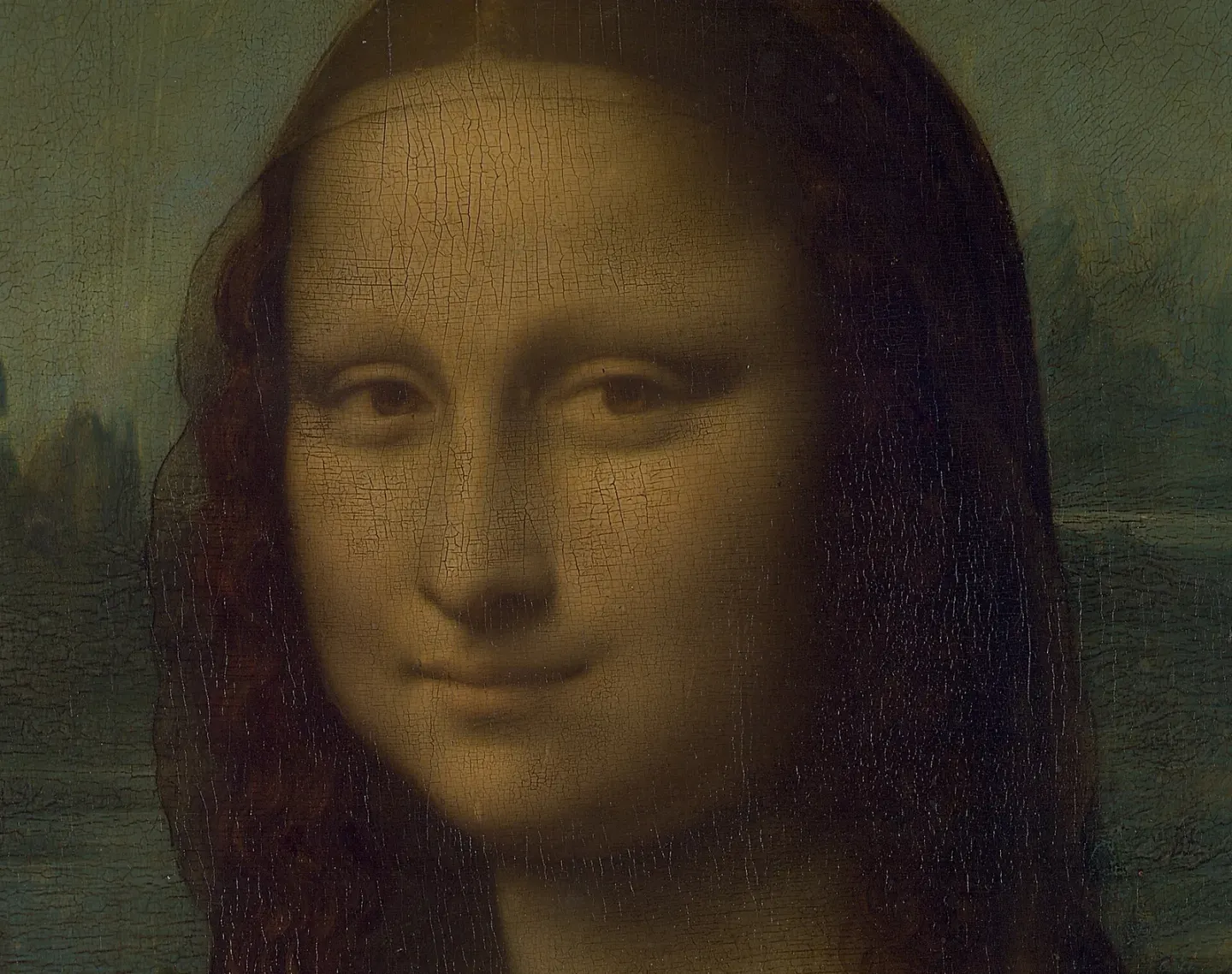
Leonardo da Vinci, Mona Lisa (c. 1503–1519), detail · Musée du Louvre, Paris · public domain · Wikimedia Commons (C2RMF)
The Effect Is Real
Whether placed to the side, above, below, or diagonally from the perspective of someone looking at a portrait, the effect that those eyes are looking at you remained robustly. This is the result of a study that shook this effect in various directions by conducting three experiments with photographic portraits (PMID 22705629). What the researchers moved was the position of the photograph relative to the viewer, but if we translate this to an exhibition hall, it means that even when looking up at a portrait hung high, a direct gaze can be read as a gaze looking at you. The same study also included portraits whose gaze was averted to the side from the start, and an interaction appeared between the placement of the picture and the direction of the gaze. This means that the effect of the gaze direction differed depending on the position of the picture (PMID 22705629).
The second experiment of the same study looked separately at the fact that differences among individuals are large. In about half of the observers, the effect appeared even stronger than theoretically expected, and the researchers called them "over-rotators." This individual difference had no correlation with the five basic personality traits nor with spatial intelligence (PMID 22705629). This means that two people standing in front of the same photographic portrait can experience the intensity of the feeling that it "follows you" differently from each other.
There are also results measured by separating the eyes and the face. Although it is a short abstract presented at an academic conference and thus carries less weight of evidence than a full paper, its design fits this question precisely. A computer-generated face was displayed on a screen, and the screen itself was tilted up to 30 degrees, after which viewers were asked to judge the direction of the gaze, the direction of the face, and the direction of the background separately (DOI: 10.1068/if707). The background was accurately seen as tilted in most trials. The direction of the face was judged to face the viewer in 40 to 50% of the trials, and in 50 to 60% it was seen as actually tilted at the angle. The gaze almost always faced the viewer regardless of the tilt, and regardless of whether there were borders or background patterns (DOI: 10.1068/if707). The researchers interpreted this result as a special property of the eyes, and summarized that the face lies somewhere in between. This means that even though you realize the screen is tilted by looking at the background, only the gaze holds onto you until the end.
The same effect was confirmed even with schematic faces where the eyes, nose, and mouth were drawn with just a few lines (DOI: 10.1068/p5930). Whether it is a photograph, a computer face, or a line drawing, as long as the condition of a direct gaze is met, this experience reappears. A direct gaze within a flat picture is still read as a gaze looking at you even when viewed from an angle.
It Weakens or Disappears on Three-Dimensional Faces
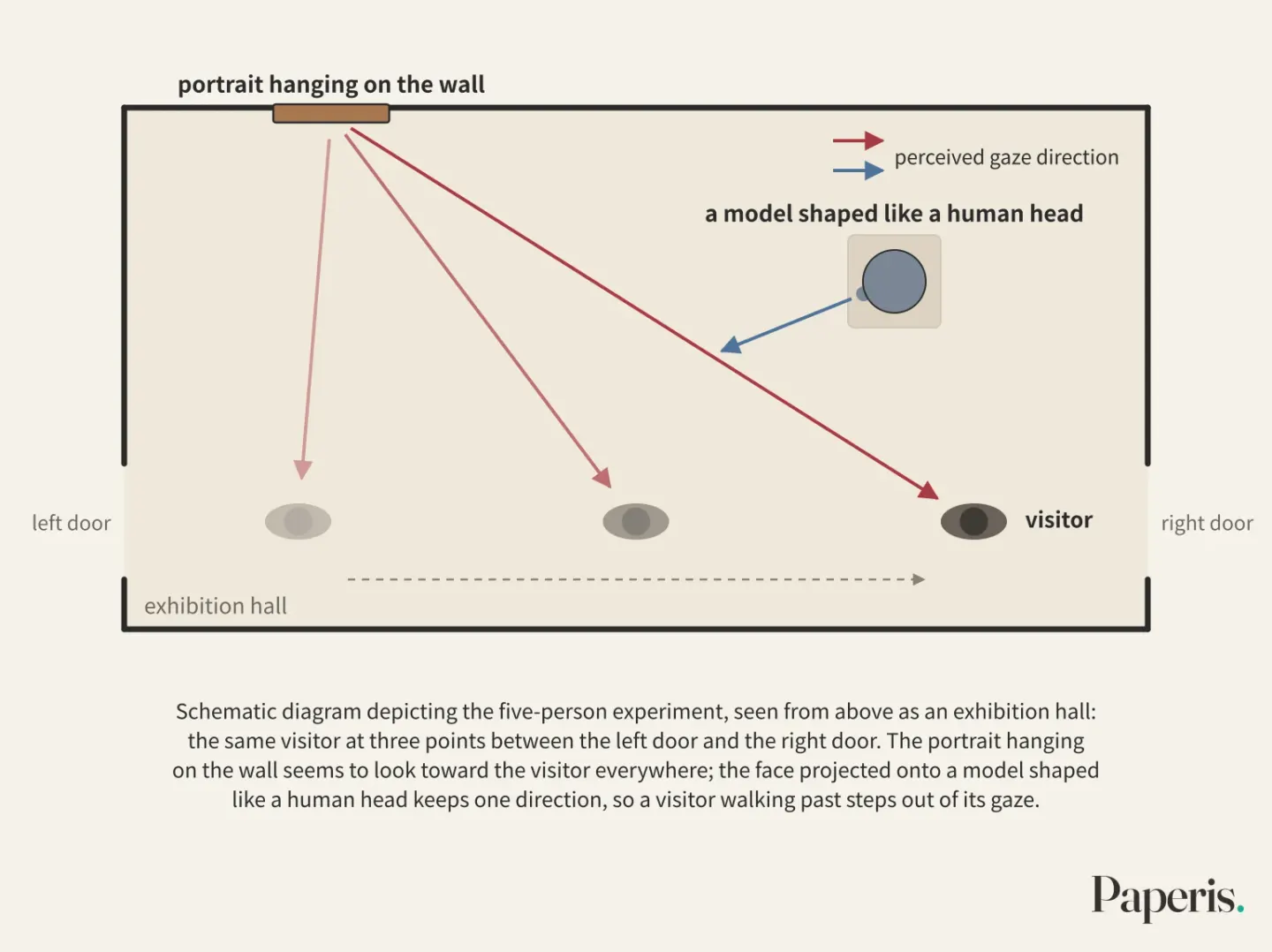
The face of a conversational computer character displayed on a flat monitor screen makes viewers at any angle feel that it is looking right at them (DOI: 10.1145/2070719.2070724). This makes it difficult for the gaze to single out one person among many. For researchers creating such characters, the Mona Lisa effect has been a headache. One research team projected faces onto a three-dimensional model molded in the shape of a human head and compared it with a flat screen. In a small experiment where five participants judged the direction of gaze, the three-dimensional projection surface completely eliminated the Mona Lisa effect and conveyed gaze direction very accurately regardless of the viewing angle (DOI: 10.1145/2070719.2070724). Another research team three-dimensionally scanned the face of a remote conversation partner, created a facial-shaped screen molded to that shape, and reported in a four-page conference paper that this screen accurately conveyed gaze direction to solve the problem of the Mona Lisa effect (DOI: 10.1145/2254556.2254632).
The results varied depending on the type of three-dimensionality. The third experiment of the earlier study using photographic portraits applied the same gaze direction and same positional changes to a virtual three-dimensional head. In this experiment, in addition to the condition where the image is moved in front of the viewer, a condition where the viewer moves their position in front of the image was also included. This condition is closer to visitors walking through an exhibition hall. The Mona Lisa effect also appeared in this virtual three-dimensional head, though it was smaller than on the flat photographic face (PMID 22705629). When a face is taken out of a flat surface and made three-dimensional, the results are summarized as follows. The effect disappeared on faces projected onto physical three-dimensional models, and decreased on virtually created three-dimensional heads.
Translating these results to an exhibition hall makes the difference clear. Suppose we set up a model shaped like a human head in the middle of a room and project a face onto it. According to the experiment with five people, a person walking past it sideways steps out of that gaze. In the same experiment, the face projected on a flat surface followed the viewer regardless of the viewing angle, and the eyes of a portrait hanging on the wall seem to follow in that same way. This scene is an extrapolation of the experimental results to an exhibition hall, and studies measured with sculpted busts are not among the evidence gathered in this article. The Mona Lisa effect appears most prominently when the face is on a flat surface. What happens when viewing a painting from an oblique angle is covered from a different angle in "Perspective and Space — The One Footprint a Picture Is Calculated For", which deals with perspective.
Gaze Is Read by Combining the Eyes and the Head
In the early 19th century, a man named William H. Wollaston amazed people at the Royal Society of London by showing several portrait prints. He left the eye area—containing the pupils and eyelids—untouched, but changed other parts of the face, such as the nose; that alone made the direction of the gaze look dramatically different (PMID 32279602). Although studies covering these prints did not address the Mona Lisa effect, they show how we read other people's gazes. His name was attached to this phenomenon. The Wollaston illusion is an illusion where the eye area stays the same, but the surrounding facial parts like the nose are changed, yet the gaze direction appears different.
Although this illusion was reproduced several times afterward, it had never been directly measured with the original prints Wollaston used. A 2020 study took only the pupils and irises from Wollaston's most famous print, and then sequentially attached the eyelids, eyebrows, nose, skull outline, and hair to measure the gaze direction people perceived. These facial parts shifted the perceived gaze direction by up to 20 degrees (PMID 32279602). The researchers explained this as a pulling effect. This means that if there is a cue that the head has turned slightly, the gaze is pulled in that direction. The reverse direction also held true. Follow-up experiments in the same research stream used copies of the original prints and computer-generated faces to show that the direction of the eye line in turn pulled the judgment of the head's facing direction toward itself (PMID 34868537). The eyes and the head pull on each other and are read together.
There are also models that refine this relationship into numbers. One research team proposed a model that calculates the perceived gaze direction as a value obtained by adding the eye direction and the head direction in a fixed ratio, and in an experiment where arrows on a screen had to be matched to where the gaze was pointing, this simple addition explained most of the judgments. Adding more complex terms did not clearly increase the explanatory power (DOI: 10.1167/16.8.8). The same research team also produced results showing that even when faces were shown inverted upside down, the degree to which eye and head information was combined was similar to that for upright faces (DOI: 10.1167/15.1.21). In an experiment observing 40 infants aged 4 to 5 months and 7 to 8 months, the way infants looked at direct gazes and averted gazes varied according to head direction. The researchers interpreted that the ability to read gaze consistently even when the head turns is already operating at 4 to 5 months of age (DOI: 10.1167/16.3.4). A chapter in a book summarizing gaze research concludes that the foundation for us to accurately read someone else's eye line involves at least two mechanisms—one analyzing the brightness contrast of the eyes and another calculating space based on the shape of the eyes—and that both must take the direction of the counterpart's head into account (DOI: 10.1093/acprof:oso/9780195333176.003.0007).
The brightest part of the eye is the whites. The strong contrast between the dark pupil and the bright whites is important for accurately discerning gaze direction, and among primates, this combination can be found only in humans; this is the background summarized at the beginning of a paper by experimental art history researchers (PMID 27679567). An abstract presented at a conference tested this point using a virtual reality screen. When 9 participants were shown a digitally created human head and asked to judge whether the gaze was directed to their right or left, the effect where head direction distorts gaze judgment appeared only in faces featuring human eyes, and disappeared when switched to monkey eyes where the whites are not exposed. Judgments were also sharper with human eyes, and reactions were slower with monkey eyes (DOI: 10.1167/18.10.230). Although it is a conference abstract with a small sample, the direction that the whites are heavily used as a cue to read gaze matches the previous summary.
We do not read gaze from the pupil alone, but read it combined with the direction of the head. Where the pupil is placed within the whites is one cue, and how much the head has turned is the other cue (DOI: 10.1068/p5930). Now a flat picture can be put into this system. In a flat picture, the relationship between the drawn pupils and the face does not change no matter which side you view it from. If you stand at an angle, the entire picture simply looks narrower, but neither the position of the pupil within the eye nor the positions of the eyes, nose, and mouth within the facial outline change. There are experiments showing that where the eyes, nose, and mouth are placed within the facial outline acts strongly as a cue telling the degree to which the head has turned, and the same study also offered explanations for the Mona Lisa effect (DOI: 10.1068/p5930). However, the connection that "because it is a flat picture the cues remain the same, and therefore the eyes follow you" is a candidate explanation. Researchers of three-dimensional projection reported that their data matched a newly rewritten model of the effect, but the contents of that model do not appear in the abstract (DOI: 10.1145/2070719.2070724), and results confirming every single link of this chain in a single experiment are not among the evidence gathered in this article.
There is a breadth to the judgment of "looking at me." The gaze cone is the breadth of directions in which one feels "looked at" even when the counterpart's eye line is not precisely directed at oneself. It has been suggested that this breadth is roughly 5 degrees on either side of a given gaze direction (PMID 25327821). Based on this suggestion, a research team had participants look at the eyes of a portrait inside a brain imaging device. Portraits with an eye line pointing directly at them (0 degrees), portraits pointing at the edge of the cone (5 degrees), and portraits clearly looking away (10 degrees) were alternately displayed in the center and at the edge of the screen. Brain responses to the 5-degree gaze were similar to the direct eye-contact gaze and different from the 10-degree gaze. Responses in gaze-sensitive regions were not affected by where on the screen the portrait was displayed (PMID 25327821). The researchers presented this as a "possible explanation" for why the feeling of eye contact is maintained even when a portrait is shifted away from the very center. There is still a distance between the measurement that brain region activity is the same and the feeling of "following you," and the researchers' phrasing leaves that distance intact.
The boundary between "looking at me" and "looking away from me" may be a special spot in gaze judgment. Another abstract presented at a conference tested this boundary using the Wollaston illusion. When a head facing front was turned slightly, the gaze was pulled by 8 degrees, and when the already-turned head was turned further by the same amount, it was pulled by only 4 degrees. The pull was greatest when the eyes themselves were close to the front (DOI: 10.1167/13.9.404). The researchers formed a prediction that if recognizing gaze directed at oneself is particularly important, the visual system might have refined its calculations near that boundary, and reported that the results supported that prediction. This is the result of a single abstract, not a formal paper.
Where Does the Mona Lisa Actually Look?
It was pointed out in 2019 that although the Mona Lisa effect appears consistently, it had never actually been tested on the Mona Lisa painting itself (PMID 30671222). Now for the latter claim, the claim about a single painting. The researchers displayed the Mona Lisa on a screen and had viewers use a ruler to measure the direction her gaze was pointing. They enlarged or reduced the painting, shifted its left-right position within the screen, and changed the distance of the ruler used for measurement. The results pointed to the same side regardless of the conditions. People judged that the Mona Lisa's gaze was directed just to the right of them (PMID 30671222). The abstract does not state how many participants there were or by how many degrees the gaze was deflected.
Whether the painting was placed on the left or the right side within the screen, the judgment was always "to my right." What the researchers moved was the position of the painting on the screen, and this was not an experiment where the viewer walked past the front of the painting. Nor did the researchers measure it in an actual exhibition room.
The researchers captured these results directly in the title of their paper. The title states that scientists think she is looking at them, but she is not (PMID 30671222). Looking at the definition used by this study—namely, that "a direct gaze makes one feel looked at"—the name of the painting and the name of the phenomenon do not match. The effect caused by a direct gaze ends up carrying the name of a painting that does not look straight ahead. What these results shake is the owner of that name. The results for photographs, computer faces, and schematic faces seen in the previous section remain unchanged regardless of this study. There is a result suggesting that the painting that gave its name to the effect may not actually be an example of that effect.
Two Studies, Different Answers
When we changed our distance standing in front of a printed reproduction of the Mona Lisa, the answer to "Is she looking at me?" changed. A different study in 2022 asked the same question in a different way (PMID 35845241). This time, instead of a screen, they hung a high-quality printed reproduction of the Mona Lisa and had 30 participants answer a simple question at six distances from 55 centimeters to 755 centimeters: "Is the figure in the painting looking at me?" One group started from the closest position and moved farther away, while the other group did the reverse and approached. The results split depending on the distance. At the farthest distances, the impression that the Mona Lisa was staring directly at me was robust, and at the closest distances, that impression became ambiguous (PMID 35845241).
If we overlay this result onto a gallery scene, it paints a picture where she seems to be looking at us when we look at the painting from the doorway, but that certainty fades when we step right up in front of the painting. The researchers noted that they tried to control the size of the painting projected onto the retina by varying the distance. In a second experiment of the same study, 41 participants were divided into two groups, and screens were used to show either the whole face to one group or just the eye region to the other, and the answers to "Is she looking at me?" confirmed the overall results of the first experiment, the researchers reported (PMID 35845241). Another session of the same experiment produced the result that she smiles not just with her face, but with her eyes as well.
The two studies measured different things in different ways. The 2019 study had participants use a ruler in front of a screen to measure the direction the gaze was pointing, while the 2022 study had them look at a printed reproduction at various distances and answer "Is she looking at me?" The former method asks where the gaze is directed, and the latter asks whether that gaze feels like it is looking at me. Studies testing which difference—questioning method, distance, or medium—split the two answers are not in the evidence gathered by this article. If the judgment of "looking at me" has a width like a gaze cone, both results could be true together, but studies measuring this are not in the evidence gathered by this article. Each of the two results came from a single experiment by one research team. The two studies measuring the gaze of the Mona Lisa painting gave different answers, and where the difference comes from is not uncovered by the evidence gathered by this article.
What We Have Learned
A direct gaze in a painting captures the viewer's attention. Eye tracking is a method of using machines to follow and record where and when a person looks. In a study where painted portraits were shown with either a direct gaze or an averted gaze, and eye tracking and brain imaging were measured separately, participants looked at the eyes and mouth of the portrait for longer when the portrait was looking at them (PMID 29913388). In the brain imaging, when the gaze was direct, areas known to be involved in processing faces, areas related to attention, and areas related to the task of figuring out another person's mind were more active. The researchers interpreted that even static, sometimes highly stylized figures in paintings trigger brain activity fitting the experience of "someone attentive watching me," and they also noted that the medium used to express a painting has a substantial impact on brain activity (PMID 29913388). The measurement that an area was activated does not mean that the painting was felt to be alive, and that interpretation belongs to the researchers.
A review paper summarizing studies showing that gaze is processed automatically and draws the viewer's attention there recommended that people building robot faces should pay particular attention to the appearance and movement of the eyes and head (DOI: 10.1109/roman.2001.981930). The reason researchers tried to solve the problem of a face displayed on a flat screen looking at everyone in the room using a three-dimensional head was also because they considered it important to accurately convey gaze in conversation (DOI: 10.1145/2070719.2070724). Where the gaze flows within a painting was covered separately in "Composition and Gaze — Stepping Stones the Painting Lays, a Path the Eye Chooses".
There is also research that asked with today's experiments why painters painted certain faces facing forward. In work the researchers called "experimental art history," they asked why medieval painters more frequently painted Christ's face straight-on and the faces of secular figures in side profiles at various angles (PMID 27679567). Across three experiments, direct-gaze frontal faces were more strongly connected with positive adjectives, and frontal sacred faces were perceived more positively than both direct-gaze profiles and averted profiles. A control study using collections of face photographs from Brazil and the Netherlands yielded a similar but weaker effect. The researchers' conclusion is cautious. Many factors influence the impression of a face, and eye contact and face orientation reinforce rather than determine the overall impression of a portrait (PMID 27679567). In these experiments, a direct gaze made the impression of a portrait strong, but that alone did not determine the impression.
Now we return to the exhibition room from the beginning. If you walk sideways past a portrait looking straight ahead, those eyes seem to follow you. Various experiments shifting and tilting photographs, computer faces, and line-drawing faces have repeatedly confirmed this phenomenon, and the exhibition room scene is a translation of those results. The fact that we combine cues from the eyes and head to read someone else's gaze is a candidate for that explanation. A face projected onto a human head-shaped model did not follow in five participant experiments. And in front of the Mona Lisa, the namesake of that phenomenon, another story attaches. In a study where people were asked to measure with a ruler on a screen, participants judged that her gaze was directed to her right, and in a study asking "Is she looking at me?" while viewing a printed reproduction from various distances, the impression that she was was robust at the furthest distances and became ambiguous at the closest distances. The Mona Lisa effect is real and most pronounced when a face is on a flat surface, but whether the Mona Lisa painting itself is a good example of that effect remains unsettled as the two studies gave different answers.
Source Papers
- "The Mona Lisa Illusion-Scientists See Her Looking at Them Though She Isn't." (2019) — PMID 30671222 — The Mona Lisa effect appears consistently, but the Mona Lisa herself had never been tested. When the gaze of the Mona Lisa on a screen was measured with a ruler, participants judged it to point to the right of the viewer, regardless of magnification, screen position, or ruler distance.
- "Looking Into Mona Lisa's Smiling Eyes: Allusion to an Illusion." (2022) — PMID 35845241 — Print reproductions, 30 people, six distances from 55 to 755 cm: from afar, the impression of "looking at me" is robust, while it is ambiguous up close. Screen tests with 41 people (full face/eyes only) confirmed the general results of the first experiment. The eyes also appear to smile.
- "Differentiating the differential rotation effect." (2012) — PMID 22705629 — Three photographic portrait experiments: the effect is robust even with vertical, horizontal, and diagonal position changes; averted gaze interacts with position; about half of observers show a stronger effect than expected (independent of Big Five personality traits and spatial intelligence); virtual 3D heads show the effect, but smaller.
- "Mona Lisa Effect of Eyes and Face" (2012) — DOI: 10.1068/if707 — Conference abstract. Computer-generated faces on a screen tilted by ±30 degrees: gaze almost always points toward the observer, faces are judged as toward the observer 40-50% of the time and accurate 50-60% of the time, and backgrounds are mostly accurate. The special properties of the eyes.
- "The Effect of Face Eccentricity on the Perception of Gaze Direction" (2008) — DOI: 10.1068/p5930 — In schematic faces, the position of internal features within the head outline acts strongly as a cue for head rotation, confirming the Mona Lisa effect and providing an explanation.
- "Taming Mona Lisa: Communicating gaze faithfully in 2D and 3D facial projections" (2012) — DOI: 10.1145/2070719.2070724 — Flat 2D screens have limitations in communicating gaze due to the Mona Lisa effect. In an experiment with 5 people, a stereoscopic projection surface of a head model completely eliminated the effect and accurately transmitted gaze direction.
- "LiveMask: a telepresence surrogate system with a face-shaped screen for supporting nonverbal communication" (2012) — DOI: 10.1145/2254556.2254632 — A 4-page conference paper. A face-shaped screen communicates gaze direction more accurately than a flat screen, solving the problem of the Mona Lisa effect.
- "Quantifying the Wollaston Illusion." (2020) — PMID 32279602 — When facial features were sequentially added to the eyes of Wollaston's plate, the perceived gaze shifted by up to 20 degrees, showing an attractive effect.
- "Inverting the Wollaston Illusion: Gaze Direction Attracts Perceived Head Orientation." (2021) — PMID 34868537 — Gaze direction pulls perceived head orientation toward itself.
- "Testing the dual-route model of perceived gaze direction: Linear combination of eye and head cues" (2016) — DOI: 10.1167/16.8.8 — Perceived gaze = linear combination of eye direction and head direction explains most of the variance, with no additional explanatory power from non-linear terms.
- "Gaze constancy in upright and inverted faces" (2015) — DOI: 10.1167/15.1.21 — The degree of eye and head information integration is similar in upright and inverted faces.
- "Wollaston's effect in infants: Do infants integrate eye and head information in gaze perception?" (2016) — DOI: 10.1167/16.3.4 — 40 infants aged 4-5 and 7-8 months perceive gaze differently depending on the head direction context.
- "Gaze Perception and Visually Mediated Attention" (2010) — DOI: 10.1093/acprof:oso/9780195333176.003.0007 — Book chapter (review). Gaze perception relies on at least two mechanisms—a brightness contrast mechanism and a spatial calculation mechanism—and must take head direction into account.
- "The Mona Lisa effect: neural correlates of centered and off-centered gaze." (2015) — PMID 25327821 — About 5 degrees on either side of the gaze cone. Brain responses to a 5-degree gaze are similar to eye contact and differ from 10 degrees. Gaze-sensitive regions are unaffected by presentation position — the authors propose a "possible explanation".
- "Perception of gaze direction using 3D virtual reality displays. Effect of Sclera and Head Orientation." (2018) — DOI: 10.1167/18.10.230 — Conference abstract (VSS 2018), 9 people. The Wollaston illusion appears even in virtual reality 3D displays, but disappears in monkey eyes without whites (sclera), and the judgment slope is steeper for human eyes.
- "Revisiting the Wollaston Illusion: Categorical perception of gaze" (2013) — DOI: 10.1167/13.9.404 — Conference abstract (VSS 2013). Slightly turning a frontal head pulls the gaze by 8 degrees, whereas an already turned head pulls it by 4 degrees, with eyes closer to the front showing a stronger pull — supporting the optimization hypothesis near the categorical boundary of gaze directed at us.
- "How the eyes affect the I: gaze perception, cognition and the robot-human interface" (2002) — DOI: 10.1109/roman.2001.981930 — Review. Gaze and head direction are processed automatically and trigger reflexive shifts in attention, so special care must be given to the appearance and movement of eyes and heads in robot face design.
- "Perception of direct vs. averted gaze in portrait paintings: An fMRI and eye-tracking study." (2018) — PMID 29913388 — In portraits with direct gaze, viewers look longer at the eyes and mouth, with increased activation in brain regions related to faces, attention, and social cognition, confirming the influence of the medium of expression.
- "Effects of Facial Symmetry and Gaze Direction on Perception of Social Attributes: A Study in Experimental Art History." (2016) — PMID 27679567 — Frontal faces making eye contact are more strongly associated with positive adjectives, and sacred frontal faces are more positive than profile views. Contrast studies are weaker. Eye contact reinforces rather than determines impressions.
Sources (19)
- The Mona Lisa Illusion-Scientists See Her Looking at Them Though She Isn'tPMID 30671222
- Looking Into Mona Lisa's Smiling Eyes: Allusion to an IllusionPMID 35845241
- Differentiating the differential rotation effectPMID 22705629
- Mona Lisa Effect of Eyes and FaceDOI 10.1068/if707
- The Effect of Face Eccentricity on the Perception of Gaze DirectionDOI 10.1068/p5930
- Taming Mona Lisa: Communicating gaze faithfully in 2D and 3D facial projectionsDOI 10.1145/2070719.2070724
- LiveMask: a telepresence surrogate system with a face-shaped screen for supporting nonverbal communicationDOI 10.1145/2254556.2254632
- Quantifying the Wollaston IllusionPMID 32279602
- Inverting the Wollaston Illusion: Gaze Direction Attracts Perceived Head OrientationPMID 34868537
- Testing the dual-route model of perceived gaze direction: Linear combination of eye and head cuesDOI 10.1167/16.8.8
- Gaze constancy in upright and inverted facesDOI 10.1167/15.1.21
- Wollaston's effect in infants: Do infants integrate eye and head information in gaze perception?DOI 10.1167/16.3.4
- Gaze Perception and Visually Mediated AttentionDOI 10.1093/acprof:oso/9780195333176.003.0007
- The Mona Lisa effect: neural correlates of centered and off-centered gazePMID 25327821
- Perception of gaze direction using 3D virtual reality displays. Effect of Sclera and Head OrientationDOI 10.1167/18.10.230
- Revisiting the Wollaston Illusion: Categorical perception of gazeDOI 10.1167/13.9.404
- How the eyes affect the I: gaze perception, cognition and the robot-human interfaceDOI 10.1109/roman.2001.981930
- Perception of direct vs. averted gaze in portrait paintings: An fMRI and eye-tracking studyPMID 29913388
- Effects of Facial Symmetry and Gaze Direction on Perception of Social Attributes: A Study in Experimental Art HistoryPMID 27679567