
Paperis Articles
The Industrial Revolution — The Factory Owner's Ledger and the Worker's Household Budget
In late eighteenth-century Britain, machines, coal and factories changed how things were made. Why it happened then and there, and whether workers' lives improved over those decades, still depend on which records historians use to rebuild the books and which lines they read first.
Your field's papers, as audio
Pick your fields and journals — Paperis summarizes the key papers and turns them into audio. Listen on your commute.
Start Paperis free →The Industrial Revolution — The Factory Owner's Ledger and the Worker's Household Budget
Spinning Yarn at Home
In mid-18th-century England, almost all the woolen yarn used for cloth was spun by hand by women and children at home. At the time, there were likely over 1 million women and children spinning yarn, and in poor households, this earnings could make up over 30 percent of the household income (DOI: 10.1111/j.1468-0289.2010.00588.x).
In the late 18th century, spinning machines such as the spinning jenny and the water frame emerged (DOI: 10.1111/ehr.12693), and yarn and cloth increasingly came from large buildings where machines were driven by the power of water and steam (OpenStax World History Volume 2 9.1) (OpenStax World History Volume 2 6.3). Following the jobs, people also moved from the countryside to cities (OpenStax World History Volume 2 6.3).
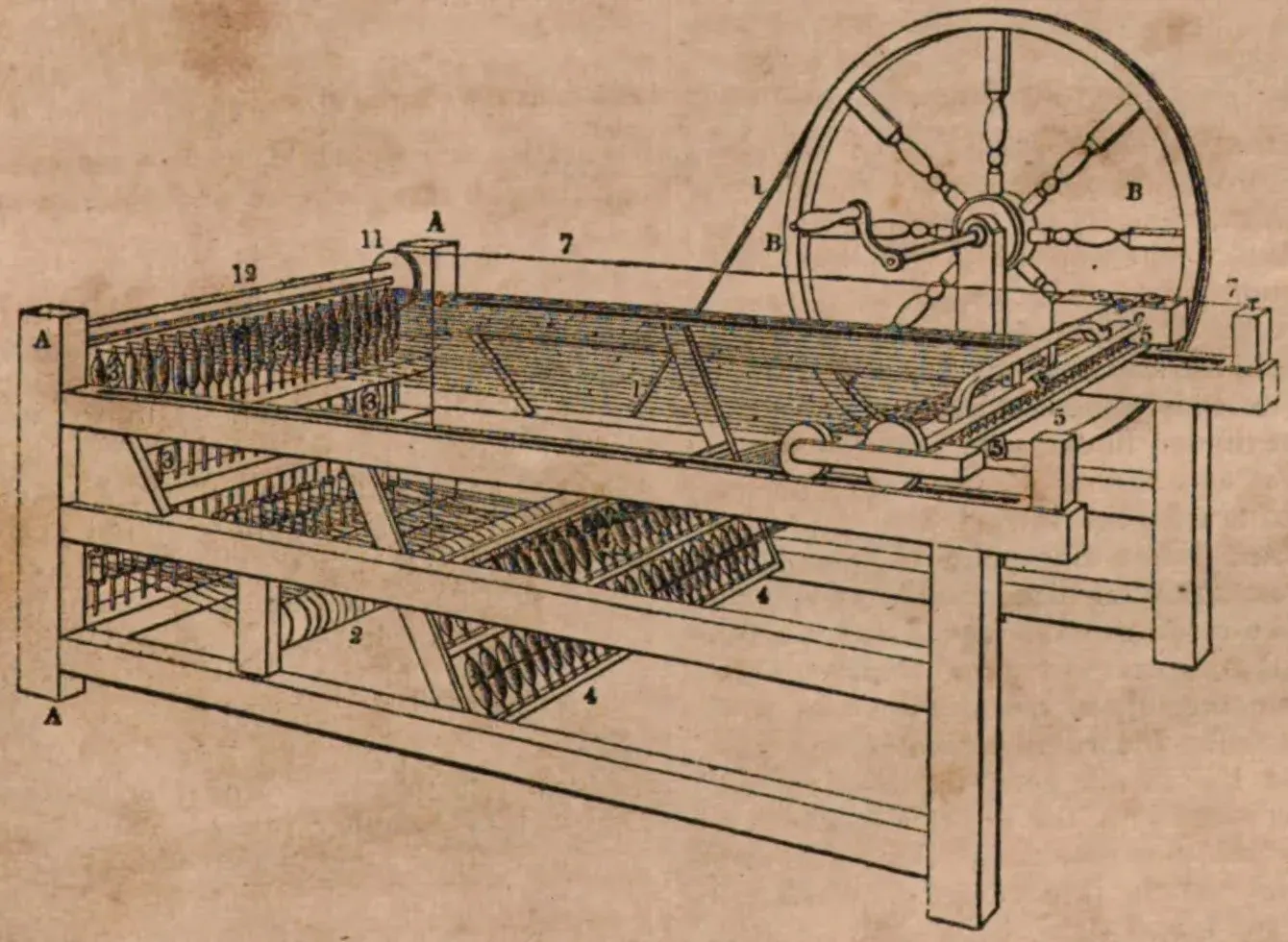
A spinning jenny (woodcut, 1836) · The Penny Magazine, 1836 · Wikimedia Commons (public domain)
This article traces this change focusing on Britain, where it first happened, while placing other European countries, China, India, and Japan of the same period side by side.
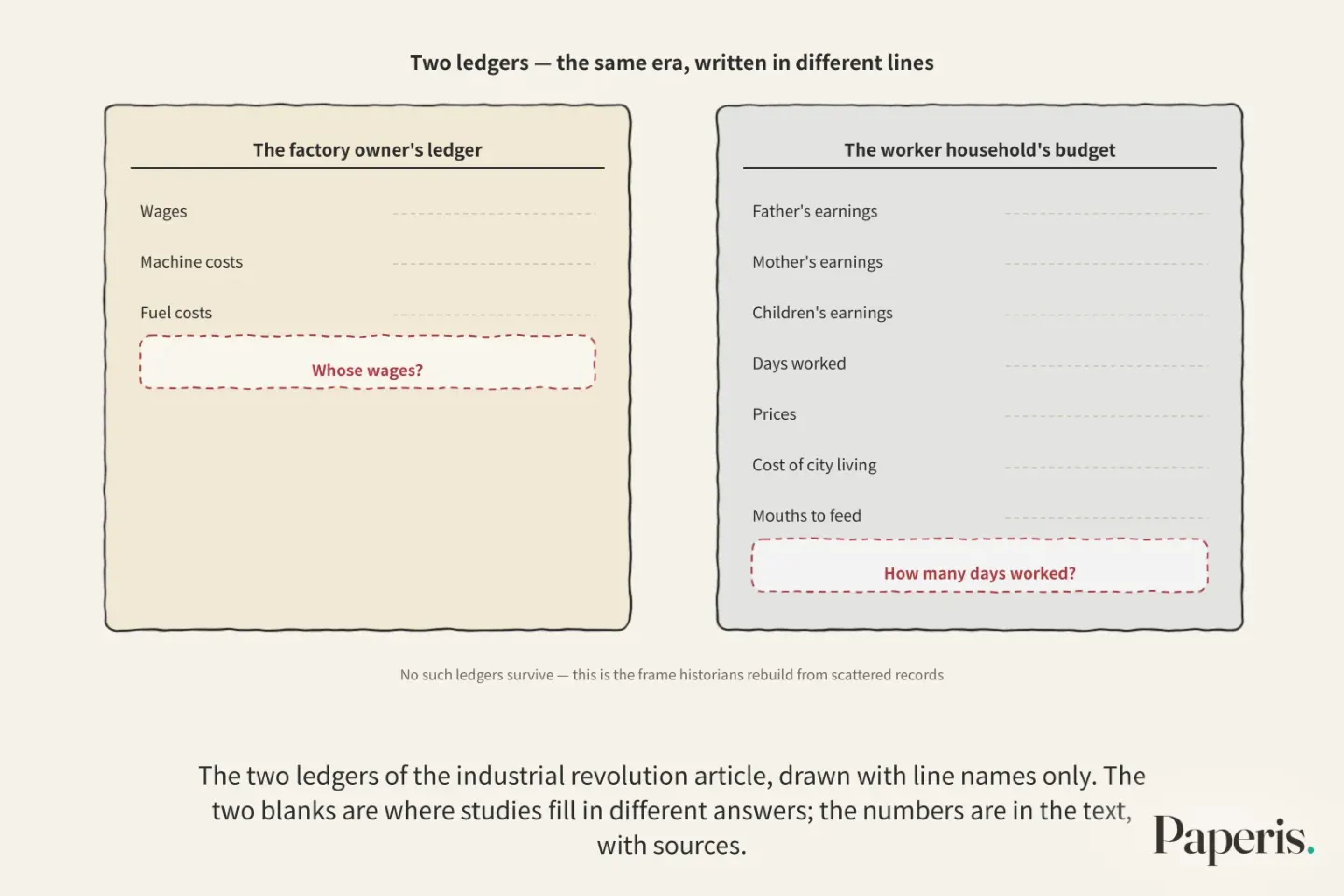
As guides, we lay open two ledger books. One is the account book of a factory owner calculating whether or not to bring in machines, and the other is the household account book of a worker's family living next to that factory. The former ledger asks, "Why on earth did Britain introduce machines at that very time?", and the latter ledger asks, "So, did people's livelihoods improve?". Both questions are still divided among scholars.
Machines, Coal, and Factories
The name "Industrial Revolution" was given later. French writers in the 1820s first used it to compare the mechanization of their country's cotton industry to the political revolution of 1789, and the term spread widely after a lecture transcript by English social reformer Arnold Toynbee was published as a book in 1884. The picture that commonly comes to mind when thinking of this period is coal and steam (DOI: 10.1017/s1361491606001870). A steam engine is a device that runs machinery using steam from water boiled by burning coal. The Industrial Revolution is a name that refers to the period when power-driven machinery was introduced to the textile industry in Britain, James Watt's steam engine was put into use, and the method of making goods in factories took root. The same name is used for the start of industrialization in other countries without consensus on the dates (DOI: 10.2307/493817). This change happened first in 18th-century Britain and spread across other European countries and the United States over the 19th century (OpenStax World History Volume 2 9.1).
Three things changed when looking at the ledger. The first is the workplace. The putting-out system is a method where merchants distributed raw materials to homes in the countryside, collected the items made at home, and paid wages. At this time, the wage lines were scattered across every cottage, and the spinning in the first section was precisely such domestic work (OpenStax World History Volume 2 6.3). The factory system is a method where workers are gathered in one building to work with machinery. The scattered wage lines gathered into a single building's payroll. A review article dealing with mechanization conveys E. P. Thompson's observation that machines drove workers into factories that were bad for their health, tightly monitored, and offered little share for workers to decide for themselves (DOI: 10.1146/annurev-economics-091823-025129).
The second is power. Next to the payroll, new lines for machinery costs and fuel costs appear. Factories increasingly relied on the power of the steam engine (OpenStax World History Volume 2 6.3).
The third is fuel. Fossil fuels are fuels like coal and oil formed from organisms buried underground a very long time ago. One study notes that pre-industrial societies could only obtain heat and energy to the extent that plants grew it from sunlight each year, and as the energy used from coal increased significantly during the Industrial Revolution, production grew just as much. It also notes the problem that, unlike the old energy that grew anew each year, accumulated fuel decreases as much as it is used (DOI: 10.1017/cbo9780511779619).
A 1982 article summarizing these definitions calls the name a misnomer right from its title (DOI: 10.2307/493817). The name carries a feeling of "suddenly," but the speed of the change is a point of contention. A 1992 paper notes that the view that changes were gradual and continuous with the past was dominant in economic and social history around that time, while countering that the changes in technology, women's and children's labor, and regional specialization were large and unprecedented (DOI: 10.1111/j.1468-0289.1992.tb01290.x). A study re-estimating Britain's national income tracing back to the 13th century finds that per capita output had already doubled between 1270 and 1700 (DOI: 10.1017/cbo9781107707603). This means that even before the introduction of machinery, per capita output in the British economy had been growing slowly for a long time.
The Factory Owner's Ledger — Why Britain?
In his 2009 book, Robert Allen explains "Why Britain?" through the calculus of a factory owner. Machines cost money to buy and fuel, but they save labor. According to his math, when wages are cheap, it is better to use more people; when wages are high and fuel is cheap, machines come out ahead. This is the arithmetic used by one explanation, and as we will see below, some research questions this very arithmetic.
The high-wage economy hypothesis is the explanation that because British wages were high while capital and energy were cheap, labor-saving machinery became a profitable venture in Britain before anywhere else. According to Allen, inventing and using steam engines, cotton mills, and the technology of using coal instead of wood to make iron were unusually profitable in Britain. Because wages were high, many people could afford to pay for school and apprenticeships. This technology spread to the world only after 19th-century British engineers modified the machines to run more cheaply (DOI: 10.1017/cbo9780511816680).
A 2018 study calls this explanation the most widely accepted answer today, yet draws its counterargument from the numbers in ledgers. Examining spinning—one of the industries that led industrialization—from the late 16th to the early 19th century, it shows that spinning was a low-wage, low-productivity job, and that wages did not rise significantly before the invention of the spinning jenny and the water frame. This study concludes that the motivation for mechanization must be sought elsewhere (DOI: 10.1111/ehr.12693). Another criticism points out that the high-wage explanation looks only at men's wages and misjudges the share that women and children played in household upkeep, offering the alternative that what drove invention was actually cheap and easily manageable women's and children's labor (DOI: 10.1111/j.1468-0289.2012.00663.x).
Even when looking at the same spinning industry, what is measured differs. One estimate covering 1550 to 1770 reports that spinning jobs grew substantially from the late 17th century onward and that earnings from them could exceed 30 percent of a poor household's income (DOI: 10.1111/j.1468-0289.2010.00588.x), whereas the earlier study views a single person's wages as not having risen significantly before the arrival of machines. If the two preceding criticisms are right, the truth or falsity of the sentence "Britain had high wages" changes depending on whose wages are written in the ledger.
Regarding the vein of coal, researchers who place coal at the center of the story have clashed with econometricians who view coal as largely irrelevant. A study that recalculates coal prices and the royalties collected by coalfield landowners finds that the increase in coal production during the Industrial Revolution was driven primarily by rising demand, that such expansion could have occurred at any time before 1760, and that the mere fact that England possessed coal in the ground added a negligible share to income (DOI: 10.1017/s1361491606001870). On the other hand, a study tracing the sizes of European cities from 1300 to 1900 records that before 1750, being close to a coalfield had no correlation with city growth, whereas after 1750, cities close to coalfields grew much faster (DOI: 10.1093/ej/ueaa117). The former study measures the share that coal added to British income, while the latter measures the growth of European cities. Because what is measured differs, the two conclusions cannot be lined up in a single row.
Another Line in the Ledger — Knowledge, Handiwork, the Atlantic
The factory owner's ledger must also record whether there are people to build and repair the machines. A review criticizing Joel Mokyr, author of the book The Enlightened Economy, summarizes his view as finding the early industrialization of England in the supply of knowledge and technology by a small number of intellectuals and exceptionally skillful artisans (DOI: 10.5871/jba/009.283). A study examining apprenticeship records across England from 1710 to 1770 supports Mokyr's argument, noting that the share of apprentices entering work like machinists—who erect and install machines—and carpenters, joiners, and turners grew throughout the 18th century (DOI: 10.1515/9780691210629-010).
One scholar offers a more radical interpretation. They argue that a combination of engines drawing power from fossil fuels, science leaning on experiments, and artisans and entrepreneurs grounded in the basics of mechanics arose only in Britain between the 17th and 19th centuries, and was difficult to spawn elsewhere (DOI: 10.1353/jwh.2002.0034). This is the interpretation of one scholar, and the same writing notes alongside that many economies outside Britain also experienced periods of growth.
The other side looks to the Atlantic. The people who labored on Atlantic sugar plantations were enslaved people. They could be legally compelled to perform work demanded by their owners in exchange mostly for only enough food, clothing, and shelter to sustain their lives (OpenStax World History Volume 2 6.3). A review responding to Mokyr argues that Britain's Atlantic slave economy altered the market for knowledge and technology. This is a counterargument that Mokyr brushed this possibility aside lightly. As the market widened, the division of labor deepened, and the skills for handling machinery and metal accumulated owing to the technology required to run the Atlantic slave economy, which this review argues was decisive in shaping the form of the British Industrial Revolution (DOI: 10.5871/jba/009.283). Separately from this review, a textbook records that no one disputes the point that profits from plantation crops like sugar grown by enslaved people were frequently invested in capitalist enterprises including factories emerging in the 18th century. It adds that whether sugar plantations can be viewed as capitalist enterprises is still contested among historians (OpenStax World History Volume 2 6.3).
There are also explanations that put institutions first. An economic model simulating very long-term growth points to two things: a virtuous cycle where more people increase ideas and those ideas in turn increase people, and the improvement of institutions like property rights that enlarged the share returning to inventors. In this model, the latter comes out as arguably the largest factor (DOI: 10.2202/1534-6013.1028). This is the result of model calculations, not actual records.
Why Europe — The Great Divergence
Expanding the question turns "Why Britain?" into "Why not Asia?" The Great Divergence refers to the wide gap in living standards that opened up between parts of Western Europe and advanced regions of Asia. Even when it started opening up is a matter of dispute.
In his 2000 book, historian Kenneth Pomeranz argues that as late as 1750, Europe and East Asia were comparable in life expectancy, consumption, and markets, and core areas of China and Japan were no more ecologically constrained than Western Europe. Trade is the buying, selling, or exchanging of goods between people and societies. Pomeranz points to two crossroads: luckily accessible coal, and trade with the New World (DOI: 10.1515/9780691217192).
Counterarguments to this assessment come from wage records. Research comparing wages and prices from 1500 to 1800 suggests that grain-measured wages in advanced regions of India and China were similar to those in Northwest Europe, but silver-measured wages were much lower. Because silver wages represent the purchasing power for tradable goods, this study concludes that the Great Divergence was already well underway before 1800 (DOI: 10.1111/j.1468-0289.2005.00331.x). Another paper uploaded to a university repository supports this traditional view while conceding that the other side is right in pointing out regional differences within both continents. Within Europe, the North Sea rim pulled ahead of the Mediterranean, while within Japan outpaced China and India in Asia. However, Japan also remained behind the North Sea rim until after the Meiji Restoration of 1868, when a new government took power (DOI: 10.82444/warw.33637156).
There is also criticism that Pomeranz's side exaggerates the similarities between Europe and East Asia. The critique is that we must narrow the time and place and look more closely at politics, military affairs, culture, and institutions (DOI: 10.1111/j.1478-0542.2010.00698.x). In a response a decade after his book came out, Pomeranz wrote that this is a problem on which no one can have the last word. He agreed with criticisms that his book did not provide sufficient answers, and he acknowledged as an important difference the fact that China lacked a war-and-tax state like Europe's. Still, he maintains that subsequent research has largely supported his hypothesis on agricultural productivity (DOI: 10.1353/hsp.2011.0051).
One scholar considers the old picture of a stagnant non-West to be mistaken. The argument is that various economies—such as medieval Europe, Golden Age Netherlands, and Qing Dynasty China—experienced periods of growth where population and living standards rose together. What he points to as the characteristic of the West after 1800 is not growth itself, but the combination that growth relied upon (DOI: 10.1353/jwh.2002.0034).
Gathering the six strands of explanation presented so far, along with the types of evidence behind them, yields the following.
- High wages and cheap energy: A single researcher's book, which is countered by studies that reexamine spinning wages and female and child labor.
- Coal: A study showing that coal contributed little to income is measured against a study showing that cities near coalfields grew fast after 1750.
- Knowledge and craftsmanship: Mokyr's argument, backed by research on apprenticeship records.
- The Atlantic slave economy: An argument from a commentary that technology's market changed, while the point that plantation profits were frequently invested in corporations is recorded by textbooks as undisputed fact.
- Institutions: The calculation results of growth models.
- Coal and the New World: The argument of a comparative history book, whose dating of the two regions as comparable up to 1750 is contradicted by wage comparison studies.
Regarding why Britain, even a 2018 study that disputed the high-wage explanation called it the most widely accepted answer at the time (DOI: 10.1111/ehr.12693). Regarding the reasons for the Great Divergence, textbooks note that historians are divided (OpenStax World History Volume 2 9.1), and Pomeranz himself wrote that it is a problem on which no one can have the last word (DOI: 10.1353/hsp.2011.0051).
The Worker's Account Book — Did Living Standards Improve?
Now we open a different ledger. The important thing in an account book is not the number of coins received, but what can be bought with that money. The face amount of the money received is called the nominal wage, and the actual quantity of goods that can be bought with that money is called the real wage. Although the cotton textile industry became one of the largest industries in the British economy, the real wages of the weavers who spun the cotton did not rise for decades. An article summarizing this case concludes that mechanization raises wages only when new jobs are created or when people are sufficiently hired in other fields, and that when workers cannot demand a share of increased production, wages are hard to rise (DOI: 10.1146/annurev-economics-091823-025129).
The standard of living debate is a long-standing academic dispute over whether the lives of workers improved or worsened during the Industrial Revolution. Because many things, such as nutritional status, are difficult to measure directly, scholars use various yardsticks. One such study collects heights recorded in military and charitable organization records to measure changes in the physiques of Britons during the industrialization period (DOI: 10.1017/cbo9780511983245).
One estimation measured by wages and the cost of living is pessimistic. A study that newly estimated the earnings and living costs of male and female manual workers from 1770 to 1870, while factoring in unemployment, the number of dependents, and the cost of living in cities, suggests that the average standard of living for working-class families did not improve by even 15 percent between the 1780s and the 1850s. The author calls this period a long plateau and suggests that it aligns with other economic, political, and population indicators (DOI: 10.1017/s0022050700021100).
Many old wage records are daily wages, so annual income has been guessed without knowing how many days were worked in a year. A study recalculated from the pay of workers employed on an annual basis in England from 1260 to 1850 suggests that past estimates guessed from daily wages overestimated medieval workers' annual incomes and underestimated Industrial Revolution workers' annual incomes. The same study suggests that modern economic growth began more than two centuries earlier than commonly thought, and that this growth was driven by a change where households worked more (DOI: 10.1093/ej/uez017).
Among the income lines of the account books was the earnings of children. A study that read over 600 autobiographies written by working-class men in the 18th and 19th centuries notes that child labor appears to have increased from around 1790 to 1850 (DOI: 10.1017/cbo9780511780455). The author points to several interconnected links. Mechanization and new divisions of labor increased the usefulness of children's labor, there were many mouths to feed in a single household, fathers' wages were unstable, and many homes lost their fathers or had breadwinners who were in poor health (DOI: 10.1111/j.1468-0289.2012.00651.x). Another study examines the health of working children from 1780 to 1850, casting doubt on the old stereotype of the sick and abused factory child (DOI: 10.1515/9781782044017).
There were also people who fought back against the machines. From 1811, some British textile workers fought back by smashing machines under the name of Luddites, but they were suppressed by 1816 (OpenStax World History Volume 2 6.3).
City life also enters the account books. Textbooks summarize that industrialization and urbanization brought opportunity and misery together. Britain enacted the Public Health Act in 1848 to manage problems like sewage, but textbooks note that this law and other sanitation and emission regulatory laws enacted in 19th-century Britain and the United States did not achieve great results (OpenStax World History Volume 2 10.5).
The answer may also differ by country. A collection of papers comparing industrialization and health across various countries includes a chapter titled "Was Industrialization Hazardous to Your Health? Not in Sweden!" (DOI: 10.7208/chicago/9780226771595.001.0001).
The Industrious Revolution — Did People Choose to Work More, or Were They Forced to by Hardship?
There is an argument that changes in household spending shifted before machines did. The industrious revolution refers to a change, preceding the Industrial Revolution, where households spent more time offering their labor for sale in the market, using that money to consume more goods bought in the market. This is a concept introduced by Jan de Vries in a 1994 paper. He argues that this demand-side change within the household preceded the supply-side change of the Industrial Revolution (DOI: 10.1017/s0022050700014467). The stage for this change is northwestern Europe and North America during the long eighteenth century (DOI: 10.1017/cbo9780511818196).
There are also studies that read the same scene differently. A study that calculated how many days a year needed to be worked to buy a basket of basic necessities and compared this against actual labor days found two "periods of working longer" among rural laborers, but both were due to economic hardship, with no signs of a desire to buy new goods. It notes that for urban workers, the situation was different, leaving greater room to purchase new goods. This study looked at England from around 1300 to 1830 (DOI: 10.1111/j.1468-0289.2010.00566.x). Another study comparing wages across some 20 European cities and regions suggests that no clear relationship is visible between economic development and changes in living standards between 1500 and 1800. This study proposes that the increased consumption of certain market goods can also be explained as the result of relative changes in prices, or of falling real wages that forced people to work more (DOI: 10.1017/s136149169900009x).
The same fact of working longer is read on one side as arising from a desire to buy things, and on the other as stemming from the tightness of making a living. Even when opening the same household account book, the same era looks different depending on which line you read first.
Following the Household Account Book of a Spinning Family
Let us gather the previous facts into a single imagined household. In the mid-18th century, the value of the yarn spun by the mother and children made up a large share of this household's income (DOI: 10.1111/j.1468-0289.2010.00588.x). At the end of the 18th century, spinning machinery arrived (DOI: 10.1111/ehr.12693).
In the early 19th century, the children of this household may have gone out to work at a younger age. This is because there is an interpretation that child labor increased in households where the usefulness of children's labor grew, mouths to feed were many, and the father's wages wavered (DOI: 10.1111/j.1468-0289.2012.00651.x). There is an estimate that the standard of living for the average working-class family did not improve by even 15 percent until the 1850s (DOI: 10.1017/s0022050700021100), and other research suggests that annual incomes inferred from daily wages underestimate the Industrial Revolution era (DOI: 10.1093/ej/uez017).
Depending on whether a father was present, whether they moved to the city, and how many family members there were, this household's seventy years would be filled differently than a single average summary line.
The Second Industrial Revolution
Between the mid-19th century and the early 20th century, industry transformed drastically once again. The Second Industrial Revolution is the major transformation of industry from the mid-19th century to the early 20th century driven by new technologies like steel, electricity, and chemicals. In the 1850s, ways to produce steel cheaply and in large quantities opened up, and during the Second Industrial Revolution, synthetic dyes and chemical fertilizers emerged. During this period, industrialization also gained momentum in Russia and Japan (OpenStax World History Volume 2 9.1).
A new line for electricity was added to factory owners' ledger books. By the late 19th century, electricity began to push out steam and drive factory machinery (OpenStax World History Volume 2 10.1).
Workers' household ledgers also changed, but the scale of that change differed by country and period. One study covering the United States suggests that over the century following the Civil War, namely between 1870 and 1970, inventions like electric lighting, indoor plumbing, and automobiles transformed homes and workplaces, raising Americans' living standards higher than ever before (DOI: 10.2307/j.ctvc77bwm). Textbooks note that during the same period, among the countries of Asia, Africa, and Latin America, industrialization did not occur outside of Japan, and that this led to economic and military disadvantages (OpenStax World History Volume 2 9.1). New industries required new raw materials. Industrialized nations' entrepreneurs and politicians believed that to obtain those raw materials at prices so low that the local people would not accept them, they had to directly rule the lands of Africa and Asia (OpenStax World History Volume 2 9.2).
Standing Once Again Before Two Ledgers
There are limits to the ledger metaphor used in this article. In reality, two such ledgers do not actually survive. Historians gather scattered data—like records of daily wages, annual employment salaries, a worker's autobiography, and heights in military records—to reconstruct the ledgers, and depending on what they collect, the ledgers change.
While the Industrial Revolution transformed how things were made using machines, coal, and factories, why it happened in Britain at that time and whether people's living standards improved over those few decades depend entirely on which records are used to build the ledgers and which lines are read first. Whether we look at the wages of men or the wages of women and children, daily wages or annual income, Britain or China, the line for machine costs or the line for manual skill and the Atlantic, those are the crossroads.
Where to Look Next
- The question of whose wages are being measured is the same in the Middle Ages. "Did Wages Really Rise After the Black Death? Where, When, and Whose" covers that question.
- How to trust and read records left by people, like a worker's autobiography, is in "Reading Historical Records — Grandmother's Diary and That Day's Newspaper".
- The stories of people, goods, and diseases that crossed the Atlantic can be found in "Trade Routes — A Transit Map Where Goods Were Handed On at Every Transfer", and what a city where people gather and live is can be found in "Cities and States — Where the First Maintenance Bills Arrived".
Source Papers
- "World History, Volume 2: from 1400 — 6.3 Capitalism and the First Industrial Revolution" (2022) — OpenStax World History Volume 2 6.3 — Spinning as cottage work, movement to cities, factories relying on the steam engine, Luddites (1811–1816), legally coerced labor on sugar plantations and the investment of its profits.
- "World History, Volume 2: from 1400 — 9.1 The Second Industrial Revolution" (2022) — OpenStax World History Volume 2 9.1 — Britain first, the power of water and steam, a new phase from the mid-19th to the early 20th century, mass production of steel in the 1850s, industrialization in Russia and Japan, historians divided on the reasons for the Great Divergence.
- "World History, Volume 2: from 1400 — 9.2 Motives and Means of Imperialism" (2022) — OpenStax World History Volume 2 9.2 — Industrial country entrepreneurs and politicians who believed distant lands must be directly ruled to acquire new raw materials cheaply.
- "World History, Volume 2: from 1400 — 10.1 Inventions, Innovations, and Mechanization" (2022) — OpenStax World History Volume 2 10.1 — Electricity replaces steam in the late 19th century.
- "World History, Volume 2: from 1400 — 10.5 Regulation, Reform, and Revolutionary Ideologies" (2022) — OpenStax World History Volume 2 10.5 — The opportunities and pains of industrialization and urbanization, the Public Health Act of 1848, the low effectiveness of regulatory laws in Britain and the US.
- "Ten Years After: Responses and Reconsiderations" (2011) — DOI: 10.1353/hsp.2011.0051 — Pomeranz’s reply ten years later — a problem where no one can have the last word, agreeing with the criticism that it does not provide sufficient answers, acknowledging differences in military-fiscal states, agricultural productivity is supported.
- "The British Industrial Revolution in Global Perspective" (2009) — DOI: 10.1017/cbo9780511816680 — Allen’s argument that high wages and cheap capital and energy made machine invention a profitable business only in Britain.
- "The Great Divergence: China, Europe, and the Making of the Modern World Economy" (2000) — DOI: 10.1515/9780691217192 — The claim that Europe and East Asia were comparable until 1750, with the location of coal and New World trade serving as the turning point.
- "Learning From Ricardo and Thompson: Machinery and Labor in the Early Industrial Revolution and in the Age of Artificial Intelligence" (2024) — DOI: 10.1146/annurev-economics-091823-025129 — Cotton weavers' real wages did not rise for decades, factories with tight surveillance (Thompson), conditions under which mechanization raises wages.
- "Spinning the industrial revolution" (2018) — DOI: 10.1111/ehr.12693 — There was no high-wage economy for spinning, and wages did not rise significantly before the introduction of machinery.
- "The lure of aggregates and the pitfalls of the patriarchal perspective: a critique of the high wage economy interpretation of the British industrial revolution" (2012) — DOI: 10.1111/j.1468-0289.2012.00663.x — The high-wage explanation was biased toward men's wages, with cheap female and child labor as an alternative explanation.
- "Childhood and Child Labour in the British Industrial Revolution" (2010) — DOI: 10.1017/cbo9780511780455 — Over 600 worker autobiographies, increase in child labor from 1790 to 1850.
- "Pessimism Perpetuated: Real Wages and the Standard of Living in Britain during and after the Industrial Revolution" (1998) — DOI: 10.1017/s0022050700021100 — Average worker family living standards improved by less than 15% from the 1780s to the 1850s.
- "Britain's Atlantic slave economy, the market for knowledge and skills, and early industrialisation: a response to Joel Mokyr's 'Holy Land of Industrialism'" (2021) — DOI: 10.5871/jba/009.283 — Commentary arguing that the Atlantic slave economy changed the market for knowledge and skills and was decisive for the shape of the British industrial revolution (including a summary of Mokyr's claims).
- "Childhood and child labour in the British industrial revolution" (2012) — DOI: 10.1111/j.1468-0289.2012.00651.x — An interpretation linking the rise in child labor to mechanization, dependency ratios, male wages, and household instability.
- "Health and Welfare during Industrialization" (1997) — DOI: 10.7208/chicago/9780226771595.001.0001 — A collection of papers dealing with industrialization and health in various countries (Sweden chapter title).
- "Height, Health and History: Nutritional Status in the United Kingdom, 1750–1980" (1990) — DOI: 10.1017/cbo9780511983245 — Research measuring nutritional status during the industrialization period using height from military and charity records.
- "Rehabilitating the Industrial Revolution" (1992) — DOI: 10.1111/j.1468-0289.1992.tb01290.x — Noting that gradualism was dominant as of 1992, emphasizing the magnitude and unprecedented nature of change.
- "The Industrial Revolution: A Misnomer" (1982) — DOI: 10.2307/493817 — The name for the period when textile machinery, the Watt steam engine, and the factory system took root, first used in France in the 1820s and widely spread after Toynbee's lecture notes in 1884.
- "The Industrious Revolution: Consumer Behavior and the Household Economy, 1650 to the Present" (2008) — DOI: 10.1017/cbo9780511818196 — The industrious revolution in long 18th-century northwestern Europe and North America.
- "The Industrial Revolution and the Industrious Revolution" (1994) — DOI: 10.1017/s0022050700014467 — The industrious revolution as a demand-side change at the household level preceding the industrial revolution.
- "British Economic Growth, 1270–1870" (2014) — DOI: 10.1017/cbo9781107707603 — GDP per capita doubled between 1270 and 1700.
- "Child Workers and Industrial Health in Britain, 1780-1850" (2013) — DOI: 10.1515/9781782044017 — Questioning the stereotype of the sick and abused factory child.
- "Coal and the Industrial Revolution, 1700-1869" (2007) — DOI: 10.1017/s1361491606001870 — Expansion of coal production was due to demand and was possible even before 1760, with coal ownership's contribution to income being negligible.
- "Unreal Wages? Real Income and Economic Growth in England, 1260–1850" (2019) — DOI: 10.1093/ej/uez017 — Worker income during the industrial revolution was underestimated when viewed through annual pay.
- "Accounting for the great divergence" (2013) — DOI: 10.82444/warw.33637156 — Supporting the traditional view, acknowledging revisionists are right about regional differences, minor divergences within the continent (North Sea vs. Mediterranean, Japan vs. China/India).
- "Was there an 'industrious revolution' before the industrial revolution? An empirical exercise for England, c. 1300-1830" (2010) — DOI: 10.1111/j.1468-0289.2010.00566.x — Two industrious revolutions of rural workers driven by destitution, room for consumption for urban workers.
- "Efflorescences and Economic Growth in World History: Rethinking the "Rise of the West" and the Industrial Revolution" (2002) — DOI: 10.1353/jwh.2002.0034 — Growth phases of various economies, the feature of the West after 1800 being the combination of fossil fuel engines, science, and artisans.
- "Wages and the standard of living in Europe, 1500-1800" (1999) — DOI: 10.1017/s136149169900009x — Increase in consumption can also be explained by increased labor due to falling real wages.
- "9. England's Eighteenth-Century Demand for High-Quality Workmanship: Evidence from Apprenticeship, 1710–1770" (2020) — DOI: 10.1515/9780691210629-010 — The increasing share of apprentices for machine-installation artisans supports Mokyr's argument.
- "Coal and the European Industrial Revolution" (2014) — DOI: 10.1093/ej/ueaa117 — European cities closer to coalfields grew faster after 1750.
- "Energy and the English Industrial Revolution" (2010) — DOI: 10.1017/cbo9780511779619 — Energy, previously bound to annual photosynthesis, increased massively through coal.
- "The Rise and Fall of American Growth: The U.S. Standard of Living since the Civil War" (2016) — DOI: 10.2307/j.ctvc77bwm — Major changes in US living standards in the 100 years following the Civil War.
- "The California School and Beyond: How to Study the Great Divergence?" (2010) — DOI: 10.1111/j.1478-0542.2010.00698.x — Criticism that the California School exaggerates similarities.
- "The early modern great divergence: wages, prices and economic development in Europe and Asia, 1500–1800" (2005) — DOI: 10.1111/j.1468-0289.2005.00331.x — Silver wages were low in advanced parts of Asia, meaning the Great Divergence was already underway before 1800.
- "‘Th'ancient Distaff’ and ‘Whirling Spindle’: measuring the contribution of spinning to household earnings and the national economy in England, 1550–1770" (2011) — DOI: 10.1111/j.1468-0289.2010.00588.x — Over 1 million women and children spinning in the mid-18th century, potentially accounting for over 30% of poor household income.
- "Was an Industrial Revolution Inevitable? Economic Growth Over the Very Long Run" (2001) — DOI: 10.2202/1534-6013.1028 — Growth model — the virtuous cycle of population and ideas, and the increase in inventors' share (property rights, etc.) perhaps as the most important factor.
Sources (37)
- World History, Volume 2: from 1400 — 6.3 Capitalism and the First Industrial Revolution
- World History, Volume 2: from 1400 — 9.1 The Second Industrial Revolution
- World History, Volume 2: from 1400 — 9.2 Motives and Means of Imperialism
- World History, Volume 2: from 1400 — 10.1 Inventions, Innovations, and Mechanization
- World History, Volume 2: from 1400 — 10.5 Regulation, Reform, and Revolutionary Ideologies
- Ten Years After: Responses and ReconsiderationsDOI 10.1353/hsp.2011.0051
- The British Industrial Revolution in Global PerspectiveDOI 10.1017/cbo9780511816680
- The Great Divergence: China, Europe, and the Making of the Modern World EconomyDOI 10.1515/9780691217192
- Learning From Ricardo and Thompson: Machinery and Labor in the Early Industrial Revolution and in the Age of Artificial IntelligenceDOI 10.1146/annurev-economics-091823-025129
- Spinning the industrial revolutionDOI 10.1111/ehr.12693
- The lure of aggregates and the pitfalls of the patriarchal perspective: a critique of the high wage economy interpretation of the British industrial revolutionDOI 10.1111/j.1468-0289.2012.00663.x
- Childhood and Child Labour in the British Industrial RevolutionDOI 10.1017/cbo9780511780455
- Pessimism Perpetuated: Real Wages and the Standard of Living in Britain during and after the Industrial RevolutionDOI 10.1017/s0022050700021100
- Britain's Atlantic slave economy, the market for knowledge and skills, and early industrialisation: a response to Joel Mokyr's 'Holy Land of Industrialism'DOI 10.5871/jba/009.283
- Childhood and child labour in the British industrial revolutionDOI 10.1111/j.1468-0289.2012.00651.x
- Health and Welfare during IndustrializationDOI 10.7208/chicago/9780226771595.001.0001
- Height, Health and History: Nutritional Status in the United Kingdom, 1750–1980DOI 10.1017/cbo9780511983245
- Rehabilitating the Industrial RevolutionDOI 10.1111/j.1468-0289.1992.tb01290.x
- The Industrial Revolution: A MisnomerDOI 10.2307/493817
- The Industrious Revolution: Consumer Behavior and the Household Economy, 1650 to the PresentDOI 10.1017/cbo9780511818196
- The Industrial Revolution and the Industrious RevolutionDOI 10.1017/s0022050700014467
- British Economic Growth, 1270–1870DOI 10.1017/cbo9781107707603
- Child Workers and Industrial Health in Britain, 1780-1850DOI 10.1515/9781782044017
- Coal and the Industrial Revolution, 1700-1869DOI 10.1017/s1361491606001870
- Unreal Wages? Real Income and Economic Growth in England, 1260–1850DOI 10.1093/ej/uez017
- Accounting for the great divergenceDOI 10.82444/warw.33637156
- Was there an 'industrious revolution' before the industrial revolution? An empirical exercise for England, c. 1300-1830DOI 10.1111/j.1468-0289.2010.00566.x
- Efflorescences and Economic Growth in World History: Rethinking theDOI 10.1353/jwh.2002.0034
- Wages and the standard of living in Europe, 1500-1800DOI 10.1017/s136149169900009x
- 9. England's Eighteenth-Century Demand for High-Quality Workmanship: Evidence from Apprenticeship, 1710–1770DOI 10.1515/9780691210629-010
- Coal and the European Industrial RevolutionDOI 10.1093/ej/ueaa117
- Energy and the English Industrial RevolutionDOI 10.1017/cbo9780511779619
- The Rise and Fall of American Growth: The U.S. Standard of Living since the Civil WarDOI 10.2307/j.ctvc77bwm
- The California School and Beyond: How to Study the Great Divergence?DOI 10.1111/j.1478-0542.2010.00698.x
- The early modern great divergence: wages, prices and economic development in Europe and Asia, 1500–1800DOI 10.1111/j.1468-0289.2005.00331.x
- ‘Th'ancient Distaff’ and ‘Whirling Spindle’: measuring the contribution of spinning to household earnings and the national economy in England, 1550–1770DOI 10.1111/j.1468-0289.2010.00588.x
- Was an Industrial Revolution Inevitable? Economic Growth Over the Very Long RunDOI 10.2202/1534-6013.1028