Paperis Articles
Cities and States — Where the First Maintenance Bills Arrived
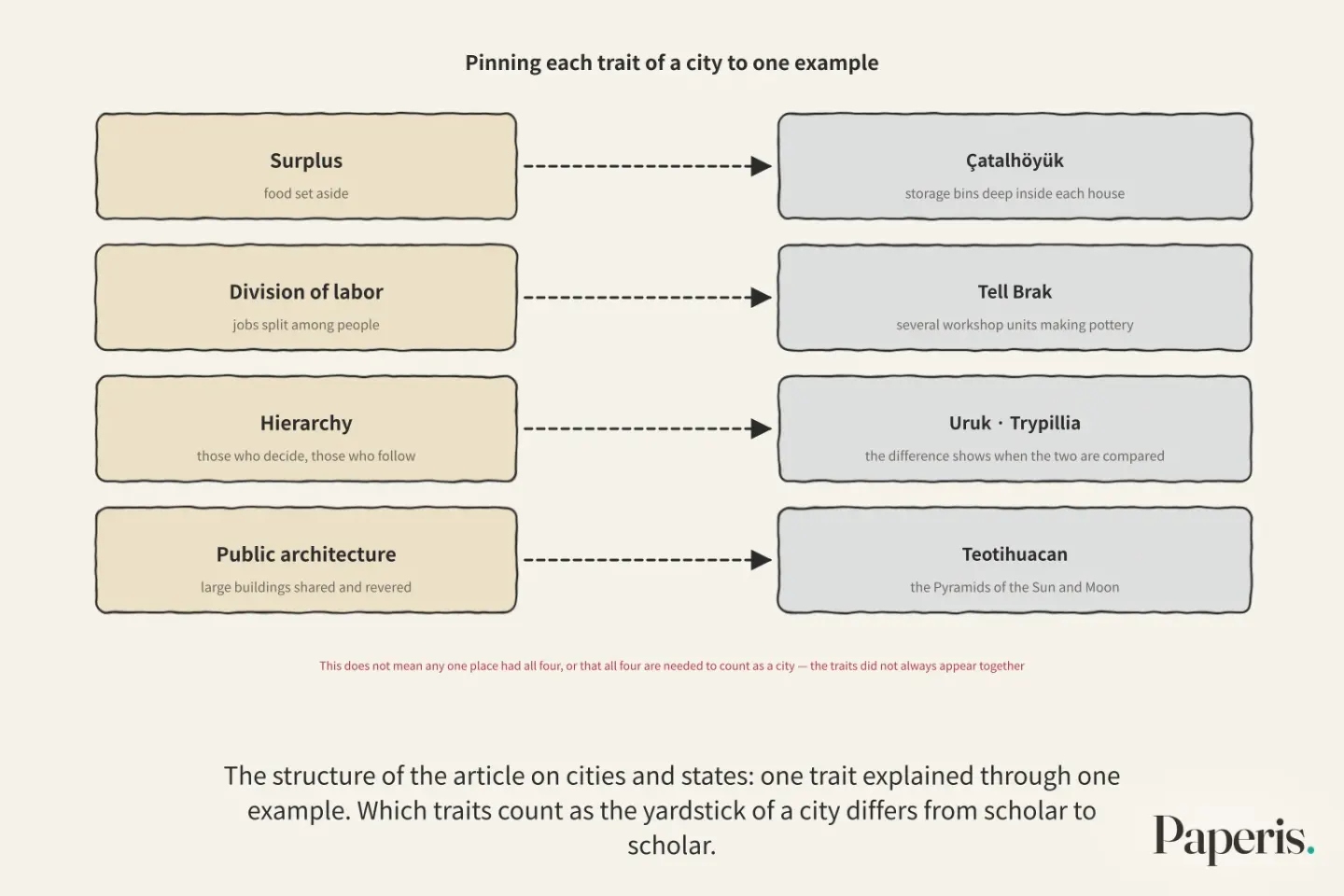
Living together in large numbers did not by itself make a city. Cities are told apart by features such as surplus food, division of labor, hierarchy and public buildings, yet each place combined them differently, and the state sometimes rose with the city and sometimes stays hard to see even where cities stood.
Your field's papers, as audio
Pick your fields and journals — Paperis summarizes the key papers and turns them into audio. Listen on your commute.
Start Paperis free →Cities and States — Where the First Maintenance Bills Arrived
Houses Back-to-Back
On the Konya Plain in central modern-day Turkey, there is a site where people gathered to live about 9,000 years ago (DOI: 10.1017/cbo9780511761416). At this site, called Çatalhöyük, houses were packed tightly together with their walls touching, and people moved in and out through the roofs. The dead were buried beneath the floors of the houses. The area of the site reaches 21 hectares (DOI: 10.1017/s0003598x00085410).
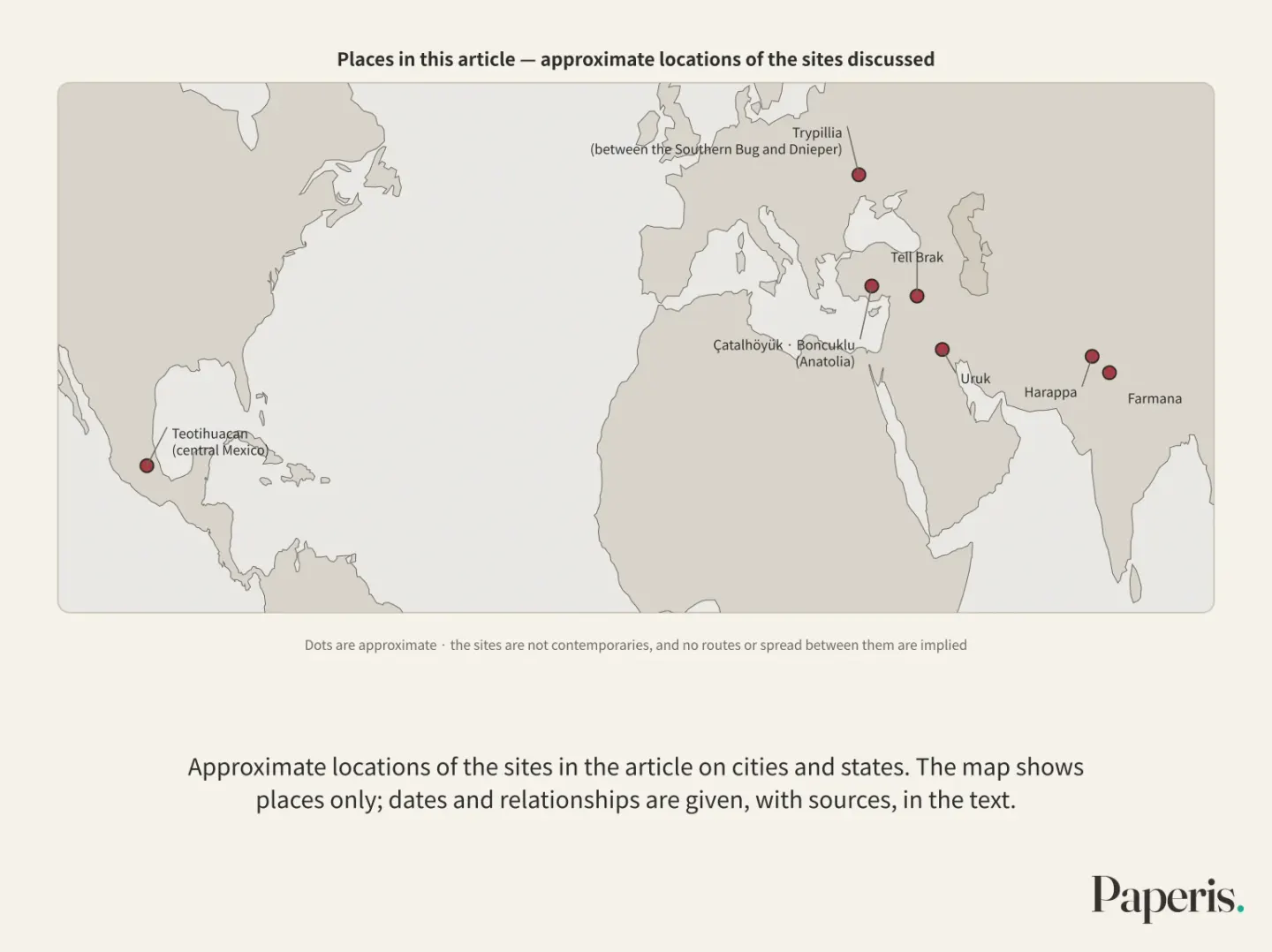
If people gathered and lived on this large a scale, can we call this place a city? Scholars are divided on this question. Starting from that division, this article follows when a place where people gathered to live becomes a city, and when it becomes a state. We look together at cases from various regions around the world, such as Anatolia and Mesopotamia in West Asia, between the Southern Bug and Dnieper rivers in Eastern Europe, the Indus River basin in South Asia, and the land of modern-day Mexico. Early farming-based large societies also arose in many other places including modern-day China, Egypt, and Peru, but this article does not cover those places (OpenStax World History Volume 1 3.1).
As our guide, we carry a single apartment maintenance fee bill. The bill lists items like security, cleaning, elevator maintenance, and shared electricity. Someone takes on work that I do not do directly, and many households share that cost. People simply gathering and living in large numbers is a different matter from living in a place where such a bill arrives.
Farming First, Cities Much Later
The Neolithic Revolution is a major shift from a life where people gathered food to find what to eat, to a life centered mostly on growing crops and raising livestock themselves. This change did not spread outward from a single spot. Textbooks point to Southwest Asia, China, sub-Saharan Africa, Mesoamerica, and South America, noting that it happened separately in these places at different times starting about 12,000 years ago (OpenStax World History Volume 1 2.3).
A life of staying in one place spread alongside farming. Settlement is a lifestyle of living in one spot instead of moving around with the seasons. Yet even in places that took up farming, settlement and agriculture did not change overnight. At Bozankulu on the Anatolian plateau, hunter-gatherers living there adopted crop growing by the mid-9th millennium BCE in calibrated radiocarbon years, and a style of mixing small-scale farming and sheep-and-goat herding with gathering continued for hundreds of years. Around them were communities that deliberately turned down farming. The people of Bozankulu appear to be ancestors of the much larger community on the East Mound of Çatalhöyük stretching from 7100 BCE in calibrated radiocarbon years, by which time farming and herding had become the mainstay feeding that large settled community (DOI: 10.1073/pnas.1800163115). The road from farming to large villages was not a straight line.
Once farming took root, extra food appeared. Surplus is the food harvested by farmers in amounts left over after feeding their own families. At Çatalhöyük, people kept this surplus separately in each house. Households piled grain, fruit, and nuts in storage bins deep inside the houses, and hung the heads and horns of wild cattle called aurochs near the entrance. Those heads and horns held religious meaning, but they also served to remind people of feasts eaten together, and such sharing is read as having softened the jealousy that storehouses brimming in every home might otherwise invite (DOI: 10.1017/s0003598x00098896).
Close blood relatives were rare among children buried inside and outside the homes. This suggests that burial spots for children may not have been decided by bloodlines at least. At earlier Bozankulu, by contrast, people buried in the same house frequently shared parent-child or sibling ties, so the kin structures of communities in this period varied from place to place (DOI: 10.1016/j.cub.2021.03.050). To use a billing analogy, Çatalhöyük was a place where each house kept its own storehouse and gathered every now and then to share through feasts.
The criteria diverge on what to call a place like this. Textbooks cite Çatalhöyük as an example of a "Neolithic city," noting that the population of such early cities reached as many as 6,000 people (OpenStax World History Volume 1 3.1). Some books introduce it as a 9,000-year-old small town (DOI: 10.1017/cbo9780511761416). Researchers who have studied the site for a long time use the terms "mega-site" or "clustered village" (DOI: 10.1017/s0003598x00098896; DOI: 10.2307/4128346). A mega-site is a term for a settlement formed by countless houses gathered together that was very large for that era. The fact that the same ruins go by different names means that the standard for what counts as a city is not fixed into a single definition.
Cities That Divided the Work
At the large northern Mesopotamian site of Tell Brak, urban layouts already appear in the late 5th and early 4th millennia BCE. To supply the needs of a growing city, various work units each produced all sorts of vessels, while procuring raw materials like clay appears to have been coordinated collectively (DOI: 10.1007/s12520-025-02290-8). Even within the single task of pottery making, multiple work units were divided.
Division of labor means people take on different roles, each focusing on a single task while relying on others for the rest. Textbooks list the division of labor as a core feature separating early large societies from the societies before them (OpenStax World History Volume 1 3.1). Because there must be a surplus so that people who do not farm can eat and live, the division of labor stands upon a surplus.
Measured against the bill, it looks like this. For there to be a share to pay, something left over must come first (surplus), and there must be separate people in charge of security and cleaning (division of labor). The bill has more items on it. The split between those who set the amounts and those who only pay meets us at the site comparing Uruk and Triphylia, and large facilities used together meet us in front of the pyramids of Teotihuacan. These items did not always appear all at once in every place.
Uruk — The Side That Issued the Bill Arrives
In what is now southern Iraq, the land between the Tigris and Euphrates rivers was once called Sumer. Large cities stood here in the fourth millennium BCE (OpenStax World History Volume 1 3.2). From this point on, we need the term state. A state is an organization that governs people, collects taxes, and uses law and force. Urbanization is the process by which people gather in cities and the share of life lived in cities grows larger. Uruk was the center that drove urbanization and state formation in Mesopotamia during the Uruk period, roughly from 3800 to 3300 BCE, and the very name of the Uruk period comes from this city, often called "the first city" (DOI: 10.1093/oso/9780190687854.003.0004).
In the Sumerian cities that later began writing on clay tablets, the side that issued bills is clearly visible. The surviving tablets contain records of contracts, receipts, and accounts of taxes and wages (OpenStax World History Volume 1 3.2). This means there was a side that wrote and left behind bills and receipts. How these records connected to writing is followed in "Writing — How Grain Ledgers Came to Hold Songs".
Why it had to be this exact place remains a matter of debate. The abundance of the south has long been explained by herding, long-distance trade, and diverse resources. A 2025 study based on satellite terrain data and new core samples proposed the hypothesis that tidal irrigation near the coast enabled high-yield, diverse farming, which may have driven urbanization. Because the economic principles behind the rise of Sumer remain speculative, the researchers argue that we need to better understand the appearance of the land and water in those times, and they place changes in coastal geography as a major factor in urbanization (DOI: 10.1371/journal.pone.0329084). Nor did cities grow in just one southern location. The northern site of Tell Brak also showed urban features early on (DOI: 10.1007/s12520-025-02290-8), and some research suggests that Central Asia played a major role in the origins of Old World cities (DOI: 10.9783/9781934536230).
Who the bill-issuing side was is also not simple. The written and pictorial records of the Uruk period show no clear evidence of a single ruler, and the visible political structure is deeply intertwined with the role of religion (DOI: 10.1093/oso/9780190687854.003.0004).
Around the same time, between the Southern Bug and Dnieper rivers in Eastern Europe, there were also places where houses congregated on a massive scale. These are the giant settlements of the Trypillia culture, considered the largest settlements in European prehistory. This phenomenon lasted for about four centuries, roughly from 4000 to 3600 BCE, and no single site lasted longer than 150 years. Comparing the two places reveals a hierarchy. Hierarchy is an arrangement where rulers and followers, and households with much and those with little, are divided into a top and bottom. The author of a paper comparing the two places suggests that while Uruk moved toward a stratified society and coercive state administration, Trypillia maintained a life without class differences. However, the same text also notes that small-scale stratified societies persisted in late Trypillia, making it difficult to discern just how egalitarian Trypillia was based on this comparison alone (DOI: 10.4324/9781315630731-24). The mere fact that people gathered on a massive scale did not automatically create a city or a state.
The Indus — Cities Without Palaces
The Indus story always comes with the word civilization. Civilization is a term scholars use for societies that share traits like cities, division of labor, social hierarchy, economic surplus, and writing, though which specific traits to include varies from scholar to scholar. In the Indus River basin of South Asia, in present-day Pakistan and India, a civilization grew between roughly 2800 and 1800 BCE, and large cities rose within it (OpenStax World History Volume 1 3.4). The cities from between 2200 and 1900 BCE, late in its peak, were planned in advance, equipped with drainage systems, and used consistent units of weight and length. Their sphere of influence spanned over 1 million square kilometers (DOI: 10.1371/journal.pone.0084814). Think of it like a utility bill where the line items for sewer cleaning fees and standardized scale weights are crystal clear.
Yet near the bottom of the bill, the line for the property manager's name is blank. The Indus cities yield no clear evidence of lavish tombs, monuments glorifying a single individual, large temples, or royal palaces. One archaeological paper notes that after nearly a century of excavation, clear evidence of a ruling class has still not emerged, arguing that the Indus was far more egalitarian than other early complex societies and that complex societies do not necessarily require a ruling class (DOI: 10.1007/s10814-020-09147-9). Textbooks premise that the political structure of the Indus remains poorly understood, yet add that the consistent, grid-like street layouts across different cities lend weight to the theory of some central authority, and that elevated areas called citadels may have served as the residences of the ruling elite. Because the Indus script has not yet been deciphered, this debate must be settled through artifacts (OpenStax World History Volume 1 3.4).
The cities were connected to the surrounding land. A hinterland is the broad tract of land surrounding a city that supplied it with food and people. When researchers analyze the teeth of individuals buried in the cemeteries at Harappa and Farmana, nearly all appear to be first-generation migrants who moved from the hinterland during their childhood. The research team reads the act of burial in these cemeteries itself as one step in a system that managed migration, while noting that this needs further confirmation through other lines of analysis (DOI: 10.1371/journal.pone.0123103).
The cities also came to an end. De-urbanization is the process where people leave large cities and shift toward living scattered in smaller villages. In the late period of the Indus civilization, settlement patterns shifted from a few large cities and numerous smaller towns toward scattered villages, and in parts of northwestern India, villages may have actually become denser after around 1900 BCE (DOI: 10.1080/00934690.2018.1464332). The scattering of the civilization around that time was woven together from water and climate pressures that may have been triggered by weakened monsoons, the severing of interregional trade, and social changes. Following the urban period, infectious diseases increased at Harappa, and that burden fell more heavily on marginalized groups within society (DOI: 10.1371/journal.pone.0084814).
Teotihuacán — A City That Rose Apart, Across the Sea
Across the sea from the Old World, a large city also rose on the central plateau of present-day Mexico. Teotihuacán was founded around 150 BCE, collapsed around 600 CE, and was the largest city in the Americas before the 1400s (DOI: 10.1017/cbo9781139046817). The settlement system of this region grew separately from the cities of the Old World (DOI: 10.1371/journal.pone.0087902).
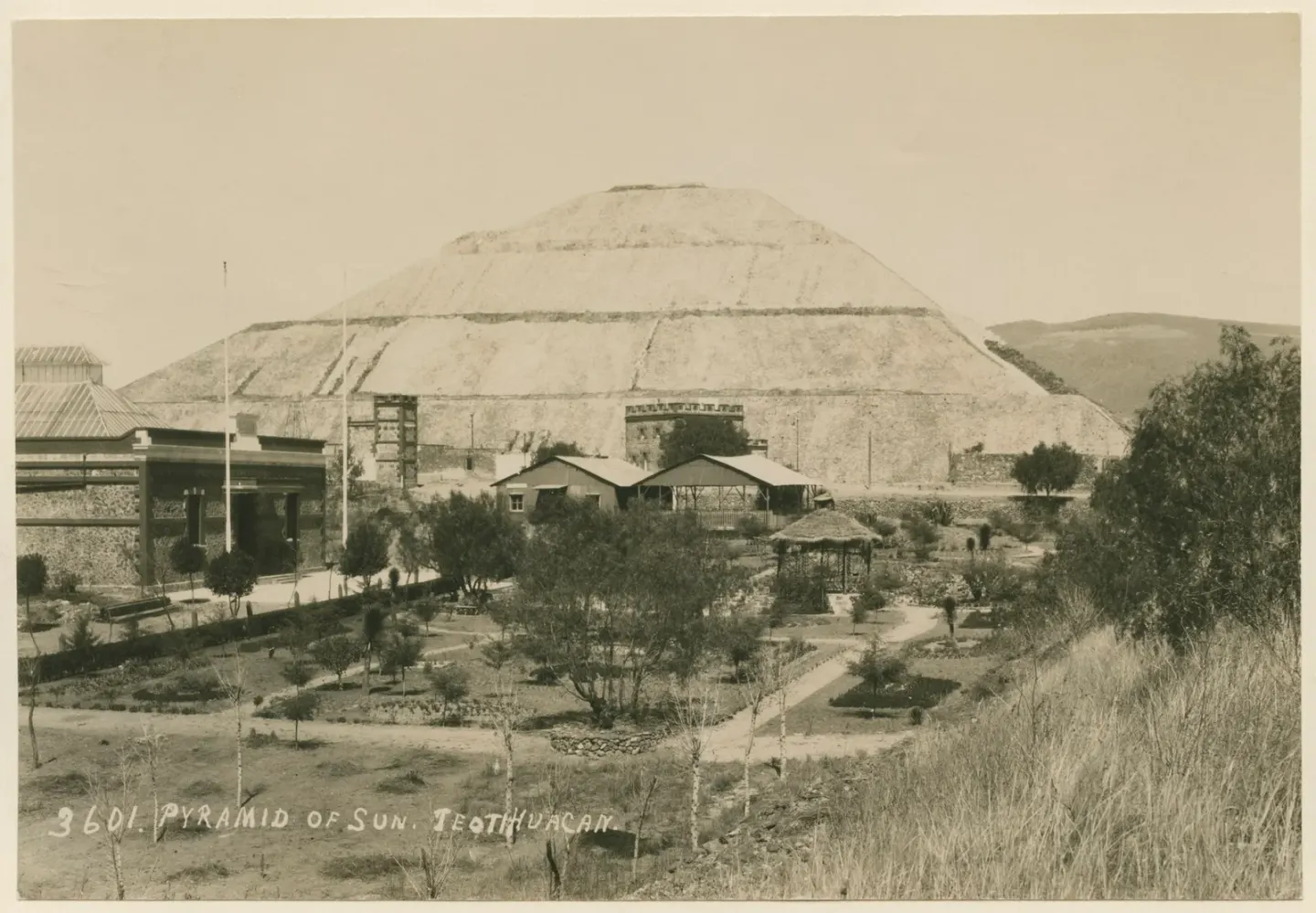
The Pyramid of the Sun at Teotihuacan, around 1900, before its steps were restored · Photo by Charles Betts Waite, c. 1900 / Etnografiska museet, Stockholm · Wikimedia Commons (public domain)
Here, public architecture catches the eye first. Public architecture is a building constructed on a large scale for use or reverence by the entire community rather than a single household. Along a wide avenue stretching north and south, massive stone temples such as the Pyramid of the Sun and the Pyramid of the Moon stand in a row (OpenStax World History Volume 1 8.2). Beneath the Feathered Serpent Pyramid, built around 200 CE, a mass grave of human sacrificial victims was found. A researcher who excavated and interpreted this suggests that this pyramid commemorated the inauguration of rulers governing through force on behalf of the gods (DOI: 10.1017/cbo9780511489563). Noting that the view that this city was led by a single powerful family has been widely accepted, yet pointing out that there is also much data indicating it was ruled together by multiple rulers, a research team showed through a mathematical model that such joint rule could function in principle. A model only shows that something is possible, not that it actually happened (DOI: 10.1371/journal.pone.0109966). There is also an interpretation that the cities and states of central Mexico grew alongside long-standing religious traditions (DOI: 10.1093/acprof:oso/9780190251062.001.0001).
Teotihuacán had a hinterland as well. Around 200 CE, the Teotihuacán state expanded into central Mexico, creating a vast hinterland to feed the large city (DOI: 10.1080/00438243.1973.9979706).
The big city was also a place where many children died. When bones recovered from a residential compound in Teotihuacán were analyzed, it turned out that many children died and people's lifespans were comparatively short. That pattern was fundamentally similar to pre-industrial Old World cities and different from other non-urban groups in North America (DOI: 10.1525/aa.1985.87.3.02a00010). The debate over whether farming made people healthier is covered by another article in this field.
States Alongside Cities, or Apart
Now for the last line of the bill. Who comes to collect if you do not pay the bill? The state, as defined in Uruk, is the answer. Mesopotamia saw a shape where a single city became a single country. A city-state was a political form in which a single city was itself a single country. The cities of Sumer constantly fought one another over the surrounding farmland and water, and rulers wrote laws on clay tablets. The era of independent city-states ended around 2300 BCE (OpenStax World History Volume 1 3.2). Around that time, Sargon of Akkad conquered the cities of Sumer and the rest of Mesopotamia, placing them under the rule of a single person (OpenStax World History Volume 1 3.2; OpenStax World History Volume 1 4.1). The story after that continues in the installment on empires.
Reviewing the places we saw in this article through a single bill, it looks like this. At Çatalhöyük, each house kept its own granary and shared food through feasts. In Triphylia, a huge number of people gathered, but no single settlement lasted longer than 150 years, and even though some authors think there were no class differences, it is hard to say for sure just how equal they were. In the cities of Sumer, taxes and wages were written on clay tablets, and laws were written down as well. In the Indus, drainage systems and units of weight were uniform, but traces of a royal palace are not clear. In Teotihuacan, the state expanded its hinterland, but whether that state was led by a single ruler or jointly by many remains under dispute.
Placed side by side, it sums up this way. Large villages did not automatically become cities, cities did not always leave clear traces of kings and palaces, and states sometimes appeared alongside cities or remained invisible even when cities were present. Therefore, it is difficult to read cities and states as steps climbed one by one on a ladder of progress.
The bill analogy has two limitations. First, the direction in which power flows is backward. In an apartment building, residents elect those who manage the place, but in ancient states, the ruling side—such as priests and kings—commanded obedience from those who followed. The followers hoped for protection and paid food and taxes in return, but the side that commanded and the side that followed were divided from the beginning (OpenStax World History Volume 1 3.1). There are authors who view Uruk as having moved toward coercive state administration (DOI: 10.4324/9781315630731-24), and excavators who read Teotihuacan's rulers as having governed by force (DOI: 10.1017/cbo9780511489563). Ancient states were not governing bodies elected by residents, and power flowed from the ruling side to the following side. Also, today's bills arrive from an already established administrative system, but in ancient cities, how that system came to be was precisely the question, and the answer differed from place to place. There are places like the Indus where we still do not know who wrote the bill.
Where to Read Next
The health of people who lived in cities is explored further in "Did Farming Make Us Sicker? Reading the Marks Left on Bone". The tooth analysis method that read the Harappan migrants can be found in "What Bones Tell — One Person's Diary, Split Between Teeth and Bone", and the method that read the family ties of Çatalhöyük is in "What Genes Can Tell Us — An Old Book Copied Down the Generations". How large cities come to an end can be followed in "Did Drought Bring Down the Maya? — Setting the Record of the Weather Against the Record of the Cities" and "Did the Bronze Age World Collapse All at Once? — What Ended and What Carried On". How states gathered human labor is covered by "Did Slaves Build the Pyramids? — A Workers' Town, Bones, a Papyrus, and a Vanished River Branch". Records on clay tablets are continued in the installment on writing in this series, vast realms beyond city-states in the installment on empires, and the roads connecting cities in the installment on trade routes.
Source Papers
- "World History, Volume 1: to 1500 — 2.3 The Neolithic Revolution" (2023) — OpenStax World History Volume 1 2.3 — Agriculture began independently in multiple regions starting around 12,000 years ago, and many hunter-gatherer societies chose not to adopt it.
- "World History, Volume 1: to 1500 — 3.1 Early Civilizations" (2023) — OpenStax World History Volume 1 3.1 — The division of labor is a core feature of early civilizations; Çatalhöyük is a Neolithic city, early urban populations reached up to 6,000, priests and kings issued commands of obedience, and early civilizations arose in Mexico, Peru, China, the Indus Valley, Iraq, and Egypt.
- "World History, Volume 1: to 1500 — 3.2 Ancient Mesopotamia" (2023) — OpenStax World History Volume 1 3.2 — Cities in southern Mesopotamia in the fourth millennium BC, redistribution of goods by temples and royal palaces alongside scribal record-keeping, rulers' legal records, inter-city wars over agricultural land and water, and the end of the independent city-state era around 2300 BC.
- "World History, Volume 1: to 1500 — 4.1 From Old Babylon to the Medes" (2023) — OpenStax World History Volume 1 4.1 — Sargon of Akkad established the first empire of Mesopotamia around 2300 BC (cited here without the word "empire").
- "World History, Volume 1: to 1500 — 3.4 The Indus Valley Civilization" (2023) — OpenStax World History Volume 1 3.4 — The Indus civilization around 2800–1800 BC, with a political organization not yet fully understood, a theory of central authority based on neat street layouts, the presumed use of citadels, and an undeciphered script.
- "World History, Volume 1: to 1500 — 8.2 Early Cultures and Civilizations in the Americas" (2023) — OpenStax World History Volume 1 8.2 — The North-South Avenue and the Pyramids of the Sun and the Moon in Teotihuacan.
- "Religion in the Emergence of Civilization: Çatalhöyük as a Case Study" (2010) — DOI: 10.1017/cbo9780511761416 — An interdisciplinary study introducing Çatalhöyük as a 9,000-year-old settlement in central Türkiye.
- "'Always momentary, fluid and flexible': towards a reflexive excavation methodology" (1997) — DOI: 10.1017/s0003598x00085410 — Çatalhöyük: 21 hectares, densely packed rooms accessed via roofs, and burials beneath floors.
- "Agricultural origins on the Anatolian plateau" (2018) — DOI: 10.1073/pnas.1800163115 — Foragers at Bozönkülu adopted cultivation in the mid-ninth millennium BC, low-level food production continued for centuries, and some communities declined cultivation; this connects to the eastern mound of Çatalhöyük from 7100 BC onward.
- "Private pantries and celebrated surplus: storing and sharing food at Neolithic Çatalhöyük, Central Anatolia" (2009) — DOI: 10.1017/s0003598x00098896 — Individual houses kept their own grain in storage bins, and aurochs heads and horns at entrances served as memories of feasts.
- "Daily Practice and Social Memory at Çatalhöyük" (2004) — DOI: 10.2307/4128346 — Interpreting the formation of "clustered villages" in the Neolithic Near East through repeated household practices and social memory.
- "Variable kinship patterns in Neolithic Anatolia revealed by ancient genomes" (2021) — DOI: 10.1016/j.cub.2021.03.050 — Close genetic relatives were rare among children buried inside and outside houses at Çatalhöyük and Barcın.
- "Pottery production, early urbanization and the Uruk phenomenon at Tell Brak in Upper Mesopotamia" (2025) — DOI: 10.1007/s12520-025-02290-8 — Urbanization at Tell Brak in the late fifth to early fourth millennium BC, involving the joint coordination of multiple production units and raw material procurement.
- "The Uruk Phenomenon" (2020) — DOI: 10.1093/oso/9780190687854.003.0004 — The center of urbanization and state formation during the Uruk period (roughly 3800–3300 BC); clear evidence of single-person rule is absent, and political structures were intertwined with religion.
- "Morphodynamic Foundations of Sumer" (2025) — DOI: 10.1371/journal.pone.0329084 — A hypothesis that tidal irrigation may have driven high-yield agriculture and urbanization; the author notes that economic mechanisms can only be speculative.
- "A Central Asian Village at the Dawn of Civilization: Excavations at Anau, Turkmenistan" (2003) — DOI: 10.9783/9781934536230 — An interpretation arguing that Central Asia made a substantive contribution to the origins of Old World urbanization, challenging the theory of Mesopotamian-centered diffusion.
- "Trypillia and Uruk" (2016) — DOI: 10.4324/9781315630731-24 — A comparison between Trypillian mega-sites (roughly 4000–3600 BC, individual sites lasting under 150 years) and Uruk; one side featured a classless life, while the other featured a stratified society and coercive state administration.
- "Infection, Disease, and Biosocial Processes at the End of the Indus Civilization" (2013) — DOI: 10.1371/journal.pone.0084814 — Planned cities, sanitation, standard weights and measures, and a 1-million-square-kilometer sphere of influence in the late peak period; climate, economic, and social changes contributed jointly to the dissolution, followed by increased infections in post-urban Harappa and the vulnerability of marginalized groups.
- "Killing the Priest-King: Addressing Egalitarianism in the Indus Civilization" (2020) — DOI: 10.1007/s10814-020-09147-9 — An argument that the Indus civilization lacks clear evidence of lavish tombs, personal monuments, large temples, or royal palaces, and that a ruling class is not a prerequisite for social complexity.
- "Evidence for Patterns of Selective Urban Migration in the Greater Indus Valley (2600-1900 BC): A Lead and Strontium Isotope Mortuary Analysis" (2015) — DOI: 10.1371/journal.pone.0123103 — Nearly all individuals in the Harappa and Farmana cemeteries were first-generation migrants who arrived from the hinterlands during childhood; the author notes that further confirmation is needed.
- "Landscapes of Urbanization and De-Urbanization: A Large-Scale Approach to Investigating the Indus Civilization's Settlement Distributions in Northwest India" (2018) — DOI: 10.1080/00934690.2018.1464332 — Settlement distributions shifted to a dispersed pattern, and settlement density may have increased in parts of northwest India after around 1900 BC.
- "Ancient Teotihuacan: Early Urbanism in Central Mexico" (2015) — DOI: 10.1017/cbo9781139046817 — Founded around 150 BC and collapsed around AD 600, this was the largest city in the Americas prior to the 1400s.
- "The Pre-History of Urban Scaling" (2014) — DOI: 10.1371/journal.pone.0087902 — Settlement systems in the Basin of Mexico evolved independently of the Old World (cited here only for that point, without addressing scaling laws).
- "Human Sacrifice, Militarism, and Rulership: Materialization of State Ideology at the Feathered Serpent Pyramid, Teotihuacan" (2005) — DOI: 10.1017/cbo9780511489563 — The Feathered Serpent Pyramid from around AD 200 features mass sacrificial burials, interpreted as commemorating the accession of a ruler who governed through force on behalf of the gods.
- "Can Government Be Self-Organized? A Mathematical Model of the Collective Social Organization of Ancient Teotihuacan, Central Mexico" (2014) — DOI: 10.1371/journal.pone.0109966 — Data pointing to a co-ruling government and an egalitarian artistic ideology; a mathematical model demonstrating that decentralized cooperation is theoretically possible (proof of concept).
- "Urbanization and Religion in Ancient Central Mexico" (2015) — DOI: 10.1093/acprof:oso/9780190251062.001.0001 — An argument that cities and states in central Mexico developed alongside long-standing religious traditions.
- "Teotihuacán regional population administration in Eastern Morelos" (1977) — DOI: 10.1080/00438243.1973.9979706 — Around AD 200, the Teotihuacan state expanded into central Mexico to create a hinterland capable of sustaining a large city.
- "An Estimate of Mortality in a Pre‐Columbian Urban Population" (1985) — DOI: 10.1525/aa.1985.87.3.02a00010 — Bones from the Tlailotacan residential compound: high infant mortality and relatively short lifespans resemble pre-industrial cities of the Old World and differ from non-urban North American groups.
Sources (28)
- World History, Volume 1: to 1500 — 2.3 The Neolithic Revolution
- World History, Volume 1: to 1500 — 3.1 Early Civilizations
- World History, Volume 1: to 1500 — 3.2 Ancient Mesopotamia
- World History, Volume 1: to 1500 — 4.1 From Old Babylon to the Medes
- World History, Volume 1: to 1500 — 3.4 The Indus Valley Civilization
- World History, Volume 1: to 1500 — 8.2 Early Cultures and Civilizations in the Americas
- Religion in the Emergence of Civilization: Çatalhöyük as a Case StudyDOI 10.1017/cbo9780511761416
- 'Always momentary, fluid and flexible': towards a reflexive excavation methodologyDOI 10.1017/s0003598x00085410
- Agricultural origins on the Anatolian plateauDOI 10.1073/pnas.1800163115
- Private pantries and celebrated surplus: storing and sharing food at Neolithic Çatalhöyük, Central AnatoliaDOI 10.1017/s0003598x00098896
- Daily Practice and Social Memory at ÇatalhöyükDOI 10.2307/4128346
- Variable kinship patterns in Neolithic Anatolia revealed by ancient genomesDOI 10.1016/j.cub.2021.03.050
- Pottery production, early urbanization and the Uruk phenomenon at Tell Brak in Upper MesopotamiaDOI 10.1007/s12520-025-02290-8
- The Uruk PhenomenonDOI 10.1093/oso/9780190687854.003.0004
- Morphodynamic Foundations of SumerDOI 10.1371/journal.pone.0329084
- A Central Asian Village at the Dawn of Civilization: Excavations at Anau, TurkmenistanDOI 10.9783/9781934536230
- Trypillia and UrukDOI 10.4324/9781315630731-24
- Infection, Disease, and Biosocial Processes at the End of the Indus CivilizationDOI 10.1371/journal.pone.0084814
- Killing the Priest-King: Addressing Egalitarianism in the Indus CivilizationDOI 10.1007/s10814-020-09147-9
- Evidence for Patterns of Selective Urban Migration in the Greater Indus Valley (2600-1900 BC): A Lead and Strontium Isotope Mortuary AnalysisDOI 10.1371/journal.pone.0123103
- Landscapes of Urbanization and De-Urbanization: A Large-Scale Approach to Investigating the Indus Civilization's Settlement Distributions in Northwest IndiaDOI 10.1080/00934690.2018.1464332
- Ancient Teotihuacan: Early Urbanism in Central MexicoDOI 10.1017/cbo9781139046817
- The Pre-History of Urban ScalingDOI 10.1371/journal.pone.0087902
- Human Sacrifice, Militarism, and Rulership: Materialization of State Ideology at the Feathered Serpent Pyramid, TeotihuacanDOI 10.1017/cbo9780511489563
- Can Government Be Self-Organized? A Mathematical Model of the Collective Social Organization of Ancient Teotihuacan, Central MexicoDOI 10.1371/journal.pone.0109966
- Urbanization and Religion in Ancient Central MexicoDOI 10.1093/acprof:oso/9780190251062.001.0001
- Teotihuacán regional population administration in Eastern MorelosDOI 10.1080/00438243.1973.9979706
- An Estimate of Mortality in a Pre‐Columbian Urban PopulationDOI 10.1525/aa.1985.87.3.02a00010