Paperis Articles
Empire — Many Peoples Bound by Roads, Taxes and the Sword
An empire is a polity in which one center rules many different peoples across a wide territory, usually held together by force. The Mongols, the Inca, Persia, the Ottomans and Rome each combined roads, taxes, watchful officials and ways of handling difference in their own manner, and the reasons empires split and fell do not reduce to one.
Your field's papers, as audio
Pick your fields and journals — Paperis summarizes the key papers and turns them into audio. Listen on your commute.
Start Paperis free →Empire — Many Peoples Bound by Roads, Taxes and the Sword
Up to Half of All Humanity Inside Two Countries
2,000 years ago, up to half of all people on Earth lived inside just two countries. To the west lay the Roman Empire, which encircled the Mediterranean, and to the east, the Han Empire, centered on the plains of northern China. The two countries were roughly comparable in area and population, and their periods largely overlapped (DOI: 10.1093/oso/9780195336900.001.0001).
The people living within them were not a single group. They spoke different languages, served different gods, and lived by different customs. Centuries before that, in the Persian Empire, some twenty-four peoples with different languages, gods, and customs lived under a single king (DOI: 10.1017/cbo9781139087551). With what did a power like Han bind such different people together?
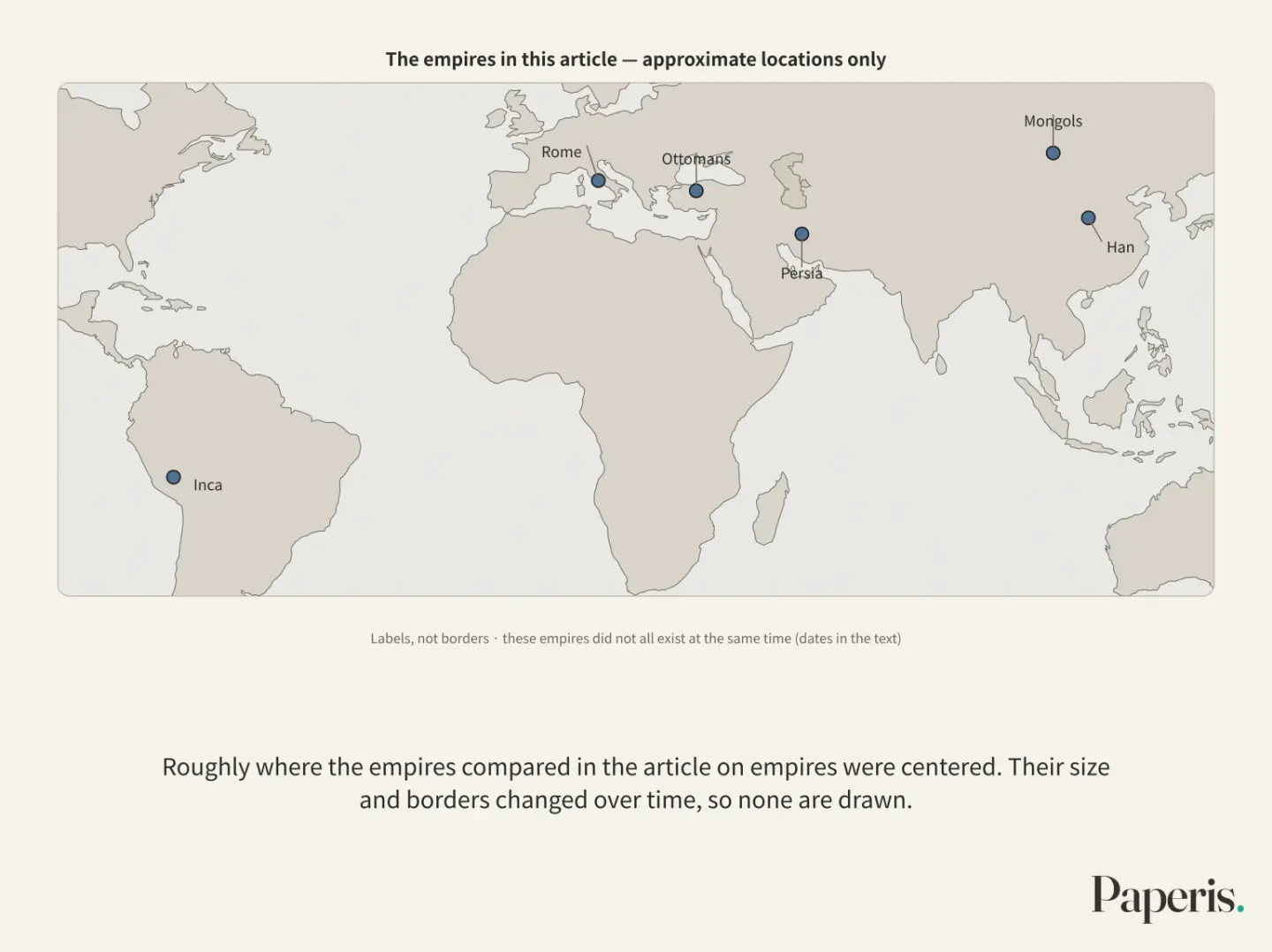
Taking up that question, this article looks at empires across multiple continents together. Persia in West Asia, the Mongols who rose from the steppe, the Inca of the Andes, and the Ottomans of Anatolia and the Balkans appear, while Rome and Han are compared side by side. In one section, we look at Goryeo, which existed alongside the Mongol Empire.
What Is an Empire?
An empire is a political entity in which a single center rules over multiple distinct ethnic groups and a vast territory, usually bound together by force. A vast territory alone does not make an empire. What separates an empire is that the rulers and the ruled are different, and they are bound together without that difference disappearing. Comparing empires across multiple continents for more than 2,000 years, historians Jane Burbank and Frederick Cooper focus on the fact that empires ruled by accepting, creating, and utilizing differences among people. The threads the two point to were force and ambition (DOI: 10.1515/9781400834709).
A state is an organization that rules over people, collects taxes, and uses law and force. Empires also collect taxes and use force. The difference is that the people being ruled were not a single group from the beginning.
An empire is a very ancient framework. Textbooks point to the state established by Sargon of Akkad around 2300 BCE in Mesopotamia, present-day Iraq, as the region's first empire. That empire lasted for about 150 years, but several subsequent powers imitated Sargon's methods (OpenStax World History Volume 1 4.1). A study comparing ancient empires notes that the first known empires took shape in that region from around 2350 BCE (DOI: 10.1093/oso/9780195371581.001.0001). The dates vary slightly depending on what is counted as the first empire.
When looking at an empire, the first question to ask is not how vast it was, but what bound different people together.
The Road: News That Traveled Roughly 300 Kilometers a Day
In the 15th-century Andean Inca Empire, armies moved quickly along roads to suppress rebellions, and local goods gathered in the empire's storehouses along those same routes. Heavily expanded during the Inca period, those roads may have reached 25,000 miles, or 40,000 kilometers, at their largest, becoming stone staircases in the mountains and rope bridges across canyons (OpenStax World History Volume 1 8.3).
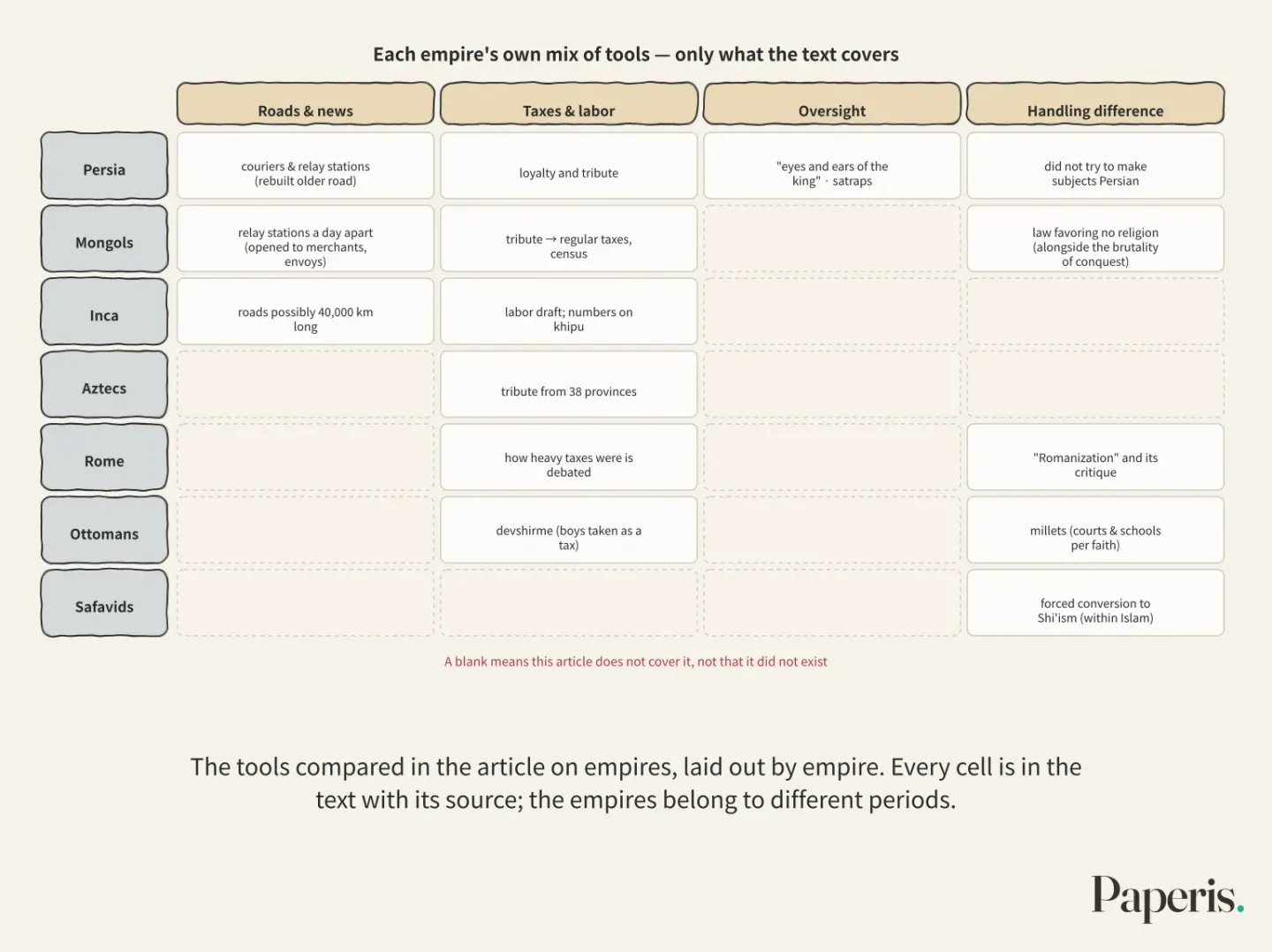
News traveled along the road, too. A relay station is a place placed at regular intervals along a main road so that messengers carrying news can change horses and rest. At the end of the 6th century BCE in Persia, couriers changed horses roughly every 30 kilometers, allowing the king's letters to travel roughly 300 kilometers a day. That road network, too, had been adapted from the roads of the earlier Neo-Assyrian Empire (OpenStax World History Volume 1 4.3). In the 13th-century Mongol Empire, the Great Khan Ogedei allowed merchants and ambassadors to use the relay stations, too. Those relay stations had been set up at daily intervals by his father, Genghis Khan, for military communication (OpenStax World History Volume 1 14.2).
An edited volume on the roads of the premodern world brings together the main roads of Achaemenid Persia, Rome, the Inca, and classical China in a single book (DOI: 10.1002/9781118244326). An empire's main roads were also conduits through which letters from the center reached the periphery, and goods from the periphery traveled to the storehouses of the center (OpenStax World History Volume 1 4.3; OpenStax World History Volume 1 8.3). Building those roads required the bodies of the subjects who were ruled.
Taxes and People: Who Collects and Who Watches
Tribute is goods or money that the ruled party gives to the center as a sign of submission. In the 13th century, the Mongols initially collected tribute from the lands they conquered. Ögedei, the son of Genghis Khan, adopted the plan of the Khitan-born official Yelü Chucai and replaced tribute with taxes collected repeatedly at set times. Möngke, the grandson of Genghis Khan who became the Great Khan, ordered a census to measure not only taxes but also the resources held by land and people (OpenStax World History Volume 1 14.2). Tribute gathered on an as-needed basis turned into an obligation paid at regular times.
In the 15th and 16th centuries, the Aztec Empire in central Mexico levied tribute on thirty-eight provinces. What was offered was usually determined by what that land produced, and the Gulf Coast of Mexico, where rubber was produced, had to offer 16,000 rubber balls. More harsh conditions were sometimes attached to regions that had resisted and been incorporated (OpenStax World History Volume 1 8.3).
Who watched the collectors was also a problem. The Persian king sent officials called the "King's Eyes and Ears" to the provinces to inspect the governors' ledgers, and if the reports were bad, he replaced or punished the governors. A satrap is a governor who managed and ruled over one of the jurisdictions divided by the Persian king. Under Darius I, there were twenty such districts, and the governors had to prevent rebellions and send up the prescribed taxes (OpenStax World History Volume 1 4.3).
Taxes were also paid with the body. The people of the Inca paid taxes by building roads and bridges or by joining the army (OpenStax World History Volume 1 8.3). Corvée labor is labor where the state imposes an obligation on the people to work for a set period and calls them out. The roads and bridges expanded during Inca times were built by people called out in this way. The Inca had no writing, but calculations were kept on strings. The khipu is an Incan recording tool that used various strands of strings with different colors and knots to record numbers and contents. Numbers such as population and taxes were recorded on khipu (OpenStax World History Volume 1 8.3). Roads, labor, storehouses, and string calculations interlocked within a single system.
There has been a long debate over the taxes of the Roman Empire. The historian Keith Hopkins put forward a model proposing that money collected from heavily taxed provinces such as Syria, Asia, and Hispania was spent in the city of Rome and the border regions, and since the taxed side had to sell goods to earn that money back, taxes stimulated trade. A paper published in 2002 summarizes that this model has been criticized in various directions over the past 20 years. There are counterarguments that taxes were mostly paid in kind rather than money, that even if the state received money there is no guarantee the peasants paid in money, and that taxes were so heavy that many peasants abandoned their land (DOI: 10.1163/9789004401624_007). A paper studying Roman merchants looks at taxes from a different place. It accepts as persuasive the argument of historian Walter Scheidel that for the growth of Roman trade, the imperial political framework—such as long-term internal peace, low taxes, Latin and Greek acting as common languages, and Roman law—was more important than technology (DOI: 10.2143/as.41.0.2129571). The side asking about the weight of taxes borne by peasants and the side asking about the imperial framework that lowered merchants' business costs look at the same taxes from different places.
How They Handled Difference
The law established by the 13th-century Mongol leader Chinggis Khan favored no single religion, and forbade discriminating or showing favoritism on religious grounds. Although Chinggis Khan himself worshipped Tengri, the god revered by various peoples of Central Asia, he exempted all religious leaders from taxes and forced labor (OpenStax World History Volume 1 14.2). However, the peace and justice put forward by the Mongols were only for those who accepted their rule. Those who resisted were met with unhesitating cruelty (OpenStax World History Volume 1 14.2). Burbank and Cooper cite the Mongols and the Ottomans as examples of practical toleration that combined the politics of religious protection and loyalty (DOI: 10.1515/9781400834709).
Textbooks note that what the Persian kings wanted from those they ruled was loyalty and tribute, and that they did not try to turn those people into Persians (OpenStax World History Volume 1 4.3). One research work suggests that the Persian Empire created a framework flexible enough to fit the needs of various peoples, and that each region's response to that framework differed. The same book examines the tension throughout the empire where central authority and local autonomy pulled against each other (DOI: 10.1017/cbo9781139087551).
Rising in Anatolia in the late 13th century and capturing Constantinople in 1453, the Ottoman Empire ruled people of different languages and religions for nearly 700 years (OpenStax World History Volume 2 4.2). A millet was a unit through which the Ottoman Empire allowed non-Muslim religious communities to run their own courts and schools. Orthodox Christian, Armenian Christian, and Jewish communities formed millets first, and other communities followed. Therefore, people who did not deal directly with the state could live without knowing Turkish, and children mostly learned in their local languages (OpenStax World History Volume 2 4.2).
The same empire took children with its other hand. Devshirme was a system in which the Ottoman Empire took boys from Christian villages as slaves, converted them to Islam, and trained them as the sultan's soldiers and administrators. The targets were mainly villages in the Balkans and the Caucasus. The children taken were between eight and ten years old, and the Ottomans regarded this as a form of tax paid by Christian lands. In theory, the children never saw their families again, and the system raised them to be loyal to the sultan instead of their families (OpenStax World History Volume 2 4.2).
There was also an empire that tried to erase differences within the same Islam by the sword. The Safavid Empire, which arose in Iran in the early 16th century, established Shiism as the state religion in Iran—where most of the population was Sunni—and ordered conversion. Historians generally view that coercion and force were used in this conversion. Sunni scholars were left with a choice of conversion or exile, and Sunnis who stayed without converting could face death. The Safavid rulers were generally more lenient toward non-Muslim subjects than toward Sunnis, allowing Christians in various places to build churches and maintain their customs. However, Armenian and Georgian Christians in the Caucasus, suspected of rebellion, were sometimes enslaved or driven away to other places (OpenStax World History Volume 2 4.3).
Regarding Rome, the explanation of "Romanization" was used for a long time. Romanization is an explanation holding that people in lands ruled by Rome gradually accepted Roman-style life and culture. One archaeologist criticizes this explanation for viewing Rome's rule too favorably, solely as spreading civilization and assimilating peoples. Based on his own excavations in Britannia, Jordan, and North Africa, he argues that the experience of undergoing the Roman Empire varied greatly from person to person. What he covers includes walls and violence, censuses and taxes, and mines and pollution. Under the power of the empire, he argues, some lives were shaken, some improved, and some collapsed (DOI: 10.23943/princeton/9780691160177.001.0001).
The empires seen here mostly ruled while leaving differences intact, but even within a single empire, they combined lenient protection with forced extraction, and some empires even tried to forcibly erase sectarian differences.
Goryeo Alongside the Mongol Empire
Roughly one year after the Mongol army invaded Goryeo in 1231, a study estimates that the Mongols sent 19 documents to Goryeo. Those documents demanded not only tribute but also hostages, troop mobilization, and household censuses (KCI ART002054986). The tallies of tribute, people, and population that we saw earlier were placed before a single country all at once. Goryeo treated the Mongols as a "great power" and tried to persuade them so that it could refuse or avoid fulfilling those demands, but the Mongols, who stood outside the Chinese diplomatic tradition, did not accept that logic (KCI ART002054986).
A buma is a person who marries an imperial princess and becomes an imperial son-in-law, a position that also served as a rank within the Mongol Empire. Seen from the outside, Goryeo in the Mongol era was a country that maintained its own ancestral altars, but seen from the inside, it held a dual status: as the Mongol princess married into it, the King of Goryeo became a son-in-law to the Mongol imperial family. Therefore, the relationship between Mongolia and Goryeo differed from the relationships maintained with previous Chinese dynasties, and political structures such as government offices had to follow the Mongol Empire (KCI ART001734163).
The ties bound by marriage varied with each counterpart. According to a tentative study comparing Goryeo with the Uyghurs, Armenia, and Tibet, the marital relationship with the Uyghurs was shaken by political shifts within Mongolia, Armenia mostly stopped at a single marriage, and Tibet formed a complex relationship based on religion, but the marriage did not last long. Goryeo maintained its marital relationship relatively long and stably after the 1270s (DOI: 10.17292/kams.2025.82.161). A single center used different ties for each periphery.
The roads were connected, too. Goryeo envoys traveled the 1,730 kilometers between Gaegyeong and Dadu, the capital of the Mongol Empire, riding the relay station network laid out by the Mongols. Envoys traveling on official business reached their destination in as short as ten days, and at their fastest, they covered 173 kilometers a day. Comparing regular envoy delegations of a similar scale, the average speed was two to three times faster than in the Joseon dynasty, and a study attributes this speed to Mongolia's well-organized relay station network (DOI: 10.31218/TRKH.2019.06.134.69).
The way this period is read is also changing. In Korean history, a two-pronged framework of Mongol interference and Goryeo resistance has long read this period. One study views that the relationship with Goryeo imposed constraints and burdens while simultaneously opening new opportunities for the people of Goryeo, and rereads the lives of women, eunuchs, monks, and scholars who went to Mongol lands—whether of their own accord or coerced—from their own standpoints (DOI: 10.25024/review.2024.27.2.005). In seeking to view the empire from the experience of the ruled side, it points in the same direction as the Roman study in the previous section.
Why They Splinter and Fall
When the Great Khan Möngke died in 1259, the Mongol Empire plunged into civil war (OpenStax World History Volume 1 14.3). Mongolia had a specific setting for deciding the next leader. The Kurultai was an assembly where people loyal to the Mongol leadership gathered to confirm whether to accept a major change, and Genghis Khan required that future Great Khans also be chosen solely through this meeting. The final Kurultai after Möngke’s death failed, and the empire fractured for good. Khanates are the countries ruled individually by the descendants of Genghis Khan after the Mongol Empire split. By the time Kublai died in 1294, the four khanates were effectively different nations (OpenStax World History Volume 1 14.2). Rulers of three of the four khanates had converted to Islam, but the shared religion did not stop them from fighting one another (OpenStax World History Volume 1 14.3). Textbooks explain the split through several strands. The lust for power among Genghis Khan’s grandsons is one, the disappearance of the force that had kept rivals in check once conquest stopped is another, and a division over whether to live settled lives or maintain steppe traditions was yet another (OpenStax World History Volume 1 14.2; OpenStax World History Volume 1 14.3).
Explanations that seek the causes of the Mongol rise in the weather vary. An explanation that drought had been a factor prompting conquest had been put forward first, but fine-grained humidity records from that era did not exist (DOI: 10.1073/pnas.1318677111). A study that retraced 1,112 years of humidity using Siberian pine tree rings in central Mongolia notes that around the time Genghis Khan rose, that land experienced 15 consecutive years that were wetter than average, which was unprecedented among the 1,112 years. The researchers suggest that this weather enriched the grasslands, aiding the emergence of Mongol political and military power (DOI: 10.1073/pnas.1318677111). The word the authors chose is "suggest," and it does not mean that a single weather pattern created an empire.
The year 476 is often cited as the end of the Western Roman Empire. It is the year the Germanic general Odoacer forced the emperor Romulus Augustulus to step down. Textbooks add that this date, too, may be arbitrary (OpenStax World History Volume 1 13.1). The Byzantine Empire in the east lasted until it fell to the Ottomans in 1453 (OpenStax World History Volume 1 17.1). Late antiquity is a term historians use to group roughly 150 to 750, a name intended to view this era not just as the decline and fall of Rome, but as a period of vibrant transformation (OpenStax World History Volume 1 10.2).
A study comparing Rome and Han China suggests that the two empires shook in strikingly similar ways. Both split into two parts. One side held the original center but was more exposed to outside forces (Rome’s west, China’s north), while the other was the half that preserved tradition (Rome’s east, China’s south) (DOI: 10.1093/oso/9780195336900.001.0001).
Differences that once bound an empire together could also become the cracks that split it. Entering the 19th century, the Ottoman Empire weakened as it failed to respond to the nationalism of its various ethnic groups. Greece gained independence in 1830, and Serbia, Romania, and Bulgaria broke away in the 1870s (OpenStax World History Volume 2 11.2). From the outside, Russia steadily chipped away at Ottoman power in the Balkans (OpenStax World History Volume 2 4.2). Looking far earlier at the collapse of multiple kingdoms in the eastern Mediterranean over the span of a few decades in the 12th century BCE, one archaeologist attributes the cause to a web of intertwined failures involving invasions, rebellions, earthquakes, droughts, and severed trade routes (DOI: 10.1515/9781400849987).
The reasons empires rise and fall do not converge on a single cause. Succession struggles, weather, internal ethnic issues, and external pressures tangled together differently in each empire.
What Remained After the Collapse
Latin remained the language of the educated even after the political authority of the Western Roman Empire vanished, and the languages of Germanic peoples came to be written in the Latin alphabet, much like English (OpenStax World History Volume 1 13.1). What remained was the writing of those who had ruled, and the newly arrived people adapted it to fit their own speech.
The Mongol Empire enlarged the size and raised the status of "China" beyond what the preceding Song and Jin dynasties had done, and the Ming dynasty that followed tried to inherit this wholesale (DOI: 10.38080/crh.2017.11.121.77). One book studying international relations rewrites Eurasian history as a space where world orders originating from the Mongol Empire overlapped and continued in succession (DOI: 10.1017/9781108975377).
The Inca road remained, too. The Inca road was inscribed as a World Heritage site under the name "Qhapaq Ñan," and in Peru, new ways for communities along the road to participate in preservation policies are being forged (DOI: 10.1017/s0940739124000274).
Even when empires collapse, they leave behind roads, writing, and the sizes of countries. Those who widened the Inca road were the common people who had been summoned, and those who wrote their own languages with that script were the newly arrived peoples. When looking at an empire, we must ask together what bound it together, how differences were handled, and what remained after the ties came undone.
Where to Look Further
How far the claims that trace the fall of the Western Roman Empire to weather and disease hold true is examined in "Did Nature Bring Down the Western Roman Empire? — What Lead in Ice and Bacteria in Bones Can and Cannot Tell Us". Whether the kingdoms of the 12th century BCE Eastern Mediterranean truly collapsed all at once is covered by "Did the Bronze Age World Collapse All at Once? — What Ended and What Carried On". The story of how states called upon the labor of their people to build large public works is followed in Egypt by "Did Slaves Build the Pyramids? — A Workers' Town, Bones, a Papyrus, and a Vanished River Branch".
How states that preceded empires came to be continues in "Cities and States — Where the First Maintenance Bills Arrived", and how disease spread along the paths ruled by the Mongols continues in "Trade Routes — A Transit Map Where Goods Were Handed On at Every Transfer". How records for counting and administration began can be seen in "Writing — How Grain Ledgers Came to Hold Songs". Whether Rome's taxes were heavy is a question that has sparked a long-running debate, and explanations also diverge on how much the weather contributed to the rise of the Mongols.
Source Papers
- "World History, Volume 1: to 1500 — 4.3 The Persian Empire" (2023) — OpenStax World History Volume 1 4.3 — Darius stationed satraps in twenty districts and monitored them with the "King's Eyes and Ears," couriers on the Royal Road (which was repaired from the Assyrian road) changed horses roughly every 20 miles to travel about 200 miles a day, and the kings demanded loyalty and tribute but did not try to turn different peoples into Persians.
- "World History, Volume 1: to 1500 — 4.1 From Old Babylon to the Medes" (2023) — OpenStax World History Volume 1 4.1 — Around 2300 BCE, Sargon of Akkad established Mesopotamia's first empire, which lasted roughly 150 years, but its model was followed by later powers.
- "World History, Volume 1: to 1500 — 14.2 Chinggis Khan and the Early Mongol Empire" (2023) — OpenStax World History Volume 1 14.2 — The kurultai, laws favoring no single religion and tax exemptions for religious leaders, Ogedei opening day-distance postal relay stations to merchants and envoys, Yelü Chucai's regular taxes, Mongke's census, the dual face of peace and cruelty, the failure of the final kurultai, the disappearance of the force that suppressed rivals once conquest stopped, the split between settlement and nomadism, and four khanates by roughly 1294.
- "World History, Volume 1: to 1500 — 14.3 The Mongol Empire Fragments" (2023) — OpenStax World History Volume 1 14.3 — Civil war after Mongke's death in 1259, the power hunger of his grandsons, and three khanates converting to Islam though the same religion did not stop them from fighting.
- "World History, Volume 1: to 1500 — 8.3 The Age of Empires in the Americas" (2023) — OpenStax World History Volume 1 8.3 — The tribute of the Aztec's 38 provinces (mostly based on local products, with harsh conditions for resisting regions), the Inca labor tax, population and taxes recorded in quipu, roads and bridges that may have spanned up to 25,000 miles, and armies and regional goods traveling along those roads.
- "World History, Volume 2: from 1400 — 4.2 The Ottoman Empire" (2022) — OpenStax World History Volume 2 4.2 — Ruling multiethnic, multilingual, and multireligious populations for nearly 700 years, the millet system for non-Muslims (self-governing courts and schools, which other communities also followed), Turkish used only when dealing with the state, the devshirme system (taking Christian boys as slaves to convert and train them, theoretically never seeing their families again), and Russia chipping away at Ottoman control in the Balkans.
- "World History, Volume 2: from 1400 — 4.3 The Safavid Empire" (2022) — OpenStax World History Volume 2 4.3 — Making Shia Islam the state religion in Iran where a majority of the population was Sunni and forcing conversion through coercion and military force, Sunni scholars facing conversion or exile, Sunnis who refused to stay meeting death, and non-Muslims being treated generally more leniently than Sunnis except for Caucasian Christians who were enslaved and expelled.
- "World History, Volume 1: to 1500 — 13.1 The Post-Roman West in the Early Middle Ages" (2023) — OpenStax World History Volume 1 13.1 — Traditionally setting 476 as the end though it can be arbitrary, and Latin and the Latin alphabet remaining.
- "World History, Volume 1: to 1500 — 17.1 The Ottomans and the Mongols" (2023) — OpenStax World History Volume 1 17.1 — The Byzantine Empire fell in 1453.
- "World History, Volume 1: to 1500 — 10.2 The Byzantine Empire and Persia" (2023) — OpenStax World History Volume 1 10.2 — Historians group roughly 150 to 750 into late antiquity, viewing it as a period of vibrant change rather than simple decline and fall.
- "World History, Volume 2: from 1400 — 11.2 The Collapse of the Ottomans and the Coming of War" (2022) — OpenStax World History Volume 2 11.2 — Declining as it failed to respond to the nationalism of minority groups in the 1800s, with Greece (1830), Serbia, Romania, and Bulgaria (1870s) breaking away.
- "Empires in World History: Power and the Politics of Difference" (2011) — DOI: 10.1515/9781400834709 — Empires are states of vast territories and peoples bound by power and ambition, governed by accommodating, creating, and manipulating differences among populations, alongside the practical tolerance of the Mongols and Ottomans.
- "The Dynamics of Ancient Empires: State Power from Assyria to Byzantium" (2009) — DOI: 10.1093/oso/9780195371581.001.0001 — The first known empires formed in Mesopotamia starting around 2350 BCE.
- "Rome and China: Comparative Perspectives on Ancient World Empires" (2009) — DOI: 10.1093/oso/9780195336900.001.0001 — Up to half of humanity 2,000 years ago lived within the two systems of Rome and Han China, and both experienced similar tremors splitting them in two.
- "Highways, Byways, and Road Systems in the Pre‐Modern World" (2012) — DOI: 10.1002/9781118244326 — An edited volume bringing together road systems of the pre-modern world such as Achaemenid, Roman, Inca, and classical Chinese civilizations (table of contents checked only).
- "TAX TRANSFERS IN THE ROMAN EMPIRE" (2002) — DOI: 10.1163/9789004401624_007 — Hopkins's tax-trade model and critiques emerging over the past 20 years regarding payment in kind, peasant payment methods, and abandonment of farming due to heavy taxes.
- "Partners in Business: Roman Merchants and the Potential Advantages of being a "collegiatus"" (2011) — DOI: 10.2143/as.41.0.2129571 — The thesis, persuasively argued by Scheidel, that political frameworks such as peace, low taxes, a common language, and Roman law were more important than technology for the expansion of Roman trade, with merchant associations also playing a part.
- "Empire, Authority, and Autonomy in Achaemenid Anatolia" (2013) — DOI: 10.1017/cbo9781139087551 — A flexible system placing some two dozen peoples with different languages, gods, and customs under a single authority, with varying responses in each region and a tension between authority and autonomy.
- "Imperialism, Power, and Identity: Experiencing the Roman Empire" (2013) — DOI: 10.23943/princeton/9780691160177.001.0001 — Rejecting the concept of Romanization and showing how the lives of the ruled were shaken, improved, and broken under the empire's power.
- "Pluvials, droughts, the Mongol Empire, and modern Mongolia" (2014) — DOI: 10.1073/pnas.1318677111 — The theory that drought was a factor prompting conquest, though dense humidity data was lacking, with a 1,112-year tree-ring reconstruction suggesting 15 consecutive years of above-average moisture during the time of Chinggis Khan (unprecedented) and grassland productivity favoring the formation of Mongol power.
- "1177 B.C.: The Year Civilization Collapsed" (2014) — DOI: 10.1515/9781400849987 — Explaining the collapse of Late Bronze Age kingdoms as a web of multiple failures involving invasions, rebellions, earthquakes, droughts, and the severing of trade routes.
- "Before the West: The Rise and Fall of Eastern World Orders" (2022) — DOI: 10.1017/9781108975377 — Describing (Eura)sia as a space where world orders originating from the Mongol Empire succeeded one another.
- "The thrive for a new heritage ethos in Peru?: The Qhapaq Ñan's policymaking and the ethics of community participation" (2024) — DOI: 10.1017/s0940739124000274 — The World Heritage listing of the Inca road (Qhapaq Ñan) introducing community participation methods into Peru's cultural heritage policy.
- "고려의 對蒙 대응 논리와 ‘了大國이미지’ ― 1231, 1232년 외교문서를 중심으로 ―" (2015) — KCI ART002054986 — Inferring 19 Mongol documents over about a year demanding tribute, hostages, troop mobilization, and household censuses, with Goryeo attempting persuasion through the tributary logic of treating Mongolia as a "great power" but failing to win acceptance from Mongolia.
- "몽골시대 高麗의 王命" (2012) — KCI ART001734163 — Goryeo held a dual status outwardly as an independent state of ancestral shrines and inwardly as a son-in-law state through imperial princesses, while its official governmental system followed Mongolia.
- "몽골 제국의 ‘주변국’ 통치와 고려의 위상 -통혼 제도를 중심으로 한 비교사적 검토 시론-" (2025) — DOI: 10.17292/kams.2025.82.161 — (A tentative comparative historical review focusing on the marriage alliance system) Comparing Goryeo with the Uighurs, Armenia, and Tibet, Goryeo maintained continuous and stable marriage alliances after the 1270s.
- "고려 사신의 몽골 잠치(站赤) 이용" (2019) — DOI: 10.31218/TRKH.2019.06.134.69 — The Gaegyeong-Dadu distance of 1,730 km, with working envoys taking as short as ten days up to a maximum of 173 km a day, and regular envoys traveling at an average speed 2 to 3 times that of the Joseon dynasty thanks to the yam system.
- "Personal Trajectories and National History: Why the Goryeo People Went to the Mongol Empire and How They Lived There" (2024) — DOI: 10.25024/review.2024.27.2.005 — Moving beyond the dichotomy of intervention versus resistance, examining the lives of Goryeo people (women, eunuchs, monks, and scholars) who went to the Mongol Empire voluntarily or involuntarily from their own perspectives.
- "몽골제국의 붕괴와 고려-명의 유산 상속분쟁" (2017) — DOI: 10.38080/crh.2017.11.121.77 — The Mongol Empire raised the size and status of "China" higher than the Song and Jin dynasties did, and the Ming sought to inherit this.
Sources (27)
- World History, Volume 1: to 1500 — 4.3 The Persian Empire
- World History, Volume 1: to 1500 — 4.1 From Old Babylon to the Medes
- World History, Volume 1: to 1500 — 14.2 Chinggis Khan and the Early Mongol Empire
- World History, Volume 1: to 1500 — 14.3 The Mongol Empire Fragments
- World History, Volume 1: to 1500 — 8.3 The Age of Empires in the Americas
- World History, Volume 2: from 1400 — 4.2 The Ottoman Empire
- World History, Volume 2: from 1400 — 4.3 The Safavid Empire
- World History, Volume 1: to 1500 — 13.1 The Post-Roman West in the Early Middle Ages
- World History, Volume 1: to 1500 — 17.1 The Ottomans and the Mongols
- World History, Volume 1: to 1500 — 10.2 The Byzantine Empire and Persia
- World History, Volume 2: from 1400 — 11.2 The Collapse of the Ottomans and the Coming of War
- Empires in World History: Power and the Politics of DifferenceDOI 10.1515/9781400834709
- The Dynamics of Ancient Empires: State Power from Assyria to ByzantiumDOI 10.1093/oso/9780195371581.001.0001
- Rome and China: Comparative Perspectives on Ancient World EmpiresDOI 10.1093/oso/9780195336900.001.0001
- Highways, Byways, and Road Systems in the Pre‐Modern WorldDOI 10.1002/9781118244326
- TAX TRANSFERS IN THE ROMAN EMPIREDOI 10.1163/9789004401624_007
- Partners in Business: Roman Merchants and the Potential Advantages of being a \DOI 10.2143/as.41.0.2129571
- Empire, Authority, and Autonomy in Achaemenid AnatoliaDOI 10.1017/cbo9781139087551
- Imperialism, Power, and Identity: Experiencing the Roman EmpireDOI 10.23943/princeton/9780691160177.001.0001
- Pluvials, droughts, the Mongol Empire, and modern MongoliaDOI 10.1073/pnas.1318677111
- 1177 B.C.: The Year Civilization CollapsedDOI 10.1515/9781400849987
- Before the West: The Rise and Fall of Eastern World OrdersDOI 10.1017/9781108975377
- The thrive for a new heritage ethos in Peru?: The Qhapaq Ñan's policymaking and the ethics of community participationDOI 10.1017/s0940739124000274
- 몽골 제국의 ‘주변국’ 통치와 고려의 위상 -통혼 제도를 중심으로 한 비교사적 검토 시론-DOI 10.17292/kams.2025.82.161
- 고려 사신의 몽골 잠치(站赤) 이용DOI 10.31218/trkh.2019.06.134.69
- Personal Trajectories and National History: Why the Goryeo People Went to the Mongol Empire and How They Lived ThereDOI 10.25024/review.2024.27.2.005
- 몽골제국의 붕괴와 고려-명의 유산 상속분쟁DOI 10.38080/crh.2017.11.121.77