Paperis Articles
Writing — How Grain Ledgers Came to Hold Songs
In Mesopotamia, the earliest known records were ledgers from Uruk that counted grain and livestock. Picture-like signs borrowed sounds, most scripts mixed ways of writing words, syllables and single sounds, and writing arose separately in several places. For a long time only a few, such as scribes, could read and write, and Korea wrote its own language with borrowed Chinese characters before creating Hunminjeongeum.
Your field's papers, as audio
Pick your fields and journals — Paperis summarizes the key papers and turns them into audio. Listen on your commute.
Start Paperis free →Writing — How Grain Ledgers Came to Hold Songs
What Was Written Down First Was a Ledger
Mesopotamia is a land watered by the Tigris and Euphrates rivers. In the ancient southern city of Uruk stood a temple precinct called Eanna, and the earliest known cuneiform clay tablets came from there. What was written on the tablets was how grain was distributed, how fruits, crops, and materials were processed, and how livestock, fish, land, and labor were managed (DOI: 10.1002/9781119193814.ch2). The calculations of daily life were written down long before hymns to gods or stories of kings, and Mesopotamian literary works were first put into writing in the mid-3000s BCE (DOI: 10.2307/597906).
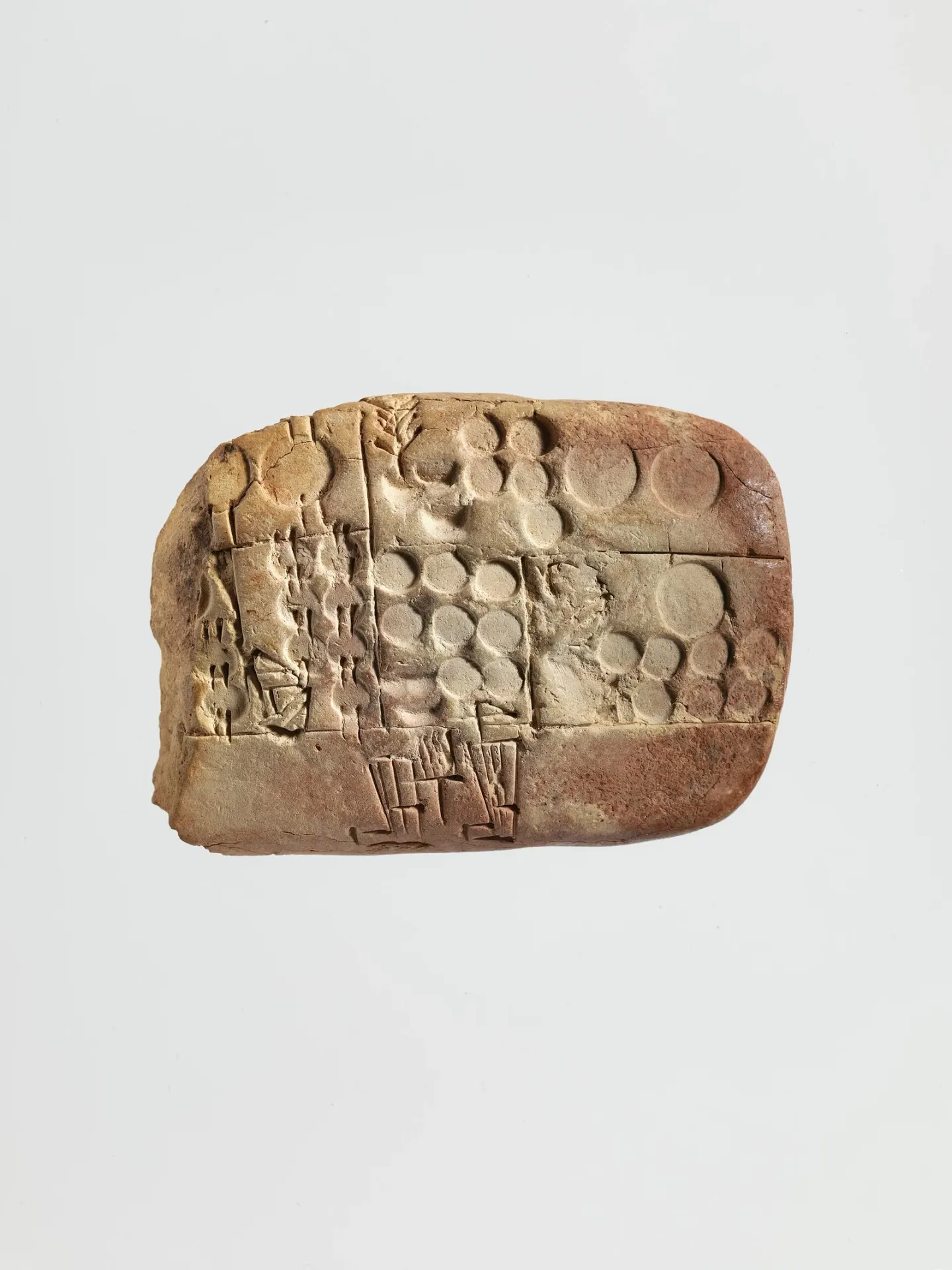
Proto-cuneiform tablet recording distributions of barley and emmer, c. 3100–2900 BC — the same kind of record as the earliest accounts the article describes · The Metropolitan Museum of Art · Wikimedia Commons (public domain)
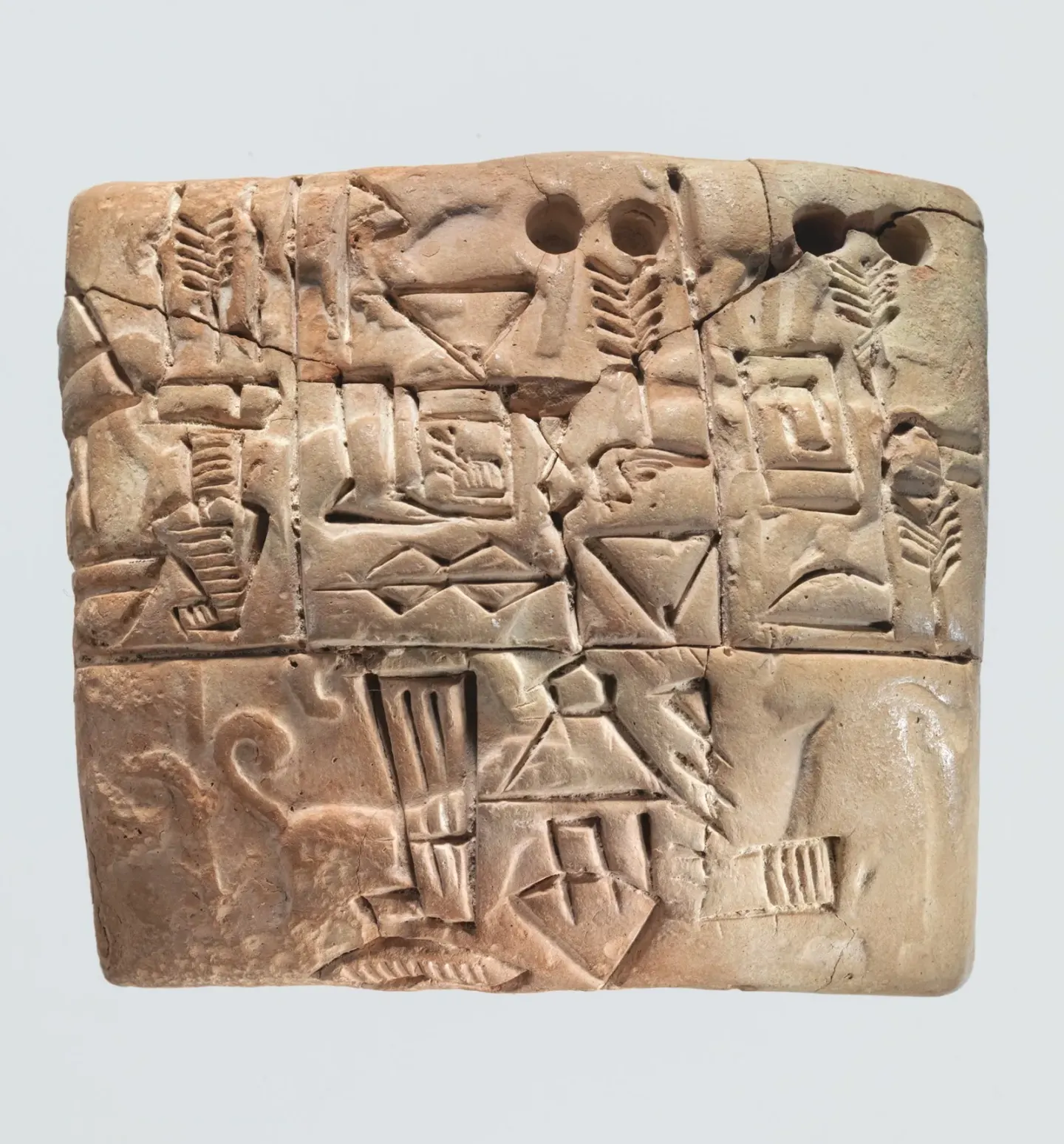
This article explores how writing began and was used in various parts of the world—starting from Mesopotamia and moving to Egypt, China, present-day southern Mexico and parts of Guatemala, and even Korea.
We take a single household ledger along as our guide. In the columns of a ledger, it is enough to have just the name of an item and a number, such as “two bags of rice” or “thirty eggs”. Looking at those columns alone, we cannot tell what tone of voice the person who wrote the ledger used. Nor can we copy letters or songs into those columns. The journey from ledger symbols to writing that could capture spoken language word for word is the first path this article will follow.
From Counting Tools to Symbols
In front of the Uruk ledgers were tools that had been used for thousands of years. In West Asia, stamps and counting tools were used beginning in the 7000s BCE (the seventh millennium BCE) (DOI: 10.3406/arnil.2016.1102). Among the counting tools, clay tokens are the most well-known. Clay tokens are small pieces of clay used for counting. In West Asia, counting tools with various shapes were used (DOI: 10.3406/arnil.2016.1102), and Mesopotamia's base-60 counting may have represented units of numbers with these tokens before writing did (DOI: 10.1007/s00407-019-00221-3).
A study examining Uruk administration describes the process by which writing emerged like this. As people flocked to parts of the river plains in the early 4000s BCE (the fourth millennium BCE), a few large towns formed organizations to manage households collectively. There grew to be a greater need for ways to supervise, control, and store information. At first, existing tools were expanded and used, with cylindrical stamps and counting tools of various shapes added to them. After searching for a means to store more information, writing was created at a certain moment (DOI: 10.3406/arnil.2016.1102).
Cuneiform is a Mesopotamian writing system written by pressing the end of a reed into wet clay to make wedge-shaped impressions. (OpenStax World History Volume 1 3.2) The earliest stage of cuneiform symbols numbered close to 600, and they were used primarily for household management. Because these symbols were not made to convey speech, we still do not know for sure what spoken language lay behind them. It is widely considered likely to have been Sumerian, but this has not been proven (DOI: 10.3406/arnil.2016.1102). Numbers were written with cup-shaped and disk-shaped impressions pressed into clay (DOI: 10.1007/s00407-019-00221-3).
Ledgers were not the only things present. Word lists grouping the names of official posts and occupations, city names, and animal categories beneath headings also emerged together. That study suggests these lists may have been an attempt to organize the world and hold it in one's hands (DOI: 10.3406/arnil.2016.1102).
Whether writing grew straight out of ledgers is still debated. The aforementioned Uruk study suggests that writing was created by drawing in, combining, and rarely drawing pictures of objects into various decorative patterns and identification marks that were already in use (DOI: 10.3406/arnil.2016.1102). There are also studies seeking the precursors of symbols in seal impressions. Among the carvings on pre-writing seals, scenes of transporting vessels and cloth served as the precursor stage for several of the earliest cuneiform symbols (DOI: 10.15184/aqy.2024.165). There is also a hypothesis that views the method of counting using tokens and clay bullae enclosing them as the origin of writing, and a review article discussing Schmandt-Besserat's book introduces this as the hypothesis of "accounting archaeology" (DOI: 10.2308/0148-4184.29.1.195). Even so, it is difficult to view writing as having grown straight from a single token alone. Some scholars view writing as having been created from the start as an attempt to convey speech, but many scholars do not agree with that conclusion, and textbooks still leave this question as an ongoing debate (OpenStax World History Volume 1 3.2).
Writing grew on top of counting tools and stamps that were already in use, and its initial columns contained only item names and numbers like a household account book. What proved decisive is viewed differently by different scholars.
Pictures Borrowing Sounds
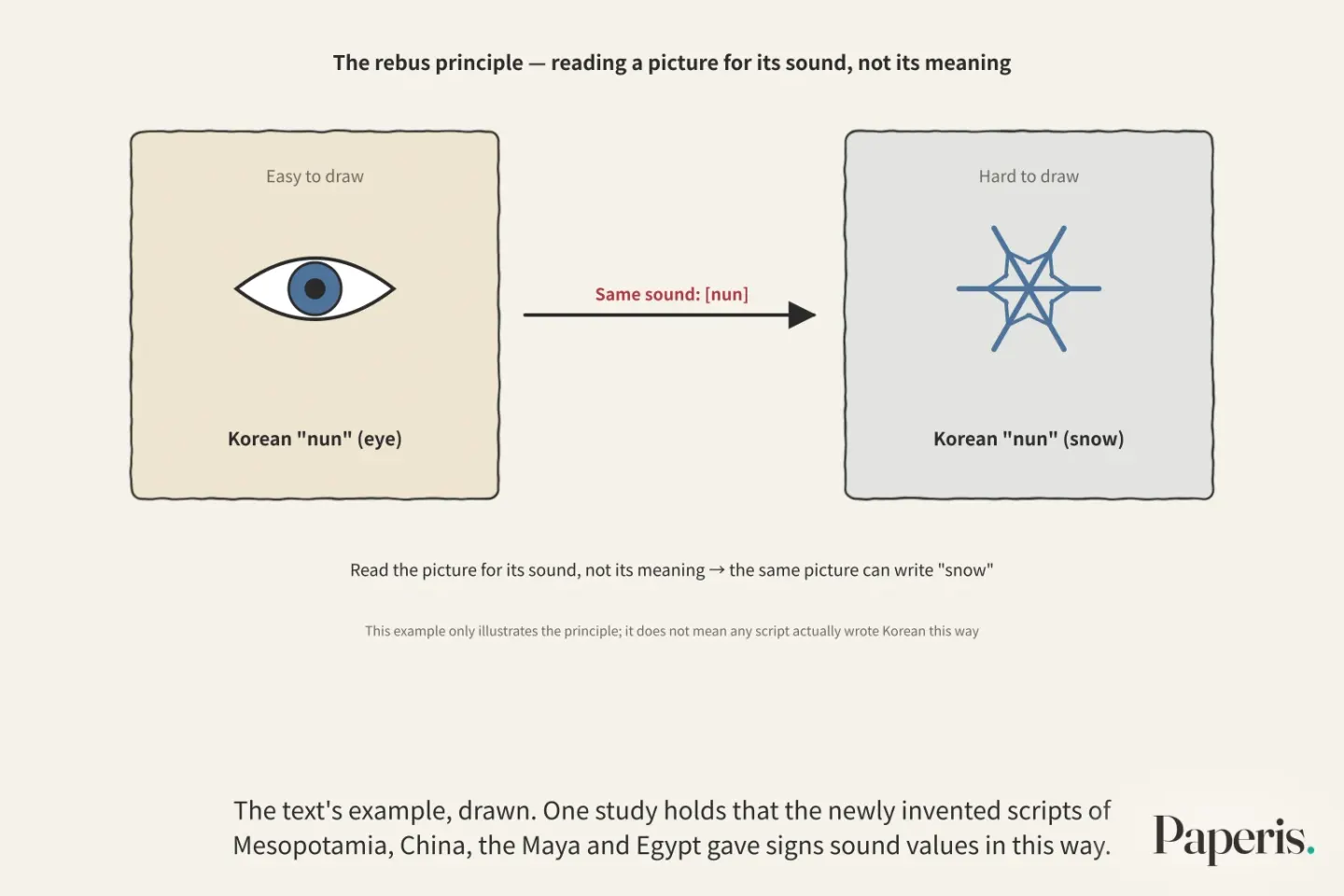
Let us imagine writing the Korean word "눈" (eye/snow) with a picture. A person's eye is easy to draw, but snow falling from the sky is hard to draw. Because the two sound the same, we can borrow a picture of a human eye to write the falling snow. The rebus principle is a method where a picture symbol is read by its sound instead of its meaning, to write another word with the same or a similar sound. Along with the method of taking only the first sound of a picture's name, this principle was importantly used for symbols to gain sounds in places where writing systems were newly created, such as Mesopotamia, China, Maya, and Egypt (DOI: 10.1080/17586801.2020.1724239).
Symbols that have gained sounds are divided into branches depending on what size of speech is chopped up and written. Logographic scripts are writing systems where a single symbol represents a single word or meaning. Syllabic scripts are writing systems where a single symbol represents a single bite of sound, such as "가" or "나". In cuneiform, symbols representing syllables gradually increased (OpenStax World History Volume 1 3.2).
Alphabetic scripts are writing systems where speech sounds are chopped into atomic sounds like "ㄱ" or "ㅏ", attaching a symbol to each atomic sound. The more finely you chop, the fewer symbols you have to memorize. Textbooks note that to read Chinese characters, one had to memorize anywhere from hundreds to thousands of symbols (OpenStax World History Volume 1 5.1).
Actual writing systems usually mix a few methods. In the cuneiform of the mid-3000s BCE, symbols representing words, symbols representing grammatical elements, symbols representing syllables, and symbols indicating categories of meaning existed together. The four were not distinguished by their appearance, and the same symbol sometimes took on different roles depending on its position (DOI: 10.1002/9781119193814.ch2). Cuneiform was not used only for the Sumerian language. Susa in Iran also adopted Mesopotamian cuneiform (DOI: 10.1080/00438243.1986.9979974), first writing Sumerian and Akkadian, and only then writing Elamite, the language of that land (DOI: 10.4324/9781315658032-20).
Hieroglyphs are writing systems written with pictorial symbols imitating people, animals, and objects, of which ancient Egyptian writing is representative. Even in these scripts where pictorial symbols are the majority, sound-representing values were separately newly created (DOI: 10.1080/17586801.2020.1724239). Egyptian writing is one of the oldest recorded languages along with Sumerian writing, but it took hundreds of years until it came to transcribe continuous speech as it is (DOI: 10.1093/oxfordhb/9780199935413.013.61). Chinese writing has similar traces. It has changed from a stage close to pictures, through a stage where a single symbol has multiple values, to a stage where other elements are added to the original character to reduce confusion (DOI: 10.1080/00438243.1986.9979980).
Rock and stone carvings in the Sinai Peninsula, counted as the first appearance of alphabetic scripts, reflect a tradition that arose in neighboring lands where Egyptians and Canaanites lived mixed together. In this branch, the emergence of letters writing vowels was a very important step (DOI: 10.1017/chol9780521224963.022). The Phoenician alphabet was a script writing only consonants (DOI: 10.1093/oso/9780195105209.001.0001). There is dispute over who adapted this writing to the Greek language. One researcher concludes that someone around the island of Euboea created the Greek alphabet to write Homer's Iliad and Odyssey (DOI: 10.1017/cbo9780511552700). Roger Woodard considers that people who were writing the Greek language with the syllabic script of Cyprus modified and created the Phoenician script (DOI: 10.1093/oso/9780195105209.001.0001).
To write a letter in the columns of an account book, there had to be symbols writing sounds, and the rebus principle opened that path. Logograms, syllables, and alphabets are differences in the size by which speech is chopped, and they were mixed and used even within a single writing system.
Did It Spread from One Place, or Arise Separately?
The earliest known writing in China consists of divination records carved on turtle plastrons and ox scapulae. Oracle bone script is a script left by carving divination contents on turtle plastrons and ox scapulae in the late Shang dynasty of China. A 1986 paper dates the oracle bones roughly to 1200–1050 BCE, considering that by then it was already a fully mature system capable of writing that spoken language across the board in principle. It notes that while the argument viewing scratch marks on pottery from Neolithic sites as the roots of Chinese characters is hard to accept, symbol characters carved on objects at the Dawenkou site in present-day Shandong could match the appearance and use of Shang dynasty clan markers and might be one of the genuine antecedent stages (DOI: 10.1080/00438243.1986.9979980). A 2020 study that sequentially selected and radiocarbon-dated oracle bone fragments placed the reign of King Wu Ding of the oracle bones at 1254–1197 BCE and the end of the Shang dynasty around 1041 BCE (DOI: 10.1017/rdc.2020.90). Because the dating methods and targeted objects differ, the two dates are not aligned one-to-one.
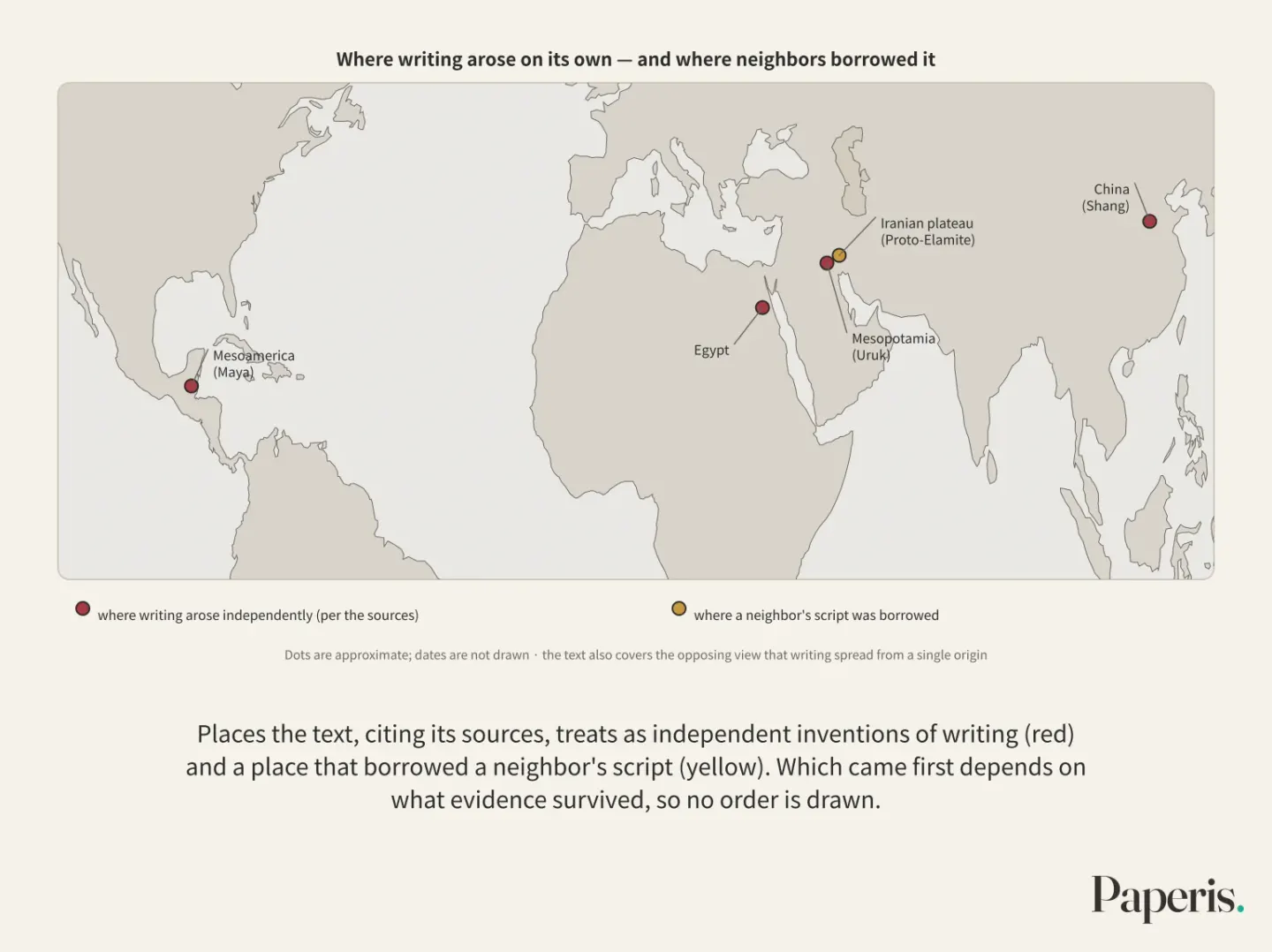
Writing arose independently in multiple places around the world, and the earliest known evidence comes from Sumer (OpenStax World History Volume 1 3.2). Scripts in which sound values of symbols were newly created based on one's own language include Mesopotamian cuneiform, Chinese writing, Maya writing, and Egyptian writing. There are also scripts that may have been created after encountering literate neighbors, such as the hieroglyphs of Anatolia in present-day Turkey and the script of the Nahuatl language (DOI: 10.1080/17586801.2020.1724239).
"Who was first?" is a matter of debate. According to a review article discussing Dreyer's book, small tags noting where goods came from were found in pre-dynastic tomb U-j in Egypt—namely, the tomb of King Scorpion I (around the 3400s–3200s BCE). Günter Dreyer, who published the excavation report, argued that these tags were the origin of writing, and those who view Mesopotamian token ledger systems as the origin contest this. The reviewer who wrote the article considers that while these tags were also connected to bookkeeping work, their usage was slightly different from that of Sumer (DOI: 10.2308/0148-4184.29.1.195).
The amount of surviving records also varies greatly from place to place. In Mesopotamia, over 6,000 clay tablets showing the first two centuries of cuneiform writing have survived, whereas in Mesoamerica, it is estimated that the writing from the first few centuries up around 400 BCE survives in fewer than a dozen pieces of writing (DOI: 10.1093/oxfordhb/9780195390933.013.0063). While clay tablets become extremely hard when baked (OpenStax World History Volume 1 3.2), China's earliest writing was likely written on fragile materials like bamboo or silk and did not survive (OpenStax World History Volume 1 5.1). Survivorship bias is the distortion that occurs when judging the whole by looking only at what survived. The "earliest writing" is the earliest among what remains, and it can change with new discoveries.
Some places borrowed their neighbors' writing. In Susa in present-day Iran, clay balls and tablets recording only numbers were used around 3200 BCE, and from around 3100 BCE to around 2700 BCE, Proto-Elamite script, which may have been created on the Iranian plateau, was used for administrative records (DOI: 10.1080/00438243.1986.9979974). Proto-Elamite borrowed numerical sign shapes, usage, and writing technology from Uruk, but the sign system was local to that region (DOI: 10.4324/9781315658032-20). Conversely, diffusionist theories proposing that various scripts around cuneiform came from a single root were also published in 1966, though the author himself noted that the academic mainstream is the opposite (DOI: 10.1017/s0003598x0003204x).
Writing was created independently in multiple places, and neighbors also borrowed and modified it.
Reading Forgotten Scripts Again
Cuneiform was forgotten for a time and then read again. Decipherment is the work of figuring out again what sounds and meanings the symbols of an old script whose reading way was forgotten represent. Cuneiform was deciphered in the 19th century (OpenStax World History Volume 1 3.2).
The Maya script was deciphered in the 1980s and 1990s. This script was used for nearly 2,000 years from around 300 BCE until the European conquest, and thousands of writings remain on stone monuments, pottery, and three folding books shaped like screens (perhaps four) (DOI: 10.4324/9781315192345-6).
The seals and pottery from the old cities of the Indus River basin have over 400 symbols, and many of those symbols have not yet been deciphered (OpenStax World History Volume 1 5.4). Rajesh Rao, a computer science professor at the University of Washington in the United States, measured the rules by which the symbols are lined up with a computer, and concluded that these symbols are writing down spoken words. What those words were is still being disputed today (OpenStax World History Volume 1 3.4). Proto-Elamite has a weak link between writing and speech from this time, so it is considered that decipherment in terms of spoken meaning will remain difficult in the future (DOI: 10.4324/9781315658032-20). Most of Linear Elamite, which was used in Susa afterward, also cannot be read (DOI: 10.1080/00438243.1986.9979974).
It is like not being able to figure out the speech habits of the people of a house from a house where only household account books remain. For a script to be deciphered, there must be spoken language behind the symbols.
Who Could Read and Write
Assurbanipal, a late Assyrian king, maintained a royal library in Nineveh, and colophons at the end of clay tablets attached phrases like “For my reading and examination”. In the ancient West Asia, a king who boasted of being able to read was relatively rare, and scholars still debate whether Assurbanipal actually read (DOI: 10.1515/za.2007.005).
A scribe is a person who underwent long training and took on reading and writing as a profession. In Mesopotamia, reading and writing were the domain of these scribes, a narrow elite group (OpenStax World History Volume 1 3.2). Because cuneiform script was cumbersome to learn, literate people were narrowed down to professional scribes, and it is thought that most Mesopotamian people encountered literary works through their ears rather than their eyes. Literature must have been transmitted entirely by mouth at first, and even after being written down, the oral transmission side likely continued just as it was (DOI: 10.2307/597906). In Egypt as well, those who could read and write were a small elite group of priests and scribes (DOI: 10.1002/9781118428429.ch31).
Regarding China, textbooks explain that because the Shang dynasty handed down logographic characters instead of phonetic ones, reading and writing remained the domain of the elite for a long time (OpenStax World History Volume 1 5.1). Even in places where alphabetic scripts were used alongside other scripts, readers were few. From around 2000 BCE to around 1150 BCE, various scripts were used in the Levant, including Canaan: Egyptian script, cuneiform, alphabetic cuneiform, and early Canaanite script. Still, most uses remained in professional positions where scribes worked, and writing was largely the property of the elite. Stone pillars erected for everyone to see or amulets worn on the body reached more people, but being able to see did not necessarily mean being able to read. For many people, the meaning of writing likely lay in its appearance and use rather than the written words. That research concludes that what ultimately survived the most stubbornly was personal and unofficial writing, and that it was that side which led to the writing systems of the new nations after the Bronze Age ended (DOI: 10.5334/bai.e). Near the end of the 2000s BCE (the second millennium BCE), while Egypt still ruled Canaan, an educational curriculum to teach alphabetic writing was established, and the subsequent training of Israelite scribes was organized around daily tasks (DOI: 10.1093/oso/9780190052461.001.0001).
At a Maya archaeological site, too, writing appears to have been the work of specialists. At the Maya site of Xultun in Guatemala, in a room with 8th-century murals, several scribes recorded events and astronomical calculations on the wall, and Maya books were likely also produced in that place by a group of ritual specialists (DOI: 10.1111/aman.12167).
Even in societies that left no writing, the past was transmitted. Indigenous peoples in North America who built large earthen mounds left no written records, and scholars use their legends as one of the tools to read the meaning of the mounds (OpenStax World History Volume 1 8.2).
Regardless of the type of script, for a long time after writing emerged, those who could read and writing were a small minority such as scribes and priests. Most people only heard or saw writing.
Borrowing Chinese Characters to Write Our Language
Ancient Korean countries learned writing from China. During the Three Kingdoms period, when Goguryeo, Baekje, and Silla existed together, Chinese characters were introduced along with the teachings of Confucianism, and Chinese writing became the official administrative script of the states (OpenStax World History Volume 1 12.3). Chacha-pyogi is a method of writing the Korean language by borrowing the sounds or meanings of Chinese characters. Idu is a chacha-pyogi system in which Chinese characters are arranged to match Korean word order, with borrowed characters inserted into particle and ending slots. Early traces of adopting Chinese characters in a Korean style appear in the Gwanggaeto Stele of Goguryeo from the early 5th century, and refined Idu writing appears in Baekje wooden tablets (documents written on pieces of wood) and Silla's Imsim Seogiseok from around the 7th century (KCI ART001137114).
In Silla, letters recording Korean verb endings appear on the Musul Ojak Monument from the mid-6th century, and documents from the late 7th century onward mix Korean-style notations like "白之 (I respectfully report)". Regarding Baekje wooden tablets, researchers hold different views. While earlier research sees refined Idu writing in Baekje wooden tablets around the 7th century (KCI ART001137114), research comparing Silla and Baekje suggests that wooden tablets, which were low-level administrative documents of late Baekje from the 6th to 7th centuries, recorded only the names of people and land in a Korean style and were otherwise close to Chinese-style Classical Chinese (KCI ART001273993). Research addressing this difference suggests that Silla's chacha-pyogi grew alongside documentary administration and emerged from a desire to ensure the king's intentions were accurately conveyed to officials (KCI ART001273993).
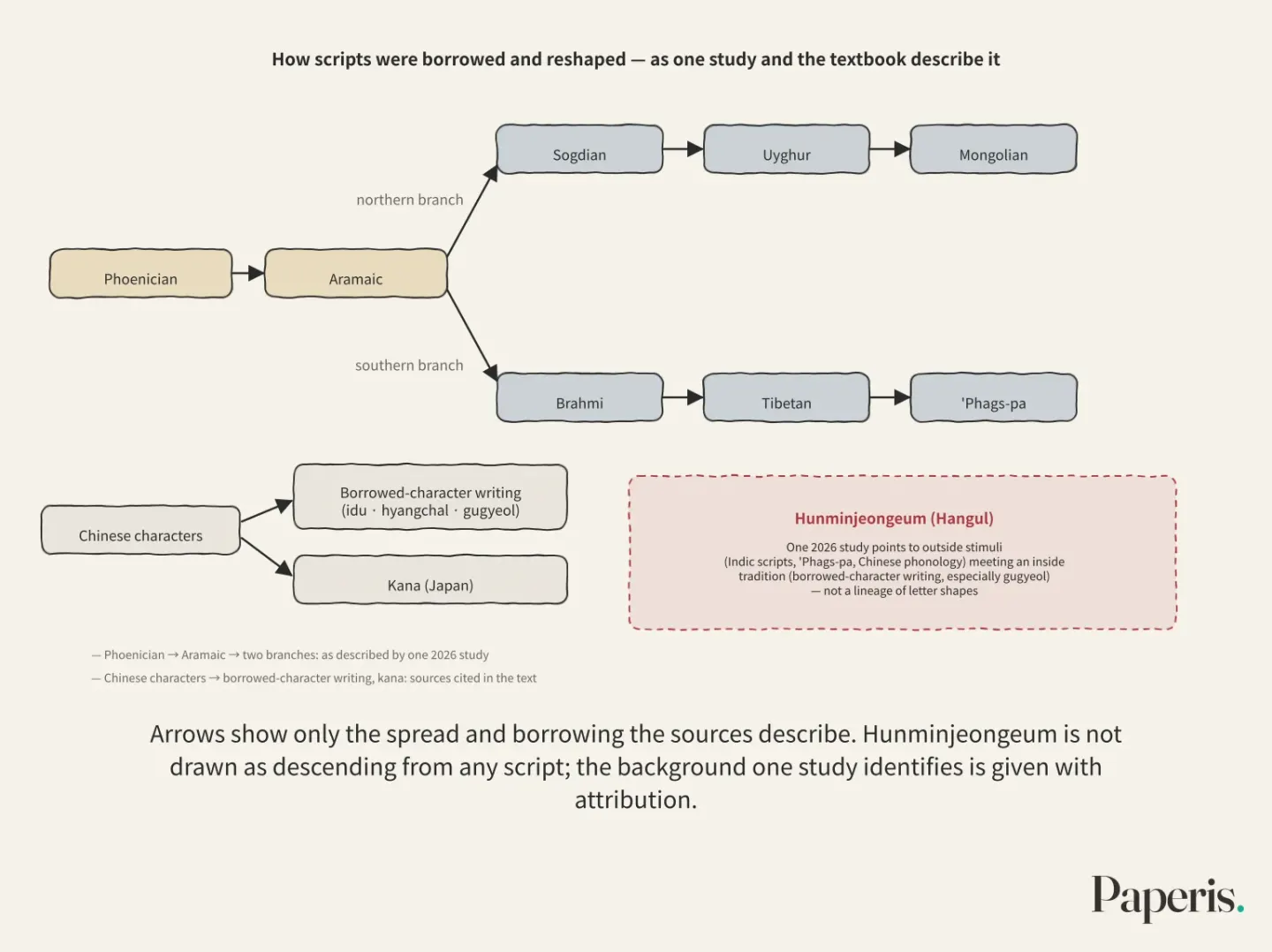
Borrowed characters were also used in songs and Buddhist scriptures. The method of recording songs called hyangga and the method of attaching marks to read Buddhist scriptures in Classical Chinese developed separately, and Buddhism and monks played a major role in this (DOI: 10.22842/kgucfh.2025.48.405). In Japan, too, because it was difficult to properly write the sounds of the Japanese language using Chinese characters, a new script called kana emerged (OpenStax World History Volume 1 12.3).
Just as Mesopotamian cuneiform did, the borrowed script was modified to fit the language of the borrowers.
Hunminjeongeum, There Is Not Just One Reason
In December 1443, during the reign of King Sejong in the early Joseon Dynasty, a record that a new script had been created appeared for the first time in the Veritable Records of the Joseon Dynasty. There was no mention of it prior to that, and the Hunminjeongeum Haeryebon—which explains the sounds of the letters and the principles behind their creation—came out three years later in September 1446 (DOI: 10.32761/kjip.2025..75.006). Hunminjeongeum is a script created during the reign of King Sejong of Joseon to write down the sounds of the Korean spoken language, and it is today's Hangeul.
Even from the question of who made it, different studies place different emphases. One study reasserts the theory that Sejong created it with the help of scholars from Jipheunjeon, a scholarly institution (KCI ART000957642), while another study confirms the theory that Sejong created it himself (KCI ART002376472).
Answers to why it was made are also multiple. There is a study that places at the center of its multiple motivations the fact that writings recorded in Classical Chinese and Idu did not match spoken words, making it difficult to transmit and teach documents to the lower classes (KCI ART001059280). There is also a study that emphasizes the intent to establish the royal authority of a newly founded dynasty and the system of the country. Choe Malli, an official during Sejong's reign, submitted a memorial opposing the new script, and that study reads this memorial as an attempt to keep royal authority in check (DOI: 10.16876/klrc.2015..37.227). There is a study that views that there was a need for a phonetic script to establish the standard for Korean Sino-Korean readings and to accurately record Chinese Sino-Korean readings and foreign language sounds (DOI: 10.17329/kcbook.2007..22.001), and contrary to the conventional view, there is also a study that views Sejong's Buddhist faith as an important factor (KCI ART001045972).
What it relied upon to be created is also a matter of debate. Stimulus diffusion is a process in which one does not simply bring over a script from elsewhere, but accepts the ideas and knowledge contained within that script to newly create one's own script. A study using this framework looks at how script and sound knowledge spread rather than whether the shapes of the letters resemble each other. According to that study, the script that extended from the Phoenician alphabet to the Aramaic alphabet spread along with Buddhism into two branches: the northern branch (Sogdian, Uighur, and Mongolian) and the southern branch (Brahmi, Tibetan, and 'Phags-pa). That study views that Hunminjeongeum emerged through the combination of script and sound knowledge spread via Buddhism and the internal tradition of borrowing Chinese characters to read and interpret Buddhist scriptures (DOI: 10.23033/inhaks.2026..80.005). A study describes the influence that the writing system borrowing Chinese characters had on Hunminjeongeum as "indirect" (DOI: 10.22842/kgucfh.2025.48.405). A study that viewed the consonant branches of Hunminjeongeum as almost identical to the Sanskrit consonant system considers that the grammatical tradition of Sanskrit introduced through Buddhism played a major role, and records that the role of the Buddhist circles in conveying that knowledge to Sejong "can be sufficiently inferred" (DOI: 10.32761/kjip.2025..75.006).
Regarding Hunminjeongeum, studies point together to the script and sound knowledge that entered from the outside and the internally accumulated tradition of borrowing Chinese characters, and they also cite multiple purposes for its creation. It is difficult to single out any one of them as the sole reason.
Once Again, Before the Household Ledger
Now, we pick up a single clay tablet from Uruk once more. On it, how much grain was distributed is written down with pressed number marks and item symbols. The person who wrote that tablet would have been a scribe who received long training, and most people in the same city probably could not read it. Because the symbols did not carry over spoken language, we do not know for sure what language that scribe spoke. The tablet was made of clay so it could last a long time, and so now we know what was counted there. However, the words behind the symbols remain unknown.
Thousand of years later, in Silla on the Korean Peninsula, officials recorded the native Korean word "I submit" in documents using the borrowed Chinese character 白之. The symbols that started in the columns of a ledger came to record speech and songs by borrowing sounds, and that work was repeated everywhere independently, while borrowing and revising.
Where to Look Next
When using old records as evidence, how to ask who wrote them, when, and why is covered in "Reading Historical Records — Grandmother's Diary and That Day's Newspaper". The method of measuring the age of oracle bones continues in "Dating with Carbon — Radiocarbon Dates, Read with an Hourglass and Tree Rings". Egyptian work records noting the days worker crews hauled stones appear in "Did Slaves Build the Pyramids? — A Workers' Town, Bones, a Papyrus, and a Vanished River Branch", and Maya stone pillars carved with dates in "Did Drought Bring Down the Maya? — Setting the Record of the Weather Against the Record of the Cities".
Places like Uruk where people crowded together to manage households collectively are taken up in "Cities and States — Where the First Maintenance Bills Arrived", and the story of Buddhism moving along roads continues in "Trade Routes — A Transit Map Where Goods Were Handed On at Every Transfer".
Source Papers
- "World History, Volume 1: to 1500 — 3.2 Ancient Mesopotamia" (2023) — OpenStax World History Volume 1 3.2 — Definition and uses of cuneiform, writing arose independently in multiple places with the earliest known evidence in Sumer (around 3000 BCE, perhaps earlier), the question of origin is still debated, growth of syllable signs, monopoly of scribes, 19th-century decipherment.
- "World History, Volume 1: to 1500 — 5.1 Ancient China" (2023) — OpenStax World History Volume 1 5.1 — Logograms, earliest Chinese writing likely recorded on perishable materials and did not survive, textbook explanation that inheriting logograms made reading and writing the domain of elites.
- "World History, Volume 1: to 1500 — 3.4 The Indus Valley Civilization" (2023) — OpenStax World History Volume 1 3.4 — Rao's conditional entropy analysis concludes that Indus signs recorded language, though what that language was remains debated.
- "World History, Volume 1: to 1500 — 5.4 Vedic India to the Fall of the Maurya Empire" (2023) — OpenStax World History Volume 1 5.4 — Indus script features over 400 signs on seals and pottery, mostly undeciphered.
- "World History, Volume 1: to 1500 — 12.3 Border States: Sogdiana, Korea, and Japan" (2023) — OpenStax World History Volume 1 12.3 — Chinese characters were the official administrative script in the Three Kingdoms period, Japan's kana arose to write Japanese speech sounds.
- "World History, Volume 1: to 1500 — 8.2 Early Cultures and Civilizations in the Americas" (2023) — OpenStax World History Volume 1 8.2 — For aceramic mound-building societies that left no writing, legend serves as a tool for scholars.
- "The Emergence of Cuneiform Writing" (2020) — DOI: 10.1002/9781119193814.ch2 — Proto-cuneiform records from the Uruk Eanna district manage grain distribution, processing, livestock, fishing, land, and labor, with four types of signs by the mid-third millennium BCE.
- "Uruk: Early Administration Practices and the Development of Proto-Cuneiform Writing" (2016) — DOI: 10.3406/arnil.2016.1102 — Seals and counting tools date back to the seventh millennium BCE, administrative demands fostered a system of nearly 600 signs created by drawing on existing decorative and identifying marks, not meant to transcribe speech but tied to an unknown language (likely Sumerian, uncertified), word lists.
- "Seals and signs: tracing the origins of writing in ancient South-west Asia" (2024) — DOI: 10.15184/aqy.2024.165 — Vessel and textile transport patterns on pre-writing seals form the antecedent of proto-cuneiform signs.
- "Three thousand years of sexagesimal numbers in Mesopotamian mathematical texts" (2019) — DOI: 10.1007/s00407-019-00221-3 — Sexagesimal numbers may have been used as pre-writing tokens and appear as impressed number signs in proto-cuneiform (c. 3300 BC).
- "Rebus and acrophony in invented writing" (2019) — DOI: 10.1080/17586801.2020.1724239 — The rebus principle and acrophony are core mechanisms for generating sound values in "newly invented" scripts of Mesopotamia, China, Maya, and Egypt, while Anatolian and Nahuatl scripts may have arisen through contact.
- "The Origins and Early Development of Writing in Egypt" (2016) — DOI: 10.1093/oxfordhb/9780199935413.013.61 — Egyptian script is one of the oldest recorded languages alongside Sumerian, taking centuries before transcribing continuous speech.
- "Early Chinese writing" (1986) — DOI: 10.1080/00438243.1986.9979980 — Oracle bone script (c. 1200–1050 B.C.) is a fully grown system passing through picture→polyphony→determinative stages, the Neolithic pottery mark origin hypothesis is hard to accept, and Dawenkou symbolic characters may be one of the true antecedent stages.
- "RADIOCARBON DATING OF ORACLE BONES OF LATE SHANG PERIOD IN ANCIENT CHINA" (2020) — DOI: 10.1017/rdc.2020.90 — Radiocarbon dating of oracle bones places Emperor Wu Ding's reign at 1254–1197 BC, with the end of the Shang dynasty around 1041 BC.
- "The Earliest Alphabetic Writing" (1982) — DOI: 10.1017/chol9780521224963.022 — Sinai inscriptions represent a mixed borderland tradition of Egyptians and Canaanites, with the development of vowel letters marking a major step.
- "Greek Writing from Knossos to Homer" (1997) — DOI: 10.1093/oso/9780195105209.001.0001 — Argument that scribes who used the Cypro-Minoan syllabary adapted the consonantal Phoenician script into the Greek alphabet.
- "Homer and the Origin of the Greek Alphabet" (1991) — DOI: 10.1017/cbo9780511552700 — Conclusion that a single person around Euboea created the Greek alphabet to write down Homer.
- "THE OLDEST WRITINGS, AND INVENTORY TAGS OF EGYPT" (2002) — DOI: 10.2308/0148-4184.29.1.195 — Review article addressing Dreyer's U-j tomb tag (c. 3400–3200 B.C.) script origin claims and countering the Mesopotamian token origin hypothesis.
- "Early Mesoamerican Writing Systems" (2012) — DOI: 10.1093/oxfordhb/9780195390933.013.0063 — Mesoamerican writing comprises fewer than roughly a dozen texts up to around 400 BCE, compared to over 6,000 texts in Mesopotamia's first two centuries.
- "The most ancient scripts of Iran: The current situation" (1986) — DOI: 10.1080/00438243.1986.9979974 — Number notation in Susa and the Iranian plateau (around 3200 BC), Proto-Elamite script (around 3100–2700 BC), Susa scribes' adoption of cuneiform, and Linear Elamite script largely undeciphered.
- "The proto-Elamite writing system" (2018) — DOI: 10.4324/9781315658032-20 — Proto-Elamite is an indigenous system that borrowed number signs and techniques from Uruk, with weak links between writing and speech making linguistic decipherment difficult, after which Iran later used cuneiform to write Sumerian and Akkadian first.
- "The Origins of Writing in the Near East" (1966) — DOI: 10.1017/s0003598x0003204x — Common origin (diffusion) hypothesis for scripts surrounding cuneiform, with the author acknowledging being outside the mainstream.
- "Classic Mayan" (2017) — DOI: 10.4324/9781315192345-6 — Mayan script dates from c. 300 B.C. to the Conquest, deciphered in the 1980s–90s, recording linguistic structures in detail.
- "Ashurbanipal: literate or not?" (2007) — DOI: 10.1515/za.2007.005 — Ancient West Asian kings who claimed to read are rare, and Ashurbanipal's literacy remains debated.
- "Literary Style in First Millennium Mesopotamia" (1968) — DOI: 10.2307/597906 — Complex script restricted literacy to professional scribes, most people encountered literature by ear, and literature likely originated as oral transmission.
- "Languages, Scripts, Literature, and Bridges Between Cultures" (2019) — DOI: 10.1002/9781118428429.ch31 — Literacy in Egypt was confined to a small elite of priests and scribes.
- "Re-writing the Script: Decoding the textual experience in the Bronze Age Levant (c.2000–1150 bc)" (2013) — DOI: 10.5334/bai.e — Despite various scripts, use remained within professional scribal environments and elite consumption, public stelae and amulets were not necessarily read, and personal/informal writing survived most stubbornly.
- "The Finger of the Scribe: How Scribes Learned to Write the Bible" (2019) — DOI: 10.1093/oso/9780190052461.001.0001 — Alphabetic writing pedagogy during Egyptian rule over Canaan at the end of the second millennium BCE, with scribal training tailored to daily administrative tasks.
- "Maya Codex Book Production and the Politics of Expertise" (2015) — DOI: 10.1111/aman.12167 — Evidence that multiple scribes recorded in the Xultun mural room, and groups of ritual experts produced books.
- "漢字·漢文의 韓國的 受容" (2004) — KCI ART001137114 — Earliest traces in the Gwanggaeto Stele (early 5th century), refined Idu writing in 7th-century Baekje wooden tablets and Silla's Imsimseogiseok, word-order rearrangement and grammatical morphing.
- "목간으로 본 한자문화의 수용과 변용" (2008) — KCI ART001273993 — Baekje wooden tablets approximate Chinese literary style, Silla's Musul-ojak-bi uses ending markers and "白之", borrowing systems developed alongside document administration.
- "훈민정음 창제 이전 불교 차자표기의 특징" (2025) — DOI: 10.22842/kgucfh.2025.48.405 — Borrowed-character writing (Hyangchal, Idu, Gugyeol) using Chinese characters' sounds and meanings, core contributions by Buddhism and monks, indirect influence on Hunminjeongeum.
- "훈민정음 창제에 끼친 범어음성체계의 영향 연구" (2025) — DOI: 10.32761/kjip.2025..75.006 — December 1443 Annals record, September 1446 Haeryebon, consonant classification nearly identical to Sanskrit with Sanskrit grammatical traditions playing a major role, Buddhist community's role reasonably inferable.
- "世宗의 訓民正音 創製와 그 協贊者" (2004) — KCI ART000957642 — King Sejong created it with the assistance of Jiphyeonjeon scholars (collaborative creation hypothesis).
- "Debunking Myths about the Creation Background of Hunminjeongeum" (2018) — KCI ART002376472 — Affirms the hypothesis that King Sejong created it himself.
- "훈민정음 창제 동기와 목적에 대한 중층 담론" (2007) — KCI ART001059280 — Contradictions between spoken language, Literary Chinese, and Idu script, problems of document delivery and communication with lower strata, moral edification.
- "세종의 문자정책과 훈민정음 창제 동기" (2015) — DOI: 10.16876/klrc.2015..37.227 — Writing system for consolidating royal authority, interpreting Choe Malli's memorial as an attempt to check royal power.
- "세종시대의 어문정책과 훈민정음 창제 목적" (2007) — DOI: 10.17329/kcbook.2007..22.001 — Need for a phonetic alphabet to set standard Chinese character pronunciations and transcribe foreign sounds.
- "세종의 불교신앙과 훈민정음 창제" (2007) — KCI ART001045972 — King Sejong's devotion to Buddhism as a major factor in the creation and dissemination of Hunminjeongeum.
- "훈민정음 창제의 문자론적 배경: 불경 전파와 한국의 불경 석독 전통" (2026) — DOI: 10.23033/inhaks.2026..80.005 — Hunminjeongeum viewed through the framework of stimulus diffusion: a product combining the northern and southern transmission paths of Phoenician→Aramaic scripts, Buddhism, Chinese phonology, and the Gugyeol tradition.
Sources (34)
- World History, Volume 1: to 1500 — 3.2 Ancient Mesopotamia
- World History, Volume 1: to 1500 — 5.1 Ancient China
- World History, Volume 1: to 1500 — 3.4 The Indus Valley Civilization
- World History, Volume 1: to 1500 — 5.4 Vedic India to the Fall of the Maurya Empire
- World History, Volume 1: to 1500 — 12.3 Border States: Sogdiana, Korea, and Japan
- World History, Volume 1: to 1500 — 8.2 Early Cultures and Civilizations in the Americas
- The Emergence of Cuneiform WritingDOI 10.1002/9781119193814.ch2
- Uruk: Early Administration Practices and the Development of Proto-Cuneiform WritingDOI 10.3406/arnil.2016.1102
- Seals and signs: tracing the origins of writing in ancient South-west AsiaDOI 10.15184/aqy.2024.165
- Three thousand years of sexagesimal numbers in Mesopotamian mathematical textsDOI 10.1007/s00407-019-00221-3
- Rebus and acrophony in invented writingDOI 10.1080/17586801.2020.1724239
- The Origins and Early Development of Writing in EgyptDOI 10.1093/oxfordhb/9780199935413.013.61
- Early Chinese writingDOI 10.1080/00438243.1986.9979980
- RADIOCARBON DATING OF ORACLE BONES OF LATE SHANG PERIOD IN ANCIENT CHINADOI 10.1017/rdc.2020.90
- The Earliest Alphabetic WritingDOI 10.1017/chol9780521224963.022
- Greek Writing from Knossos to HomerDOI 10.1093/oso/9780195105209.001.0001
- Homer and the Origin of the Greek AlphabetDOI 10.1017/cbo9780511552700
- THE OLDEST WRITINGS, AND INVENTORY TAGS OF EGYPTDOI 10.2308/0148-4184.29.1.195
- Early Mesoamerican Writing SystemsDOI 10.1093/oxfordhb/9780195390933.013.0063
- The most ancient scripts of Iran: The current situationDOI 10.1080/00438243.1986.9979974
- The proto-Elamite writing systemDOI 10.4324/9781315658032-20
- The Origins of Writing in the Near EastDOI 10.1017/s0003598x0003204x
- Classic MayanDOI 10.4324/9781315192345-6
- Ashurbanipal: literate or not?DOI 10.1515/za.2007.005
- Literary Style in First Millennium MesopotamiaDOI 10.2307/597906
- Languages, Scripts, Literature, and Bridges Between CulturesDOI 10.1002/9781118428429.ch31
- Re-writing the Script: Decoding the textual experience in the Bronze Age Levant (c.2000–1150 bc)DOI 10.5334/bai.e
- The Finger of the Scribe: How Scribes Learned to Write the BibleDOI 10.1093/oso/9780190052461.001.0001
- Maya Codex Book Production and the Politics of ExpertiseDOI 10.1111/aman.12167
- 훈민정음 창제 이전 불교 차자표기의 특징DOI 10.22842/kgucfh.2025.48.405
- 훈민정음 창제에 끼친 범어음성체계의 영향 연구DOI 10.32761/kjip.2025..75.006
- 세종의 문자정책과 훈민정음 창제 동기DOI 10.16876/klrc.2015..37.227
- 세종시대의 어문정책과 훈민정음 창제 목적DOI 10.17329/kcbook.2007..22.001
- 훈민정음 창제의 문자론적 배경: 불경 전파와 한국의 불경 석독 전통DOI 10.23033/inhaks.2026..80.005