
Paperis Articles
The Internet — Boxes Shipped in Pieces, a Sorting Hub at Every Fork
The Internet is a network of networks, joined by shared rules called protocols. Data travels as addressed pieces passed along by routers, DNS turns names into addresses, and the Web is one service running on top of it all.
Your field's papers, as audio
Pick your fields and journals — Paperis summarizes the key papers and turns them into audio. Listen on your commute.
Start Paperis free →The Internet — Boxes Shipped in Pieces, a Sorting Hub at Every Fork
"Where Is the Internet?"
At the dinner table, you look up the weather on your phone, and the child sitting next to you asks, "Where is the internet?" The weather guide that appeared on the screen definitely came from somewhere. Yet neither inside the phone nor anywhere in the room is there a place pre-stuffed with that guide. It is awkward to point at the sky or at the router in the corner of the living room.
Starting from that question, this article follows the path of a single screen as it leaves a distant computer and reaches the phone in your hand. Along that path, we look in turn at how data is split, what addresses are attached, who chooses the route, and what the sites you open every day are on that path.
As a guide, we take only a single parcel delivery service. Suppose that when sending a large load, you divide it into several boxes and mail them with the recipient's address written on each box. The boxes pass through sorting hubs along the way one by one, and each sorting hub chooses the next route to send each box. The receiving end gathers the arrived boxes and reconstructs the load. The path that data takes on the internet resembles this shape.
A Network of Networks
If your laptop, phone, and printer at home are connected by a single router to send files back and forth, that alone is already a small network (OpenStax Introduction Computer Science). A network is a fabric connecting computers and other devices to one another so they can share and exchange information.
A large network connecting distant computers began in 1969. That was ARPANET, created that year by the U.S. Department of Defense's Advanced Research Projects Agency (DOI: 10.1108/eb047726). ARPANET connected university and military computers (OpenStax Foundations Information Systems 1.1), and today's internet originated from this ARPANET (OpenStax Foundations Information Systems 1.1). In the 1970s, the need arose to connect various types of networks built separately in different places, and by around 1988, a mesh joined in that way tied together over 330 networks and tens of thousands of computers (DOI: 10.1108/eb047726).
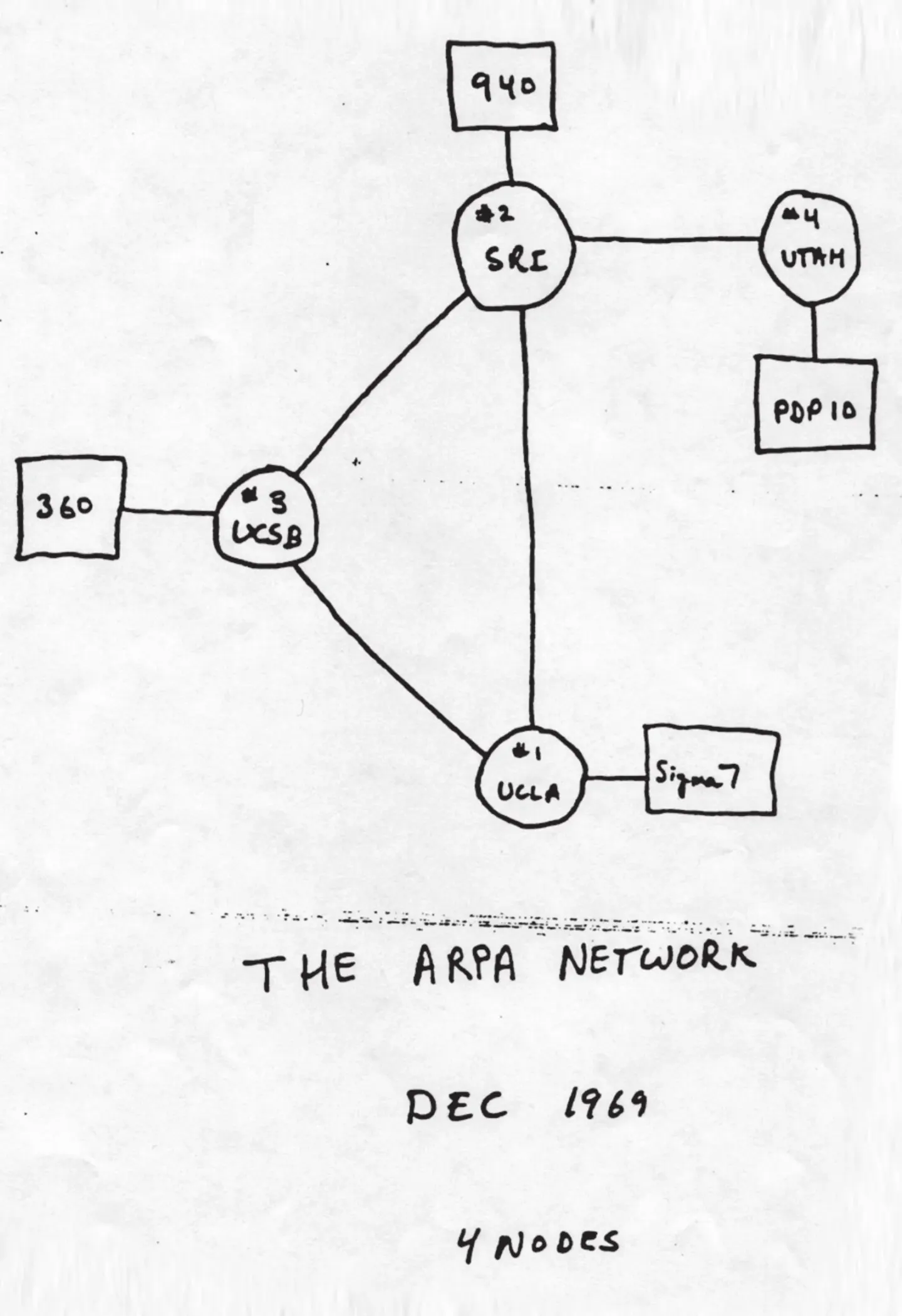
The ARPANET in December 1969, four nodes · DARPA, 1969 · Wikimedia Commons (public domain)
The internet is a network of networks, linking countless computer networks around the world with a common set of rules. Several small networks, such as a university campus network, a regional network, and a country-wide network, connect to each other to form a single large mesh (OpenStax Introduction Computer Science; DOI: 10.1108/eb047726).
For networks built separately in different places to connect, they must follow the same rules. A protocol is an agreed-upon promise established to match the format and processing method when computers send and receive data with each other. Because it is decided in advance what shape data will be packed into and how it will be handled, information can travel back and forth even if the creators are different (OpenStax Introduction Computer Science).
There is no single company or organization that operates or takes responsibility for the entire internet. However, a few administrative tasks that must be strictly coordinated—such as distributing addresses and names—are coordinated centrally (DOI: 10.1093/oso/9780199663163.003.0002).
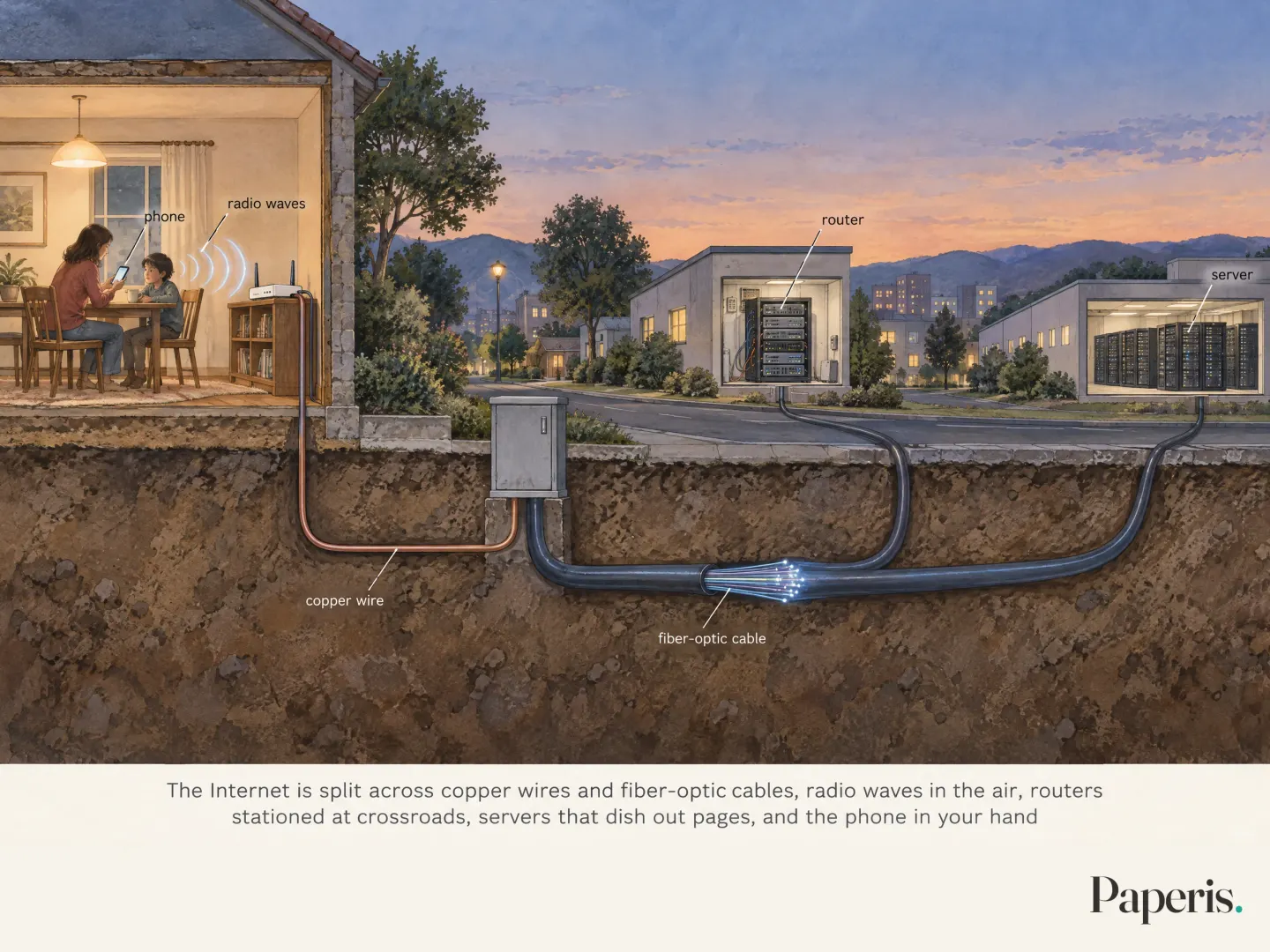
What actually connects these networks are copper wires and fiber optics, and wireless connections send signals through the air (OpenStax Introduction Computer Science). The gateway connecting a home or phone to the outside mesh is an access network laid down by an internet service provider or cable company (OpenStax Introduction Computer Science). Wi-Fi is one of several ways to connect a device to this mesh.
So, the first answer to the child's question is this. The internet does not reside in any single place; it is divided among networks all over the world and the wires and radio waves connecting them.
The Address Written on the Box
If a delivery box has no destination address, the sorting facility cannot send that box anywhere. The Internet is the same. An IP address is a unique number attached to every single device on the Internet so they can send and receive data. This address is the standard by which data finds its way on the Internet, and it is also what makes data reach the correct computer (DOI: 10.1093/oso/9780199663163.003.0002).
The form of the address is counted in bits. A single spot that can hold either a 0 or a 1 is called a bit. An IP address is a line of 32 zeros and ones, and there is also a method that uses 128 bits (DOI: 10.1093/oso/9780199663163.003.0002). The 32 digits of an IP address are divided into four chunks of eight digits each (OpenStax Foundations Information Systems 5.1). If you read one eight-digit chunk as a number, it becomes a single number between 0 and 255, and the method for reading it that way is in another piece of this series, "Bits and Data — Raised Dots and Flat Spots, a Code the Fingertips Know".
Then, once you get this number, is that it? Two types of addresses are both used (OpenStax Foundations Information Systems 5.1). A static IP address is an address that an administrator sets once and keeps using as is. A dynamic IP address is an address borrowed whenever a device connects to the Internet, so it sometimes becomes a different number.
Why We Slice and Send
In traditional telephone networks, a single dedicated path is held between two telephones until the call ends (OpenStax Introduction Computer Science; DOI: 10.1002/047148296x.tie016).
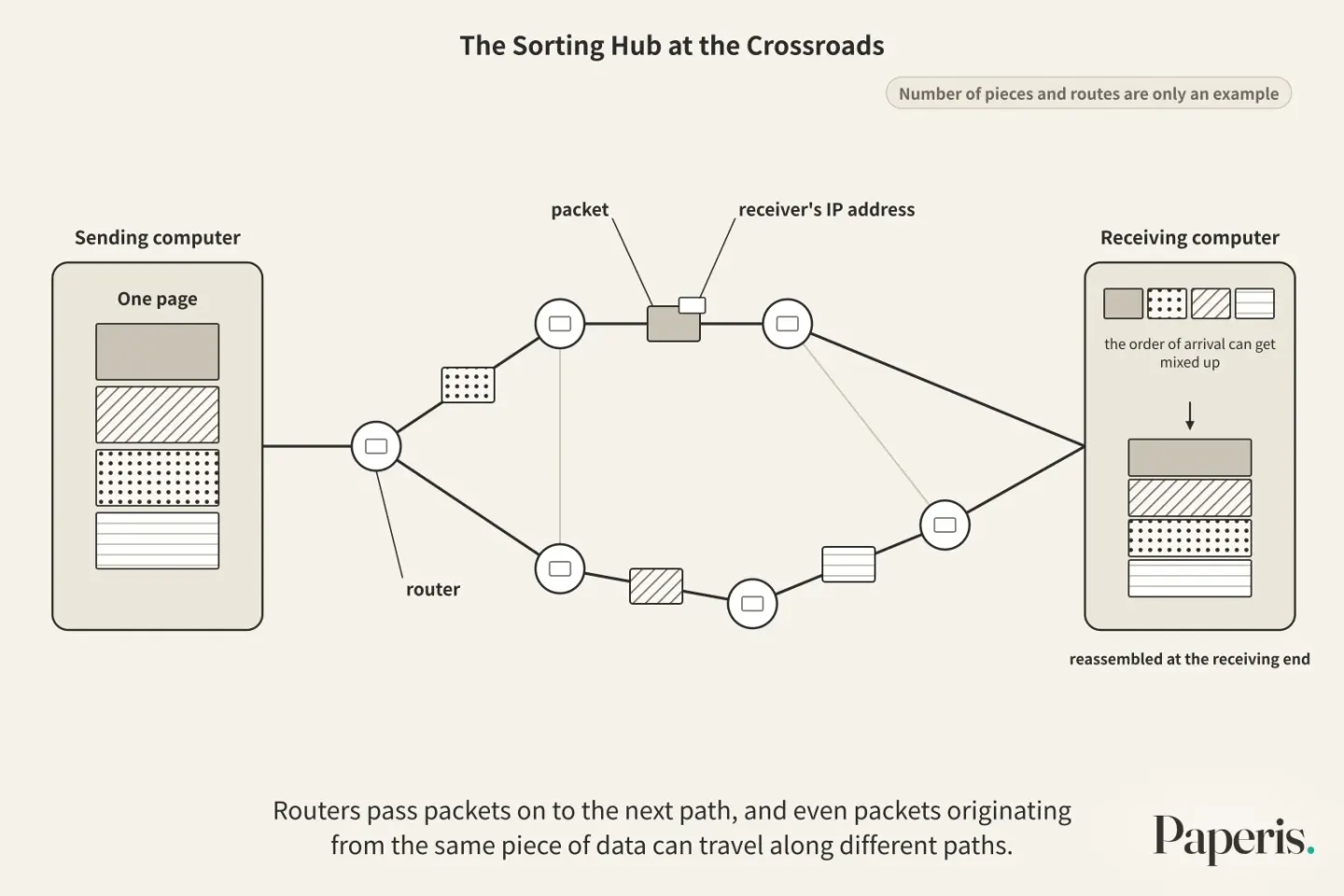
The internet sends them differently. A packet is a small piece of data to be sent, which travels across the network with the receiver's address attached. By looking at the IP address attached to the packet, it finds its way and reaches the correct computer (DOI: 10.1093/oso/9780199663163.003.0002).
Packet switching is a method where data is divided into packets, and each packet travels separately across the network to reach its destination. Even packets from the same data can take different paths, and computer networks generally use this method (OpenStax Introduction Computer Science). ARPANET was also a network that divided data into small pieces and sent them from the beginning (OpenStax Foundations Information Systems 1.1; DOI: 10.1108/eb047726).
Packets and packet switching were created to use digital networks efficiently—in other words, to allow data from multiple people to mix and travel over a single line (DOI: 10.1002/047148296x.tie016). In terms of delivery services, a phone call is like a person renting an entire truck by themselves, while packet switching is like loading boxes from many people together into a single truck. Dividing data into fine pieces is so that many people can share the same line (DOI: 10.1002/047148296x.tie016).
The Sorting Hub at the Crossroads
Packets do not go straight from the computer they start at to the destination computer. At every intersection where networks meet, they pass through a device. A router is a device that receives a packet and passes it along to the next path leading toward the destination. Think of it like a sorting hub at each crossroads in a courier delivery service (OpenStax Foundations Information Systems 5.1).
Choosing which path is appropriate uses mathematics and algorithms that deal with how paths are connected (OpenStax Introduction Computer Science). What an algorithm is is explained in another part of this series, "Algorithms — Calling Numbers One by One, Questions That Erase Half". In widely used methods, routers exchange information with each other about the shape of the network to automatically determine the most suitable path (DOI: 10.52436/1.jutif.2023.4.5.1456).
They must decide the path packets will take even between networks operated by different companies. There are separate protocols in charge of that job, and these protocols bind networks around the world together into a single internet (DOI: 10.2139/ssrn.3141666). There is also a protocol where, when a router cannot send a packet any further, it sends back a short message to the sender informing them of the error (OpenStax Introduction Computer Science).
Routers pass packets on to the next path, and even packets originating from the same piece of data can travel along different paths (OpenStax Introduction Computer Science).
A Promise to Resend Missing Boxes
Because packets leave separately and travel different paths, their arrival order can get mixed up (OpenStax Introduction Computer Science; DOI: 10.1145/1064413.1064423). When data floods a network and exceeds the volume the lines can handle, delays increase and packets can even vanish (DOI: 10.1007/978-981-96-3596-2_9).
The protocol connecting multiple networks had to deal with varying packet sizes, transmission failures, and ordering across different networks (DOI: 10.1145/1064413.1064423). TCP/IP is the core suite of protocols for the internet, where IP attaches addresses to packets to route them, and TCP ensures that all packets are gathered completely and in order. This framework was established by Vint Cerf and Robert Kahn in the 1970s, and ARPANET transitioned to it in 1983 (OpenStax Foundations Information Systems 1.1).
Many hands contributed to this work. Cerf and Kahn adopted the idea of sending packets independently, which had been refined by a research team led by French engineer Louis Pouzin in the 1970s experimental network CYCLADES (DOI: 10.1353/tech.2014.0096).
Before sending data, TCP first establishes a connection between two computers and writes sequence numbers in the headers of the packets (DOI: 10.33979/2072-8964-2025-24-4-109-119). The receiving TCP arranges the sequence using these numbers, and the sending TCP retransmits any data that fails to arrive within a set time limit (DOI: 10.33979/2072-8964-2025-24-4-109-119). In delivery terms, the receiver checks the box numbers to sort the items, and if a box fails to arrive by a designated date, the sender ships it again.
Internet protocols are stacked in multiple layers. A layer is a structure that divides the network's tasks into multiple tiers, with each tier assigned separate responsibilities and protocols. The lower layers handle only carrying the data, while the upper layers handle only what to do with that data (OpenStax Introduction Computer Science). Each layer has its own protocol to communicate with the outside (DOI: 10.47191/ijcsrr/v7-i2-41).
Dividing into layers allows work to proceed at the top while hiding the complex realities below (OpenStax Introduction Computer Science). The truck driver hauling the boxes does not need to know what goods are inside, and the person receiving the goods does not need to know which route the truck took. The idea of hiding what lies below and working on top of it also appears in another part of this series, "Programs and Programming Languages — A Score Written by People, a Piano That Plays Only the Holes". Among early approaches to layered architecture, the OSI model has seven layers (OpenStax Introduction Computer Science), whereas the TCP/IP model actually followed by the internet uses four layers (DOI: 10.47191/ijcsrr/v7-i2-41), but the takeaway is less the number of layers and more this structure of hiding and building upward.
From Names to Addresses
The website address you type into the address bar is a text-based name, but packets need a numeric IP address attached to them. A domain name is a text-based name used in place of an IP address so that humans can read and remember it easily.
Connecting names to addresses is handled separately. DNS is the internet's naming system that translates domain names into their corresponding IP addresses. Changing human-readable names into numeric network addresses is the job of DNS (DOI: 10.2139/ssrn.6106647). What a delivery driver visits is the address written next to the recipient's name. DNS gives us that address when we only know the name.
When the internet was small, it managed with a single text file listing pairs of names and addresses. As the internet grew rapidly, a naming system that could expand indefinitely and be distributed across multiple places became necessary, and DNS was standardized into its current form in 1987. Today, DNS is a system where countless computers tasked with finding names share the workload (DOI: 10.70675/40057d55z5873z474ez9239zbd61590e2659).
Because more and more things start with name lookup, DNS is considered one of the most important components on the internet (DOI: 10.70675/40057d55z5873z474ez9239zbd61590e2659). A news report about a "DNS outage" means something went wrong with the system responsible for this name lookup (DOI: 10.2139/ssrn.6106647; DOI: 10.70675/40057d55z5873z474ez9239zbd61590e2659). The system is so vast that it is hard to see inside entirely, and without a solid understanding of how it works inside, it is impossible to prevent breakdowns and misconfigurations in advance (DOI: 10.70675/40057d55z5873z474ez9239zbd61590e2659).
One Service Running on Top of the Internet
Then what are the sites we open every day on this road? The web is a service on top of the internet that connects documents contained in different computers with links so people can find and read them. Its official name is the World Wide Web (OpenStax Introduction Computer Science 11.1).
The web arrived long after the internet. ARPANET opened in 1969 and adopted TCP/IP in 1983, while the web came out in 1989–1990 (OpenStax Foundations Information Systems 1.1; OpenStax Introduction Computer Science 11.1). Even now, email and messengers run alongside the web on the same internet. The internet is a network of networks that carries data, and the web is one of several services running on top of it (OpenStax Introduction Computer Science).
When You Type a Name Into the Address Bar
Now we trace from the beginning how the weather screen at the start arrived. The place where you type the name of the weather site is your phone's browser (OpenStax Introduction Computer Science 11.1). A browser is a program that requests web pages, receives them, and displays them on the screen.
Where does the typed name go? First, it gets turned into an IP address. Turning a name into an address is the job of DNS (OpenStax Foundations Information Systems 5.1), and many things start with this name lookup (DOI: 10.70675/40057d55z5873z474ez9239zbd61590e2659).
Once you get the address, whom do you ask for what, and how? You ask the computer that has the weather page to hand over that page. A server is a computer, or a program that does that job, that hands out data when other computers make a request across a network. There is also an agreement for this request and reply. HTTP is the protocol that determines how a browser requests a web page from a server and how the server returns that page.
This request rides on top of TCP/IP (OpenStax Introduction Computer Science 11.1). TCP establishes a connection between the two computers, and the data departs as packets bearing the server's IP address (DOI: 10.33979/2072-8964-2025-24-4-109-119; DOI: 10.1093/oso/9780199663163.003.0002). The packets enter the access network through a wireless connection like Wi-Fi, and pass through routers at every junction connected by copper wire and fiber optic cable (OpenStax Introduction Computer Science).
The server returns the requested page (OpenStax Introduction Computer Science 11.1). The returning page is also split into packets and finds its way back the same way. The TCP on the phone's side looks at the sequence numbers and puts the packets together in order. Data that is not properly delivered within the set time is resent by the server's TCP (DOI: 10.33979/2072-8964-2025-24-4-109-119). When the browser draws the fully gathered page on the screen, the weather information appears.
On this path, what the web handled was the conversation where the browser and server asked and answered, and what carried that conversation was the internet.
Once Again, Where Is the Internet?
The delivery metaphor has been useful up to this point, but it diverges from reality in two ways. First, a single delivery company runs an entire shipping network, whereas the Internet has no organization that operates and takes responsibility for the whole thing (DOI: 10.1093/oso/9780199663163.003.0002). Only a few things are coordinated centrally, like assigning addresses and names. Second, if you lose a package, its contents are gone, but a packet is data, so the sender can transmit the exact same content again (DOI: 10.33979/2072-8964-2025-24-4-109-119). That is why TCP can resend data that did not get through.
Now we can give the child a slightly longer answer. The Internet is split across copper wires and fiber-optic cables, radio waves in the air, routers stationed at crossroads, servers that dish out pages, and the phone in your hand (OpenStax Introduction Computer Science). What ties all of them together is a set of promises that everyone has agreed to keep: protocols.
Where to Look Next
- How data is represented in lines of 0s and 1s is covered in another part of this series, "Bits and Data — Raised Dots and Flat Spots, a Code the Fingertips Know".
- What an algorithm is can be seen in another part of this series, "Algorithms — Calling Numbers One by One, Questions That Erase Half".
- The principles of locking the content moving back and forth across the web are covered by "Encryption — The Content Is Locked, but the Record of Comings and Goings Remains", and how the keys used for that lock remain safe even when made public is covered by "Keys and Locks — Why a Public Key Is Safe to Publish".
- The story of the padlock in the address bar continues in "What Does the Padlock in Your Address Bar Actually Guarantee? — Instead of Picking a Trustworthy Authority, the Web Decided to Write Every Issuance Down".
- The overall work of protecting networks can be started from "Security — Unseen by Others, Unchanged in Secret, Open When Needed".
Source Papers
- "Introduction to Computer Science — Appendix A: Network Design Application of Algorithms" (2024) — OpenStax Introduction Computer Science — Networks are a weave of computers and devices connected to share information, the internet is a network of networks connecting smaller networks, protocols are standard rules defining data formats and processing, connections are copper wire, fiber optics, and air, Wi-Fi, Bluetooth, 4G, access networks, packet switching (taking separate, different paths) vs. the fixed paths of telephone networks, routers and path selection (graph theory and algorithms), layers and hiding, the seven OSI layers, TCP and IP, error notification messages, and the web, email, messengers, and streaming are applications built on top of the network.
- "Introduction to Computer Science — 11.1 Modern Web Applications Architectures" (2024) — OpenStax Introduction Computer Science 11.1 — The web began from connecting content housed on different computers (1989), HTTP runs on top of the internet's premier protocol TCP/IP, browsers request and servers reply with pages, and a web page is a document viewed in a browser.
- "Foundations of Information Systems — 1.1 Introduction to Information Systems" (2025) — OpenStax Foundations Information Systems 1.1 — The 1969 ARPANET (military and universities, resource sharing, packet switching sending data in small pieces), the 1970s TCP/IP by Cerf and Kahn, the 1983 adoption of ARPANET, and the 1990 web.
- "Foundations of Information Systems — 5.1 The Importance of Network Security" (2025) — OpenStax Foundations Information Systems 5.1 — An IP address is a unique identifier pointing to a computer on the internet, written for humans in blocks of 8 bits, static and dynamic IP addresses are used together, DNS translates domain names into IP addresses, servers and routers are defined, and IP is the foundational protocol that identifies devices and determines paths.
- "The ARPANET and the DARPA Internet" (1988) — DOI: 10.1108/eb047726 — ARPANET was the first wide-area packet-switched network started in 1969, and in the 1970s the DARPA Internet was created to connect different packet-switched networks, growing to over 330 networks and tens of thousands of hosts.
- "Structure and Organization of the Domain Name System" (2015) — DOI: 10.1093/oso/9780199663163.003.0002 — While no organization is in charge of the entire internet, IP addresses and domain name management are centrally coordinated, and IP addresses serve as 32-bit or 128-bit strings that act as the standard for routing, ensuring packets reach the correct computer.
- "Circuit, Message, and Packet Switching" (2004) — DOI: 10.1002/047148296x.tie016 — Packets and packet switching were invented to use digital networks efficiently, specifically to multiplex them, and an example of circuit switching is voice telephony.
- "ANALYSIS OF IMPLEMENTATIONS OF THE TCP PROTOCOL FAMILY IN A PACKET-SWITCHED TRANSPORT NETWORK" (2025) — DOI: 10.33979/2072-8964-2025-24-4-109-119 — TCP uses timeouts, retransmissions, and sequence numbers in packet headers for reliable transmission, and establishes a connection before sending.
- "A protocol for packet network intercommunication" (2005) — DOI: 10.1145/1064413.1064423 — A protocol for resource sharing between different packet-switched networks, handling differences in packet size across networks, transmission failures, ordering, flow control, and end-to-end error checking.
- "In the Shadow of ARPANET and Internet: Louis Pouzin and the Cyclades Network in the 1970s" (2014) — DOI: 10.1353/tech.2014.0096 — French engineer Louis Pouzin's experimental network Cyclades, whose "datagram" concept was adopted by Cerf and Kahn.
- "Transport Protocol" (2025) — DOI: 10.1007/978-981-96-3596-2_9 — When traffic exceeds line capacity, congestion occurs, increasing delays and packet loss.
- "Review of the OSI Model and TCP/IP Protocol Suite on Modern Network Communication" (2024) — DOI: 10.47191/ijcsrr/v7-i2-41 — Every layer has its own protocol, comparing the seven OSI layers and the four TCP/IP layers.
- "COMPARING THE PERFORMANCE OF OSPF AND OSPF-MPLS ROUTING PROTOCOL IN FORWARDING TCP AND UDP PACKET" (2023) — DOI: 10.52436/1.jutif.2023.4.5.1456 — Routing can be static or dynamic, and dynamic routing automatically determines the best path using received network topology information.
- "Reviewing a Historical Internet Vulnerability: Why Isn't BGP More Secure and What Can We Do About it?" (2018) — DOI: 10.2139/ssrn.3141666 — BGP is an inter-network routing protocol that establishes paths for IP packets between networks operated by different providers, gluing the internet together into one.
- "Managed Domain Name System (DNS): Architecture, Security, and Economic Implications of Outsourced Internet Naming Infrastructure" (2026) — DOI: 10.2139/ssrn.6106647 — DNS is a foundational internet component that translates human-readable domain names into numeric network addresses.
- "The domain name system : a tool and a target for internet-wide measurements" — DOI: 10.70675/40057d55z5873z474ez9239zbd61590e2659 — DNS was standardized in its current form in 1987, replacing text files listing name-address pairs, is operated by millions of servers, and an increasing number of tasks begin with name lookups, making it one of the most crucial components.
Sources (16)
- Introduction to Computer Science — Appendix A: Network Design Application of Algorithms
- Introduction to Computer Science — 11.1 Modern Web Applications Architectures
- Foundations of Information Systems — 1.1 Introduction to Information Systems
- Foundations of Information Systems — 5.1 The Importance of Network Security
- The ARPANET and the DARPA InternetDOI 10.1108/eb047726
- Structure and Organization of the Domain Name SystemDOI 10.1093/oso/9780199663163.003.0002
- Circuit, Message, and Packet SwitchingDOI 10.1002/047148296x.tie016
- ANALYSIS OF IMPLEMENTATIONS OF THE TCP PROTOCOL FAMILY IN A PACKET-SWITCHED TRANSPORT NETWORKDOI 10.33979/2072-8964-2025-24-4-109-119
- A protocol for packet network intercommunicationDOI 10.1145/1064413.1064423
- In the Shadow of ARPANET and Internet: Louis Pouzin and the Cyclades Network in the 1970sDOI 10.1353/tech.2014.0096
- Transport ProtocolDOI 10.1007/978-981-96-3596-2_9
- Review of the OSI Model and TCP/IP Protocol Suite on Modern Network CommunicationDOI 10.47191/ijcsrr/v7-i2-41
- COMPARING THE PERFORMANCE OF OSPF AND OSPF-MPLS ROUTING PROTOCOL IN FORWARDING TCP AND UDP PACKETDOI 10.52436/1.jutif.2023.4.5.1456
- Reviewing a Historical Internet Vulnerability: Why Isn't BGP More Secure and What Can We Do About it?DOI 10.2139/ssrn.3141666
- Managed Domain Name System (DNS): Architecture, Security, and Economic Implications of Outsourced Internet Naming InfrastructureDOI 10.2139/ssrn.6106647
- The domain name system : a tool and a target for internet-wide measurementsDOI 10.70675/40057d55z5873z474ez9239zbd61590e2659