
Paperis Articles
Figures and Images — The Old Vow, Firm and Shining Like a Flower of Gold
A figure of speech says one thing by likening it to another. Reading Han Yong-un's "Nim-ui Chimmuk" (The Silence of 'Nim') and Yun Dong-ju's "Prelude," this primer names simile, metaphor, personification, paradox, symbol and imagery one by one, then follows research showing that the mind treats fresh and worn-out metaphors differently, and the debate still open over why.
Your field's papers, as audio
Pick your fields and journals — Paperis summarizes the key papers and turns them into audio. Listen on your commute.
Start Paperis free →Figures and Images — The Old Vow, Firm and Shining Like a Flower of Gold
When a Vow Can Be Held in Your Hand
Han Yong-un's poem "The Silence of Nim" begins like this. Han Yong-un was a poet who passed away in 1944, and this poem shares its title with his collection of poetry, The Silence of Nim.
Nim is gone. Ah, my beloved Nim is gone. Breaking through the blue light of the mountains, walking the small path toward the maple woods, Nim tore away and left, though it was hard to bear. The old vow, firm and shining like a flower of gold, turned to cold dust and blew away on the breeze of a sigh.
(Original: 임은 갔습니다. 아아, 사랑하는 나의 임은 갔습니다. / 푸른 산빛을 깨치고 단풍나무 숲을 향하여 난 작은 길을 걸어서 차마 떨치고 갔습니다. / 황금의 꽃같이 굳고 빛나던 옛 맹세는 차디찬 티끌이 되어서 한숨의 미풍에 날아갔습니다.)
— Han Yong-un, "The Silence of Nim" (translated by Paperis)
Let us read the third line again, slowly. A vow is a promise made with the mouth, so it can neither be held in the hand nor seen with the eyes. Yet in this line, the vow is solid and gleaming like a flower made of gold. Then it turns into cold dust and scatters in a breeze like a sigh. The poem transforms the disappearance of an old vow into something that happens right at your fingertips and before your eyes.
Why do poems not speak directly, but instead pull in other things? This article takes up that question and reads two poems together. The focus is on "The Silence of Nim" written in Korean and Yun Dong-ju's "Prelude", alongside a line of poetry by Shakespeare written in English. We will also follow studies examining how our brains understand such expressions. The title uses "Nim", and the modern-text version quoted here uses "Nim".
Figurative Language
There is a name for the way of speaking that describes a vow as a flower of gold. Metaphor is a method of speaking of something by comparing it to something else. Like a vow and a flower, a metaphor often binds two things that at first glance seem unrelated, and refuses to let you read the words strictly at face value (Ringo & Kashyap, Writing and Critical Thinking Through Literature ch. 6.10).
A metaphor always has two pairs. The tenor is the actual subject being spoken about in the metaphor. The vehicle is the other thing brought in to compare to the tenor. In the third line, the tenor is "the old vow", and the vehicle is "like a flower of gold" at first, and then "cold dust". Two vehicles are attached to a single tenor, and the two point in opposite directions. That which was firm and shining becomes cold dust.
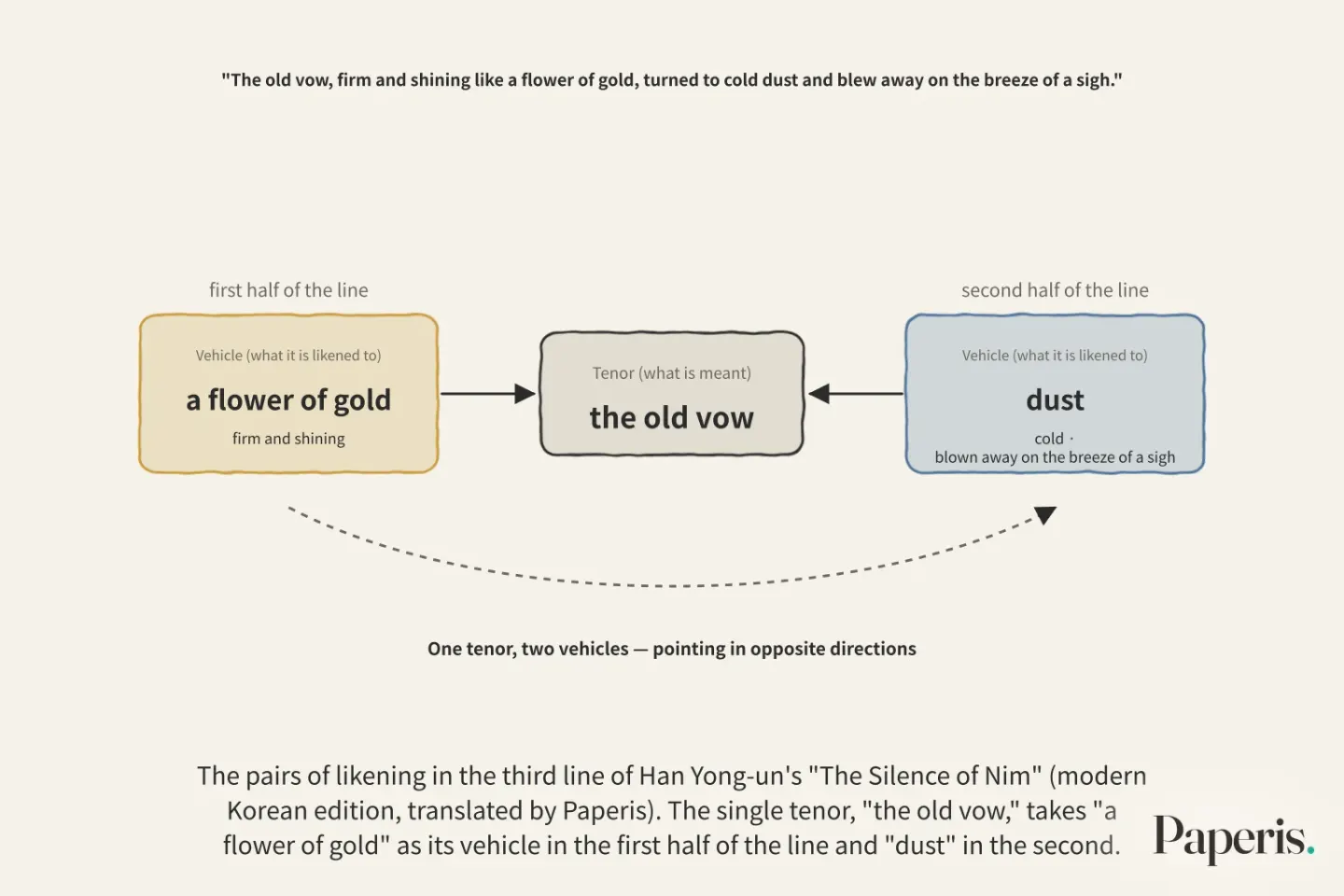
Therefore, the first question when reading a metaphor is always the same: what is being compared to what? With this single question, an unfamiliar line of poetry unravels into a relationship of two parts.
The voice speaking as "I" within a poem also has a name. The speaker is the voice speaking inside the poem, and cannot be assumed to be the same person as the poet. Thus, in this article, "I" refers to the speaker within the poem.
Through Eyes, Ears, and Skin
There is a reason the third line paints a picture right before your eyes. "gold" is a color, "firm" is the feeling of something in your hand, and "cold" is the temperature on your skin. There are three senses in a single line. An image is a scene of sensory impressions that rises in the mind when reading or hearing words, also called imagery. The textbook notes that an image can evoke multiple senses at once (Ringo & Kashyap, Writing and Critical Thinking Through Literature ch. 4.11).
The next two lines of "The Silence of Nim" mix the senses even further.
The memory of the sharp first kiss turned the needle of my fate around, stepped backward, and vanished. I went deaf to Nim's fragrant voice and blind to Nim's flowerlike face.
(Original: 날카로운 첫키스의 추억은 나의 운명의 지침을 돌려 놓고 뒷걸음쳐서 사라졌습니다. / 나는 향기로운 임의 말소리에 귀먹고 꽃다운 임의 얼굴에 눈멀었습니다.)
— Han Yong-un, "The Silence of Nim" (translated by Paperis)
The memory is a "sharp" memory, bringing a blade to mind. The voice is a "fragrant" voice, carrying a scent, and the face is a "flowerlike" face. A fragrance caught by the nose is attached to a voice heard by the ear. In the second line, the "blue light of the mountains" and the "maple woods" open a path before the eyes.
Language that leans on the senses like this is a tool used to make the reader experience the world within the poem (Evory, Naming the Unnameable ch. 3). Empirical studies are also accumulating showing that people reading literary texts like novels experience sights, hear sounds within the story, and feel what the characters feel as if living it. Researchers call this imagery, or the act of replaying scenes in the mind, and examine its conditions and effects, though some unanswered questions still remain (DOI: 10.1515/9783110645958-004). Metaphors arising like scenes also lean on this sensory language.
"Like" and "Is"
When a friend says of someone, "He is like a bear," and when they say, "He's a total bear," the feeling is different. The former announces that it is comparing, while the latter firmly declares them to be the same.
A simile is a figure of speech that attaches words like "-like", "-as", or "as if" to openly reveal that a comparison is being made. "like a flower of gold" is a simile. A metaphor is a figure of speech that states one subject is directly another subject, without any marker of comparison. The fourth line's "the needle of my fate" is a metaphor. A needle refers to the hand of a clock or compass, but the poem does not separately announce that fate has a needle; it says so directly.
There are also poems that present the comparison itself as a question. The English playwright and poet William Shakespeare's Sonnet 18 asks like this in its first line. Shakespeare passed away in 1616, and this poem is one of 154 in a collection of sonnets published in 1609.
Shall I compare thee to a summer's day?
— William Shakespeare, Sonnet 18
Textbooks explain metaphor as a stronger comparison than simile (Ringo & Kashyap, Writing and Critical Thinking Through Literature ch. 4.11). There is also a difference in memory. In three experiments comparing the "The desert is an oven" form and "The desert is like an oven" form, the metaphor form was consistently better remembered than the simile form, and concrete sentences were better remembered than abstract ones. However, even when a short story was attached beforehand to provide context, memory for difficult sentences increased only a little, contrary to expectation. Instead, the ability to distinguish sentences that had not been shown before improved significantly (DOI: 10.1080/01638539909545084). Unlike older accounts that viewed simile and metaphor as practically the same thing, recent studies find that metaphor binds the two pairs more closely together, and whether the two are the same or different remains a debate today (DOI: 10.34135/lartis.23.8.1.08). Textbooks and some recent studies view that when the single word "like" is dropped, the comparison becomes stronger.
When a Memory Steps Backward
Let us look at the fourth line once more. The memory "turned" the needle of fate like a person, and retreated "stepped backward" just like a person. Personification is a figure of speech in which something that is not human is portrayed as thinking, moving, and speaking like a person. Because the memory retreats with human gestures, its disappearance becomes an action of moving backward while keeping its face turned toward this side.
As the poem nears its end, the penultimate line features this sentence.
Ah, Nim is gone, but I have not let Nim go.
(Original: 아아, 임은 갔지만은 나는 임을 보내지 아니하였습니다.)
— Han Yong-un, "The Silence of Nim" (translated by Paperis)
Nim has left, yet the speaker says they have not let Nim go. The two sides contradict each other. Paradox is language that on the surface seems contradictory, but upon reflection makes sense. The sentence immediately before it is “Just as we fear parting when we meet, when we part we believe we will meet again.”. Parting and meeting are inverted and interlocked within a single sentence.
How to resolve this contradiction is up to the reader. Is what left the body and what was not let go the heart, or something else entirely? Irony—where words or expectations clash with reality—is covered separately in another part of this series dealing with narrative structure. Paradox is a signal not to stop at the surface meaning, but to chew on it once more.
Stars, Wind, and the Road
Yun Dong-ju's "Prelude" is a poem with the date November 20, 1941, written at the end. Yun Dong-ju passed away in 1945, and this poem is the first poem in the first edition of the posthumous collection Sky, Wind, Stars, and Poems published in 1948. The spelling transcribed here is from the first edition, so there are places where it differs from today's orthography. The word “우르러” (ureureo) in the first line, “Until the day I die, looking up to the sky,” uses an older spelling of the word for "looking up" compared to today's spelling “우러러” (ureoreo). Let us read the latter part of the poem.
With a heart that sings of the stars I must love all things that are dying, and the road that has been given to me I must walk.
Tonight, too, the stars are brushed by the wind.
(Original: 별을 노래하는 마음으로 / 모든 죽어가는것을 사랑해야지 / 그리고 나한테 주어진 길을 / 걸어가야겠다. / 오늘 밤에도 별이 바람에 스치운다.)
— Yun Dong-ju, "Prelude" (translated by Paperis)
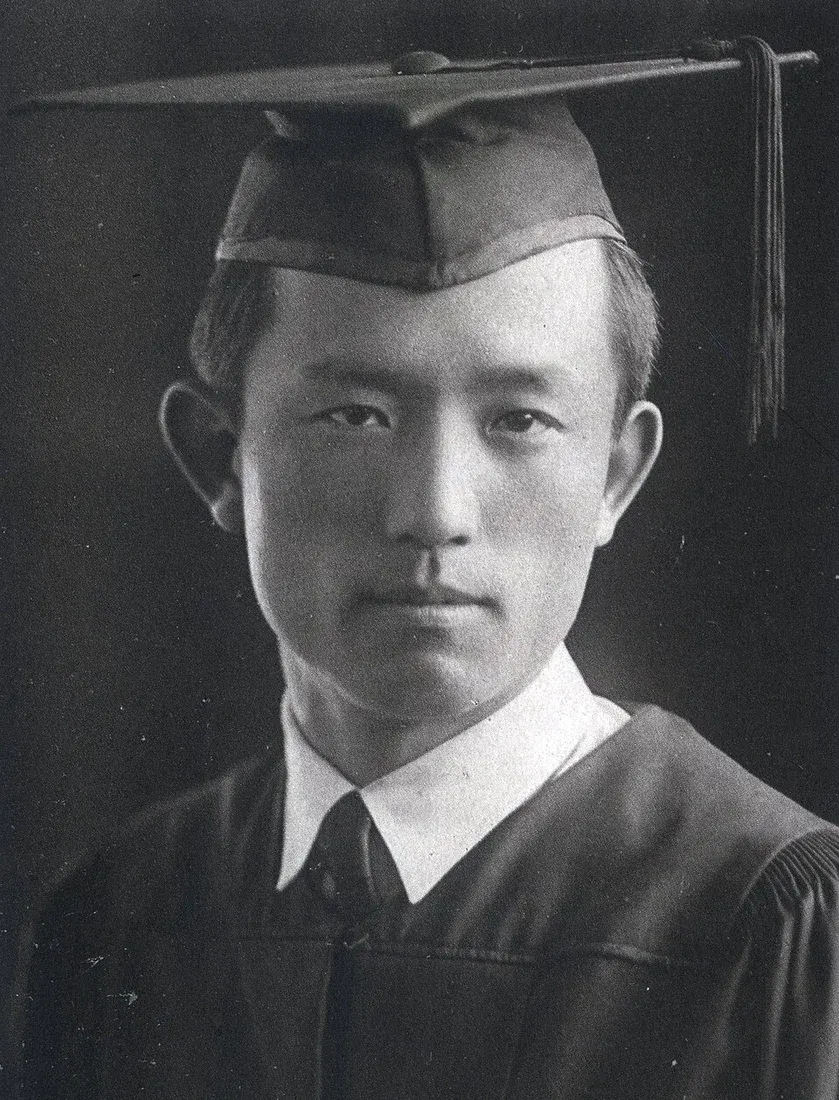 Yun Dong-ju (1941, graduation photograph) · photo: unknown photographer · Public domain · Wikimedia Commons
In this nine-line poem, "stars" appear twice, and "wind" also appears twice. The wind appears once earlier in “and even at the wind that stirs in the leaves / I was troubled” and once in the final line. What are the stars and the wind compared to here? Unlike the vow in "The Silence of Nim", the poem does not write down the tenor.
A symbol uses a concrete object to bring to mind a larger meaning that is not written down. The stars and the wind in "Prelude" are like that. Textbooks also note that the meaning of a symbol is not pinned down to just one, so various interpretations can emerge (Ringo & Kashyap, Writing and Critical Thinking Through Literature ch. 4.11). We summarize it this way in this article: whereas a metaphor writes down or lets you guess the tenor, a symbol leaves that spot open. The empty space of a symbol is filled by the reader holding onto the words of the poem.
This poem is divided into two stanzas by a single blank line: lines 1–8 and line 9. One domestic study reads the scene in the final 9th line as representing, through a symbol, a state of mind that has transcended conflict and anguish (expressed in this study as the "poet's mind"). The same study also notes that because this poem omits its meaning and speaks indirectly, it gives rise to multiple meanings (DOI: 10.15705/kopoet..31.201108.005). That reading is one researcher's interpretation, and readings that fill the stars and the wind with other meanings remain open.
Spending Time
It is not only poetry that speaks in comparisons. "Spend time," "save time," "waste time." These phrases treat time like money. Even so, they do not sound like metaphors to the ear. A dead metaphor is a frozen comparison used so often that it no longer sounds like a metaphor. "Table leg" or "mountain waist" are also comparisons to the body that have set. One critic introduced by the textbook even says that if you trace words back to their roots, nearly all words look like frozen metaphors (Ringo & Kashyap, Writing and Critical Thinking Through Literature ch. 6.10).
The "spend time" cluster has a structure larger than a single word. Spend, save, waste, and earn are all words used when dealing with money, yet we apply these words as a package to time as well. A conceptual metaphor is a framework for understanding an entire domain of thought by comparing it to another, forming a structure larger than a single word. One line of explanation for understanding metaphors looks at such mappings between domains and connects this thinking to experiences lived through the body (DOI: 10.1037/bul0000145). This is grounded in the claim of cognitive linguistics that people understand abstract thoughts through bodily and sensory experiences (DOI: 10.14384/kals.2026.33.1.029).
There are also experiments comparing familiar and unfamiliar metaphors in the brain. One functional magnetic resonance imaging experiment compared English sentences such as "The daughter grasped the flower," "The public grasped the idea," and "The public understood the idea." The metaphorically used "grasped," much like the literal "grasped," engaged areas that plan physical action. Furthermore, in both sentence types, the more familiar the expression, the fainter the activity in the region responsible for body movement. The authors interpreted that the more familiar a metaphor becomes, the less elaborately the brain replays the action in the mind, and they also noted that metaphor comprehension does not rely solely on such mental replays (DOI: 10.1162/jocn.2010.21596). This is the result of a single experiment, and the tendency for activity to grow fainter as familiarity increased was also observed in literal sentences.
The Brain Handles Novel and Conventional Metaphors Differently
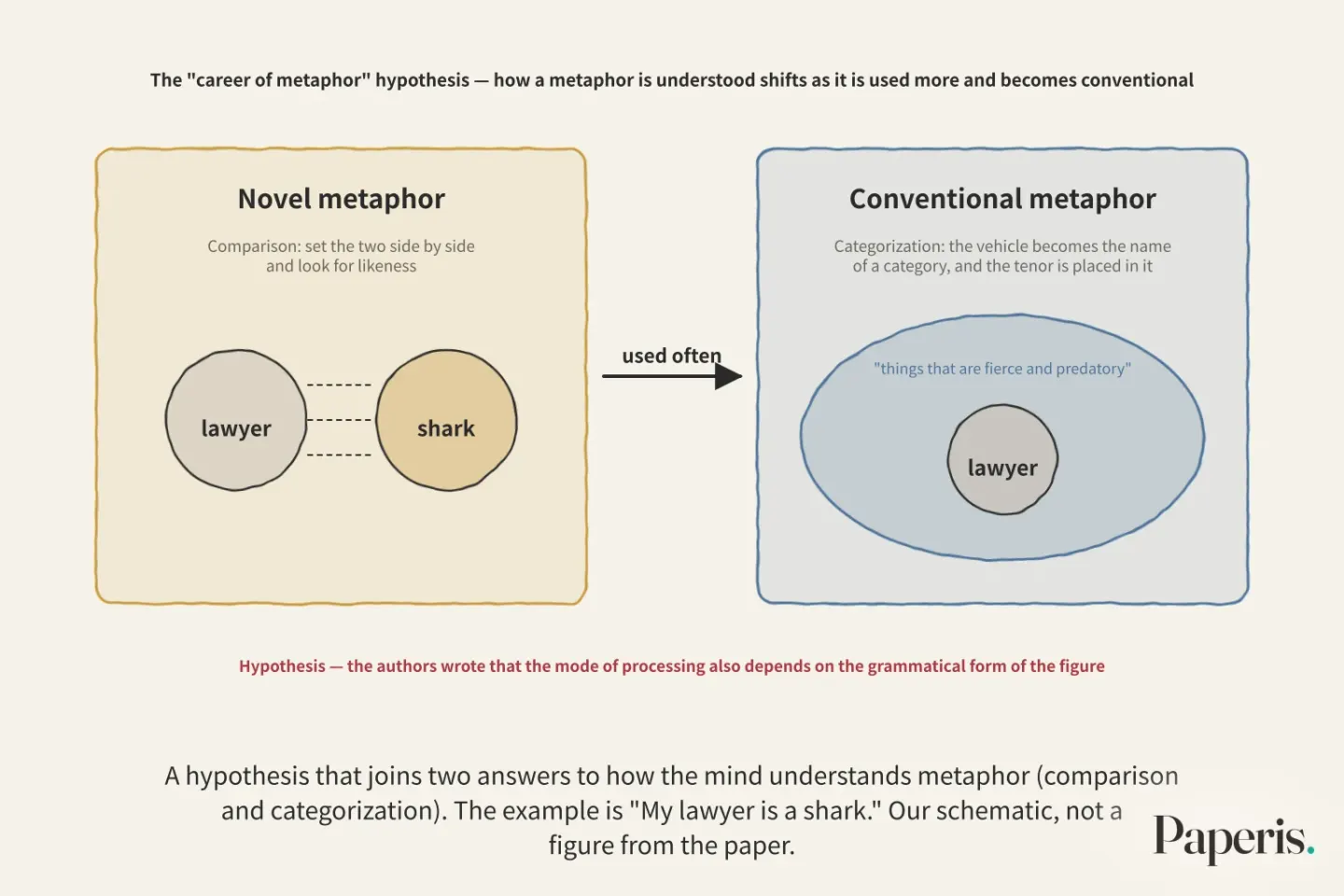
The phrase "My lawyer is a shark" is read to mean that this lawyer is ferocious and preys on others. There are two representative answers regarding how the brain parses this phrase. One is comparison. This explanation suggests putting the lawyer and the shark side by side and finding their points of resemblance. The other is categorization. Categorization is the act of grouping multiple targets into a single set sharing the same properties. In this explanation, "shark" goes beyond a fish of the sea to become the name of the category "things that are ferocious and prey on others," and the lawyer enters that category (DOI: 10.1093/acprof:oso/9780195111095.001.0001).
The hypothesis connecting the two explanations is the "career of metaphor." A novel metaphor is a pairing heard for the first time, requiring the listener to figure out the meaning on the spot. This hypothesis views that as a metaphor is used more frequently and becomes conventional, the way it is solved shifts from comparison toward categorization. The authors reported through three experiments that this shift also appears in the way people speak metaphors, and noted that how a metaphor is resolved depends on its phrasing along with how conventionalized it is (DOI: 10.1037/0033-295x.112.1.193).
Experiments supporting this hypothesis followed. In an EEG experiment using Chinese, a novel metaphor elicited a stronger brainwave signal than a conventional metaphor. There was no such difference between novel and conventional similes. The authors considered that this difference cannot be explained by familiarity alone and read it as a result supporting the career of metaphor hypothesis (DOI: 10.3389/fpsyg.2024.1404498).
A domestic study compared 12 patients with right-hemisphere brain damage and 12 typical adults. The patient group had more difficulty across metaphor comprehension tasks overall, and both groups understood familiar metaphors more easily than novel metaphors. The authors discussed the possibility that the patients' difficulties were related to limitations in working memory (DOI: 10.12963/csd.17429).
The idea of viewing metaphor as the work of the right hemisphere has also been studied for a long time. Early studies placed weight on the right hemisphere, but as evidence accumulated, the view shifted toward the idea that both hemispheres are involved and that reliance differs by the type of metaphor (PMID 40074403). In a meta-analysis gathering 23 neuroimaging studies and 354 participants, there was no overall dominance of the right hemisphere for metaphors, and most regions activated by metaphors were in the left. The right hemisphere was engaged only for novel metaphors (PMID 22824234). In another meta-analysis gathering 30 studies and 480 participants, right-hemisphere activity overlapped only in studies dealing with novel metaphors, and the authors interpreted that the right hemisphere is more related to difficulty than to whether something is a metaphor or not (PMID 37718244). One review considers that the burden of having to weave unfamiliar meanings into one calls upon the right hemisphere, and that this burden is not unique to metaphor (PMID 29643825).
There are also experiments using novel metaphors taken from poetry. Using transcranial magnetic stimulation from outside the head to temporarily disrupt activity in a brain region, disrupting a region in the right temporal cortex impaired novel metaphor processing while leaving conventional metaphors intact. Conversely, disrupting a region in the left frontal cortex impaired literal expressions and conventional metaphors while leaving novel metaphors intact. The authors suggested that the right hemisphere may be crucial for weaving together two seemingly unrelated meanings when understanding a novel metaphor (DOI: 10.1162/jocn.2008.20.1.170). While the result of a single experiment, it fits the picture that the brain handles novel and conventional metaphors through different pathways.
However, how to account for that difference is still debated. Theories explaining metaphor comprehension are divided into three streams—comparison, categorization, and domain-mapping—weighing each other's evidence, and a proposal has also emerged to tie together analogy-based mechanisms and concept-combining mechanisms (DOI: 10.1037/bul0000145). A systematic review examining 116 brain studies noted that because each study defines and measures "familiarity" and "conventionality" differently, the results are hard to compare with one another (PMID 35126074). The memory, neuroimaging, and brain stimulation experiments seen earlier all dealt with word pairs or short sentences. Connecting these studies further to the task of reading and interpreting a poem remains a task for the future (DOI: 10.1037/bul0000145). While evidence has accumulated that the brain handles novel and conventional metaphors differently, how it does so remains debated.
Again Before "The Silence of Nim"
Returning to the lines read in this article, we now name the learned devices one by one.
"like a flower of gold" is a simile with the marker "like", and the color of gold and the feel of firm fingertips rise as images. In "cold dust", the exact opposite subsidiary subject is attached to the same vow, changing the firm thing into something scattered. "the breeze of a sigh" is read as a metaphor equating a sigh directly to a gentle breeze.
"the needle of my fate" is an unmarked metaphor. Whether this pair strikes a reader as a novel metaphor or a frozen one was not measured by any study within the scope found by this article. The life-cycle hypothesis of metaphor noted earlier states that how a metaphor unpacks depends not only on how frozen it is, but also on its phrasal form. Because this line joins two nouns with the possessive particle like "the needle of my fate", it cannot be said to match the forms of the experiments that backed the hypothesis. Theories explaining metaphor remain contested. How the mind linked fate and a needle when reading this line remains an open question. That memory recedes through personification as it "stepped backward", and "fragrant Nim's voice" brings the ear and the nose together. And there remains the paradox: "Nim is gone, but I have not let Nim go."
Even after naming all these, one blank remains until the end. None of the lines translated here state who Nim, a Korean word for a deeply cherished person, left untranslated here, is. What fills that spot is passed to the reader, much like the empty seat of a symbol. What to hold onto when filling it is the words written in the lines. Who was the Nim you read?
Where to Look Next
Other parts of this series connect directly to this article. The installment on rhythm covers lines, stanzas, and the melody created by repeating sounds. The installment on speaker and point of view delves deeply into the speaker—defined in just one sentence here—along with the narrator of a novel. The installment on plot structure covers irony, where the surface and the inside mismatch, and the installment on characters covers how to read people in fiction. There is no published article that directly follows this one yet.
Source Papers
- "Writing and Critical Thinking Through Literature — 6.10 Figurative Language" (2021) — Ringo & Kashyap, Writing and Critical Thinking Through Literature ch. 6.10 — Figurative language is not meant to be taken literally and often compares two things that look different. It introduces a critic's claim that almost all words look like frozen metaphors.
- "Writing and Critical Thinking Through Literature — 4.11 Rhetorical and Literary Devices" (2021) — Ringo & Kashyap, Writing and Critical Thinking Through Literature ch. 4.11 — Metaphors and similes are both comparisons, with a metaphor being a stronger comparison. Images are words that appeal to the senses and rely on one or more senses. The meaning of a symbol is not pinned down to just one, allowing for multiple interpretations.
- "Naming the Unnameable: An Approach to Poetry for New Generations — 3 3: Images" — Evory, Naming the Unnameable ch. 3 — In poetry and fiction, images are tools that make the reader experience that world.
- "Mental Simulation during Literary Reading" (2021) — DOI: 10.1515/9783110645958-004 — Readers experience text as if seeing landscapes, hearing sounds, and feeling what characters feel, studying this bundled as imagery and mental simulation. A chapter organizing unresolved questions.
- "Memory for metaphors and similes in discourse" (1999) — DOI: 10.1080/01638539909545084 — Across three experiments, metaphor forms were remembered better than simile forms, and concrete sentences better than abstract ones. Contrary to expectation, adding context only slightly increased the memory of difficult sentences, but greatly improved distinguishing unpresented sentences.
- "HOW LIKE-SIMILE RELATES TO METAPHOR: AN EXPLORATION OF ANALYTICAL PARAMETERS" (2023) — DOI: 10.34135/lartis.23.8.1.08 — Challenging the traditional view that similes and metaphors are identical, research shows metaphors tie two pairs closer together. It covers the equality-inequality debate.
- "윤동주 “서시”의 의미 연구" (2011) — DOI: 10.15705/kopoet..31.201108.005 — Dividing "Prelude" into two stanzas of lines 1–8 and line 9, it reads the scenery of line 9 as a symbol of the poet's mind overcoming conflict. It suggests that ellipsis and indirect expression produce various meanings.
- "Metaphor comprehension: A critical review of theories and evidence." (2018) — DOI: 10.1037/bul0000145 — Categorizes metaphor comprehension theories into three branches: non-trope (comparison), categorization, and conceptual mapping, and evaluates the evidence. It calls for further research on functions in context, emotion, and links to literary interpretation, and proposes a path integrating mechanisms relying on analogy and conceptual combination.
- "개념적 은유 이론에 대한 신경과학적 통찰" (2026) — DOI: 10.14384/kals.2026.33.1.029 — Cognitive linguistics viewed humans as understanding abstract thoughts through bodily and sensory experiences, and brain imaging studies revisited this.
- "The Neural Career of Sensory-motor Metaphors" (2010) — DOI: 10.1162/jocn.2010.21596 — fMRI. Figurative action sentences also activate action-planning regions, and the more familiar they are, the less primary motor region activity decreases, making the simulation less detailed. They also rely on abstract meaning codes.
- "Understanding Figurative Language" (2001) — DOI: 10.1093/acprof:oso/9780195111095.001.0001 — A categorization theory where everyday metaphors create new categories, and words like "shark" become the names of those categories.
- "The Career of Metaphor." (2005) — DOI: 10.1037/0033-295x.112.1.193 — The hypothesis that as metaphors become more conventionalized, processing shifts from comparison to categorization. Three experiments showed this shift appears in the form in which metaphors are spoken. It notes that processing depends on both conventionality and linguistic form.
- "Conventionality matters in Chinese metaphor but not simile comprehension: evidence from event-related potentials" (2024) — DOI: 10.3389/fpsyg.2024.1404498 — Chinese ERP. Novel metaphors elicited a larger N400 than conventional metaphors, with no difference in similes -> interpreted as supporting the career of metaphor hypothesis, not explainable by familiarity alone.
- "우반구 손상 환자의 은유이해 특성 및 작업기억과의 관계" (2017) — DOI: 10.12963/csd.17429 — 12 right-hemisphere-damaged patients and 12 typical adults. The patient group had difficulty across metaphor comprehension, and both groups understood conventional metaphors more easily than novel metaphors. The difficulty was discussed as possibly related to working memory limits.
- "Brain asymmetries in figurative language comprehension." (2025) — PMID 40074403 — A review of the neural basis of idioms, metaphors, and irony. While early views emphasized the right hemisphere, both hemispheres are involved, and a sharp split of left=literal and right=figurative is not supported.
- "Looking at the brains behind figurative language--a quantitative meta-analysis of neuroimaging studies on metaphor, idiom, and irony processing." (2012) — PMID 22824234 — Meta-analysis of 23 studies and 354 participants. No overall right-hemisphere dominance for metaphors, mostly left hemisphere. The right hemisphere is involved only in novel metaphors.
- "Neural network of metaphor comprehension: an ALE meta-analysis and MACM analysis." (2023) — PMID 37718244 — 30 studies and 480 participants. Metaphor comprehension converges on left hemisphere regions, while the right hemisphere converges only in novel metaphor studies -> related to difficulty rather than figurativeness.
- "Factors Influencing Right Hemisphere Engagement During Metaphor Comprehension." (2018) — PMID 29643825 — Examining novelty, task difficulty, and context, it proposes that integration load drives right-hemisphere involvement, not restricted to figures of speech.
- "The Role of the Right Cerebral Hemisphere in Processing Novel Metaphoric Expressions: A Transcranial Magnetic Stimulation Study" (2007) — DOI: 10.1162/jocn.2008.20.1.170 — Novel metaphors sourced from poetry. Right posterior superior temporal sulcus rTMS disrupted novel metaphors while leaving conventional metaphors intact, whereas left inferior frontal gyrus rTMS disrupted literal language and conventional metaphors while leaving novel metaphors intact. It concludes that the right hemisphere may be crucial for weaving together meanings of seemingly unrelated concepts, a component of novel metaphor comprehension.
- "The Elephant in the Room: A Systematic Review of Stimulus Control in Neuro-Measurement Studies on Figurative Language Processing." (2021) — PMID 35126074 — Review of 116 studies. Definitions and manipulations of familiarity and conventionality vary widely, posing a serious obstacle to comparing and verifying results.
Sources (20)
- Writing and Critical Thinking Through Literature — 6.10 Figurative Language
- Writing and Critical Thinking Through Literature — 4.11 Rhetorical and Literary Devices
- Naming the Unnameable: An Approach to Poetry for New Generations — 3 3: Images
- Mental Simulation during Literary ReadingDOI 10.1515/9783110645958-004
- Memory for metaphors and similes in discourseDOI 10.1080/01638539909545084
- HOW LIKE-SIMILE RELATES TO METAPHOR: AN EXPLORATION OF ANALYTICAL PARAMETERSDOI 10.34135/lartis.23.8.1.08
- 윤동주 「서시」의 의미 연구DOI 10.15705/kopoet..31.201108.005
- Metaphor comprehension: A critical review of theories and evidenceDOI 10.1037/bul0000145
- 개념적 은유 이론에 대한 신경과학적 통찰DOI 10.14384/kals.2026.33.1.029
- The Neural Career of Sensory-motor MetaphorsDOI 10.1162/jocn.2010.21596
- Understanding Figurative LanguageDOI 10.1093/acprof:oso/9780195111095.001.0001
- The Career of MetaphorDOI 10.1037/0033-295x.112.1.193
- Conventionality matters in Chinese metaphor but not simile comprehension: evidence from event-related potentialsDOI 10.3389/fpsyg.2024.1404498
- 우반구 손상 환자의 은유이해 특성 및 작업기억과의 관계DOI 10.12963/csd.17429
- Brain asymmetries in figurative language comprehensionPMID 40074403
- Looking at the brains behind figurative language — a quantitative meta-analysis of neuroimaging studies on metaphor, idiom, and irony processingPMID 22824234
- Neural network of metaphor comprehension: an ALE meta-analysis and MACM analysisPMID 37718244
- Factors Influencing Right Hemisphere Engagement During Metaphor ComprehensionPMID 29643825
- The Role of the Right Cerebral Hemisphere in Processing Novel Metaphoric Expressions: A Transcranial Magnetic Stimulation StudyDOI 10.1162/jocn.2008.20.1.170
- The Elephant in the Room: A Systematic Review of Stimulus Control in Neuro-Measurement Studies on Figurative Language ProcessingPMID 35126074