
Paperis Articles
Character — A Man Who Worries About His Train Even on the Morning He Becomes a Vermin
Even when an author never explains a character, readers infer who that person is from their thoughts, words, and actions. This primer follows telling and showing, flat and round characters, and the absorption of getting lost in a story. Pooled experiments with brief fiction reading show a small benefit on test tasks, but the immediate effect unique to literary fiction has had mixed replications, and the direction of the link with lifelong reading remains unsettled.
Your field's papers, as audio
Pick your fields and journals — Paperis summarizes the key papers and turns them into audio. Listen on your commute.
Start Paperis free →Character — A Man Who Worries About His Train Even on the Morning He Becomes a Vermin
The Morning He Became a Bug
A man opens his eyes in the morning. And he realizes his body is no longer human.
Als Gregor Samsa eines Morgens aus unruhigen Träumen erwachte, fand er sich in seinem Bett zu einem ungeheueren Ungeziefer verwandelt.
When Gregor Samsa woke one morning from troubled dreams, he found himself transformed in his bed into a monstrous vermin.
— Franz Kafka, The Metamorphosis (translated by Paperis from the German)
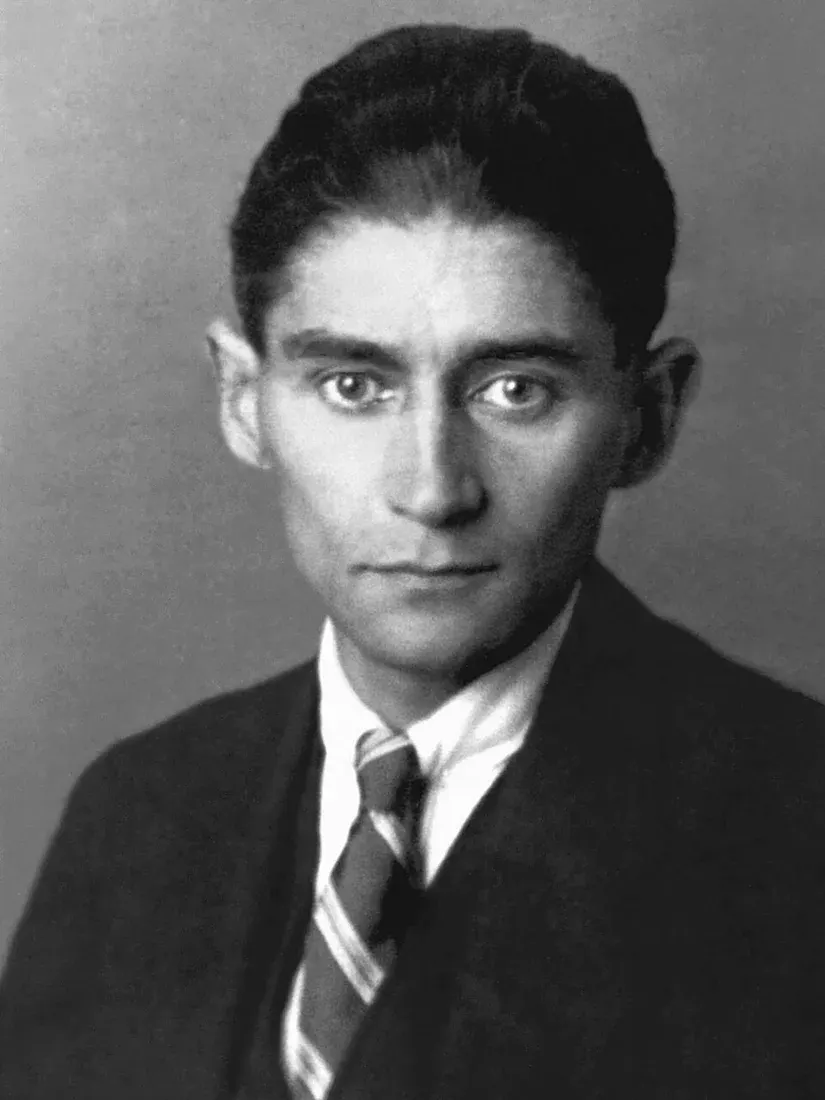 Franz Kafka (1923–24) · photo: unknown photographer · Public domain · Wikimedia Commons
Hearing this much, you would expect a scream or terror to follow in the next line. Gregor, too, first looks at his body and thinks this:
»Was ist mit mir geschehen?« dachte er. Es war kein Traum.
"What has happened to me?" he thought. It was no dream.
— Franz Kafka, The Metamorphosis (translated by Paperis from the German)
Yet, upon trying to sleep a little longer and finding he cannot turn his body, he unexpectedly moves on to a different worry at once.
»Ach Gott,« dachte er, »was für einen anstrengenden Beruf habe ich gewählt! Tag aus, Tag ein auf der Reise. …«
"Oh God," he thought, "what a strenuous job I've chosen! Day in, day out, on the road."
— Franz Kafka, The Metamorphosis (translated by Paperis from the German)
Gregor is a traveling salesman who goes about selling goods. On the morning his body has turned into a "vermin", he immediately worries about his grueling job and train times. Not a single sentence in the quoted opening explains what kind of person he is. And yet, the reader already begins to surmise something. For instance, the surmise that work is a tremendously heavy burden to this person. Just what one surmises may differ from reader to reader.
We do much the same when getting to know a new colleague at work. Someone might introduce them by saying, "They're a meticulous person," but usually we know it first by watching them correct typos in meeting materials one by one. This article follows how we come to know people in fiction. We read together Kafka's The Metamorphosis, written in German by Kafka, who passed away in 1924, and "When the Buckwheat Blooms" (original title "Momilkkot Pil Muryeop"), published in Korean by Yi Hyo-seok in 1936. At the end, we examine how far the claim that "reading novels helps us better read other people's minds" holds up through research.
People in the Text
A character is a being who experiences events, speaks, and acts within a story, and they do not have to be human. Gregor, turned into a vermin, is still a character in this novel. Even though his body has changed, he still thinks and worries. Literature textbooks also note that characters do not necessarily have to be human (Ringo & Kashyap, Writing and Critical Thinking Through Literature ch. 4.06).
It is usually the narrator who brings the characters to the reader. The narrator is the voice telling the story within the novel. How the narrator reveals the characters is covered in detail in another piece in this series, the one dealing with the speaker and point of view. This piece stays with how the reader gets to know the person brought by that voice.
Becoming curious about what kind of person a new colleague is usually happens when something about them catches your attention. Novels are much the same. Whether you chuckle or feel a pang of sympathy at the lament, "What has happened to me?" (or: "Oh God," he thought, "what a strenuous job I've chosen! Day in, day out, on the road."), a reader who feels something turns to the next page. The explanation that a reader must react to a character in some way to keep reading the story is also found in literature textbooks (Ringo & Kashyap, Writing and Critical Thinking Through Literature ch. 4.06).
Telling and Showing
Writers often compare these two as ways of revealing characters. Telling is when the narrator directly explains what kind of person a character is. Showing is when the narrator portrays a character's words, actions, and gestures, letting the reader figure out what kind of person they are. Literature textbooks also explain by comparing the two (Ringo & Kashyap, Writing and Critical Thinking Through Literature ch. 4.06). To put it like a new colleague, the introduction "He's a meticulous person" is telling, while the hands fixing typos are showing.
At the opening of "When the Buckwheat Blooms", the two are side by side. This is the passage where Heo Saengwon, a peddler who travels from market to market selling goods, and his partner Jo Seondal are wrapping up a summer market.
A summer market is a lost cause from the start: the sun is still high, yet the marketplace is already forlorn, and the hot sun slanting under the stall awnings roasts the length of your back. Heo Saengwon of the cloth stall, pockmarked and left-handed, at last tried his partner Jo Seondal. "Shall we pack up?" "Good thinking. When have we ever done a fine trade at the Bongpyeong market? We'll have to make our money at the Daehwa market tomorrow."
(Original: 여름장이란 애시당초에 글러서, 해는 아직 중천에 있건만 장판은 벌써 쓸쓸하고 더운 햇발이 벌여놓은 전 휘장 밑으로 등줄기를 훅훅 볶는다. 얼금뱅이요 왼손잡이인 드팀전의 허 생원은 기어코 동업의 조 선달에게 나꾸어 보았다. “그만 거둘까?” “잘 생각했네. 봉평 장에서 한번이나 흐붓하게 사본 일 있을까해. 내일 대화 장에서가 한몫 벌어야겠네.”)
— Yi Hyo-seok, "When the Buckwheat Blooms" (translated by Paperis)
The first sentence is telling. Eolgeumbaengi means a pockmarked person, and deuteimjeon is a shop that sells cloth. The narrator hands over Heo Saengwon's appearance, the fact that he is left-handed, and his trade all bundled into a single phrase. It is quick and clear, but what he hopes for and what he fears are not in this phrase.
The two lines that follow are showing. Heo Saengwon asks first, "Shall we pack up?", and Jo Seondal receives it with, "Good thinking," before moving on to the calculation of the Daehwa market tomorrow. The narrator does not explain that the two men move from market to market to live, or that they are closing up today and already calculating tomorrow. The dialogue lets you hear it.
The words inside quotation marks may even be handled like actual voices in the head. In one brain imaging experiment while 21 readers silently read a short story, sentences directly conveying a character's words in quotation marks activated the auditory cortex used for hearing voices more strongly than sentences paraphrasing them like "he said that ~." The same difference appeared in the region used for guessing others' intentions. This difference was not seen in sentences conveying a character's thoughts (PMID 32378999). Although it is an experiment with few readers, this matches the guess that dialogue makes a character "audible."
The Reader Who Fills in the Blanks
If someone is a new colleague, you can ask them later. You cannot do that with a character in a novel. So the reader infers the reasons for themselves from what is shown.
Gregor thinks this in his bed:
»Vorläufig allerdings muß ich aufstehen, denn mein Zug fährt um fünf.«
“For now, though, I have to get up—my train leaves at five.”
— Franz Kafka, The Metamorphosis (translated by Paperis from the German)
Yet the time for that train has already passed, and the narrator writes, "The next train was at seven." Gregor thinks he cannot quit his job because he has to pay off his parents' debt to the boss. Reading this passage, the reader infers one reason why he worries about the train time on the very morning his body has turned into a vermin. What to infer may differ from person to person. A motive is a desire or need that drives a character to act. That he cannot quit his job because he must pay off a debt is written in the work as Gregor's thought, and reading it as the motive behind his worry is the reader's part.
Reading the inside from words and actions shown on the outside is something we do every day outside of novels as well. Theory of mind is the ability to infer other people's thoughts, feelings, and desires from their words and actions. Psychology suggests that this ability can explain not only relationships with real people, but also the understanding of fictional characters (PMID 23741659). Reading characters can also be seen as using this ability.
Novels also layer minds within minds. "He remembered that she was at home" is a sentence where her situation enters one layer inside his mind. Between two experiments that had participants read short texts where these layers were increased from zero to five, in the condition where readers set their own reading speed, the one-layer texts were read the fastest, and reading slowed down as the layers increased. Texts with zero layers were slow by about the same amount as four-layer texts. Incorrect answers to questions about the content increased only at five layers (PMID 23741659). Researchers interpret this as suggesting that readers seem to prefer texts where characters' minds are revealed, yet are a little too demanding to follow.
Problems that teach the power to fill in the blanks are also dealt with in Korean language education. One domestic study views "imaginative reading"—stitching together information within a work to draw a new picture—as the root of deep empathy, and points out that textbook questions linger on fact-checking. This study notes that it observed students who read the novelist Yi Chong-jun's "The Snowy Road" failing to reach imaginative reading and thus falling short of deep empathy (DOI: 10.23109/fsikle.2019.13.1.002). Put in the terms of this essay, characters come into being where what the narrator gives and what the reader fills in meet.
Flat Characters and Round Characters
Jo Seondal only answers Heo Saengwon's question once at the beginning. How much can we know about him from that single answer?
One old way of dividing characters is by their depth (Ringo & Kashyap, Writing and Critical Thinking Through Literature ch. 4.06). A flat character is briefly summed up by one or two traits and hardly changes throughout the story. A round character possesses multiple layers of traits and inner thoughts like a real person, and can change as they experience the story. Textbooks explain that characters at the center of a story are more likely to be changed by what they experience, while minor characters often remain almost unchanged (Ringo & Kashyap, Writing and Critical Thinking Through Literature ch. 4.06).
Which side a given character belongs on can also depend on the reader's response (Ringo & Kashyap, Writing and Critical Thinking Through Literature ch. 4.06). Which side Jo Seondal is on cannot be known from the first few lines, and can only be judged by following the story to the end.
What about Gregor? He is at the center of the novella, and we hear his inner thoughts in quotation marks. How each person reads those thoughts is up to the individual reader. One domestic study views Gregor as an outsider unable to navigate social life, following the loneliness and anxiety he feels in a society with withered human relationships (KCI ART001679179). This is that researcher's reading. Is the Gregor you saw in the opening lines a diligent person bound to his work, or someone else?
Moving Into the Story
If you have ever missed your stop while listening to a novel on your commute, you were in that moment inside the story. Narrative transportation is the experience of the mind moving into the world of a story, picturing the scenes, feeling the emotions, and pouring all of one's attention into that story. This experience has been made measurable through questionnaire scales (DOI: 10.1037/0022-3514.79.5.701).
When transportation was measured across four experiments that created this scale, several things moved together. Readers who were deeply transported held more beliefs matching the story and evaluated the protagonist more favorably. They also found fewer awkward spots in the story. Whether the story was introduced as a true event or as a made-up tale made little difference to transportation and belief (DOI: 10.1037/0022-3514.79.5.701).
What deepens transportation rests on both the reader and the text. In a study where college students read about a man's college reunion, people who had experiences or knowledge touching on the theme of the story were more deeply transported (DOI: 10.1207/s15326950dp3802_5). Readers who had personal experience to bring to the story went in more deeply. Another experiment suggests that transportation may depend more on the difficulty of the text than on its genre. People who read a difficult novel or difficult nonfiction were slightly more transported than those who read an easy novel, and a pleasant mood while reading bridged that difference. The better someone was at putting themselves in others' shoes, the deeper their transportation was (DOI: 10.24839/2325-7342.jn26.4.422).
After Reading a Work of Fiction
If you meet many people in fiction, do you better read the minds of your real-life peers too? Behind this expectation lies an idea. One psychologist views fiction as a simulation running on the reader's mind, and argues that within it the reader can be themselves and a character at the same time (DOI: 10.1002/wcs.1185).
Five experiments from 2013 fueled this expectation. People who read short literary fiction scored better on a theory of mind test than those who read nonfiction, popular fiction, or nothing at all, and the researchers concluded that literary fiction transiently boosts theory of mind (PMID 24091705). One of the tests where scores rose back then showed only the eyes of people's faces. The Reading the Mind in the Eyes Test is a test that has people guess another person's mental state by looking only at their eyes. This result drew great attention (DOI: 10.1037/pspa0000064).
In science, a single result must be checked again. Replication is the process where another researcher runs the same experiment again to see if the same result comes out. Three research teams divided hundreds of people into four conditions like drawing lots and ran the tests again, but the Reading the Mind in the Eyes Test scores of the group that read literary fiction were not clearly higher than any other condition (DOI: 10.1037/pspa0000064). The original researchers countered. They said that many participants did not read the text properly and that some studies did not follow the procedure of randomly assigning participants to conditions, and that when such data were removed, the result that literary fiction is better than popular fiction appeared again (DOI: 10.1037/pspa0000072). The replication team fired back, saying that even in the results re-analyzed by the original researchers in their own way, the shape of the original result did not appear, and added that their purpose was not to prove that there is no benefit, but to make claims cautiously (DOI: 10.1037/pspa0000079).
Other replications are also mixed. Three experiments conducted with pre-registered plans left two inconclusive failures and one success (DOI: 10.1177/1948550618775410). There were also replications that largely matched the original result. However, when that replication, the original study, and other replications were pooled and calculated together, the effect was small and indistinct, and the difference in results between studies was large (DOI: 10.1525/collabra.117). In an experiment with Japanese college students conducted outside the West, having them read literary fiction briefly did not raise scores (PMID 37347739). The 2013 result that literary fiction immediately boosts mind-reading compared to other texts often failed to appear when rerun or showed mixed results.
If you broaden your view to short reading experiments as a whole, the picture changes a little. Scattered experiments are gathered through a meta-analysis. A meta-analysis is a method that gathers the results of multiple studies dealing with the same question and recalculates them all at once.
One meta-analysis that gathered experiments assigning texts to read asked "Does reading fiction causally improve the ability to fathom others' minds?" and answered yes. The group made to read fiction showed a small but clear benefit in tasks of fathoming others' minds compared to the group that read nonfiction or nothing at all, this result held up even when recalculated in various ways, and it did not appear to be due to missing unpublished studies. Whether that benefit translates into real-life relationships was left for future confirmation (DOI: 10.1037/xge0000395).
A meta-analysis that gathered more experiments also confirmed a small benefit, where the effect was clear only in empathy and mind-reading, and the effect was greater when fiction was compared with reading nothing than when compared with nonfiction (PMID 38602788). Another study reviewing twenty-one studies summarizes that reading fiction does not consistently alter empathy, and that small, conditional benefits are most visible when readers are engrossed in challenging stories and led to picture the minds of characters (PMID 42856748).
Long-Time Readers
You can also measure how much fiction someone has read in the past. The Author Recognition Test has people pick out real authors from a list mixed with fake names to gauge how much fiction that person has encountered over their lifetime. The replications by the preceding three research teams also administered this test, and regardless of what they were given to read, those who scored higher on this test also scored higher on the Reading the Mind in the Eyes Test (DOI: 10.1037/pspa0000064). A study of Japanese university students also reaffirmed the link between fiction-reading habits and the Reading the Mind in the Eyes Test (PMID 37347739).
A meta-analysis pooling the connections between lifetime reading volume and various abilities found a small positive relationship, with that association being largest for verbal ability rather than mind-reading. Reviewing experimental and correlational studies together, the authors conclude there is robust evidence for a small positive relationship between reading fiction and cognitive benefits (PMID 38602788).
There are also experiments that had people read over a long period. When 210 adults were randomly assigned to read fiction or nonfiction for 45 minutes a day, five days a week for 4 weeks, or to abstain from leisure reading, the fiction group did not outperform the other groups on any measures of theory of mind, empathy, or social functioning. Rather, the nonfiction group outperformed the reading-abstention group in empathy, and no association with lifetime reading volume was observed. The authors note limitations including a small participant count and the inability to restrict media consumption outside the experiment, and suggest that any benefits might emerge from longer reading or from a specific, immersive style of reading (DOI: 10.1037/aca0000617). In a longitudinal study following 234 adolescents five times from age twelve and a half to sixteen, reading experience and theory of mind prospectively predicted each other, but that relationship vanished once verbal ability, gender, and parental education were accounted for (PMID 40193461).
Thus, while the association where long-time readers are slightly better at reading other people's minds remains, it is still unclear which direction that relationship runs in. It could be that people who are good at reading minds are drawn to fiction, that long-term reading gradually builds that ability, or that something else like verbal ability drives them both (DOI: 10.1037/pspa0000064). Even in an experiment that had participants maintain steady reading for 4 weeks, no benefits were seen. Pooling short-term reading experiments shows that prompting people to read fiction yields a small, causal benefit on test tasks, the immediate effects unique to literary fiction have yielded mixed results across replications, and we do not yet know which direction the association with long-time readers comes from. In either case, it remains unconfirmed whether this translates to real life.
Back to Gregor's Morning
Now we reread the opening of The Metamorphosis. In the few lines we read, the narrator simply announces that Gregor has turned into a vermin, without telling us what kind of person he is. Instead, the narrator lets us hear his thoughts in quotation marks. After wondering what has happened to him, he immediately laments his strenuous job and worries about the five o'clock train, even though the time for that train to leave has already passed. Filling in the blanks between those thoughts, the reader gathers, for instance, that he is a man hounded by his work, and upon encountering his thought that he cannot quit his job because he has to pay off a debt, the reader can add another reason to that supposition. Even while reading these few lines, the reader is engaged in inferring the inner life of another.
Whether Gregor is flat or round cannot be decided yet. Whether he changes as he undergoes the story lies beyond the opening. Yet if a reader is following his train worries even in a story where a person turns into a vermin, that reader has already been transported into this story.
Still, there is weak ground to expect that this single opening passage will raise scores on the Reading the Mind in the Eyes test. The immediate effects of literary fiction alone have yielded mixed results in replication, and the gains gathered from short reading experiments are also small. What current research can tell us is a smaller fact: the act of reading characters resembles the act of inferring the minds of others, and readers can become deeply absorbed in that activity. There is a correlation wherein people who have done that activity for a long time read the minds of others slightly better, but the question of which direction that correlation comes from remains open.
Where to Look Next
How far the narrator opens up and shows the inside of a character continues from another part of this series, the one covering narrator and point of view. The order of conflicts and events the characters run into is covered by the part on plot structure, the pictures drawn by words by the part on metaphor and image, and the melody of speech sounds by the part on rhythm.
Another story where a single brief experiment grew into a big belief only for replication to falter exists in music as well. "The Mozart Effect — Ten Minutes in the Earphones Before the Test" traces that process.
Source Papers
- "Writing and Critical Thinking Through Literature — 4.06 Character" (Heather Ringo·Athena Kashyap, LibreTexts, CC BY-NC 4.0) — Ringo & Kashyap, Writing and Critical Thinking Through Literature ch. 4.06 — Characters do not need to be human, readers must react to characters to keep reading, the distinction between telling versus showing and flat versus round characters (central characters change while minor characters barely change), and how those determinations can depend on reader response.
- "Processing Speech and Thoughts during Silent Reading: Direct Reference Effects for Speech by Fictional Characters in Voice-Selective Auditory Cortex and a Theory-of-Mind Network." (2020) — PMID 32378999 — 21 participants in fMRI. Direct speech by characters activated voice-selective auditory cortex and intention-understanding regions more than indirect speech did, while sentences conveying thoughts showed no such difference.
- "Theory of Mind and embedding of perspective: A psychological test of a literary "sweet spot"." (2012) — PMID 23741659 — Theory of mind also explains the comprehension of fictional characters. Perspective embedding levels 0 to 5: one layer is the fastest, and understanding slows down as the layers increase; zero layers are as slow as four layers, and incorrect answers increase only at five layers.
- "소설의 ‘상상적 읽기’와 공감 - 이청준의 “눈길” 읽기를 예로" (2019) — DOI: 10.23109/fsikle.2019.13.1.002 — A Korean language education study confirming that imaginative reading (the process of connecting information within a work to paint new images) is the root of deep empathy, that textbooks linger on factual reading, and that students who read "The Snowy Road" failed to reach imaginative reading and thus did not attain deep empathy.
- "카프카의 “변신”에 나타난 불안의 미학" (2012) — KCI ART001679179 — A researcher's interpretation viewing Gregor as an outsider unable to participate in social life, and reading the solitude and anxiety he feels in a society lacking human relationships as the zeitgeist of modernism.
- "The role of transportation in the persuasiveness of public narratives." (2000) — DOI: 10.1037/0022-3514.79.5.701 — Created a scale to measure transportation (imagery, emotion, and attentional focus), finding that greater transportation increased beliefs fitting the story and favorable evaluations of the protagonist while reducing the detection of awkward aspects, and that true/fictional labels generally had no effect.
- "Transportation Into Narrative Worlds: The Role of Prior Knowledge and Perceived Realism" (2004) — DOI: 10.1207/s15326950dp3802_5 — 152 college students. People with experience and knowledge related to the story's theme achieved deeper transportation.
- "The Effects of Genre and Reading Difficulty on Narrative Transportation: The Mediating Role of Affect" (2021) — DOI: 10.24839/2325-7342.jn26.4.422 — Difficult novels and nonfiction showed higher transportation than easy novels (a small difference), mediated by positive emotion, and empathy traits correlated positively with transportation. Transportation may depend on difficulty and emotion rather than genre.
- "The cognitive science of fiction" (2012) — DOI: 10.1002/wcs.1185 — The hypothesis (the author's assertion) that fiction is a simulation running on the mind and that the reader can be themselves while also becoming the character.
- "Reading literary fiction improves theory of mind." (2013) — PMID 24091705 — In five experiments, reading literary fiction scored higher on theory of mind tests than nonfiction, popular fiction, or no reading, leading the authors to conclude that literary fiction temporarily heightens theory of mind.
- "Does reading a single passage of literary fiction really improve theory of mind? An attempt at replication." (2016) — DOI: 10.1037/pspa0000064 — Three research teams, 792 participants, four conditions randomly assigned; literary fiction showed no advantage on the Reading the Mind in the Eyes Test. Lifetime fiction exposure (author recognition test) predicted scores regardless of condition. Concluding that people who read well tend to be drawn to fiction, that lifetime reading gradually reinforces it, or that other variables like verbal ability may be at play.
- "Panero et al. (2016): Failure to replicate methods caused the failure to replicate results." (2017) — DOI: 10.1037/pspa0000072 — The original authors' rebuttal: excluding unread participants and failed random assignments shows that literary fiction increases theory of mind more than popular fiction does.
- "No support for the claim that literary fiction uniquely and immediately improves theory of mind: A reply to Kidd and Castano’s commentary on Panero et al. (2016)." (2017) — DOI: 10.1037/pspa0000079 — The replication team's counter-rebuttal: re-analyzing using the original authors' method still fails to reproduce the original pattern of results. The goal is not to prove the absence of a benefit, but to urge moderation in claims.
- "Reading Literary Fiction and Theory of Mind: Three Preregistered Replications and Extensions of Kidd and Castano (2013)" (2018) — DOI: 10.1177/1948550618775410 — Three preregistered experiments: two inconclusive failures, one success.
- "The Effect of Reading a Short Passage of Literary Fiction on Theory of Mind: A Replication of Kidd and Castano (2013)" (2018) — DOI: 10.1525/collabra.117 — Direct replication largely aligned with the original results, but the effect of a small-scale meta-analysis pooling existing direct replications was small, non-significant, and showed high cross-study heterogeneity.
- "Is reading fiction associated with a higher mind-reading ability? Two conceptual replication studies in Japan." (2023) — PMID 37347739 — Japanese college students: Study 1 (338 participants) replicated the correlation between fiction reading habits and Reading the Mind in the Eyes Test scores, while Study 2 (304 participants) failed to replicate the causal effect of reading a short literary fiction piece.
- "Fiction reading has a small positive impact on social cognition: A meta-analysis." (2018) — DOI: 10.1037/xge0000395 — 14 studies, 53 effect sizes. Answering "Yes" to "Does fiction reading causally increase social cognition?" — it increased social cognition performance in a small yet significant way compared to nonfiction or no reading, robust to sensitivity analysis and not appearing to stem from publication bias. Real-world transfer and mechanisms remain tasks for future work.
- "Cognitive effects and correlates of reading fiction: Two preregistered multilevel meta-analyses." (2024) — PMID 38602788 — Experimental meta-analysis: small cognitive benefits, varying by comparison group (vs. no reading/video > vs. nonfiction) and outcome variable (only empathy and mind-reading significant). Correlational meta-analysis: small positive relationship with lifetime fiction exposure, largest in verbal ability, with correlational designs showing larger effects than experimental ones. Concluding robust evidence for a small positive relationship between fiction reading and cognitive benefits.
- "Empathy and perspective-taking in literary fiction: a systematic review and meta-analysis of psychological evidence and theoretical insights." (2026) — PMID 42856748 — 21 studies. Small yet reliable benefits. Concluding that fiction does not uniformly alter empathy, and that benefits are most visible when engaged with demanding stories and guided to simulate characters' minds while transported.
- "The impact of fiction reading on social outcomes: A 4-week randomized controlled study." (2023) — DOI: 10.1037/aca0000617 — 210 adults, 4 weeks, 45 minutes a day, 5 days a week. Fiction reading did not outperform nonfiction or no reading in any social outcomes (nonfiction outperformed no reading on latent empathy variables), and showed no association with lifetime exposure. Stating limitations in sample size, measurement, and external media.
- "Longitudinal development of theory of mind in adolescence and its associations with fiction reading experience." (2025) — PMID 40193461 — 234 participants aged 12.5 to 16 measured 5 times. The bidirectional association between reading experience and theory of mind disappeared after controlling for verbal ability, gender, and parental education.
Sources (20)
- Writing and Critical Thinking Through Literature — 4.06 Character
- Processing Speech and Thoughts during Silent Reading: Direct Reference Effects for Speech by Fictional Characters in Voice-Selective Auditory Cortex and a Theory-of-Mind NetworkPMID 32378999
- Theory of Mind and embedding of perspective: A psychological test of a literary \PMID 23741659
- 소설의 ‘상상적 읽기’와 공감 - 이청준의 「눈길」 읽기를 예로DOI 10.23109/fsikle.2019.13.1.002
- The role of transportation in the persuasiveness of public narrativesDOI 10.1037/0022-3514.79.5.701
- Transportation Into Narrative Worlds: The Role of Prior Knowledge and Perceived RealismDOI 10.1207/s15326950dp3802_5
- The Effects of Genre and Reading Difficulty on Narrative Transportation: The Mediating Role of AffectDOI 10.24839/2325-7342.jn26.4.422
- The cognitive science of fictionDOI 10.1002/wcs.1185
- Reading literary fiction improves theory of mindPMID 24091705
- Does reading a single passage of literary fiction really improve theory of mind? An attempt at replicationDOI 10.1037/pspa0000064
- Panero et al. (2016): Failure to replicate methods caused the failure to replicate resultsDOI 10.1037/pspa0000072
- No support for the claim that literary fiction uniquely and immediately improves theory of mind: A reply to Kidd and Castano’s commentary on Panero et al. (2016)DOI 10.1037/pspa0000079
- Reading Literary Fiction and Theory of Mind: Three Preregistered Replications and Extensions of Kidd and Castano (2013)DOI 10.1177/1948550618775410
- The Effect of Reading a Short Passage of Literary Fiction on Theory of Mind: A Replication of Kidd and Castano (2013)DOI 10.1525/collabra.117
- Is reading fiction associated with a higher mind-reading ability? Two conceptual replication studies in JapanPMID 37347739
- Fiction reading has a small positive impact on social cognition: A meta-analysisDOI 10.1037/xge0000395
- Cognitive effects and correlates of reading fiction: Two preregistered multilevel meta-analysesPMID 38602788
- Empathy and perspective-taking in literary fiction: a systematic review and meta-analysis of psychological evidence and theoretical insightsPMID 42856748
- The impact of fiction reading on social outcomes: A 4-week randomized controlled studyDOI 10.1037/aca0000617
- Longitudinal development of theory of mind in adolescence and its associations with fiction reading experiencePMID 40193461