Paperis Articles
How Stories Are Built — The Order Things Happen and the Order They Are Told
Story is the order in which events happen; plot is the order the author chooses to tell them in and the web of reasons that links them. Conflict drives a story, foreshadowing is laid down in advance, and irony is a gap between words or expectations and what actually happens. Whether knowing the ending spoils the fun differs from experiment to experiment, and one study sums the effect up as small and conditional.
Your field's papers, as audio
Pick your fields and journals — Paperis summarizes the key papers and turns them into audio. Listen on your commute.
Start Paperis free →How Stories Are Built — The Order Things Happen and the Order They Are Told
A Rainy Day, a Lucky Day
Hyeon Jin-geon's 1924 short story "A Lucky Day" begins with the weather.
The sky was sullenly overcast, as if it might snow, but no snow came; a half-frozen rain drizzled down instead.
For Kim Cheomji, who pulled a rickshaw inside Dongsomun Gate, this day of all days was a lucky day, come at long last.
(Original: 새침하게 흐린 품이 눈이 올 듯하더니 눈은 아니 오고 얼다가 만 비가 추적추적 내리었다. 이날이야말로 동소문 안에서 인력거꾼 노릇을 하는 김 첨지에게는 오래간만에도 닥친 운수 좋은 날이었다.)
— Hyeon Jin-geon, "A Lucky Day" (translated by Paperis)
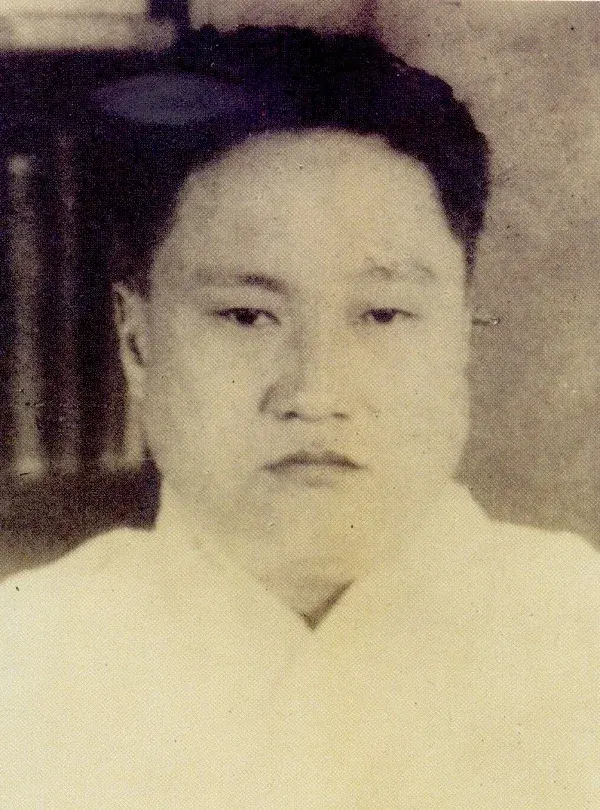 Hyeon Jin-geon (around 1943) · photo: unknown photographer · Public domain · Wikimedia Commons
Both the title and the second sentence tell us that this is a lucky day. Indeed, on this rainy day Kim Cheomji picks up passengers one after another and makes money. Yet the words "lucky" also appear in the story's final line, and the position they occupy there is entirely different from the beginning. We will examine that final position separately in the section on endings.
The reason the same words sound different at the beginning and the end lies in the order in which the story is told. Think of when you come home from work and tell your family at the dinner table about what happened that day. We rarely start from the moment we opened our eyes in the morning. We begin with "Do you know what happened on the subway today?", bring out the most surprising scene first, and add why that happened only later. The moment we choose what to leave out and what to tell first, the same day becomes a different story.
This article uses novels written in Korean alongside novels written in English and German to follow the order in which stories tell events, and what that order does to the reader. At the end, we look at experiments testing whether knowing the ending beforehand spoils enjoyment, and research using computers to measure anywhere from a thousand to tens of thousands of stories.
The Order of Events and the Order of Telling
Story is the order in which events actually happened in the narrative. If we arrange the events of "A Lucky Day" in the order they happened, the sick wife's begging for seolleongtang broth started three days before that rainy morning. Yet the novel begins with the rain of that morning, and the wife's request is slipped in afterward as a past event. It is a single sentence: “For three days she had been pestering her husband, saying she wanted to drink seolleongtang broth.”
Plot is the order in which the author chooses to arrange the events and the web of causes connecting them. If story is “what happened when”, plot is “in what order, connecting what to what, do we tell those events”. English literature textbooks also describe plot as the major events and the ways those events are connected to one another, and separately treat the method of slipping in past events later (Ringo & Kashyap, Writing and Critical Thinking Through Literature ch. 4.07).
Just as we might bring up the most surprising scene at the dinner table first, the author chooses and omits events. Franz Kafka's novella The Metamorphosis, written in German, makes a major choice of this kind in its very first sentence.
Als Gregor Samsa eines Morgens aus unruhigen Träumen erwachte, fand er sich in seinem Bett zu einem ungeheueren Ungeziefer verwandelt.
When Gregor Samsa woke one morning from troubled dreams, he found himself transformed in his bed into a monstrous vermin.
— Franz Kafka, The Metamorphosis (translated by Paperis from the German)
This sentence skips the moment a human turns into a "vermin", and begins by telling of waking up in an already-transformed body. The transformation of a human into a vermin is already over by the time the first sentence begins. Deciding where to start telling is also part of the plot.
There is a narrative theory holding that when authors weave events together, they aim to make readers experience suspense, curiosity, or emotional immersion. The same theory suggests that if that goal clashes with what a character wants, contrived devices or logical holes can arise (DOI: 10.1353/nar.0.0016). Meanwhile, a domestic Korean study on language education also views plot as the result that readers actively make sense of as they read (KCI ART001057339). The weaver is the author, and the one piecing it together by reading is the reader. Even with the same events, if the order of telling changes, the story experienced by the reader changes.
The Force That Drives a Story, Conflict
In "A Lucky Day", Kim Cheomji pulls a rickshaw and earns money on a rainy day, while at home his sick wife longs for a bowl of seolleongtang broth. One person picks up passengers outside, and the other hopes for a bowl of soup at home.
Conflict is when differing desires or forces collide within a story. This conflict is the force that pushes the plot forward (Ringo & Kashyap, Writing and Critical Thinking Through Literature ch. 4.07). In "A Lucky Day", one way to read the conflict is to look for where the desires and circumstances of the two characters clash. What a character wants and why they move that way—in short, their motivation—is covered in another part of this series dealing with characters.
When conflict builds up, at some point the flow of the story turns around (Ringo & Kashyap, Writing and Critical Thinking Through Literature ch. 4.07). The climax is the spot where the flow of the story turns. Just how to view the major divisions of a story is not fixed to a single standard. Many modern screenwriting books recommend making a major break in the story at around the three-quarters mark. The spot is mostly the same, but different books define this exact point as a major turning point of cause and effect, as the moment of deepest emotional darkness, or as the place where the question raised earlier is answered (DOI: 10.1386/josc.2.1.85_1).
You may remember learning to divide stories into five stages and memorizing them back in school. Previous Korean language education research cautions against this kind of reading that forces stories to fit a rigid template (KCI ART001057339). The final part where a story closes is called the resolution, but the resolution does not necessarily tie up every thread of the conflict either (Ringo & Kashyap, Writing and Critical Thinking Through Literature ch. 4.07). The names of the stages are graduations for looking at a story, not a blueprint that every story must follow.
A Trail Laid Ahead
"The Story of an Hour", a short story published by Kate Chopin in the magazine Vogue in 1894, begins like this:
Knowing that Mrs. Mallard was afflicted with a heart trouble, great care was taken to break to her as gently as possible the news of her husband's death.
— Kate Chopin, "The Story of an Hour"
A single opening sentence contains the heavy news of a husband's death. Yet this sentence tells us of the wife's heart trouble before the news itself. On a first reading, the heart trouble passes by simply as the reason why the news must be broken with care. Where this heart trouble appears again in the story, we will see in the section dealing with the ending.
Foreshadowing is a device that quietly lays down hints in advance for what is to come. A passage of foreshadowing feels like an offhand remark when you read it first, but when you look back after reading to the end, its weight changes. This device does not belong to modern fiction alone. One study analyzing the biographical accounts in Sima Qian's historical work Records of the Grand Historian suggests that placing unexpected events early on arouses the reader's expectation and tension, while connecting the beginning and the end to make the structure tight (KCI ART003279470).
Just as there are various ways to lay foreshadowing, there are also various ways to resolve it. One study divides the ways foreshadowing is resolved into four types: immediate continuation, subversion, gradual revelation, and remaining open (DOI: 10.54698/kl.2025.19.51). Foreshadowing that resolves through subversion leads into the misalignment and reversal we will cover in the next section.
When Words and Reality Diverge
Imagine someone saying, "What lovely weather," on a day when a torrential downpour is falling. The words and reality are exact opposites, and the speaker says this hoping the listener will understand the opposite meaning. Verbal irony is usually a scene like this (DOI: 10.1080/01638539509544937).
Irony is a discrepancy between words or expectations and reality. A domestic study analyzing Hyeon Jin-geon's short stories summarizes that there are broadly two long-agreed-upon forms of irony: one where the words themselves contradict their meaning, and one where the events that unfold contradict expectations (KCI ART002894655). The latter is what matters in the structure of a story.
Situational irony is a discrepancy between what a character or reader expects and what actually happens. The aforementioned domestic study analyzing Hyeon Jin-geon's short stories reads that Hyeon Jin-geon builds irony through discrepancies in words and misalignments in cause and effect, exposing through that distance the contradictions of reality in the colonial era (KCI ART002894655). This is one researcher's reading, and readers may answer differently as to what this irony targets in the novel. An educational study suggests that irony in this novel plays a central role in turning everyday speech into literary language (DOI: 10.23016/kllj.2009.46..335).
There is one more name frequently called out separately in literature. Dramatic irony occurs when a reader knows something a character does not, so the character's words take on unintended double meanings. People easily catch irony even when the speaker did not intend it. This happened across four experiments, and the researchers note that many instances of dramatic irony in literature rest precisely upon this situation (DOI: 10.1080/01638539509544937). In "A Lucky Day", Kim Cheomji says at a drinking table, "I raked in money today. My luck was truly good today." To Kim Cheomji, this statement is true. He really did make money that day. This line sounds different only after the reader has learned more than Kim Cheomji, that is, when coming back to read it again knowing the ending.
A twist is a turning point that flips the direction the reader has believed the story was taking. If irony is a discrepancy between words or expectations and reality, a twist is the event where that discrepancy is revealed in a single moment. Both are present together in the two endings of the next section.
Two Endings, Read Anew
This section discusses endings. If you have not yet read "A Lucky Day" and "The Story of an Hour" and want to read them without knowing the endings, you can skip this section and go to the next.
Kim Cheomji in "A Lucky Day" comes home carrying the seolleongtang. His wife is already dead. The final lines are these:
"I bought you seolleongtang, so why can't you eat it, why can't you eat it... Strange, today of all days! My luck was so good..."
(Original: “설렁탕을 사다놓았는데 왜 먹지를 못하니, 왜 먹지를 못하니... 괴상하게도 오늘은! 운수가 좋더니만... ”)
— Hyeon Jin-geon, "A Lucky Day" (translated by Paperis)
The words "lucky day" from the title and the second sentence return in the final lines as "My luck was so good today." The statement that luck is good directly contradicts what actually happened that day. We can read this as the irony of the situation defined earlier. Readers who now reread "My luck was truly good today" at the drinking spot know what Kim Cheomji did not know then.
Mrs. Mallard in "The Story of an Hour" goes to her room alone upon hearing the news, weeps, and keeps whispering, "Free! Body and soul free!". As she comes down the stairs, her husband walks in the front door. The husband was far from the scene of the accident and did not even know an accident had happened. The reader's belief that "the husband is dead" is upended at this moment. The final sentence is the diagnosis of the doctors:
When the doctors came they said she had died of heart disease — of the joy that kills.
— Kate Chopin, "The Story of an Hour"
In the original English, the word "heart" appears in only two places: the first sentence and this final sentence. The heart trouble that passed by in the first sentence as the reason to break the news gently returns in the final sentence as the cause of death. If we read the heart trouble of the first sentence as foreshadowing, this is where that foreshadowing is gathered in. The doctors say her death was due to "joy." Yet the reader is the one who heard her whisper "Free!" in the room where she was alone. When we reread the doctors' words with that scene known to the reader kept close by, we can read it as dramatic irony.
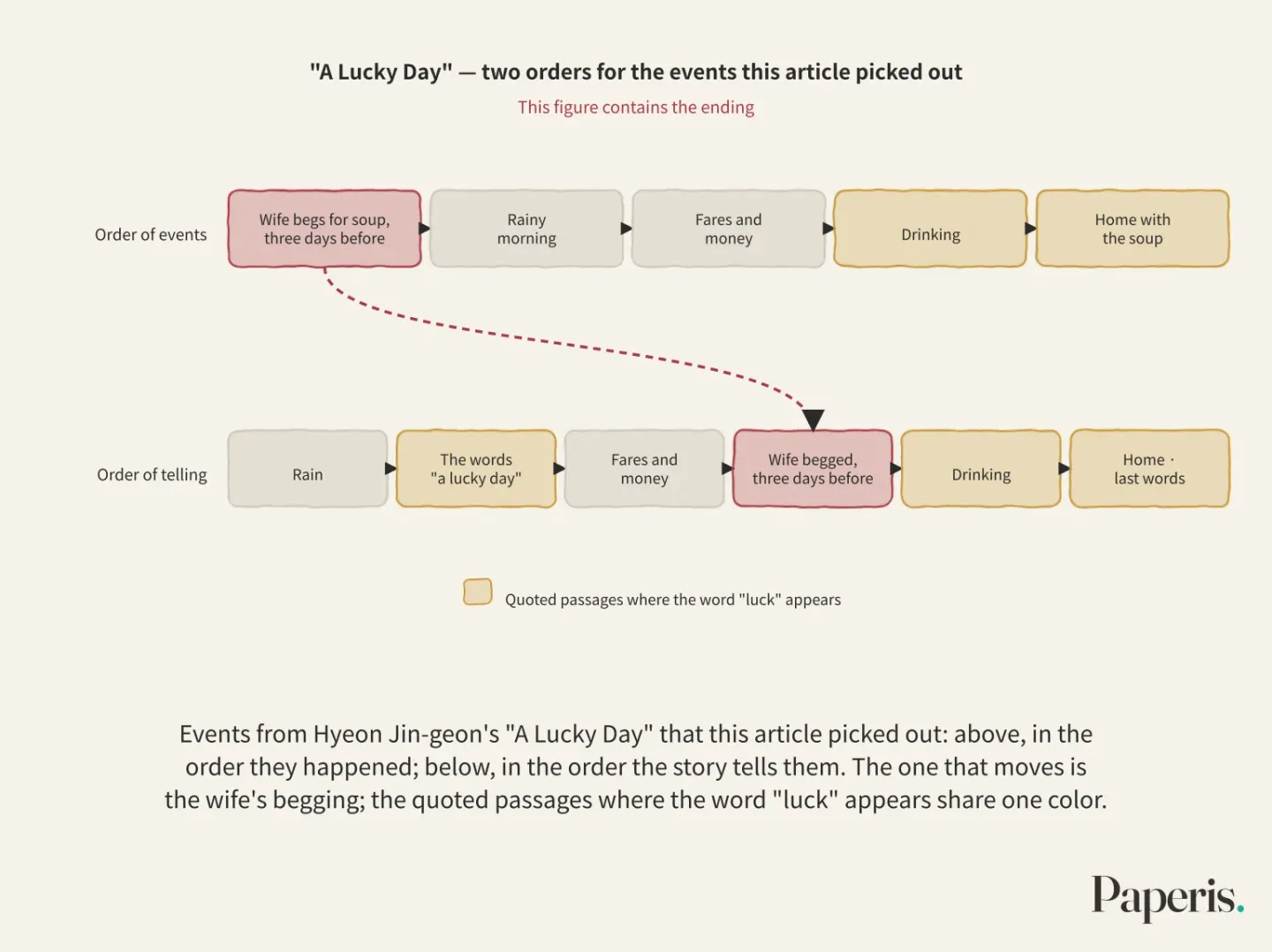
Now let us apply the two orders promised by the title to "A Lucky Day." If we place the events chosen by this article in the order they happened, the wife's pestering for seolleongtang starting three days prior is at the very front, followed by the rainy morning, the customers and money, the drinking spot, and the return home carrying the seolleongtang. In the order they are told, the rain stands at the very front, the words "A Lucky Day" come in the second sentence, the customers and money follow, and only then is the wife's pestering inserted. The events are the same; only the order differs. Thanks to that order, the reader hears the word about good luck first, carries that word along, and meets it again at the drinking spot and in the final lines.
Does Knowing the Ending Diminish the Fun?
Articles discussing drama or movie plots on the internet often carry a warning that reads "Spoiler Warning." A spoiler is information that reveals the outcome or a twist of a story before reaching that point in the plot. Many people avoid spoilers, and there are theories suggesting that spoilers ruin excitement and suspense (DOI: 10.1177/0093650214564051). Suspense is a state of being on edge while waiting for what will happen next. Suspense appears to rest upon the basic mental functions of anticipating, looking ahead, and predicting (PMID 25946306).
So, does knowing the ending make the fun disappear as well? The experimental findings on this question are mixed. In initial experiments, participants enjoyed stories whose endings were revealed in advance just as much as, or even more than, stories read without knowing the ending (PMID 30115003). Another experiment suggested that knowing the ending makes it easier to take in the clues and events of a story, thereby increasing enjoyment. However, that benefit did not always appear in very easily readable stories (DOI: 10.1075/ssol.3.1.09lea).
The results of experiments attempting to replicate these findings differed. In an experiment where 412 participants encountered both stories with known endings and stories with unknown endings, the version read without knowing the ending was more fun, more suspenseful, more moving, and overall more enjoyable (DOI: 10.1177/0093650214564051). In an experiment closely replicating the earlier methods, spoilers given before reading reduced enjoyment, whereas spoilers given during reading had no clear effect (DOI: 10.1080/0163853x.2016.1141350). In another experiment, spoilers detracted from enjoyment under certain conditions for an entire television episode, but not for short stories (PMID 30115003).
The most recent experiments again lean toward no effect. When 326 college students read three published short stories featuring unexpected or twist endings, whether they were given the theme in advance or given the plot and ending in advance, there was generally no clear difference in enjoyment (DOI: 10.61645/ssol.190).
There is also a clue that suspense and enjoyment may not necessarily move together. In an experiment where 50 participants were shown suspenseful movie scenes three times, self-rated suspense and excitement, along with bodily arousal measured by galvanic skin conductance, decreased with repeated viewing, but self-rated enjoyment did not change significantly. The researchers attribute this to the result of becoming accustomed to the same scene (PMID 33192815). People also showed a tendency to overestimate how much spoilers would ruin the fun, though this overestimation sometimes disappeared depending on the individual or conditions. When spoilers revealed the unfolding process instead of the outcome of events, people actually anticipated a smaller negative effect (DOI: 10.1016/j.jcps.2015.05.003).
Most of these experiments involved participants encountering short stories, video clips, or at most a single television episode (one survey asked about a television series based on a novel). Therefore, it is difficult to directly apply these findings to full-length novels or long-running dramas as a whole. There is one takeaway: the belief that knowing the ending in advance greatly diminishes enjoyment has not been consistently confirmed in one direction by experiments (DOI: 10.61645/ssol.190). Research conducting two experiments and surveys using television and film concludes that the effect of spoilers is quite small, much like in short story experiments, and varies depending on conditions (DOI: 10.1080/15213269.2017.1338964).
The Shape of a Story Measured by Computer
Some research attempts to measure the structure of a story using computers. An emotional arc is a line connecting the rise and fall of the emotions expressed in a text as it is followed from beginning to end. When emotional arcs extracted from 1,327 novels from Project Gutenberg, a free e-book collection, were classified, six basic shapes emerged, and more complex curves could be seen as combinations of these six. The researchers report that stories with certain shapes were more popular, as measured by download counts (DOI: 10.1140/epjds/s13688-016-0093-1).
Another study measured the words used in about 40,000 stories, including novels and movie scripts. As a result, three distinct strands appeared as a consistent structure: setting the stage, driving the plot forward, and psychological tension (DOI: 10.1126/sciadv.aba2196). Applying the same method to over 12,000 song lyrics, the lyrics also set the stage upfront, drove the plot through to the end, and had the highest tension around the middle (DOI: 10.1371/journal.pone.0303188).
The two studies asked different questions. The former study looked at which arc shapes were downloaded more, while the 40,000-story study examined whether closer adherence to a fixed structure led to higher popularity, but no such evidence was found (DOI: 10.1126/sciadv.aba2196). Therefore, it is difficult to combine the two results into a single line. Moreover, what both studies measured were the words used in the text. Whether these curves can capture how the same words sound different depending on what has been heard before them—like the final line of "A Lucky Day"—is something neither study answers.
Where to Look Next
Who is telling the story and whether that voice is reliable are covered by other entries in this series on narrator and point of view. What characters want as they act, and the experience of getting lost in a story, are covered by the entries on character and mind reading. The ways language is used by comparison are handled by the entry on metaphor and imagery, and the sounds of poetry by the entry on meter.
Surprise when expectations are thwarted in music is covered in "Haydn — Why Is the Ear Surprised, and When Does Surprise Feel Good?".
Source Papers
- "Writing and Critical Thinking Through Literature — 4.07 Plot" (Heather Ringo·Athena Kashyap, LibreTexts, CC BY-NC 4.0) — Ringo & Kashyap, Writing and Critical Thinking Through Literature ch. 4.07 — Defines plot as main events and how they connect, conflict as the force pushing the plot, the climax as a turning point, and explains that resolutions do not always tie up conflicts.
- "Cheap Plot Tricks, Plot Holes, and Narrative Design" (2009) — DOI: 10.1353/nar.0.0016 — Discusses how an author's plot construction aims to control reader experiences like suspense, curiosity, and emotional immersion, and how flaws arise when plots clash with character goals.
- "허구적 서사물의 플롯 이해에 기반한 서사 추론 교육" (2007) — KCI ART001057339 — A Korean language education study arguing that plot exists as the result of a reader's active understanding and warning against algorithmic reading that applies fixed narrative schemata.
- "The plot point, the darkest moment, and the answered question: three ways of modelling the three-quarter-point" (2010) — DOI: 10.1386/josc.2.1.85_1 — An analysis showing how screenwriting guides define the three-quarter point differently: as a turning point of causality, the darkest moment, or the answering of a question.
- "“史記ㆍ列傳”의 복선 연구" (2025) — KCI ART003279470 — An analysis showing how Sima Qian used foreshadowing to connect the beginning and end, generating reader expectation and tension through unexpected events in the early parts.
- "서사해석 이론의 새 관점 연구 : 복선을 중심으로" (2025) — DOI: 10.54698/kl.2025.19.51 — Categorizes the resolution of foreshadowing into linear, reversal, gradual, and open types.
- "현진건 단편 소설의 아이러니 양식과 그 현실인식" (2022) — KCI ART002894655 — Identifies the agreed-upon forms of irony as rhetorical and situational, reading Hyeon Jin-geon as exposing the contradictions of colonial modernity from a distance through linguistic mismatch and causal incongruity.
- "현진건의 “운수 좋은 날”에 나타나는 '아이러니(Irony)'의 교육 연구" (2009) — DOI: 10.23016/kllj.2009.46..335 — An educational study taking the irony in "A Lucky Day" as a literary education topic, viewing irony as playing a fundamental role in turning everyday language into literary language.
- "Inferring meanings that are not intended: Speakers' intentions and irony comprehension" (1995) — DOI: 10.1080/01638539509544937 — Shows in four experiments that people easily detect unintended irony in speakers, and that dramatic irony in literature builds on this situation.
- "Reading a suspenseful literary text activates brain areas related to social cognition and predictive inference." (2015) — PMID 25946306 — Suggests suspense rests on the cognitive processes of expectation and prediction, with suspense ratings linked to brain activity in areas related to social cognition and predictive inference.
- "Spoilers Affect the Enjoyment of Television Episodes but Not Short Stories." (2019) — PMID 30115003 — Notes that prior work found spoiled short stories were enjoyed as much as or more than unspoiled ones, and finds in their own experiments that spoilers lower enjoyment only for television.
- "The fluency of spoilers: Why giving away endings improves stories" (2013) — DOI: 10.1075/ssol.3.1.09lea — Finds that increased enjoyment from spoilers is mediated by processing fluency, and that the effect varies by condition for very easy stories.
- "Spoiler Alert: Consequences of Narrative Spoilers for Dimensions of Enjoyment, Appreciation, and Transportation" (2014) — DOI: 10.1177/0093650214564051 — Finds in a within-subjects experiment (N=412) that unspoiled stories were funnier, more suspenseful, and more moving and enjoyable.
- "The Effect of Spoilers on the Enjoyment of Short Stories" (2016) — DOI: 10.1080/0163853x.2016.1141350 — In close replication experiments, pre-reading spoilers reduced enjoyment while mid-story spoilers had no effect.
- "The Role of Different Spoiler Types in the Experience of Short Stories" (2025) — DOI: 10.61645/ssol.190 — Involves 326 college students and three short stories with twist endings, finding no significant effect of either thematic or plot spoilers on enjoyment.
- "(Don't) Tell Me How It Ends: Spoilers, Enjoyment, and Involvement in Television and Film" (2017) — DOI: 10.1080/15213269.2017.1338964 — Across two experiments and surveys, television and film spoiler effects are quite small and conditional.
- "Re-Living Suspense: Emotional and Cognitive Responses During Repeated Exposure to Suspenseful Film." (2020) — PMID 33192815 — In 50 participants watching the same scene three times, suspense, arousal, and skin conductance decreased while self-reported enjoyment showed no significant difference.
- "The misforecasted spoiler effect: Underlying mechanism and boundary conditions" (2015) — DOI: 10.1016/j.jcps.2015.05.003 — Shows that people over-forecast the impact of spoilers and under-forecasted negative effects for spoilers revealing plot process.
- "The emotional arcs of stories are dominated by six basic shapes" (2016) — DOI: 10.1140/epjds/s13688-016-0093-1 — Identifies six basic shapes in emotional curves across 1,327 Project Gutenberg novels, finding certain curves more successful by download count.
- "The narrative arc: Revealing core narrative structures through text analysis" (2020) — DOI: 10.1126/sciadv.aba2196 — Finds consistent structures of setting the stage, plot progression, and cognitive tension across roughly 40,000 traditional narratives, with no evidence that following the structure correlates with popularity.
- "Songs tell a story: The Arc of narrative for music" (2024) — DOI: 10.1371/journal.pone.0303188 — Analyzes 12,280 song lyrics to show they set the stage early, push the plot through to the end, and peak in cognitive tension at the center.
Sources (18)
- Writing and Critical Thinking Through Literature — 4.07 Plot
- Cheap Plot Tricks, Plot Holes, and Narrative DesignDOI 10.1353/nar.0.0016
- The plot point, the darkest moment, and the answered question: three ways of modelling the three-quarter-pointDOI 10.1386/josc.2.1.85_1
- 서사해석 이론의 새 관점 연구 : 복선을 중심으로DOI 10.54698/kl.2025.19.51
- 현진건의 「운수 좋은 날」에 나타나는 '아이러니(Irony)'의 교육 연구DOI 10.23016/kllj.2009.46..335
- Inferring meanings that are not intended: Speakers' intentions and irony comprehensionDOI 10.1080/01638539509544937
- Reading a suspenseful literary text activates brain areas related to social cognition and predictive inferencePMID 25946306
- Spoilers Affect the Enjoyment of Television Episodes but Not Short StoriesPMID 30115003
- The fluency of spoilers: Why giving away endings improves storiesDOI 10.1075/ssol.3.1.09lea
- Spoiler Alert: Consequences of Narrative Spoilers for Dimensions of Enjoyment, Appreciation, and TransportationDOI 10.1177/0093650214564051
- The Effect of Spoilers on the Enjoyment of Short StoriesDOI 10.1080/0163853x.2016.1141350
- The Role of Different Spoiler Types in the Experience of Short StoriesDOI 10.61645/ssol.190
- (Don't) Tell Me How It Ends: Spoilers, Enjoyment, and Involvement in Television and FilmDOI 10.1080/15213269.2017.1338964
- Re-Living Suspense: Emotional and Cognitive Responses During Repeated Exposure to Suspenseful FilmPMID 33192815
- The misforecasted spoiler effect: Underlying mechanism and boundary conditionsDOI 10.1016/j.jcps.2015.05.003
- The emotional arcs of stories are dominated by six basic shapesDOI 10.1140/epjds/s13688-016-0093-1
- The narrative arc: Revealing core narrative structures through text analysisDOI 10.1126/sciadv.aba2196
- Songs tell a story: The Arc of narrative for musicDOI 10.1371/journal.pone.0303188