Paperis Articles
Speaker and Point of View — "Hearken!": A Voice That Begs to Be Believed
Poems and stories always speak through someone's voice. That voice cannot simply be assumed to be the author's; it may stand inside the story or outside it, and sometimes it is hard to take at its word.
Your field's papers, as audio
Pick your fields and journals — Paperis summarizes the key papers and turns them into audio. Listen on your commute.
Start Paperis free →Speaker and Point of View — "Hearken!": A Voice That Begs to Be Believed
A Voice Insisting "I Am Not Mad"
Some stories grab listeners from the very first word and pick a fight. "The Tell-Tale Heart," a short story published in 1843 by the American writer Edgar Allan Poe, who passed away in 1849, begins just like that.
True!—nervous—very, very dreadfully nervous I had been and am;
— Edgar Allan Poe, "The Tell-Tale Heart"
In the very next sentence, this "I" asks: "but why will you say that I am mad?" Calling the listener "you," the narrator challenges them first. Then, insisting repeatedly that they are not mad, the narrator says they will tell the story of harming an old man from the very beginning. The more we hear the words "I am not mad," which way does the listener's mind lean?
This piece reads poems and novels written in Korean alongside this short story written in English. It follows who the speaking voice in a work is, where that voice stands both inside and outside the story, and what that position does to the person reading.
As our guide, we take a single scene. A friend tells us about an argument they had with a downstairs neighbor last night. We were not there. All we know are the words the friend chose and told us.
Is the "I" in a Poem the Poet?
The poet Kim So-wol's "Azaleas" begins like this. Kim So-wol passed away in 1934.
If, sick of the sight of me,
(Original: 나 보기가 역겨워)
— Kim So-wol, "Azaleas" (translated by Paperis)
The speaker in this poem calls themselves "I" and addresses someone who is leaving. One naturally wants to read that "I" as Kim So-wol himself. When reading literature, we step back from that assumption here. The speaker is the voice speaking within the poem, and cannot be assumed to be the same person as the one who wrote it.
There is a reason for taking that step back. The reader encounters the experience contained in the poem through the voice of the speaker. One textbook on teaching poetry notes that whether the poet actually lived through the experience is not strictly necessary for the poem to resonate (Evory, Naming the Unnameable ch. 4). Therefore, we know who the "I" in "Azaleas" is only to the extent that the poem tells us. The "I" in the poem cannot be assumed to be a confession by the poet themselves.
The "I" in Fiction
Fiction has the same distinction. The narrator is the voice telling the story within the fiction. The author is a person living outside the book, and the narrator is a voice that speaks only within it, so the two are not the same person (Ringo & Kashyap, Writing and Critical Thinking Through Literature ch. 4.09). In domestic literary studies, the narrator of a novel is sometimes also called a "speaker" (KCI ART001049512).
In "Spring, Spring", published in 1935 by Kim Yu-jeong, who passed away in 1937, an "I" working at his future father-in-law's home does the telling. It is a story of "I" pestering to be allowed the wedding with Jeomsun, where the wedding refers to holding the marriage ceremony.
“Father-in-law! Now, um……” Whenever I scratch the back of my head like this and say I'm of age now, so shouldn't he let us have the wedding, his answer is always, “You brat! Wedding or no wedding, there's growing to be done first!” and that's that. The growing he means is not mine but the height of Jeomsun, who is to be my wife.
(Original: “장인님! 인제 저…….” 내가 이렇게 뒤통수를 긁고, 나이가 찼으니 성례를 시켜줘야 하지 않겠느냐고 하면 대답이 늘, “이 자식아! 성례구 뭐구 미처 자라야지!”하고 만다. 이 자라야 한다는 것은 내가 아니라 내 아내가 될 점순이의 키 말이다.)
— Kim Yu-jeong, "Spring, Spring" (translated by Paperis)
First-person narration is a method in which "I", a character within the story, tells of things he experienced or saw close at hand. There are two "I"s in this passage. There is the "I" scratching the back of his head before his future father-in-law, and there is the "I" recounting that scene to us and explaining whose height the words "growing to be done" point to. A domestic study summarizes that first-person fiction contains two "I"s—the protagonist who experiences and the narrator who tells—and that in fiction written while looking back on past events, the telling side generally knows more (KCI ART001049512).
First-person narration comes with a price. The same study notes that because there is no other eye within the story to supplement the words of "I", those words can also govern how the entire work is read (KCI ART001049512). Much like a friend telling us about a dispute with a neighbor, in a first-person story, what we know is only the words chosen by "I".
The First Sentence Without an "I"
Hyeon Jin-geon's novella "A Lucky Day" begins like this. It is a short story published in 1924 by Hyeon Jin-geon, who passed away in 1943.
The sky was sullenly overcast, as if it might snow, but no snow came; a half-frozen rain drizzled down instead.
(Original: 새침하게 흐린 품이 눈이 올 듯하더니 눈은 아니 오고 얼다가 만 비가 추적추적 내리었다.)
— Hyeon Jin-geon, "A Lucky Day" (translated by Paperis)
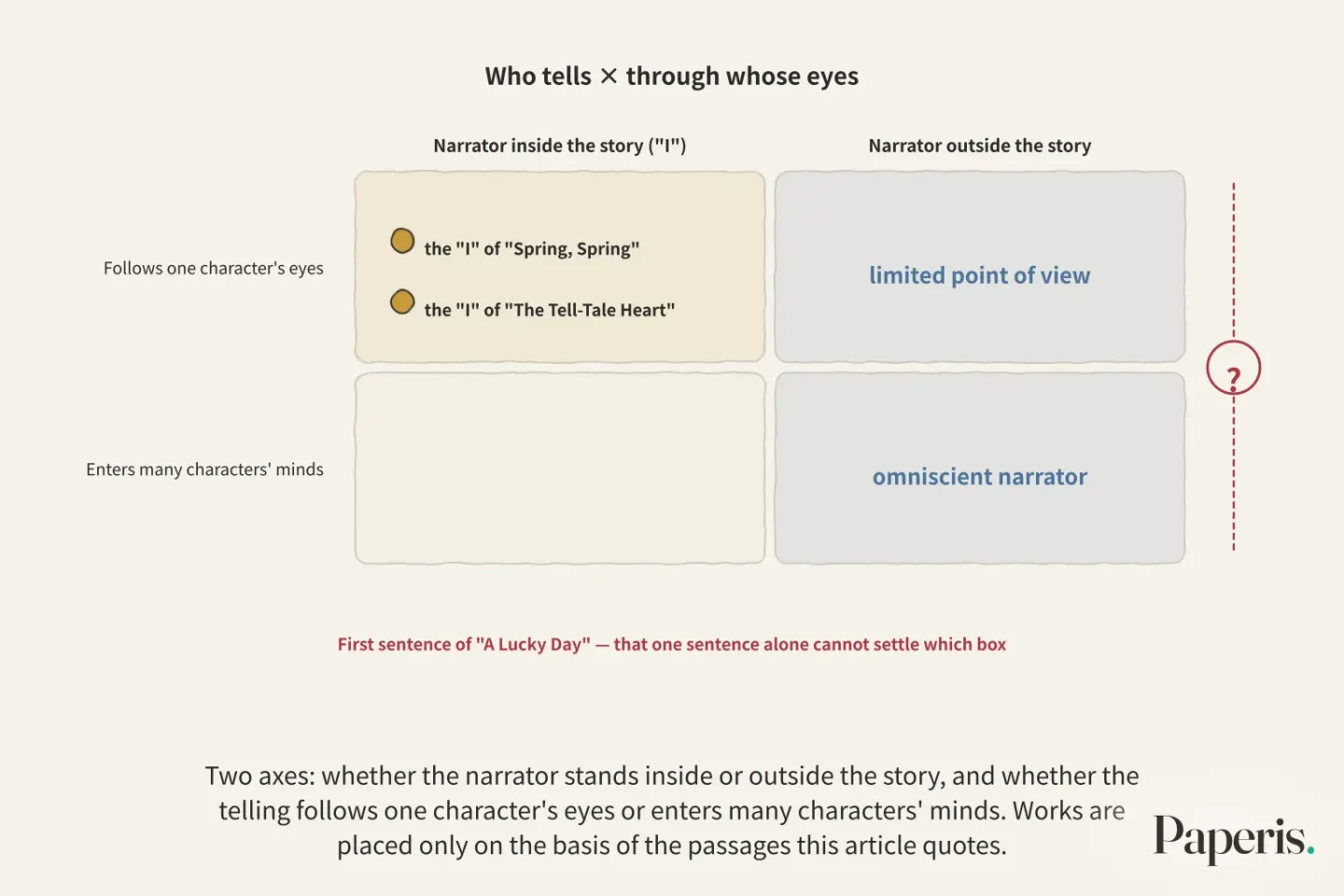
There is no "I" in this sentence. The voice describing the weather is not identified as anyone inside the story. In the sentences that follow, this voice calls the protagonist who pulls a rickshaw inside Dongsomun Gate by his name, "Kim Cheomji". Third-person narration is a method in which a narrator standing outside the story refers to the characters as "he" or by their names.
Then, whose eyes do the "sullenly overcast" skies reflect? It could be the eyes of the rickshaw puller standing in the rainy street, or it could be the eyes of the narrator looking down over the entire street. The first sentence alone cannot decide. Even when we know whose voice is speaking, we must ask separately through whose eyes we are seeing.
Who Speaks, Whose Eyes
Let us imagine the opening of "Spring, Spring" being told by the father-in-law. Rendered in the father-in-law's words, the narrator "I" scratching the back of his head and saying he is of age might be painted as quite a different person. If you change who speaks and whose eyes you see through, the same event becomes a different story.
Point of view is whose eyes and mind the events of a story are shown through. Narrative theory has a framework that records "who speaks," "someone sees," and "characters move" separately as "who speaks" and "who sees" (DOI: 10.2307/1773182). Depending on the textbook, first-person and third-person are sometimes called point of view directly (Evory, Naming the Unnameable ch. 4). In this article, separate from who speaks, we call whose eyes we see through the point of view.
Once you divide the speaker and the seer, paths diverge even within the same third-person narration (Evory, Naming the Unnameable ch. 4). An omniscient narrator is a narrator who can enter and tell the inner thoughts of anyone in the story. A limited point of view is a method where the narrator sticks to a single character, showing only as much as that character sees and knows. At this time, the character the narrator sticks to is called the focalizer (DOI: 10.2307/1773182). Whether the first sentence of "A Lucky Day" belongs to which side cannot be settled by that sentence alone, as we saw earlier.
In first-person stories, you separately come to ask how far you can trust the "I" (Ringo & Kashyap, Writing and Critical Thinking Through Literature ch. 4.09).
An Unreliable Narrator
Let us return to Poe’s "I". To prove he is not mad, "I" offers up his ears.
Above all was the sense of hearing acute. I heard all things in the heaven and in the earth. I heard many things in hell.
— Edgar Allan Poe, "The Tell-Tale Heart"
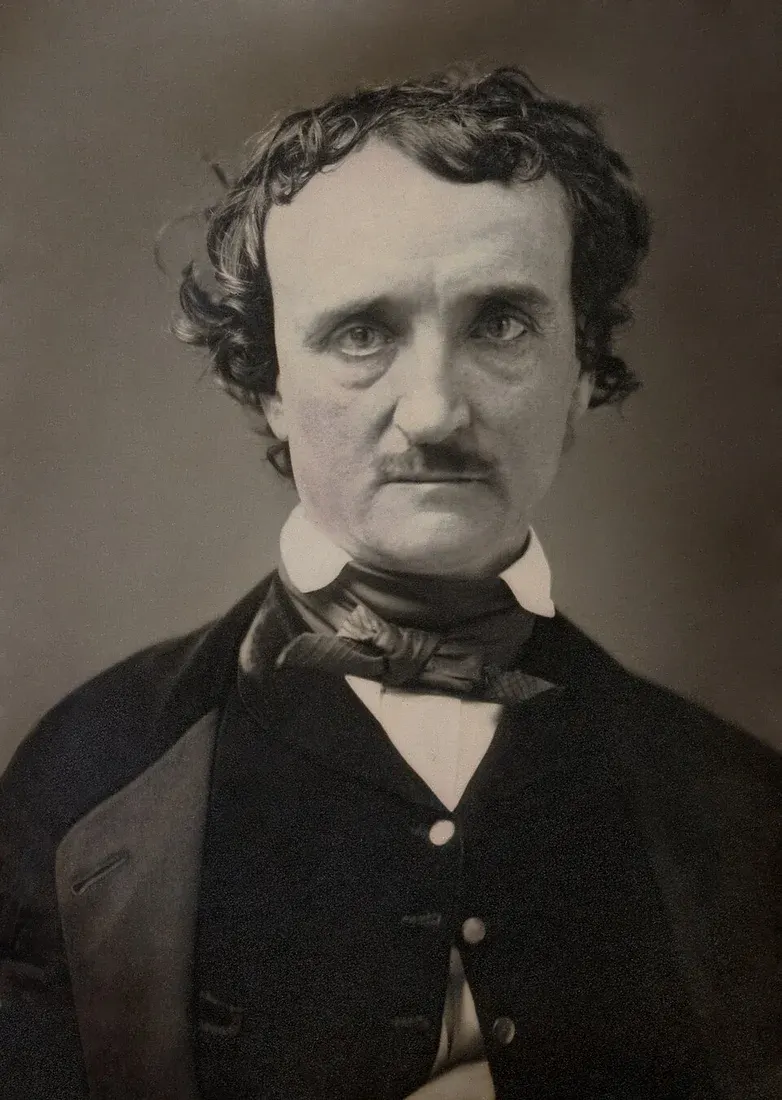 Edgar Allan Poe (around 1849) · photo: unknown photographer · Public domain · Wikimedia Commons
Then he turns around and asks, "How, then, am I mad?", and cries, "Hearken!", telling us to observe how healthily and calmly he can tell the whole story. Does the claim of hearing sounds from hell sound like proof that he is not mad? The very words he puts forward to win our trust can become reasons to doubt him.
An unreliable narrator is a narrator whose spoken words are hard to take at face value, requiring the reader to be skeptical and adjust their listening. This concept was first introduced by the critic Wayne Booth (KCI ART001049512). The book in which Booth addressed such narrators is The Rhetoric of Fiction, published in 1961, and this book came out in a second edition in 1983 (DOI: 10.1353/nar.2007.0012). The introduction to the second edition notes that such narrators, written by the novelist Henry James, reveal far more than they themselves realize (DOI: 10.7208/chicago/9780226065595.001.0001). One study dealing with unreliable narration places "The Tell-Tale Heart" as one of three representative examples and analyzes it (DOI: 10.1515/sem.2006.078).
Unreliable narrators are not all of one kind. Some narrators cannot be trusted at all, while the stories of other narrators sound somewhat deficient. There is research that divides these two (DOI: 10.1353/nar.2003.0001). There is also research suggesting that the degree of intentionality varies from narrator to narrator (DOI: 10.1515/sem.2006.078). Comparing it to a friend's story, a friend who leaves out a piece of a quarrel and a friend who repeatedly says "I am not angry at all" are of different kinds.
Where unreliability lies is still debated. Booth saw this as an internal matter of the text—namely, something occurring between the narrator and the authorial persona read in the text. Later researchers view it as the reader attributing motives to the narrator in order to resolve inconsistent passages (DOI: 10.4000/books.pufr.3950). The debate between these two perspectives has continued for a long time (DOI: 10.1515/sem.2007.041). Whichever side one takes, recognizing an unreliable narrator involves the reader's own judgment.
When Inner Speech Mixes into Narration
Let us compare two sentences. This is an example created for this article. The first version is "He lifted the pot lid and thought, 'The soup is salty again.'" The second version is "He lifted the pot lid. The soup was salty again. This time he really had to cut back on the salt." In the second version, is "This time he really had to cut back on the salt" said by the narrator, or is it the character's inner speech?
Free indirect discourse is a technique that blends a character's inner speech into the narrator's sentences without a tag like "he thought." This technique ties a character's train of thought and the narrator's voice into a single sentence. Whether this increases or decreases reader empathy has led to conflicting theoretical guesses (DOI: 10.1515/jlt.2010.004).
There is research that tested this with experiments. College students were asked to read a short story featuring an immoral character, divided into the original version and a version rewritten using free indirect discourse with the same information. In the last two of the four experiments, the group that read the rewritten version answered that the character's thoughts and feelings were more visible. The information received was the same. However, there was no consistent effect on empathy or liking toward that character, and in the first experiment, it actually became harder to figure out where the narrator's opinion lay. Previous studies had leaned toward increased empathy and understanding, and the researchers concluded that the effect of free indirect discourse is more limited than expected. However, the group that read the rewritten version showed a greater tendency to explain the character's behavior as due to the situation, and the researchers interpreted this as indirect evidence that free indirect discourse makes people view events from the character's side (DOI: 10.1515/jlt.2010.004). In another survey study, first-person narration and narration where the narrator spells out the character's mind increased the tendency to adopt the character's perspective, but free indirect discourse did not (DOI: 10.5334/gjgl.225).
One reading experiment suggests that not only the preceding sentence but also the sentence that follows can influence whose voice a sentence sounds like (DOI: 10.1177/0963947007072844). However, it has been pointed out that it is difficult to directly translate laboratory results using rewritten short texts into real-world reading. This is especially true for complex devices like free indirect discourse (DOI: 10.1075/lal.5.04hal). Free indirect discourse leaves the impression of making a character's inner self more visible, but whether it boosts empathy varies across studies.
Does Reading "I" Make Me the Person in the Story?
"Come" and "go" are words that contain the speaker's standing place. In previous research, adults more accurately remembered verbs like come and bring in English stories when the movement was directed toward the protagonist. Three- and four-year-old children showed the same pattern (DOI: 10.1037/0012-1649.36.2.202). Readers tend to picture scenes from the story from the spot where the protagonist is standing. This is not always the case, however; one experiment found that in third-person writing, readers only stood in the protagonist's place when explicitly told to do so (DOI: 10.1177/1747021818779496).
Pronouns also shift that standing place. In an experiment where participants read short sentences, those starting with "you" or "I" caused readers to imagine the scene from the perspective of the person performing the action, while those starting with "he" made them picture it from an outside observer's vantage point. However, when a short background story was added first, readers chose an external viewpoint even for sentences starting with "I." The researchers concluded that stepping into the actor's shoes happens only when the reader is directly addressed as the subject of the sentence, such as with "you" (PMID 19076318). When replicated with hundreds of participants, the effect repeated for short sentences but largely faded in longer narratives. Comprehension remained unchanged even when the perspective did not shift according to the pronoun. Instead, the researchers concluded that this perspective-shifting is neither universal nor essential for understanding. Rather, the surrounding context of the story and the reader's propensity for absorption influenced that positioning (PMID 26889684).
In an experiment using literary short stories, narratives referring to the protagonist as "I" drew readers in more deeply than those using "he." The sense of entering the story world and the vividness of mental imagery were particularly high. However, evaluations of story quality did not vary by pronoun, and bodily arousal measured through skin conductance appeared slightly higher for the "he" condition (PMID 27192060). An fMRI brain-imaging experiment where participants listened to short literary pieces found no differences in brain activity driven by pronouns. Instead, listeners fell into groups: those who preferred a first-person perspective, those who favored a third-person perspective, and those comfortable with both (PMID 28391032).
These experiments were mostly conducted in laboratories using brief sentences or short stories. First-person pronouns sometimes draw readers into the character's shoes, but which perspective readers adopt depends on the narrative context and the individual reader.
Back in Front of “Hearken!”
We now listen once again to the voice at the opening. True!—nervous—very, very dreadfully nervous I had been and am; This "I" is a character within the story, so it is a first-person narration. We cannot conclude that this "I" is Poe himself. As we saw earlier, the narrator and the author are not the same person. The "I" calls the listener "you" and draws them into the story. And as proof that he is not mad, he offers ears that have heard even the sounds of hell. Whether to believe those words as they are, or to doubt them and listen with a grain of salt, is up to us. Looking at the experiments in the previous section, a single pronoun does not decide whether we stand in the "I"'s shoes or watch from a step back.
There are limits to a friend who tells us about a quarrel with a neighbor. Because a friend is a real person who also lives outside the story, we can ask the downstairs neighbor if they were really angry. The narrator of a novel is a voice that speaks only within the book, so there is no such witness, and only the sentences left by that voice remain in our hands.
Where to Explore Further
- Among other parts in this series, the one covering rhythm reads the first and final stanzas of "Azaleas", following the lines, stanzas, and repetition.
- The part covering story structure reads beyond the opening sentence of "A Lucky Day" and explores the irony not covered here.
- The part covering characters and mind-reading explores getting absorbed in stories and how far the claim that "fiction builds theory of mind" is supported.
- The part covering metaphor and imagery explores what words in poetry are used to compare.
- Among Paperis articles already published, there is not yet one that directly follows on from this piece.
Related Papers
- "Writing and Critical Thinking Through Literature — 4.09 Narration Point of View Dialogue" — Ringo & Kashyap, Writing and Critical Thinking Through Literature ch. 4.09
- "Naming the Unnameable: An Approach to Poetry for New Generations — 4 4: Voice" — Evory, Naming the Unnameable ch. 4
- "18세기 일인칭 소설과 ‘신뢰할 수 없는 화자’" (2007) — KCI ART001049512
- "Frames, Preferences, and the Reading of Third-Person Narratives: Towards a Cognitive Narratology" (1997) — DOI: 10.2307/1773182
- "Estranging Unreliability, Bonding Unreliability, and the Ethics of Lolita" (2007) — DOI: 10.1353/nar.2007.0012
- "The Rhetoric of Fiction" (1983, 2nd ed. · 1st ed. 1961) — DOI: 10.7208/chicago/9780226065595.001.0001
- "Understanding and handling unreliable narratives: A pragmatic model and method" (2006) — DOI: 10.1515/sem.2006.078
- "Reconsidering Unreliability: Fallible and Untrustworthy Narrators" (2003) — DOI: 10.1353/nar.2003.0001
- "Reconceptualizing the Theory and Generic Scope of Unreliable Narration" (1999) — DOI: 10.4000/books.pufr.3950
- "Reconsidering the unreliable narrator" (2007) — DOI: 10.1515/sem.2007.041
- "Readers Closing in on Immoral Characters' Consciousness. Effects of Free Indirect Discourse on Response to Literary Narratives" (2010) — DOI: 10.1515/jlt.2010.004
- "Does narrative perspective influence readers’ perspective-taking? An empirical study on free indirect discourse, psycho-narration and first-person narration" (2017) — DOI: 10.5334/gjgl.225
- "The ‘dual voice’ of free indirect discourse: a reading experiment" (2007) — DOI: 10.1177/0963947007072844
- "Empirical research into the processing of free indirect discourse and the imperative of ecological validity" (2008) — DOI: 10.1075/lal.5.04hal
- "Taking the perspective of the narrator" (2018) — DOI: 10.1177/1747021818779496
- "In Cinderella's slippers? Story comprehension from the protagonist's point of view." (2000) — DOI: 10.1037/0012-1649.36.2.202
- "When you and I share perspectives: pronouns modulate perspective taking during narrative comprehension." (2009) — PMID 19076318
- "Mentally simulating narrative perspective is not universal or necessary for language comprehension." (2016) — PMID 26889684
- "Taking Perspective: Personal Pronouns Affect Experiential Aspects of Literary Reading." (2016) — PMID 27192060
- "Readers select a comprehension mode independent of pronoun: Evidence from fMRI during narrative comprehension." (2017) — PMID 28391032
Sources (19)
- Writing and Critical Thinking Through Literature — 4.09 Narration Point of View Dialogue
- Naming the Unnameable: An Approach to Poetry for New Generations — 4 4: Voice
- Frames, Preferences, and the Reading of Third-Person Narratives: Towards a Cognitive NarratologyDOI 10.2307/1773182
- Estranging Unreliability, Bonding Unreliability, and the Ethics of LolitaDOI 10.1353/nar.2007.0012
- The Rhetoric of FictionDOI 10.7208/chicago/9780226065595.001.0001
- Understanding and handling unreliable narratives: A pragmatic model and methodDOI 10.1515/sem.2006.078
- Reconsidering Unreliability: Fallible and Untrustworthy NarratorsDOI 10.1353/nar.2003.0001
- Reconceptualizing the Theory and Generic Scope of Unreliable NarrationDOI 10.4000/books.pufr.3950
- Reconsidering the unreliable narratorDOI 10.1515/sem.2007.041
- Readers Closing in on Immoral Characters' Consciousness. Effects of Free Indirect Discourse on Response to Literary NarrativesDOI 10.1515/jlt.2010.004
- Does narrative perspective influence readers’ perspective-taking? An empirical study on free indirect discourse, psycho-narration and first-person narrationDOI 10.5334/gjgl.225
- The ‘dual voice’ of free indirect discourse: a reading experimentDOI 10.1177/0963947007072844
- Empirical research into the processing of free indirect discourse and the imperative of ecological validityDOI 10.1075/lal.5.04hal
- Taking the perspective of the narratorDOI 10.1177/1747021818779496
- In Cinderella's slippers? Story comprehension from the protagonist's point of viewDOI 10.1037/0012-1649.36.2.202
- When you and I share perspectives: pronouns modulate perspective taking during narrative comprehensionPMID 19076318
- Mentally simulating narrative perspective is not universal or necessary for language comprehensionPMID 26889684
- Taking Perspective: Personal Pronouns Affect Experiential Aspects of Literary ReadingPMID 27192060
- Readers select a comprehension mode independent of pronoun: Evidence from fMRI during narrative comprehensionPMID 28391032