
Paperis Articles
Rhythm in Poetry — Where the Breath Breaks on Its Own
A poem is built from lines and stanzas, returning sounds (rhyme), and beat-like patterns (meter). English verse counts stressed syllables; Korean verse counts syllables and spoken phrase-units, and scholars dispute how well that count fits. Rhythm helps the ear and memory, but it can also make a rhyming statement sound truer.
Your field's papers, as audio
Pick your fields and journals — Paperis summarizes the key papers and turns them into audio. Listen on your commute.
Start Paperis free →Rhythm in Poetry — Where the Breath Breaks on Its Own
The Places That Form When You Read Aloud
Read the following three lines out loud and slowly. They are the beginning of the poem "Azaleas" by the poet Kim So-wol, who passed away in 1934.
나 보기가 역겨워 (na bogiga yeokgyeowo) 가실 때에는 (gasil ttaeeneun) 말없이 고이 보내드리오리다. (mareopsi goi bonaedeuriorida.)
If, sick of the sight of me, you go away, I will see you off gently, without a word.
— Kim So-wol, "Azaleas" (translated by Paperis)
As you read, you naturally pause once after "sight of me" and again after "go away". There is no mark anywhere telling you where to rest, yet resting places form on their own. The third line is as long as the first two combined, so the breathing rhythm for reading it also becomes long all at once.
If you write the same content in a single line as "When you are sick of the sight of me and leave, I will send you off without a word," the resting places disappear. The meaning is almost the same, but what hits the ear changes. Poetry lays out this difference beforehand through letter placement and speech sounds.
This article deals with how to read that layout. We will read poetry written in Korean like this poem alongside English poetry by the English playwright and poet William Shakespeare, whose collection of poems was published in 1609. The two languages differ in how they count the patterns of speech sounds, and that difference lies at the very center of this article.
Lines and Blocks
"Azaleas" has four blocks of three lines each, twelve lines in all. In the first and last blocks, the first two lines are identical: "If, sick of the sight of me, / you go away,". There is a name for this structure where sounds return in a regular pattern. Meter is the melody created when speech sounds repeat regularly. Poems deliberately create and reuse this kind of repetition (Ringo & Kashyap, Writing and Critical Thinking Through Literature ch. 6.11).
To read meter, we must first understand two units that make up a poem. Just as the twelve lines of "Azaleas" are bound into four blocks of three, a poem has two layers: lines, and the blocks formed by grouping those lines. A line is a unit of language broken and written down as a single row in a poem. Lines can break independently of sentences, so a line can end even where a sentence does not (Ringo & Kashyap, Writing and Critical Thinking Through Literature ch. 6.06).
The beginning of "Azaleas" works this way. The line ends at "If, sick of the sight of me,", but the sentence does not finish until the end of the third line. The two places where the breath paused in the first stanza were precisely the places where the lines ended.
A stanza is a grouping of several lines separated from the blocks before and after by a blank line (Ringo & Kashyap, Writing and Critical Thinking Through Literature ch. 6.14). "Azaleas" has four stanzas, with three lines per stanza. With a blank line left between each stanza, the four three-line blocks are visibly distinct.
The Sound That Returns: Rhyme
The first material of rhythm is the repetition of the same sound. Rhyme is the arrangement of two or more words so that they match in sound. Rhyme is commonly defined as occurring when two words produce the same sound from their last stressed vowel to the end. However, according to a study on German poetry, imperfect rhymes with slightly different sounds are also commonly used as rhymes at the ends of lines, and they sound even more rhyme-like within a poem structured with an even meter (DOI: 10.1037/aca0000277).
Rhymes are named according to the positions where they are placed. End rhyme is rhyme that matches the ending sounds of words placed at the ends of lines. In poetry that follows a fixed form, rhyme occurs primarily in this end-of-line position (Evory, Naming the Unnameable ch. 6). Alliteration is the repetition of the initial consonant sounds of words placed close together (Ringo & Kashyap, Writing and Critical Thinking Through Literature ch. 6.12).
Shakespeare's Sonnet 18 has clear end rhymes. A sonnet is a short European fixed-form poem with a set number of lines and rhyme scheme. When read in English, the words at the ends of the lines are paired to match their ending sounds, such as day and May, temperate and date, and shines and declines. These pairs vanish the moment they are translated into our language. End rhyme is attached to the sounds of the words, so a translation that transfers only the meaning cannot bring it across together. Therefore, this text presents the rhymes of English poetry using the English words as they are.
In "Azaleas", repeating sounds can also be counted. Looking in turn at the ends of the third lines of the four stanzas, they are bonaedeuriorida, ppuriorida, gasiopsoseo, and heulliorida. Three out of the four end with orida. Throughout the entire poem, words starting with ga, such as gasil, gasineun, and gasiopsoseo, appear five times. Because this is the return of the same word in a modified form, it is closer to the repetition of a word than to strict alliteration. Even so, the same initial sound repeatedly echoes in the ear.
English Verse Counts Strong Sounds
The second ingredient of rhythm is a repeating pattern of speech, much like a beat. Meter is the framework that arranges speech-sound patterns to repeat regularly within a line of poetry, like a beat (Ringo & Kashyap, Writing and Critical Thinking Through Literature ch. 6.11). What is counted to catch that pattern differs from language to language.
English counts stresses. Stress is the extra force and prominence given to certain syllables over others when speaking. When people speak English, certain words come out stronger than others, and poetry purposely weaves that alternation of strong and soft evenly (Ringo & Kashyap, Writing and Critical Thinking Through Literature ch. 6.11). The most common grouping in English has one soft syllable followed by one strong syllable. iambic pentameter is a meter that lays out five groups of a soft syllable followed by a strong syllable in a single line. Thus, a regular line has ten syllables, and the “soft-strong” grouping continues five times (Ringo & Kashyap, Writing and Critical Thinking Through Literature ch. 6.11). However, this framework is merely a standard, and the number of beats does not always fit every line perfectly (Ringo & Kashyap, Writing and Critical Thinking Through Literature ch. 6.11).
Let us return to Sonnet 18, which we looked at earlier for rhyme. This poem has fourteen lines in total, and translating the first two lines into Korean yields this.
Shall I compare thee to a summer's day? Thou art more lovely and more temperate:
— William Shakespeare, Sonnet 18
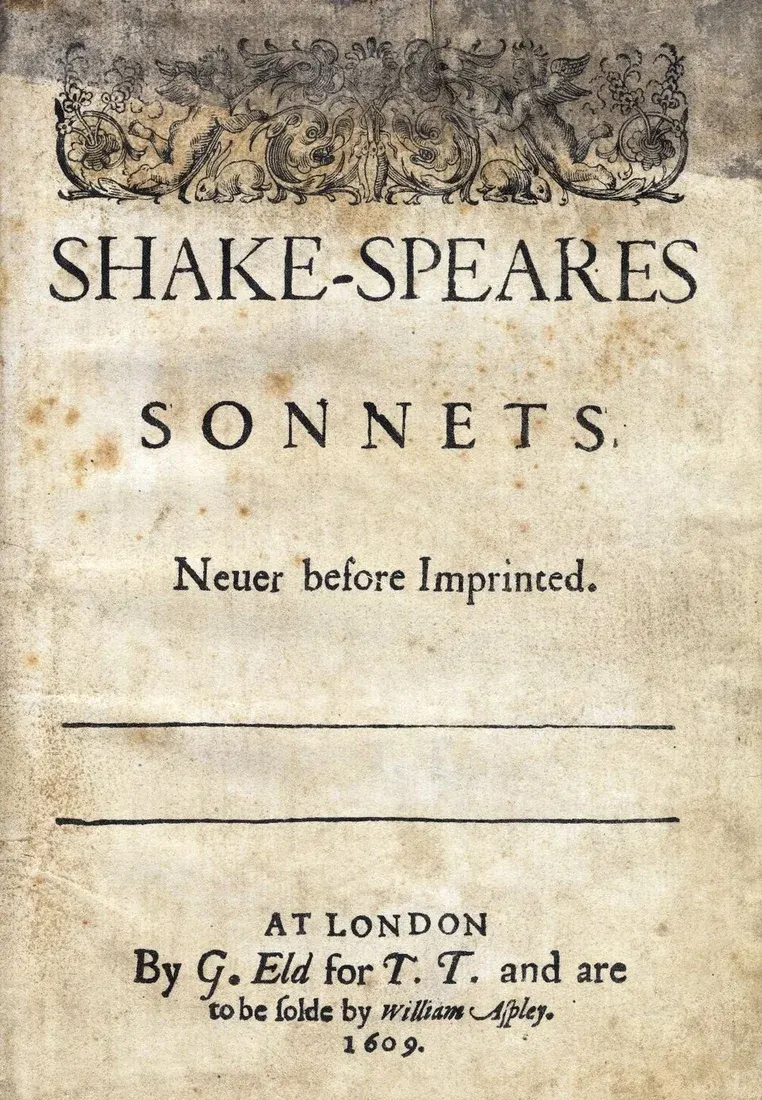 Title page of the first edition of Shake-speares Sonnets (London, 1609) · Public domain · Wikimedia Commons
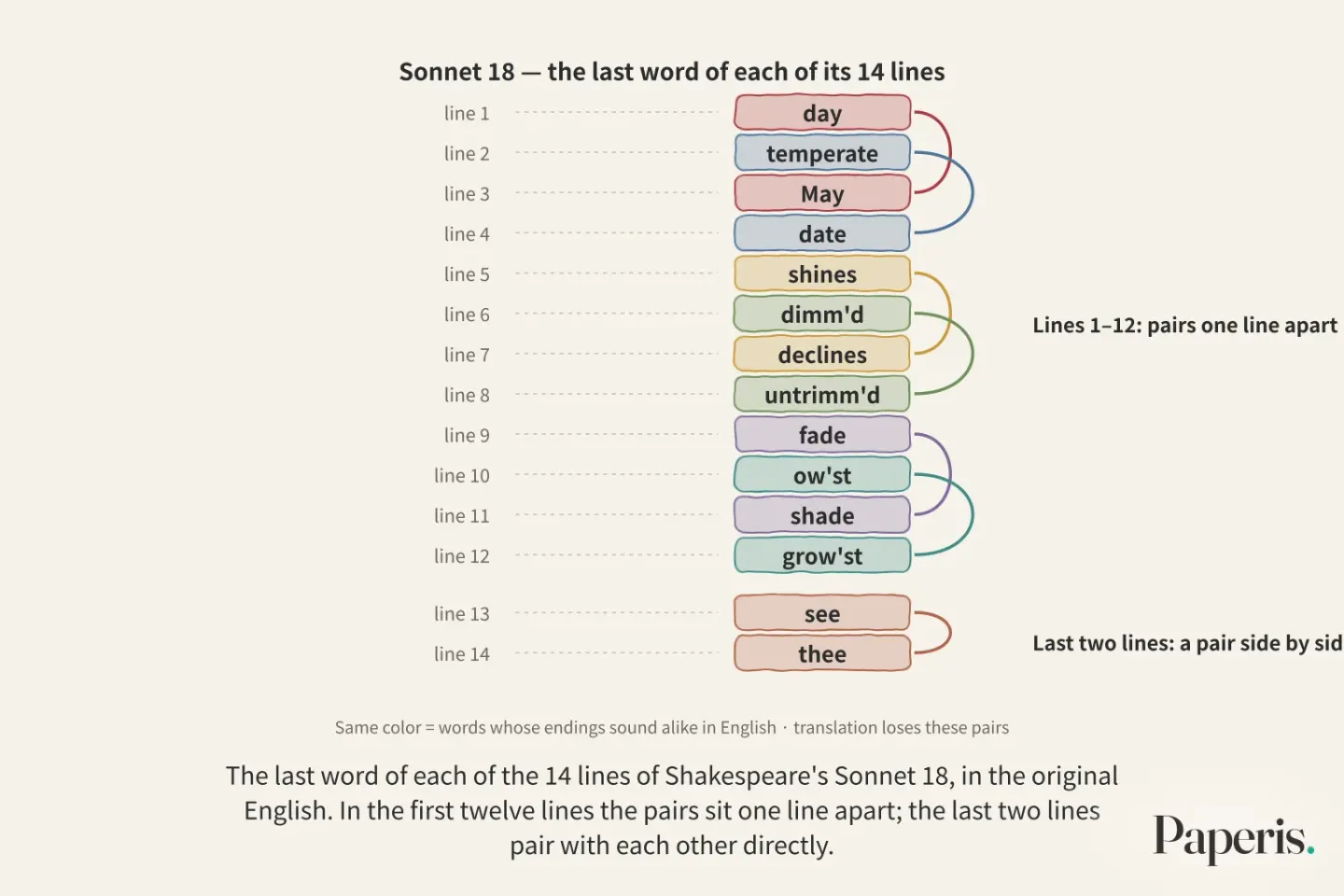
In the English original, "day" at the end of the first line rhymes with "May" at the end of the third line, and "temperate" at the end of the second line rhymes with "date" at the end of the fourth line. If we connect the seven pairs along the end-words, the first twelve lines rhyme on alternating lines, while in the final two lines, "see" and "thee" rhyme immediately back-to-back.
Setting the number of lines and the placement of rhymes while writing each line in iambic pentameter is the rule of the Shakespearean sonnet (Ringo & Kashyap, Writing and Critical Thinking Through Literature ch. 6.14). When reading, one simply follows the stresses and unstresses within the lines alongside the pairings at the ends of the lines.
Korean Poems Count Letters and Beats
The meter of Korean poetry is commonly counted by the number of letters and the word beats where one pauses (DOI: 10.35419/kmlit.2009..38.003). It is different from the way English counts stresses.
The first is the number of letters. Syllable meter is a meter that matches the number of syllables in each line or in the beats within it. In our language, a single letter is a single syllable, so you can just count the letters. The pattern frequently discussed in Kim So-wol's poetry is the 7-5 rhythm (DOI: 10.35419/kmlit.2009..38.003). The 7-5 rhythm is a syllable meter that pairs and repeats a seven-syllable chunk and a five-syllable chunk.
Let us count just the first two lines of each stanza in "Azaleas". "If, sick of the sight of me," (na bogiga yeok-gyeowo) in the first stanza is seven letters, and "you go away," (gasil ttaeneun) is five letters. "With every step you take," (gasineun georeum georeum) in the third stanza is also seven, and "on those flowers laid there" (noin geu g⼦-eul) is five. The final stanza is the same as the first stanza, so it is seven and five again. However, "From Yaksan in Yeongbyeon," (Yeongbyeon-e Yaksan) in the second stanza is five letters, and "azaleas" (jindallae-kkot) is four letters, falling outside this mold. Even if you count only the first two lines, this mold breaks in the second stanza. The third line of each stanza is longer, around twelve letters.
The second is the beat where one pauses. An umbo is a unit commonly used when counting the meter of Korean poetry, and it is the word beat bound between pauses when read aloud. You count how many of these beats come in one line. The number of beats can vary depending on where you pause, and the reader decides the halting place. For example, you might pause the same line as “말없이 고이 / 보내드리오리다” ("mal-eopsi goi / bonaedeuriorida"), or you might pause it as “말없이 / 고이 / 보내드리오리다” ("mal-eopsi / goi / bonaedeuriorida"). Researchers also question whether counting with this unit fits Korean poetry well (DOI: 10.35419/kmlit.2009..38.003).
Researchers debate whether this counting method fits Kim So-wol's poetry well. One study that counted the entire collection Azaleas counts that poems strictly keeping the syllable meter number 28 pieces at 22%, and poems keeping the framework of beat meter number 46 pieces at 37%. The rest show variations deviating from the mold, ranging from poems divided into lines to irregular ones, and this study reads the rhythm of Azaleas toward various changes and individuality rather than a fixed mold (DOI: 10.35419/kmlit.2009..38.003). There are also studies that view that fixed metrical forms cannot be found in modern Korean poetry, and that one should look at what meter does within the poem rather than the meter itself (KCI ART000939092).
How Kim So-wol handled letter counts is also revealed in the classical Chinese poems he translated. In the 1920s, folk-song-style poems following set syllable counts established themselves, and Kim So-wol and the poet Kim Eok were two poets in prominent positions around that time (KCI ART000967207). This study finds that the tension of the poetic diction loosened in a few places where Kim So-wol translated classical Chinese poems and strictly followed syllable rules, and it sees that in his later poetry the tendency to be bound to set syllable counts grew weaker than in his early period (KCI ART000967207). The meter of Korean poetry has counting methods themselves as an issue of research.
Even Without Fixed Forms
English-language textbooks view most poetry written today as work that does not follow a fixed meter or rhyme (Ringo & Kashyap, Writing and Critical Thinking Through Literature ch. 6.06). Free verse is poetry that does not follow the rules of fixed meter and rhyme, with the poet deciding the stanza structure and rhythm themselves (Ringo & Kashyap, Writing and Critical Thinking Through Literature ch. 6.14). In free verse, rhyme often occurs within lines rather than at line endings (Evory, Naming the Unnameable ch. 6).
Poetry without a form still has rhythm. The 2009 study mentioned earlier reads that poems breaking away from the mold of Azaleas also divide pauses and intonation uniquely within lines to create an internal rhythm (DOI: 10.35419/kmlit.2009..38.003).
Rhythm also arises on the listener's end. One researcher suggests that meter resides more in the pattern that the listener assembles than in the sound itself, and that it draws attention by creating an anticipation of where the next stressed sound will fall (DOI: 10.2307/461485). Read-aloud experiments show both the work of that anticipation and its limits. When participants read poems aloud, they lengthened the syllables in metrically stressed positions compared to unstressed ones. However, when the researchers swapped in a few nonsense syllables, the difference in length disappeared at those positions (DOI: 10.3389/fpsyg.2023.1043651). The authors interpret that anticipating a beat in advance is not always enough to maintain the pattern, which appears to be supported by the sounds that actually arrive in each syllable. When measured by sound intensity, strength and weakness remained even on nonsense syllables only among participants with musical training (DOI: 10.3389/fpsyg.2023.1043651). In this experiment, the ear's anticipation and the actual sound built the pattern together.
The Frame That Ears and Memory Hold Onto
Poetry is a mode of expression that existed before written speech (DOI: 10.1037/aca0000902). Originally, poetry was used as a way to memorize stories (Ringo & Kashyap, Writing and Critical Thinking Through Literature ch. 6.06). As you sing along to a song, the final word of the next line sometimes catches on the tip of your tongue before the lyrics do. This is a scene where rhyme aids memory.
Pairs of rhyming words are memorized faster than unrelated pairs. In experiments investigating why, rhyme greatly narrowed the pool of possible answers to be recalled, bringing it close to a recognition task. As this explanation suggests, other rules that similarly narrowed the candidate pool, such as a rule changing only the final sound of a pair, were just as helpful as rhyme, and the advantage of rhyme disappeared in multiple-choice tests where the number of candidates was fixed (DOI: 10.1037/h0028365). The way rhyme aided memory in this experiment was by narrowing the slots where answers could fit.
Even among lists of phonetically similar words, the degree to which they are remembered depends on which sounds are identical. In experiments where lists of words were immediately repeated back in order, the rate of correct word recall was highest for rhyming lists, followed by lists sharing the same initial sound, and lowest for lists that shared neither and were merely phonetically similar (PMID 16496721). Matching the final sound caught in memory better than matching the initial sound. This difference diminished when the same words were repeated across multiple lists (PMID 16496721).
There are also experiments where young children outperformed adults in verbatim memorization of rhymed text. When parents read unfamiliar rhyming nursery poems to them at bedtime for ten days, four-year-olds outperformed their parents and young adults in recalling the poems word for word. The adults knew there would be a test, but the children did not. There was no difference in the degree of recalling the gist of the poems or in lists of words heard alongside them (DOI: 10.1111/desc.12398). The authors suggest that verbatim memorization is a skill improved through practice, and that children, who live by relying on nursery rhymes and spoken language, have honed that skill.
There are experiments suggesting that patterns can arise in the process of transmission. Dutch-speaking participants listened to strings of meaningless, randomly ordered syllables and typed them back using four keys, and this result was passed on to the next person for ten generations. As the generations progressed, the sounds grew shorter, easier to recall, and acquired a chunked structure (DOI: 10.1093/jole/lzy013). The hypothesis of this study is that stratified frameworks like lines and stanzas may be the result of being tuned to memory.
Ears also enjoy rhythm and rhyme. In an experiment where four-line stanzas of 19th- and 20th-century German poetry were played with varying rhyme and meter, participants rated the stanzas as more beautiful, processed them more strongly, and felt more positive emotions both when rhyme was present and when the meter was regular. The effect on emotion varied depending on whether the words used were real words (DOI: 10.3389/fpsyg.2013.00010).
When It Rhymes, It Sounds Right
The tendency for the ear to welcome rhyme seeps into our judgments, too. An experiment presented participants with two versions of unfamiliar proverbs describing human behavior. One was the original version with a rhyming end, while the other kept the same meaning but changed a single ending word to break the rhyme. Participants judged the rhyming version as a more accurate description of human behavior (DOI: 10.1111/1467-9280.00282).
The researchers explain this effect through processing fluency. Processing fluency is the degree to which a piece of speech or writing slips smoothly into the mind. Rhyme helps people take in words more smoothly, much like hearing the same words repeated, and people may misattribute that smoothness to a feeling that the statement is correct (DOI: 10.1111/1467-9280.00282). The researchers of the earlier German poetry experiment likewise explain the reason rhyme and meter enhance beauty in terms of this same smoothness (DOI: 10.3389/fpsyg.2013.00010).
This illusion can be reduced. When participants in the same experiment were warned beforehand to distinguish between the sound properties and the meaning of the words, the advantage making the rhyming version seem more accurate diminished (DOI: 10.1111/1467-9280.00282). The effect where rhyming words sound more correct is reduced when people are warned to separate sound from meaning.
A similar thing happens in advertising slogans. In an experiment where newly invented ad slogans were divided into rhyming and non-rhyming versions and evaluated, the rhyming slogans received higher ratings for being more likable, easier to remember, more persuasive, and more trustworthy. However, when the versions were evaluated separately one by one, public service announcements were rated favorably regardless of whether they rhymed. When the same participants compared both versions side by side, the difference between commercial and public service slogans vanished, and the rhyming version came out ahead in both form and content across all slogans (DOI: 10.1111/sjop.12069).
Other experiments suggest that rhyme and meter may be linked to enjoyment. In this experiment, listeners enjoyed poetry far more than non-poetry control texts, and they enjoyed poems written by artificial intelligence more than modern poems written by humans. There was no difference in preference between expressive readings and flat readings. The artificial intelligence poems strictly adhered to traditional rhyme and meter, whereas modern Western poets generally write in free verse. The artificial intelligence poems also made emotions easier to recognize even after reading just a single line, and they were more consistent. In addition to these points, the authors interpret that the smoothness of traditional forms may have boosted enjoyment (DOI: 10.1037/aca0000902).
Sonnet 18 closes its final two lines with a couplet.
So long as men can breathe, or eyes can see, So long lives this, and this gives life to thee.
— William Shakespeare, Sonnet 18
In English, the poem ends with "see" and "thee" rhyming. The poem states that it will survive a long time on its own. If that claim sounds plausible, it is worth asking how much of it comes from the meaning and how much from the matching ending sounds.
Again Before "Azaleas"
Now, using the tools we gathered so far, let's go all the way through "Azaleas". In this poem, there is an "I" addressing the person leaving. The speaker is the voice speaking within the poem, and cannot be assumed to be the same person as the one who wrote it. In the final stanza, the speaker brings up the words of the first stanza once again.
나 보기가 역겨워 (na bogiga yeokgyeowo) 가실 때에는 (gasil ttaeeneun) 죽어도 아니 눈물 흘리오리다. (jugeodo ani nunmul heulliorida.)
If, sick of the sight of me, you go away, I will not shed a tear, not even if I die.
— Kim So-wol, "Azaleas" (translated by Paperis)
The first two lines are not a single character different from the first stanza. The seven syllables and five syllables come again, and the ear catches its breath at the exact same spot where it steadied its breath in the first stanza. The end of the third line also returns to (-orida). In between, the first two lines of the second stanza broke the mold once with five and four syllables, and the third stanza changed its ending to (-gasiopsoseo) only in the third line.
When something changes within a repeating mold, that line stands out (Ringo & Kashyap, Writing and Critical Thinking Through Literature ch. 6.06). The third line of the first stanza was "I will see you off gently, without a word", and the third line of the final stanza is "I will not shed a tear, not even if I die." Different words have stepped into the same spot, the same ending sound. If you read the two lines aloud back-to-back, what sounds different is for the reader to decide.
Knowing the rhythm does not settle the meaning of a poem. The rhythm tells the ear where to catch its breath, what sound will return, and which spot has changed. What to hear in that spot is still left to the reader.
Where to Look Next
If you want to look at repeated patterns of beats and meter in music, the series continues with "Rhythm and Beat — Evenly Spaced Stepping Stones, and the Steps That Cross Them". Other parts of this series cover what poems compare things to in the installment on figures of speech, and the speaking voice within a poem in the installment on speaker and point of view. The installments on the structure of a story and on characters move over to fiction.
Source Papers
- "Writing and Critical Thinking Through Literature — 6.11 Sound in Poetry - Meter" — Ringo & Kashyap, Writing and Critical Thinking Through Literature ch. 6.11 — Poetic meter is a pattern of strong and weak syllables; the most common bundle in English is weak-strong, pentameter has five bundles per line, and actual lines do not always keep the exact beat count.
- "Writing and Critical Thinking Through Literature — 6.06 The Line in Poetry" — Ringo & Kashyap, Writing and Critical Thinking Through Literature ch. 6.06 — Lines can break separately from sentences, poetry was originally a way to memorize stories, variation within repetition makes the line stand out, and most poetry today is free verse.
- "Writing and Critical Thinking Through Literature — 6.14 Form in Poetry" — Ringo & Kashyap, Writing and Critical Thinking Through Literature ch. 6.14 — Stanzas are grouped blocks of lines, the Shakespearean sonnet is 14 lines of iambic pentameter with abab cdcd efef gg, and free verse leaves stanza structure and rhythm to the poet.
- "Writing and Critical Thinking Through Literature — 6.12 Sound in Poetry - Alliteration Consonance Assonance" — Ringo & Kashyap, Writing and Critical Thinking Through Literature ch. 6.12 — Alliteration is the repetition of consonant sounds at the beginnings of words.
- "Naming the Unnameable: An Approach to Poetry for New Generations — 6: Acoustics" — Evory, Naming the Unnameable ch. 6 — Rhyme in metered poetry is mostly end rhyme, whereas rhyme in free verse tends to lie inside the lines.
- "How perfect are imperfect rhymes? Effects of phonological similarity and verse context on rhyme perception." (2019) — DOI: 10.1037/aca0000277 — A rhyme is formed when sounds match starting from the last stressed vowel, investigated via rapid-judgment tasks on the perception of imperfect rhymes.
- "김소월 시에서 민요조 율격의 위상" (2009) — DOI: 10.35419/kmlit.2009..38.003 — In Azaleas, strict syllable counts are 22% and metrical foot patterns are 37%, with rhythm driven more by variation and individuality, and intrinsic rhythm shaped by internal line pauses and intonational segmentation.
- "한국현대시의 율격 교육에 관한 연구" (2004) — KCI ART000939092 — Fixed metrical forms cannot be found in modern Korean poetry, and the function of meter matters more than meter itself.
- "안서와 소월의 한시 번역과 창작시의 율격" (2005) — KCI ART000967207 — Kim So-wol strictly kept syllable counts in a few translated classical Chinese poems, losing poetic tension, and his later poems show a weaker tendency toward fixed syllable counts than his early ones.
- "Perception and English Poetic Meter" (1973) — DOI: 10.2307/461485 — Meter lies in the pattern constructed by the listener rather than in physical sounds, guiding attention through expectation.
- "What a difference a syllable makes—Rhythmic reading of poetry" (2023) — DOI: 10.3389/fpsyg.2023.1043651 — Metrically stressed syllables are pronounced longer when read aloud, but this disappears in unstressed syllables; expectation alone does not seem to constantly maintain the pattern.
- "Why are rhymes easy to learn?" (1969) — DOI: 10.1037/h0028365 — Rhymes narrow down answer candidates to bring recall closer to recognition, an advantage that vanishes in multiple-choice tests with provided options.
- "Reexamining the phonological similarity effect in immediate serial recall: the roles of type of similarity, category cuing, and item recall." (2005) — PMID 16496721 — Word recall in immediate serial recall follows the order: rhyming lists > alliterating lists > similar-sounding lists.
- "Preschoolers have better long‐term memory for rhyming text than adults" (2016) — DOI: 10.1111/desc.12398 — After ten days of bedtime reading, four-year-olds outperformed adults in verbatim recall of rhyming nursery rhymes, with no differences in gist or word lists.
- "The emergence of verse templates through iterated learning" (2019) — DOI: 10.1093/jole/lzy013 — In a transmission chain of Dutch speakers over ten generations, random syllable strings grew shorter, easier to memorize, and structured.
- "Aesthetic and Emotional Effects of Meter and Rhyme in Poetry" (2013) — DOI: 10.3389/fpsyg.2013.00010 — In four-line German poetry stanzas, rhyme and even meter each enhanced aesthetic evaluation, processing intensity, and positive emotion, with emotional effects mediated by wordness.
- "Birds of a Feather Flock Conjointly (?): Rhyme as Reason in Aphorisms" (2000) — DOI: 10.1111/1467-9280.00282 — Rhyming proverbs appear more accurate than rhymeless control versions, an advantage that diminishes when participants are told to distinguish sound from meaning (misattribution of processing fluency).
- "Rhyme as reason in commercial and social advertising" (2013) — DOI: 10.1111/sjop.12069 — Rhyming new advertising slogans lead in favorability, memory, persuasion, and trust, while public service slogans show no difference when evaluated separately, though all prefer the rhymed version in direct comparison.
- "Pleasurable experiences of verbal poetry: Words speak louder than voices." (2026) — DOI: 10.1037/aca0000902 — Poetry is a pre-literate form of expression where listeners prefer human modern poetry over AI poetry, while AI poetry adheres to traditional rhyme and meter, which the authors interpret as traditional forms possibly heightening pleasure via fluency.
Sources (17)
- Writing and Critical Thinking Through Literature — 6.11 Sound in Poetry - Meter
- Writing and Critical Thinking Through Literature — 6.06 The Line in Poetry
- Writing and Critical Thinking Through Literature — 6.14 Form in Poetry
- Writing and Critical Thinking Through Literature — 6.12 Sound in Poetry - Alliteration Consonance Assonance
- Naming the Unnameable: An Approach to Poetry for New Generations — 6: Acoustics
- How perfect are imperfect rhymes? Effects of phonological similarity and verse context on rhyme perceptionDOI 10.1037/aca0000277
- 김소월 시에서 민요조 율격의 위상DOI 10.35419/kmlit.2009..38.003
- Perception and English Poetic MeterDOI 10.2307/461485
- What a difference a syllable makes—Rhythmic reading of poetryDOI 10.3389/fpsyg.2023.1043651
- Why are rhymes easy to learn?DOI 10.1037/h0028365
- Reexamining the phonological similarity effect in immediate serial recall: the roles of type of similarity, category cuing, and item recallPMID 16496721
- Preschoolers have better long‐term memory for rhyming text than adultsDOI 10.1111/desc.12398
- The emergence of verse templates through iterated learningDOI 10.1093/jole/lzy013
- Aesthetic and Emotional Effects of Meter and Rhyme in PoetryDOI 10.3389/fpsyg.2013.00010
- Birds of a Feather Flock Conjointly (?): Rhyme as Reason in AphorismsDOI 10.1111/1467-9280.00282
- Rhyme as reason in commercial and social advertisingDOI 10.1111/sjop.12069
- Pleasurable experiences of verbal poetry: Words speak louder than voicesDOI 10.1037/aca0000902