Paperis Articles
Major and Minor — When the Third Drops a Half Step
A scale is a row of notes climbing from the tonic in a fixed order of whole and half steps, and the minor scale has its third note a half step lower than the major. Research on major–minor perception has mostly studied Western listeners, and the differences depend heavily on subjective perception.
Your field's papers, as audio
Pick your fields and journals — Paperis summarizes the key papers and turns them into audio. Listen on your commute.
Start Paperis free →Major and Minor — When the Third Drops a Half Step
Same Melody, Different Face
"Twinkle, Twinkle, Little Star" can be played with just one finger even by a child touching a piano for the very first time. You play the first two lines of this melody just as they are, and then immediately play the same two lines again, moving down just two notes to the keys directly below. The rhythm and tempo stay exactly the same. What to call that difference is left for the listener to decide for a moment.

Clip: two lines of Twinkle, then with E and A lowered a half step
Western music gave these two faces the names of major and minor. Music in a minor key is sometimes described as sounding more solemn or sad than major (Ewell & Schmidt-Jones, Music Fundamentals ch. 3.01). This article follows what changes when two notes are lowered, why that difference is talked about as brightness and darkness, and whether that connection is the same for everyone, in turn.
What we are covering is Western music theory. Among them, the rules of pitch refined by Western music between roughly 1600 and 1900 serve as the foundation (Brandt & McClure, Sound Reasoning ch. 2.12). Other music of the world weaves different pitches in different ways. The later part of this article also covers the ears of people who have never heard Western music.
Notes in Order of Height
From C in the middle of the piano, press the white keys one by one to the right. After passing D, E, F, G, A, and B, another C appears. It is higher than the first C, but has the same name and sounds similar.
Pitch refers to how high or low a sound is heard. There is also a name for the distance between two notes that share a name, like the two C's. An octave is the distance up to a note that vibrates twice as fast, and the two notes sound similar enough to be called by the same name. Hearing two sounds that are in a double relationship as the same note appears to be a property that occurs widely in human hearing (Brandt & McClure, Sound Reasoning ch. 2.13).
The eight notes we just stepped up from C to C form a single scale. A scale is a line of notes arranged in order of height according to a fixed sequence of intervals, starting from one note and going up to the same-named note an octave above. What divides scales is not which notes go into them, but in what order the intervals between the notes are placed (Brandt & McClure, Sound Reasoning ch. 2.13).
Let us start by defining the words used to measure intervals. An interval is how far apart the pitches of two notes are. Western music counts intervals in units of a single keyboard step. A half step is one of the twelve steps into which Western music divides an octave, and is the distance from a key on the keyboard to the very next key. A whole step is the distance combining two half steps. (Brandt & McClure, Sound Reasoning ch. 2.13) Here, "the very next key" is counted without distinguishing between white and black keys. Intervals are covered in more detail in another part of this series, the one dealing with pitch and intervals.
Then, if we step up using only the white keys, are the steps even? Looking at the keyboard, there are no black keys between E and F, and between B and C. The white keys between these two places are a half step apart, and the rest of the white keys with a black key between each of them are a whole step apart (Ewell & Schmidt-Jones, Music Fundamentals ch. 1.03). Therefore, if you step up using only the white keys starting from C, the intervals follow the order of whole step, whole step, half step, whole step, whole step, whole step, half step (Ewell & Schmidt-Jones, Music Fundamentals ch. 3.02). A major scale is a scale that ascends in the order of whole step, whole step, half step, whole step, whole step, whole step, half step.

Clip: the C major scale going up
This order is the same no matter which key you start from. If you start from F, to keep the same intervals, you use the black key right below B instead of B, which is B♭. Only a single black key intervenes, but the order of intervals makes it the same major scale (Brandt & McClure, Sound Reasoning ch. 2.13). What determines a scale is the order of its intervals.
Closing Notes
Ears accustomed to Western songs often notice when the final note is missing. If you play the second line of "Twinkle, Twinkle, Little Star" and stop after hitting D one more time instead of the final C, it is easy to feel as though the song has been left unfinished. You have to hit the final C for the song to feel closed (Brandt & McClure, Sound Reasoning ch. 2.30).

Clip: a line ending on C, then one stopping on D
This note is the tonic. The tonic is the note from which a scale starts, and the central note that gives the most stable and resting feeling when a piece of music clearly reaches that note. (Brandt & McClure, Sound Reasoning ch. 2.09) The first note of a scale becomes the central note of that scale (Ewell & Schmidt-Jones, Music Fundamentals ch. 1.09).
Almost all Western classical music works close by returning to the tonic at the end (Brandt & McClure, Sound Reasoning ch. 2.09) (Brandt & McClure, Sound Reasoning ch. 2.30).
Tonal music is music in which a single tonic note serves as the center, and other notes are organized based on that note. Then, do center notes exist only in Western music? The textbook notes that center notes are important in various traditions outside of the West as well, and adds that why this has spread so widely is still being studied (Brandt & McClure, Sound Reasoning ch. 2.09).
Third, when the third note goes down a half step
Now we return to the first two plates. The two notes that went down in "Twinkle, Twinkle, Little Star" were E and A. Counting from C, E is the third note, and A is the sixth note.
There is a scale that starts from the same C, but goes up with the third note lowered by a half step. A minor scale is a scale based on the third note being a half step lower than in a major scale, and its most basic form, the natural minor scale, ascends in the order of whole step, half step, whole step, whole step, half step, whole step, whole step. (Ewell & Schmidt-Jones, Music Fundamentals ch. 3.01) If you follow this order from C, the third, sixth, and seventh notes are each lower by a half step than in the major scale. The melody of "Twinkle, Twinkle, Little Star" does not feature the seventh note B, so lowering just those two notes turns it into a song in a minor scale.

Clip: C major scale, then C natural minor
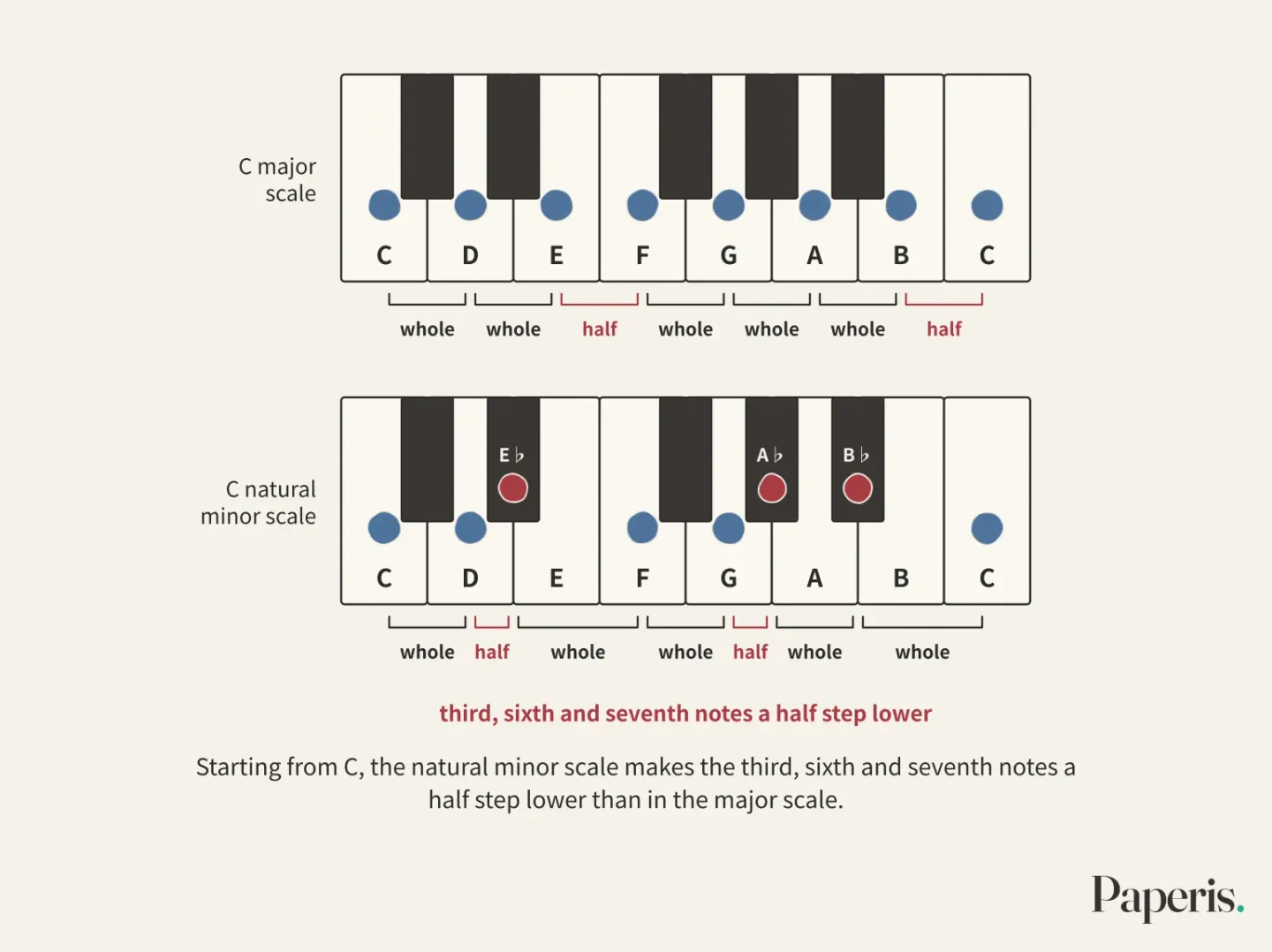
There are two more forms of the minor scale: one that raises the seventh note, and one that raises both the sixth and seventh notes when ascending (Ewell & Schmidt-Jones, Music Fundamentals ch. 3.02). Whichever form is used, the fact that the third note is a half step lower than in the major scale does not change (Brandt & McClure, Sound Reasoning ch. 2.13). Compared from the same tonic, a single half step on the third note divides major and minor. This contrast is the foundation upon which Western classical music weaves its sounds (Brandt & McClure, Sound Reasoning ch. 2.12).
The name of the scale becomes the name of the music. Major is music built on a major scale, and minor is music built on a minor scale. (Brandt & McClure, Sound Reasoning ch. 2.13) Minor keys also have a distinct tonic (Ewell & Schmidt-Jones, Music Fundamentals ch. 1.08), and songs in a minor key likewise return to the tonic to close (Brandt & McClure, Sound Reasoning ch. 2.30). However, because the endings of songs in minor keys are less settled, there are also pieces that end brightly by changing just the final chord or the final passage to major (Brandt & McClure, Sound Reasoning ch. 2.30). What the chords of major and minor keys look like is handled in the installment covering chords.
You can make a minor scale using only the white keys. If you start from A and step only on the white keys up to A, the order of the natural minor scale comes out as is. Therefore, a minor key with A as its tonic uses the exact same seven notes as a major key with C as its tonic (Ewell & Schmidt-Jones, Music Fundamentals ch. 3.02). Even though they use the same seven notes, depending on which note is taken as the tonic, it becomes either a major key or a minor key.
When You Move the Whole Song
So what happens if you don't just lower the third note by itself, but instead move the entire song by the exact same distance? Transposition is the act of moving every note of a melody up or down by the same distance. Transposition itself is covered in detail in another part of this series, the one dealing with pitch and intervals. Here, we play the first line of "Twinkle, Twinkle" starting on C once, and then play it once more starting on F. In the second version, all the notes go up by five keyboard keys, becoming "F-F-C-C-D-D-C."

Clip: the first line of Twinkle from C, then from F
What changed in this clip is only the height. The gaps between the notes are set in the second version just as they were in the first. This is because every note was moved by the exact same distance. And among major keys, no matter which note is taken as the tonic, the order of the gaps is identical (Brandt & McClure, Sound Reasoning ch. 2.25). The initial minor version was different. The starting and ending C remained the same, but two notes dropped so the order of the gaps itself changed. Textbooks note that shifting a major-key song to a minor key greatly changes the song (Ewell & Schmidt-Jones, Music Fundamentals ch. 3.01). Transposition changes the height, while changing a major key to a minor key changes the gaps between notes.
There is a name that jointly refers to which note is taken as the central note and which scale is used. Key is a term that jointly refers to which note is taken as the tonic and whether the major or minor scale is used. The first version we just heard is a major key with C as the tonic, and the second version is a major key with F as the tonic. Because "Twinkle, Twinkle" happens to be a song that starts on the tonic, the starting note and the tonic just happened to be the same, but what determines the key is the tonic, not the starting note. Since any of the twelve notes can be the tonic, there are twelve major keys and twelve minor keys (Brandt & McClure, Sound Reasoning ch. 2.25).
Does Minor Sound Sad?
Textbook authors view major pieces in the Western classical repertory as almost always brighter than minor pieces, and see it as nearly impossible for Westerners familiar with Western music to hear it otherwise (Brandt & McClure, Sound Reasoning ch. 2.12). Then does this connection hold everywhere? The same textbook cites research by musicologist David Huron, noting that there are also cultures that base their scale on the minor side and use it for joyful occasions (Brandt & McClure, Sound Reasoning ch. 2.12).
What do experiments say about this connection? A systematic review published in 2025 gathered 70 studies covering the perception of major and minor, and combined 37 of them in a meta-analysis (PMID 39721138). Across behavioral, EEG, and neuroimaging data alike, major and minor consistently elicited different emotional and brain responses. However, the authors concluded that this difference heavily depends on the listener's subjective perception, and proposed a framework that incorporates personal factors such as age, musical experience, cultural background, and affective disorders. Most of the gathered studies targeted adults, and predominantly Western listeners (PMID 39721138).
Sounding sad and becoming sad are also different. When a 2013 review gathered 16 comparisons weighing the emotion recognized as expressed by music against the emotion actually felt by the listener, the felt emotion was frequently rated the same as or weaker than the recognized emotion (PMID 24381565). For pieces chosen by oneself or liked, the gap between the two was smaller (PMID 24381565). Even if one recognizes a piece in a minor key as "a sad song," one's mood does not necessarily sink by quite that much.
Other Cues, A Child's Ear
There are many more cues to whether music sounds bright than just major and minor keys. Textbooks first point out that songs are so diverse that any generalization is bound to be oversimplified, and then note that minor-key songs tend to differ from major-key songs in tempo, pitch, and melodic movement as well (Brandt & McClure, Sound Reasoning ch. 2.14). This means that in actual songs, scales, tempo, and pitch all move together.
When these cues are separated, the balance can shift. In a preliminary study involving 10 patients with mild cognitive impairment, 10 patients with early Alzheimer's disease, and 23 healthy individuals, no significant correlation emerged in any of the three groups between whether a piece was major or minor and judgments of “happy or sad” (DOI: 10.1159/000358010). What largely drove the judgments was the number of notes sounding per second (DOI: 10.1159/000358010). The authors concluded that how dense the notes are matters much more than the key, but because this is a preliminary study with a small sample, we cannot broadly conclude that “keys do not matter”. Rhythm and tempo are covered in the primer on rhythm.
Instrument sounds also play a role. In an experiment where the same melody was played alternately in major and minor, and on a marimba and a viola, participants picked whether the music was happy or sad more quickly when the key and the instrument pointed in the same direction, such as a major key with a marimba and a minor key with a viola (DOI: 10.3758/s13421-024-01614-8). This experiment was designed by choosing the marimba and the viola as instruments commonly heard in the West as happy and sad, respectively. Differences in instrument sound are handled in the primer on timbre.
So when does this connection first form? Previous research findings on whether young children recognize the emotion in music are mixed (DOI: 10.1177/0305735616652954). In a study where 76 children aged 3 to 6 listened to unfamiliar nursery-rhyme-style tunes and were asked to choose matching faces, even young children correctly matched the intended emotion of the songs, and they recognized happy songs more easily (DOI: 10.1177/0305735616652954). However, the “happy songs” in this study were in a major key and fast, while the “sad songs” were in a minor key and slow (DOI: 10.1177/0305735616652954). This design makes it impossible to tell whether the children were listening to the key or the tempo.
There is also an exploratory study that played three short piano pieces—a major-key piece, a minor-key piece, and a piece with an unclear tonality—to 78 children aged 6 to 7 and 8 to 9 (DOI: 10.1177/1029864912450454). The children liked the major-key pieces more than the minor-key pieces. However, only the 8-to-9-year-old group rated the minor-key pieces as sadder than the major-key pieces, and the 6-to-7-year-old children without musical training did not even pick the major-key piece as the happiest one (DOI: 10.1177/1029864912450454). The authors concluded that even school-age children can make judgments of emotion and beauty for unfamiliar songs. However, because this study compared children of different ages at a single point in time, it did not follow the development of a single child's ear over time.
Ears of Another Culture
What happens if you play major and minor keys to people who have never heard Western music? There is a study that played various Western and non-Western chord structures to people from the Khowar and Kalasha, two tribes in northwestern Pakistan, and to British people. The two groups were people who did not know each other's music (DOI: 10.1371/journal.pone.0244964).
When other emotional cues like tempo, pitch, staccato-legato, and timbre were bundled similarly, Western-style chord structures failed to convey emotions to participants who had not been exposed to Western music (DOI: 10.1371/journal.pone.0244964). Which chord structure they preferred, including the distinction that "major is happy and minor is sad," was also influenced by culture. However, the effect of acoustic roughness on emotional expression was similar in both cultures (DOI: 10.1371/journal.pone.0244964). The authors' conclusion is that while chord structures alone can color emotions, they do so when those structures have meaning in the listener's culture.
Some argue, however, that the connections are not entirely arbitrary. A 2013 review looking at developmental and cross-cultural studies acknowledged that learning certainly plays a part, but concluded that the emotions attached to major and minor are not arbitrarily determined, and are best understood by considering both the physical properties of voices that vary with emotion and their biological uses (DOI: 10.3389/fpsyg.2013.00464). This review was written by a single researcher, and the explanation regarding voices is his interpretation.
There is also a single study in the same direction. When musicians were asked to transcribe pre-verbal babies' cries and babbles into musical notation, intervals of a single semitone were more frequent in cries than all other intervals, whereas this was not the case in babbles (DOI: 10.1177/20416695221092471). The authors suggest that the link between semitone intervals and sadness may have grown out of such social signals (DOI: 10.1177/20416695221092471). However, what separates major and minor keys is the interval between the tonic and the third note, which is a different interval from the one frequently found in baby cries. The connection between the two is also the authors' hypothesis.
While it seems clear that learning plays a role in the emotions attached to major and minor keys, how much the properties of sounds and voices contribute is still debated (DOI: 10.3389/fpsyg.2013.00464). A review collecting cross-cultural studies notes that long-standing assumptions about music cognition must be re-tested with diverse music and diverse people (PMID 22811369). Most answers to date have come from Western listeners (PMID 39721138).
Back in Front of "Twinkle, Twinkle, Little Star"
We now retrace the first two versions. The two versions started in the same key and closed by returning to the same key. The tonic did not change. What changed was that the third note, E, and the sixth note, A, lowered by a semitone each, and as a result, the scale used by the song changed from a major scale to a minor scale. Major with C as the tonic became minor with C as the tonic.
The version that started on F was different. All the notes moved up together by five keyboard steps, so the order of intervals remained the same, and therefore it remained the same song.
In the first clip, only those two notes had changed. The tempo and instruments were the same, and both versions played only the melody without chords. Whether one heard that difference as dark, or simply heard it as different, is up to the listener. The studies examined in this article did not test sounds like this clip. Studies that changed only the scale of a melody without chords and played it to people unfamiliar with Western music do not exist among the evidence for this article.
Because the 70 studies gathered in a 2025 systematic review mostly targeted adults, mainly Western listeners, the consistent differences in the meta-analysis must also be read as results within that scope, and even those differences relied heavily on the subjective perception of the listeners (PMID 39721138). In one small pilot study, no meaningful correlation between mode and judgments of "happy/sad" emerged even among 23 healthy adults (DOI: 10.1159/000358010). To extend "minor is sad" beyond that, the evidence is still lacking.
Where to explore further
Half steps and intervals, octaves, and transposition are covered from the start in another installment of this series, the one dealing with pitch and intervals. The chords that support major and minor keys and where "consonance" comes from are handled in the installment on chords, speed and beat in the one on rhythm, and how the same melody sounds different depending on the instrument—like the marimba and the viola—in the one on timbre.
Source Papers
- "The major-minor mode dichotomy in music perception." (2025) — PMID 39721138 — Systematic review of 70 studies and meta-analysis of 37 studies: Major and minor modes consistently elicit different affective and brain responses, but are heavily dependent on subjective perception, and most studies focus on adults and Western listeners.
- "Emotion felt by the listener and expressed by the music: literature review and theoretical perspectives." (2013) — PMID 24381565 — Comparison of 16 studies contrasting felt emotion and emotion expressed by the music: Felt emotion is frequently rated the same or lower, with the gap narrowing for self-selected and favorite pieces.
- "Music perception and cognition: a review of recent cross-cultural research." (2012) — PMID 22811369 — Review of cross-cultural music cognition research over the past decade: More research using diverse data and groups is needed to test long-standing assumptions in music cognition.
- "A vocal basis for the affective character of musical mode in melody" (2013) — DOI: 10.3389/fpsyg.2013.00464 — Review of developmental and cross-cultural research: While learning plays a part, the emotional association of major and minor modes is not arbitrary and is best understood by considering emotion-related vocal characteristics together.
- "Minor second intervals: A shared signature for infant cries and sadness in music" (2022) — DOI: 10.1177/20416695221092471 — Study where musicians transcribed infant vocalizations: Minor seconds were more frequent in cries than in other intervals and were not in babbling; suggestion that the connection may develop from statistical regularities of social signals.
- "Harmonic organisation conveys both universal and culture-specific cues for emotional expression in music" (2021) — DOI: 10.1371/journal.pone.0244964 — Northwest Pakistani Khow and Kalasha people and British participants: When different cues were combined similarly, Western harmony failed to convey emotion to unexposed participants, the distinction between major=joy/minor=sad was influenced by culture, and the effect of roughness was similar across cultures.
- "Preschoolers' attribution of affect to music: A comparison between vocal and instrumental performance" (2016) — DOI: 10.1177/0305735616652954 — 76 children aged 3 to 6 correctly matched the emotions of "happy songs" (major, fast) and "sad songs" (minor, slow) even at a young age.
- "The development of the aesthetic experience of music: Preference, emotions, and beauty" (2012) — DOI: 10.1177/1029864912450454 — Exploratory study of 78 children aged 6 to 9: Preference for major pieces, with only 8- to 9-year-olds rating minor pieces as sadder.
- "Happy and Sad Judgements in Dependence on Mode and Note Density in Patients with Mild Cognitive Impairment and Early-Stage Alzheimer's Disease" (2014) — DOI: 10.1159/000358010 — Preliminary study (10+10 patients, 23 controls): No significant correlation between mode and joy/sadness judgments, with the effect of note density being large.
- "Play it again, but more sadly: Influence of timbre, mode, and musical experience in melody processing" (2024) — DOI: 10.3758/s13421-024-01614-8 — Joy/sadness classification was faster when mode (major/minor) and timbre (marimba/viola) pointed in the same direction.
- "Music Fundamentals — 1.03 Introduction to the Piano Keyboard" (Ewell·Schmidt-Jones, LibreTexts, CC BY 3.0) — Ewell & Schmidt-Jones, Music Fundamentals ch. 1.03 — On the keyboard, E–F and B–C are half steps between adjacent white keys, while whole steps exist between the remaining neighboring white keys with black keys in between.
- "Music Fundamentals — 1.08 Major Keys and Scales" — Ewell & Schmidt-Jones, Music Fundamentals ch. 1.08 — Both major and minor keys possess a strong central pitch.
- "Music Fundamentals — 1.09 Scale Degrees of the Diatonic Scale" — Ewell & Schmidt-Jones, Music Fundamentals ch. 1.09 — The first note of a scale is the tonic and the central pitch of the key.
- "Music Fundamentals — 3.01 Minor Keys and Scales" — Ewell & Schmidt-Jones, Music Fundamentals ch. 3.01 — Interval sequence of the natural minor scale, transposing a major piece to minor drastically changes the song, and minor keys are sometimes described as solemn or sad.
- "Music Fundamentals — 3.02 Learning Major and Minor Scales" — Ewell & Schmidt-Jones, Music Fundamentals ch. 3.02 — Interval sequence of the major scale, A minor scale with no key signature.
- "Sound Reasoning — 2.09 The Tonic" (Brandt·McClure, LibreTexts, CC BY) — Brandt & McClure, Sound Reasoning ch. 2.09 — The tonic provides maximum stability and rest, nearly all Western classical works end on the tonic, and many other traditions also feature a central pitch.
- "Sound Reasoning — 2.12 The Major-minor Contrast" — Brandt & McClure, Sound Reasoning ch. 2.12 — The Western harmonic language of 1600–1900, the general association of major and minor modes with emotion, and its cultural nature (Huron).
- "Sound Reasoning — 2.13 Modes and Scales" — Brandt & McClure, Sound Reasoning ch. 2.13 — Half steps and whole steps, the definition of a scale, and the third note of any minor scale form is lowered by a half step.
- "Sound Reasoning — 2.14 Hearing the Mode" — Brandt & McClure, Sound Reasoning ch. 2.14 — Minor pieces tend to be lower and slower or urgent and tense, serving as other perceptual cues.
- "Sound Reasoning — 2.25 Leaving the Key" — Brandt & McClure, Sound Reasoning ch. 2.25 — Key = tonic + major/minor, twelve keys per mode, and keys of the same mode share the same construction.
- "Sound Reasoning — 2.30 Final Closure" — Brandt & McClure, Sound Reasoning ch. 2.30 — Songs return to the tonic to close, and minor pieces have less definitive endings, sometimes leading to the final chord or passage being changed to major.
Sources (21)
- The major-minor mode dichotomy in music perceptionPMID 39721138
- Emotion felt by the listener and expressed by the music: literature review and theoretical perspectivesPMID 24381565
- Music perception and cognition: a review of recent cross-cultural researchPMID 22811369
- A vocal basis for the affective character of musical mode in melodyDOI 10.3389/fpsyg.2013.00464
- Minor second intervals: A shared signature for infant cries and sadness in musicDOI 10.1177/20416695221092471
- Harmonic organisation conveys both universal and culture-specific cues for emotional expression in musicDOI 10.1371/journal.pone.0244964
- Preschoolers' attribution of affect to music: A comparison between vocal and instrumental performanceDOI 10.1177/0305735616652954
- The development of the aesthetic experience of music: Preference, emotions, and beautyDOI 10.1177/1029864912450454
- Happy and Sad Judgements in Dependence on Mode and Note Density in Patients with Mild Cognitive Impairment and Early-Stage Alzheimer's DiseaseDOI 10.1159/000358010
- Play it again, but more sadly: Influence of timbre, mode, and musical experience in melody processingDOI 10.3758/s13421-024-01614-8
- Music Fundamentals — 1.03 Introduction to the Piano Keyboard
- Music Fundamentals — 1.08 Major Keys and Scales
- Music Fundamentals — 1.09 Scale Degrees of the Diatonic Scale
- Music Fundamentals — 3.01 Minor Keys and Scales
- Music Fundamentals — 3.02 Learning Major and Minor Scales
- Sound Reasoning — 2.09 The Tonic
- Sound Reasoning — 2.12 The Major-minor Contrast
- Sound Reasoning — 2.13 Modes and Scales
- Sound Reasoning — 2.14 Hearing the Mode
- Sound Reasoning — 2.25 Leaving the Key
- Sound Reasoning — 2.30 Final Closure