Paperis Articles
Timbre — Same Pitch, Same Loudness, a Different Face
A piano and a violin playing the same note at a similar loudness sound different because the harmonics stacked inside each note are mixed in different proportions, and because the sounds start and fade in different shapes. In experiments, the ear took in these cues separately yet read them together.
Your field's papers, as audio
Pick your fields and journals — Paperis summarizes the key papers and turns them into audio. Listen on your commute.
Start Paperis free →Timbre — Same Pitch, Same Loudness, a Different Face
A Single "Hello"
Your phone rings, you pick it up, and no name appears on the screen. Even so, when a single "Hello" comes from the other side, you usually know right away whether it is your mom or a friend. That is because even the same "Hello" sounds different for each person.
Musical instruments are the same. Even if a piano and a violin play a note of the same pitch at a similar volume, if you listen with your eyes closed, you will not get confused about which side is the piano. The pitch is the same and the volume is similar, but what is different? This article follows that "what." It looks at what is layered inside a single sound, how instruments and voices craft those layers differently, what the shapes of a sound starting and disappearing do, and how the ear and brain recognize that difference.
This series covers the basics of Western music theory. Most of the experiments in this article were also done with the sounds of Western orchestral instruments.
As a guide, we take a single face along with us. Height and weight can be measured with a single scale, but a face is a shape created by eyes, nose, and mouth together, so it cannot be written down with a single scale. Still, we recognize a face at a glance. If the pitch and volume of a sound are height and weight, what this article deals with is the face of a sound.
Neither Height nor Size
First, let's establish two terms. Pitch refers to how high or low a sound is heard. Loudness is literally how loud a sound is heard. And then there is the main character of this article. Timbre is the property of sound that makes two sounds with the same pitch, loudness, and duration sound different from each other.
This definition points to timbre as the difference that remains after matching pitch, loudness, and duration (PMID 24312021). Therefore, experiments on timbre usually start by first making the pitch, loudness, and duration of the sounds identical (DOI: 10.1121/1.1929229) (DOI: 10.1121/1.381428).
Timbre works outside of music as well. Distinguishing between "ah" and "ee", distinguishing consonants, recognizing instruments, and distinguishing between the sound of a closing door and boiling water all rely in part on timbre (PMID 24312021). There are also studies covering how animals perceive the timbre of human vowels or animal cries (PMID 24312021). Timbre is also explained as a property that tells us where a sound came from—in other words, the owner of the sound (DOI: 10.1162/jocn.2006.18.12.1959). Timbre would also play a part in recognizing Mom on the other end of the phone. However, studies directly measuring the recognition of people by voice are not covered in this article.
Multiple Vibrations in a Single Note
When you press a single piano key, you hear a single note. But that single note is actually a sound made of multiple vibrations with different speeds overlapping all at once.
The fundamental is the slowest-vibrating component within a single note, and is usually heard as the pitch of that note. A review on the singing voice summarizes that the pitch we hear matches the speed of the fundamental (PMID 8061767). Overtones are components that ring out together mixed into a single note of an instrument or voice, vibrating twice, three times, and four times faster than the slowest vibration in that note. When calculating the vibration of air inside a tube or a string, overtones are whole-number multiples of the fundamental, so if the fundamental vibrates 100 times per second, the overtones vibrate 200, 300, and 400 times (OpenStax Physics 14.4). Actual instrument sounds sometimes deviate slightly from this calculation. There is also a timbral experiment where synthesized sounds were played while varying the degree of deviation from whole-number multiples within the range of actual instrument sounds (PMID 34852574).
Clip: fundamental alone → with harmonics added → fundamental alone
When you compare a sound with only a fundamental tone and a sound with overtones added to the same fundamental tone all at once, a fascinating thing happens. All the added components vibrate faster than the fundamental tone, but the perceived pitch stays the exact same. What changes is the texture of the sound. When only the fundamental tone sounds, it sounds plain and round; when overtones are added, the sound becomes full and bright. The perceived pitch generally follows the speed of the fundamental tone, and the overtones change the face of the sound while keeping that pitch intact.
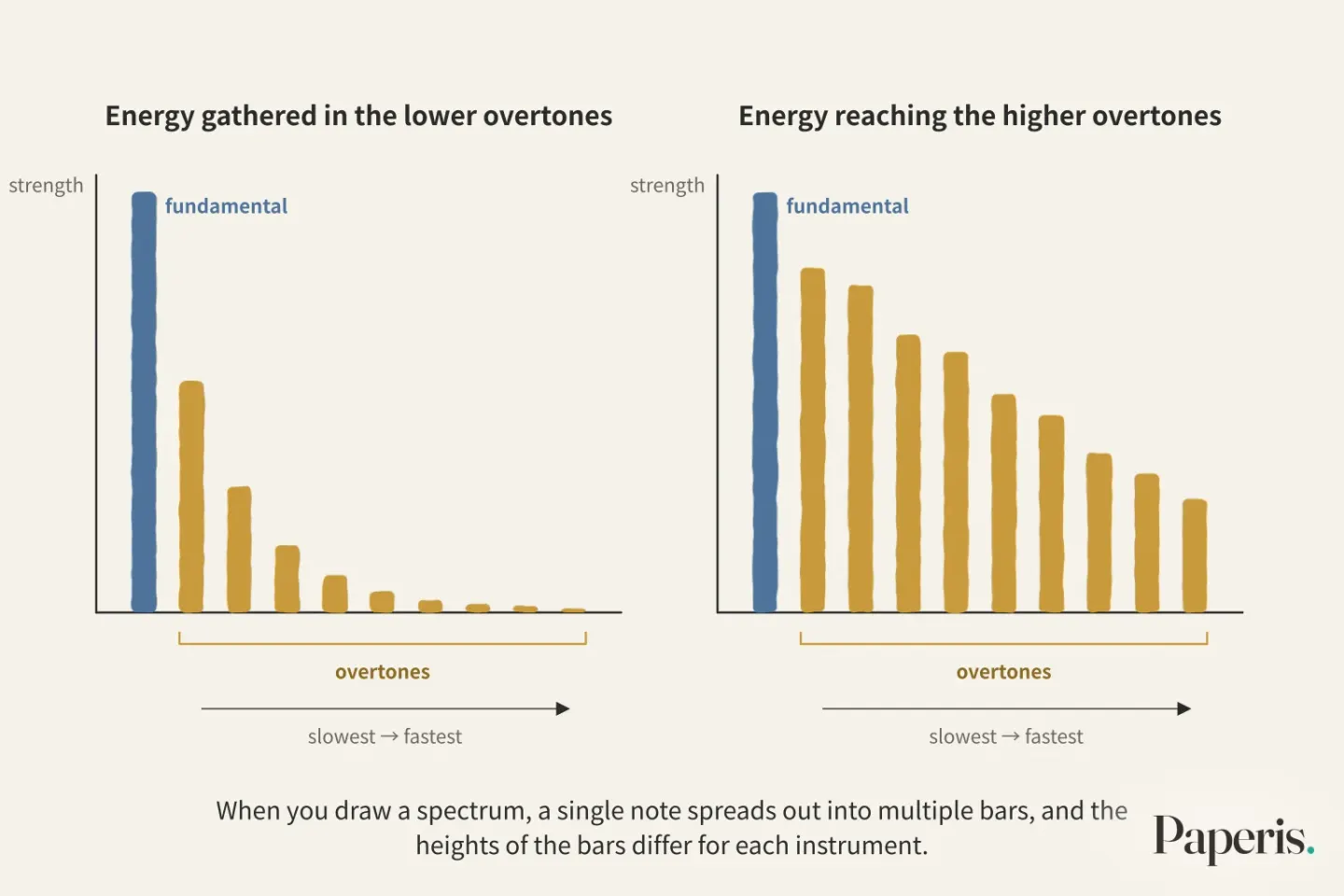
What makes each instrument different is how strongly each overtone rings out (OpenStax Physics 14.4). There is a picture that lets you see that mixture at a glance. A spectrum is an arrangement of the fundamental and overtones contained in a single sound, ordered by how fast they vibrate from slowest to fastest. When you draw a spectrum, a single note spreads out into multiple bars, and the heights of the bars differ for each instrument.
Bright Sounds, Dark Sounds
People often use words like "bright", "dark", "crisp", and "muffled" when talking about sound. Among them, "bright" is a term with quite solid evidence.
Brightness is the degree to which a sound is heard as bright or dark, depending on how much of the sound's energy is concentrated in the higher harmonics. The more energy is concentrated in the higher harmonics, the brighter a sound is heard. In a study comparing 14 orchestral instrument sounds in various ways, brightness was a sensory quality that people rated consistently in a single line, and the brightness rated directly by people matched how much the energy was concentrated toward the higher end of the spectrum (DOI: 10.1121/10.0002275). In the same study, adding information about which family an instrument belongs to or what produces its sound to a computational model explaining brightness judgments did not improve the model (DOI: 10.1121/10.0002275). This means that when the ear judges brightness, it relies primarily on the sound itself rather than guesses like "this is a brass instrument."
Clip: a dark and a bright tone at the same pitch and loudness
Brightness is not determined by the instrument alone. In an experiment where clarinet sounds synthesized through a physical model were played to 16 people, changing the blowing pressure and the lip force pressing the reed changed the timbre, and the difference was separated by cues such as brightness and the shape of the sound onset (DOI: 10.3813/aaa.918322). In actual performances, when musicians played excerpts of Bach and Mozart pieces flatly versus with expression, timbral cues including brightness changed (DOI: 10.1525/mp.2010.28.2.135). The authors of that study suggest that timbre can carry a performer's expression—such as changes in the timing and intensity of notes—to the listener (DOI: 10.1525/mp.2010.28.2.135). Just as a person's face has expressions, a single instrument's timbre has expressions made by the performer.
Overtone Shares Chosen by the Instrument's Body
Why do different instruments have different shares of overtones? An instrument's body does not resonate loudly at just any speed. The air inside a pipe or the string of a stringed instrument only resonates loudly at certain set speeds, and those speeds become the positions of the fundamental tone and the overtones (OpenStax Physics 14.4). Therefore, which overtones the instrument's body amplifies and which it makes sound less loudly shapes the face of that instrument's sound.
Depending on the shape of the pipe, there are also pipes that only amplify the fundamental tone and overtones that vibrate at odd-numbered multiples, such as three times and five times higher than the fundamental tone (OpenStax Physics 14.4). The ratio in which odd-numbered and even-numbered components are mixed also appears in perception experiments. In the clarinet synthetic sound experiment seen earlier, that ratio was one of the three clues that explained people's judgments. The authors view this ratio as a clue particularly suited for instruments that make sound with a single reed, like the clarinet (DOI: 10.3813/aaa.918322).
The voice also changes the shares of overtones through the shape of the body (OpenStax Physics 14.4). Formants are peaks rising above the spectrum where overtones around certain vibration speeds become exceptionally loud due to the shape of the throat and the inside of the mouth. The reason "ah" and "ee" sound different even when sung at the same pitch is because the positions of these peaks are different, and what vowel is heard is mainly determined by the positions of the two lowest formants (PMID 8061767). A review paper on the singing voice divides the timbre of the voice into two layers. They are which vowel it is, and the quality of the voice itself (PMID 8061767). The studies covered here did not measure how much each of the two layers is used when recognizing a person.
Timbre is also connected to how large the sound appears to be, in other words, the sense of the sound's bulk. In an experiment where participants were asked to rank seven orchestral instrument sounds—matched for pitch but not for loudness—by "how large they are (bulk)," people assigned very similar orders, and that order was also very similar to the order that the French composer Charles Koechlin wrote down in his orchestration book (DOI: 10.1177/1029864916649638). Koechlin separated this bulk as a dimension distinct from the loudness of the sound (DOI: 10.1177/1029864916649638). This sense of bulk appeared to be connected to the shape of the spectrum, especially the strength concentrated on the lower side, and had no relation to musical training, native language, or mild hearing loss (DOI: 10.1177/1029864916649638). The authors speculate that this may be a universal sense of timbre common to people, but this is a result obtained from the participants of a single study.
Start and End
If timbre were determined solely by the share of overtones, we should be able to recognize an instrument even if we cut out and listen only to the middle of a single note. But sounds have a beginning and an end, and their shapes are also part of their face.
The attack is the first part of a sound, from when it starts until it reaches its loudest. A piano note jumps straight to its loudest the moment a hammer strikes the string with a "bang," whereas a violin note can be made to grow gradually as the bow is drawn. The decay is the part where the sound fades away and disappears after reaching its peak loudness. A piano note gradually dies down even if you keep holding the key down, while a violin note continues as long as the bow is drawn continuously.
Clip: a piano note, then the same note with its attack removed
A 2020 study reviewing previous research on orchestral timbre points to attack length and how much power is loaded into the upper part of the spectrum as the two clues that have most robustly explained timbre differences (DOI: 10.1121/10.0002275). Even in experiments using synthetic sounds with matched pitch, loudness, and duration, and with clues adjusted precisely, people used attack length and brightness, as well as the fine patterns of the spectrum, to judge how different two sounds were (DOI: 10.1121/1.1929229).
However, the ear struggles to distinguish very short attacks. In an experiment where people were asked to order synthetic sounds by attack length, participants were frequently confused among very short attacks (PMID 34852574). Instead, people successfully distinguished roughly where the sound's power was clustered in time even for short attacks, and reanalyzing six existing timbre studies showed that this factor explained people's judgments better than attack length did (PMID 34852574).
The beginning part also contains information about the object that made the sound. In an experiment where people listened to recordings of metal struck with various mallets and rated how hard the mallet looked, four values measured from the first 0.3 seconds or so of the sound could predict those judgments quite well (DOI: 10.1121/1.399298). This means that clues about how hard the mallet is are carried in the initial sound.
There are also opposing results. In an experiment comparing real orchestral sounds with their imitations, brightness and the fluctuation of the spectrum over time separated judgments, and virtually no evidence emerged that attack length separated them (DOI: 10.2307/40285796). The share of a clue depends on the sounds used in the experiment. Even in the synthetic sound experiment mentioned earlier, the degree to which the spectrum fluctuated over time became less prominent depending on how many other clues changed alongside it (DOI: 10.1121/1.1929229).
How the Ear Distinguishes Timbres
When recognizing a face, we look at the eyes, nose, and mouth all at once. Timbre researchers also typically avoid asking one-by-one questions like "Is this a nasal sound?", instead asking only how differently two sounds are heard.
A timbre space is a map that arranges various sounds by playing them in pairs, scoring how different they sound, and placing the sounds closer together the more similar they are. The raw material for this map is the perceived distance people feel between sounds adjusted for pitch, loudness, and duration (DOI: 10.1121/1.1929229). How many axes the map has and what each axis represents are read after the experiment concludes. A 1977 timbre space created from 16 synthesized sounds analyzing real instrument sounds had three axes. One was where the energy was concentrated in the spectrum, and the other two were close to whether the overtones entered together at the onset and whether a slight high sound was mixed into the attack (DOI: 10.1121/1.381428). On this map, sounds generally clustered together by instrument family (DOI: 10.1121/1.381428).
How many cues there are remains disputed. A 2013 study found five axes in the timbre space of sustained orchestral instrument sounds, and reported that most of those axes come not from either temporal cues or overtone cues alone, but from patterns where the two are intertwined (DOI: 10.1121/1.4770244). The authors stated that this disagrees with previous studies (DOI: 10.1121/1.4770244). This is about as much as can be said right now. Timbre is a multi-layered sensation that cannot be captured by a single scale, and brightness and attack are cues that multiple studies have repeatedly singled out. However, the share of the attack has varied across studies, and how many layers there are and what each layer precisely is also differ slightly from experiment to experiment.
A similar picture emerges in the brain. In an experiment measuring brain responses when the attack, brightness, and fine spectral details were altered, the three cues were processed partially separately during the memory stage that holds onto sounds briefly (DOI: 10.1162/jocn.2006.18.12.1959). Yet, in another experiment addressing the same three cues, trying to ignore one cue caused another cue to intrude (DOI: 10.1162/jocn.2008.20.1.49). This means that while the cues are received separately, they are also read mixed together, which resembles how we look at the eyes and mouth separately when viewing a face yet ultimately recognize it as a single face.
Disputes also remain over where in the brain this occurs. The temporal lobe is the side part of the cerebrum located inside the temples above the ears, and is involved in hearing sounds and understanding speech. A 2003 review gathering brain-damaged patient and brain imaging studies concluded that the right temporal lobe, particularly its front part, is mainly involved in handling the spectral and temporal shapes of timbre (PMID 14681128). The same review added that the share of the left temporal lobe is still being debated, and that brain imaging studies point to a broader network extending to the front and back of the temporal lobe, and perhaps even toward the frontal brain (PMID 14681128). A 2022 review summarizing timbre perception research also covers potential problems remaining in the experimental process and future tasks (PMID 35422736).
Now it is time to take the cues we have learned and listen to the same melody. There are variations written by Mozart on a French song familiar to us as "Twinkle, Twinkle, Little Star", and the first two measures of that theme are played sequentially using simulated sounds made by piecing together short recorded fragments of piano, violin, flute, and clarinet.

Clip: the same melody on piano, violin, flute and clarinet
The melody and pitch are identical all four times, and the perceived loudness is also matched. The four sounds are simulated melodies made by piecing together short recordings of each instrument. The sound mimicking the piano has a distinct start for each note that quickly fades away, and the four also differ in brightness. If four sounds with identical pitch and loudness sound different, that difference is timbre.
Timbre also helps us follow the melody of each instrument when multiple instruments play together. In an experiment where an ascending scale and a descending scale were played alternatingly by different instruments, the greater the timbre difference between the two instruments, the more people heard the scales played by each instrument as separate streams, especially when the keys of the two scales were distant or when the notes alternated rather than sounding simultaneously (DOI: 10.2307/40285649). The sounds in this experiment were synthesized sounds mimicking orchestral instruments. The largest shares in this came from the ratio of energy concentrated in the lower overtones and, when the two scales were in discordant keys, the length of time the sound took to fade away (DOI: 10.2307/40285649).
Before Another "Hello"
The face analogy goes wrong in one place. A face is seen all at once in a single glance, but the face of a sound unfolds along time. From the "bang" at the start to the dying-out shape, even the spectrum that undulates over time goes into the face. Therefore, a single spectrum snapshot cut from just the middle of a note does not draw the full face of that sound.
This point becomes clear when you try making imitation sounds. In an experiment comparing actual instrument sounds and sounds imitated in various ways, people guessed the instrument names of actual sounds and splice-and-dice recorded sounds much more clearly than synthetic sounds made by other methods (DOI: 10.2307/40285796). When the distribution of the spectrum and its undulations disagreed with the original instrument, the imitation sounded clumsy (DOI: 10.2307/40285796). The performance clips in this article are sounds made by stitching together recorded pieces or synthesized from scratch. Because they differ from actual performances, please listen to the differences among the sounds rather than the instrument names.
Returning to the "hello" from across the phone, even in that single word, along with pitch and loudness, clues like the share of overtones, the peaks carved out by the inside of the mouth, and the shape of the initial consonant entering are carried together. In the instrument sound experiment, the ear received such clues separately while also reading them mixed together. We only guess that it is likely the same when recognizing the owner of a voice, and the studies covered here did not measure that directly.
Where to Look Further
Frequency and wavelength, and what a wave is, are covered in "Waves — Fans Rising in Their Seats, a Wave Circling the Stadium". The fundamental and overtones of this article are multiple layers of those vibrations overlapping.
Among other parts of this series, the one covering pitch and intervals deals with how the height of a single note connects to the speed of vibration, and where that height sits on the keyboard. The part covering chords and consonance connects how overtones overlap when two notes sound together to harmony.
Source Papers
- "Neural and behavioral investigations into timbre perception." (2013) — PMID 24312021 — Review article outlining timbre as the attribute that distinguishes sounds of the same pitch, loudness, and duration, used in the perception of speech, instruments, and environmental sounds, extending up to animal timbre perception and auditory cortex representations.
- "Multidimensional perceptual scaling of musical timbres" (1977) — DOI: 10.1121/1.381428 — Derived a three-dimensional timbre space from the similarities of 16 instrument tones synthesized based on real instrument sound analyses and matched in pitch, loudness, and duration; the axes are interpreted as spectral energy distribution, simultaneous high-harmonic transients and spectral fluctuation, and attack high-frequency energy, with sounds clustering by instrument family.
- "Separate Neural Processing of Timbre Dimensions in Auditory Sensory Memory" (2006) — DOI: 10.1162/jocn.2006.18.12.1959 — Timbre characterizes the identity of a sound source, and its three dimensions—attack time, spectral centroid, and spectral fine structure—are processed partially separately in sensory memory (MMN).
- "Physics — 14.4 Sound Interference and Resonance" (2020) — OpenStax Physics 14.4 — Pipes and strings resonate loudly at specific fixed speeds, with the lowest being the fundamental and its multiples being harmonics; the mixing of harmonics creates the characteristics of instruments and the voice, and pipes closed at one end resonate only at odd multiples.
- "Perceptual aspects of singing." (1994) — PMID 8061767 — Vocal timbre has two aspects, vowel quality and voice quality, with vowel quality mainly determined by the two lowest formants, and perceived pitch corresponding to the fundamental frequency.
- "Brightness perception for musical instrument sounds: Relation to timbre dissimilarity and source-cause categories" (2020) — DOI: 10.1121/10.0002275 — Attack time and spectral centroid are the two most robust acoustic correlates of timbre difference, brightness matches spectral centroid as a single dimension, and instrument family and sound-source information did not improve the model (14 instrument tones).
- "From Clarinet Control to Timbre Perception" (2010) — DOI: 10.3813/aaa.918322 — 16 participants evaluated physical-model clarinet synthesized sounds (blowing pressure, lip pressure) to yield a three-dimensional timbre space explained by attack time, spectral centroid, and odd-even harmonic ratio.
- "Acoustical Correlates of Timbre and Expressiveness in Clarinet Performance" (2010) — DOI: 10.1525/mp.2010.28.2.135 — When playing Bach and Mozart passages mechanically versus expressively, timbre descriptors (attack, spectral centroid, odd-even ratio) changed significantly, concluding that timbre can mediate expression.
- "Koechlin's volume : Perception of sound extensity among instrument timbres from different families" (2016) — DOI: 10.1177/1029864916649638 — The perception of "largeness" for 7 orchestrally matched orchestral instruments was common among participants and related to low-frequency energy, independent of musical training or native language, suggesting it may be a universal timbre property.
- "Acoustic correlates of timbre space dimensions: A confirmatory study using synthetic tones" (2005) — DOI: 10.1121/1.1929229 — Timbre space is the organization of dissimilarity distances between sounds matched in pitch, loudness, and duration; in controlled synthetic tones, listeners used attack time, spectral centroid, and spectral fine structure, while spectral flux was less prominent.
- "Ordinal scaling of temporal audio descriptors and perceptual significance of attack temporal centroid in timbre spaces." (2021) — PMID 34852574 — While there was much confusion in ordering short attack and decay times, time centroids were well discriminated, and in a meta-analysis of 6 timbre spaces, the attack time centroid had greater explanatory power than attack time.
- "Auditory correlates of perceived mallet hardness for a set of recorded percussive sound events" (1990) — DOI: 10.1121/1.399298 — Successfully predicted perceived mallet hardness using regression on four acoustic indices of the attack portion (first 325ms) of metal struck sounds.
- "Perceptual and Acoustical Features of Natural and Synthetic Orchestral Instrument Tones" (1999) — DOI: 10.2307/40285796 — Real and sampled sounds were better identified by instrument than FM and mixed synthesis, with the first dimension being spectral centroid and the second being spectral fluctuation, showing little evidence for attack time correspondence, and imitation was poor when spectral distribution and fluctuation mismatched.
- "Acoustic structure of the five perceptual dimensions of timbre in orchestral instrument tones" (2013) — DOI: 10.1121/1.4770244 — The sustained instrument timbre space is 5-dimensional, and unlike previous studies, most dimensions depend on spectral-temporal patterns rather than pure temporal or spectral features.
- "Interactive Processing of Timbre Dimensions: An Exploration with Event-related Potentials" (2007) — DOI: 10.1162/jocn.2008.20.1.49 — Attack time, spectral centroid, and spectral fine structure are processed interactively, and there is a cost to filtering out irrelevant dimensions (ERP).
- "Neuropsychological studies of musical timbre." (2003) — PMID 14681128 — Lesion and imaging studies support the dominant involvement of the right temporal lobe (especially the anterior part), while the share of the left temporal lobe is debated, and imaging studies suggest a broader network.
- "A Review of Research on the Neurocognition for Timbre Perception." (2022) — PMID 35422736 — Review article centering on multidimensional scaling to organize the characteristics, neurocognition, and experimental results of timbre perception while discussing potential experimental issues.
- "Timbre and Auditory Streaming" (1994) — DOI: 10.2307/40285649 — As timbre differences grew larger, listeners heard intersecting scales separated by instrument, with the energy ratio of low harmonics and (in dissonant scales) decay length being most crucial for segregation.
Sources (18)
- Neural and behavioral investigations into timbre perceptionPMID 24312021
- Multidimensional perceptual scaling of musical timbresDOI 10.1121/1.381428
- Separate Neural Processing of Timbre Dimensions in Auditory Sensory MemoryDOI 10.1162/jocn.2006.18.12.1959
- Physics — 14.4 Sound Interference and Resonance
- Perceptual aspects of singingPMID 8061767
- Brightness perception for musical instrument sounds: Relation to timbre dissimilarity and source-cause categoriesDOI 10.1121/10.0002275
- From Clarinet Control to Timbre PerceptionDOI 10.3813/aaa.918322
- Acoustical Correlates of Timbre and Expressiveness in Clarinet PerformanceDOI 10.1525/mp.2010.28.2.135
- Koechlin's volume : Perception of sound extensity among instrument timbres from different familiesDOI 10.1177/1029864916649638
- Acoustic correlates of timbre space dimensions: A confirmatory study using synthetic tonesDOI 10.1121/1.1929229
- Ordinal scaling of temporal audio descriptors and perceptual significance of attack temporal centroid in timbre spacesPMID 34852574
- Auditory correlates of perceived mallet hardness for a set of recorded percussive sound eventsDOI 10.1121/1.399298
- Perceptual and Acoustical Features of Natural and Synthetic Orchestral Instrument TonesDOI 10.2307/40285796
- Acoustic structure of the five perceptual dimensions of timbre in orchestral instrument tonesDOI 10.1121/1.4770244
- Interactive Processing of Timbre Dimensions: An Exploration with Event-related PotentialsDOI 10.1162/jocn.2008.20.1.49
- Neuropsychological studies of musical timbrePMID 14681128
- A Review of Research on the Neurocognition for Timbre PerceptionPMID 35422736
- Timbre and Auditory StreamingDOI 10.2307/40285649