Paperis Articles
Pitch and Intervals — Raise the Key and It's Still the Same Song; Vibrate Twice as Fast and It Keeps Its Name
How high a sound is comes from how fast it vibrates, and a note vibrating twice as fast is an octave up, alike enough to share its name. Western music splits that span into twelve half steps, and an interval is how many steps lie between two notes. Our ears follow the gaps between notes, not only the height of each one.
Your field's papers, as audio
Pick your fields and journals — Paperis summarizes the key papers and turns them into audio. Listen on your commute.
Start Paperis free →Pitch and Intervals — Raise the Key and It's Still the Same Song; Vibrate Twice as Fast and It Keeps Its Name
Raising the Key Keeps the Same Song
If the original song is too low at the karaoke room, you press the key button on the remote a few times. When the accompaniment starts again, every single note from the first to the last is slightly higher. Yet most listeners do not say that a different song is playing. Every single sound has changed, but the song remains the same.
The same goes for playing the "Ode to Joy" melody from the final movement of Beethoven's Ninth Symphony on the piano. If you play it once at the starting pitch and then immediately play the whole thing a few steps higher, the second one clearly sounds higher. Yet both are the same melody.

Clip: the Ode to Joy theme in C, then five half steps higher (synthesized piano)
This article follows those reasons. We will look in turn at where the pitch of a sound comes from, why two sounds with a twofold difference in pitch sound similar, how to measure the distance between two sounds, and what the ear grasps and remembers. How we listen to music depends on various factors that differ across cultures, and is also tied to the properties of the ear (PMID 18824100). The names and spaces covered in this article are the ways Western music divides and names pitches.
Pitch Comes from the Speed of Vibration
Sound is created when something vibrates. A vibrating object shakes the air around it, and the air shakes at the same speed as that object, carrying that vibration to the ear (OpenStax Physics 14.1).
Pitch refers to how high or low a sound is heard. That pitch depends on the speed of the vibration. Sounds that vibrate faster are heard as higher, and sounds that vibrate slower are heard as lower (Ewell & Schmidt-Jones, Music Fundamentals ch. 1.04). There is a specific word for counting this speed. Frequency is the number of times a shake repeats in one second, measured in a unit called hertz. If it shakes once in a second, it is 1 hertz (OpenStax Physics 13.2). Frequency is a value measured by machines, while pitch is the feeling heard by the human ear.
A single musical instrument sound actually has multiple vibrations of different speeds layered together. Even so, we hear only a single pitch, and that pitch generally follows the speed of the base vibration among the layered vibrations (Ewell & Schmidt-Jones, Music Fundamentals ch. 1.04). Information about the layered vibrations is combined somewhere along the path from the ear up to the brain, and there is an area in the brain receiving sound that is particularly sensitive to pitch. Exactly where that place is remains debated (PMID 23938209). Most experimental results so far align with the explanation that pitch likely emerges from the regularity with which sound patterns repeat at regular intervals (PMID 19933556). How layered vibrations change the color of sound is covered in the timbre part of this series.
Climbing Twelve Steps Brings You Back Again
You sit at the piano and play a C. This time you move to the right, stepping one key at a time to the immediate next key, whether white or black. If you move twelve times, you pass through seven white keys and five black keys and arrive back at C (Ewell & Schmidt-Jones, Music Fundamentals ch. 1.04).
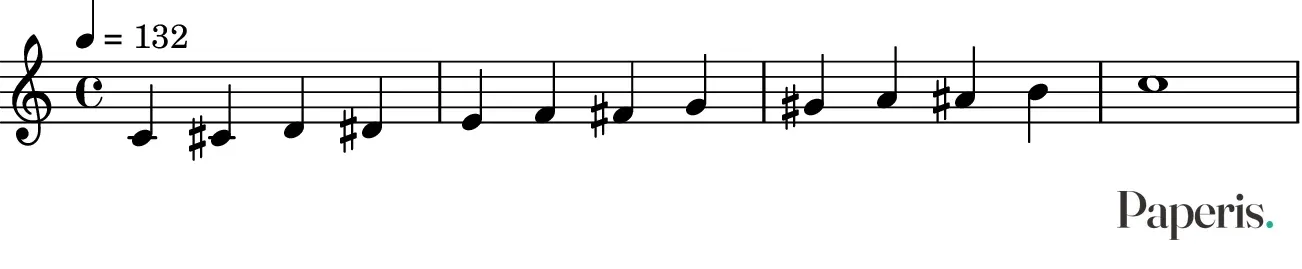
Clip: thirteen half steps from C up to C
Each white key has its own name. Pitch names are names given to each height, and the familiar do-re-mi are precisely those. If you press only the white keys starting from do, you pass through seven names—re, mi, fa, sol, la, si—and on the eighth, do appears again. Above that, the same seven names repeat in the same order (Ewell & Schmidt-Jones, Music Fundamentals ch. 1.04).
Double the Vibration, Same Name
Whether you count by twelve steps or by the eighth white key, you land on the same upper C. The distance from the first C to this C has a name. An octave is the distance to a note vibrating twice as fast, and the two notes sound similar enough to share the same name. The upper C vibrates twice as many times per second as the lower C, and to the human ear, the two sound like similar sounds. This property, where two notes with a twofold difference in frequency sound similar, appears broadly across cultures (DOI: 10.1111/desc.13395).

Clip: C, the C above, then both together
Sounding similar does not mean sounding identical. Anyone can hear that the upper C is higher. In an experiment gathering many participants, when asked to sort notes into only two groups of high and low, people tended to judge based on pitch itself rather than octave similarity. When they were made to sort into three groups of high, middle, and low so they could not sort by pitch alone, octave similarity emerged, and that similarity was most distinct between immediately neighboring octaves (DOI: 10.3758/s13414-022-02496-1). These researchers write that although octaves are used across many cultures as the foundation for hearing pitch, it has historically been difficult to demonstrate that similarity through experiments (DOI: 10.3758/s13414-022-02496-1).
Humans hear this similarity early on. In previous infant studies, human babies reacted differently to notes shifted by an octave versus notes shifted by a different distance. In a 2023 experiment using the same head-turn procedure arranged side-by-side on 11 marmoset monkeys, the monkeys reacted similarly to the two conditions (DOI: 10.1111/desc.13395). Where this similarity comes from remains debated. One hypothesis is that it may have been based on people with different vocal pitch ranges—such as adults and children, men and women—singing together (DOI: 10.1111/desc.13395), and another hypothesis, citing experimental results that even rats hear octave similarity, is that it is based on the structure of mammalian voices (DOI: 10.1098/rsos.221181).
One Step is a Semitone, Two Steps is a Tone
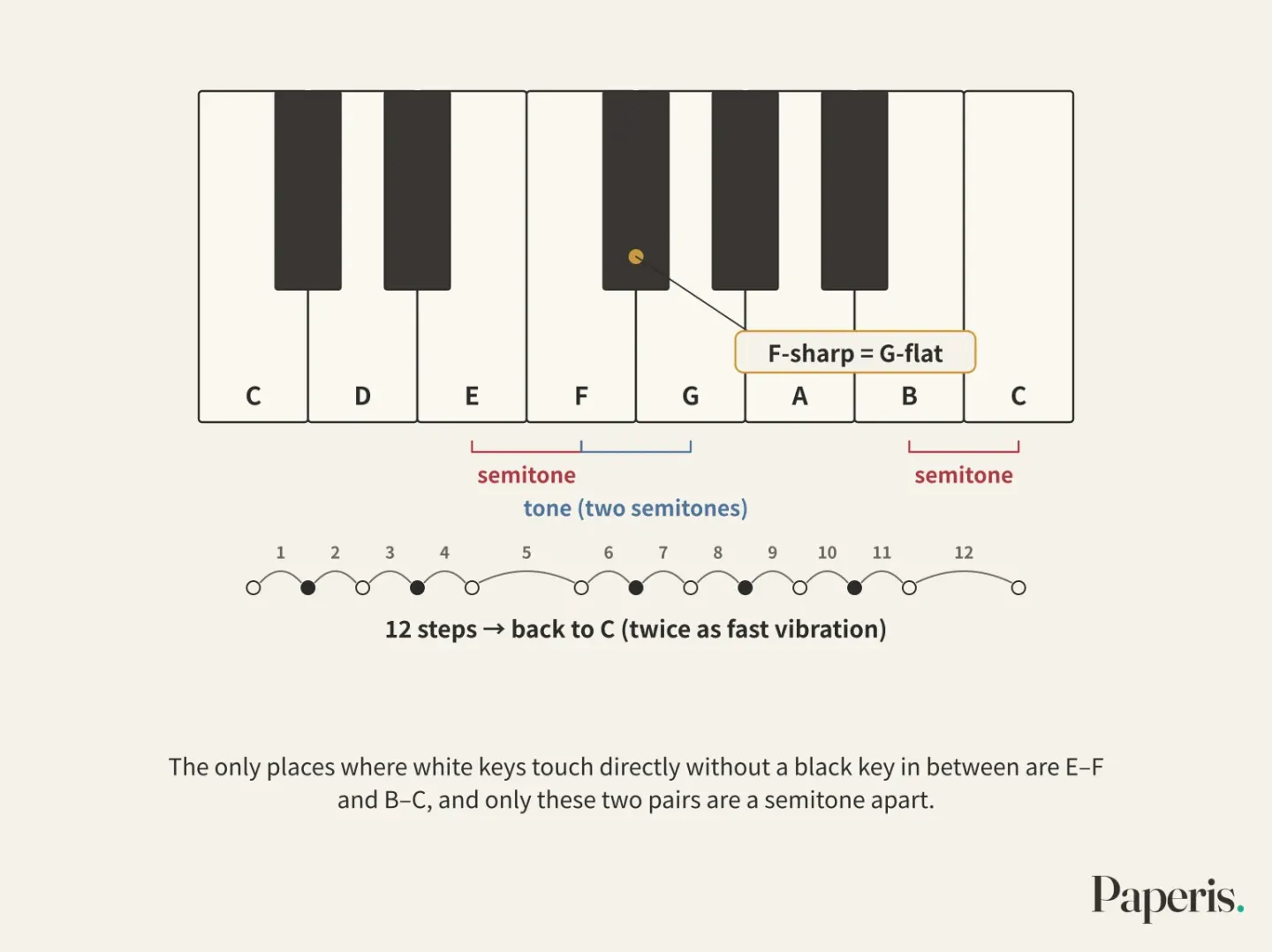
Each of those twelve steps we moved through earlier also has a name. A semitone is one of the twelve divisions Western music splits an octave into, and it is the distance from a key to the very next key on the keyboard. A tone is the distance of two semitones combined. White keys usually have a black key wedged between them, so they are a tone apart (Ewell & Schmidt-Jones, Music Fundamentals ch. 1.04). The gap from F to G is like that. The only places where white keys touch directly without a black key in between are E–F and B–C, and only these two pairs of white keys are a semitone apart (Ewell & Schmidt-Jones, Music Fundamentals ch. 1.03; Ewell & Schmidt-Jones, Music Fundamentals ch. 1.05).
The black key between F and G is a semitone above when viewed from F, and a semitone below when viewed from G. Black keys are named by adding a sign to the adjacent white key's name. A sharp is a sign indicating a note a semitone higher than the original note, written as ♯. A flat is a sign indicating a note a semitone lower than the original note, written as ♭. Therefore, this black key is both F-sharp and G-flat. One key, one sound, but two names (Ewell & Schmidt-Jones, Music Fundamentals ch. 1.04).
An interval is the distance between two notes
From E to F is just the neighboring key, which is a single semitone. From C to E is four semitones, or two whole tones. An interval refers to how far apart the pitches of two notes are. Intervals are also called by numbers. Counting from the lower note name to the upper note name, including both ends, you count how many positions it spans (Ewell & Schmidt-Jones, Music Fundamentals ch. 4.01). From C to G spans five positions—C, D, E, F, G—so it is a fifth, and on the keyboard, it is seven semitones. From C to the C above it is eight positions, making it an octave, which is the octave we saw earlier.

Clip: C, G, then both together
When two notes are sounded together, a property arises that did not exist when they were played separately (PMID 18824100). That blending is covered in the chord-focused part of this series. What is important in this part is that an interval is the "betweenness" of two notes. If you raise two notes by the same amount, the interval does not change.
A song is this "betweenness" connected one after another. A melody is a stem of notes of different pitches following one another in sequence, commonly called a melody. Transposition is the act of raising or lowering all the notes of a melody by the same distance. Raising the key at a karaoke room is precisely transposition.
Rewriting what happened at the karaoke room in terms of intervals looks like this: When you raise the key, the pitch of every single note changes, but the intervals between the notes do not change at all.
The Ear Remembers the Distance Between Notes, Too
When we all sing "Happy Birthday" together, the first note is whatever pitch someone happened to pull out that day. Even so, everyone joins right in, and the song finishes safely. Even though the pitch of the first note is different every time, everyone's ears remember how many steps the subsequent notes move.
Relative pitch is the ability to recognize and remember melodies through the pitch relationships between notes. Humans hear consecutive notes not just as individual pitches, but also as relationships between notes (PMID 18824100). Although this ability to hear relationships is similar across ages and species, the differences are also distinct. Human infants easily accomplish tasks involving recognizing relationships, whereas non-human animals can only manage a very little bit after long training, and usually cling to how high each individual note is (PMID 16380107). However, this review concludes that this ability in infants comes from a general perceptual mechanism that is tied neither specifically to music nor exclusively to humans (PMID 16380107).
In measurements by a research team comparing the brain responses of musicians and non-musicians, the musicians' brains reacted more strongly when the rises and falls of a melody or the intervals changed occasionally. By contrast, when the pitch of a plain, simple single note changed, the responses of the two groups were similar (PMID 14681168). The place where the difference appeared in musicians was the part that hears between the notes in a melody.
People Who Name Notes Without a Reference
Some people name the pitch of a car horn or a siren when it sounds. Absolute pitch is the ability to name a heard pitch without a reference note, or to produce a pitch of that height given only its name. To such a person, naming notes is not an effortful task but an automatic one (PMID 38761646). It is very rare in the United States and Europe (DOI: 10.1121/1.2151799).
Having absolute pitch does not mean one remembers the pitch height itself any better. That memory is tied to the word for the pitch name. Even among those with absolute pitch, how accurate they are, whether they can produce the pitch themselves, and whether they get it right when instruments and pitch ranges change varies from person to person (PMID 8451339). The tests that draw the line between having it and not having it are also not standardized. In a 2025 systematic review that gathered and examined 160 studies, the threshold of correct answers to determine that "absolute pitch is present" ranged from 20% to 100% across studies. When answers wrong by a semitone were counted without being given credit as correct, the average correct rates for participants classified as having absolute pitch and those classified as not having it were 85.9% and 17.0%, respectively. However, because the profile of absolute pitch changes depending on what is measured and how, this review concludes that it is difficult to broadly interpret the results of any single study (PMID 39838215).
Studies debate why it develops in only some people. One of the two long-competing explanations is that it is learned early in childhood, and the other is that it is largely inborn (PMID 16103017). A critical period is a set window of time in childhood during which a certain ability is acquired unusually easily. A 1993 review considered that, although the causes were not yet fully uncovered, the evidence pointed toward the explanation that it is learned early. The explanation is that anyone can acquire absolute pitch until around age six, after which people shift toward listening to the relations between features rather than the individual features themselves, making acquisition difficult or impossible (PMID 8451339).
Some studies suggest that language plays a role. A tonal language is a speech in which the meaning changes if the same sound is produced with a different pitch, with Standard Mandarin being a prime example. In a 2006 study that tested music conservatory students in the US and China on the spot, students who started music earlier had more absolute pitch, and even when comparing groups who started music at the same age, Chinese students who spoke Standard Mandarin had significantly more absolute pitch. The researchers considered this result to suggest that the potential to acquire absolute pitch may exist in everyone, and that if babies are allowed to pair pitch with speech during the critical period when they learn their native language, that potential can be brought to life (DOI: 10.1121/1.2151799).
In a study where the same research team examined students at a US music school again, East Asian students who were highly fluent in a tonal language scored the highest. The researchers viewed this result as supporting the hypothesis that the process by which tonal language speakers acquire absolute pitch follows the same course as learning an additional tonal language (DOI: 10.1121/1.3081389). This research team later also added results pointing to genetic factors (DOI: 10.1093/oso/9780190206833.003.0007).
There is also the other side of the explanation. There are reviews suggesting it depends on both genetic factors and early musical training (PMID 12830161), and models have also emerged proposing that absolute pitch develops relatively independently of musical experience and comes in multiple types (PMID 16103017). How much and how early learning, language, and inborn factors each work together has not yet been settled.
Back at the Noraebang
Now, returning to the opening scene, let us try raising the song by two semitones, which is by one whole step.
If you transpose the earlier "Ode to Joy" melody so that it can be played using only the white keys, it starts with E-E-F-G. If you raise every note by a whole step, E becomes F sharp, F becomes G, and G becomes A, so the melody starts with F sharp-F sharp-G-A. Not a single note name remained the same. However, the distance from E to F was a half step, and the distance from F sharp to G is also a half step. Just as the distance from F to G was a whole step, the distance from G to A is also a whole step. The intervals between the notes remain exactly the same.

Clip: the same theme in C, then a whole step up in D
Even though every single pitch name was changed and none were left the same, it sounded like the same song because the shape in which notes connect to one another remained exactly the same in both versions (Ewell & Schmidt-Jones, Music Fundamentals ch. 3.03). What the ear listening with relative pitch follows is precisely that connecting shape. Someone with absolute pitch might even recognize by name that the first note changed from Mi to F-sharp.
If you raise a song by twelve semitones, it goes up one octave, and the note name becomes the same as the beginning again. The sound vibrates twice as fast, but the song and the name remain the same.
Where to Look Next
What frequency and wavelength mean in waves, and how sound travels through the air, are covered in "Waves — Fans Rising in Their Seats, a Wave Circling the Stadium".
Other parts of this series continue here. Where consonance comes from when two or more notes sound together is covered in the installment on chords and consonance, while overlapping vibrations within a single note and the distinct tone color of each instrument are covered in the installment on timbre. Scales—which sound bright or dark depending on the order in which semitones and whole tones are arranged—are continued in the installment on major and minor keys, and dividing time rather than pitch is continued in the installment on rhythm and beat.
Source Papers
- "Music Fundamentals — 1.04 Pitch- Sharp Flat and Natural Notes" (2023) — Ewell & Schmidt-Jones, Music Fundamentals ch. 1.04 — Pitch is how high or low a sound is perceived to be and depends on the frequency of the underlying sound wave, Western music has twelve notes in an octave, sharps and flats are a half step up and down, two names share the same key, and two half steps make a whole step.
- "Music Fundamentals — 1.03 Introduction to the Piano Keyboard" (2023) — Ewell & Schmidt-Jones, Music Fundamentals ch. 1.03 — The only places where adjacent white keys are a half step apart are E–F and B–C (exceptions), while the remaining neighboring white keys are a whole step apart.
- "Music Fundamentals — 1.05 Chromatic and Diatonic Half Steps" (2023) — Ewell & Schmidt-Jones, Music Fundamentals ch. 1.05 — Half steps can exist between adjacent note names, such as E–F and B–C.
- "Music Fundamentals — 4.01 Intervals and Inversions" (2023) — Ewell & Schmidt-Jones, Music Fundamentals ch. 4.01 — An interval is the distance between two notes, also described in half steps and whole steps, and numerical names for intervals are assigned by counting up to and including the positions where the two notes are placed, with any interval of an octave or smaller being a simple interval.
- "Music Fundamentals — 3.03 Ear Training" (2023) — Ewell & Schmidt-Jones, Music Fundamentals ch. 3.03 — A piece sounds largely the same even when transposed to another key, and what matters in that case is the relationship by which the notes connect to one another.
- "Physics — 14.1 Speed of Sound, Frequency, and Wavelength" (2020) — OpenStax Physics 14.1 — A vibrating string compresses and rarefies the air, sending out waves of the same frequency, which cause the eardrum to vibrate and complex mechanisms to convert into neural signals that the brain interprets.
- "Physics — 13.2 Wave Properties: Speed, Amplitude, Frequency, and Period" (2020) — OpenStax Physics 13.2 — The unit of frequency is the hertz, with 1 hertz equaling one cycle per second.
- "Music perception, pitch, and the auditory system." (2008) — PMID 18824100 — Music perception depends on various culture-specific factors while being bound by the properties of the auditory system, notes are heard not only in absolute pitch but also in relative pitch, and sounding notes together creates properties not present in the individual notes.
- "Pitch coding and pitch processing in the human brain." (2014) — PMID 23938209 — Different sounds can produce the same pitch, leading to the idea that there is a convergence site for representations, part of the auditory cortex is sensitive to pitch though its exact location is debated, and overtone information is combined into a single representation in the upper brainstem or auditory cortex.
- "Pitch perception." (2009) — PMID 19933556 — The pitch of complex sounds is likely based on the temporal regularity of the waveform, and temporal models account for most of the data.
- "A comparison between common marmosets (Callithrix jacchus) and human infants sheds light on traits proposed to be at the root of human octave equivalence" (2023) — DOI: 10.1111/desc.13395 — Two tones with a frequency ratio of two sound similar to humans, appear across cultures, and emerge early in development, whereas 11 marmosets, unlike human infants, respond similarly to octave shifts and other pitch interval shifts, leading to the conclusion that pitch range differences across adults, infants, and genders, along with singing, may be important.
- "Pitch chroma information is processed in addition to pitch height information with more than two pitch-range categories" (2022) — DOI: 10.3758/s13414-022-02496-1 — Octave similarity is used across cultures but is difficult to demonstrate experimentally, height dominates in two-range tasks with octave effects appearing only when height alone is insufficient, the effect is strongest between adjacent octaves, and tone language and musical training affect learning but not octave perception.
- "Do rats ( Rattus norvegicus ) perceive octave equivalence, a critical human cross-cultural aspect of pitch perception?" (2024) — DOI: 10.1098/rsos.221181 — A registered report format experiment concluding that rats also perceive octave equivalence, suggesting that the overtone structure of mammalian voices may be a core prerequisite.
- "Infant music perception: domain-general or domain-specific mechanisms?" (2006) — PMID 16380107 — Relative pitch processing exhibits both similarities and clear differences across ages and species, human infants easily perform relative pitch tasks whereas non-human animals succeed only slightly after prolonged training, leading to the conclusion that infant music perception is the product of general perceptual mechanisms rather than music- or species-specific ones.
- "Music and learning-induced cortical plasticity." (2003) — PMID 14681168 — Musicians show a larger brain response (MMNm) than non-musicians when melody contours and intervals occasionally change, but show similar responses to frequency changes in pure tones.
- "Should absolute pitch be considered as a unique kind of absolute sensory judgment in humans? A systematic and theoretical review of the literature." (2024) — PMID 38761646 — Absolute pitch is a rare ability to automatically and effortlessly identify notes without a reference pitch, including naming the pitches of everyday sounds like car horns and sirens.
- "Absolute pitch." (1993) — PMID 8451339 — Absolute pitch varies in degree, note memory is mediated by note names rather than pitch memory itself being superior, the causes are not yet fully understood, but evidence points toward an early learning hypothesis up to around age 6, after which a developmental shift from features to relations makes acquisition difficult or impossible.
- "Conceptual coherence but methodological mayhem: A systematic review of absolute pitch phenotyping." (2025) — PMID 39838215 — Across 160 studies involving 23,221 participants, definitions show 99% agreement yet judgment thresholds vary wildly from 20% to 100%, mean accuracy is 85.9% for absolute pitch possessors versus 17.0% for non-possessors, and the generalizability of individual studies is limited.
- "Absolute pitch among American and Chinese conservatory students: Prevalence differences, and evidence for a speech-related critical period" (2006) — DOI: 10.1121/1.2151799 — Absolute pitch is extremely rare in America and Europe, field tests show it is more common the earlier musical training begins, and among those with the same starting age, it is far more prevalent in Mandarin speakers, leading to the conclusion that the potential may be universal and is realized through pairing during the native language acquisition period.
- "Absolute pitch among students in an American music conservatory: Association with tone language fluency" (2009) — DOI: 10.1121/1.3081389 — East Asian students with high tone language fluency score the highest, fluent students show no difference from non-fluent white students from non-tone language backgrounds, the advantage of early training does not interact with language effects, country of early music education does not explain the results, and these findings support the hypothesis that acquiring absolute pitch for tone language speakers is the same process as acquiring a second tone language.
- "Absolute pitch: a model for understanding the influence of genes and development on neural and cognitive function." (2003) — PMID 12830161 — Absolute pitch appears to depend on both genetic factors and early childhood musical training, supporting the concept of a sensitive period.
- "The Mystery of Absolute Pitch: A Rare Ability That The Involves Both Nature and Nurture" (2019) — DOI: 10.1093/oso/9780190206833.003.0007 — A book chapter by the same researchers pointing to subsequent results indicating genetic factors in addition to the links with early training and tone languages.
- "Absolute pitch: music and beyond." (2005) — PMID 16103017 — Moving beyond the long-standing debate between early learning and innate theories, this paper proposes a new model in which absolute pitch is relatively independent of musical experience and manifests in multiple forms.
Sources (23)
- Music Fundamentals — 1.04 Pitch- Sharp Flat and Natural Notes
- Music Fundamentals — 1.03 Introduction to the Piano Keyboard
- Music Fundamentals — 1.05 Chromatic and Diatonic Half Steps
- Music Fundamentals — 4.01 Intervals and Inversions
- Music Fundamentals — 3.03 Ear Training
- Physics — 14.1 Speed of Sound, Frequency, and Wavelength
- Physics — 13.2 Wave Properties: Speed, Amplitude, Frequency, and Period
- Music perception, pitch, and the auditory systemPMID 18824100
- Pitch coding and pitch processing in the human brainPMID 23938209
- Pitch perceptionPMID 19933556
- A comparison between common marmosets (Callithrix jacchus) and human infants sheds light on traits proposed to be at the root of human octave equivalenceDOI 10.1111/desc.13395
- Pitch chroma information is processed in addition to pitch height information with more than two pitch-range categoriesDOI 10.3758/s13414-022-02496-1
- Do rats ( Rattus norvegicus ) perceive octave equivalence, a critical human cross-cultural aspect of pitch perception?DOI 10.1098/rsos.221181
- Infant music perception: domain-general or domain-specific mechanisms?PMID 16380107
- Music and learning-induced cortical plasticityPMID 14681168
- Should absolute pitch be considered as a unique kind of absolute sensory judgment in humans? A systematic and theoretical review of the literaturePMID 38761646
- Absolute pitchPMID 8451339
- Conceptual coherence but methodological mayhem: A systematic review of absolute pitch phenotypingPMID 39838215
- Absolute pitch among American and Chinese conservatory students: Prevalence differences, and evidence for a speech-related critical periodDOI 10.1121/1.2151799
- Absolute pitch among students in an American music conservatory: Association with tone language fluencyDOI 10.1121/1.3081389
- Absolute pitch: a model for understanding the influence of genes and development on neural and cognitive functionPMID 12830161
- The Mystery of Absolute Pitch: A Rare Ability That Involves Both Nature and NurtureDOI 10.1093/oso/9780190206833.003.0007
- Absolute pitch: music and beyondPMID 16103017