Paperis Articles
Rhythm and Beat — Evenly Spaced Stepping Stones, and the Steps That Cross Them
The beat is the even pulse you find yourself tapping your foot to while listening to music; meter groups those beats into strong and weak; rhythm is the pattern of long and short sounds laid on top. The human brain appears to anticipate the beat, though how it does so is still debated.
Your field's papers, as audio
Pick your fields and journals — Paperis summarizes the key papers and turns them into audio. Listen on your commute.
Start Paperis free →Rhythm and Beat — Evenly Spaced Stepping Stones, and the Steps That Cross Them
Applause Without a Signal
As a performance reaches its peak, clapping begins somewhere in the audience. Within a few seconds, thousands of people are meeting their hands together at the exact same moment. No one counted out "One, two," yet the applause goes along with the song, and as the song gets faster, the applause speeds up right along with it.
What people have tuned together is the steady pulse flowing through the music. Starting from that pulse, this article listens in turn to how music divides time, what kind of pattern is laid over it, and why the listener's body and brain follow that pulse.
This series covers the basics of Western music theory taught in schools today. Because not all music in the world is woven with this framework, we will also meet such music once in the middle.
As our guide, we take only a single stepping stone across a stream. Evenly placed stones and the footsteps crossing those stones are the picture of this article.
The Place Where We Tap Our Feet — The Beat
The beat is the steady pulse you match when tapping your foot while listening to music. Because the beat returns steadily, you can anticipate when the next beat will arrive. Performers on stage coordinate with one another using that beat, and people in the audience rest their claps on it. It is the performers who create that beat. When you time the sounding of notes to regular intervals, a beat is created (Ewell & Schmidt-Jones, Music Fundamentals ch. 2.05).
If you clearly felt the beat beforehand, you can feel the beat during the intervals when the sound stops for several beats (Ewell & Schmidt-Jones, Music Fundamentals ch. 2.04). If you strike two groups of four beats with woodblock sounds, pause the sound for two groups, and then re-enter, the re-entered sound falls right on the place of the beat that would have continued during the pause.

Clip: a steady beat with two silent groups
Compared to stepping stones, the beat is the stones placed at equal intervals across a stream. Because the stones are placed evenly, even a first-time crosser knows roughly where the next stone will be. Even if the water rises and submerges a few stones, looking at the intervals where the preceding stones were placed allows you to guess the positions of the submerged stones.
The beat is the scale by which music evenly divides time. Because that scale exists, multiple people can clap their hands at the exact same moment.
Grouping by Twos and Threes — Beats and Measures
When even beats continue and a heavy sound arrives once every two beats, it sounds like "thump clap, thump clap," and when it arrives once every three beats, it sounds like "thump clap clap." The interval between beats remains the same, but the gait changes.
A strong beat is a beat felt heavily within a grouping of beats.
A weak beat is a beat following a strong beat that is felt lightly.
Meter is a framework in which beats are grouped into strong beats and weak beats and repeated. When strong-weak repeats, it is duple meter, when strong-weak-weak repeats, it is triple meter, and when grouped by fours, it is quadruple meter.
A measure is a single grouping of meter, starting from the first beat and going up until just before the next first beat. In most music, almost every measure contains the same number of beats (Ewell & Schmidt-Jones, Music Fundamentals ch. 2.04).

Clip: the same beat grouped in twos, then in threes
While playing beats of the same speed with a bass drum and a snare drum, placing the bass drum once every two beats, and then once every three beats, changes duple meter into triple meter. The "thump" marked by the bass drum is always the first beat of the measure. Within a measure, the first beat is usually felt the strongest (Ewell & Schmidt-Jones, Music Fundamentals ch. 2.04).
Counting the beats from a "thump" until just before the next "thump" gives the number of beats in a measure, and that number distinguishes the meter. You can figure out the meter by ear without a score (Ewell & Schmidt-Jones, Music Fundamentals ch. 2.08).
Returning to the stepping stones, meter is a stream with one large stone placed every few small stones. If there is one large stone for every two, it is duple meter, if one for every three, it is triple meter, and from one large stone up until just before the next large stone is a single measure.
The Pattern Placed on the Beat — Rhythm
If you tap your fingers on a desk to imitate a verse of a song, some taps wait a long time and other taps come in rapid succession.
Rhythm is a pattern of long and short sounds laid out over time. If a beat is an even grid, rhythm is where you place sounds on that grid (Ewell & Schmidt-Jones, Music Fundamentals ch. 2.04). Sounds that use a whole beat, sounds that sustain across two beats, and sounds that slip quickly into a single beat mix together to form a pattern. There is music that divides a beat in two, and music that divides it in three (Ewell & Schmidt-Jones, Music Fundamentals ch. 2.07).
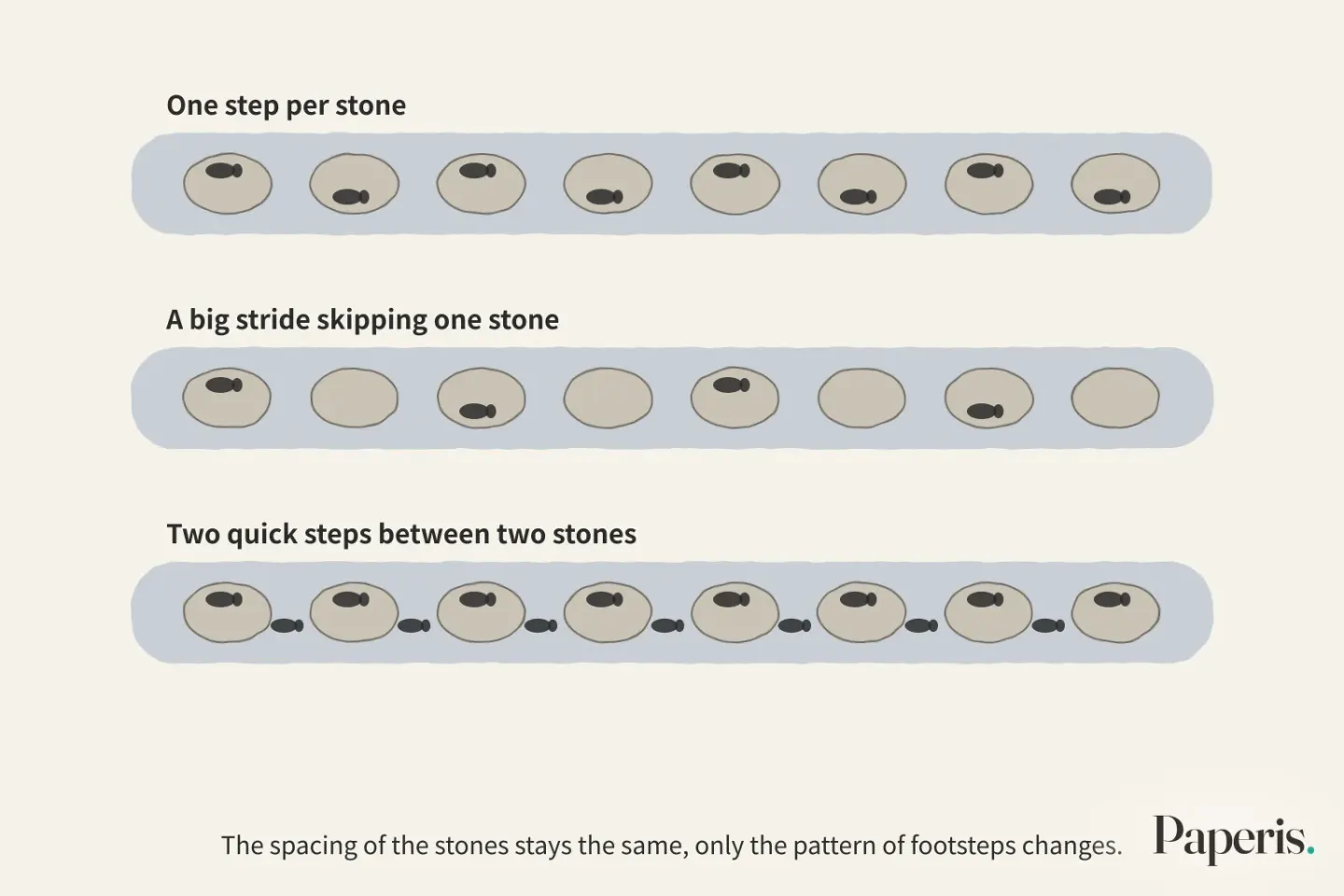
In a stepping-stone path, rhythm is your footsteps. You might take one step per stone, take a big stride skipping one stone, or take two quick steps between two stones. The spacing of the stones stays the same, only the pattern of footsteps changes. In music too, what repeats is the framework of strong and weak beats, and the rhythms placed upon them can differ from measure to measure (Ewell & Schmidt-Jones, Music Fundamentals ch. 2.08).
Rhythms whose sound lengths interlock simply, such as 2 to 1 or 3 to 1, are easier to notice, tap along with, and remember than rhythms with complex ratios. A review paper summarizes that the results of multiple studies converge in that direction (PMID 42569973). This means simply interlocked patterns stick in the ear more easily.
Not all music flows with an even beat. Free rhythm is not tied to an even beat, but is a rhythm where the performer decides when to make sound on the spot. Music like this has no beat to clap along to (Ewell & Schmidt-Jones, Music Fundamentals ch. 2.05). From the perspective of meter, the simple repetition of strong and weak beats applies to most Western music, but there is also music not structured that way (Ewell & Schmidt-Jones, Music Fundamentals ch. 2.08). The beats and measures covered in this article are for music with an even beat, and among that, the way Western music divides time.
Same Pattern, Different Speed — Tempo
With the same stepping stone pattern, you can cross a stepping stone bridge leisurely, or you can cross it in a hurry. In music, what determines that speed is tempo.
Tempo is the speed at which beats pass by. When written as a number, it is written as how many beats pass by in a minute (Ewell & Schmidt-Jones, Music Fundamentals ch. 2.11). A metronome is a device that plays beats with a ticking sound at a set speed. If you set it to 60 beats per minute, it ticks once a second; if you set it to 120 beats per minute, it ticks once every 0.5 seconds.

Clip: the same rhythm, slow and then twice as fast
If you play the same two-measure pattern once at 70 beats per minute and twice at 140 beats per minute, the second version goes through the pattern twice in the same amount of time. When the beat intervals shrink by half, every sound within the pattern is pulled along together. The ratio of long and short remains the same, so it can be recognized as the same pattern.
When the beat gets faster, the music gets faster too. However, even if the beat stays the same and you just subdivide the inside of a beat into smaller parts to fill it with faster sounds, the music feels more rushed (Ewell & Schmidt-Jones, Music Fundamentals ch. 2.11).
The speed at which you naturally tap comfortably without any cues slows down as you get older (PMID 35369160). This means that the body has a tempo that comes to it naturally.
A Sidestepping Strong Sound — Syncopation
When "thump clap thump clap" plays evenly, and a sound comes in half a beat early between the beats, the ear gets a slight snagged feeling. What creates that snag is syncopation.
The off-beat is the space between beats.
Syncopation is when a strong sound is placed on a weak or off-beat. When a strong sound is placed on an off-beat, a sound expected to start on the beat starts early between the beats.
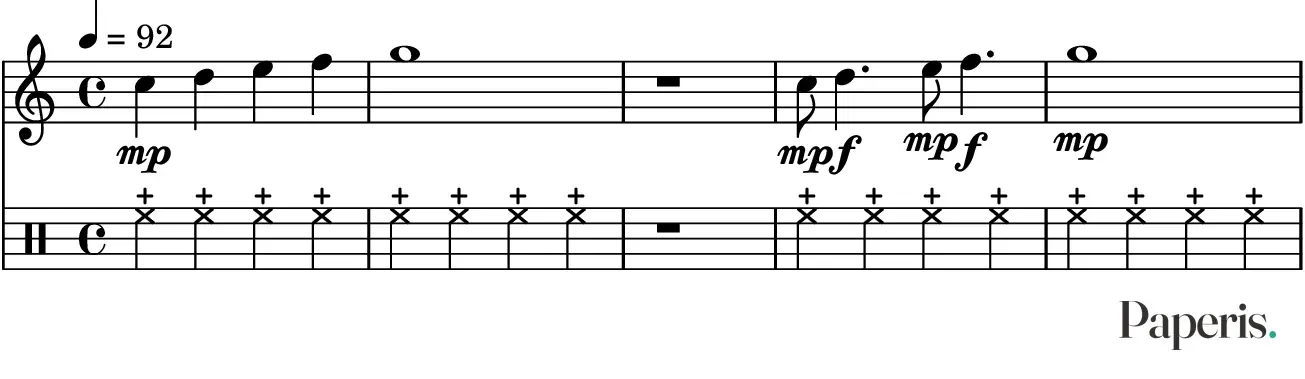
Clip: a melody on the beat, then with D and F pulled half a beat early
Over a hi-hat tapping evenly on every beat, a synthesized piano-like sound plays a melody of C-D-E-F for one beat each and ends on G; in the first version, every note is placed on the beat with the same loudness. In the second version, only D and F enter half a beat early and louder than the other notes, dragging out long. Then D and F enter early between the beats and loudly, hanging long over the next beat the hi-hat taps. Since the strong sound is placed on the off-beat, the D and F in the second version are syncopation.
In stepping stones, syncopation is a step of putting your foot out between the stones when it is time to step on a large stone. The large stone stays right in that spot. The reason the walker feels the misalignment is also because they know the spot of the stone.
Syncopation is also connected to the body. Groove is the pleasurable feeling of wanting to move your body when listening to music. According to a review summarizing previous studies, this feeling is strongest in rhythms where syncopation is at a middle point, neither too little nor too much (PMID 42931798). While feeling the groove, the activity of brain regions in charge of movement and brain regions involved in reward appear together, and this activity is linked to anticipating when the next sound will come and learning (PMID 38141692).
Where the groove comes from has different explanations depending on the theory. Current theories view it as the brain filling in the "gap where prediction missed" created by syncopation, and a newly emerged theory views syncopation as re-securing the shaken beat with bodily movement (PMID 42931798).
The brain looks ahead to the next beat — beat perception
Though dance styles vary widely across cultures, dance generally moves to the beat. That movement reaches forward anticipating when the next beat will arrive, and can adapt to music of various tempos (PMID 39506663).
Beat perception is the ability to find a regular beat within sound and align one's body to that beat. This ability lets people dance together and play music together, which is why one review suggests that beat perception can be viewed as a foundational characteristic of music (PMID 22524344).
When listening to a beat, the brain regions that receive sound work together with the brain regions responsible for movement, and this is true even when listening quietly without moving the body (PMID 33061902). Listening to a beat enlists the ear along with the brain areas responsible for movement.
In a review pooling 22 studies examining the brain when tapping or moving to sound, cerebral regions that plan movement and clusters of neurons deep within the brain were important for timing to a regular beat, while the cerebellum beneath the back of the head was important for following complex rhythms and aligning with an external beat (PMID 39595826).
This work can also be glimpsed through brain waves measured from the scalp. When listening to rhythms, the brain's electrical activity shows responses matching the tempo of the beat and the rate at which strong beats return, and these responses are captured even when imagining a beat in one's head. The research team that produced these results views the phenomenon where brain activity oscillates along with the rhythm as underlying the processing of rhythm (PMID 25385771).
Now we trace the applause in the concert hall once more. While a song plays, people's brains find a regular beat within the sound (PMID 22524344). Even when just listening quietly, brain regions responsible for movement are active, and one review suggests this can be explained as the brain looking ahead to the next beat (PMID 33061902). However, whether that brain activity acts as the cause of beat perception has not yet been sorted out by experiments (PMID 33061902). Because the beat returns regularly so that the next spot can be guessed, people off the stage can join in too (Ewell & Schmidt-Jones, Music Fundamentals ch. 2.05). As thousands of people each guess the same beat, the clapping comes together as one without a signal.
Newborns and Parrots
Does beat perception come from learning or is it innate? In one experiment, researchers played rhythms to newborns while omitting the first beat of a measure. Even though that first beat was neither struck louder nor played with a different sound than the other beats, when it was omitted, the baby's brain showed activity that appears when an expectation is violated (DOI: 10.1073/pnas.0809035106). The researchers concluded that this result strongly supports the view that beat perception is innate.
In another study, a response to detecting the beat appeared even in adults who had not learned music (DOI: 10.1111/j.1749-6632.2009.04761.x). This means that musical study does not necessarily have to come first in order to hear beats. However, the newborn result is a single experiment, and a review looking back at this body of research brings together findings that both learning and the combination of listening and moving are involved in the growth of beat perception (PMID 22524344).
Because babies are clumsy in their movements and have limits in moving to the beat, they understand the metric structure of rhythm, and their movements change depending on the tempo of the music they hear. When an adult holds and rocks a baby to a rhythm, depending on the way they are rocked, the baby may perceive the beats of that rhythm differently (DOI: 10.1111/nyas.12649). This means that listening and bodily movement are intertwined from a very early age.
Are there animals other than humans that can keep a beat? So far, the only animals known to spontaneously move their bodies to various tempos while anticipating the next beat while listening to music are parrots (PMID 39506663). One paper, noting the similarities between parrots and humans, proposes that the ability to learn by imitating heard sounds became the root of human dancing (PMID 39506663).
Alongside the hypothesis connecting the ability to learn through imitation and beat synchronization, there are observations from the opposing side. As the perception and synchronization of beats have been observed in other mammals including rats, a rebuttal appeared in one review arguing that it is difficult to take this hypothesis literally (PMID 37325439). The statement that it is only parrots counts animals that spontaneously move to music in that way, whereas the rat side looked at the ability to perceive and synchronize to beats, so the criteria are different.
Monkeys in the laboratory tap along with a metronome and continue tapping at the same tempo even after the sound stops (PMID 25358709). Meanwhile, one review summarizes that evidence is growing that human beat perception is universal, occurs spontaneously, and develops relatively early, and it appears to be unique to humans (PMID 40517090). Just how far beat perception is uniquely human remains an open question.
What We Still Do Not Know
Several reviews converge on the idea that the brain anticipates the beat (PMID 35352057; PMID 33061902). What remains divided is how that anticipation happens. One side suggests that the brain listens to music while maintaining a model that guesses the upcoming sounds (PMID 35352057). The other side suggests that without such a model, the fluctuations of the brain and body naturally embody the structure of the music, leading to anticipation on their own (PMID 40102614).
Either way, more experiments are needed to prove whether the brain activity found so far acts as the cause of beat perception (PMID 33061902). Experiments comparing humans and animals use differing tasks, and many fail to isolate whether subjects are listening to the length of an interval, a rhythmic pattern, an isochronous beat, or a hierarchy of meters (PMID 34420380).
Even stepping-stone illustrations have an end. Stepping stones are placed in a stream from the beginning, but the beat of music is something a listener finds within the sounds and continues within their mind. The baby's brain responding to a missing first beat also happened because it was expecting a beat in that spot.
A beat is a grid that the listener finds within the sound and builds together, and because everyone anticipates that grid together, the claps of thousands of people match in a single instant.
Where to look next
Other parts of this series cover different sides of sound. The part covering pitch and intervals continues the topic of sound height, the part covering chords and consonance continues the blending of sounds that ring together, and the part covering timbre continues sounds with the same height that sound different. How major and minor keys differ and how far that feeling varies depending on the listener is continued in the part covering major and minor keys.
Among already published articles, there is no article yet that directly follows this part.
Source Papers
- "Music Fundamentals — 2.04 Rhythm" (LibreTexts) — Ewell & Schmidt-Jones, Music Fundamentals ch. 2.04 — Basic definitions of beats, measures, and strong beats; once beats are felt clearly, they are felt even when there is no sound; the first beat of a measure is usually the strongest; the definition of syncopation.
- "Music Fundamentals — 2.05 Time Signature" (LibreTexts) — Ewell & Schmidt-Jones, Music Fundamentals ch. 2.05 — Evenly spaced beats enable synchronization between performers and listener engagement; free rhythm without beats.
- "Music Fundamentals — 2.07 Simple and Compound Time Signatures" (LibreTexts) — Ewell & Schmidt-Jones, Music Fundamentals ch. 2.07 — Meters that divide beats into two and meters that divide beats into three.
- "Music Fundamentals — 2.08 Meter in Music" (LibreTexts) — Ewell & Schmidt-Jones, Music Fundamentals ch. 2.08 — Meter is a repeating framework of strong and weak beats, which can be spoken without sheet music; most Western music uses simple frameworks, while some music has unclear or complex frameworks.
- "Music Fundamentals — 2.11 Tempo" (LibreTexts) — Ewell & Schmidt-Jones, Music Fundamentals ch. 2.11 — Tempo is speed, expressed as the number of beats per minute; perceived speed also depends on how finely beats are subdivided.
- "Newborn infants detect the beat in music" (2009) — DOI: 10.1073/pnas.0809035106 — Omitting a first beat that is not marked with an accent elicits a prediction-violation response in the newborn brain; the authors conclude that beat perception is innate.
- "Is Beat Induction Innate or Learned? Probing Emergent Meter Perception in Adults and Newborns using Event‐related Brain Potentials" (2009) — DOI: 10.1111/j.1749-6632.2009.04761.x — Beat induction operates in non-musician adults and beat induction operates in newborns.
- "Without it no music: beat induction as a fundamental musical trait." (2012) — PMID 22524344 — The definition of beat perception and its status as a fundamental characteristic of music; learning and perception-action coupling are also involved in its development.
- "Rhythm and interpersonal synchrony in early social development" (2015) — DOI: 10.1111/nyas.12649 — Infants struggle to move in time with a beat, but they perceive metric structure, and rocking methods alter meter interpretation.
- "Motor and Predictive Processes in Auditory Beat and Rhythm Perception." (2020) — PMID 33061902 — The motor system is engaged even during passive listening and can be explained by an internal predictive model; causal mechanisms require further experiments.
- "From Sound to Movement: Mapping the Neural Mechanisms of Auditory-Motor Entrainment and Synchronization." (2024) — PMID 39595826 — A scoping review of 22 studies on moving to sound; the supplementary motor area and basal ganglia are involved in beat-based timing, while the cerebellum handles tracking complex rhythms and matching external beats.
- "Exploring how musical rhythm entrains brain activity with electroencephalogram frequency-tagging." (2014) — PMID 25385771 — Brainwave responses to beat and meter tempo, including during imagined meter; the authors view entrainment and resonance phenomena as the basis of rhythm processing.
- "Beat-based dancing to music has evolutionary foundations in advanced vocal learning." (2024) — PMID 39506663 — Dancing is predictive, tempo-flexible beat matching; parrots are the only animals that move spontaneously in this way, leading to the vocal learning origin hypothesis.
- "Phylogenic evolution of beat perception and synchronization: a comparative neuroscience perspective." (2023) — PMID 37325439 — Beat perception and synchronization in mammals such as mice challenge the vocal learning hypothesis.
- "Neurophysiology of timing in the hundreds of milliseconds: multiple layers of neuronal clocks in the medial premotor areas." (2014) — PMID 25358709 — A metronome synchronization-continuation tapping task in monkeys.
- "Core systems of music perception." (2025) — PMID 40517090 — A summary stating that pitch systems and meter systems are universal, automatic, early-developing, and appear unique to humans.
- "A review of psychological and neuroscientific research on musical groove." (2024) — PMID 38141692 — The experience of groove is linked to activity in motor and reward networks and connects to temporal prediction and learning.
- "Musical Groove as Stabilization of Coordinated Movement: A Dynamical and Embodied Approach to Musical Rhythm." (2026) — PMID 42931798 — Groove is strongest at medium levels of syncopation; an embodied dynamics theory different from prediction theory is proposed.
- "Embodied Responses to Harmony and (Poly)Rhythm: An Integrated Ratio-Based Perception-Action Framework." (2026) — PMID 42569973 — Simple ratio rhythms are better detected, produced, and remembered.
- "Sensorimotor Synchronization in Healthy Aging and Neurocognitive Disorders." (2022) — PMID 35369160 — Spontaneous tapping speed slows down with age.
- "Music in the brain." (2022) — PMID 35352057 — Music perception, behavior, emotion, and learning rely on the brain's predictive capacity, summarized using a predictive coding model.
- "Musical neurodynamics." (2025) — PMID 40102614 — A neural resonance theory proposing that brain-body dynamics, rather than predictive models, embody musical structure to anticipate events.
- "Rhythmic abilities in humans and non-human animals: a review and recommendations from a methodological perspective." (2021) — PMID 34420380 — Many experiments fail to distinguish between single intervals, rhythm patterns, even beats, and metric hierarchies.
Sources (23)
- Music Fundamentals — 2.04 Rhythm
- Music Fundamentals — 2.05 Time Signature
- Music Fundamentals — 2.07 Simple and Compound Time Signatures
- Music Fundamentals — 2.08 Meter in Music
- Music Fundamentals — 2.11 Tempo
- Newborn infants detect the beat in musicDOI 10.1073/pnas.0809035106
- Is Beat Induction Innate or Learned? Probing Emergent Meter Perception in Adults and Newborns using Event‐related Brain PotentialsDOI 10.1111/j.1749-6632.2009.04761.x
- Without it no music: beat induction as a fundamental musical traitPMID 22524344
- Rhythm and interpersonal synchrony in early social developmentDOI 10.1111/nyas.12649
- Motor and Predictive Processes in Auditory Beat and Rhythm PerceptionPMID 33061902
- From Sound to Movement: Mapping the Neural Mechanisms of Auditory-Motor Entrainment and SynchronizationPMID 39595826
- Exploring how musical rhythm entrains brain activity with electroencephalogram frequency-taggingPMID 25385771
- Beat-based dancing to music has evolutionary foundations in advanced vocal learningPMID 39506663
- Phylogenic evolution of beat perception and synchronization: a comparative neuroscience perspectivePMID 37325439
- Neurophysiology of timing in the hundreds of milliseconds: multiple layers of neuronal clocks in the medial premotor areasPMID 25358709
- Core systems of music perceptionPMID 40517090
- A review of psychological and neuroscientific research on musical groovePMID 38141692
- Musical Groove as Stabilization of Coordinated Movement: A Dynamical and Embodied Approach to Musical RhythmPMID 42931798
- Embodied Responses to Harmony and (Poly)Rhythm: An Integrated Ratio-Based Perception-Action FrameworkPMID 42569973
- Sensorimotor Synchronization in Healthy Aging and Neurocognitive DisordersPMID 35369160
- Music in the brainPMID 35352057
- Musical neurodynamicsPMID 40102614
- Rhythmic abilities in humans and non-human animals: a review and recommendations from a methodological perspectivePMID 34420380