Paperis Articles
Chords and Consonance — Teeth That Mesh, Teeth That Grind
When several notes sound at once, some pairs blend clearly and others clash roughly. Part of the difference lies in the sound itself, in whether its components mesh, and part lies in the music a listener has grown up with, in whether that meshing comes to be liked.
Your field's papers, as audio
Pick your fields and journals — Paperis summarizes the key papers and turns them into audio. Listen on your commute.
Start Paperis free →Chords and Consonance — Teeth That Mesh, Teeth That Grind
Two Randomly Pressed Keys
A child sits at a piano in a relative's living room during a holiday. The child uses two fingers to randomly pick two keys and press them together. Some pairs blend clearly and sound like a single note, while other pairs rumble harshly as if rubbing against each other. Moving a finger by just one step completely changes the feel of the sound.
Even people who have never studied music hear this difference. The sounds the child made already have names. A chord is multiple notes of different pitches sounding at the same time. This article follows in order the names given to those differences, the most basic chords built by stacking three notes, and where the feeling of “fitting together” comes from.
The scope covered is the basics of Western music theory. In Western music, chords grew over hundreds of years from singing multiple melodies together, and today they have become a framework common enough that pop music and jazz performers read sheet music with chord names written on it to play. Still, in many music traditions around the world, harmony is not a separate branch that is handled on its own (Brandt & McClure, Sound Reasoning ch. 2.02). The rules this article covers are the rules of one tradition.
The guide illustration is a single gear. Two gears with teeth that fit precisely turn smoothly, and two wheels with teeth slightly misaligned grind against each other every time they turn. A meshing and misalignment similar to this occurs even within two notes sounding together. However, feeling that a meshed sound is “good” is up to the listener, so that part varies depending on the music the person has lived with.
Resonating Sounds, Consonance and Dissonance
Just as the two keys pressed by a child sounded like a single block, sounds of different pitches can ring together. Pitch refers to how high or low a sound is heard. Even if just two notes ring together, they become a two-note chord (DOI: 10.1016/j.heares.2015.01.009).
An interval refers to how far apart the pitches of two notes are. On a keyboard, how far apart two fingers are spread is the interval itself, and intervals themselves are covered in detail in another part of this series on intervals. How two notes sounding together sound depends on this interval (PMID 11458869).
When you press middle C on the piano and the G above it together, the two notes melt into each other and ring clear. When you press the same C and the black key immediately to the right of it together, the two notes rub against each other and buzz.
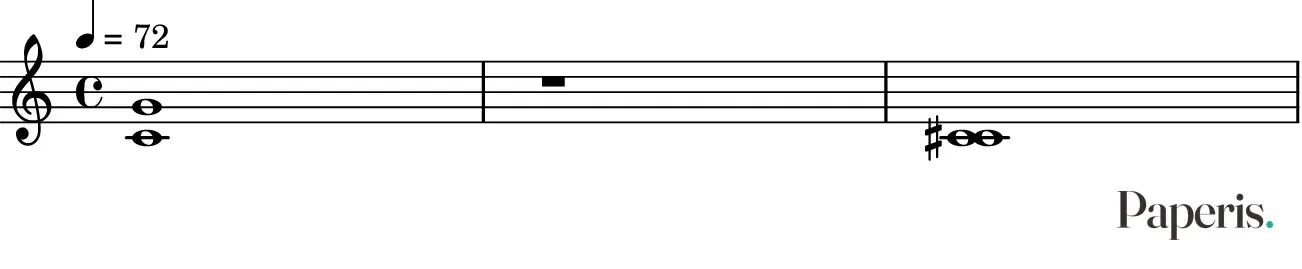
Clip: C with G, then C with C♯
There is a name for the difference between the two pairs. Consonance is when notes sounding together blend well, sounding clear and stable. Dissonance is when notes sounding together clash with each other, sounding rough or unstable. The first pair is what Western music counts as a representative consonance, and the latter pair is counted as a representative dissonance.
Then, what does it mean for a sound to be unstable? When you stop a sound on a chord with a clashing pair, like C and the black key right next to it, it can sound like it is not yet finished, as if waiting for the next chord (Ewell & Schmidt-Jones, Music Fundamentals ch. 4.03). Resolution is when a chord containing dissonance moves to consonance and the built-up tension is released. To ears accustomed to Western music, sounding B and F together sounds somewhat floating, and then if B moves up one step to C and F moves up one step to E, it sounds like the sound settles back into place.
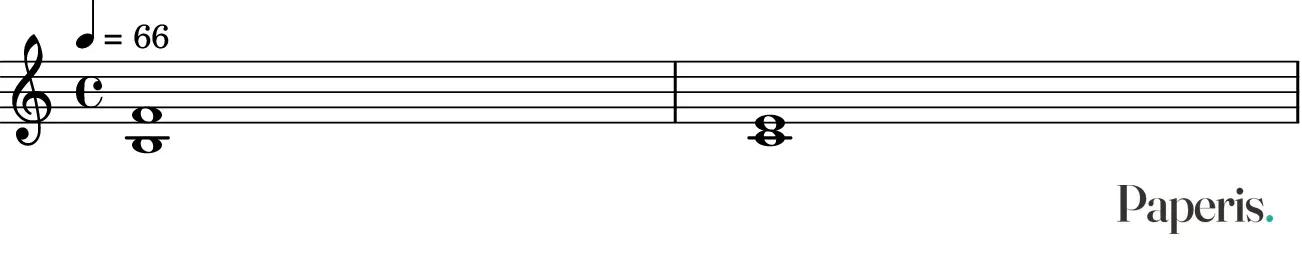
Clip: B–F moving to C–E
This distinction occupies a central place in the texture of Western music (DOI: 10.1016/j.neuropsychologia.2014.03.011). How much people and cultures differ in which pairs they like to listen to is left as the final question of this article.
One thing is to take away from here: notes that ring together have partners that blend cleanly and partners that clash, and dissonance can also sound like a sound waiting for the next chord.
A Chord Built on Three Notes
Open a sheet music accompaniment, and you will see rows of alphabet letters written above the lyrics. Each of those letters is the name of the chord to be played at that spot. Beneath those names lie three-note chords, because the harmony of Western music is built on three-note chords (Ewell & Schmidt-Jones, Music Fundamentals ch. 5.01).
A triad is a chord consisting of three notes, made by stacking two notes on top of the bottom note, each skipping one note name. If you pick C from do-re-mi-fa-sol, skip re to pick mi, and skip fa to pick sol, you get C-E-G (Ewell & Schmidt-Jones, Music Fundamentals ch. 5.01). In the same way, D-F-A and G-B-D are also triads.
Even if you play the three notes one at a time instead of pressing them all at once, it sounds like the same chord. The very first piece of Bach's The Well-Tempered Clavicle, Book 1—the C major prelude—arpeggiates only the three note names C, E, and G one note at a time throughout the entire first measure. The sounding pitches are five in number, because C and E also appear once more in a higher register. An octave is the distance up to a note vibrating twice as fast, making two notes sound so similar that they are called by the same name. The high C is one octave above the low C, so they use the same name.
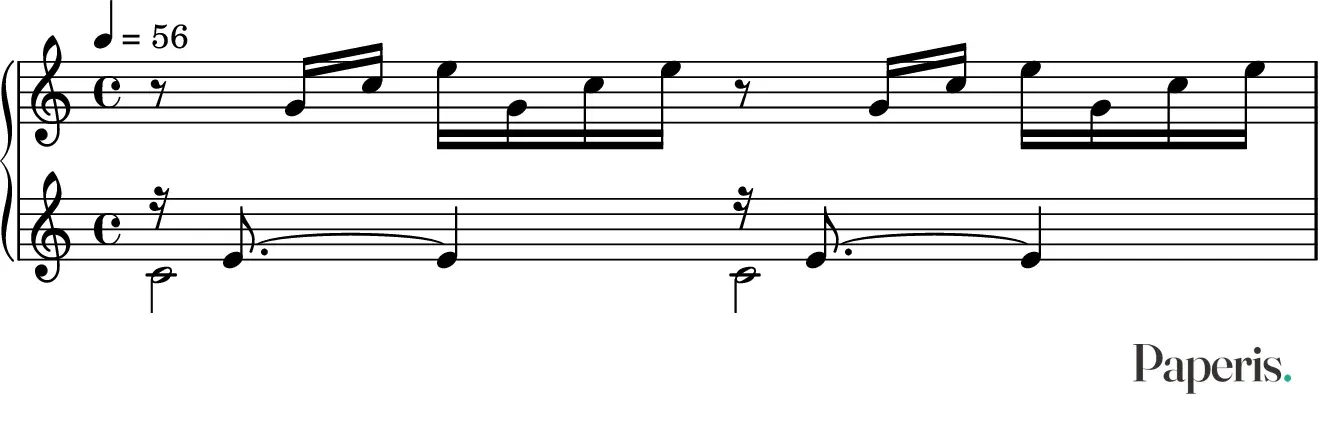
Clip: first bar of Bach's Prelude in C, WTC I (synthesized piano)
If even one of the three notes of a triad changes slightly in pitch, the name of the chord changes even if the note name positions stay the same (Ewell & Schmidt-Jones, Music Fundamentals ch. 5.01). Major triads and minor triads are two names that split that way, and the difference is counted in semitones. A semitone is one of the twelve steps into which Western music divides an octave, which is the distance from a key on the keyboard to the very next key. Whether a white key or a black key, if it is the immediate neighbor key, it is one semitone step; from C to E is four semitones, and from E to G is three semitones.
A major triad is a triad like C-E-G where the interval between the bottom two notes is four semitones, and the interval between the top two notes is three semitones. A minor triad is a triad like C-E♭-G where the interval between the bottom two notes is three semitones, and the interval between the top two notes is four semitones. (Ewell & Schmidt-Jones, Music Fundamentals ch. 5.02) E♭ is the black key immediately to the left of E.
The two chords share the same bottom and top notes, and differ by only a single semitone in the middle note.

Clip: C–E–G, then C–E♭–G
Just one middle note changes, yet the feel of the entire chord shifts. What the difference in that feel is, and to whom and to what extent it applies, is handled in another part of this series covering major and minor keys. What we will take away from this part is the structure. The basic unit of Western chords is three notes, and the interval between those three notes determines the name of the chord.
Interlocking Gears
When tuning two guitar strings to the same note, at the moment they are nearly matched but still slightly off, the sound flutters with a "wah-wah" effect. If the vibrating speeds of the two strings are very close but not identical, the combined sound repeatedly swells and fades (OpenStax Physics 14.4). This swelling and fading flutter is called a beat. This flutter meets again a little later.
First, let us look at a single sound. Even when pressing a single piano key, what reaches the ear is not just a single vibration. Overtones are components that sound together, mixed into a single note of an instrument or voice, vibrating at twice, three times, and four times the speed of the slowest vibration of that note. (OpenStax Physics 14.4) How overtones create different timbres for each instrument is the job of another part of this series covering timbre, and here we only look at what overtones do when two notes sound together. Note pairs classified as consonant are already contained within such overtone series (DOI: 10.1007/s10071-020-01404-0).
When two notes sound together, the overtones of both notes enter the ear at the same time. In a consonant pair, the overtones of the two notes overlap or line up neatly, so that the entire combined sound fits closely to the overtone series of a single note (DOI: 10.1016/j.neuropsychologia.2014.03.011). Harmonicity is the degree to which components sounding together line up in a single row like the overtones of a single note. The higher the harmonicity of a chord, the more people hear that chord as consonant (DOI: 10.1016/j.neuropsychologia.2014.03.011). According to a review paper from 2001, when listening to consonant pairs, the signals in the auditory nerve clearly carry not only the pitches of the two played notes, but also the pitches of other notes connected to that pair by overtones (PMID 11458869). In terms of gears, these are two wheels whose teeth mesh tightly.
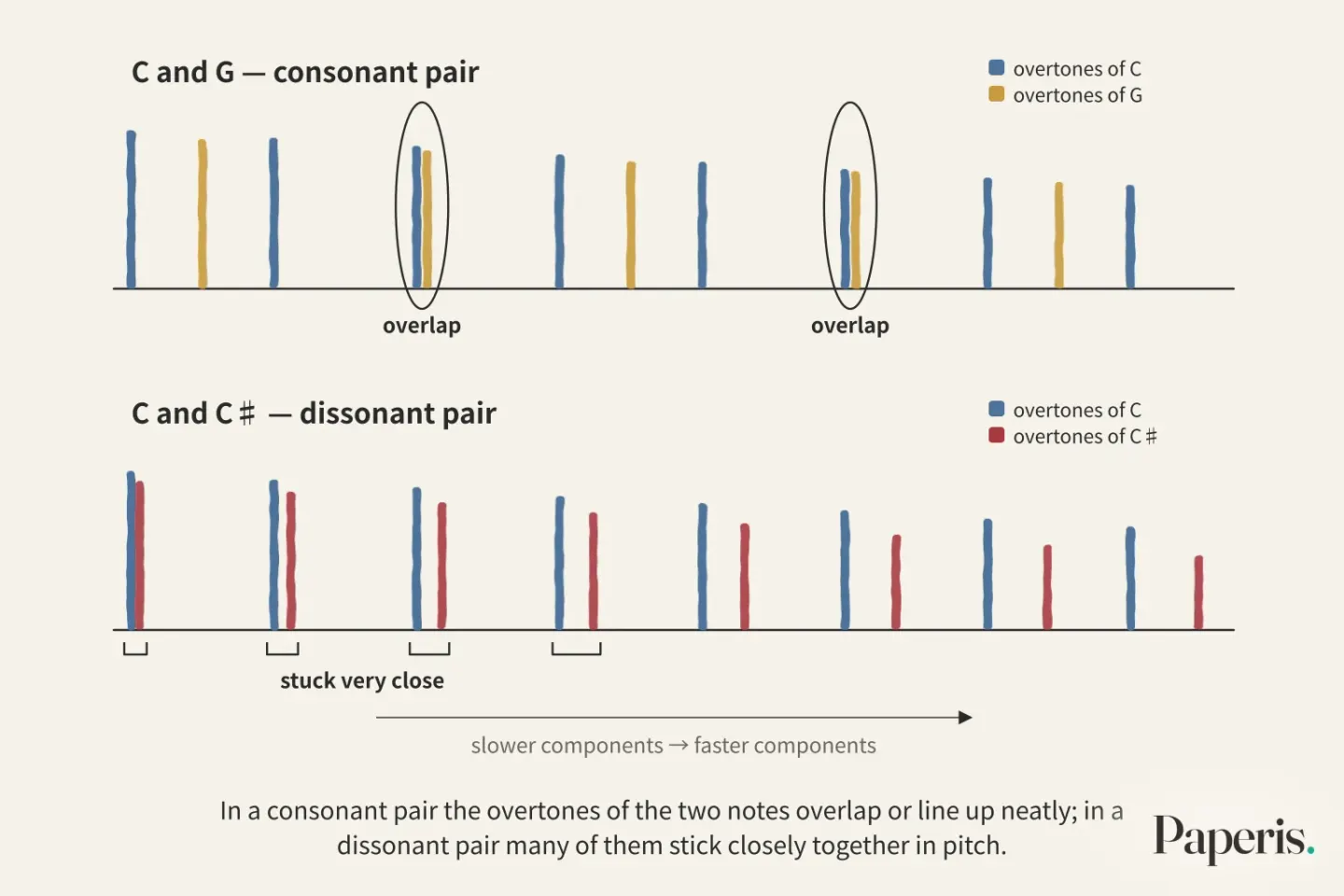
In dissonant pairs, the situation is different. Among the overtones of the two notes, many stick closely together in pitch. The cochlea, the innermost part of the ear, hears sounds separated by vibration speed, but its skill has limits, so components with speeds that are too close cannot be separated out and instead interfere with each other. This interference plays a part in hearing consonance and dissonance (PMID 12804282). Interference causes the signals in the auditory nerve to fluctuate roughly, and the ear hears this as roughness and dissonance (PMID 11458869).
Roughness is the sensation where components with very close pitches interfere with each other inside the ear, making the sound flutter rapidly and feel grating. In auditory research, this term is used to describe the grating feeling given by sounds like dissonance or sharp voices like screams (PMID 36028614).
Then, how do guitar string beats and roughness connect? If the difference in speed between two sounds is very small, the ear hears a slowly swelling and fading beat. The speed of the beat is equal to the difference in speed between the two sounds, so widening the difference makes the flutter faster as well (OpenStax Physics 14.4). When the flutter becomes fast, the sound no longer ripples slowly, but instead sounds like it is vibrating roughly. The humming of the C and C♯ pair is the sound of very closely attached overtones of the two notes interfering in this way (PMID 11458869). In terms of gears, these are two wheels whose teeth are slightly misaligned and grinding.
Clip: A with a very close tone (slow beats), then with a slightly farther tone (fast roughness)
So then, is what divides consonance interlocking, or the absence of separation? According to the same review paper, many psychologists, musicologists, and physiologists at the time viewed consonance as "a state devoid of roughness." Opposing that view, this review concluded that consonance is a property stemming primarily from pitch relationships among notes and cannot be explained solely by the absence of roughness (PMID 11458869).
One research team tried to solve this question by inversely utilizing differences in personal taste. According to two conference abstracts, participants liked both sounds without flutter and sounds with high harmonicity. However, among more than 250 participants, the only thing that consistently moved together with the degree of preference for consonant chords was the degree of preference for harmonicity (DOI: 10.1121/1.3384926) (DOI: 10.1121/1.4783492).
According to the same abstracts, the degree of preference for harmonicity grew with the number of years spent playing an instrument, whereas the degree of dislike for flutter had no correlation with musical experience. The researchers interpreted that the more people are exposed to music, the more they learn to listen for harmonicity (DOI: 10.1121/1.3384926) (DOI: 10.1121/1.4783492). Even in laboratory studies measuring neural responses along the pathway from the ear up to the brain, participants whose responses clearly followed harmonicity liked consonance more, and this relationship appeared even in people without musical training (DOI: 10.1016/j.neuropsychologia.2014.03.011) (DOI: 10.1016/j.heares.2015.01.009). The authors of the 2014 study believe that these neural responses drive the perception of consonance (DOI: 10.1016/j.neuropsychologia.2014.03.011).
Inside sound, there are two clues that divide consonance: harmonicity, where overtones interlock in a single row, and roughness, where overly close components separate. In the two conference abstracts and two laboratory studies, the factor that moved more closely together with people's preference for consonance was harmonicity. However, a 2022 review paper we will look at later places roughness more to the front (PMID 36372030).
Where the Ears That Love Interlocking Come From
The Tsimane people living in the Bolivian Amazon rainforest are an indigenous society that has lived with almost no exposure to Western culture and Western music. One research team had Tsimane people, residents of a Bolivian city and town, and US residents listen to various sounds and rate how pleasant they were to hear. The details below follow an abstract presented by this research team at a conference (DOI: 10.1121/1.4949844).
Tsimane people rated consonant chords, dissonant chords, and singing overlapped with consonance and dissonance as equally pleasant. They showed preferences similar to Western participants in several other aesthetic contrasts, and their abilities measured in a discrimination task were also similar to Western participants. Residents of the Bolivian city and town clearly preferred consonance more, but that degree was smaller than that of US residents (DOI: 10.1121/1.4949844).
The research team concluded that consonance preference varies greatly by culture and in some cases may not exist at all. The difference can likely be explained by how much Western music has been heard, and the research team's interpretation is that culture plays a major role in shaping the aesthetic response to consonance (DOI: 10.1121/1.4949844).
A follow-up study published in 2025 took advantage of the changed circumstances in the Amazon in the meantime. A small but clear consonance preference appeared among Tsimane people living more mixed with outside markets and culture, and did not appear among those living less mixed. Moving toward Bolivian town residents, big city residents, and non-musician Americans, the consonance preference was greater, and other preferences measured by the same task showed no differences between groups (DOI: 10.1016/j.cognition.2025.106333). The authors concluded that consonance preference changes with exposure to globalized culture (DOI: 10.1016/j.cognition.2025.106333).
There are also counterarguments. Another research team argued in a preprint manuscript before formal peer review that it is premature to conclude that consonance preference is not innate with an experiment comparing only five groups. Even an innate tendency does not need to appear in everyone without exception. When they analyzed traditional music from around the world, the tendency to avoid dissonance was consistent, but there was also much music that prolonged dissonance, such as Eastern European harvest songs or Papua New Guinean lullabies. Just as an innate aversion to bitter tastes can be overridden by culture and experience, they believe musical preference is likely a mix of the innate and the nurtured. They also conclude that broader cross-cultural research is needed (DOI: 10.31235/osf.io/964ut).
A 2022 review paper broadly synthesizing research on consonance and dissonance concludes that there is still no consensus in this field. Gathering studies on human and animal vocalizations, this review considers roughness to be linked to signals of pain or danger and to elicit a cautious bodily response. Therefore, it highlights roughness and how much sounds resemble the human voice as the primary factors explaining consonance and dissonance. And viewing the examined evidence, it writes that the side of avoiding dissonance is firmly supported by evidence from multiple fields, but the side of being drawn to consonance is still close to a guess and requires further confirmation. The conclusion of this review is that cross-cultural research will be needed in the future (PMID 36372030).
Putting the two results side by side raises a catch. Contrary to the review's synthesis that the side of avoiding dissonance is solid, the Tsimane participants in the conference abstract did not avoid dissonance. It is this article that has placed these two against each other, and the two studies did not directly address one another.
Interlocking and splitting are things that happen within sound and the ear, and the degree to which one feels that interlocking is "good" is heavily blended with the share of music that has been taken in. Whether that share is everything or whether an innate tendency underlies it is divided across studies.
Back to the Piano
We return to the child at the piano in the living room. When the child presses C and G together, the overtones of the two notes overlap in multiple places, making the combined sound align neatly into a single line, which is why it sounds clear. When the child presses C and the black key right next to it, the overtones of the two notes fail to overlap and end up very close together, and because the cochlea cannot separate the two, a buzzing roughness occurs. These are interlocking gears and grinding gears.
This time, the child presses three keys at once: C, E, and G. This is a major triad. If E is moved to the black key directly to its left, it becomes a minor triad while the very bottom and very top remain the same. The name changes because of the interval of just one middle note.
Even if that child prefers the clear pair over the rough pair, we cannot say that all of that preference came from the sound. Consonance and dissonance are distinctions that Western music places at its center, what sounds pleasing involves a share that differs from person to person, and there is evidence that the music one has listened to can cultivate a not-insignificant part of that share. How large that share is has not yet been determined.
Where to Look Next
What it means for a sound to "vibrate how fast" is explained by frequency and wavelength in "Waves — Fans Rising in Their Seats, a Wave Circling the Stadium".
Within this series, the distance between two notes and semitones are continued by the installment covering musical intervals, the story of how overtones create the distinct timbre of each instrument is continued by the installment covering timbre, and how the emotional difference between major and minor triads broadens into major and minor keys is continued by the installment covering major and minor keys.
Source Papers
- "Sound Reasoning — 2.02 Harmony in Western Music" — Brandt & McClure, Sound Reasoning ch. 2.02 — Western harmony grew over hundreds of years from combining melodies, and in many world musical cultures, harmony is not treated as a separate category.
- "Music Fundamentals — 4.03 Consonance and Dissonance" — Ewell & Schmidt-Jones, Music Fundamentals ch. 4.03 — Basic definitions of consonance and dissonance (stability and instability), and when you hear a chord containing dissonance, you can feel a pull toward the chord that will resolve it.
- "Music Fundamentals — 5.01 Triads" — Ewell & Schmidt-Jones, Music Fundamentals ch. 5.01 — The foundation of Western harmony is three-note chords built in thirds (triads), and names like major and minor are divided by changes in pitch.
- "Music Fundamentals — 5.02 Naming Triads" — Ewell & Schmidt-Jones, Music Fundamentals ch. 5.02 — In a major triad, the distance between the bottom note and middle note is four semitones and between the middle note and top note is three semitones, and a minor triad is the reverse.
- "Physics — 14.4 Sound Interference and Resonance" — OpenStax Physics 14.4 — Resonance frequencies are all multiples of the fundamental frequency (harmonics), and when two sounds with similar frequencies overlap, beats are created that grow louder and softer at a rate equal to their difference.
- "Subcortical representation of musical dyads: Individual differences and neural generators" (2015) — DOI: 10.1016/j.heares.2015.01.009 — How clearly brainstem neurons encode the harmonicity of a two-note chord predicts consonance preference even in non-musicians.
- "Neurobiological foundations for the theory of harmony in western tonal music." (2001) — PMID 11458869 — Consonant intervals carry strong related pitches in the auditory nerve, and dissonant intervals produce roughness because too-close components interfere. Concludes that consonance is above all a function of pitch relations and is not explained solely by the absence of roughness.
- "Is consonance attractive to budgerigars? No evidence from a place preference study" (2020) — DOI: 10.1007/s10071-020-01404-0 — Combinations of consonant intervals naturally fall within the harmonic series of a sound with overtones (this paper is cited only for this statement in the introduction).
- "Phase locked neural activity in the human brainstem predicts preference for musical consonance" (2014) — DOI: 10.1016/j.neuropsychologia.2014.03.011 — The degree to which the combined spectrum of a chord fits into a single harmonic series (harmonicity) predicts consonance, and people with stronger harmonicity encoding in the brainstem like consonance more.
- "Interference effects and phase sensitivity in hearing." (2002) — PMID 12804282 — The cochlea is a frequency analyzer with limited resolution, so close components interfere on the basilar membrane, and this interference is involved in the perception of consonance and dissonance.
- "Roughness perception: A multisensory/crossmodal perspective." (2022) — PMID 36028614 — In auditory research, roughness refers to sound properties like dissonance and the harsh feeling given by voices like screams and pain cries.
- "Individual differences reveal the basis of consonance." (2010) — DOI: 10.1121/1.3384926 — Conference abstract. Across more than 250 participants, the only thing that consistently correlated with consonance preference was harmonicity preference, and harmonicity preference correlated with years of playing an instrument, while beat avoidance was unrelated to musical experience.
- "Exploring the acoustic basis of consonance using individual differences." (2009) — DOI: 10.1121/1.4783492 — Conference abstract. In two cohorts, only harmonicity preference correlated with consonance preference, and harmonicity preference explained most of the effect of experience. Concludes that a substantial part of consonance perception is rooted in harmonicity.
- "Consonance preferences are not universal: Indifference to dissonance among native Amazonians" (2016) — DOI: 10.1121/1.4949844 — Conference abstract. The Tsimane rated consonant and dissonant chords and vocal songs as equally pleasant, and residents of Bolivian cities and towns showed a weaker consonance preference than US residents. Concludes that culture plays a dominant role.
- "Preferences for consonance are evident in Indigenous Amazonians with higher, but not lower, levels of global integration" (2025) — DOI: 10.1016/j.cognition.2025.106333 — A small but significant consonance preference is found only in Tsimane people who are more mixed into globalization. Concludes that consonance preference is altered by exposure to a globalized culture.
- "Music perception: No strong evidence to reject innate biases" (2017) — DOI: 10.31235/osf.io/964ut — Preprint commentary. Comparing five groups is insufficient to reject innate tendencies, and innateness does not require complete universality. A tendency to avoid dissonance and exceptions are seen together in traditional music.
- "Consonance and dissonance perception. A critical review of the historical sources, multidisciplinary findings, and main hypotheses." (2022) — PMID 36372030 — There is no consensus on explaining consonance and dissonance. The aversion of dissonance is solidly supported by evidence from multiple fields, but the attraction of consonance remains at the stage of conjecture, and cross-cultural studies are needed.
Sources (17)
- Sound Reasoning — 2.02 Harmony in Western Music
- Music Fundamentals — 4.03 Consonance and Dissonance
- Music Fundamentals — 5.01 Triads
- Music Fundamentals — 5.02 Naming Triads
- Physics — 14.4 Sound Interference and Resonance
- Subcortical representation of musical dyads: Individual differences and neural generatorsDOI 10.1016/j.heares.2015.01.009
- Neurobiological foundations for the theory of harmony in western tonal musicPMID 11458869
- Is consonance attractive to budgerigars? No evidence from a place preference studyDOI 10.1007/s10071-020-01404-0
- Phase locked neural activity in the human brainstem predicts preference for musical consonanceDOI 10.1016/j.neuropsychologia.2014.03.011
- Interference effects and phase sensitivity in hearingPMID 12804282
- Roughness perception: A multisensory/crossmodal perspectivePMID 36028614
- Individual differences reveal the basis of consonanceDOI 10.1121/1.3384926
- Exploring the acoustic basis of consonance using individual differencesDOI 10.1121/1.4783492
- Consonance preferences are not universal: Indifference to dissonance among native AmazoniansDOI 10.1121/1.4949844
- Preferences for consonance are evident in Indigenous Amazonians with higher, but not lower, levels of global integrationDOI 10.1016/j.cognition.2025.106333
- Music perception: No strong evidence to reject innate biasesDOI 10.31235/osf.io/964ut
- Consonance and dissonance perception. A critical review of the historical sources, multidisciplinary findings, and main hypothesesPMID 36372030