
Paperis Articles
Stress — The Load on the Scale, the Arm That Held It Too Long
The same event weighs differently on different people, and a brief stress response usually helps the body while a prolonged one becomes entangled with health. We look at what is settled and what is still being sorted out.
Your field's papers, as audio
Pick your fields and journals — Paperis summarizes the key papers and turns them into audio. Listen on your commute.
Start Paperis free →Stress — The Load on the Scale, the Arm That Held It Too Long
Friday Afternoon Mail
At five o'clock on a Friday afternoon, an email arrives from the team lead. It asks for a presentation on this quarter's results at the executive meeting on Monday morning. The weekend unfolds differently for two people who received the same email. One tosses and turns until dawn on Saturday, and by Sunday evening, their stomach feels bloated. The other organizes the materials on Saturday morning and goes to the mountains in the afternoon.
The email was the same. What divided the two people's weekends, and what happened inside the body of the person who tossed and turns, are the questions of this article. We ask one more thing. What happens to the body when such weekends continue for months?
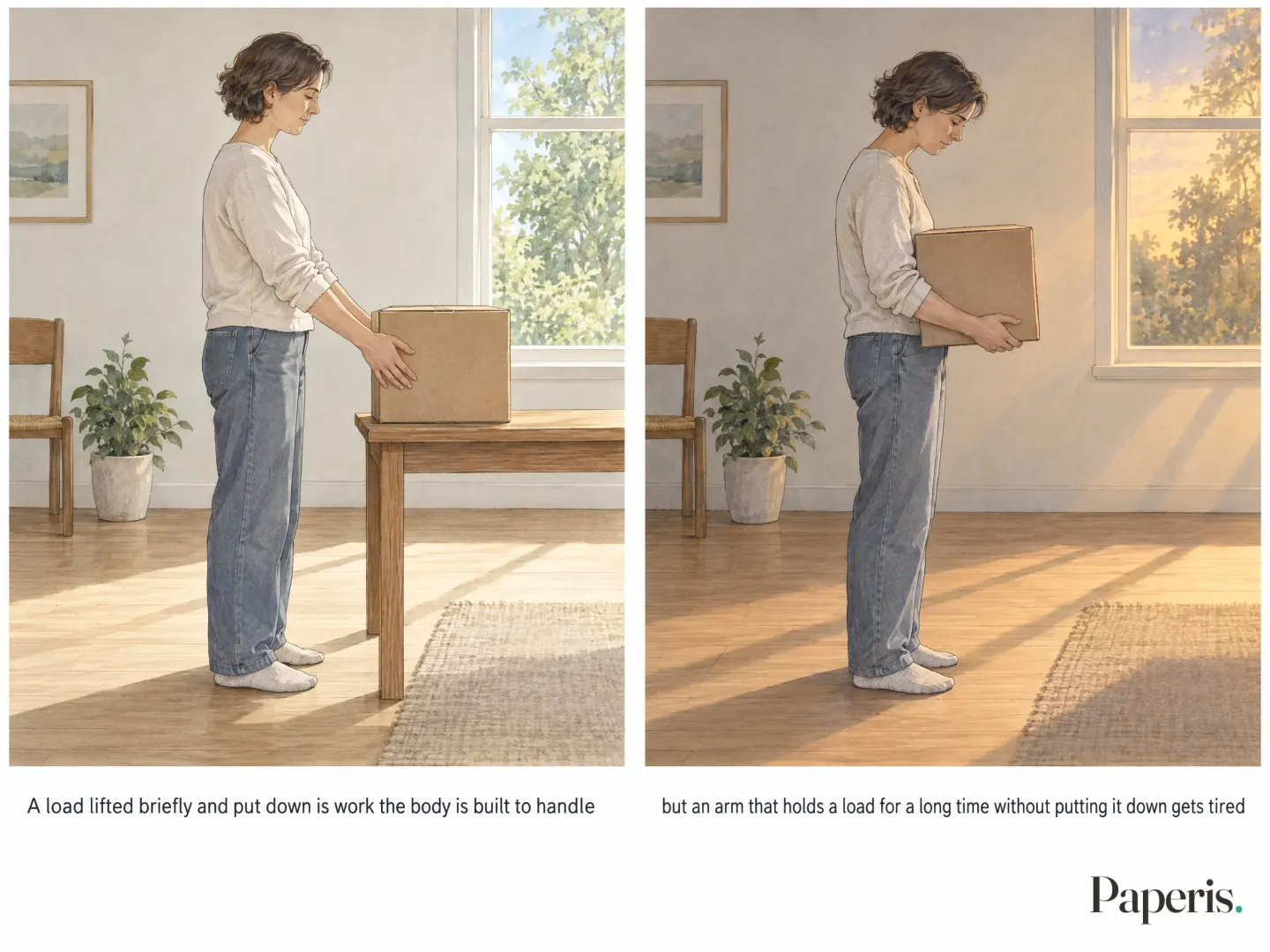
Imagine a scale. A newly added load goes onto one pan, and the strength to lift that load goes onto the other. When a heavy load arrives, the body prepares to lift it. A load lifted briefly and put down is work the body is built to handle, but an arm that holds a load for a long time without putting it down gets tired. This picture has limits. Unlike an iron scale, a human scale weighs the same load differently for each person and each day. And some loads are heavy no matter who weighs them.
It Starts with Weighing
Stress is the process by which the mind and body react when a situation is deemed too burdensome to handle or threatening. The reason the same email felt heavy to only one person lies within this definition. The weight does not arrive attached to the email, but is usually determined on the scale that weighs the email (OpenStax Psychology 2e 14.1). This definition, which places weight on the weighing process between an event and the reaction, was proposed by Lazarus and Folkman in 1984 (OpenStax Psychology 2e 14.1).
A stressor is an event or situation that can cause stress. Friday's email is one. Once the email goes on the scale, the weighing happens twice.
Primary appraisal is the judgment that evaluates how harmful or threatening the event will be to me. The same event is read as a threat if losses are visible, and as a challenge if gains are visible (OpenStax Psychology 2e 14.1). Secondary appraisal is the judgment that weighs what resources are available to counter this event and how well they will work. If someone believes there is something they can try, the same threat approaches them as less heavy (OpenStax Psychology 2e 14.1).
The person who tossed and turned may have seen the mistake in front of the executives and considered the weekend to be the only time to prepare. The person who went to the mountain may have seen an opportunity to report the results and may have already had the materials in hand. This weighing moves moment by moment even within a single day. In data that asked 164 people about their daily lives 2,908 times, the more people viewed the current task as important, the higher their stress was, and the more plentiful they considered their available resources to be, the lower it was. When resources were seen as lacking, the effect of importance was greater, and this relationship was observed both between people and within a single person's day (PMID 42743212).
This framework is currently being refined. In self-reported data from 2,216 patients hospitalized for psychosomatic disorders, a revised model fit generally well, but the authors stated that they could not measure the weighing process itself (PMID 33746820). A revised proposal has also been suggested that primary appraisal is closer to a feeling the body makes first rather than a thought being calculated (PMID 40056329).
Weighing does not determine everything. Even though the same load differs for each person, some loads are heavy on anyone's scale. Even in front of such loads, weighing still intervenes in how large that weight is felt to be (OpenStax Psychology 2e 14.1).
What Becomes a Load
The year a child is born is a joyous year, yet one where sleep and schedules change entirely. There is a tool that started from the idea that even welcome changes can become a load. The Social Readjustment Rating Scale is a questionnaire that picks out major life changes experienced over the past year and adds up the scores assigned to each change to measure the burden on a life. It was created in 1967 with 43 events, and it includes welcome things like marriage or a vacation (PMID 38109368; OpenStax Psychology 2e 14.2).
There are many studies showing that people who accumulated high scores in a short period had more illnesses. However, the correlation has appeared small in some examples (OpenStax Psychology 2e 14.2). In a study following 87 medical students for 3 years, a few correlations were seen, but overall there was no statistically clear correlation between life events and illness (PMID 884413). A study following 34 nursing students for 3 months confirmed earlier reports that illness increased as life changes accumulated, and counting only the number of bad events or unexpected events predicted it just as well as the total number of events. Using the scores that individuals assigned to each event did not improve predictability (PMID 757210).
Meanwhile, a study comparing 107 questionnaires collected by going door-to-door in a residential area concluded that a method of having people select only the events that were unwelcome to them worked best (PMID 6874998). This lines up with what is cited as the heaviest criticism against the scale. The score table does not ask how the person evaluated that event (OpenStax Psychology 2e 14.2). Because it is a correlational study that measured scores and illness together, it also cannot sort out which came first (OpenStax Psychology 2e 14.2). In 2023, the scores were re-evaluated by 540 people, mostly British adults, and while the new scores turned out higher, they largely agreed with the old scores (PMID 38109368).
Along with major events, the load includes small things that pile up day by day. These are everyday hassles, like missing an elevator right in front of you. In one study, the frequency of these hassles tracked more strongly with physical health problems than the life change scores did (OpenStax Psychology 2e 14.2). Among researchers who measure stress, a proposal has emerged to divide time units into acute, event-based, daily, and chronic (PMID 29551356).
A Monday presentation is a load that has an end date, but it can remain heavy for a while even after it is over (OpenStax Psychology 2e 14.2). There are also loads where an end date is not in sight. Chronic stress is stress that comes from burdens that continue or repeat for weeks or months. Heavy workloads with no end in sight for months are that kind of load. Long-lasting reactions after experiencing life-threatening events are touched on briefly in "Mental Disorders — A Scale That Rises and Falls, a Line People Drew".
Two Branches That Lift the Body's Load
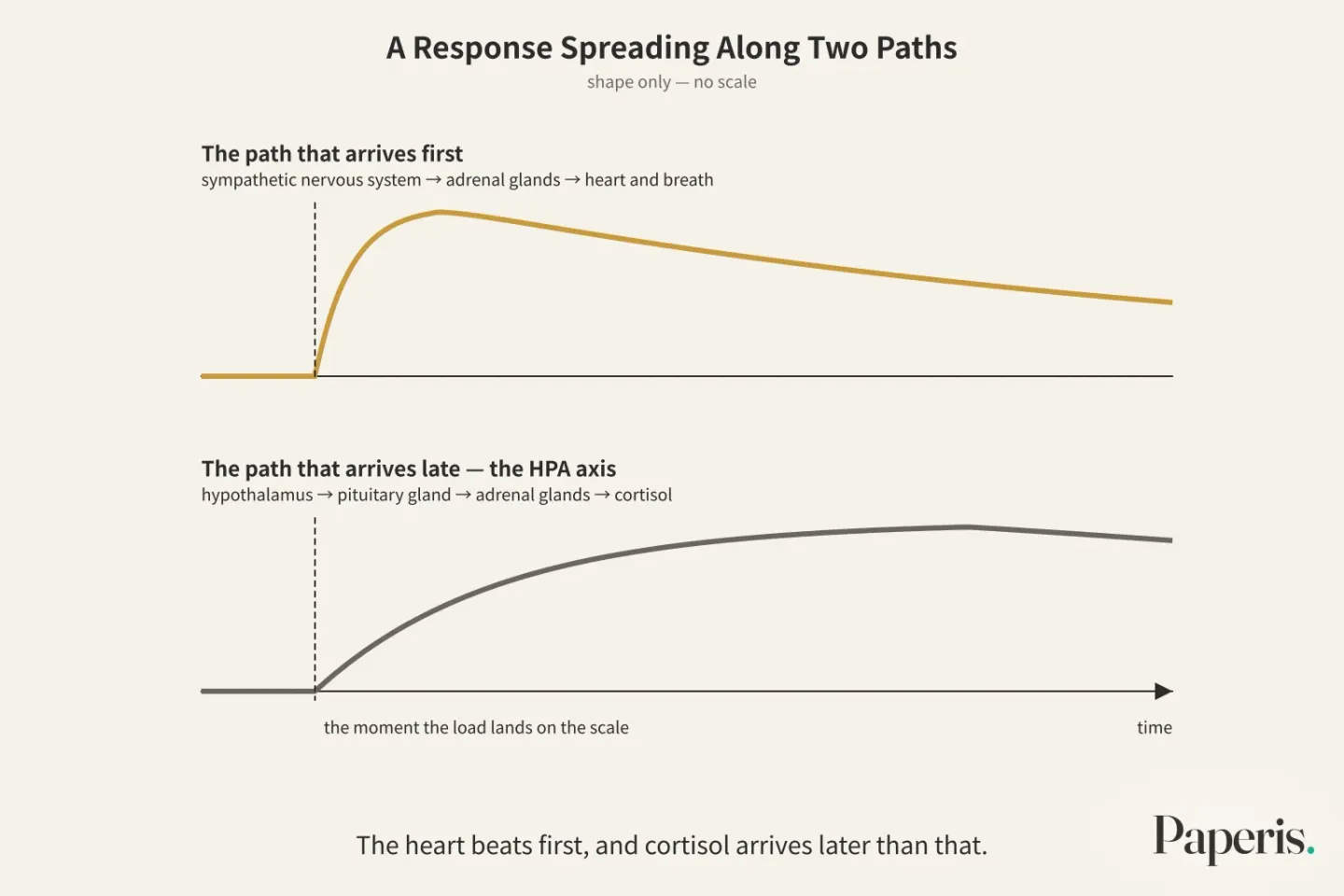
On a Sunday night, lying in bed and thinking about tomorrow's presentation, my heart beats fast and my palms grow sweaty. Nothing has happened yet, so why did the body already move? The news that the scale has tipped spreads through the body along two paths (OpenStax Psychology 2e 14.1).
The path that arrives first is the nerves. The sympathetic nervous system is a branch of the autonomic nervous system, the side that steps to the front when the body needs to tense up and exert force. When this nerve turns on, a small gland above the kidney releases hormones.
The adrenal glands are small glands perched one on top of each kidney. Hormones like adrenaline coming from there rush the heart and breath (OpenStax Psychology 2e 14.1). There is a name for the whole body waking up all at once like this. The fight-or-flight response is a reaction where the body, having sensed a threat, rouses itself in an instant so it can fight back or run away. It is a name given in the early 20th century by the American physiologist Walter Cannon at Harvard Medical School (OpenStax Psychology 2e 14.1).
The path that arrives later is a chain where a hormone summons the next hormone. The HPA axis is a hormone chain where the hypothalamus deep in the brain and the pituitary gland dangling right below it hand off signals in turn, causing the adrenal glands to release cortisol. The heart beats first, and cortisol arrives later than that (OpenStax Psychology 2e 14.1). Cortisol is a hormone that comes out of the adrenal glands, its amount rising and falling to match the time of day and the burden the body receives.
What cortisol does precisely in the stress response was a subject of debate for a long time. Across domains of the body like blood vessels, immunity, and metabolism, it props up responses, holds them back so they do not go too far, and prepares the body for the next load (PMID 10696570). Adding energy to use when lifting a load for the first time is also among those jobs (OpenStax Psychology 2e 14.1). Nerves, hormones, and immunity move separately yet together to make up the response (PMID 36950689). What cortisol does in the midst of the stress response spans both helping the response and holding it down. The place that decides what to see as a threat and commands these two paths is the brain (PMID 17615391).
This response is an originally useful mechanism. A short stress lasting from a few minutes to a few hours while immunity is at work actually boosts the immune response, and acute stress raises the power to fight off infection (PMID 24798553; PMID 20302192). However, that same short response can also heighten immune responses on the harmful side, such as inflammation (PMID 24798553). The acute stress response in a young and healthy person can help with adaptation and usually leaves no burden on health (PMID 17716101). A stress response that is briefly lifted and put back down is a mechanism built to let the body get past a crisis.
Three Stages Seen in Rats, and the New Framework That Followed
What happens to the body if you carry a heavy load for a long time? The first picture of the answer to this question was three stages drawn by the endocrinologist Hans Selye while studying rats at McGill University in the 1930s (OpenStax Psychology 2e 14.1). General adaptation syndrome is Selye's model that the body goes through three stages—alarm, resistance, and exhaustion—when harmful stimuli continue.

Hans Selye · Chris Lund (National Film Board of Canada), 1956 · Wikimedia Commons (public domain)
This picture came from rat experiments. No matter what had tormented them for a long time, the rats' adrenal glands were enlarged (OpenStax Psychology 2e 14.1). Because it was a picture that only looked at the body's reaction, how one carries that load is almost left out (OpenStax Psychology 2e 14.1).
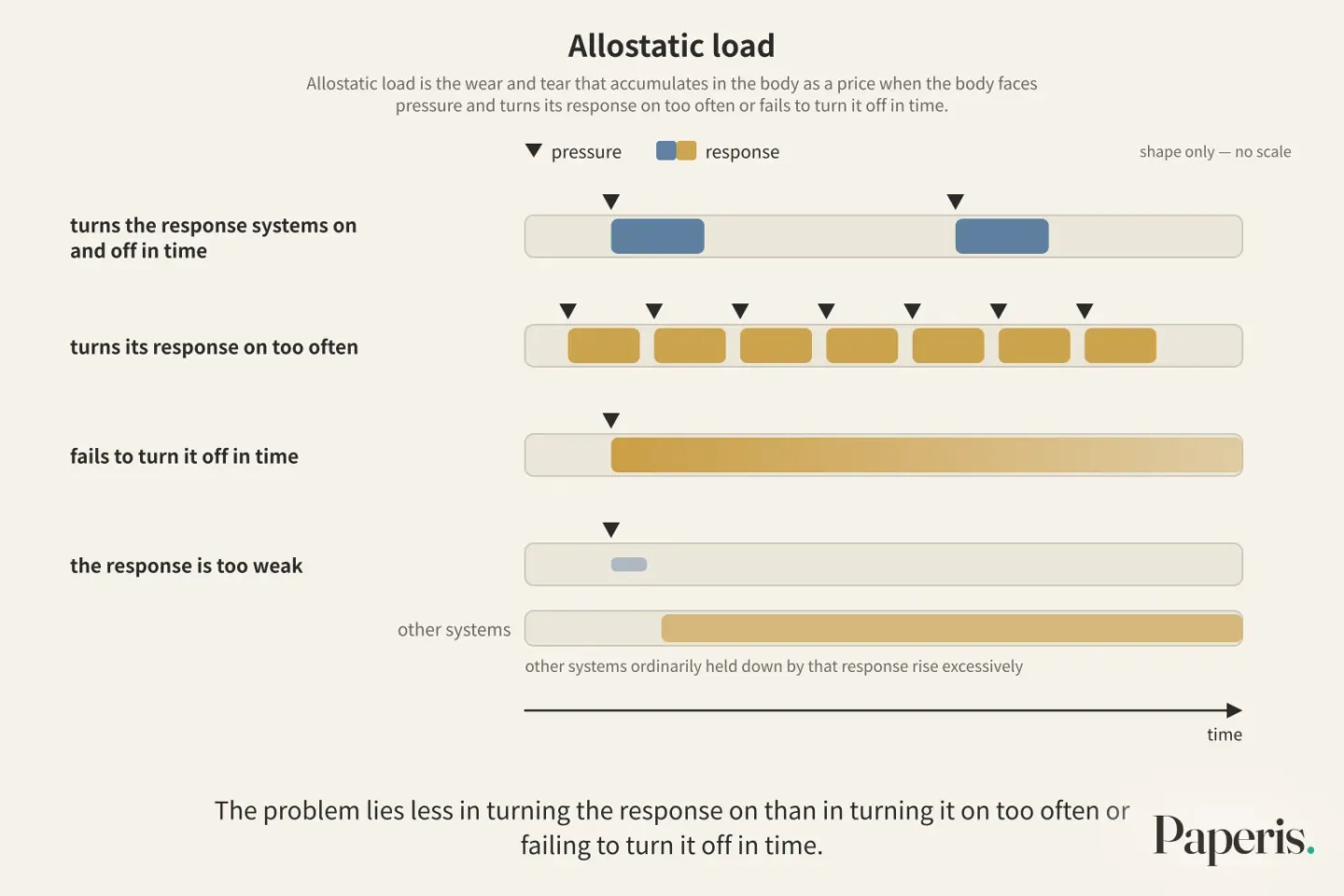
The new framework organized after that tallies the price the body pays for a long-continued reaction (PMID 9629234; PMID 8379800). The body maintains stability by changing, turns the response systems on and off in time, and gets through things that are hard to endure if they are not turned on too often (PMID 9629234). Allostatic load is the wear and tear that accumulates in the body as a price when the body faces pressure and turns its response on too often or fails to turn it off in time. Cases where the response is too weak, so that other systems ordinarily held down by that response rise excessively, also fall under this (PMID 9629234). This wear and tear includes not only what was experienced, but also genes, eating and moving habits, and the way of reacting ingrained in the body while growing up (PMID 17290796). The problem lies less in turning the response on than in turning it on too often or failing to turn it off in time.
Long-Carried Burdens and the Body — What Goes Together and What Is a Cause
Long-running daily stress goes hand in hand with a higher risk of high blood pressure (11 studies, 5,696 people, odds ratio 2.40). Conversely, stress was also seen more often on the side of people with high blood pressure (odds ratio 2.69). The authors noted that studies defined stress in different ways, concluding that chronic stress may be a risk factor for high blood pressure but more research is needed to confirm this (PMID 28415916). The fact that things go together and the question of which comes first are different matters.
The heart is similar. Chronic stress predicts coronary artery disease, people experiencing work stress or who are isolated and lonely have a high risk of a first onset, and for people with advanced atherosclerosis, a brief emotional shock can act as the trigger for a cardiac event (PMID 22473079). However, estimates of the magnitude vary. One review views the harm of adulthood stress as generally less pronounced than smoking, high blood pressure, and cholesterol, playing an important role as a trigger in people with heavily diseased arteries and in shaping the course for those already ill (PMID 29213140). Another review sees the risk share from stress as comparable to those other risk factors, even after adjusting for them (PMID 32791843). A 2024 review notes that while the link between stress and cardiovascular risk is widely accepted, the mechanisms and causal connections have remained at the guesswork stage despite decades of research (PMID 38698183).
In immunity, the direction reverses compared to short-term stress. Long-running stress suppresses or disrupts the immune responses that protect the body, keeping low-level inflammation going for a long time (PMID 24798553). Psychological stress also reduces the ability to produce antibodies after receiving a vaccine (PMID 20302192). The link with autoimmune diseases has been raised as a possibility and remains a task for further research (PMID 39518533). Severe stress in childhood connects to the risk of various chronic diseases in adulthood (PMID 29213140).
Cortisol also cannot be summed up in a single line saying "more is bad." Cortisol secretion follows a daily rhythm (PMID 38067154), and the slope at which its amount changes from morning to evening can be measured. In an analysis combining 80 studies, a flatter slope went hand in hand with poorer health. The magnitude of the association was small (r=0.147), and largest on the side of immunity and inflammation. The authors view the flat slope as both a marker reflecting a body disrupted by stress, and potentially a factor contributing to that disruption (PMID 28578301).
The pathways do not lie only within the body. Stress reaches the body directly via the autonomic nervous system and hormones, and it also reaches the body by detour through lifestyle habits like sleep, eating, and smoking (PMID 32886587; PMID 17290796). The burden can also keep playing inside the head. There is a hypothesis that worry and rumination prolong the body's response both before an event arrives and after it has passed, and the evidence is still at a preliminary stage (PMID 16439263). How much harm will result depends on the nature, number, and duration of the burdens, alongside the person's body, available resources, and ingrained coping styles (PMID 17716101). While there is abundant evidence that stress goes hand in hand with various diseases, the firmness of the evidence for how much of a cause it is varies by disease and is still being sorted out.
Hands That Handle Loads
We look again at the Saturday of the person who went to the mountain. In the morning, they organized materials; in the afternoon, they climbed the mountain to clear their head. Both are work that handles loads. Coping is the effort, through mind and behavior, that a person puts into dealing with a stressful problem.
The morning's work reduced the load itself. Problem-focused coping is the effort to change or deal with the stress-causing problem itself. The afternoon's work reduced the weight on the mind caused by the load. Emotion-focused coping is the effort to change or reduce the painful emotions brought on by a problem.
In front of a load seen as changeable, hands that tackle the problem appear more often; in front of a load seen as unchangeable, hands that handle emotion appear more often, but in front of many loads, people use both together (OpenStax Psychology 2e 14.4). The person who went to the mountain did just that.
As seen in "Emotion and Motivation — A Dashboard of Swinging Needles, and the Eye That Reads Them", reappraisal is a method of interpreting a situation that caused emotion differently, so that the emotion arrives less strongly. This reappraisal is sometimes used in emotion-focused coping (OpenStax Psychology 2e 14.4).
Does teaching coping make a difference? In an analysis pooling 9 studies involving older adults, coping education increased problem-focused coping, but had no clear effect on emotion-focused coping, and the authors noted that larger randomized trials are needed (PMID 40851237).
How people view stress is also studied. Whether one believes stress grows people or breaks them down can be measured, and in one study it was changed by watching a short video (PMID 23437923). Education that changes these beliefs or causes people to interpret a heart racing from stress differently slightly raised task performance. In an analysis pooling 44 effects, the overall effect was small (d=0.23), and education that only changes beliefs was not distinct when looked at separately (d=0.18). The authors evaluated that this education cannot be a panacea, but is a low-cost, promising method (PMID 38575696). Education that makes people view stress differently helps, but its scope is small.
In an analysis pooling 58 randomized trials of stress management programs involving 3,508 non-patient participants, cortisol levels changed in a better direction than the control group (g=0.282). Cortisol changes were relatively larger on the side of mindfulness and meditation (g=0.345) and relaxation training (g=0.347), while conversation-focused therapy was small and unclear. The authors noted that whether these changes lead to health in the long run requires further study (PMID 37879237). Whether methods that reduce stress even lower the risk of heart disease requires more randomized trial data, and few methods have been verified for widespread use yet (PMID 38698183; PMID 29213140). Up to half of patients who have experienced a myocardial infarction suffer psychological distress, and the evidence on whether treating that distress improves the heart's future is mixed. Even so, the American Heart Association's position is that various therapies reduce distress and improve quality of life (PMID 40977387).
Hands Lifted Together, The Feeling of Holding the Handle
A heavy box is lighter when two people carry it. Social support is the comfort, advice, and practical help we receive from the people around us when times are hard. One review divides support into the side that props up the mind and the side that tackles problems together, and considers that close people and people who have been through the same thing are good at giving different kinds of support (PMID 21673143).
In an analysis gathering 604 studies, the sense that help is available went hand in hand with better mental health (r=.35) and physical health (r=.24), and that link showed up both at the same point in time and after time had passed (PMID 41100292). In laboratory studies, blood pressure generally rose less during stress tasks when a friend was close by, but some studies have results that are not easy to interpret. Support can also be a way to help people stick with medical treatment (OpenStax Psychology 2e 14.4). In a small study following 34 nursing students, illness did not drop noticeably even when people had someone to turn to for help (PMID 757210).
The feeling of holding a handle also shifts the scale. A sense of control is the belief that I can influence the flow and outcome of events. People with high control tend to have better physical and mental health and are less heavily shaken by the daily load (OpenStax Psychology 2e 14.4). At work, jobs with high demands and little room to decide things for oneself go hand in hand with high blood pressure and heart disease (OpenStax Psychology 2e 14.2).
The lower the social standing, the smaller the room to predict and control events and the fewer the resources to spend, which contributes to high stress and poor health (OpenStax Psychology 2e 14.3). Indicators of allostatic load also form tiers following socioeconomic standing (PMID 10649824). The room to control is shaped by conditions of work and life, along with mindset.
Resilience is the process of adapting through hard times and finding one's footing again afterward. There are reviews that define it as a process like this (PMID 30102966), and proposals to view it as a process built together by multiple systems of the brain and body (PMID 31178098). One comprehensive analysis defining resilience as a bundle of traits an individual possesses gathered 55 studies and about 29,000 people; here, people who were better at reappraisal showed higher resilience (r=0.47). This is an analysis pooling the correlation of two values, and the authors interpret it as evidence that reappraisal works as a protective strategy against stress (PMID 38657292). Control, positive emotion, optimism, and social support are thought to help this process, but most evidence connecting immunity and resilience comes from animal studies (PMID 30102966).
Monday Morning, Back at the Scale
Now we trace Friday's email from the start. The email, as a stressor, goes on the scale, and the two people each make a primary appraisal and a secondary appraisal. The scale tips further for the person who sees the mistake first and judges that the means fall short. The rapid heartbeat of that person on Sunday night is the fight-or-flight response, and a bit later the HPA axis adds cortisol.
The body is built to turn this response on and then off (PMID 9629234). If the presentation ends and the load is put down, for a young and healthy person this kind of brief response usually leaves no burden on health (PMID 17716101). There is a hypothesis that if someone chews over a mistake even after the presentation ends, the response can drag out, and the evidence is at a preliminary stage (PMID 16439263). When that kind of weekend goes on for months, the story moves over to chronic stress. There is much evidence that long-running stress goes hand in hand with various illnesses, but how much of a cause it is remains to be sorted out differently for each disease.
The person who went to the mountain used problem-focused coping in the morning and emotion-focused coping in the afternoon, using both hands together. If a colleague watches a rehearsal, that is social support, and if someone can decide their own presentation order, that connects to a sense of control. How much these hands change the scale is, as we saw earlier, often small in effect or still being confirmed. And some loads are heavy no matter who weighs them.
Where Else to Look
The stops along the HPA axis and the way cortisol rises and falls across the day are examined in detail by "What Do the Adrenal Glands and Cortisol Do? — The Letter That Sets the Day, the Gland That Rests When a Drug Writes in Its Place", while the immune system touched by long-held burdens is covered by "How Does the Immune System Tell 'Self' from 'Other'? — Guards at the Gate, and a Patrol That Remembers Faces". How insufficient sleep makes that burden heavier continues into "Sleep Loss — A Debt Built Night by Night, Reminders That Lag Behind".
Reappraisal and bodily arousal start from "Emotion and Motivation — A Dashboard of Swinging Needles, and the Eye That Reads Them". Results that shrink upon re-measurement, like the small effect of brief training, are handled by "Psychology's Replication Crisis — Why the Findings We Believed In Wobbled", and just how far data from a few dozen medical or nursing students can speak is addressed by "Who Was Being Measured — Who "People" Meant When Psychology Said It".
Reactions that linger long after trauma are briefly touched upon in "Mental Disorders — A Scale That Rises and Falls, a Line People Drew", and the marks left by childhood burdens on a growing body are taken up by "Development — The First Paths in Soft Ground, and the New Ones We Keep Making".
Source Papers
- "Psychology 2e — 14.1 What Is Stress?" (2020) — OpenStax Psychology 2e 14.1 — Lazarus and Folkman's (1984) definition of the appraisal process (primary and secondary appraisal, threat and challenge), how appraisal intervenes in the response even before potentially threatening factors, the two systems of the sympathetic nervous system and the HPA axis along with their speed differences, Cannon's fight-or-flight response, cortisol supplementing initial energy, Selye's (1930s, McGill University) rat observations and general adaptation syndrome, and the limitation of ignoring appraisal.
- "Psychology 2e — 14.2 Stressors" (2020) — OpenStax Psychology 2e 14.2 — Acute and chronic factors, the Social Readjustment Rating Scale (including desirable events) and cumulative scores in relation to illness, criticisms (failure to account for appraisal) and the limitations of correlational studies, daily hassles, and job strain (high demand and low control).
- "Psychology 2e — 14.3 Stress and Illness" (2020) — OpenStax Psychology 2e 14.3 — How low social status, characterized by a lack of control and predictability alongside resource inequality, contributes to high stress and poor health.
- "Psychology 2e — 14.4 Regulation of Stress" (2020) — OpenStax Psychology 2e 14.4 — The definition of coping, problem-focused and emotion-focused coping (including reappraisal in certain cases), their use according to controllability combined with each other, a sense of control and health, forms of social support, blood pressure when a friend is present (generally—though open to interpretation), and treatment adherence pathways.
- "From Who experiences stress to When It Occurs: Revisiting Lazarus' transactional model of stress using an ecological momentary assessment framework." (2026) — PMID 42743212 — 164 participants and 2,908 observations showing that higher situational importance appraisals increase stress, higher coping resource appraisals decrease stress, the effect of importance is larger when resources are low, and these patterns hold both between and within individuals.
- "A Modified Version of the Transactional Stress Concept According to Lazarus and Folkman Was Confirmed in a Psychosomatic Inpatient Sample." (2021) — PMID 33746820 — Self-reports from 2,216 inpatients confirming the model generally, with the limitation that it could not include the appraisal process.
- "Primary Appraisal is Affective not Cognitive: Exploring a Revised Transactional Model of Stress and Coping." (2025) — PMID 40056329 — Proposing a revised model in which primary appraisal is primarily an affective rather than cognitive process.
- "The social readjustment rating scale: Updated and modernised." (2023) — PMID 38109368 — Updating the 1967 scale of 43 events using 540 British adults, finding that the new scores are higher but largely consistent with the original.
- "Life events and illness: a three year prospective study." (1977) — PMID 884413 — A three-year study of 87 medical students finding some positive results, but overall no significant link between life events and illness.
- "The relationship between response qualities of life change events and future illness rates." (1978) — PMID 757210 — A three-month study of 34 nursing students confirming a link between accumulated life changes and illness rates, showing that the number of negative or unexpected events alone predicts as well as the total event count, subjective scores (SLCU) add no predictive power, expected events are weak predictors, and the availability of social support does not significantly lower illness rates.
- "Measuring life stress: a comparison of the predictive validity of different scoring systems for the social readjustment rating scale." (1983) — PMID 6874998 — 107 residential questionnaires indicating that the most appropriate method is having respondents check events they found unwelcome.
- "More than a feeling: A unified view of stress measurement for population science." (2018) — PMID 29551356 — Stress is not a single concept; proposing a time-scale classification of acute, event, daily, and chronic stress.
- "How do glucocorticoids influence stress responses? Integrating permissive, suppressive, stimulatory, and preparative actions." (2000) — PMID 10696570 — The purpose of glucocorticoids is controversial, with actions divided across domains into permissive, suppressive, and stimulatory effects.
- "Understanding the relationships between physiological and psychosocial stress, cortisol and cognition." (2023) — PMID 36950689 — The endocrine, nervous, and immune systems form the stress response both independently and interactively.
- "Physiology and neurobiology of stress and adaptation: central role of the brain." (2007) — PMID 17615391 — The brain determines what constitutes a threat and decides physiological and behavioral responses.
- "Effects of stress on immune function: the good, the bad, and the beautiful." (2014) — PMID 24798553 — Short-term stress lasting minutes to hours enhances immune responses, whereas long-term stress suppresses and disrupts protective immunity while inducing low-grade chronic inflammation.
- "The effect of stress on the defense systems." (2010) — PMID 20302192 — Acute stress increases resistance to infection, whereas chronic stress impairs immune responses and vaccine antibody production.
- "Stress and health: psychological, behavioral, and biological determinants." (2005) — PMID 17716101 — Acute responses in young, healthy individuals are adaptive, whereas persistence is harmful, especially in older or unhealthy people, with the relationship governed by the nature, number, and duration of factors alongside vulnerability, resources, and coping.
- "Stress, adaptation, and disease. Allostasis and allostatic load." (1998) — PMID 9629234 — Allostasis (stability through change, Sterling and Eyer 1988) allows coping when systems are efficiently turned on and off, with three types of allostatic load: frequent activation, failure to shut off, and inadequate response leading to the overactivation of other systems normally suppressed.
- "Protective and damaging effects of stress mediators: central role of the brain." (2006) — PMID 17290796 — Many everyday events elevate physiological systems and prompt sleep loss or overeating, with allostatic load reflecting experience, genetics, lifestyle, and developmental history.
- "Association between psychosocial stress and hypertension: a systematic review and meta-analysis." (2017) — PMID 28415916 — In 11 studies involving 5,696 people, the odds ratio for stress and hypertension was 2.40, and for stress among hypertensive patients was 2.69, though definitions varied, pointing to the need for more research.
- "Stress and cardiovascular disease." (2012) — PMID 22473079 — Chronic stress predicts coronary artery disease, job stress, isolation, and loneliness increase the risk of a first onset, and short-term emotional stress triggers events in advanced atherosclerosis.
- "Effects of stress on the development and progression of cardiovascular disease." (2018) — PMID 29213140 — Severe childhood stress increases the risk of multiple chronic diseases in adulthood, whereas the harm of adult stress is generally less pronounced than classic risk factors but important for triggers and prognosis, with few scalable interventions.
- "Disentangling the Links Between Psychosocial Stress and Cardiovascular Disease." (2020) — PMID 32791843 — Stress-attributable risk remains comparable to other risk factors even after adjustment.
- "Stress and cardiovascular disease: an update." (2024) — PMID 38698183 — Associations are generally accepted, but measurements and magnitudes vary, mechanisms and causality remain speculative, and more randomized trial data are needed.
- "Immunology of Stress: A Review Article." (2024) — PMID 39518533 — Acute stress temporarily enhances immunity while chronic stress disrupts and suppresses it, with potential links to autoimmunity requiring further study.
- "Diurnal cortisol slopes and mental and physical health outcomes: A systematic review and meta-analysis." (2017) — PMID 28578301 — Across 80 studies and 179 associations, a flattened diurnal cortisol slope correlated with poorer health (r = 0.147), most strongly in immunity and inflammation (r = 0.288), sparking debate over whether it is a marker or a mechanism.
- "Stress and Health: A Review of Psychobiological Processes." (2021) — PMID 32886587 — Stress exerts direct effects via autonomic and neuroendocrine pathways and indirect effects through health behavior changes.
- "The perseverative cognition hypothesis: a review of worry, prolonged stress-related physiological activation, and health." (2006) — PMID 16439263 — The hypothesis that worry and rumination increase physiological activation before and after events, receiving preliminary support.
- "Interventions for Improving Coping Strategies in Older Adults: A Systematic Review and Meta-Analysis." (2025) — PMID 40851237 — Across 9 studies, problem-faced coping increased (SMD 0.37) while emotion-focused coping showed no effect, highlighting the need for larger randomized trials.
- "A meta-analysis of cognitive reappraisal and personal resilience." (2024) — PMID 38657292 — Across 55 studies involving 29,824 participants, reappraisal correlated with personal resilience at r = 0.47, which the authors interpret as a protective strategy.
- "Rethinking stress: the role of mindsets in determining the stress response." (2013) — PMID 23437923 — Demonstrating the reliability and validity of the stress mindset measure and showing that mindsets can be altered via short videos.
- "Effectiveness of stress arousal reappraisal and stress-is-enhancing mindset interventions on task performance outcomes: a meta-analysis of randomized controlled trials." (2024) — PMID 38575696 — Across 44 effect sizes, task performance improved slightly (d = 0.23), though mindset interventions alone were not significant (d = 0.18), suggesting they are a promising low-cost approach rather than a universal cure.
- "Effectiveness of stress management interventions to change cortisol levels: a systematic review and meta-analysis." (2024) — PMID 37879237 — Among 58 randomized trials in non-clinical samples totaling 3,508 participants, cortisol improved (g = 0.282), with mindfulness and relaxation showing larger effects and talk therapy showing small, non-significant effects, while long-term health impacts require further study.
- "Post-Myocardial Infarction Psychological Distress: A Scientific Statement From the American Heart Association." (2025) — PMID 40977387 — Up to half of patients experience psychological distress following a myocardial infarction, evidence on whether treatment improves cardiac prognosis is mixed, and several interventions reduce distress and improve quality of life.
- "Mechanisms linking social ties and support to physical and mental health." (2011) — PMID 21673143 — Identifying two types of support—emotional sustenance and active coping assistance—with close individuals who have shared similar experiences providing distinct forms of support.
- "How does perceived social support relate to human thriving? A systematic review with meta-analyses." (2025) — PMID 41100292 — Across 604 studies, perceived social support correlated with mental health (r = .35) and physical health (r = .24) in concurrent and prospective associations.
- "Allostasis and allostatic load: implications for neuropsychopharmacology." (2000) — PMID 10649824 — Indicators of allostatic load also exhibit a socioeconomic status gradient.
- "The Role of Cortisol in Chronic Stress, Neurodegenerative Diseases, and Psychological Disorders." (2023) — PMID 38067154 — Cortisol secretion is regulated by brain regions that set the circadian rhythm and operates via the HPA axis.
- "Stress and the individual. Mechanisms leading to disease." (1993) — PMID 8379800 — Expanding the concept of allostasis into the temporal dimension, defining allostatic load as the cumulative cost of neural and neuroendocrine responses to repeated or chronic challenges.
- "Resilience and immunity." (2018) — PMID 30102966 — Resilience is the process of adapting to and recovering from adversity, aided by a sense of control, positive affect, optimism, and social support, though evidence linking it to immunity is mostly from animal studies.
- "Neurobiology of Resilience: Interface Between Mind and Body." (2019) — PMID 31178098 — Proposing that resilience is an adaptive process in the face of adversity that requires the integration of multiple central and peripheral systems.
Sources (42)
- Psychology 2e — 14.1 What Is Stress?
- Psychology 2e — 14.2 Stressors
- Psychology 2e — 14.3 Stress and Illness
- Psychology 2e — 14.4 Regulation of Stress
- From Who experiences stress to When It Occurs: Revisiting Lazarus' transactional model of stress using an ecological momentary assessment frameworkPMID 42743212
- A Modified Version of the Transactional Stress Concept According to Lazarus and Folkman Was Confirmed in a Psychosomatic Inpatient SamplePMID 33746820
- Primary Appraisal is Affective not Cognitive: Exploring a Revised Transactional Model of Stress and CopingPMID 40056329
- The social readjustment rating scale: Updated and modernisedPMID 38109368
- Life events and illness: a three year prospective studyPMID 884413
- The relationship between response qualities of life change events and future illness ratesPMID 757210
- Measuring life stress: a comparison of the predictive validity of different scoring systems for the social readjustment rating scalePMID 6874998
- More than a feeling: A unified view of stress measurement for population sciencePMID 29551356
- How do glucocorticoids influence stress responses? Integrating permissive, suppressive, stimulatory, and preparative actionsPMID 10696570
- Understanding the relationships between physiological and psychosocial stress, cortisol and cognitionPMID 36950689
- Physiology and neurobiology of stress and adaptation: central role of the brainPMID 17615391
- Effects of stress on immune function: the good, the bad, and the beautifulPMID 24798553
- The effect of stress on the defense systemsPMID 20302192
- Stress and health: psychological, behavioral, and biological determinantsPMID 17716101
- Stress, adaptation, and disease. Allostasis and allostatic loadPMID 9629234
- Protective and damaging effects of stress mediators: central role of the brainPMID 17290796
- Association between psychosocial stress and hypertension: a systematic review and meta-analysisPMID 28415916
- Stress and cardiovascular diseasePMID 22473079
- Effects of stress on the development and progression of cardiovascular diseasePMID 29213140
- Disentangling the Links Between Psychosocial Stress and Cardiovascular DiseasePMID 32791843
- Stress and cardiovascular disease: an updatePMID 38698183
- Immunology of Stress: A Review ArticlePMID 39518533
- Diurnal cortisol slopes and mental and physical health outcomes: A systematic review and meta-analysisPMID 28578301
- Stress and Health: A Review of Psychobiological ProcessesPMID 32886587
- The perseverative cognition hypothesis: a review of worry, prolonged stress-related physiological activation, and healthPMID 16439263
- Interventions for Improving Coping Strategies in Older Adults: A Systematic Review and Meta-AnalysisPMID 40851237
- A meta-analysis of cognitive reappraisal and personal resiliencePMID 38657292
- Rethinking stress: the role of mindsets in determining the stress responsePMID 23437923
- Effectiveness of stress arousal reappraisal and stress-is-enhancing mindset interventions on task performance outcomes: a meta-analysis of randomized controlled trialsPMID 38575696
- Effectiveness of stress management interventions to change cortisol levels: a systematic review and meta-analysisPMID 37879237
- Post-Myocardial Infarction Psychological Distress: A Scientific Statement From the American Heart AssociationPMID 40977387
- Mechanisms linking social ties and support to physical and mental healthPMID 21673143
- How does perceived social support relate to human thriving? A systematic review with meta-analysesPMID 41100292
- Allostasis and allostatic load: implications for neuropsychopharmacologyPMID 10649824
- The Role of Cortisol in Chronic Stress, Neurodegenerative Diseases, and Psychological DisordersPMID 38067154
- Stress and the individual. Mechanisms leading to diseasePMID 8379800
- Resilience and immunityPMID 30102966
- Neurobiology of Resilience: Interface Between Mind and BodyPMID 31178098