Paperis Articles
Mental Disorders — A Scale That Rises and Falls, a Line People Drew
We follow how the line of illness is drawn and where that falls short, the names the DSM gives and the criticism they draw, categories versus dimensions, causes built jointly by biology, mind and society, the serotonin debate, the evidence and limits of treatment, and the stigma that keeps people from seeking help.
Your field's papers, as audio
Pick your fields and journals — Paperis summarizes the key papers and turns them into audio. Listen on your commute.
Start Paperis free →Mental Disorders — A Scale That Rises and Falls, a Line People Drawn
Where Does Illness Begin?
On the night before an important presentation, sleep grows shallow. When you part ways with someone you have known for a long time, you lose your appetite for a couple of weeks. These kinds of days come to everyone. But the coworker sitting next to you says that for three months, it has been hard to leave the house every morning, and an old friend confides that even though nothing special is happening, their worries will not stop, leaving them unable to focus on work.
Where does the experience everyone goes through end, and where does illness begin? This article follows in turn how the line of illness is drawn, the names and causes, and what treatment does and its limits.
If you think of body temperature, the shape of this question comes into view. Body temperature rises and falls even within a single day, and it goes up a little after running. From which notch we call it a "fever" is a line decided by humans, and above and below that line, the notches continue without a break. The mind also has notches like this. However, this picture goes wrong in two places. The mind has no thermometer, so the notches are read through the person's own words and an expert's observation. And while fevers often have relatively clear causes, mind illnesses rarely have causes that run in a single stream.
The Criteria for Drawing the Line
Mental illnesses are problems in thinking, emotion, and behavior that cause significant distress or make everyday functioning difficult. They are also called psychological disorders. The definition by the American Psychiatric Association, an academic society of American psychiatrists, places clear disturbances in thinking, emotion regulation, and behavior at the center, and views these disturbances as usually accompanied by significant distress or difficulty in functioning (OpenStax Psychology 2e 15.1).
No one has ever agreed on a single line that separates a colleague's three months from a disorder (OpenStax Psychology 2e 15.1). One widely used idea asks two things instead of that line. Harmful dysfunction is the idea that a condition should be seen as a disorder when some mental operation can no longer do its job and that breakdown causes harm to the person or those around them. Did some mental operation break down, and does that breakdown create distress or life problems through the eyes of the place where that person lives? Both must be "yes" for it to be considered a disorder (OpenStax Psychology 2e 15.1).
Many cases cannot be sorted out even with these two questions. A review collecting real cases where harm is present but the dysfunction is unclear, or dysfunction is present but harm is unclear, concluded that it has failed to find concrete criteria to decide whether to accept candidates for new disorders. Although harm and operational dysfunction are useful for definitions, actual judgments must be made case by case for each candidate (PMID 33843505).
The reason why "Are they different from others?", which often comes to mind first, is not included in this question is that something rare may simply be rare, and what appears normal varies by culture and era. The American Psychiatric Association's definition does not classify a reaction expected in that society, in light of what was experienced, as an illness (OpenStax Psychology 2e 15.1).
Physical illnesses are similar in that concepts like disease have no undisputed definition even in general medicine and are not free from value judgments (PMID 33289576). The fact that a line was drawn by human hands does not mean the suffering beyond that line is fabricated. Mental illness is neither something one chooses to get, nor something that clears up simply by fixing one's mindset (OpenStax Psychology 2e 15.1).
How Common Is It
Over 1 billion people worldwide experienced mental illnesses and addictions in the single year of 2016. These illnesses accounted for 7% of all healthy life lost to disease and disability, and when counting only the years lived with disability, they made up 19% (PMID 30729322). Depression took the largest share in both men and women, with internalizing illnesses like depression being more common in women, and substance use problems more common in men (PMID 30729322).
The share these illnesses take of the overall disease burden has grown over the past few decades, with part of the reason cited as the negative labels attached to these illnesses and a lack of treatment (PMID 30729322). That they are common means the story in this article could be about someone close to me or about myself.
The Book That Gives Names
A diagnosis is the process in which an expert reviews gathered symptoms and signs against set criteria and names that state. A name must be attached so experts can talk about the same thing and decide what treatment to provide (OpenStax Psychology 2e 15.2).
The DSM is a classification book published by the American Psychiatric Association that lists diagnostic criteria for each mental disorder. The edition in use now is the fifth edition released in 2013 and the edition with text revisions made in 2022. The World Health Organization also publishes a book with similar categories and criteria called the International Classification of Diseases (OpenStax Psychology 2e 15.2).
The reason criteria are written down is to look at the same person and give the same name. Diagnostic reliability is the degree to which different experts looking at the same person separately arrive at the same diagnosis. Like a thermometer, it asks whether two thermometers applied to the same person show the same reading. Field trials for the third edition of the DSM and the tenth edition of the International Classification of Diseases were intended, above all, to check whether spelling out criteria specifically could enable clinicians to reach sufficient reliability (PMID 27133547). The field trials for the fifth edition yielded reliability estimates for 23 disorders, but because there was no information on which items caused diagnoses to diverge and why, they could not be used to fix the revealed reliability problems (PMID 27133547).
The book's lines have shifted with each edition. Homosexuality was listed as a disorder in the first and second editions before being removed by an association vote in 1973. As diagnostic names multiplied greatly across editions, criticisms followed that even common life difficulties were being turned into illnesses (OpenStax Psychology 2e 15.2). The line also moved regarding bereavement. While the definition seen earlier does not treat the expected grief after losing someone close as an illness (OpenStax Psychology 2e 15.1), the fifth edition removed the provision that previously separated bereavement from a depression diagnosis. Grief after bereavement could now be diagnosed if it met the criteria for a depression diagnosis, and this change also drew criticism for turning ordinary sorrow into illness (OpenStax Psychology 2e 15.2).
Just as a brief rise in temperature does not mean a fever, fitting a description for a few lines does not make a diagnosis. Whether someone is over the line is sorted out through expert evaluation by considering many factors together, alongside how severe the condition is and how much it disrupts daily life (OpenStax Psychology 2e 15.2).
A Few Named Conditions
There are hundreds of diagnoses in the fifth edition of the DSM. Here we look at four frequently heard ones, sentence by sentence or two. These sentences are not diagnostic criteria, and what condition someone has can be sorted out only through professional evaluation.
Worry the night before a presentation has the use of making us prepare (OpenStax Psychology 2e 15.4). Anxiety disorders are conditions where anxiety that is excessively large and long-lasting compared to the actual threat disrupts daily life. Which anxiety falls here is sorted out by professional evaluation.
Major depressive disorder is a depressive disorder where a sunken mood or the loss of interest in activities once enjoyed continues for a long time and greatly disrupts daily life. Diagnosis is made by professionals taking into account various other symptoms along with the duration for which they continued (OpenStax Psychology 2e 15.7).
Bipolar disorder is a condition where an excessively elated or irritable mood continues abnormally, experiencing mania at least once. Many people also experience sunken periods together (OpenStax Psychology 2e 15.7). In maintenance treatment to prevent elated or sunken periods from returning after they have calmed down, an analysis pooling 41 trials and 9,821 people showed that most treatments in the mood stabilizer and antipsychotic classes reduced the return of mania or depression compared to fake pills with no drug action. Effectiveness, ease of tolerating, and safety varied by treatment (PMID 33177610).
Schizophrenia is a condition where major disturbances arise in thought, perception, emotion, and behavior. Roughly 1% of people experience schizophrenia in their lifetime, and it is usually first diagnosed in early adulthood in the early-to-mid 20s. Because its English name comes from a Greek word meaning "the mind is split," it is sometimes misunderstood as a disease where the personality splits into multiple ones, but that is a different disorder (OpenStax Psychology 2e 15.8). Although it has been treated as a single disease for over a hundred years, its definition and boundaries have changed in the meantime, and its causes and the process by which the disease arises have not yet been uncovered. Even so, the DSM-4-based diagnosis of schizophrenia is evaluated as being made reliably and providing useful information (PMID 23800613).
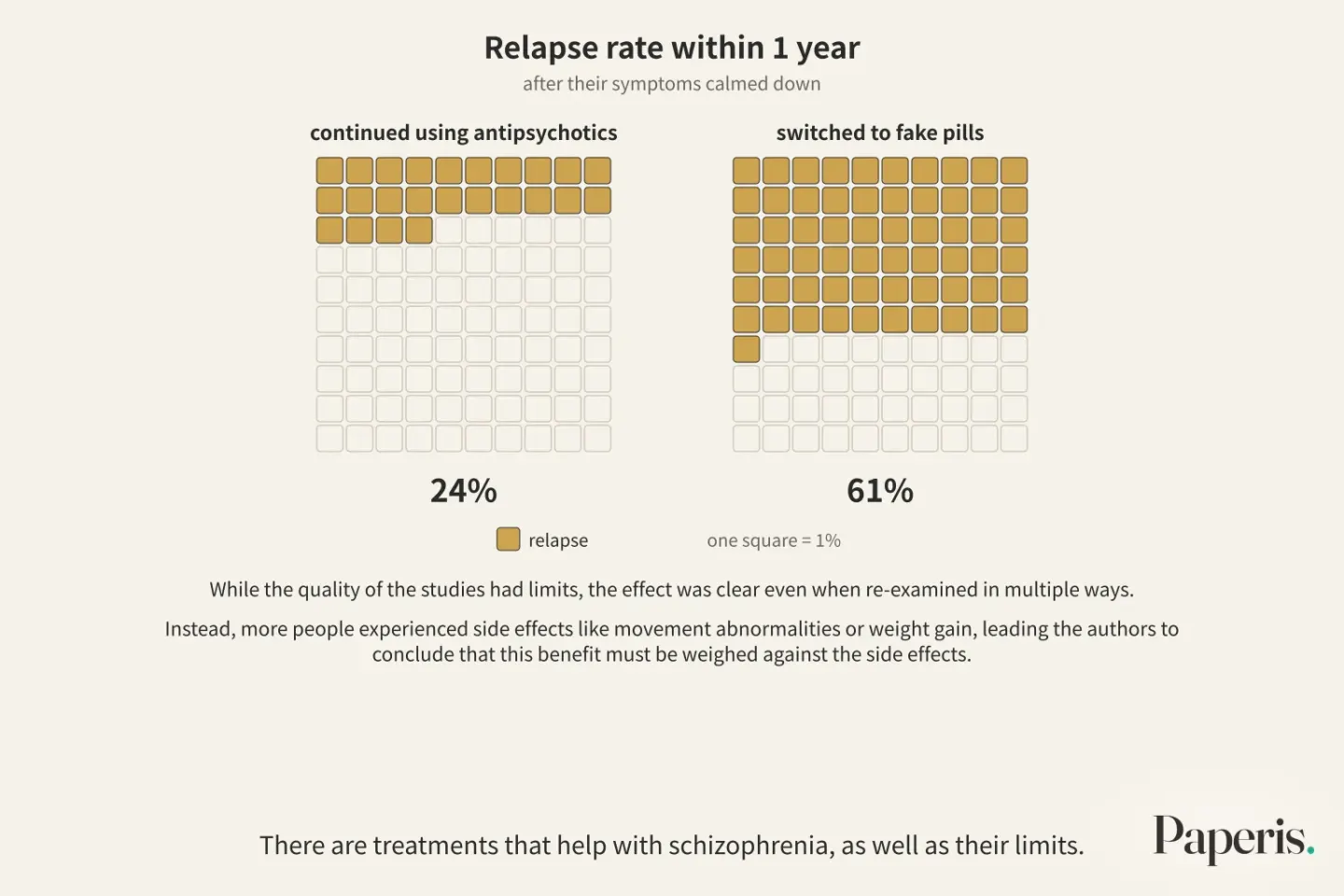
There are treatments that help with schizophrenia, as well as their limits. Those who continued using antipsychotics after their symptoms calmed down had a 24% relapse rate within 1 year, which was lower than the 61% of those switched to fake pills, and they also had fewer hospital readmissions as well as better quality of life and social functioning. Though an analysis with fewer data, the rate of reaching a symptom-calmed state was also 53%, higher than the 31% of the fake pill group. While the quality of the studies had limits, the effect was clear even when re-examined in multiple ways. Instead, more people experienced side effects like movement abnormalities or weight gain, leading the authors to conclude that this benefit must be weighed against the side effects (PMID 35556140).
Family-involved interventions also reduced 1-year relapse compared to usual treatment. Except for crisis-only interventions and short family education of two sessions or fewer, nearly all forms did so, and education alone that informed families about the disease worked better than more complex approaches. However, the certainty of the evidence ranged from moderate to very low depending on the comparison (PMID 35093198). Clinical recovery, a yardstick different from symptom calming, has been reported raggedly from 13.5% to 57% across studies, but pooling studies following 3,877 people who experienced a first episode for an average of 9.5 years put it at roughly 21%. Because there was no difference between early intervention services and other interventions, the authors viewed that new attempts to raise recovery rates are needed (PMID 36029094).
Beyond these, there are many named categories, such as obsessive-compulsive disorder and post-traumatic stress disorder after experiencing a major event (OpenStax Psychology 2e 15.2).
Box or Ruler?
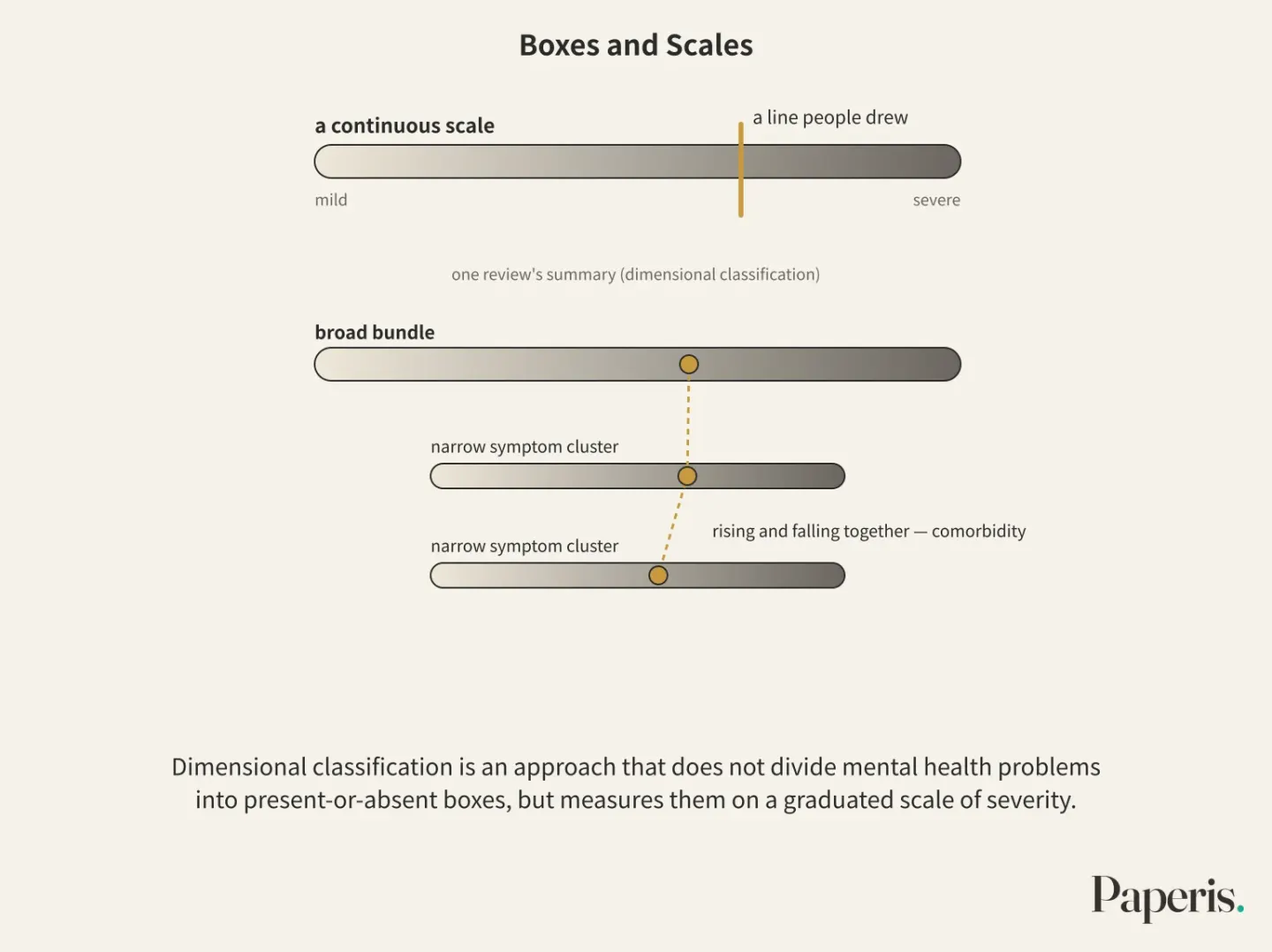
Comorbidity is having two or more disorders at the same time in one person. Depression and anxiety often arrive together in the same person, and it is estimated that over half of those with either primary diagnosis experience the other as well (OpenStax Psychology 2e 15.2).
If diagnoses overlap this frequently, we can take a fresh look at the boxes themselves. Dimensional classification is an approach that does not divide mental problems into boxes of present or absent, but measures them on a ruler of how severe they are. A review from researchers studying dimensional classification summarizes that when continuity versus discontinuity is treated as a research question rather than left to tradition, the evidence consistently supports continuity. According to this review, the rulers form hierarchies from very broad bundles down to narrow symptom clusters, and when arranged that way, the overlapping of multiple diagnoses in one person is explained by the structure of those tiers (PMID 30229571).
In terms of body temperature, a box called "having a fever" makes decisions easier, but the body moves along a ruler. The boxes still retain their utility. Psychiatric diagnostic categories are mostly groupings based on descriptive symptoms so their interiors are uneven, but they can still provide clinical usefulness, as evaluated by a review defending the medical model (PMID 33289576).
The Cause Is Not a Single Strand
If you ask "why" about a colleague's three months, the answers do not converge into one. The biopsychosocial model is a perspective that views health and functional problems as being shaped together by the body, the mind, and the social environment. Emerging in 1977, this perspective has been used as a major framework in psychiatry, but it has faced criticism for being empty both theoretically and empirically, and a 2023 review evaluates that while evidence has accumulated, the theory is still not clear enough (PMID 37681273).
Evidence that most psychological disorders have a genetic component comes from multiple strands, but many things cannot be explained by the biological side alone (OpenStax Psychology 2e 15.3). The diathesis-stress model is the idea that a illness develops only when a predisposition to get sick and the difficult events experienced in life are both present. In this model, the predisposition and the hard events fill in for each other. It posits that a weak foundation makes even a small event cause illness, while a strong foundation requires heavy events to pile up before illness occurs. The foundation is not just genetics and may also be long-standing habits of the mind (OpenStax Psychology 2e 15.3). Because this model requires both to be present, saying there is a genetic component does not mean a person's future is predetermined. What hard events do to the body and mind is followed in this series by Stress — The Load on the Scale, the Arm That Held It Too Long.
The biomedical model, which views mental illness as a brain disease and corrects chemical imbalances with medication, held sway in American healthcare for over 30 years. A 2013 review criticizing this model evaluated that while medication use increased greatly during that period, clinical innovations were rare and mental health outcomes were poor, while also noting that several evidence-backed psychological treatments were developed thanks to the adoption of drug trial methods (PMID 23664634). This evaluation looked at the currents of an era, and whether individual drugs work is measured separately by trials comparing them against placebos.
Depressed Because You Lack Serotonin?
The most famous version of the chemical imbalance story is the explanation that "depression is caused by a lack of serotonin." Neurotransmitters are chemical substances that nerve cells release to send signals to other cells, usually crossing the synapse to the cell on the other side. A synapse is the junction where one nerve cell passes a signal to the next nerve cell. Serotonin is a neurotransmitter made by nerve cells deep in the lower part of the brain and sent to various parts of the brain, and it is involved in multiple states like sleep, mood, and appetite.
An umbrella review that directly tested this explanation gathered 17 papers, including systematic reviews on serotonin in body fluids, brain imaging, experiments that deliberately reduced the building blocks of serotonin, and related genetic studies, and concluded that there is no consistent evidence that depression and serotonin go together, and no evidence to support the hypothesis that low serotonin causes depression (PMID 35854107).
The details are as follows. In the two largest and highest-quality studies (115,257 people and 43,165 people) looking at the gene for the protein that transports serotonin, neither the association between this gene and depression nor the interaction where this gene and stress together cause depression appeared. Experiments reducing the building blocks had no effect on the majority of healthy volunteers, and there was evidence of a weak effect in only 75 people who had a family history of depression. The same review noted that an analysis of blood serotonin showed lower concentrations in people who took antidepressants, providing some evidence consistent with the possibility that long-term use lowers concentrations (PMID 35854107). Whether medications reduce symptoms is a separate question measured by trials compared against a placebo.
This conclusion was promptly challenged. One rebuttal argued that the conclusions were exaggerated due to methodological weaknesses, selective reporting, oversimplification, and misinterpretation of pharmacological results, and claimed that the evidence that the serotonin system is involved in depression is clear (PMID 37322065). Another rebuttal pointed out that the original hypothesis format of "decreased serotonin activity = depression" had already been considered outdated for decades. This rebuttal views depression as a mixture of multiple subtypes and considers low serotonin to be a feature of one of those groups, while expressing concern that simplistic interpretations could undermine many patients' trust in medication (PMID 36356194). A 2025 analysis suggests viewing serotonin not as the sole cause, but as a modulating factor that can operate in vulnerable individuals (PMID 40982824).
The simple formula that "if you lack serotonin, you become depressed" is not supported by evidence, and even among the dissenting voices, its original form is seen as already outdated. The territory where debate remains is how much and in whom serotonin is involved in depression.
Treatment Through Talk
Psychotherapy is treatment that helps people solve the problems they face through psychological methods such as conversation and practice. Alongside treatments using drugs or medical procedures, it forms one of the two branches of treatment (OpenStax Psychology 2e 16.2).
Cognitive behavioral therapy is a psychotherapy that examines how thoughts and behavioral habits lead emotions, practicing the change of those thoughts and habits. It focuses on current problems rather than past events (OpenStax Psychology 2e 16.2). This is also the most studied psychotherapy for depression (PMID 23870719).
Effects are measured by comparison with sham treatments. Placebos are fake pills that look identical on the outside but contain no active ingredients, given to the control group. In psychotherapy trials, fake pills or mock counseling minus the core of treatment take that place. When 41 studies randomly dividing 2,843 people with anxiety disorders and related conditions into cognitive behavioral therapy and placebo conditions were pooled, cognitive behavioral therapy reduced target symptoms by a medium amount and the likelihood of responding to treatment was also higher (PMID 29451967).
The effect was large in obsessive-compulsive, generalized anxiety, and acute stress, small to medium in post-traumatic, social anxiety, and panic, and in the post-traumatic stress study, the drop-out rate was also higher on the cognitive behavioral therapy side (29.0% vs. 17.2%). The authors concluded it is an anxiety treatment moderately more effective than a placebo, while adding that more effective treatments are especially needed for these three conditions (PMID 29451967).
For depression, pooling 75 studies compared with control groups yielded an effect where treating 2.6 people with cognitive behavioral therapy makes one more person improve. However, there was clear evidence that only studies with positive results were published, and correcting for this made the effect smaller; the higher the quality of the study, the smaller the effect. Evidence showing it is better or worse than other psychotherapies or drugs did not emerge. The authors' conclusion was that while there is no doubt cognitive behavioral therapy is effective, its effects may have been overestimated until now (PMID 23870719).
How long the effects last is less clear. In anxiety-related conditions, better results than the control group continued up to 1 year after treatment ended. Effects confirmed beyond 1 year were generalized anxiety, social anxiety, and post-traumatic stress, it was unclear in panic, and obsessive-compulsive disorder and specific phobias were nearly impossible to know because almost no studies followed them that long. Most of these 69 trials were of low quality, and relapse rates were reported by only 6 trials, ranging from 0 to 14% at 3 to 12 months in those trials (PMID 31758858).
Who conducted the research also sways the results. An analysis pooling 36 studies of cognitive behavioral therapy for obsessive-compulsive disorder obtained a large effect overall, and the effect was large compared with mock counseling, but it was not better than other active psychotherapies. In an additional analysis, three-quarters of the studies were suspected of having researchers taking the side of that treatment, and no effect appeared in 8 studies free from such suspicion (PMID 33618297).
Medical Treatment
Medical treatment is treatment that reduces symptoms using drugs acting on the brain's chemical signals. How well drugs work for depression is shown by a large bundle of trials. In an analysis gathering 522 randomized trials involving 116,477 adults with major depressive disorder, all 21 antidepressants compared had more people respond than the placebo in short-term treatment. The size of that difference varied by drug, and the certainty of the evidence was between moderate and very low. How easy they were to tolerate also varied by drug, with only two drugs having fewer people drop out for any reason than the placebo, and one having more people drop out than the placebo (PMID 29477251). These trials compared the proportion of people who responded. Contained within the result that they are better than a placebo is also the fact that there are people who did not respond even after taking the drugs.
Some drugs have concerning side effects. And because the fact that a drug works does not mean the illness disappears, psychiatric drugs help people get through day to day but do not cure the illness, and the duration of use also varies from a short time to a long time depending on the person (OpenStax Psychology 2e 16.2). In terms of body temperature, lowering a fever and making the cause go away are different things. However, as with the schizophrenia seen earlier, in some illnesses, continuing to take drugs prevents the fever from rising again.
Drugs and talking treatment are sometimes used together. For depression, combining cognitive behavioral therapy and drugs was better than using drugs alone (PMID 23870719), and especially for depression and anxiety, research shows that the effect is greatest when the two are used together (OpenStax Psychology 2e 16.2).
Both talking treatment and drugs have had their effectiveness confirmed in trials compared with fake treatments, but the size varies by disorder and treatment, and there are people who do not respond even after taking drugs. Both "drugs cure everything" and "treatment is useless" are summaries that leave behind only one side of this evidence.
The Wall Before Help, Stigma
Stigma is a negative tag attached to a person with certain conditions and the distancing that follows, applied by others or by oneself. Movies and news have drawn mental illness as dangerous, close to crime, and unpredictable, in overwhelmingly dramatic and twisted ways. These pictures harm the individual's self-esteem, help-seeking, sticking to medication, and recovery (PMID 16478286).
The vast majority of people experiencing severe mental illness do not commit violence (PMID 24861430). The rate of committing violent crimes over 5 to 10 years was below 5% for most diagnoses, 6 to 10% for some diagnoses, and exceeded 10% in substance abuse. Even after adjusting for other causes, the relative risk was 2 to 4 times higher for most diagnoses, and what strongly predicted future violence across multiple diagnoses was a past history of crime, along with substance abuse co-occurring with other diagnoses (PMID 33096045).
Stigma also blocks the path to seeking help. In a systematic review gathering 90,189 people across 144 studies, stigma had a small to medium negative effect on help-seeking and was ranked fourth most frequently among barriers stopping help. Within that, worry about others finding out was most common, and racial and ethnic minorities, adolescents, men, soldiers, and healthcare workers hesitated particularly more because of stigma (PMID 24569086).
Whose gaze is more of a stumbling block was also measured. In 27 studies covering the general population, one's own negative attitudes toward help-seeking and one's own attitudes looking down on people with mental illness were related to actually seeking less help. The feeling that society would look down on oneself was not related, and the relation of stigma stamped onto oneself was not statistically clear. The authors concluded that campaigns fighting stigma should target these individual attitudes rather than broad public opinion (PMID 28153928). However, another review reported that the mindset of anticipating discrimination from others is also related to lower readiness to seek help, while noting that whether such intent leads to actual behavior is harder to predict, so which gaze is heavier remains divided (PMID 18444456).
Among children and adolescents, walls such as lack of knowledge, the gaze of those around them and shame, trust in strangers, and cost were cited together (PMID 31965309). A 2008 review summarized that at the center of the mind trying to seek help is the belief that "asking for help actually makes one better," and that knowledge about mental illness is as important as reducing stigma. In the 10 years up to that point, public attitudes toward help-seeking had improved (PMID 18444456).
A disease name does not tell everything about a person (OpenStax Psychology 2e 15.2). If you are in crisis right now, you can seek help rather than endure it alone.
Measuring against Several Months of a Person
We return to our first colleague. We can apply the questions of this primer to him, as he finds it hard to leave the house every morning for three months.
First is the line. If that state causes great suffering and makes work difficult, it touches one condition of definition. But whether it is a reaction anyone might show in light of what was experienced, or whether some operation of the mind has malfunctioned so that a name will or will not be attached, is for a professional to assess. When asked about the cause, the current picture looks at the background and the experienced events together.
The last is the distance until he first spoke up. Among stigmas, the most common wall was the worry that others would find out, and in one analysis looking at the general population, how people view seeking help themselves was tied to actually seeking help.
The lines on the scale were drawn by people, but the suffering beyond the lines is real, and the ways to reduce that suffering are real too.
Where to Look Further
How emotions are handled is covered in Emotion and Motivation — A Dashboard of Swinging Needles, and the Eye That Reads Them, and the habit of judging individuals by their group alone is covered in The Social Mind — A Rope Pulled from Both Ends, the Hands We Don't See. The issue of publication bias leads into Psychology's Replication Crisis — Why the Findings We Believed In Wobbled, and the problem of how "normality" differs across cultures connects to Who Was Being Measured — Who "People" Meant When Psychology Said It. Neurons and the brain are followed by The Map of the Brain — Neighborhoods with Their Own Jobs, a City Joined by Roads.
Stress — The Load on the Scale, the Arm That Held It Too Long looks at the responses that hard experiences leave on the body and mind, Personality — Today's Weather, the Climate Seen over Years looks at the ways of thinking and behaving that differ from person to person, and Development — The First Paths in Soft Ground, and the New Ones We Keep Making looks at the mind as it changes while growing up.
Source Papers
- "Psychology 2e — 15.1 What Are Psychological Disorders?" (2020) — OpenStax Psychology 2e 15.1 — The American Psychiatric Association definition; rarity or cultural violation alone is not enough; harmful dysfunction; excluding culturally expected responses; no universal standard; not a disease one chooses to have.
- "Psychology 2e — 15.2 Diagnosing and Classifying Psychological Disorders" (2020) — OpenStax Psychology 2e 15.2 — The usefulness of diagnosis; current DSM editions and the International Classification of Diseases; comorbidity; criticisms regarding the removal of homosexuality, the increasing number of diagnostic names, and the bereavement exclusion; diagnostic labels cannot tell the whole story of a person.
- "Psychology 2e — 15.3 Perspectives on Psychological Disorders" (2020) — OpenStax Psychology 2e 15.3 — Genetic factors, psychosocial factors, and the vulnerability-stress model (both are required, inversely related, and psychological vulnerability).
- "Psychology 2e — 15.4 Anxiety Disorders" (2020) — OpenStax Psychology 2e 15.4 — The usefulness of normal anxiety; anxiety that is excessive relative to the threat, lasts too long, and disrupts daily life.
- "Psychology 2e — 15.7 Depressive, Bipolar, and Related Disorders" (2020) — OpenStax Psychology 2e 15.7 — Defining the nature of major depressive disorder and considering multiple symptoms and duration together in diagnosis; mania required for the diagnosis of bipolar disorder.
- "Psychology 2e — 15.8 Schizophrenia" (2020) — OpenStax Psychology 2e 15.8 — The impairment domains of schizophrenia; a lifetime prevalence of roughly 1%; diagnosis in early adulthood; different from multiple personality disorder.
- "Psychology 2e — 16.2 Types of Treatment" (2020) — OpenStax Psychology 2e 16.2 — Psychotherapy and biomedical treatments; the focus of cognitive behavioral therapy; psychiatric medication side effects, lack of a cure, duration, and combination treatment.
- "Global Burden of Disease and the Impact of Mental and Addictive Disorders." (2019) — PMID 30729322 — Over 1 billion people in 2016; 7% of DALYs and 19% of YLDs; depression is the leading cause; stigma and a lack of treatment are part of the reason for the rising proportion.
- "What is a mental disorder? An exemplar-focused approach." (2021) — PMID 33843505 — Borderline cases of harm and dysfunction; lack of specific criteria and practical judgment; proposals to reflect evidence on indicator refinement, validity, and utility.
- "The medical model and its application in mental health." (2021) — PMID 33289576 — The disease concept cannot avoid value judgments even in general medicine; diagnostic categories are heterogeneous yet clinically useful.
- "The importance of developmental field trials in the revision of psychiatric classifications." (2016) — PMID 27133547 — DSM-III and ICD-10 reliability field trials; DSM-5 established reliability for only 23 disorders, with no information on reasons for disagreement.
- "Definition and description of schizophrenia in the DSM-5." (2013) — PMID 23800613 — Changes in definitions and boundaries; causes and pathophysiology still unexplained; DSM-IV schizophrenia provided reliably diagnosed and useful information.
- "Progress in achieving quantitative classification of psychopathology." (2018) — PMID 30229571 — Psychopathology is largely dimensional rather than categorical (synthesized by the HiTOP consortium); a hierarchical structure resolves comorbidity issues.
- "A revitalized biopsychosocial model: core theory, research paradigms, and clinical implications." (2023) — PMID 37681273 — Proposed in 1977; criticized as empty; evidence has accumulated, but theory is less clear; psychotherapy and social epidemiology are representative sources of evidence.
- "The biomedical model of mental disorder: a critical analysis of its validity, utility, and effects on psychotherapy research." (2013) — PMID 23664634 — The biomedical model has dominated for over 30 years; despite increased medication use, there is a lack of innovation and poor outcomes (author evaluation); drug trial methods gave rise to evidence-based psychotherapy.
- "The serotonin theory of depression: a systematic umbrella review of the evidence." (2023) — PMID 35854107 — 17 studies; no consistent evidence of an association between serotonin and depression; no support for the lowering-as-cause hypothesis; some evidence aligns with long-term antidepressant use potentially lowering concentrations.
- "A leaky umbrella has little value: evidence clearly indicates the serotonin system is implicated in depression." (2023) — PMID 37322065 — A counterargument that conclusions were exaggerated due to methodological weaknesses, selective reporting, oversimplification, and misinterpretation.
- "Serotonin and depression - a riposte to Moncrieff et al. (2022)." (2022) — PMID 36356194 — The foundational hypothesis has been outdated for decades; depression is heterogeneous; serotonin reduction is a feature of a subgroup; concerns that public trust in medication may be undermined.
- "THE MYTH OF SEROTONIN THEORY OF DEPRESSION: AN ANALYSIS OF UMBRELLA REVIEW METHODOLOGIES AND CLINICAL IMPLICATIONS." (2025) — PMID 40982824 — Criticisms of umbrella review methodological limitations; a proposal to view serotonin as a potential moderating factor in vulnerable groups.
- "Cognitive behavioral therapy for anxiety and related disorders: A meta-analysis of randomized placebo-controlled trials." (2018) — PMID 29451967 — 41 studies with 2,843 participants; a moderate effect compared to placebo (g=0.56) and a response odds ratio of 2.97; differences by disorder; PTSD dropout rate of 29.0% versus 17.2%; exposure-focused differences not significant; better treatments needed for PTSD, SAD, and PD.
- "A meta-analysis of cognitive-behavioural therapy for adult depression, alone and in comparison with other treatments." (2013) — PMID 23870719 — g=0.71 and NNT 2.6 compared to control groups; adjusted for publication bias to 0.53; high-quality studies show smaller effects; no difference from other treatments; combination treatment is better than medication alone; potential for overestimation.
- "Long-term Outcomes of Cognitive Behavioral Therapy for Anxiety-Related Disorders: A Systematic Review and Meta-analysis." (2020) — PMID 31758858 — 69 trials, mostly of low quality; maintained up to 12 months; durations beyond 12 months available only for GAD, SAD, and PTSD; recurrence rates of 0–14% (6 trials).
- "Cognitive behavioural therapy with exposure and response prevention in the treatment of obsessive-compulsive disorder: A systematic review and meta-analysis of randomised controlled trials." (2021) — PMID 33618297 — Large overall effect across 36 studies; investigator allegiance suspected in three-quarters; no effect in the 8 studies without allegiance.
- "Comparative efficacy and acceptability of 21 antidepressant drugs for the acute treatment of adults with major depressive disorder: a systematic review and network meta-analysis." (2018) — PMID 29477251 — 522 trials with 116,477 participants; all 21 antidepressants were more effective than placebo; differences between drugs; certainty of evidence ranged from moderate to very low; differences in discontinuation rates.
- "Media portrayal of mental illness and its treatments: what effect does it have on people with mental illness?" (2006) — PMID 16478286 — Media images of danger, crime, and unpredictability hinder self-esteem, help-seeking, medication adherence, and recovery.
- "Violence and mental disorders: a structured review of associations by individual diagnoses, risk factors, and risk assessment." (2021) — PMID 33096045 — Relative risk 2 to 4 times higher; 5- to 10-year absolute rates mostly under 5%, 6–10% for some diagnoses, and over 10% for substance abuse; past criminal history and substance abuse are strong predictors.
- "Mental illness and reduction of gun violence and suicide: bringing epidemiologic research to policy." (2015) — PMID 24861430 — The vast majority of people with severe mental illness are not violent.
- "What is the impact of mental health-related stigma on help-seeking? A systematic review of quantitative and qualitative studies." (2015) — PMID 24569086 — 144 studies with 90,189 participants; d=−0.27; 4th highest barrier; disclosure worries; particularly affected groups.
- "Association between mental health-related stigma and active help-seeking: systematic review and meta-analysis." (2017) — PMID 28153928 — 27 studies; personal attitudes are relevant, self-stigma is nonsignificant, and perceived public stigma is unrelated; interventions must target individual attitudes.
- "Why do children and adolescents (not) seek and access professional help for their mental health problems? A systematic review of quantitative and qualitative studies." (2021) — PMID 31965309 — Common yet undertreated; barriers at personal, social, relational, and structural levels.
- "Stigma and its impact on help-seeking for mental disorders: what do we know?" (2008) — PMID 18444456 — Belief in treatment efficacy is key, as is knowledge; improving public attitudes.
- "Maintenance Treatment With Antipsychotic Drugs in Schizophrenia: A Cochrane Systematic Review and Meta-analysis." (2022) — PMID 35556140 — 75 RCTs with 9,145 participants; robust despite quality limitations; 1-year relapse rates 24% vs. 61%, rehospitalization rates 7% vs. 18%, remission rates 53% vs. 31%; quality of life and functional benefits; increased movement abnormalities and weight gain; must be weighed against side effects.
- "Family interventions for relapse prevention in schizophrenia: a systematic review and network meta-analysis." (2022) — PMID 35093198 — 90 RCTs with 10,340 participants; compared to usual care, crisis intervention and brief education (2 sessions or fewer) excepted, nearly all family interventions reduced 12-month relapse; family psychoeducation alone was best; certainty ranged from moderate to very low.
- "Clinical Recovery Among Individuals With A First-Episode Schizophrenia An Updated Systematic Review And Meta-Analysis." (2023) — PMID 36029094 — Previous reports ranged from 13.5% to 57%; 26 samples with 3,877 participants over an average of 9.5 years; clinical recovery was roughly 21%; no difference from early intervention; new approaches are needed.
- "Mood stabilizers and/or antipsychotics for bipolar disorder in the maintenance phase: a systematic review and network meta-analysis of randomized controlled trials." (2021) — PMID 33177610 — 41 RCTs with 9,821 participants; most treatments reduced relapse compared to placebo; efficacy, tolerability, and safety varied across treatments.
Sources (35)
- Psychology 2e — 15.1 What Are Psychological Disorders?
- Psychology 2e — 15.2 Diagnosing and Classifying Psychological Disorders
- Psychology 2e — 15.3 Perspectives on Psychological Disorders
- Psychology 2e — 15.4 Anxiety Disorders
- Psychology 2e — 15.7 Depressive, Bipolar, and Related Disorders
- Psychology 2e — 15.8 Schizophrenia
- Psychology 2e — 16.2 Types of Treatment
- Global Burden of Disease and the Impact of Mental and Addictive DisordersPMID 30729322
- What is a mental disorder? An exemplar-focused approachPMID 33843505
- The medical model and its application in mental healthPMID 33289576
- The importance of developmental field trials in the revision of psychiatric classificationsPMID 27133547
- Definition and description of schizophrenia in the DSM-5PMID 23800613
- Progress in achieving quantitative classification of psychopathologyPMID 30229571
- A revitalized biopsychosocial model: core theory, research paradigms, and clinical implicationsPMID 37681273
- The biomedical model of mental disorder: a critical analysis of its validity, utility, and effects on psychotherapy researchPMID 23664634
- The serotonin theory of depression: a systematic umbrella review of the evidencePMID 35854107
- A leaky umbrella has little value: evidence clearly indicates the serotonin system is implicated in depressionPMID 37322065
- Serotonin and depression - a riposte to Moncrieff et al. (2022)PMID 36356194
- THE MYTH OF SEROTONIN THEORY OF DEPRESSION: AN ANALYSIS OF UMBRELLA REVIEW METHODOLOGIES AND CLINICAL IMPLICATIONSPMID 40982824
- Cognitive behavioral therapy for anxiety and related disorders: A meta-analysis of randomized placebo-controlled trialsPMID 29451967
- A meta-analysis of cognitive-behavioural therapy for adult depression, alone and in comparison with other treatmentsPMID 23870719
- Long-term Outcomes of Cognitive Behavioral Therapy for Anxiety-Related Disorders: A Systematic Review and Meta-analysisPMID 31758858
- Cognitive behavioural therapy with exposure and response prevention in the treatment of obsessive-compulsive disorder: A systematic review and meta-analysis of randomised controlled trialsPMID 33618297
- Comparative efficacy and acceptability of 21 antidepressant drugs for the acute treatment of adults with major depressive disorder: a systematic review and network meta-analysisPMID 29477251
- Media portrayal of mental illness and its treatments: what effect does it have on people with mental illness?PMID 16478286
- Violence and mental disorders: a structured review of associations by individual diagnoses, risk factors, and risk assessmentPMID 33096045
- Mental illness and reduction of gun violence and suicide: bringing epidemiologic research to policyPMID 24861430
- What is the impact of mental health-related stigma on help-seeking? A systematic review of quantitative and qualitative studiesPMID 24569086
- Association between mental health-related stigma and active help-seeking: systematic review and meta-analysisPMID 28153928
- Why do children and adolescents (not) seek and access professional help for their mental health problems? A systematic review of quantitative and qualitative studiesPMID 31965309
- Stigma and its impact on help-seeking for mental disorders: what do we know?PMID 18444456
- Maintenance Treatment With Antipsychotic Drugs in Schizophrenia: A Cochrane Systematic Review and Meta-analysisPMID 35556140
- Family interventions for relapse prevention in schizophrenia: a systematic review and network meta-analysisPMID 35093198
- Clinical Recovery Among Individuals With a First-Episode Schizophrenia an Updated Systematic Review and Meta-AnalysisPMID 36029094
- Mood stabilizers and/or antipsychotics for bipolar disorder in the maintenance phase: a systematic review and network meta-analysis of randomized controlled trialsPMID 33177610