
Paperis Articles
Personality — Today's Weather, the Climate Seen over Years
We follow the tendencies that emerge over time even when people look different from one situation to the next, the five dials, what the genetic share really means, change across the lifespan, how to judge a test, blood types, the MBTI, and the Barnum effect.
Your field's papers, as audio
Pick your fields and journals — Paperis summarizes the key papers and turns them into audio. Listen on your commute.
Start Paperis free →Personality — Today's Weather, the Climate Seen over Years
The Person in the Meeting Room, The Person at the Dinner Table
A colleague in the next team barely speaks at Monday meetings. Yet at Friday evening gatherings, they are the first to propose a toast and stay until the very end keeping the conversation going. Is this person quiet, or lively?
Look at just a single day, and the answer wavers. Work together for several years, and the story changes. Being quiet in meetings yet the first to strike up a conversation in a comfortable setting becomes familiar as the way they are.
Thinking of weather and climate helps catch this difference. Weather is the sky of today alone, so morning and evening differ, and yesterday and today differ. Climate is the average after watching the sky of that land for many years. Even a land with frequent rain has clear days, yet the climate of that land remains. This picture is used only up to dividing one person's day and the tendency that person shows for a long time. Latitude and oceans determine climate, but as we will see below, what one is born with and the environment one has lived through together make a person's tendencies.
A Name Given to a Long-Observed Average
The image of a colleague that remains after watching them for several years has a name. Personality is a person's characteristic way of thinking, feeling, and behaving that persists over time. In terms of weather and climate, it is the climate side, and the fact that it is unique to each person sits right at the center of this definition (OpenStax Psychology 2e 11.1).
How, then, do we measure this climate? The framework most widely used in personality psychology today is a five-dial model measured by traits (OpenStax Psychology 2e 11.7). A trait is a person's tendency to behave and feel in ways that are relatively consistent across various times and settings. In this approach, everyone possesses the same traits, and what differs from person to person is the degree (OpenStax Psychology 2e 11.7). Just as we record a climate using multiple dials like temperature, rain, and wind instead of just saying "hot," we record personality using values on multiple dials.
That these things could be measured was not obvious from the beginning. The first theory that tried to explain personality as a whole was Freud's (OpenStax Psychology 2e 11.1). Defense mechanisms coming from that tradition—the workings of the mind that happen automatically outside of consciousness to ease stress—were considered an important dimension of personality, and clinicians outside of psychoanalysis also paid attention to them. However, a 2005 review noted that tools for measuring them do not do so consistently or capture what they intend to measure, leaving research examining the relationship between defense mechanisms and mental health through empirical evidence still limited (PMID 16231612).
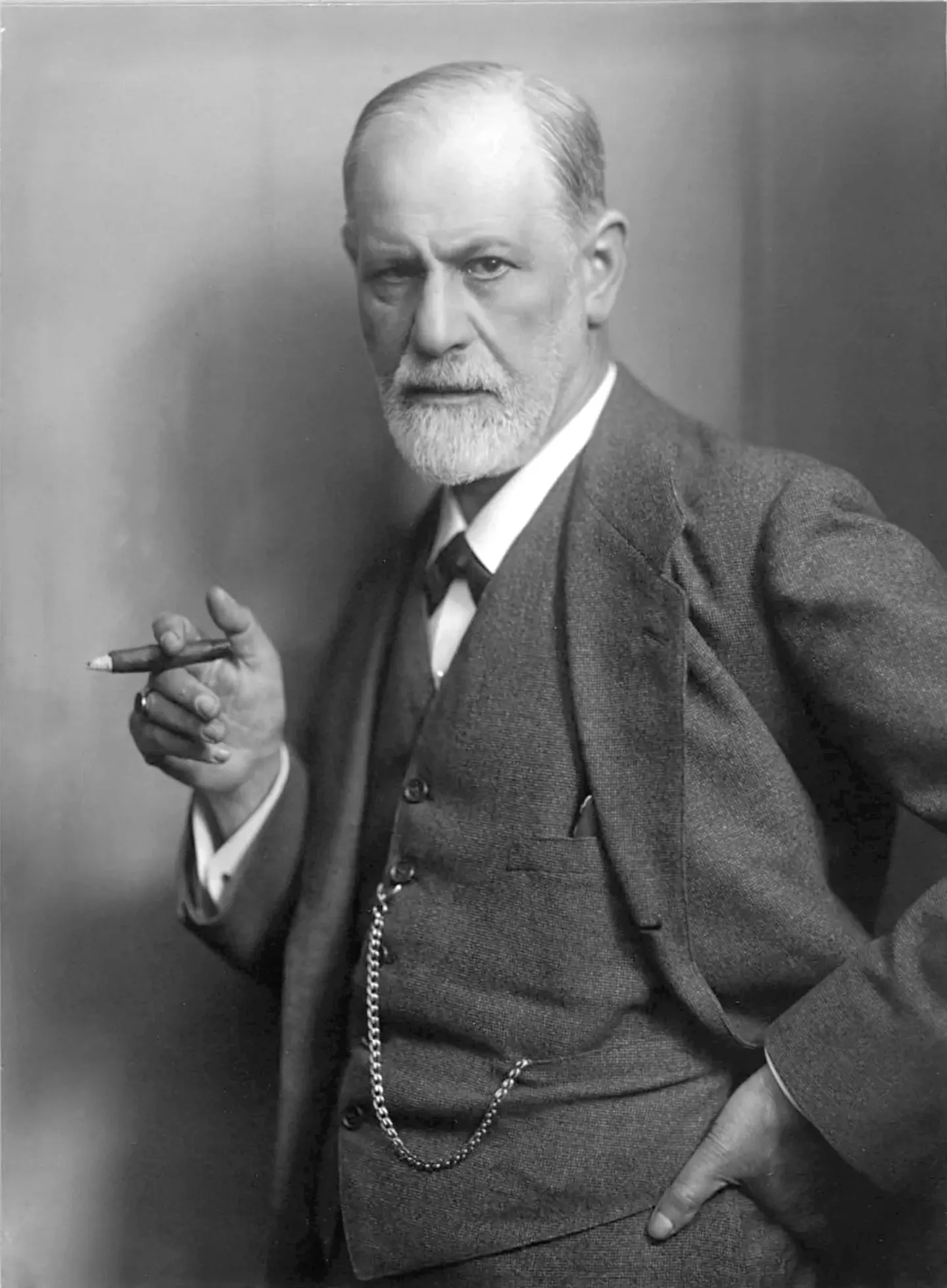
Sigmund Freud · Max Halberstadt, c. 1921 · Wikimedia Commons (public domain)
Five Dials
A climate table records a land with a few numbers like average temperature, precipitation, and wind. Personality research also uses a fixed set of a few dials. The Five-Factor Model is a framework that measures personality by dividing it into five broad dimensions. Whether asked through adjectives or theory-based questionnaires, similar five dimensions emerged, and whether answered by oneself or evaluated by people around, the same framework was used across multiple cultures. A review introducing this framework suggested that the five factors would also be useful for evaluating an individual (PMID 1635039).
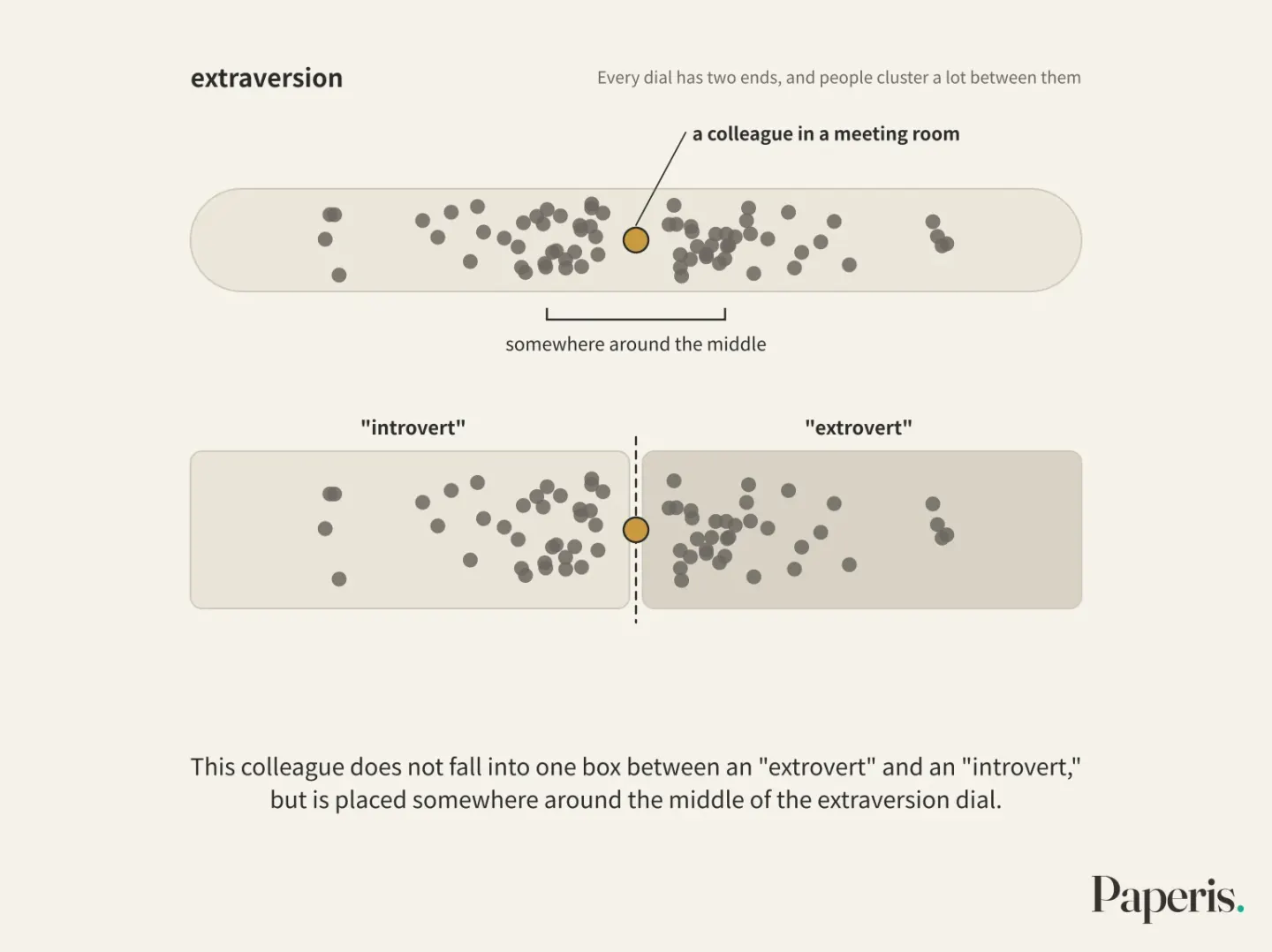
The dial that first catches a colleague in a meeting room is extraversion. Extraversion is the tendency to enjoy mingling with people. This colleague does not fall into one box between an "extrovert" and an "introvert," but is placed somewhere around the middle of the extraversion dial. Every dial has two ends, and people cluster a lot between them (OpenStax Psychology 2e 11.7).
The remaining four dials also look at just the core of each one. Agreeableness is the tendency to cooperate well with others. Conscientiousness is the tendency to discipline oneself and take action.
Neuroticism is the tendency to experience negative emotions easily. Openness is the tendency to have curiosity for new thoughts and experiences.
Must there be exactly five dials? There is an argument that the HEXACO model, reorganized into six dimensions including honesty-humility, has repeatedly emerged in various cultures and captures personality variables that the Five-Factor Model does not capture well (PMID 18453460). How many dials to divide into is still being refined today.
Weather or Climate — The Old Debate
A colleague in the conference room is quiet in every meeting, but lively in every casual gathering. If you cross over into different settings their behavior changes, but when you look at similar settings side by side, they look much more alike. The consistency that personality researchers actually found looked just like this (OpenStax Psychology 2e 11.4).
Then why did it become such a long-running dispute? Personality psychology once faced a challenge to the very idea that traits consistently reveal themselves across situations. When Walter Mischel, a psychologist who taught at Stanford, looked at decades of research, the data did not support that idea (OpenStax Psychology 2e 11.4). The person-situation debate is a decades-long controversy in personality psychology over whether what determines behavior is a person's consistent traits or the situation at hand.
Now this fight has mostly subsided, and most psychologists look at both the situation and the person when explaining behavior (OpenStax Psychology 2e 11.4; OpenStax Psychology 2e 12.1). People interpret the same setting differently, and move according to that interpretation (OpenStax Psychology 2e 11.4). To that colleague, a meeting might read as a place to hold back words, and a Friday gathering as a place to let their guard down.
Modern research also measures the daily weather separately. When you record moment-to-moment feelings, thoughts, and behaviors multiple times, that average overlaps with traits while also having distinctly different parts. There are also large differences between people in the way their momentary state changes depending on the nature of the situation (PMID 40700981). Evidence is beginning to emerge that those day-to-day fluctuations lead to changes in traits over the long term, but it is still at the early evidence stage (PMID 40700981).
Conversely, when looking at others, it is easy to mistake weather for climate. As we saw in "The Social Mind — A Rope Pulled from Both Ends, the Hands We Don't See", the fundamental attribution error is the tendency to overestimate internal causes like a person's personality and underestimate the power of the situation when explaining someone else's behavior. Personality exists and situations exist, and behavior comes from the place where the two meet.
What Climate Tables Tell Us, and What They Don't
Climate tables for an unfamiliar city are useful when packing your bags. Personality traits grouped into the Big Five go together with various life outcomes—such as happiness, physical and mental health, relationships with friends, family, and romantic partners, and career choice and job satisfaction and performance—and even predict later outcomes (PMID 16318601).
School grades are one example. The samples gathered varied by analysis, with the largest exceeding 70,000 people, and conscientiousness, agreeableness, and openness went together with academic performance. The link between conscientiousness and grades largely moved independently of intelligence, and the magnitude of the link varied depending on school level and age (PMID 19254083). Because this result measured a relationship where things go together, it is not the same as the experimental conclusion that changing conscientiousness raises grades.
Just as a climate table does not tell you tomorrow's weather, the Big Five have limitations. One criticism points out that this framework has weak power for predicting any single specific action, fails to explain the causes of behavior, and misses experiences that change depending on situations and conditions. That critique called the Big Five "the psychology of the stranger." This meant it gives information you need to know when you know nothing about that person, and the same criticism acknowledged the Big Five as one of the important models in personality research while concluding that it is not an all-encompassing model (PMID 1635046). The Big Five is an important framework that broadly sketches differences between people, but it is weak at hitting the target of a specific person's concrete behavior.
Where Does Disposition Come From — Heredity and Environment
Where did your colleague's tendencies in the conference room come from? Did they take after their parents, or was it the environment they grew up in? Heritability is the share of the differences among people within a population that is explained by genetic differences. One way to gauge this share is by comparing twins. Identical twins share the same genes, while fraternal twins share only as much similarity as ordinary siblings. In a Minnesota study that followed 350 pairs of twins from 1979 to 1999, identical twins were remarkably similar in personality whether they were raised together or apart (OpenStax Psychology 2e 11.6).
When you gather many studies rather than just one, the numbers emerge. In an analysis pooling 62 independent estimates measuring the heritability of personality, covering over 100,000 men and women of all ages, the average was 0.40, leading the authors to interpret that 40 percent of individual differences in personality come from genetics and 60 percent from the environment. The value differed depending on how it was measured, coming out to 0.47 in twin studies and 0.22 in family and adoption studies (PMID 25961374).
This 40 percent does not mean that 40 percent of any one person's personality comes from their genes. It is a value obtained by dividing up the degree to which people in that group differ from one another. Nor is it a structure where a single gene determines a single personality trait. Many genes are involved together, and other factors regulate whether those genes are actually used (OpenStax Psychology 2e 11.6).
The inborn share shows up very early. Temperament is an inborn tendency, observable from infancy, that influences how one thinks, acts, and responds to surroundings. Because it appears early in life, many psychologists view temperament as having a biological basis. Among the aspects that connect temperament to adult personality are how one responds to novel or overwhelming stimuli and how well one regulates those responses. However, how a child's personality eventually manifests can vary depending on the environment they experience as they grow and on their maturation (OpenStax Psychology 2e 11.6). When measured again over time, the dimensions of temperament were less stable than adult personality traits (PMID 10668348).
The Climate Changes Too — Lifelong Change
Against the idea that personality hardens in childhood, the behaviorist Skinner viewed personality as developing across the entire lifespan (OpenStax Psychology 2e 11.4). Today's long-term tracking data also point to personality changing the way the climate changes over decades. We divide the way it changes into two. One is how well the relative rank of who is higher and who is lower within the same group is maintained, and the other is which direction the group's overall average moves.
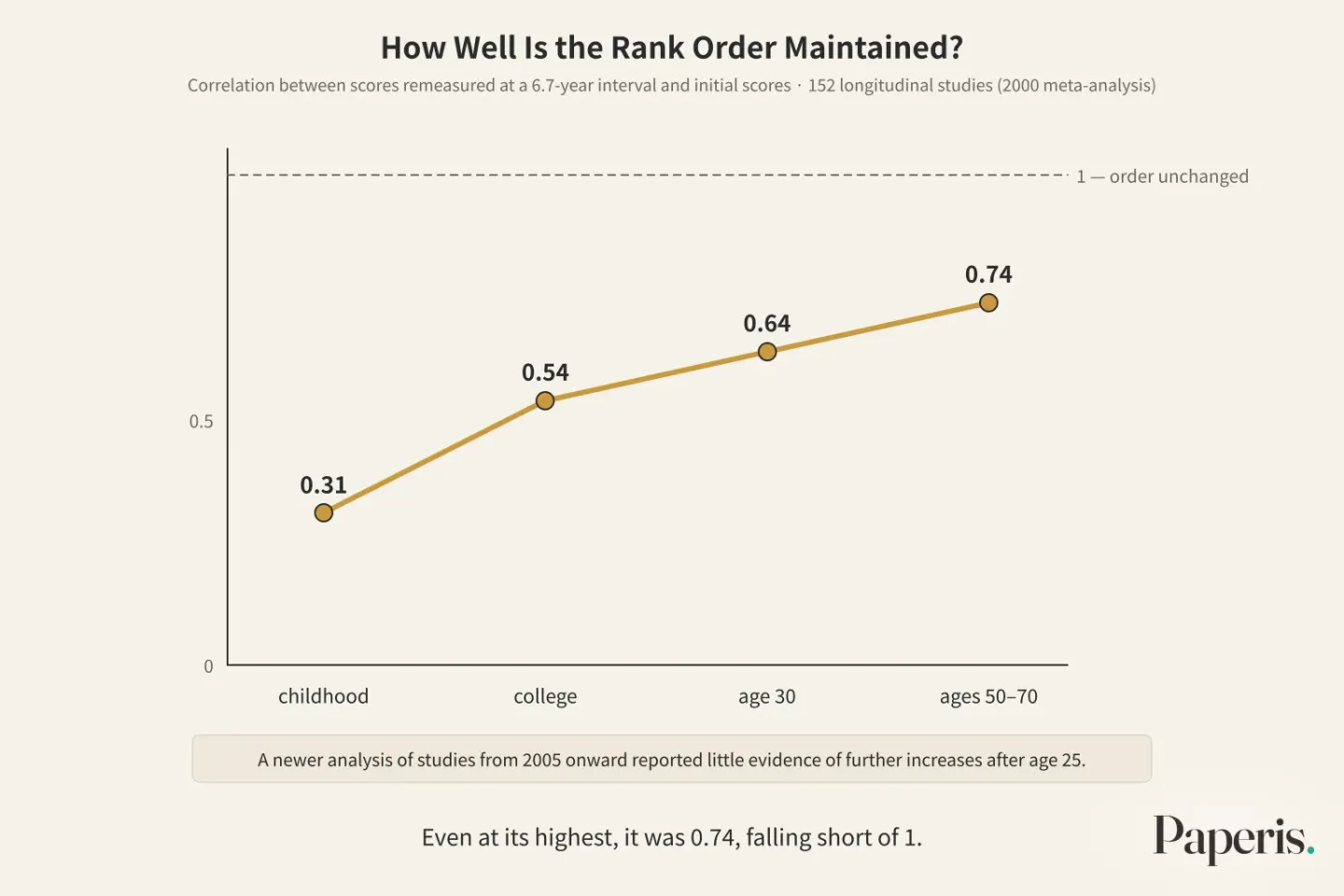
Let us look at rank first. Collecting 152 long-term tracking studies and calculating how closely the scores of the same people measured again at an interval of 6.7 years matched their initial scores, the correlation rose from 0.31 in childhood to 0.54 in college age, and 0.64 at age 30, before leveling off near 0.74 between the ages of 50 and 70. Even at its highest, it was 0.74, not reaching 1 (PMID 10668348). A newer analysis gathering studies published since 2005 agreed with previous meta-analyses up to the point where the rank becomes increasingly stable during childhood and flattens out in young adulthood, but reported that, unlike earlier results, there is little evidence of a further rise after age 25 (PMID 35834197). The two analyses differ on when the rank stops becoming more stable.
The average generally moves toward the more mature side (PMID 35834197). The opposite end of neuroticism is also called emotional stability (OpenStax Psychology 2e 11.7), and in an analysis pooling 92 samples, people's conscientiousness, emotional stability, and the social dominance aspect of extraversion particularly increased between the ages of 20 and 40. Among extraversion, the sociability aspect and openness increased in adolescence and decreased in old age, while agreeableness changed only in old age. Four of the six categories changed even in middle and old age (PMID 16435954). In a new analysis, the magnitude of cumulative change across the lifespan was slightly smaller than previous estimates, but emotional stability increased more steadily and largely than seen before (PMID 35834197). A review examining six longitudinal studies reported that neuroticism rises again after age 80 (PMID 17025010).
Why this change happens remains unsettled. The researchers who portrayed personality as not changing in the aforementioned 92-sample analysis replied that they, too, had always acknowledged change, and that this result fits their conclusion that change after age 30 is not large. They placed weight on environments common to all cultures and late-stage biological maturation as its causes. They also wrote that the answer depends on future research (PMID 16435955). Personality is quite steady, but it shifts little by little even after adulthood, continuing into middle and old age.
What Makes Us Believe Personality Tests
To trust the numbers on a climate table, we first need to be able to trust the thermometer. Personality scores are no different. Reliability is the degree to which measuring the same person again yields similar scores. We check this by re-measuring across time, or by seeing whether answers to questions that ask the same thing agree with each other (OpenStax Psychology 2e 11.9; DOI: 10.1177/0013164402062004004). Validity is the degree to which a test actually measures what it claims to measure. The primary goal in building a scale is to create a tool that truly measures the intended concept, and to this end, researchers separately verify whether it is distinct from other, similar concepts and whether it adds new information (PMID 30896212).
There are cases where the label and the contents do not match. When a questionnaire purportedly measuring "trait anxiety" was re-examined using data from 388 studies and over 31,000 people, its scores moved together with anxiety symptoms and depression symptoms with almost equal strength, and people with depression actually scored higher than people with anxiety disorders. The authors proposed viewing this scale as a tool that measures negative affect broadly rather than anxiety itself (PMID 33091745). Even if a thermometer consistently shows the same number, we must independently verify whether that number is the air temperature.
Let us look at the types of tests through these two yardsticks. Imagine a colleague in a meeting room receives the statement, "I enjoy socializing with people." Self-report tests are exams where people read statements about themselves and answer for themselves how much those statements apply to them. If that questionnaire was given by their company, the answers may skew toward looking better than reality, sometimes without the person even being aware of it. On the flip side, these tests are simple and inexpensive (OpenStax Psychology 2e 11.9).
Projective tests are exams that show ambiguous pictures or incomplete sentences and attempt to gauge personality through the stories or interpretations that a person makes up. The tests that ask people to look at pictures and invent stories are the ones that first stumble against the yardsticks of reliability and validity. Although they have been widely used for a long time, administration procedures are hardly standardized across clinicians, and their reliability and validity are rated from moderate to low (OpenStax Psychology 2e 11.9). Because this reliability issue is an old criticism, new criteria are being proposed to reduce measurement error (PMID 28379075). Projective tests do have the advantage that it is difficult to fake answers on them (OpenStax Psychology 2e 11.9).
Blood Types, Categories, and "That's So Me"
There is also a way of explaining people by dividing them into several types. The idea that you can tell someone's personality by their blood type is also a common belief. When reanalyzing a large-scale survey data of more than 10,000 people randomly sampled from two countries, there was no meaningful difference between blood types in 65 out of 68 personality items. The share of personality differences explained by blood type was not even 0.3% (PMID 25016835). Another study that checked blood type genotypes in 1,427 healthy participants found a difference in a single persistence score, but the authors wrote that the association was weak and the results were preliminary, so they should be interpreted with caution (PMID 25978647). Explanations that divide personality by blood type have not found support in large-scale data.
Tests that determine types through questionnaires also need their evidence examined separately. Reviewing 104 samples covering the Enneagram, which divides people into nine types, the evidence for reliability and validity was mixed. Some analyses partially matched the theory, related to the Big Five as theorized, and some studies found it helpful for personal growth. However, factor analyses generally found fewer than nine dimensions, and no study extracted nine types from the data (PMID 33332604).
The MBTI faces the same question. The MBTI is a test that has people choose one side for each of four indices to attach a four-letter type (DOI: 10.1037/1065-9293.57.3.210). The scores themselves come out quite consistently. In an analysis pooling the reliability of multiple studies, the MBTI scales generally showed strong internal consistency—the degree to which items point to the same side—and test-retest reliability, though there were differences across studies (DOI: 10.1177/0013164402062004004). Even in an analysis synthesizing 193 studies from 1999 to 2024 using the current edition (Form M), the internal consistency was 0.845 to 0.921, and it matched well with six other personality tests. However, the 25 years of literature collected by that analysis lacked studies checking whether items group as theorized and studies testing test-retest reliability (DOI: 10.1002/jcad.70006).
The part that wavers is the theory dividing people into types. In a study examining 468 self-reports and observer ratings together, evidence did not emerge that the MBTI truly measures dichotomous preferences or qualitatively distinct types, and the test was measuring four relatively independent dimensions. The authors considered that Jung's theory underlying the MBTI was wrong or that the MBTI failed to properly translate that theory, while also showing that the four indices measure facets of four of the Big Five (DOI: 10.1111/j.1467-6494.1989.tb00759.x). The other two evaluations are the authors' judgments. One author concluded that substantial caution is needed when inferring from four-letter types, and that the MBTI may not yet back the claims made by its promoters (DOI: 10.1037/1065-9293.57.3.210). Other authors evaluated that the theory that everyone has a "true type" determined by four dichotomies does not fit known data, is untestable, and is internally contradictory (DOI: 10.1111/spc3.12434). Speaking in terms of climate, the values of the four dials are read quite steadily, but the evidence weakens when cutting those values into one of two boxes to slap on a label. MBTI scores come out quite consistently and measure parts of the Big Five, but the theory dividing people into four-letter types has weak evidence.
There is a separate reason why test results feel like "that's so me." The Barnum effect is the tendency to accept vague personality descriptions that fit anyone as accurate descriptions meant just for oneself. The technique where a fortune teller continues with plausible-sounding words while watching the other person's reaction begins by relying precisely on this effect (PMID 3360083). In an experiment giving fake evaluations, people felt that evaluations with favorable content were more accurate than unfavorable ones, and accepted evaluations written by the group leader as more accurate than those written by another participant (PMID 16370658). There are studies showing that how strong this tendency is varies from person to person, though the samples were mostly students (PMID 21315874).
That does not mean all test results are the Barnum effect. When 75 people who answered the Big Five questionnaire were given randomly generated fake score sheets, people recognized fake scores that differed significantly from their actual scores and did not accept them (PMID 12061595). The feeling that "it seems right" does not become evidence that a test is accurate, and a test's values are verified separately through reliability and validity.
Where to Look Further
Whether behavior is attributed to the situation or the person, and the habit of seeing others' behavior as a matter of personality, are covered in "The Social Mind — A Rope Pulled from Both Ends, the Hands We Don't See". How consequences behind behavior build habits is in "Learning — The Sound That Comes First, the Taste That Lingers", and the movements of emotion that touch upon neuroticism are in "Emotion and Motivation — A Dashboard of Swinging Needles, and the Eye That Reads Them".
The issue of how the samples used in personality research determine the limits of conclusions leads to "Who Was Being Measured — Who "People" Meant When Psychology Said It", and the circumstances where famous effects wobble when measured again connect to "Psychology's Replication Crisis — Why the Findings We Believed In Wobbled".
Temperament itself in infancy is looked at by "Development — The First Paths in Soft Ground, and the New Ones We Keep Making".
Source Papers
- "Psychology 2e — 11.1 What Is Personality?" (2020) — OpenStax Psychology 2e 11.1 — Definition of personality (unique patterns of enduring thoughts, feelings, and actions); Freud's theory as the first comprehensive personality theory.
- "Psychology 2e — 11.4 Learning Approaches" (2020) — OpenStax Psychology 2e 11.4 — Skinner's view that personality develops across the lifespan; Mischel's person-situation debate (inconsistency across situations, consistency within similar situations), now explained by both situation and person, where people act based on how they interpret the situation.
- "Psychology 2e — 11.6 Biological Approaches" (2020) — OpenStax Psychology 2e 11.6 — Minnesota twin study of separated twins (350 pairs, 1979–1999), definition of heritability, multiple genes and epigenetic factors, biological basis of temperament and the influence of environment and maturation on expression, reactivity and self-regulation as parts of adult personality.
- "Psychology 2e — 11.7 Trait Theorists" (2020) — OpenStax Psychology 2e 11.7 — Five-factor model as today's most widely used theory, trait approach, qualities of the five dimensions, most people in the middle of the continuum, emotional stability.
- "Psychology 2e — 11.9 Personality Assessment" (2020) — OpenStax Psychology 2e 11.9 — Advantages of self-report tests and the risk of socially desirable responding, reliability (consistency over time), nature of projective tests, lack of standardization and moderate-to-low reliability and validity of storytelling tests.
- "Psychology 2e — 12.1 What Is Social Psychology?" (2020) — OpenStax Psychology 2e 12.1 — Behavior as the product of both situation and person, modern approach studying the interaction of the two.
- "An introduction to the five-factor model and its applications" (1992) — PMID 1635039 — Five dimensions of the five-factor model, supported in both adjectives and questionnaires, applied across observers and cultures, authors' claim that it is also useful for individual assessment.
- "Empirical, theoretical, and practical advantages of the HEXACO model of personality structure" (2007) — PMID 18453460 — Six-factor structure including Honesty-Humility replicates across cultures, encompassing variables that the five-factor model does not capture well.
- "Personality states" (2025) — PMID 40700981 — Means of personality states converge with traits yet differ, situation-state linkage and individual differences therein, early evidence that state fluctuations are involved in long-term trait changes.
- "Personality and the prediction of consequential outcomes" (2006) — PMID 16318601 — Concurrent and predictive links of the five-factor model with happiness, health, relationships, career choice, satisfaction, and performance.
- "A meta-analysis of the five-factor model of personality and academic performance" (2009) — PMID 19254083 — Cumulative sample size over 70,000 across analyses, correlations of conscientiousness, agreeableness, and openness with academic grades, conscientiousness link largely independent of intelligence, moderated by school stage and age.
- "The five-factor model in personality: a critical appraisal" (1992) — PMID 1635046 — Six limitations of the five-factor model (predicting specific behavior, causal explanation, context, etc.), "The Psychology of Strangers", an important model but not a unified model.
- "Heritability of personality: A meta-analysis of behavior genetic studies" (2015) — PMID 25961374 — 62 independent effect sizes and over 100,000 individuals, average heritability of .40 (authors' interpretation: 40% of individual differences genetic, 60% environmental), twins .47 versus family and adoption .22.
- "The rank-order consistency of personality traits from childhood to old age" (2000) — PMID 10668348 — 152 longitudinal studies, rank-order consistency plateauing from .31 (childhood) to .54 (college) to .64 (age 30) to .74 (ages 50–70), temperament dimensions less consistent than adult traits.
- "Personality stability and change: A meta-analysis of longitudinal studies" (2022) — PMID 35834197 — Evidence that rank-order stability plateaus in young adulthood and does not increase after age 25, mean-level change is in the direction of maturation and slightly smaller than previously thought, emotional stability increases steadily and to a greater degree.
- "Patterns of mean-level change in personality traits across the life course" (2006) — PMID 16435954 — 92 samples, social dominance, conscientiousness, and emotional stability increase particularly between ages 20 and 40, social vitality and openness increase in adolescence then decrease in old age, agreeableness changes only in old age, all four change in middle and old age.
- "[Stability of personality in later life]" (2006) — PMID 17025010 — Review of six longitudinal studies, rank-order consistency persists into old age, neuroticism increases after age 80.
- "Age changes in personality and their origins: comment on Roberts, Walton, and Viechtbauer (2006)" (2006) — PMID 16435955 — Agreement with the conclusion that change after age 30 is not large, preferring the latter between common environment and intrinsic maturation as the cause, resolution left to further research.
- "[Defense mechanisms]" (2005) — PMID 16231612 — Defense styles appear as major dimensions of personality and interest clinicians outside psychoanalysis, but lacking reliability and validity of assessment tools still limits empirical research.
- "Constructing validity: New developments in creating objective measuring instruments" (2019) — PMID 30896212 — Primary goal of scale development is valid measurement of the construct, emphasizing convergent, discriminant, and incremental validity.
- "Specificity of trait anxiety in anxiety and depression: Meta-analysis of the State-Trait Anxiety Inventory" (2020) — PMID 33091745 — 388 studies and 31,021 individuals, trait anxiety scale correlates similarly with anxiety and depressive symptoms, higher in depressive disorder groups than anxiety disorder groups, suggestion to view it as a non-specific negative affect scale.
- "Not Your Same Old Story: New Rules for Thematic Apperceptive Techniques (TATs)" (2017) — PMID 28379075 — Old criticisms of TAT reliability and proposed solutions for measurement error.
- "[No relationship between blood type and personality: evidence from large-scale surveys in Japan and the US]" (2014) — PMID 25016835 — Large-scale random sample over 10,000 individuals, no difference in 65 out of 68 items, variance explained by blood type less than 0.3%.
- "ABO Blood Type and Personality Traits in Healthy Japanese Subjects" (2015) — PMID 25978647 — 1,427 individuals, significant but weak relation in persistence scores, authors emphasize preliminary and cautious interpretation.
- "The Enneagram: A systematic review of the literature and directions for future research" (2021) — PMID 33332604 — 104 samples, mixed evidence for reliability and validity, factor analyses usually yield fewer than nine factors, no cluster studies deriving the nine types.
- "The cold reading technique" (1988) — PMID 3360083 — Definition of the Barnum effect, cold reading initiated by relying on this effect.
- "The Barnum effect in a group setting" (1981) — PMID 16370658 — Positive fake feedback evaluated as more accurate, feedback from higher-status sources accepted more.
- "Schizotypy, self-referential thinking and the Barnum effect" (2011) — PMID 21315874 — Individual differences in the Barnum effect, limitations of student-heavy samples.
- "Possible barnum effect in the five factor model" (2002) — PMID 12061595 — 75 individuals, recognized and rejected random scores vastly different from actual scores (results running counter to the Barnum effect).
- "Evaluating the validity of Myers-Briggs Type Indicator theory: A teaching tool and window into intuitive psychology" (2019) — DOI: 10.1111/spc3.12434 — Authors' assessment that the "true types" four-dichotomies theory contradicts known data, is untestable, and has internal contradictions.
- "Cautionary comments regarding the Myers-Briggs Type Indicator" (2005) — DOI: 10.1037/1065-9293.57.3.210 — Substantial caution in official deductions of four-letter types, authors' conclusion that promotional claims may not yet be supported.
- "Reinterpreting the Myers-Briggs Type Indicator From the Perspective of the Five-Factor Model of Personality" (1989) — DOI: 10.1111/j.1467-6494.1989.tb00759.x — 468 individuals, true dichotomous preference and qualitative types unsupported, four relatively independent dimensions, Jung's theory wrong or poorly translated, four indices measure facets of four of the five factors.
- "Myers-Briggs Type Indicator Score Reliability Across Studies: A Meta-Analytic Reliability Generalization Study" (2002) — DOI: 10.1177/0013164402062004004 — Internal consistency and test-retest reliability generally strong, variability across studies.
- "A 25-Year Review and Psychometric Synthesis of the Myers–Briggs Type Indicator (MBTI) – Form M" (2025) — DOI: 10.1002/jcad.70006 — 193 papers using Form M, internal consistency 0.845–0.921, evidence of convergence with six tests, structural validity and test-retest studies absent in the 25-year literature.
Sources (34)
- Psychology 2e — 11.1 What Is Personality?
- Psychology 2e — 11.4 Learning Approaches
- Psychology 2e — 11.6 Biological Approaches
- Psychology 2e — 11.7 Trait Theorists
- Psychology 2e — 11.9 Personality Assessment
- Psychology 2e — 12.1 What Is Social Psychology?
- An introduction to the five-factor model and its applicationsPMID 1635039
- Empirical, theoretical, and practical advantages of the HEXACO model of personality structurePMID 18453460
- Personality statesPMID 40700981
- Personality and the prediction of consequential outcomesPMID 16318601
- A meta-analysis of the five-factor model of personality and academic performancePMID 19254083
- The five-factor model in personality: a critical appraisalPMID 1635046
- Heritability of personality: A meta-analysis of behavior genetic studiesPMID 25961374
- The rank-order consistency of personality traits from childhood to old agePMID 10668348
- Personality stability and change: A meta-analysis of longitudinal studiesPMID 35834197
- Patterns of mean-level change in personality traits across the life coursePMID 16435954
- [Stability of personality in later life]PMID 17025010
- Age changes in personality and their origins: comment on Roberts, Walton, and Viechtbauer (2006)PMID 16435955
- [Defense mechanisms]PMID 16231612
- Constructing validity: New developments in creating objective measuring instrumentsPMID 30896212
- Specificity of trait anxiety in anxiety and depression: Meta-analysis of the State-Trait Anxiety InventoryPMID 33091745
- Not Your Same Old Story: New Rules for Thematic Apperceptive Techniques (TATs)PMID 28379075
- [No relationship between blood type and personality: evidence from large-scale surveys in Japan and the US]PMID 25016835
- ABO Blood Type and Personality Traits in Healthy Japanese SubjectsPMID 25978647
- The Enneagram: A systematic review of the literature and directions for future researchPMID 33332604
- The cold reading techniquePMID 3360083
- The Barnum effect in a group settingPMID 16370658
- Schizotypy, self-referential thinking and the Barnum effectPMID 21315874
- Possible barnum effect in the five factor modelPMID 12061595
- Evaluating the validity of Myers-Briggs Type Indicator theory: A teaching tool and window into intuitive psychologyDOI 10.1111/spc3.12434
- Cautionary comments regarding the Myers-Briggs Type IndicatorDOI 10.1037/1065-9293.57.3.210
- Reinterpreting the Myers-Briggs Type Indicator From the Perspective of the Five-Factor Model of PersonalityDOI 10.1111/j.1467-6494.1989.tb00759.x
- Myers-Briggs Type Indicator Score Reliability Across Studies: A Meta-Analytic Reliability Generalization StudyDOI 10.1177/0013164402062004004
- A 25-Year Review and Psychometric Synthesis of the Myers–Briggs Type Indicator (MBTI) – Form MDOI 10.1002/jcad.70006