
Paperis Articles
Development — The First Paths in Soft Ground, and the New Ones We Keep Making
The paths laid down in infancy tend to last, but they are not the last ones. We follow stages and continuity, attachment and temperament, the teenage brain and thinking in old age — with the evidence and the rechecks.
Your field's papers, as audio
Pick your fields and journals — Paperis summarizes the key papers and turns them into audio. Listen on your commute.
Start Paperis free →Development — The First Paths in Soft Ground, and the New Ones We Keep Making
Four People in a Single Photograph
There is a family photograph taken during the holidays. A baby who has just turned one, a middle-school cousin, parents in their forties, and a grandmother past eighty sit side by side. If you take the picture again in the same spot ten years later, all four people will have changed. The baby will be talking, the cousin will be an adult, and the parents and grandmother will also have changed in their bodies, thoughts, and ways of treating people.
There are two common thoughts about change. One is the idea that a child is just a small adult, and the other is the idea that once you become an adult, change is over. This article puts both thoughts to the test against the evidence, one by one.
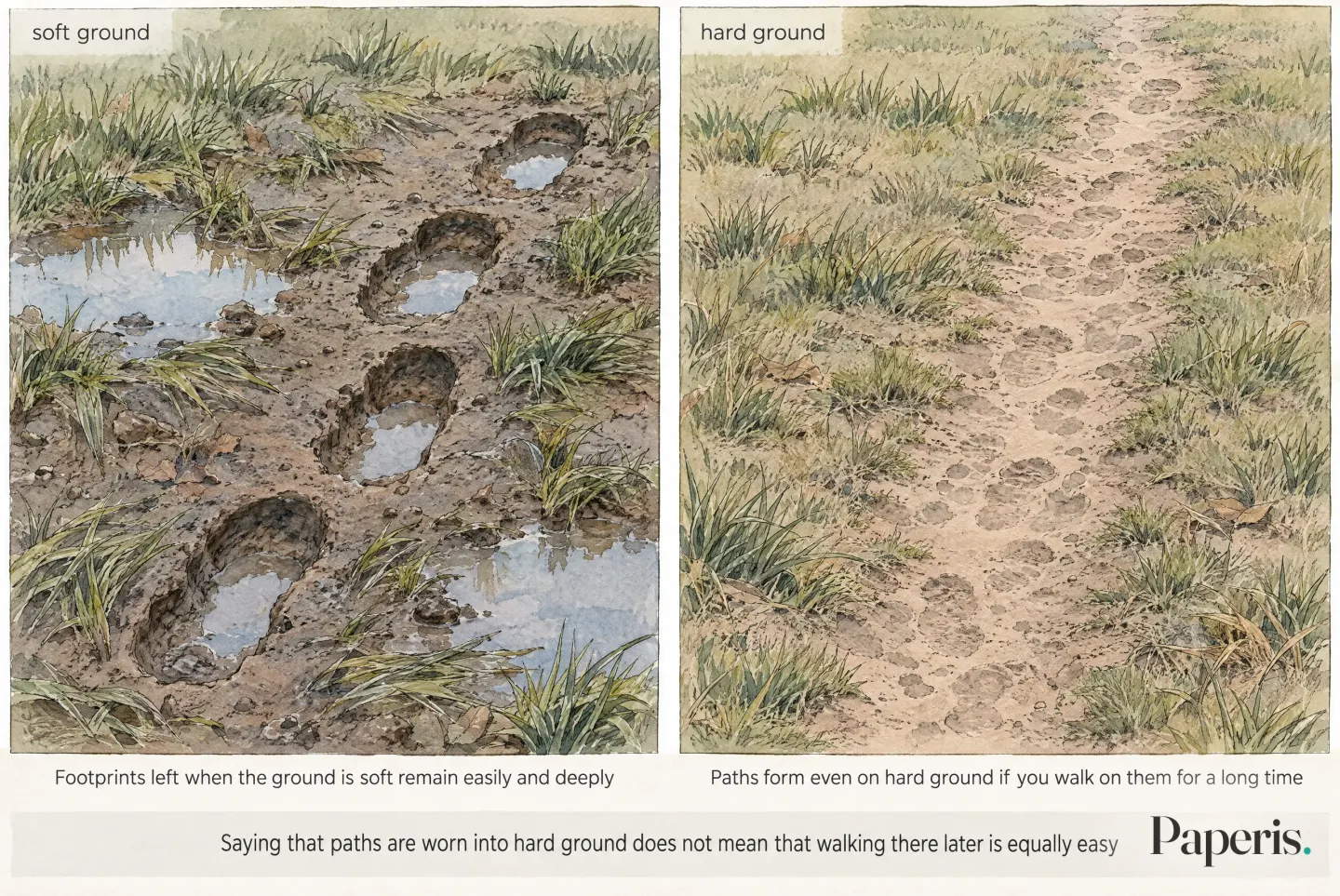
If you picture a grassy field, you will not lose your way. Paths form where people walk frequently. The shape of the land creates places where paths are likely to form, and actual walking makes the paths. As footsteps accumulate, the shape of the land changes a little, too. When the ground is soft, like after rain, footprints remain easily and deeply. Paths form even on hard ground if you walk on them for a long time. This picture also has limits. In real people, the land and the walking cannot be separated, and the person making the path does not stand apart outside the grassy field.
Development is the change people experience in their bodies, thoughts, and emotions, personalities, and social relationships from before birth until death (OpenStax Psychology 2e 9.1). People who study development look at this change by dividing it into three domains: body, thought, and emotion-personality-relationship.
One Step at a Time, or Crossing the Ridge?
The day a child first walks alone is a day worth marking on the calendar. Yet even before that day, the child has been pulling up to stand and shifting one foot for months. Looking at the same change, developmental research holds two views.
Stage theories view development as happening as a person moves into qualitatively different stages at designated times. Through this lens, a child at some point crosses a ridge and enters a path different from before. Continuous theories view development as a process where abilities already possessed slowly accumulate and improve. Through this lens, footprint after footprint piles up to become a path (OpenStax Psychology 2e 9.1).
Three famous developmental theories lean toward the stage side. Psychoanalyst Sigmund Freud saw personality as solidifying through childhood stages. Most of his theories lack support in modern research, but the idea that childhood experiences partly influence personality remains (OpenStax Psychology 2e 9.2). Erik Erikson, who revised Freud's theory, saw personality as developing across the entire lifespan, dividing the span from infancy to old age into eight stages and assigning each stage a task to resolve within relationships with others (OpenStax Psychology 2e 9.2; OpenStax Psychology 2e 11.3). The third is Jean Piaget, who studied children for over 50 years and whom we meet in the next section.
Let us return to that day of first walking alone. When that day arrives may come earlier or later across cultures depending on how children are cared for, but walking itself comes to children in any society (OpenStax Psychology 2e 9.1). What stage theories view as the same for everyone is the order of crossing the ridges (OpenStax Psychology 2e 9.1), not promising that even the month of taking the first step is identical.
Peekaboo, and a Redrawn Scale
When a mother covers her face with her hands and pops out saying "Peekaboo!", a baby bursts into giggles. From when do babies know that a covered face still exists somewhere?
Piaget saw that a child's thinking differs from an adult's in its very method. He gave this question a name. Object permanence is the understanding that an object still exists somewhere even when it vanishes from in front of our eyes. On Piaget's scale, this understanding arises around 5 to 8 months of age, and his other understandings also change roughly according to age at each junction (OpenStax Psychology 2e 9.2).
That scale has been redrawn. In one experiment, 3-month-old babies stared longer at a scene where a hidden object seemed to have had another object pass right through it. Based on such results, developmental psychologists today view babies as understanding objects earlier than Piaget thought (OpenStax Psychology 2e 9.3). There are several studies showing that children reach the milestones Piaget spoke of earlier, and that changes are also more continuous than what he drew (OpenStax Psychology 2e 9.2).
Such experiments guess a baby's knowledge by where and how long the baby looks. In theory of mind studies using the same method, it is still debated whether looking longer stems from a deep understanding or merely from noticing something new in that scene, and experiments that found an understanding that another person can believe something false in babies around one year of age also yield mixed results (PMID 19673160). What is relatively agreed upon is that by the end of their second year, babies understand other people's goals, intentions, and what they see and know to some degree (PMID 19673160). The time when children come to understand that others have different thoughts and beliefs from their own is usually between three and five years of age (OpenStax Psychology 2e 9.3).
The question Piaget posed—do children think differently from adults—remains, and the age scale he drew is being redrawn.
The Starting Point of Being Near a Caregiver
When a one-year-old baby plays on a playground and falls, they turn toward their caregiver, are held in their arms, and then go back to play. This is the first path made between a baby and a caregiver. Attachment is the long-lasting emotional bond that a baby forms with the person who cares for them. John Bowlby called the spot where a baby returns after falling a secure base. This means that the reassurance of having a caregiver nearby serves as a support while the baby explores their surroundings (OpenStax Psychology 2e 9.3).
How differently this path is made in each baby is revealed the moment a caregiver briefly leaves and returns. The strange situation is an observation procedure where a baby is briefly separated from a caregiver in an unfamiliar room and then reunited, watching the baby's reactions when parting and meeting again. In this procedure, created by Mary Ainsworth for babies around one year old (12 to 18 months), babies who welcome the returning caregiver are classified as having secure attachment, and those who do not are classified as having insecure attachment. This procedure has been supported in subsequent studies (OpenStax Psychology 2e 9.3). However, there is also criticism that a baby's inborn temperament can play a major role in attachment classification (OpenStax Psychology 2e 9.3).
So, is it okay to read a child's path with this classification? The most common group among babies is secure attachment, and disorganized attachment—a classification established later—is seen more frequently in children who have experienced abuse (OpenStax Psychology 2e 9.3). However, a review article points out that four assumptions spread in policy and practice do not match the evidence. These four are: that a single child can be definitively evaluated based on an attachment measurement alone, that disorganized attachment reliably points to abuse, that it strongly predicts later illness, and that it is a fixed trait that does not change. The same review considers attachment theory itself to be very useful for helping families and for creating and evaluating evidence-based care programs (PMID 28745146).
Does the same yardstick work in other cultures? Ainsworth's research has been criticized for not accounting for how attachment looks different across cultures (OpenStax Psychology 2e 9.3). While Western theories viewed relationships where mother and child stay extremely close as a problem, in Japan, such relationships are considered desirable, are more common, and have evidence of fewer negative effects on children than in the West. A review article therefore warns against importing attachment theory as-is outside the culture where it was made (PMID 12395563).
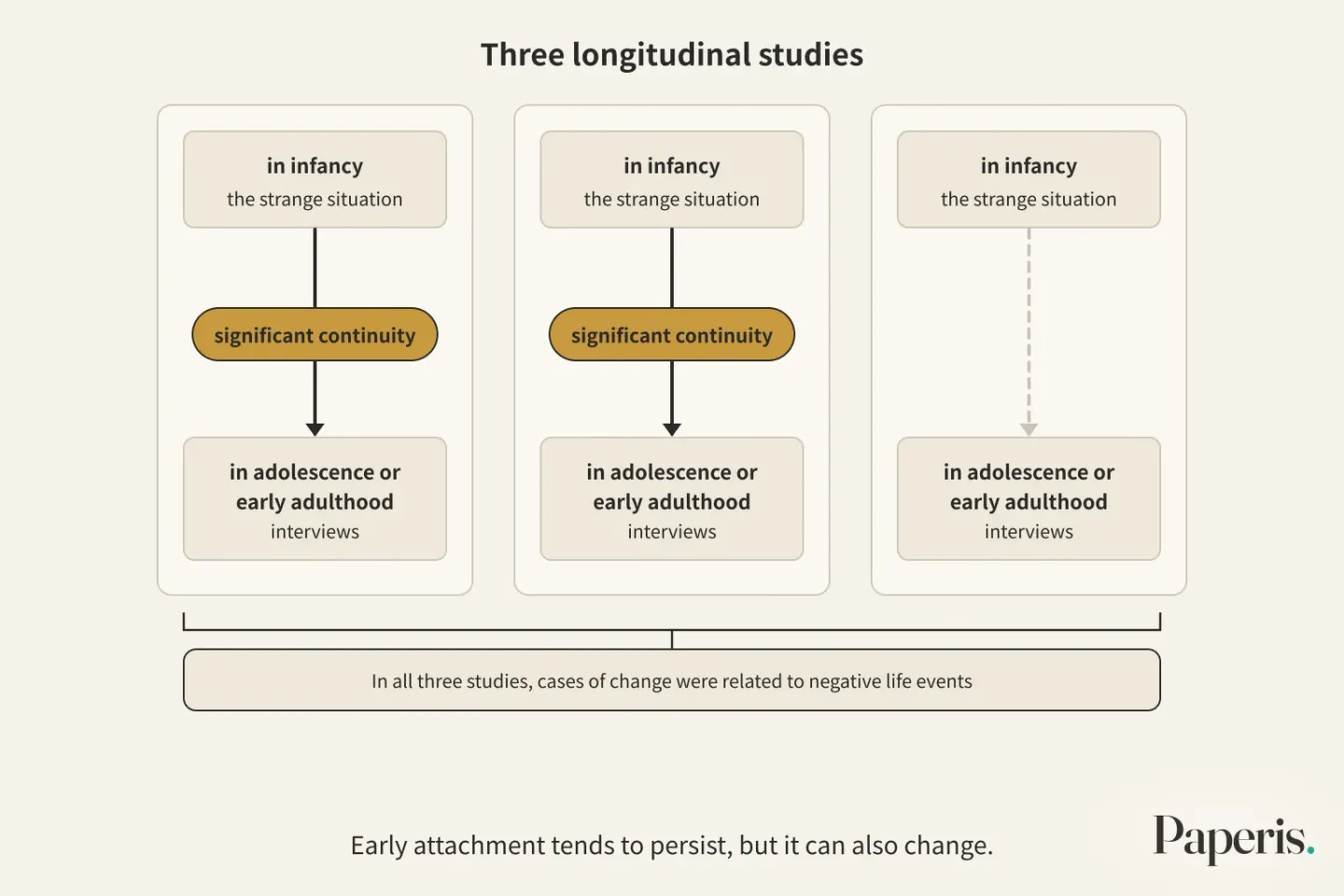
Early attachment tends to persist, but it can also change. Among three longitudinal studies that measured attachment in infancy using the strange situation and re-measured it in adolescence or early adulthood through interviews, two showed significant continuity of attachment, and in all three studies, cases of change were related to negative life events (PMID 10953933). As we saw in Emotion and Motivation — A Dashboard of Swinging Needles, and the Eye That Reads Them, emotion regulation is the process of altering which emotions are experienced and expressed, when, and how intensely. In a longitudinal study from Minnesota in the U.S., people who had insecure attachment twice in infancy, compared to those who had secure attachment twice, engaged in less regulation where they kept their emotions open and worked through conflicts together with romantic partners 20 to 35 years later, and more often suppressed their emotions and withdrew (PMID 31916790). This study showed an association, and in the same study, peer relationships at age sixteen also showed a similar continuity with adult emotion regulation (PMID 31916790). The first path lasts a long time, and later paths overlap on top of it.
Innate and Experienced
Some babies burst into tears at an unfamiliar sound, while others turn their heads to look toward where the sound is coming from. Temperament is an innate tendency, visible from infancy, that influences the ways we think, act, and respond to our surroundings. There is also the view that a baby's temperament can change a caregiver's responses (OpenStax Psychology 2e 9.3). How an infant's temperament connects to adult personality is carried on in Personality — Today's Weather, the Climate Seen over Years.
So, is that baby who cries easily born that way, or did what they experienced make them that way? Nature and nurture is the old question asking whether human traits come from what we are born with or what we experience in life. Following the view we just saw, the two may be intertwined from the very beginning for that baby. If a baby who cries easily changes the caregiver's response, that response also becomes part of the world the baby experiences (OpenStax Psychology 2e 9.3). Even within the picture that the two influence each other, "which side accounts for what percentage" remains an unanswered question (OpenStax Psychology 2e 9.1). One review notes that biologists and psychologists are rethinking the 20th-century premise that viewed genes as the primary driver of development, and views the development that actually unfolds for a person as one of several possibilities that could have occurred (PMID 27906523). Childhood stress can be imprinted on chemical markers that regulate when and how much genes are used, and results showing that such changes persist in several genes involved in stress responses have accumulated across both human and animal studies (PMID 40770493).
The numbers coming out of twin studies must also be read within this picture (OpenStax Psychology 2e 11.6). Heritability is the proportion of differences among people within a population that is explained by genetic differences. Because it is a proportion measured based on differences among people, it cannot be read across to an individual person, such as saying "so-and-so percent of my personality is genetic." One review points out that measured heritability tells us neither how much of that trait is inherited through genetics nor how much genes and environment each act in an individual's development. The same review takes it as an established fact that genetic factors have a substantial influence on the development of all human traits, and goes on to argue that heritability figures are therefore of little use except in very rare cases, and that continuing to use this term severely harms public understanding (PMID 27906501). How far heritability can be used is explored further in Personality — Today's Weather, the Climate Seen over Years.
Small-sample reports that specific genes are involved in individual differences in attachment have not been replicated in large samples. Across about 1,000 babies from two birth cohorts, candidate genes related to dopamine, serotonin, and oxytocin showed no consistent relationship with attachment (with an exception where a small association for one gene appeared in both cohorts), and gene-environment interactions were also not replicated in the two cohorts (PMID 21749372). When re-analyzing the U.S. child follow-up data, which was one of those two cohorts, the average effects of these genes were close to zero even when including non-white children (PMID 23421800). In attempts that registered analysis plans in advance and re-ran the analysis using the same U.S. data and other birth cohort data, the effects of newly highlighted genetic markers also failed to replicate (PMID 42334157). Genes play a major role in development, but attempts to explain relational patterns like attachment with one or two genes have not been replicated.
When the Ground Is Soft
During pregnancy, different organs in a fetus's body form at separate times. If they are exposed to harmful substances during those periods, those organs are especially vulnerable to damage (OpenStax Psychology 2e 9.3). A sensitive period is a time-limited window during which a specific experience or exposure has an unusually large effect on development. People also use the term critical period for these times when a fetus's organs are being formed (OpenStax Psychology 2e 9.3).
Brain development continues from the fetal stage through adolescence, and along the way, various processes happen according to their own timelines. Exposure to harmful substances during those times can derail development (PMID 10852851). Developmental problems in babies caused by heavy drinking during pregnancy persist even into adulthood (OpenStax Psychology 2e 9.3). Most neural connections are formed in the first few years of life, and the pruning that trims away some of those connections continues past childhood and into adolescence, a process thought to make the brain work more efficiently (OpenStax Psychology 2e 9.3). The brain's property of changing itself based on experience becomes especially large during sensitive periods, making experience a window of opportunity that builds and solidifies connections. Windows like this are rarely seen in the adult brain (PMID 27567276). Footprints left when the ground is soft remain easily and deeply.
The term sensitive period often sounds like "if you miss this time, it's over." The picture that evidence paints regarding the development of the mind is broader than that. Nerve cells retain the property of changing in response to environmental signals throughout life, and the same machinery that regulates gene usage is involved in both the changes of sensitive periods and changes that last a lifetime (PMID 40770493). Early-life stress leaves traces in the brain and influences later mental health, but a significant portion of children who experience such things maintain their functioning and adapt well throughout their lives (PMID 40562842). Resilience is the process of adapting while going through difficult experiences and then finding one's way back to baseline afterward. The resilience this review paper deals with is the side that protects functioning amidst those challenges. This review paper views resilience as a process actively created by the brain changing at the molecular and circuit levels, and a substantial portion of that evidence comes from mouse experiments (PMID 40562842).
Childhood adversity leaves big marks, but it is not the last chance in the development of the mind. This metaphor also has its limits. Saying that paths are worn into hard ground does not mean that walking there later is equally easy.
The Fifteen-Year-Old Brain
There are fifteen-year-olds who make reckless choices with friends that they would never make alone. Adolescent decisions are especially prone to wavering in emotionally charged situations or when peers are nearby (PMID 22929913).
So, is the brain at this age still unfinished? The front part of the brain involved in judgment and planning keeps growing into early adulthood. Textbooks also carefully connect this point to adolescent risk-taking (OpenStax Psychology 2e 9.3). Yet brain imaging studies do not support a simple model that explains it by that alone. Evidence is piling up that changes in how social signals and emotions are processed, starting around puberty, are more important (PMID 22903221). While the power to suppress impulses grows slowly and evenly throughout adolescence, the response to rewards does not grow in a straight line and famously spikes during this period (PMID 22929913). That said, the link between puberty and brain changes varies across studies, and more replication research is needed to sort it out (PMID 29972766).
The same changes can also become an opportunity. This shift, which makes people sensitive to social signals, can also be an advantage for flexibly adjusting one's goals to match a changing environment (PMID 22903221). Being sensitive to peers is both a window of vulnerability and a window of opportunity, and ways to utilize peers to help with emotional regulation are being studied (PMID 37302349). Adolescence is a period of reorganization accompanied by both risks and opportunities (PMID 15668099).
When friends become this important, do teenagers constantly clash with their parents? Only a minority of adolescents experience major conflicts with their parents, and most report holding warm feelings toward them. The old picture portraying adolescence solely as a time of storm and stress is exaggerated (OpenStax Psychology 2e 9.3). There is a separate question that children grapple with during this period. Identity is a picture one paints of oneself regarding the kind of person one is. Erikson saw building an identity as the task of adolescence (OpenStax Psychology 2e 9.2).
Meanwhile, the first appearance of various mental disorders such as depression and anxiety also increases during adolescence (PMID 33334434). What mental disorders are and how they are treated is covered in "Mental Disorders — A Scale That Rises and Falls, a Line People Drew".
The Road Even After Becoming an Adult
Does change end once we become adults? There is a view that sees the span from age eighteen to the mid-twenties as a separate period neither childhood nor adulthood, and this period is considered a product of Western culture and our current era (OpenStax Psychology 2e 9.3). When a person becomes an adult also differs across cultures (OpenStax Psychology 2e 9.3).
Let us go to the grandmother in the photograph. What a grandmother has piled up over a long time and what she must newly untangle right there take different paths as she grows older. Crystallized intelligence is the knowledge and skill accumulated in the head and practiced in the body through living a long time. Fluid intelligence is the power of the mind to quickly handle and figure out what comes in anew. The former is generally maintained or even increases despite advancing age, while the latter decreases and slows down in old age (OpenStax Psychology 2e 9.3). More specifically, processing speed, memory that briefly holds and uses information in the head, the power to suppress unhelpful responses, and long-lasting memory decrease with age, and the size of brain structures and the condition of nerve fiber bundles also worsen (PMID 19035823). Knowledge already accumulated is, as seen above, generally maintained. Even in people without dementia or the stage preceding it, these changes arrive little by little, and distinguishing normal aging from disease is a task of clinical care (PMID 24094294).
The rate of decline differs from person to person (PMID 32772803). In a review combining multiple longitudinal studies, people who received education for a long time tended to have higher thinking abilities throughout adulthood. The direction in which education raises ability, the direction in which people with higher ability receive education longer, and common factors that affect both, such as parental circumstances, work together (PMID 32772803). Yet the rate of decline by age had almost no relation to the duration of education. The authors conclude that there is great potential in improving the developmental conditions of the first few decades of life (PMID 32772803). There are also people whose thinking abilities are well maintained even though there are considerable pathological changes in the brain, and various concepts have been proposed to explain this, though their definition and measurement are still being sorted out (PMID 31732015). In the older brain, the frontal regions actually become more active, and one theory interprets this as compensation that shores up declining functions through alternative routes (PMID 19035823).
There are also longitudinal results that do not fit the idea that the shape of old age is predetermined in childhood. In a study following two groups of men (237 college students, 332 inner-city youths) for 60 years, results showed that how healthy and satisfying old age at 70 to 80 is can be predicted by conditions measured before age 50. The researchers divided conditions like drinking, smoking, exercise, and education into those people can control to some extent, and conditions like parents' social class, childhood temperament, and major depression into those difficult to control. When considering the former conditions, the only thing among the latter bundle that affected the quality of old age was depression (PMID 11384887). The authors conclude that people can shape their health after retirement much more than they think. However, this is a single study looking only at men (PMID 11384887).
Again, the Four People in the Photo
We look at the photo again. The baby past one year old already knows that a hidden face is still there. That is true even by Piaget's scale. If they fall while playing, they will turn toward their caregiver. No matter which attachment style that baby is sorted into, you cannot read the child's future from that single sorting style.
The time when puberty arrives varies greatly from person to person (OpenStax Psychology 2e 9.3), but in the brains of your cousins' peers, responses to reward are commonly enlarged, and the power to suppress impulse is growing slowly. That sensitivity, which sways more easily in front of friends, can also become the power to reset one's own goals.
As Erikson saw it, parents in their forties also have the tasks of this period. Even though the grandmother in her eighties has slower counting and judgment than before, the knowledge and know-how she has accumulated through life largely remain intact.
All four people are on a path. A path made first in soft ground remains for a long time, and new paths are made throughout life.
Where to Look Further
Whether attachment theory made in the West works in other cultures—how the question of whose data a study comes from sets the boundaries of its conclusion—is covered by "Who Was Being Measured — Who "People" Meant When Psychology Said It". Findings from small samples disappearing when remeasured, like attachment gene studies, lead into "Psychology's Replication Crisis — Why the Findings We Believed In Wobbled".
Emotion regulation is looked at by "Emotion and Motivation — A Dashboard of Swinging Needles, and the Eye That Reads Them", and the way experience changes behavior by "Learning — The Sound That Comes First, the Taste That Lingers". How brain regions connect and work together is handled by "The Map of the Brain — Neighborhoods with Their Own Jobs, a City Joined by Roads", and how memories are stored and retrieved by "The Three Steps of Memory — Putting It In, Keeping It, Taking It Out". The story dividing normal aging from disease leads into "What Is Dementia? — Snow That Settles Without a Sound, a Branch Beginning to Bend".
"Personality — Today's Weather, the Climate Seen over Years" covers personality continuing from temperament and heritability, "Stress — The Load on the Scale, the Arm That Held It Too Long" covers the ways body and mind respond to pressure and resilience, and "Mental Disorders — A Scale That Rises and Falls, a Line People Drew" covers mental disorders and their treatment.
Source Papers
- "Psychology 2e — 9.1 What Is Lifespan Development?" (2020) — OpenStax Psychology 2e 9.1 — The three domains of development, the continuous versus discontinuous perspectives, the universality of stage order alongside cultural differences in the timing of milestones, and the debate over gene-environment interactions and their relative contributions.
- "Psychology 2e — 9.2 Lifespan Theories" (2020) — OpenStax Psychology 2e 9.2 — The lack of support for Freud's theory, Erikson's lifelong stages and the identity crisis of adolescence, what remains of Freud (childhood experiences partly influencing personality), Piaget: children thinking differently than adults, object permanence emerging around 5 to 8 months of age, stages roughly tied to age ranges, and subsequent research supporting more continuous models and earlier milestones.
- "Psychology 2e — 9.3 Stages of Development" (2020) — OpenStax Psychology 2e 9.3 — Critical and sensitive periods for each organ system during pregnancy, prenatal alcohol exposure causing developmental problems that persist into adulthood, postnatal neural connections forming and pruning believed to increase efficiency, an experiment on 3-month-old infants understanding objects (a single experiment), understanding others' beliefs at ages 3 to 5, attachment, secure bases, the strange situation along with subsequent support and critiques (temperament, culture, Ainsworth's study not accounting for cultural differences), the definition of temperament and the view that temperament can elicit parenting responses, differences in the onset age of puberty, a cautious link between adolescent prefrontal cortex maturation and risk-taking behavior, major conflicts being rare with positive emotions toward parents reported and storm-and-stress exaggerated, emerging adulthood, and crystallized versus fluid intelligence.
- "Psychology 2e — 11.6 Biological Approaches" (2020) — OpenStax Psychology 2e 11.6 — Heritability as the proportion of differences among people that is attributed to genetics.
- "Psychology 2e — 11.3 Neo-Freudians: Adler, Erikson, Jung, and Horney" (2020) — OpenStax Psychology 2e 11.3 — Erikson parting ways with Freud by viewing personality as developing across the lifespan, with a task at each of the eight stages.
- "The developmental origins of naïve psychology in infancy." (2009) — PMID 19673160 — The looking-time paradigm potentially reflecting only novelty detection, leaving the depth of infant understanding debated, mixed results for infant false-belief tasks, and a broad consensus achieved by the end of the second year regarding the understanding of others' goals, intentions, perceptions, and knowledge.
- "Family systems theory, attachment theory, and culture." (2002) — PMID 12395563 — Very close mother-infant relationships being viewed as adaptive and more common in Japan with fewer negative effects than in the West, and a warning against applying theories outside the cultures in which they were created.
- "Disorganized attachment in infancy: a review of the phenomenon and its implications for clinicians and policy-makers." (2017) — PMID 28745146 — The four assumptions that definitive assessments of attachment are used, that disorganized attachment is an indicator of abuse, that it strongly predicts pathology, and that it is a fixed trait are unfounded and misleading.
- "The stability of attachment security from infancy to adolescence and early adulthood: general introduction." (2000) — PMID 10953933 — Attachment stability being significant in two out of three long-term longitudinal studies (from the strange situation to the adult attachment interview), with discontinuity in all three studies linked to negative life events.
- "Infants' attachment insecurity predicts attachment-relevant emotion regulation strategies in adulthood." (2021) — PMID 31916790 — The Minnesota Longitudinal Study of Risk and Adaptation, showing that infant insecure attachment relates to emotion regulation strategies in romantic conflict situations 20 to 35 years later, with peer relationship insecurity at age 16 predicting similar outcomes.
- "Developmental evolution." (2017) — PMID 27906523 — Reexamining the premise that genes are the primary cause of development, recognizing that development is probabilistic and conditional, and that unfolding development is one of multiple possibilities (the developmental systems approach).
- "Epigenetic regulation of brain development, plasticity, and response to early-life stress." (2026) — PMID 40770493 — Epigenetic mechanisms regulating sensitive periods and lifelong plasticity together, with early stress capable of being inscribed on the epigenome, and human and animal studies converging on long-term changes in stress-response genes.
- "The heritability fallacy." (2017) — PMID 27906501 — Measured heritability telling us neither how heritable a trait is nor the relative influence of genes and environment in development, while genetic factors are already known to substantially influence the development of all traits leading to the authors' conclusion: heritability estimates are of little value except in rare cases and the use of the term does great harm to public understanding.
- "Dopaminergic, serotonergic, and oxytonergic candidate genes associated with infant attachment security and disorganization? In search of main and interaction effects." (2011) — PMID 21749372 — Over 1,000 participants across two birth cohorts showing no consistent additive associations for candidate genes (with COMT as a single exception) and gene-environment interactions failing to replicate.
- "Molecular-genetic correlates of infant attachment: a cautionary tale." (2013) — PMID 23421800 — Updating and expanding the SECCYD results of 21749372 using the same data, finding average effects of "usual suspect" polymorphisms close to zero, negligible effects in both white and non-white subsamples, and a failure to replicate serotonin transporter results.
- "Does variation in the μ-opioid receptor gene (OPRM1) moderate the association between maternal sensitivity and child attachment? A preregistered attempted replication and extension of Tchalova et al. (2024)." (2026) — PMID 42334157 — A preregistered replication attempt using SECCYD and Generation R data, showing that the moderating effect of OPRM1 is not replicated, representing yet another failure to replicate in the candidate gene literature.
- "Critical periods of vulnerability for the developing nervous system: evidence from humans and animal models." (2000) — PMID 10852851 — Neural development continuing from the embryonic period through adolescence, and toxic exposure timed to vulnerable periods of the developmental process disrupting development.
- "Cerebral plasticity: Windows of opportunity in the developing brain." (2017) — PMID 27567276 — Plasticity in the developing brain increasing during critical and sensitive periods to create and consolidate experience-dependent connections as windows of opportunity, which are uncommon in the adult brain.
- "Neurobiology of resilience to early life stress." (2026) — PMID 40562842 — Early stress leaving traces on the brain while many children develop adaptive capacities (resilience), with resilience being an active process and the review focusing on rodent research.
- "Decision-making in the adolescent brain." (2012) — PMID 22929913 — Impulse control developing slowly and linearly while the reward system develops nonlinearly and becomes hyperreactive in adolescence, with decisions particularly influenced by peers and emotional contexts.
- "Understanding adolescence as a period of social-affective engagement and goal flexibility." (2012) — PMID 22903221 — Imaging research not supporting a simple model of frontal immaturity, highlighting instead changes in social-affective processing beginning around puberty alongside the adaptive advantage of goal flexibility.
- "Puberty and the human brain: Insights into adolescent development." (2018) — PMID 29972766 — Research results on the link between puberty and brain development being inconsistent and requiring replication studies.
- "Peer facilitation of emotion regulation in adolescence." (2023) — PMID 37302349 — Adolescent peer sensitivity serving as both a vulnerability and a window of opportunity, with the possibility of improving emotion regulation through peer-based interventions.
- "Cognitive and affective development in adolescence." (2005) — PMID 15668099 — Adolescence serving as a sensitive period for the reorganization of regulatory systems, bringing both risks and opportunities.
- "Puberty Initiates Cascading Relationships Between Neurodevelopmental, Social, and Internalizing Processes Across Adolescence." (2021) — PMID 33334434 — The onset of several mental disorders increasing together during adolescence, supported by a theoretical model focusing on depression, anxiety, and self-harm.
- "The adaptive brain: aging and neurocognitive scaffolding." (2009) — PMID 19035823 — Processing speed, working memory, inhibition, long-term memory, brain structural size, and white matter decreasing with age, and proposing the scaffolding theory of aging and cognition (STAC) which interprets increased prefrontal activation as a compensatory scaffold.
- "Normal cognitive aging." (2013) — PMID 24094294 — Subtle cognitive changes occurring even in the absence of dementia or mild cognitive impairment, making the distinction between normal aging and disease a clinical challenge.
- "Education and Cognitive Functioning Across the Life Span." (2020) — PMID 32772803 — Individual differences in the rate of cognitive decline, education positively relating to cognitive level through common factors like educational effects, selection, and parental socioeconomic resources, with the relationship to the rate of age-related decline being negligible, pointing to the potential for improving developmental conditions in the first decades of life.
- "Brain reserve, cognitive reserve, compensation, and maintenance: operationalization, validity, and mechanisms of cognitive resilience." (2019) — PMID 31732015 — Various constructs explaining the paradox where cognition is well maintained despite significant pathological changes in the brain, while discussing the overlap and distinction in definitions and measurements.
- "Successful aging." (2001) — PMID 11384887 — A 60-year follow-up of two male cohorts (237 college students and 332 inner-city youths), suggesting that the quality of aging at ages 70 to 80 can be predicted by variables from before age 50, and when controlling for 7 variables classified by researchers as partly controllable, only depression among the variables classified as uncontrollable retains an effect.
Sources (30)
- Psychology 2e — 9.1 What Is Lifespan Development?
- Psychology 2e — 9.2 Lifespan Theories
- Psychology 2e — 9.3 Stages of Development
- Psychology 2e — 11.6 Biological Approaches
- Psychology 2e — 11.3 Neo-Freudians: Adler, Erikson, Jung, and Horney
- The developmental origins of naïve psychology in infancyPMID 19673160
- Family systems theory, attachment theory, and culturePMID 12395563
- Disorganized attachment in infancy: a review of the phenomenon and its implications for clinicians and policy-makersPMID 28745146
- The stability of attachment security from infancy to adolescence and early adulthood: general introductionPMID 10953933
- Infants' attachment insecurity predicts attachment-relevant emotion regulation strategies in adulthoodPMID 31916790
- Developmental evolutionPMID 27906523
- Epigenetic regulation of brain development, plasticity, and response to early-life stressPMID 40770493
- The heritability fallacyPMID 27906501
- Dopaminergic, serotonergic, and oxytonergic candidate genes associated with infant attachment security and disorganization? In search of main and interaction effectsPMID 21749372
- Molecular-genetic correlates of infant attachment: a cautionary talePMID 23421800
- Does variation in the μ-opioid receptor gene (OPRM1) moderate the association between maternal sensitivity and child attachment? A preregistered attempted replication and extension of Tchalova et al.PMID 42334157
- Critical periods of vulnerability for the developing nervous system: evidence from humans and animal modelsPMID 10852851
- Cerebral plasticity: Windows of opportunity in the developing brainPMID 27567276
- Neurobiology of resilience to early life stressPMID 40562842
- Decision-making in the adolescent brainPMID 22929913
- Understanding adolescence as a period of social-affective engagement and goal flexibilityPMID 22903221
- Puberty and the human brain: Insights into adolescent developmentPMID 29972766
- Peer facilitation of emotion regulation in adolescencePMID 37302349
- Cognitive and affective development in adolescencePMID 15668099
- Puberty Initiates Cascading Relationships Between Neurodevelopmental, Social, and Internalizing Processes Across AdolescencePMID 33334434
- The adaptive brain: aging and neurocognitive scaffoldingPMID 19035823
- Normal cognitive agingPMID 24094294
- Education and Cognitive Functioning Across the Life SpanPMID 32772803
- Brain reserve, cognitive reserve, compensation, and maintenance: operationalization, validity, and mechanisms of cognitive resiliencePMID 31732015
- Successful agingPMID 11384887