
Paperis Articles
Basic Rights and Their Limits — A Scale Without Markings
The Constitution protects freedom and equality. For the state to take some of that freedom away, it has to get past a four-step scale — and the justices who read that scale sometimes read it differently.
Your field's papers, as audio
Pick your fields and journals — Paperis summarizes the key papers and turns them into audio. Listen on your commute.
Start Paperis free →Basic Rights and Their Limits — A Scale Without Markings
Same Clause, Two Judgments
On October 30, 2008, nine judges decided whether a single criminal law provision made in 1953 violated the Constitution. It was the provision punishing adultery by a person with a spouse, and the conclusion was that it did not violate the Constitution. On February 26, 2015, the Constitutional Court decided by a 7-to-2 vote that the same provision violated the Constitution (Constitutional Court 2007Hun-Ga17) (Constitutional Court 2009Hun-Ba17).
This article is written about the Constitution of the Republic of Korea. The Constitution is the highest of all laws, setting the basic framework of the country and the fundamental rights of its people. In the place where the conclusions diverged under the same Constitution and the same clause, there is a scale.
Rights Protected by the Constitution
The place that made the two judgments is the Constitutional Court. A statute is a law made by the National Assembly according to the procedures set by the Constitution. The Constitutional Court is the body that decides whether statutes comply with the Constitution and resolves disputes surrounding the Constitution. There are nine justices (Constitution of the Republic of Korea, Article 111(2)).
What was disputed in the adultery crime case was an individual's freedom regarding sexual life and private life. Fundamental rights are the basic freedoms and rights guaranteed by the Constitution. The Constitution writes these as "fundamental human rights" (Article 10) and "freedoms and rights" (Article 37), and the Constitutional Court and academia call them fundamental rights (Constitution of the Republic of Korea, Article 10) (Constitution of the Republic of Korea, Article 37).
Article 10 of the Constitution writes that "All citizens shall have human dignity and worth, and the right to pursue happiness," and stipulates that the State has the duty to confirm and guarantee fundamental human rights (Constitution of the Republic of Korea, Article 10).
Human dignity and worth is the value every person possesses simply for being a person. The right to pursue happiness is the right to decide matters concerning one's own life for oneself and pursue happiness.
There are also rights whose names are not written in the Constitution. Article 37, Paragraph 1 stipulates that "The freedoms and rights of citizens shall not be neglected on the ground that they are not enumerated in the Constitution" (Constitution of the Republic of Korea, Article 37(1)). Therefore, the work of reading rights out of the words written in the provisions arises.
In the 2015 adultery crime case, five justices viewed that the right to pursue happiness and others "presuppose an individual's right to self-determination," and wrote that the right to sexual self-determination is included within it (Constitutional Court 2009Hun-Ba17).
The right to sexual self-determination is the right to decide for oneself whether to engage in sexual activity and with whom. This name is nowhere in the constitutional provisions. As the 2008 decision text summarized, the majority justices of the 1990 decision viewing the crime of adultery as constitutional also judged on the premise of this right (Constitutional Court 2007Hun-Ga17), and two justices who opposed the 2015 conclusion wrote that it is "clear" that this right is included in the right to self-determination (Constitutional Court 2009Hun-Ba17). The list of constitutional provisions is not the entirety of rights.
Freedom of Body and Speech, and Equality
The Constitution lists freedoms concerning the body, privacy, and speech one by one. “All citizens shall enjoy personal liberty.” (Constitution of the Republic of Korea, Article 12(1)) “All citizens shall not be violated of their freedom and privacy of private life.” (Constitution of the Republic of Korea, Article 17) The secrecy of communications such as letters and phone calls is also protected separately (Constitution of the Republic of Korea, Article 18).
Liberty rights is a collective name for the freedoms that individuals enjoy without state interference, such as the body, privacy, communication, and speech. Article 12 provides that no person shall be arrested or detained except by statute, and shall not be punished except by statute and due process (Constitution of the Republic of Korea, Article 12(1)). What liberty rights protect is the space where the state cannot intrude casually into my life.
Article 21, Paragraph 1 provides, “All citizens shall enjoy freedom of speech and the press, and freedom of assembly and association.” (Constitution of the Republic of Korea, Article 21(1)) Freedom of expression is the right to speak or show my thoughts. The Constitutional Court views this freedom as including both the freedom to reveal thoughts and the freedom to spread them (2010Hun-Ma47, Constitutional Court).
What was contested in the Internet Real-Name Verification System case is one branch within it. The Constitutional Court wrote that freedom of expression “also includes the freedom of anonymous expression to express and propagate one's thoughts or opinions anonymously or under a pseudonym without revealing one's identity to anyone” (2010Hun-Ma47, Constitutional Court). Freedom of anonymous expression is the freedom to speak and spread one's thoughts without revealing one's name or by using a different name.
Equality occupies a separate article. Article 11, Paragraph 1 writes, “All citizens shall be equal before the law,” and provides that no person shall be discriminated against in any area of life due to sex, religion, or social status (Constitution of the Republic of Korea, Article 11(1)). The right to equality is the right to be treated equally before the law and not to be discriminated against without reason.
The Constitution also contains rights that pair with the state's duty to strive for social security, such as the right to live a life worthy of human dignity (Constitution of the Republic of Korea, Article 34(1) and (2)). This article stays with liberty rights and the right to equality.
Fundamental Rights Also Have Limits
Right in the article specifying freedom of expression, there is a boundary. Article 21, Paragraph 4 writes, "Neither speech nor the press shall violate the honor or rights of other persons nor public morals or social ethics," and stipulates that a person whose honor or rights have been infringed may claim compensation (Constitution of the Republic of Korea, Article 21(4)). My freedom stops where it meets another person's rights.
The general rule that applies to all fundamental rights is Article 37, Paragraph 2. "All freedoms and rights of citizens may be restricted by Act only when it is necessary for national security, the maintenance of order, or public welfare, and even when restricted, the essential aspects of freedoms and rights shall not be infringed" (Constitution of the Republic of Korea, Article 37(2)).
Restricting fundamental rights is the state paring away part of fundamental rights by statute. This single sentence attaches four conditions when paring them away. The purpose must be national security, the maintenance of order, or public welfare; it must be limited to cases where it is necessary; it must be done through an act made by the National Assembly; and even if pared away, the essential aspect of the right must remain (Constitution of the Republic of Korea, Article 37(2)).
This article blocks misunderstandings in two directions at once. Fundamental rights can be restricted, so they are not unlimited. And the restriction is not justified merely because the state made a statute. A statute restricting fundamental rights must separately pass the test of being "necessary."
Unconstitutional means that a statute or state action runs counter to the Constitution. A statute judged by the Constitutional Court to have failed that test is decided to be unconstitutional. However, to make such a decision, six or more of the nine justices must agree (Constitution of the Republic of Korea, Article 113(1)).
This article follows that test by comparing it to a scale. On one pan goes the social interest the law aims to protect, and on the other pan goes the fundamental right diminished because of that law.
The Four Steps of the Scale
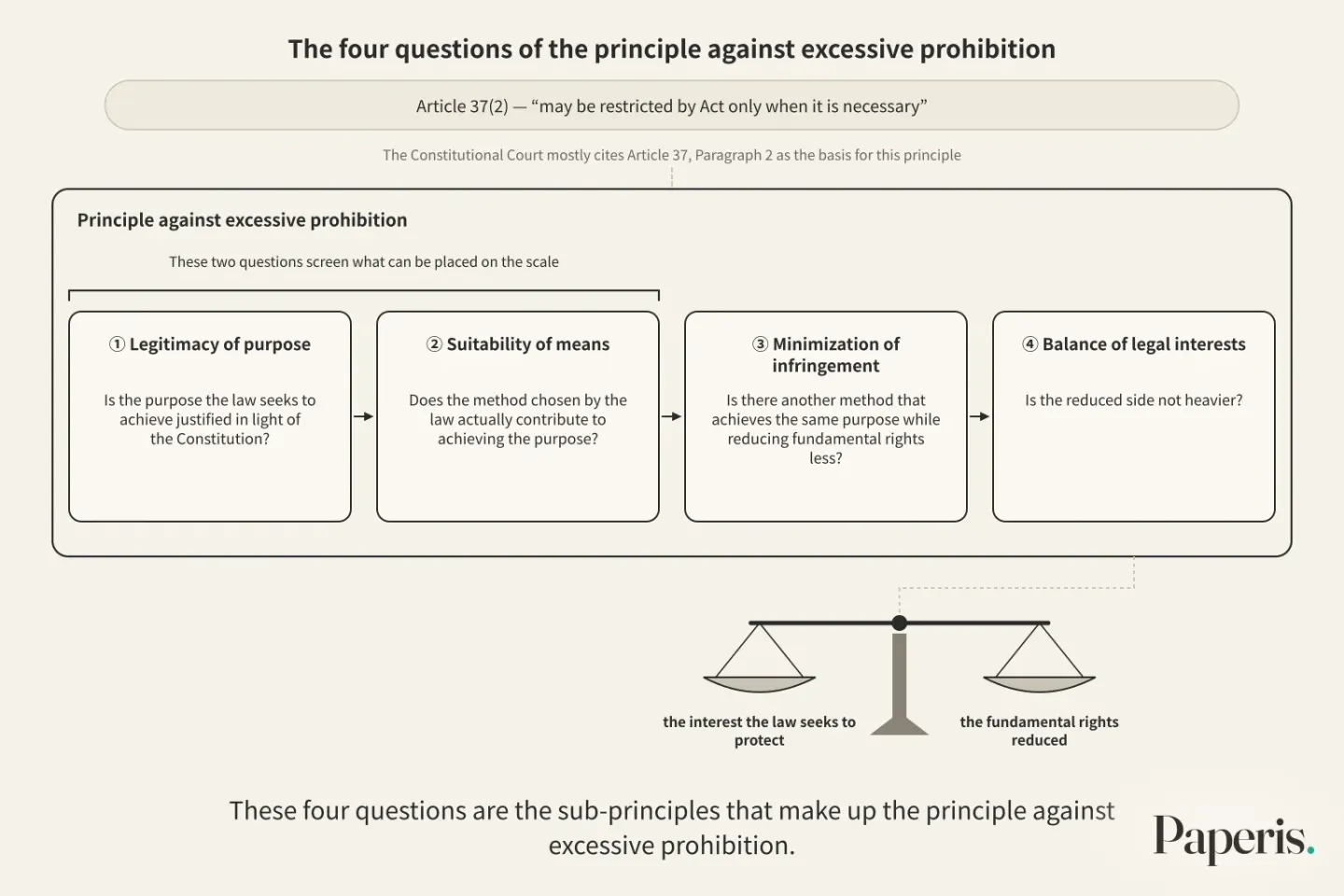
The heading of the passage taking center stage in the decision on the Internet real-name system is "Whether the Principle Against Excessive Prohibition Is Violated" (Constitutional Court 2010Hun-Ma47). The principle against excessive prohibition is the principle that when the state restricts fundamental rights, the purpose must be justified, the means must be appropriate, it must not exceed the necessary extent, and the public interest to be protected and the private interest to be lost must achieve balance.
The Constitutional Court mostly cites Article 37, Paragraph 2 as the basis for this principle. There are also scholars who view that the basis should be found not in that provision, but in the larger principle that the country must operate according to law, and those scholars view that whether this principle is used is also determined by the nature of each fundamental right (DOI: 10.15821/slr.2024.31.4.002). When trimming away freedoms, this principle asks four things.
Legitimacy of purpose is the step that asks whether the purpose the law seeks to achieve is justified in light of the Constitution. Suitability of means is the step that asks whether the method chosen by the law actually contributes to achieving the purpose. These two questions screen what can be placed on the scale.
Minimization of infringement is the step that asks whether there is another method that can achieve the same purpose while reducing fundamental rights less. Whether such another method exists is determined by examining together whether the other method achieves the purpose equally and whether it truly reduces fundamental rights less (DOI: 10.29305/tj.2017.12.163.75).
Balance of legal interests is the step that places the interest the law seeks to protect and the fundamental rights reduced because of the law on the scale, asking whether the reduced side is not heavier. These four questions are the sub-principles that make up the principle against excessive prohibition (DOI: 10.15821/slr.2024.31.4.002) (KCI ART001773416).
Weighing the Real-Name System
The internet real-name system was a legal system that required sites with an average of 100,000 or more daily users to allow only people who had gone through an identity verification process to write posts on bulletin boards, and in 2011 there were 146 such sites (Constitutional Court 2010Hun-Ma47).
This system was discussed around 2005 as personal information leaks and the harm of verbal abuse continued to occur, and was introduced through a 2007 law revision. Bulletin board operators had to keep users' identity verification information until 6 months after a post was published (Constitutional Court 2010Hun-Ma47).
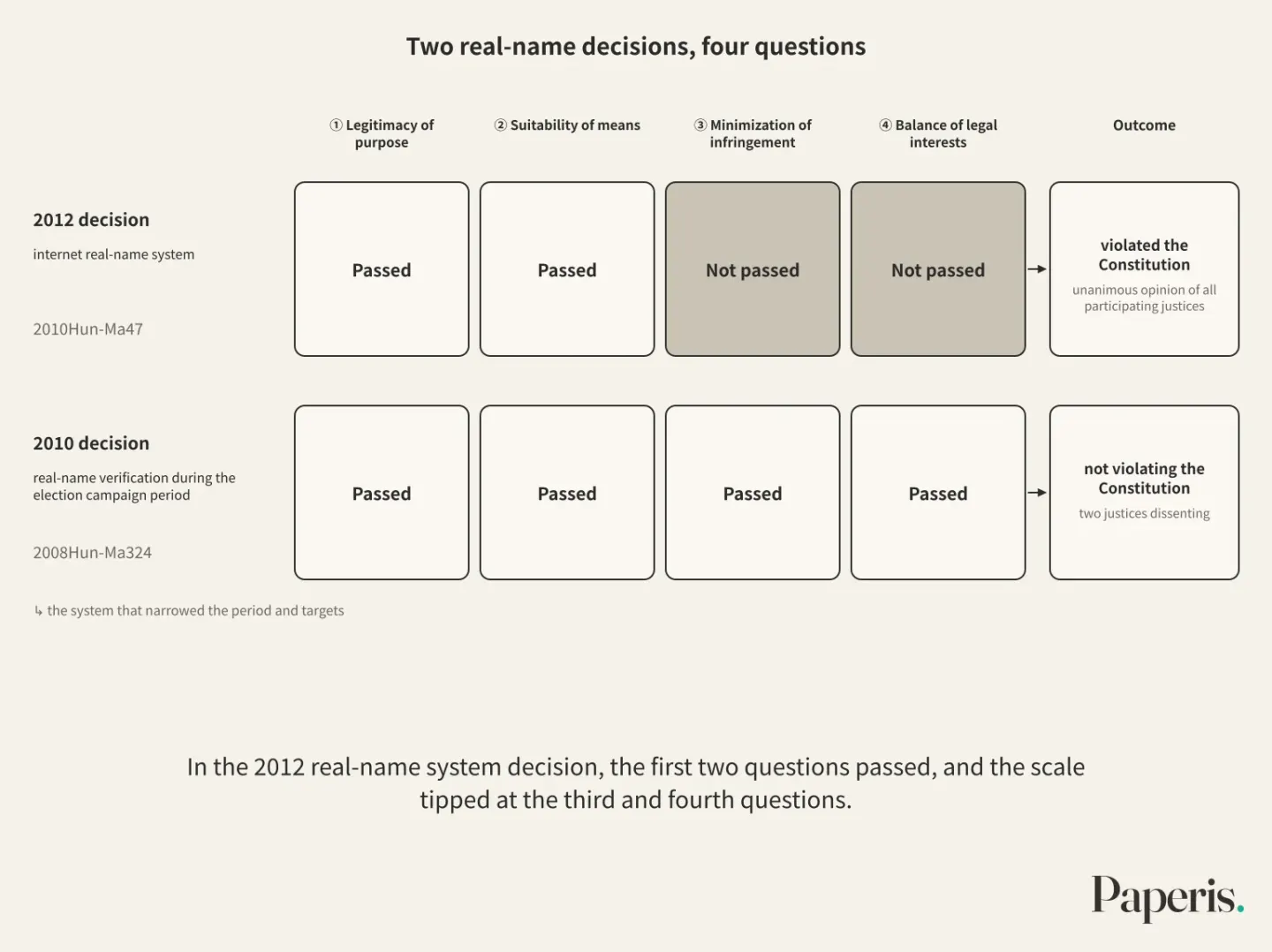
The first and second questions passed. Regarding the goal of blocking verbal abuse, defamation, and illegal information and securing data to find the offender when harm occurred, the Constitutional Court wrote that this system "is recognized as a suitable means contributing to the achievement of a legitimate purpose" (Constitutional Court 2010Hun-Ma47).
The scale moved at the third question. The same purpose was that it "could be sufficiently achieved by other means that do not restrict internet users' freedom of expression or right to informational self-determination." Internet address tracking, the removal and temporary blocking of posts, and subsequent damages and criminal punishment are those other means (Constitutional Court 2010Hun-Ma47).
The scope of application was also broad. Read literally, even people who only read posts were targets for verification, and if a post was not deleted, the verification information could be stored without a time limit. The Constitutional Court did not recognize the minimum-infringement requirement, stating that this system treats all citizens like potential criminals (Constitutional Court 2010Hun-Ma47).
The two pans were placed on the scale at the fourth question. The decision text wrote that "in order to justify the prior restriction of freedom of expression, the effect of the public interest to be achieved by that restriction must be clear." However, users moved to overseas sites, and even with the data submitted by the Korea Communications Commission, no evidence could be found that defamation, insult, and slander posts had decreased meaningfully enough after the implementation of the system to justify preventing expression in advance (Constitutional Court 2010Hun-Ma47).
The basic rights side of the scale was heavy. It was highly likely to make people hesitate to speak out of fear that their name and resident registration number would be exposed and they would suffer disadvantages, and foreigners and some overseas Koreans without resident registration numbers were practically blocked from posting. On August 23, 2012, the Constitutional Court decided with the unanimous opinion of all participating justices that these provisions violated the Constitution (Constitutional Court 2010Hun-Ma47).
A dissenting opinion is an opinion written and left by a judge who does not agree with the conclusion of a judgment explaining why their thoughts are different. In the Constitutional Court, the judges are called Justices, and its rulings are called decisions rather than judgments. There is no dissenting opinion in this decision. The beginning of the decision text contains the argument of the Korea Communications Commission, which submitted an opinion to the trial, and it is the side of the argument that the court did not accept. The argument was that this system did not expose real names, and thus did not violate the freedom of anonymous expression in a way that goes against the principle of prohibition of excessive infringement (Constitutional Court 2010Hun-Ma47).
There is also a decision where the same scale tipped the other way. In 2010, the Constitutional Court viewed as not violating the Constitution a provision that required real-name verification when writing posts supporting or opposing a political party or candidate on internet news outlet bulletin boards during the election campaign period. The verification period was narrowed to the election campaign period and the targets to support or oppose posts, and minimum infringement was recognized in that instead of the real name, only a "real-name verified" mark appeared. The balance of legal interests was considered separately. The judgment was that public interests such as election fairness were greater than the inconvenience users experienced during the verification process, the hesitation they experienced while posting, and the costs to internet news outlets (Constitutional Court 2008Hun-Ma324).
In that decision, two justices issued a dissenting opinion. The reason was that preventing things in advance even though there are subsequent regulatory means is "treating citizens as potential criminals" (Constitutional Court 2008Hun-Ma324). Academia was also divided. Before the 2012 decision, there was research arguing that the real-name system was unconstitutional because it infringed on the essential aspect of freedom of expression (KCI ART001379184), and research arguing that it was not unconstitutional because it infringed neither the essential content nor the prohibition of excessive infringement (KCI ART001482308).
In the 2012 real-name system decision, the first two questions passed, and the scale tipped at the third and fourth questions. The system of the 2010 decision, which narrowed the period and targets, passed those two questions as well.
The Crime of Adultery — The Same Scales, a Different Read
Article 241 of the Criminal Act, enacted in 1953, punished a married person who committed adultery, along with their partner, by imprisonment for up to 2 years. The Constitutional Court decided in 1990, 1993, 2001, and 2008 that this provision did not violate the Constitution (Constitutional Court 2009Hun-Ba17).
In the 2008 decision, four justices voted for constitutionality, four voted for unconstitutionality, and one voted for nonconformity with the Constitution, falling short of the required six, so the provision remained constitutional (Constitutional Court 2007Hun-Ga17). A decision of nonconformity with the Constitution is a decision where the court rules that a law goes against the Constitution, but rather than destroying its effect on the spot, gives the National Assembly an opportunity to fix it. The detailed circumstances of that decision are covered in "What the Constitutional Court Does — Five Windows and Six Votes".
Among the four on the constitutional side back then, three justices answered the fourth question that what gets infringed is the restriction of sexual activity in a specific relationship, which is light, while the public interest protected is heavy (Constitutional Court 2007Hun-Ga17). On February 26, 2015, seven out of nine justices delivered unconstitutionality opinions, leading the Constitutional Court to decide that the provision violated the Constitution (Constitution of the Republic of Korea, Article 111(2)) (Constitutional Court 2009Hun-Ba17).
The majority opinion is the view held by the greater number of judges who participated in the trial, making up the ruling and its reasons. The decision document calls the opinions of five justices in this case the majority opinion. Regarding the purpose of protecting the institution of marriage and the couples' duty of chastity, the majority opinion wrote that "the legitimacy of its legislative purpose is recognized" (Constitutional Court 2009Hun-Ba17).
From the majority opinion's view, where this provision ran into trouble was the second and third questions. It stated that it is difficult to see citizens' perceptions as still aligned on whether punishing adultery with state penalties is appropriate, that prosecution requires divorce as a premise which fails to protect the family, and that separate civil systems such as divorce and damages exist. The majority opinion wrote that "the maintenance of marriage and family should be left to the free will and affection of the parties, and cannot be coercively forced through punishment" (Constitutional Court 2009Hun-Ba17).
In the same passage, the majority opinion wrote that whether to govern a certain act with punishment and leave it to morals "cannot help but be determined according to the societal conditions of that era, the consciousness of society members, etc." The dissenting opinion also wrote that the issue "cannot help but be determined by the societal conditions of that era or the consciousness of society members, etc." In the same sentence, the majority opinion moved toward the side that the state must step back, while the dissenting opinion moved toward the side that it is a matter for the legislature to decide (Constitutional Court 2009Hun-Ba17).
On the fourth question as well, the majority opinion viewed that the interests to be protected are hard to achieve through this provision, whereas the right to sexual self-determination and freedom of privacy are excessively reduced (Constitutional Court 2009Hun-Ba17). The remaining two justices on the unconstitutionality side had different reasons. One viewed it as excessive to uniformly punish even cases where a marriage has practically broken down and partners who are not married.
Another justice, while acknowledging the need to block adultery by law, viewed that because the meanings of condonation and forgiveness—exceptions that block prosecution—are unclear, it violates the principle of clarity, and that fixing only prison sentences lost the balance between responsibility and punishment (Constitutional Court 2009Hun-Ba17).
The dissenting opinion of two justices first expressed doubt in including even adultery within the scope protected by the right to sexual self-determination. They also viewed that whether to govern it with punishment is a matter for the legislature to decide (Constitutional Court 2009Hun-Ba17).
The dissenting opinion also did not agree with the judgment that society has changed. "Although the majority opinion states that our society's majority legal consciousness regarding adultery has changed, there is no evidence whatsoever to prove this, such as the results of fact-finding surveys on the current public legal consciousness." It then cited data showing that 60.4% of respondents favored keeping the law in a 2014 survey (Constitutional Court 2009Hun-Ba17).
Although the dissenting opinion did not write out the four questions in order, it wrote its judgment corresponding to the fourth question like this: "It cannot be said that the public interest outcomes gained from the provision subject to adjudication and the negative effects caused thereby deviated from a reasonable proportional relationship." (Constitutional Court 2009Hun-Ba17) There were multiple passages where the two sides read differently, and one of them was where society stands right now.
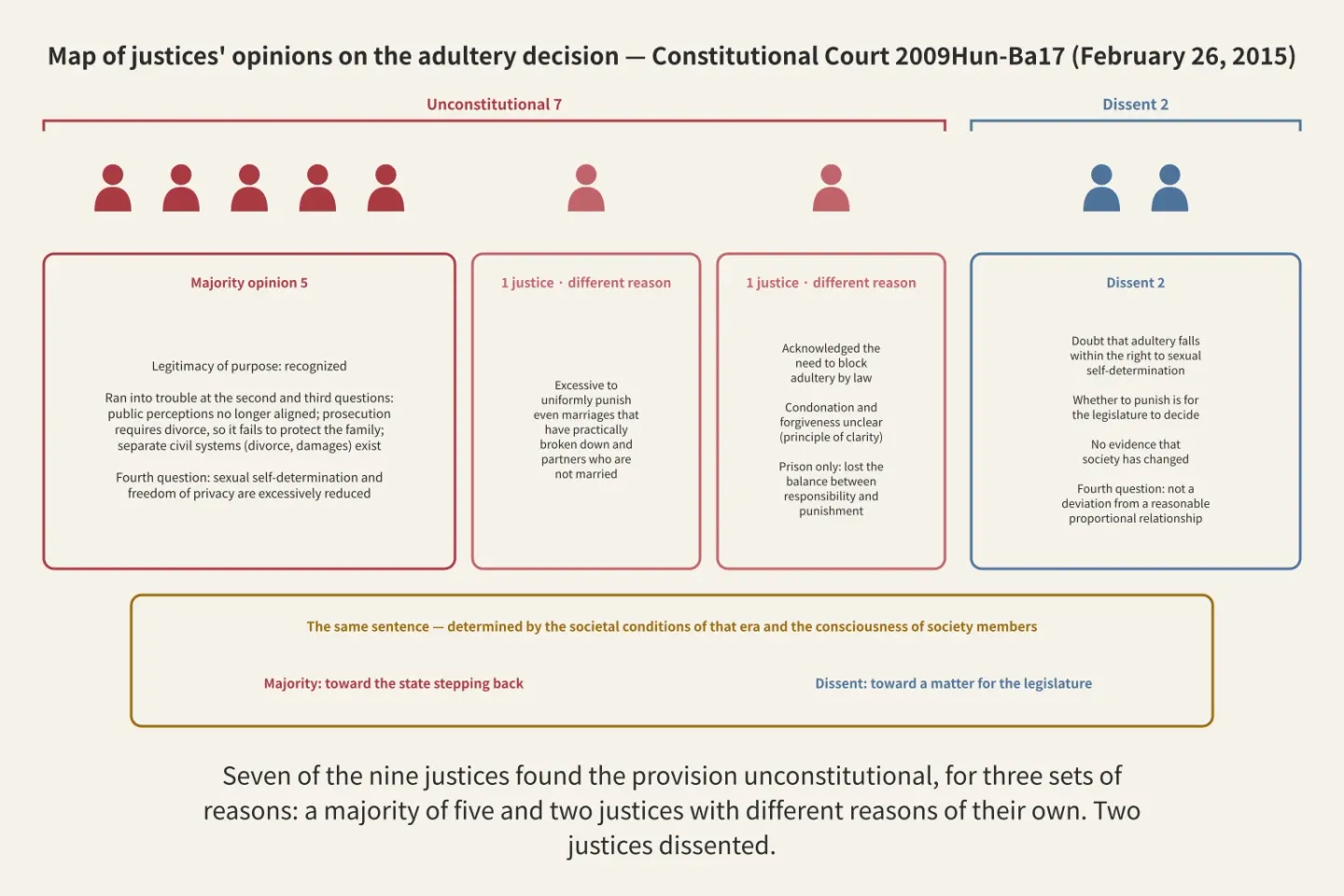
Figure: a diagram Paperis drew using only what the article says
Equality is Measured with Different Yardsticks
In October 1998, five women preparing for Grade 7 or Grade 9 national civil service exams and one male university student with a disability filed a constitutional complaint with the Constitutional Court. This was because of the discharged veteran's bonus points system, which added 3% or 5% of the total possible score on each written exam to applicants who had completed their military service (Constitutional Court 98Hun-Ma363).
The Constitutional Court uses broadly two yardsticks to measure equality. The prohibition of arbitrariness principle is a loose yardstick for measuring equality that only checks whether there is a reasonable justification for discrimination. Under this yardstick, discrimination may not violate equality as long as there is a reasonable justification, and the other yardstick is a stricter one (KCI ART001584116) (DOI: 10.17926/kaolp.2018.18.2.581).
The Constitutional Court named two cases where it uses the strict yardstick. They are cases where the Constitution specifically demands equality, and cases where related fundamental rights are significantly restricted because of discrimination. The bonus points system fell under both (Constitutional Court 98Hun-Ma363).
Article 32, Paragraph 4 of the Constitution stipulates, "Women's labor shall be special protected, and no unfair discrimination shall be received regarding employment, wages, and working conditions" (Constitution of the Republic of Korea, Article 32(4)). The bonus points treated men and women differently precisely in that realm of employment, and also served as a heavy restriction on the right to enter public office (Constitutional Court 98Hun-Ma363). The ruling wrote that strict review "does not stop at reviewing the presence or absence of a reasonable justification," but also examines whether there is a strict proportional relationship between the purpose and the means of the discrimination (Constitutional Court 98Hun-Ma363).
What was divided on the surface were discharged veterans and non-veterans. The Constitutional Court looked inside that division. Because almost all women do not fall under discharged veterans and most men become discharged veterans, it viewed this system as practically discrimination based on sex. Men judged unable to handle military service and men who served as supplemental service personnel were also left outside the benefits (Constitutional Court 98Hun-Ma363).
It acknowledged the purpose. The ruling wrote that helping discharged veterans who became disadvantaged in job preparation due to military service return to society is "entirely possible in terms of legislative policy and also very necessary," and that "this legislative purpose is justifiable" (Constitutional Court 98Hun-Ma363). Where it caught was the method. In the 1998 Grade 7 general administrative exam, 72 out of 99 successful candidates were discharged veterans who received bonus points, and in an exam where passing was decided by a fraction of a point, the bonus points determined success or failure (Constitutional Court 98Hun-Ma363).
The Constitutional Court judged that this system lost the proportionality of discrimination, infringed upon the right to equality, and blocked entry into public office based on criteria unrelated to ability. The ruling also named other support methods such as calculating pay steps, job placement, and vocational training. On December 23, 1999, unconstitutionality was decided by the unanimous opinion of all participating justices (Constitutional Court 98Hun-Ma363).
There is no dissenting opinion in this decision either. The front part of the ruling contains the opinion of the Minister of Patriots and Veterans Affairs, an affiliated agency, which is an argument the court did not accept. It was the argument that bonus points are a system that compensates even a little for the losses of those who missed out on studies and livelihoods due to military service while protecting the morale of active-duty soldiers, and that mechanically making people who served in the military and those who did not compete identically actually runs counter to substantive equality (Constitutional Court 98Hun-Ma363).
The ruling started by examining whether bonus points are a system grounded in the Constitution and looked at Article 39, Paragraph 2. The Constitution stipulates, "No person shall receive disadvantageous treatment due to the fulfillment of military service obligations" (Constitution of the Republic of Korea, Article 39(2)). The Constitutional Court read that what this clause prohibits is legal disadvantage and does not impose even the duty to give compensation or special favors, and judged that bonus points were not a system grounded in this clause (Constitutional Court 98Hun-Ma363).
There is an evaluation that although the Constitutional Court has newly established the framework for equality review since this decision, its criteria and methods do not yet satisfy the demands of the constitutional state's rationality (DOI: 10.31779/plj.9.3.200808.009). There is also criticism that the method of dividing the yardstick into two itself increases the possibility of arbitrary judgment (DOI: 10.17926/kaolp.2018.18.2.581). Equality is measured by whether there is a reasonable justification for discrimination, and discrimination where the Constitution specifically demands equality or fundamental rights are greatly reduced is measured more strictly.
The Final Line, The Essential Content
The end of Article 37, Paragraph 2 reads, "Even when restricting them, [we] shall not infringe upon the essential content of freedoms and rights" (Constitution of the Republic of Korea, Article 37(2)). The prohibition of infringing on essential content is the principle that even when restricting a fundamental right, one must not destroy the core of that right.
Regarding how much of that core must be protected, theories are deeply divided, and it is evaluated that the Constitutional Court has not taken only one side. That research suggests that, separately from what can already be achieved by the principle of prohibition of excessive restriction, it is the right direction to bring to life the meaning of this principle that the Constitution has written down (KCI ART001835349).
The Constitutional Court sometimes examines the principle of prohibition of excessive restriction and this principle side by side in a single decision, but which one it looks at first varies from decision to decision (KCI ART001986176). Article 37, Paragraph 2 draws one more line that cannot be crossed even for restrictions that have passed the scales (Constitution of the Republic of Korea, Article 37(2)).
Scales Without Graduations
The scales in this article have limits. A kitchen scale has graduations that tell you the weight, but these scales have no graduations. It is the judges who read the weights of the benefits and fundamental rights placed on the plates. In the crime of adultery case, nine judges split 7 to 2, and the reasons of the seven on the unconstitutionality side also divided into three (Constitutional Court 2009Hun-Ba17).
There is criticism that when applying this principle, there is much room for subjective judgment to intervene, and thus it risks becoming an excessive means of controlling the National Assembly. The same study concludes that because of the nature of fundamental rights norms, this principle is unavoidable, so rather than guarding against it, it should be refined more precisely to serve as a standard for rational argumentation (KCI ART001773416).
There is also criticism that there are many decisions where arguments concentrate on the third question while the fourth question is left empty (DOI: 10.29305/tj.2017.12.163.75). Actual decision texts do not always write out the four questions separately. The majority opinion in the adultery decision lumped the second and third together into a single passage called "appropriateness of means and least restriction," and considered the fourth separately (Constitutional Court 2009Hun-Ba17).
Fundamental rights can be restricted, and that restriction is not justified merely by the reason of being a statute. The provisions dealt with by the decisions in this article were all statutes or enforcement decrees beneath them (Constitutional Court 2010Hun-Ma47) (Constitutional Court 2009Hun-Ba17) (Constitutional Court 98Hun-Ma363). The decision text leaves behind the weight reading that led to that conclusion along with the conclusion, and the dissenting opinion leaves behind a differently read weight. Cases where the Constitutional Court changed its judgment on the same provision, like the crime of adultery, are also recorded in the decision text.
Where to Look Next
How the majority opinion and dissenting opinions are divided and written within a decision is covered by "How to Read a Court Judgment — A One-Line Answer and Its Reasons". The point where freedom of expression collides with another person's privacy continues in "The Right to Be Forgotten — The Internet Never Forgets", and new ways the state enters privacy in "Facial Recognition and Surveillance — What the Law Has Not Decided".
"What is a Constitution — A Wall That Cannot Be Easily Torn Down" covers unconstitutionality and nonconformity with the Constitution, and "What the Constitutional Court Does — Five Windows and Six Votes" covers constitutional complaints and the number of judges required for a ruling of unconstitutionality. Among fundamental rights, the right to vote is the subject of "Elections and Representation — The Same Pie, Different Slices".
Source Papers
- "Article 10 of the Constitution of the Republic of Korea" (Effective 1988) — Original legal text — Human dignity and value, right to pursue happiness, and the State's duty to guarantee fundamental human rights.
- "Article 11 of the Constitution of the Republic of Korea" (Effective 1988) — Original legal text — Equality before the law, and prohibition of discrimination based on sex, religion, or social status.
- "Article 12 of the Constitution of the Republic of Korea" (Effective 1988) — Original legal text — Freedom of the person, prohibition of arrest, detention, or search except through the law, and prohibition of punishment except through the law and due process.
- "Article 17 of the Constitution of the Republic of Korea" (Effective 1988) — Original legal text — Privacy and freedom of private life.
- "Article 18 of the Constitution of the Republic of Korea" (Effective 1988) — Original legal text — Secrecy of correspondence.
- "Article 21 of the Constitution of the Republic of Korea" (Effective 1988) — Original legal text — Freedom of speech, press, assembly, and association, along with their responsibilities (prohibition of infringing upon others' honor or rights, and compensation for damages).
- "Article 32 of the Constitution of the Republic of Korea" (Effective 1988) — Original legal text — Paragraph 4: Special protection for women's labor and prohibition of unfair discrimination in employment, wages, and working conditions.
- "Article 34 of the Constitution of the Republic of Korea" (Effective 1988) — Original legal text — Right to a human life and the State's duty to promote social security and social welfare.
- "Article 37 of the Constitution of the Republic of Korea" (Effective 1988) — Original legal text — Protection of unenumerated freedoms and rights, restriction by law only when necessary, and prohibition of infringing upon essential content.
- "Article 39 of the Constitution of the Republic of Korea" (Effective 1988) — Original legal text — Paragraph 2: Prohibition of unfavorable treatment resulting from the fulfillment of military service obligations.
- "Article 111 of the Constitution of the Republic of Korea" (Effective 1988) — Original legal text — Jurisdiction of the Constitutional Court and its composition of nine justices.
- "Article 113 of the Constitution of the Republic of Korea" (Effective 1988) — Original legal text — Concurrence of six or more justices is required for decisions of unconstitutionality of laws, etc.
- "Confirmation of Unconstitutionality of Article 44-5, Paragraph 1, Item 2, Etc. of the Act on Promotion of Information and Communications Network Utilization and Information Protection, Etc." (2012) — Constitutional Court 2010Hun-Ma47 — The internet bulletin board real-name verification system is acknowledged in its purpose and means, but lacks minimum infringement and balance of legal interests, thus violating freedom of speech, etc.; unconstitutional by unanimous consent of the participating justices.
- "Confirmation of Unconstitutionality of Article 82-6, Paragraph 1, Etc. of the Public Official Election Act" (2010) — Constitutional Court 2008Hun-Ma324 — Real-name verification for support or opposition posts on internet news agency bulletin boards during the election campaign period is constitutional (consolidated case provisions constitutional / claims rejected, partially dismissed) because minimum infringement is met through limited periods, targets, and non-display of real names, and the balance of legal interests is satisfied as the public interest such as election fairness outweighs user inconvenience and hesitation and news agency costs; dissenting opinion by two justices (treating citizens as potential criminals).
- "Referral for Unconstitutionality of Article 241 of the Criminal Act" (2008) — Constitutional Court 2007Hun-Ga17 — Constitutional with 4 constitutional, 4 unconstitutional, and 1 nonconformity opinions; although the unconstitutional opinion was in the majority, it fell short of the required unconstitutional quorum of six, settling previous three constitutional decisions (the 1990 majority opinion also acknowledged the restriction of sexual self-determination).
- "Constitutional Complaint on Unconstitutionality of Article 241 of the Criminal Act" (2015) — Constitutional Court 2009Hun-Ba17 — Unconstitutionality of the crime of adultery (seven justices, reasoning composed of three parts: 5 in the majority opinion considered the purpose legitimate but lacking appropriateness of means, minimum infringement, and balance of legal interests / 1 penalized marital breakdown and unmarried paramour uniformly / 1 focused on clarity, responsibility, and proportionality of punishment), two dissenting opinions, overturning four constitutional rulings from 1990 to 2008.
- "Confirmation of Unconstitutionality of Article 8, Paragraph 1, Etc. of the Act on Support for Discharged Soldiers" (1999) — Constitutional Court 98Hun-Ma363 — The discharged soldier point system is subject to strict scrutiny; while its purpose is legitimate, it loses proportionality in discrimination and infringes upon the right to equality and the right to hold public office, unconstitutional by unanimous consent of the participating justices.
- "Constitutional Basis of the Principle of Prohibition of Excessive Restrictions" (2024) — DOI: 10.15821/slr.2024.31.4.002 — The principle of prohibition of excessive restrictions consists of four sub-principles: legitimacy of purpose, appropriateness of means, minimum infringement, and balance of legal interests; the Constitutional Court mostly cites Article 37, Paragraph 2 as its basis, but the author argues it should be found in the principle of the state governed by the rule of law, and its application depends on the characteristics of fundamental rights.
- "Principle of Proportionality and Fundamental Rights" (2013) — KCI ART001773416 — The principle of proportionality carries a high room for subjective judgment, posing a risk of excessive legislative control, but because it is inevitable given the nature of fundamental rights norms, it must be refined to serve as a rational standard of argumentation.
- "Argumentation Structure of the Principle of Prohibition of Excessive Restrictions - Focusing on the Principle of Minimum Infringement -" (2017) — DOI: 10.29305/tj.2017.12.163.75 — Minimum infringement is a review that weighs legislative alternatives on both fronts of achieving the purpose and the degree of fundamental rights restriction, and the author critiques that the Constitutional Court's mainstream precedents concentrate argumentation on minimum infringement, often leaving the balancing part empty.
- "A Constitutional Study on Review Standards for the Principle of Equality" (2018) — DOI: 10.17926/kaolp.2018.18.2.581 — The Constitutional Court applies strict scrutiny (proportionality) when there is a special equality demand or severe fundamental rights restriction, and relaxed scrutiny (prohibition of arbitrariness) otherwise, but these standards heighten the possibility of arbitrary judgment.
- "Review Standards for the Principle of Equality under the Constitution" (2011) — KCI ART001584116 — Review standards for the general principle of equality are divided into relaxed scrutiny (prohibition of arbitrariness, meaning it may not be a violation if there is a rational reason) and strict scrutiny (proportionality).
- "Rationalization Plan for the Standards and Methods of Review for the General Principle of Equality" (2008) — DOI: 10.31779/plj.9.3.200808.009 — The Constitutional Court has developed a new interpretation theory of the principle of equality since the 1999 discharged soldier point decision, but the review standards and methods still fail to satisfy the demands of rule-of-law rationality.
- "Unconstitutionality of the “Internet Real-Name System”" (2009) — KCI ART001379184 — The argument that the restricted real-name verification system infringes upon the essential part of freedom of expression—namely, the freedom of anonymous expression—as well as the freedom of privacy, and violates equality, making it unconstitutional.
- "Whether the Internet Real-Name System Is Unconstitutional by Infringing Freedom of Expression" (2010) — KCI ART001482308 — The conclusion that the internet real-name verification system does not infringe the essential content of freedom of expression and the principle of prohibition of excessive restrictions, and is therefore constitutional.
- "Theory and Practice of the Principle of Prohibition of Infringing Essential Content — Looking Back on 25 Years of Constitutional Adjudication —" (2013) — KCI ART001835349 — The absolute theory and relative theory conflict regarding the degree of guarantee, and the Constitutional Court has also oscillated between the two positions; the author believes that the independent meaning of this principle, explicitly stated in the Constitution, must be realized.
- "Principle of Prohibition of Excessive Restrictions and Prohibition of Infringing Essential Content - Focusing on the Review of Application by the Constitutional Court -" (2015) — KCI ART001986176 — The Constitutional Court sometimes lists the principle of prohibition of excessive restrictions and the prohibition of infringing essential content in parallel, and the order of judgment varies across decisions.
Sources (4)
- 과잉금지원칙의 헌법적 근거DOI 10.15821/slr.2024.31.4.002
- 과잉금지원칙의 논증구조 -침해의 최소성 원칙을 중심으로DOI 10.29305/tj.2017.12.163.75
- 평등원칙 심사기준에 관한 헌법적 고찰DOI 10.17926/kaolp.2018.18.2.581
- 일반적 평등원칙의 심사 기준과 방법의 합리화 방안DOI 10.31779/plj.9.3.200808.009