
Paperis Articles
Separation of Powers — A Country That Splits Its Keys
Why the legislature that makes laws, the government that carries them out and the courts that judge are kept apart and made to check one another
Your field's papers, as audio
Pick your fields and journals — Paperis summarizes the key papers and turns them into audio. Listen on your commute.
Start Paperis free →Separation of Powers — A Country That Splits Its Keys
A Door That Cannot Be Opened with a Single Key
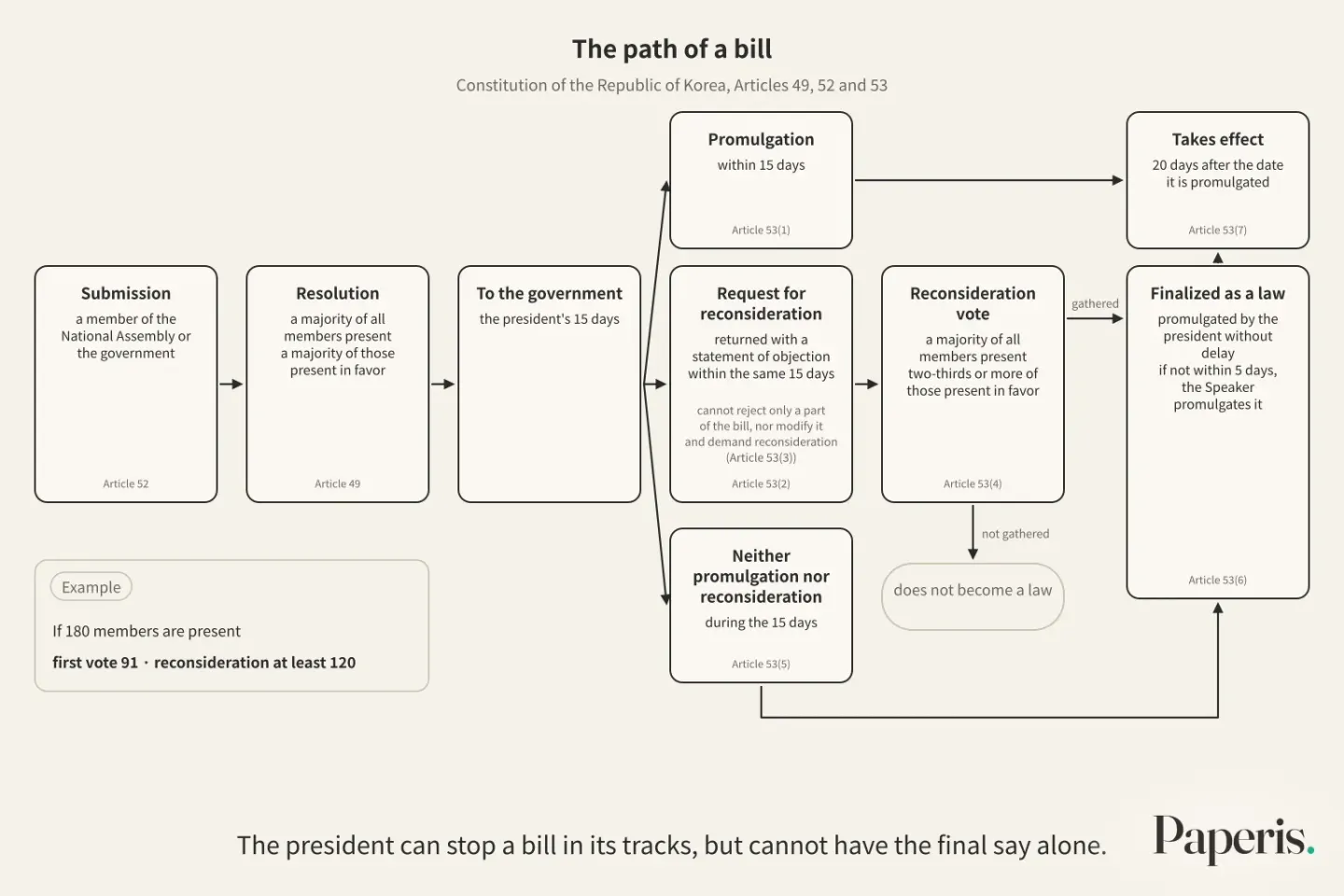
Even when the news reports that a bill has passed the National Assembly, that law does not take effect on that day. A bill voted on by the National Assembly goes to the government, and it must go through the process of the President making it widely known to the public within 15 days. The President may also send the bill back to the National Assembly, stating that they object to it. Then, the National Assembly must gather more votes in favor than the first time and vote on it again (Constitution of the Republic of Korea, Article 53). On the path where a single law comes into being, the National Assembly's turn and the President's turn are separate.
Think of a safe that opens only when two keys are turned together. If two people hold the keys separately, even if one person changes their mind or makes a mistake, they cannot open the door alone. The Constitution placed such a device on the country's major powers as well. This article follows in order who holds those keys, how the keys mesh with each other, and who prevails when they clash.
This article is written regarding the current Constitution of the Republic of Korea, which was made in 1987 and took effect in 1988. The Constitution is the highest law among all laws, setting the basic framework of the country and the basic rights of the citizens. Basic rights are the fundamental freedoms and rights guaranteed by the Constitution.
Dividing the Nation's Work into Three Sentences
The Constitution divides the nation's work into three sentences. "Legislative power shall be vested in the National Assembly." (Constitution of the Republic of Korea, Article 40) "Executive power shall be vested in the Government headed by the President." (Constitution of the Republic of Korea, Article 66(4)) "Judicial power shall be vested in the courts composed of judges." (Constitution of the Republic of Korea, Article 101(1))
We give a name to each of the three authorities appearing in these three sentences. Statutes are laws made by the National Assembly in accordance with procedures set by the Constitution. Legislative power is the authority to make statutes.
Executive power is the authority to actually run the nation's affairs by executing statutes. Judicial power is the authority to judge what is right according to the law when disputes arise.
The principle that bundles these three authorities together is the subject of this article. Separation of powers is the principle of dividing the nation's power into the work of making laws, the work of executing laws, and the work of judging according to laws, and entrusting them to different institutions. One more promise usually accompanies the separation of powers. It is the promise that one institution cannot infringe upon the powers of another institution (KCI ART002304046).
The idea of dividing things this way emerged long ago. Unlike the 18th-century thinker Locke, who had previously divided power into only two parts, the 18th-century French thinker Montesquieu saw that to protect individual freedom, the work of judging had to be separated from the institutions that make and execute laws. Therefore, he established the theory of dividing the nation's power into three functions for the first time and entrusting them to three independent institutions (KCI ART001055238). To the people who wrote the United States Constitution in 1787, the mingling of powers itself looked like the very definition of tyranny (KCI ART001055238).
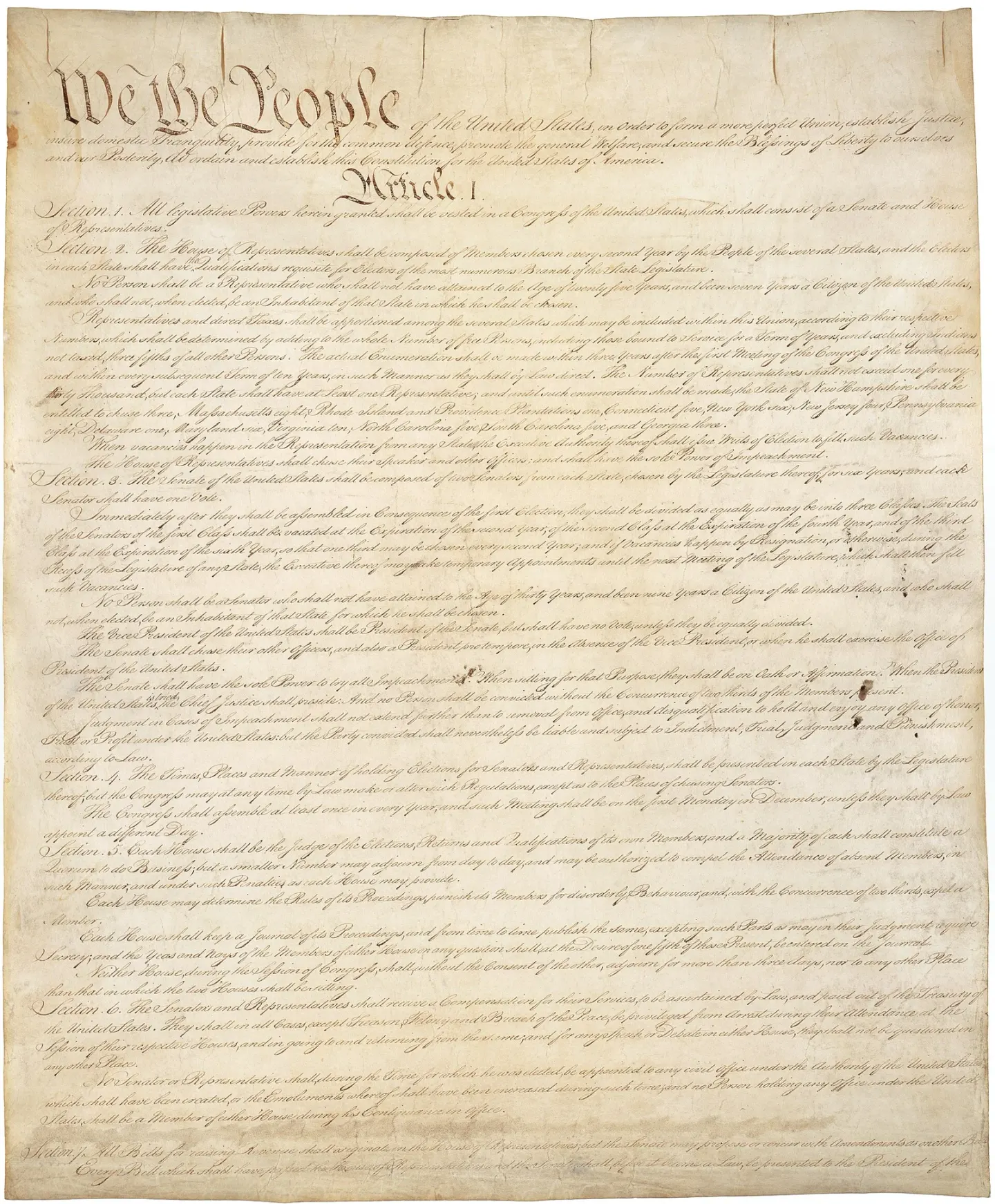
First page of the original United States Constitution, 1787 · Constitutional Convention, 1787 / U.S. National Archives · Wikimedia Commons (public domain)
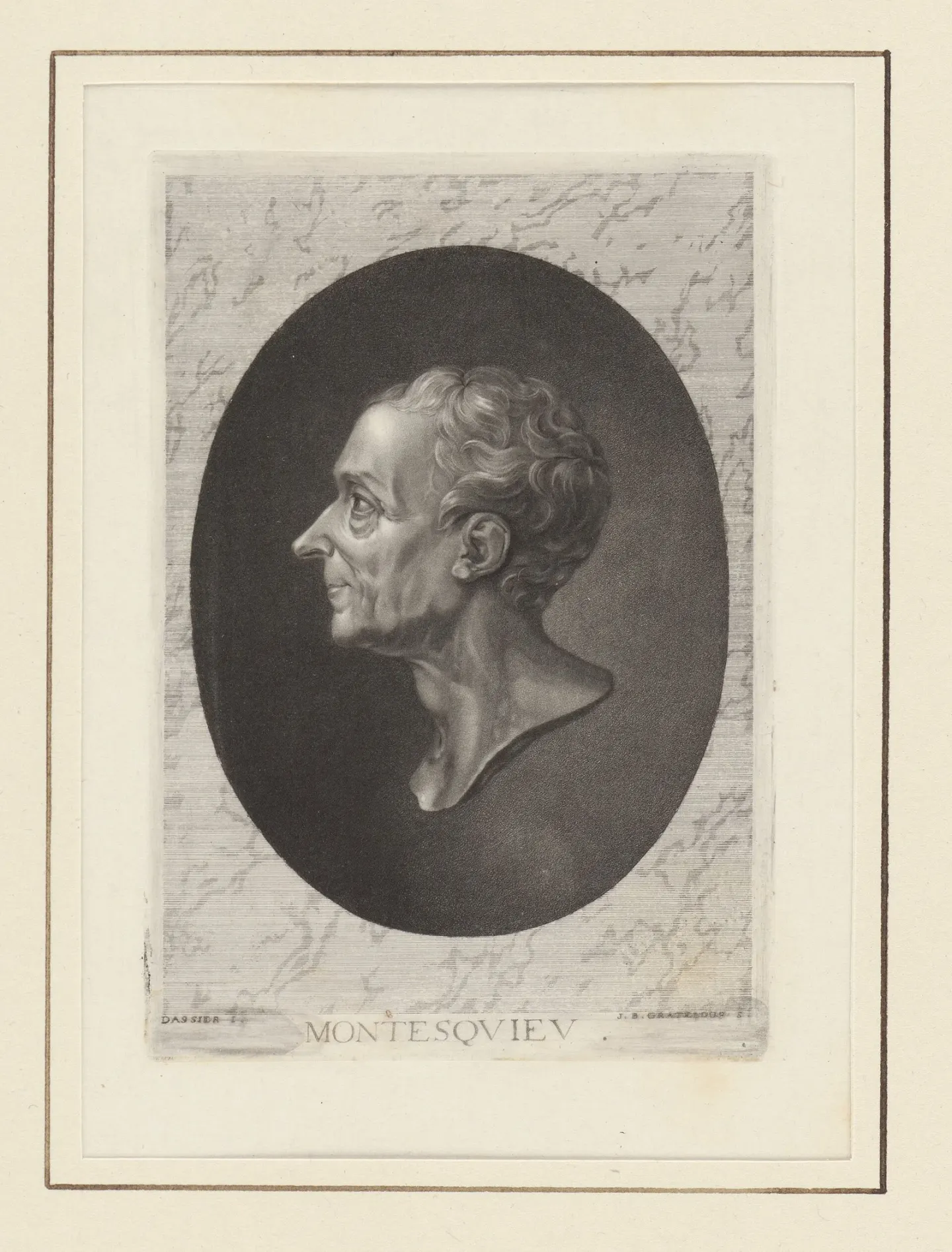
Montesquieu (1689–1755) · Print by Jean-Baptiste de Grateloup after Jacques-Antoine Dassier, 1768 / Rijksmuseum · Wikimedia Commons (public domain)
The biggest reason for dividing power is to protect the freedom and rights of the citizens (KCI ART001780161). Giving legitimacy to power is also cited as a motive for the separation of powers (DOI: 10.17248/knulaw..55.201608.1).
In our Constitution, the person who leads the executive power is the President. The President is the head of state and represents the country in foreign relations (Constitution of the Republic of Korea, Article 66(1)). The presidential system is a form of government in which the President leads the government and holds executive power, standing apart from the National Assembly to check each other. Both the President and members of the National Assembly are elected separately by the citizens (Constitution of the Republic of Korea, Article 67(1); Article 41(1)). In a presidential system, the President stands on the side of proposing and leading policies, while the National Assembly stands on the side of monitoring, approving, rejecting, or amending those policies (KCI ART002270438). However, the same study views that when determining important policies, neither side should try to monopolize leadership alone, and cooperation between the two is necessary (KCI ART002270438).
The safe-key analogy has its limits. Actual national affairs are not cleanly sliced into three like keys. Complete division as if blocked by partition walls is impossible in both theory and practice, so the U.S. Constitution also designed the three institutions to mix and take charge of each other's work a little bit (KCI ART001055238). There is also an analysis that because national affairs are intertwined, it is difficult for one institution to monopolize a single function (DOI: 10.17248/knulaw..55.201608.1). Whether Montesquieu intended a strict separation differs by research readings. There is an analysis that he did not argue for strict separation (DOI: 10.17248/knulaw..55.201608.1), and an analysis that while he argued for strict separation, he also emphasized cooperation among powers (KCI ART002270438). Even in our Constitution, bills can be proposed not only by members of the National Assembly but also by the Government (Constitution of the Republic of Korea, Article 52).
Nor does this safe open only when two keys are turned together identically. Even if the President does nothing for 15 days, a bill becomes final, and if the National Assembly gathers more votes, a bill sent back by the President also becomes a law (Constitution of the Republic of Korea, Article 53(4) and (5)).
Locking Each Other with Shared Keys
The National Assembly asks the government to submit documents and calls witnesses to question them. The text of the Constitution reads: "The National Assembly may inspect state affairs or investigate specific matters of state affairs, and may demand the submission of documents necessary therefor, the attendance of witnesses and the testimony or expression of opinions." (Constitution of the Republic of Korea, Article 61(1))
Two tasks are contained in this provision. A parliamentary inspection of state affairs is when the National Assembly looks across overall state affairs to check whether work is being done properly. A parliamentary investigation is when the National Assembly designates a specific matter of state affairs and investigates that matter. As the government's organization, personnel, budget, and authority have grown large enough to overwhelm the National Assembly and the courts, parliamentary inspections and investigations have come to lie at the center of how the National Assembly keeps the government in check (DOI: 10.35901/kjcl.2025.31.2.35). The same study notes that problems such as calling excessively many witnesses or making them wait for a long time have been pointed out for decades, and states that the fundamental rights of witnesses must also be respected (DOI: 10.35901/kjcl.2025.31.2.35).
Checks and balances is a device where divided powers each hold a means to prevent the other's abuse of authority, ensuring that neither side grows excessively large. The underlying idea is that preventing the abuse of power requires constitutional means to counter the intrusion of other organs (KCI ART001055238). Merely dividing power leaves each organ with unchecked power within its own box. Therefore, the Constitution gives each organ an extra key to stop another organ in its tracks.
The keys held by the National Assembly are numerous beyond just the parliamentary inspection. The Prime Minister can be appointed by the President only with the consent of the National Assembly (Constitution of the Republic of Korea, Article 86(1)). The National Assembly may recommend to the President the removal of the Prime Minister or a State Council member from office, and this recommendation requires a motion proposed by at least one-third of the all members of the National Assembly and concurred in by a majority of the all members (Constitution of the Republic of Korea, Article 63). The country's budget is also drafted and submitted by the government, after which the National Assembly reviews and finalizes it (Constitution of the Republic of Korea, Article 54(1) and (2)). The key that drafts and the key that finalizes are separated.
There is also an organ that reviews laws themselves. The Constitutional Court is an organ that decides whether laws fit the Constitution and settles disputes surrounding the Constitution. If whether a law runs counter to the Constitution becomes a precondition for a trial currently underway, the court makes a request to the Constitutional Court and conducts the trial in accordance with that adjudication (Constitution of the Republic of Korea, Article 107(1); Article 111(1)). Unconstitutional means that a law or a state action runs counter to the Constitution. Whether laws made by the National Assembly are unconstitutional or not is decided in this adjudication.
The composition of this organ also has divided keys. All nine justices are appointed by the President, but among them, three are appointed from persons elected by the National Assembly, and three are appointed from persons nominated by the Chief Justice of the Supreme Court (Constitution of the Republic of Korea, Article 111(2) and (3)). Three branches of power share and fill the seats of a single organ.
The heaviest key held by the National Assembly is impeachment. Impeachment is a resolution by which the National Assembly decides to refer a public official, such as the President or a judge, to the adjudication of the Constitutional Court when they violate the Constitution or laws in the performance of their duties. The Constitution lists public officials such as the Prime Minister and State Council members in addition to the President and judges as its targets (Constitution of the Republic of Korea, Article 65(1)). To impeach the President, a majority of the all members of the National Assembly must propose it and at least two-thirds of the all members must concur. For other public officials, a proposal by at least one-third of the all members and concurrence by a majority are sufficient. A person who has been impeached cannot exercise their authority until the adjudication takes place (Constitution of the Republic of Korea, Article 65). How the adjudication proceeds is covered in "What the Constitutional Court Does — Five Windows and Six Votes".
The key held by the courts comes conversely from not being swayed by anyone. "Judges shall adjudicate independently according to their conscience in accordance with the Constitution and laws." (Constitution of the Republic of Korea, Article 103) Judicial independence is when judges conduct trials according to the Constitution, laws, and conscience without receiving interference or instructions from anyone. Devices supporting this independence also exist in the Constitution. Judges are not removed from office unless they are impeached or sentenced to imprisonment without prison labor or a heavier punishment (Constitution of the Republic of Korea, Article 106(1)). Because the belief that trials are fair stems from this independence, judicial independence is counted as a constitutional value that must be guaranteed in a democratic state (KCI ART002216229).
Discussions continue regarding just how far judicial independence extends. One study argues that while a judge's independence from the parties to a case is an absolute requirement, in relation to other power organs with democratic legitimacy or to the citizenry, it should be viewed as a flexible concept that accepts a certain degree of involvement and control (DOI: 10.35215/jcj.2026.13.1.001).
Organs that check one another also work together. One study views the process where the Constitutional Court points out that a law is unconstitutional and the National Assembly amends the law as a division of labor and cooperation between the two organs of making laws fit the Constitution (KCI ART002974532). The divided organs hold the keys that stop each other in their tracks together with the keys that open doors.
The Path a Law Takes
We will follow a single bill along its path. This bill is made up for this article, and each step follows the constitutional text as written.
The first step is submission. A member of the National Assembly or the government introduces a bill (Constitution of the Republic of Korea, Article 52). The second step is resolution. Unless the Constitution or laws provide otherwise, the National Assembly passes a bill with a majority of all members present and a majority of those present voting in favor. If the ayes and nays are equal, the bill is considered rejected (Constitution of the Republic of Korea, Article 49).
A passed bill is sent to the government, and now it is time for the president's key to turn. Promulgation is the act in which the state widely notifies the citizens of a finalized law. The president promulgates a bill within 15 days of receiving it (Constitution of the Republic of Korea, Article 53(1)).
The president also has another path. The veto power is the authority for the president, when objecting to a bill passed by the National Assembly, to return it to the Assembly with a statement of objection and demand its reconsideration. This request for reconsideration must be made within the same 15 days, and can be done even when the Assembly is closed because it is out of session (Constitution of the Republic of Korea, Article 53(2)). The president cannot pick and choose only a part of the bill to reject, nor can they modify the bill and demand reconsideration (Constitution of the Republic of Korea, Article 53(3)).
When the bill is returned, the National Assembly votes again. This time, the door is narrower. If a majority of all members are present and two-thirds or more of the members present vote in favor to pass the same resolution as before, that bill is finalized as a law (Constitution of the Republic of Korea, Article 53(4)). At the time of the initial vote, a simple majority was enough. If 180 members are present, 91 votes are enough to pass it the first time, but a reconsideration requires at least 120 members to vote in favor.
If the president neither promulgates nor demands reconsideration during the 15 days, the bill is finalized as a law as-is (Constitution of the Republic of Korea, Article 53(5)). A finalized law must be promulgated by the president without delay. If the president does not promulgate a law finalized after the period has passed within 5 days of its finalization, or a law finalized through reconsideration within 5 days of being sent to the government, the Speaker of the National Assembly shall promulgate it (Constitution of the Republic of Korea, Article 53(6)). Unless otherwise provided, a law takes effect 20 days after the date it is promulgated (Constitution of the Republic of Korea, Article 53(7)).
Walking this path once reveals how the keys mesh together. A law does not finish immediately with just the National Assembly's vote, and the president can bring a bill to a halt. However, even if the president sits on their hands, the law is finalized, and if the promulgation of a finalized law is delayed, the Speaker of the National Assembly promulgates it instead. The president can stop a bill in its tracks, but cannot have the final say alone. If the National Assembly gathers the favor of two-thirds or more of the members present in a session attended by a majority of all members, it overrides that halt; if it fails to gather them, that bill does not become a law (Constitution of the Republic of Korea, Article 53(4)).
How heavy that "greater favor" is remains a matter of academic interest. One study considers that because the favor required for reconsideration is so high, it is practically difficult for the National Assembly to control the veto through reconsideration. The same study views that the veto also has constitutional limits in that it must not infringe upon the National Assembly's legislative power, and must be used fairly and impartially in light of the president's duty to realize the public interest and the principle of equality. The view is that an exercise of the veto that crosses those limits can be contested in the Constitutional Court (DOI: 10.35215/jcj.2024.11.1.006). This is the view of one researcher, and the veto is a power granted to the president by the constitutional text.
When Lending the Key to Making Laws
Let us imagine a legal provision that simply states, "Other necessary matters shall be determined by Presidential Decree." This example is also fabricated. It is difficult for the National Assembly to write every single detail into a statute, and there are times when details must be left to administrative agencies with expertise (KCI ART002002805). Even so, if they are left without any boundaries, the key to making laws passes over to the government entirely.
The Constitution drew that boundary like this: "The President may issue presidential decrees concerning matters delegated to him with the scope specifically defined and those necessary for the enforcement of Acts." (Constitution of the Republic of Korea, Article 75) A presidential decree is an order issued by the President regarding matters entrusted by a statute or necessary for enforcing a statute. A statute can entrust matters to a presidential decree, but a condition that must be observed at that time is included within the provision. That is the phrase 'with the scope specifically defined'.
The principle prohibiting blanket delegation is the principle that when the National Assembly entrusts matters that should be determined by statute to a subordinate norm like a presidential decree, it must specifically set what and how much is being entrusted within the statute. This principle is intended to protect the legislative function of the National Assembly and prevent executive power from arbitrarily making ordinances and infringing upon the freedoms and rights of citizens (DOI: 10.21589/ajlaw.2013.7.3.11). It is also a device to ensure that the legislative power entrusted by citizens to the National Assembly does not end up as an empty shell due to blanket delegation (DOI: 10.31536/jols.2020.17.1.007).
The Constitutional Court has read 'with the scope specifically defined' in this way. It means that the basic matters of the content to go into the presidential decree must be written specifically and clearly in the statute, so that anyone can predict roughly what will go into the presidential decree just by looking at that statute (DOI: 10.17251/legal.2016.29.2.315). Whether that prediction is possible is judged by placing all related provisions together rather than isolating a single provision (DOI: 10.17251/legal.2016.29.2.315). The greater the effect of restricting fundamental rights, the clearer the delegation must be, and entrusting regulations that impose burdens on citizens requires greater clarity than entrusting regulations that grant benefits (DOI: 10.31536/jols.2020.17.1.007).
There are also criticisms of this standard. Several studies argue that the subject required to predict the outline should be set as the administrative agency receiving the delegation and making the presidential decree, and should not be set as 'anyone' like the Constitutional Court does (KCI ART002002805; DOI: 10.16960/jhlr.21.3.202009.165). There is also the criticism that saying a statute should define the scope means 'writing it down' in the statute rather than weaving multiple provisions together to 'interpret it' (DOI: 10.17251/legal.2016.29.2.315). The standard stating that greater restrictions on fundamental rights demand greater clarity is also criticized as being uniform (DOI: 10.31536/jols.2020.17.1.007).
There is also a place where the borrowed key is reviewed once more. If whether an order such as a presidential decree violates the Constitution or statutes becomes a premise for a trial, the Supreme Court conducts the final review (Constitution of the Republic of Korea, Article 107(2)).
Returning to the key metaphor, the National Assembly can lend the key to making laws. However, the party lending it must specify in the statute which door it is to be used to open.
When State Organs Dispute
Around 6:00 AM on December 26, 1996, a plenary session of the National Assembly was held. The Vice Speaker of the National Assembly chaired the meeting in place of the Speaker, and all 155 members in attendance belonged to the ruling party. Five bills were placed on the agenda, and it was announced that they were put to a vote without questioning or debate and passed with the unanimous consent of all attending members in about 6 minutes (Constitutional Court 96Hun-Ra2).
The circumstances immediately preceding this are also recorded in the decision. An extraordinary session had been convened three days earlier, but opposition lawmakers blocked it, preventing the plenary session from being held for two consecutive days. Afterward, the time for opening the plenary session was changed to dawn, and opposition lawmakers were not properly notified of the changed time (Constitutional Court 96Hun-Ra2). Four days later, 125 opposition lawmakers filed a petition against the Speaker of the National Assembly with the Constitutional Court. The Speaker's side replied that it was an unavoidable measure taken because normal proceedings were impossible due to the violence and duress of the opposition lawmakers (Constitutional Court 96Hun-Ra2).
The petition they filed is the subject of this section. A competence dispute adjudication is a trial in which the Constitutional Court settles disputes when a disagreement arises over who holds what powers among state organs, between state organs and local governments, or among local governments. The Constitution assigns this adjudication to the work of the Constitutional Court, and the Constitutional Court Act divides its three branches into types (Constitution of the Republic of Korea, Article 111(1); Constitutional Court Act, Article 62(1)). It is a system that maintains the balance among state powers by clarifying the boundaries of competence (KCI ART003337159).
The decision was handed down on July 16, 1997, with nine justices answering three questions. To read the judgment, you need to know a few terms. The conclusion (jumoori) consists of the short sentences at the very beginning of a judgment document that state the outcome of the trial. The majority opinion is the opinion held by a greater number of participating judges that forms the conclusion and its reasons.
A dissenting opinion is an opinion left by a judge who did not agree with the conclusion of the judgment, explaining why their view is different. In the Constitutional Court, the judges are called Justices, and its rulings are called decisions rather than judgments.
The first question was whether members of the National Assembly could file this adjudication against the Speaker of the National Assembly. The Constitutional Court Act sets out competence dispute adjudications between state organs as "competence dispute adjudications among the National Assembly, the Government, the Courts, and the National Election Commission" (Constitutional Court Act, Article 62(1) item 1). In a 1995 decision, the Constitutional Court had ruled that members of the National Assembly could not become petitioners (Constitutional Court 96Hun-Ra2). This time, six justices changed that ruling. They took the view that this list was merely illustrative, that members and the Speaker of the National Assembly are also state organs established by the Constitution whose respective powers are granted by the Constitution and laws, and that since there is no other way to resolve a dispute between the two, they can be parties (Constitutional Court 96Hun-Ra2). To the argument that internal matters of the National Assembly should be handled by the Assembly itself, the majority opinion replied that "the autonomous power of the National Assembly must also be permitted within limits that do not violate the Constitution or laws" (Constitutional Court 96Hun-Ra2).
Three justices who wrote a dissenting opinion viewed that internal disputes within the National Assembly are not the subject of this adjudication. They also acknowledged that, from that perspective, opposition lawmakers would have no way to obtain relief even if their powers were infringed. However, they viewed that such a gap should be filled by the National Assembly enacting laws, and that the Constitutional Court should not expand the parties beyond the scope written in the statute. They wrote of this gap as "an obvious legislative deficiency, and such legislation should be enacted at the earliest possible date" (Constitutional Court 96Hun-Ra2).
The second question was whether the powers of the opposition lawmakers had been infringed. The majority opinion viewed that the power to deliberate and vote on bills "is guaranteed not only to members of the majority party in the National Assembly, but barring special circumstances, to minority members and individual members of the National Assembly alike" (Constitutional Court 96Hun-Ra2). To the circumstances put forward by the Speaker's side, it replied that "the unlawful act of the respondent in this case cannot be justified" merely on the grounds that opposition lawmakers had blocked the meetings (Constitutional Court 96Hun-Ra2). Excluding the three who dissented on the first question, the conclusion of the six was that the Speaker of the National Assembly had infringed the lawmakers' powers.
The third question was whether that day's declaration of passage should be invalidated—in other words, whether those laws would lose effect—and here the justices split three ways. Each of the three opinions has a name. Dismissal is a decision that ends a case without examining the substance, viewing the request as improper because it lacks the conditions to receive a trial. Rejection means that a court does not accept a demand or request. The same terms are used in decisions of the Constitutional Court.
Upholding is a decision where the Constitutional Court accepts a petition. In the third question, none of the opinions reached a majority, so there was no side that could be called the majority opinion. Three justices were of the view that the petition should be dismissed, as in the first question. Another three justices viewed that it should be rejected. Their reasoning was that since 155 members attended and voted unanimously, and public observation or reporting was not blocked, while there was a flaw of violating the National Assembly Act, it was not a flaw of clearly violating the Constitution. They wrote that immediately invalidating a law simply because of a procedural flaw "brings about a hazard to the stability of the national legal order" (Constitutional Court 96Hun-Ra2).
The remaining three justices viewed that the petition should be upheld to confirm invalidity. They wrote that "processing a bill solely with the majority party in the legislative process without giving the minority an opportunity to attend and without going through a debate process cannot be regarded as decision-making based on the majority principle" (Constitutional Court 96Hun-Ra2). Because the upholding opinion did not reach a majority of the justices, the Constitutional Court rejected the petition, and the laws did not lose effect (Constitutional Court 96Hun-Ra2). How dismissal, rejection, and upholding are used in other adjudications of the Constitutional Court is covered next in "What the Constitutional Court Does — Five Windows and Six Votes".
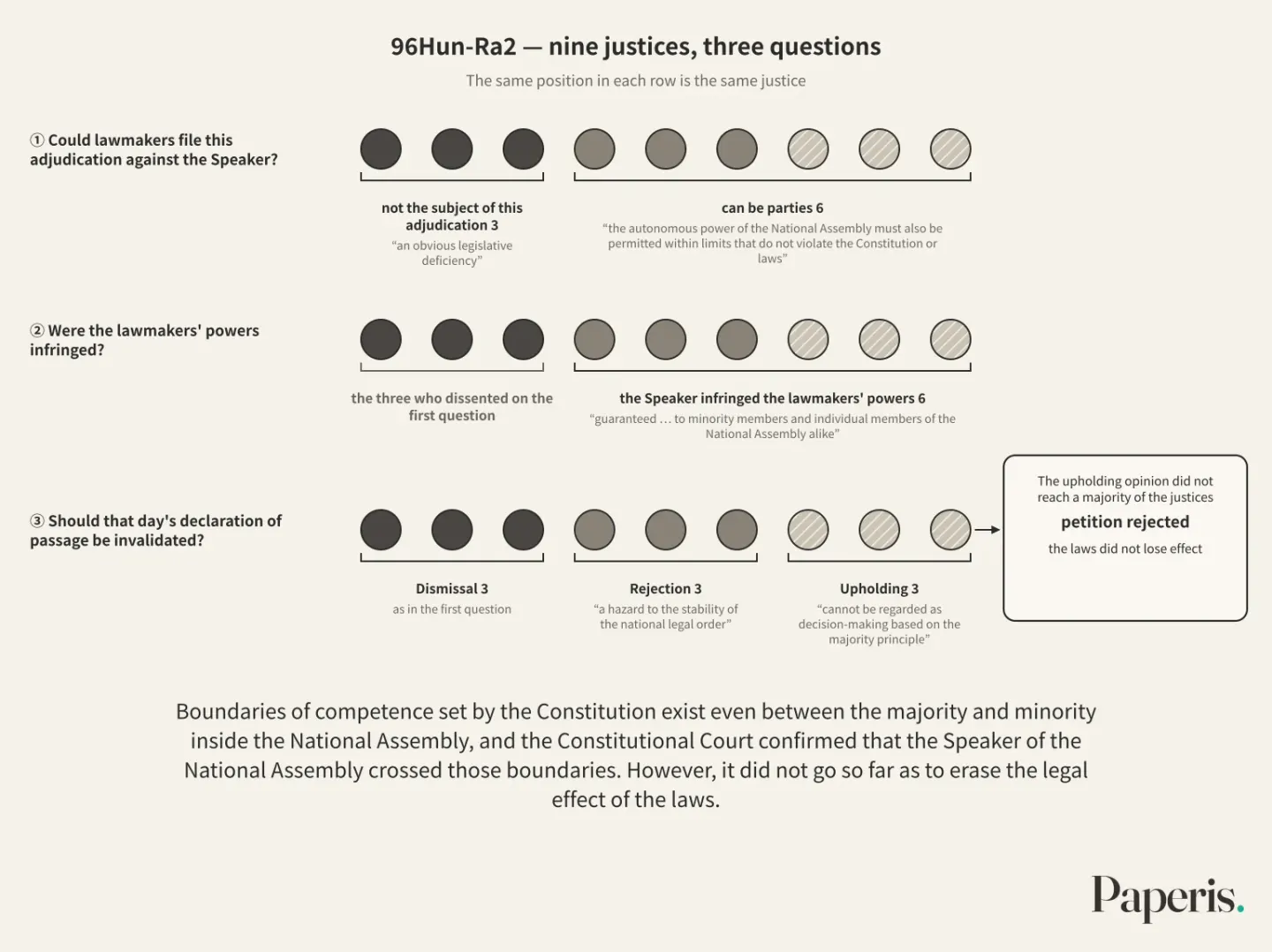
This decision jointly shows the path by which the Constitutional Court settles disputes between state organs and the point where that path stops. Boundaries of competence set by the Constitution exist even between the majority and minority inside the National Assembly, and the Constitutional Court confirmed that the Speaker of the National Assembly crossed those boundaries. However, it did not go so far as to erase the legal effect of the laws. In subsequent similar major cases as well, the Constitutional Court has maintained the conclusion of acknowledging competence infringement while not invalidating the declaration of passage (KCI ART003014233).
Evaluations of this framework are divided. There coexists the assessment that it is inevitable under the principle of the separation of powers, and the criticism that the Constitutional Court abdicated its duty to protect democracy (KCI ART003014233). The author of that study acknowledges that if competence infringement is confirmed yet not viewed as invalid, powers cannot be protected or reclaimed, leaving a limit to the practical effectiveness of this adjudication. At the same time, the author concludes that judicial self-restraint is appropriate, reasoning that invalidating a law on the grounds of procedural violation could lead to situations where procedural violations are intentionally created to invalidate laws. The final words of that conclusion are that tension and balance between law and politics must be properly maintained (KCI ART003014233).
Divided So They Open It Together
Now we return to the first safe. The National Assembly passes bills, but if the president sends them back, it must gather more votes; the president stops bills in their tracks, but if the Assembly gathers those votes, that stop is overcome. The courts try cases without taking orders from anyone, and the Constitutional Court holds even laws made by the Assembly up to the Constitution. The Assembly audits and investigates the government, and when it lends the key to make laws, it must set limits. The Constitution did not give all the keys to any single institution.
The institutions holding the divided keys block each other, but they also open doors together. The idea that independent institutions divide power and exercise it together is one way to reread the separation of powers (KCI ART002270438). How to reread the separation of powers to fit today's countries continues to be discussed in academia, and one study analyzes that five high school "Politics and Law" textbooks under the 2015 revised curriculum faithfully contain the old theory of the separation of powers but do not sufficiently contain the new discussions (DOI: 10.37409/RSSE.32.1.1).
Where to Look Next
What majority and dissenting opinions are and how to read a court judgment are covered in "How to Read a Court Judgment — A One-Line Answer and Its Reasons". How the court system is structured and what the Supreme Court does continue in "Korea's Three-Tier Courts and the Supreme Court — The Three Steps a Case Climbs, and Sometimes Comes Back Down".
Other parts of this series follow as well. What the constitution is and what unconstitutional means are covered in "What Is a Constitution — The Wall You Cannot Simply Knock Down", impeachment trials and the five types of trials by the Constitutional Court in "What the Constitutional Court Does — Five Windows and Six Votes", and the rules for electing members of parliament in "Elections and Representation — The Same Pie, Different Slices". The limits when the state restricts fundamental rights are covered in "Fundamental Rights and Their Limits — A Scale Without Graduations".
Source Papers
- "Article 40 of the Constitution of the Republic of Korea" (Enacted 1988) — Statutory text — Legislative power belongs to the National Assembly.
- "Article 49 of the Constitution of the Republic of Korea" (Enacted 1988) — Statutory text — Unless otherwise provided by the Constitution, the National Assembly shall make decisions with the attendance of a majority of the members registered and the concurrent vote of a majority of the members present; in case of a tie, the motion shall be rejected.
- "Article 52 of the Constitution of the Republic of Korea" (Enacted 1988) — Statutory text — Members of the National Assembly and the Executive may introduce bills.
- "Article 53 of the Constitution of the Republic of Korea" (Enacted 1988) — Statutory text — Promulgation within 15 days, demand for reconsideration with a statement of objections, prohibition of partial or modified reconsideration, enactment by a two-thirds majority of members present upon reconsideration, enactment upon expiration of the period, promulgation by the Speaker of the National Assembly if the President fails to do so within 5 days, and entry into force 20 days after promulgation.
- "Article 54 of the Constitution of the Republic of Korea" (Enacted 1988) — Statutory text — The National Assembly shall deliberate and decide upon the budget bill, which is formulated and submitted by the Executive.
- "Article 61 of the Constitution of the Republic of Korea" (Enacted 1988) — Statutory text — Parliamentary inspection and investigation of state administration by the National Assembly, and the power to demand the production of documents and the attendance of witnesses.
- "Article 63 of the Constitution of the Republic of Korea" (Enacted 1988) — Statutory text — Recommendation for the removal of the Prime Minister or a State Council member (motion by one-third of all members, approval by a majority of all members).
- "Article 65 of the Constitution of the Republic of Korea" (Enacted 1988) — Statutory text — Grounds and voting quorums for impeachment (motion by a majority and approval by two-thirds for the President), and suspension of powers upon passage of an impeachment motion.
- "Article 66 of the Constitution of the Republic of Korea" (Enacted 1988) — Statutory text — The President is the head of state, and executive power belongs to the Government headed by the President.
- "Article 67 of the Constitution of the Republic of Korea" (Enacted 1988) — Statutory text — The President shall be elected by universal, equal, direct, and secret ballot of the citizens.
- "Article 75 of the Constitution of the Republic of Korea" (Enacted 1988) — Statutory text — Presidential decrees concerning matters delegated with specific scopes defined by statute.
- "Article 86 of the Constitution of the Republic of Korea" (Enacted 1988) — Statutory text — The Prime Minister is appointed by the President with the consent of the National Assembly.
- "Article 101 of the Constitution of the Republic of Korea" (Enacted 1988) — Statutory text — Judicial power belongs to courts composed of judges.
- "Article 103 of the Constitution of the Republic of Korea" (Enacted 1988) — Statutory text — Judges shall judge independently according to their conscience in accordance with the Constitution and statutes.
- "Article 106 of the Constitution of the Republic of Korea" (Enacted 1988) — Statutory text — Judges shall not be removed from office except by impeachment or sentence of imprisonment without prison labor or heavier punishment.
- "Article 107 of the Constitution of the Republic of Korea" (Enacted 1988) — Statutory text — If the constitutionality of a statute is a prerequisite for a trial, the court shall request a ruling from the Constitutional Court, and the Supreme Court shall have final review power over the constitutionality or legality of administrative orders and rules.
- "Article 111 of the Constitution of the Republic of Korea" (Enacted 1988) — Statutory text — Jurisdiction of the Constitutional Court (review of unconstitutional statutes, competence disputes, etc.) and composition of its 9 justices (3 elected by the National Assembly, 3 designated by the Chief Justice of the Supreme Court).
- "Article 62 of the Constitutional Court Act" (Enacted 2026) — Statutory text — Three types of competence disputes (between state agencies, between a state agency and a local government, and between local governments).
- "Article 41 of the Constitution of the Republic of Korea" (Enacted 1988) — Statutory text — The National Assembly shall be composed of members elected by universal, equal, direct, and secret ballot by the citizens.
- "Competence Dispute between Members of the National Assembly and the Speaker of the National Assembly" (1997) — Constitutional Court 96Hun-Ra2 — Members of the National Assembly also qualify as parties to a competence dispute (precedent modification, 6 justices); infringement of opposition members' deliberation and voting rights recognized due to failure to notify the date of the plenary session; the claim for confirmation of nullity of the passage declaration split 3 for dismissal, 3 for rejection, and 3 for upholding, falling short of a majority for upholding, thus rejected.
- "Revisiting the Principle of Separation of Powers" (2007) — KCI ART001055238 — Montesquieu initially divided power into three parts for the sake of liberty; complete separation is impossible, so the US Constitution blends functions; meaning of checks and balances.
- "The Principle of Separation of Powers as a Standard for Constitutional Review — Focusing on US Supreme Court Precedents —" (2017) — KCI ART002304046 — Two components of the separation of powers (division and assignment of three powers, prohibition of infringing upon the powers of other branches).
- "Separation of Powers and the President's Appointment Power — Focusing on the National Assembly's Check Function —" (2017) — KCI ART002270438 — The President provides leadership while the legislature exercises control through monitoring, approval, veto, and revision, requiring cooperation and power-sharing among independent institutions.
- "Reconsidering the Principle of Separation of Powers" (2016) — DOI: 10.17248/knulaw..55.201608.1 — Neither Locke nor Montesquieu argued for strict separation, and state functions overlap, making monopoly of functions difficult.
- "The Principle of Separation of Powers at the European Union Level — Focusing on the Concept of 'Power' —" (2013) — KCI ART001780161 — Separation of powers is an organizational principle aimed at protecting citizens' liberties and rights through checks and balances.
- "Problems of Witness Summoning and Investigation in Parliamentary Inspections and Investigations" (2025) — DOI: 10.35901/kjcl.2025.31.2.35 — With the expansion of the executive branch, parliamentary inspections and investigations have become the core of control over the government, and excessive witness summons is a decades-old problem requiring respect for witnesses' fundamental rights.
- "A Study on Judicial Independence and Accountability" (2017) — KCI ART002216229 — Judicial independence is the foundation of trial fairness and a constitutional value that must be guaranteed in a democratic state.
- "Meaning and Limits of Judicial Independence: A Theoretical Exploration of the Harmonization of Judicial Independence and Accountability" (2026) — DOI: 10.35215/jcj.2026.13.1.001 — Independence from the parties is absolute, but in relations with other branches of power and the public, judicial independence needs to be viewed as a flexible concept that accommodates a certain degree of involvement and control.
- "The Principle of Separation of Powers and the Efficiency of Legal Change — Focusing on the Feedback Function of Constitutional Review of Statutes —" (2023) — KCI ART002974532 — Constitutional review of statutes represents a division of labor and cooperation between the National Assembly and the Constitutional Court, serving as a feedback mechanism from the Constitutional Court to the National Assembly.
- "Competence Dispute over the President's Veto Power" (2024) — DOI: 10.35215/jcj.2024.11.1.006 — The view that overcoming a veto through strict voting quorums is practically difficult, and since the veto also has constitutional limits, it can become the subject of a competence dispute.
- "Review Standards for the Prohibition of Comprehensive Delegation" (2013) — DOI: 10.21589/ajlaw.2013.7.3.11 — Article 75 serves as a mechanism to guarantee the legislature's lawmaking function and prevent arbitrary rule-making by the executive, thereby blocking violations of citizens' freedoms and rights.
- "The Principle of Prohibition of Comprehensive Delegated Legislation as Seen Through Constitutional Court Decisions — Focusing on Legislative Implications —" (2020) — DOI: 10.31536/jols.2020.17.1.007 — The greater the restriction on fundamental rights and the more intrusive the regulation, the more explicit the delegation must be, and the legislative power must not be rendered hollow by comprehensive delegation.
- "Evaluation of the Constitutional Court's Views on the Principle of Prohibition of Comprehensive Delegated Legislation" (2016) — DOI: 10.17251/legal.2016.29.2.315 — The Constitutional Court's predictability standard (anyone can roughly predict, judged comprehensively from all related provisions) and criticisms thereof (the delegate is the subject, and it is a 'regulation', not an 'interpretation').
- "The Principle of Prohibition of Comprehensive Delegation as a Control on Delegation Methods for Enabling Statutes — Focusing on Fundamental Rights Review —" (2015) — KCI ART002002805 — Criticism that predictability should be judged from the perspective of the delegate rather than the 'general public'.
- "A Study on the Constitutional Court's Review Standards for the Principle of Prohibition of Comprehensive Delegation" (2020) — DOI: 10.16960/jhlr.21.3.202009.165 — Criticism that the subject of predictability should not be 'anyone' but the administrative agency serving as the delegate.
- "Parties to Competence Disputes and Their Relationship with Other Lawsuits" (2026) — KCI ART003337159 — Competence disputes are a system that maintains a balance among state powers by resolving jurisdictional conflicts through constitutional interpretation.
- "Competence Disputes Arising from Legislative Procedure Defects: Focusing on the Relationship between Members of Parliament's Infringement of Powers and the Validity of the Act of Declaring a Bill Passed" (2023) — KCI ART003014233 — The Constitutional Court maintains the stance that 'it is illegal but not void'; criticisms of perceived inevitability coexist with criticisms of dereliction of duty, and the author concludes that judicial self-restraint is appropriate while acknowledging limits to practical effectiveness.
- "What Should the Principle of Separation of Powers Teach?: Focusing on Problems and Improvement Measures in the 2015 Revised High School 'Politics and Law' Curriculum and Textbooks" (2025) — DOI: 10.37409/RSSE.32.1.1 — Textbooks faithfully reflect classical separation of powers theory but fail to adequately implement modern separation of powers theory.
Sources (9)
- 권력분립원리의 재고찰DOI 10.17248/knulaw..55.201608.1
- 국정감사ㆍ조사에서 증인 소환 및 조사의 문제점DOI 10.35901/kjcl.2025.31.2.35
- 사법권 독립의 의미와 한계: 사법권 독립과 책임의 조화에 대한 이론적 탐색DOI 10.35215/jcj.2026.13.1.001
- 대통령의 법률안거부권에 대한 권한쟁의심판DOI 10.35215/jcj.2024.11.1.006
- 포괄위임금지원칙의 심사기준DOI 10.21589/ajlaw.2013.7.3.11
- 헌법재판소의 결정을 통해 본 포괄위임입법금지 원칙-입법적 시사점을 중심으로DOI 10.31536/jols.2020.17.1.007
- 포괄위임입법금지원칙에 대한 헌법재판소 견해의 평가DOI 10.17251/legal.2016.29.2.315
- 헌법재판소의 포괄위임금지원칙 심사기준에 관한 고찰DOI 10.16960/jhlr.21.3.202009.165
- 권력분립 원리, 무엇을 가르칠 것인가?: 2015 개정 고등학교 「정치와 법」 교육과정과 교과서의 문제점과 개선방안을 중심으로DOI 10.37409/rsse.32.1.1