Paperis Articles
Elections and Representation — The Same Pie, Different Slices
Every district elects one member of the National Assembly. But when the number of people sharing that one seat differs nearly threefold, so does the weight of a single vote. The four promises the Constitution makes about elections, and three places where the Constitutional Court found election rules unconstitutional in light of those promises.
Your field's papers, as audio
Pick your fields and journals — Paperis summarizes the key papers and turns them into audio. Listen on your commute.
Start Paperis free →Elections and Representation — The Same Pie, Different Slices
One Member of the National Assembly, Two Neighborhoods
At the end of January 2012, 106,086 people lived in the constituency combining Buyeo-gun and Cheongyang-gun in Chungcheongnam-do. At the same time, 303,516 people lived in the constituency combining Suncheon-si and Gokseong-gun in Jeollanam-do. Both areas elected exactly one member of the National Assembly each.
Let us imagine a single seat in the National Assembly as a pizza. If there is a neighborhood where 100,000 people share one pizza and a neighborhood where 300,000 people share one, the size of the slice that goes to each person differs. Comparing these two neighborhoods, a decision from 2014 noted that a single vote from a resident in the former neighborhood was about 2.86 times larger than a single vote from a resident in the latter neighborhood (Constitutional Court 2012Hun-Ma192).
Everyone received a single ballot, but its weight varied depending on where they lived. This article follows what the Constitution of the Republic of Korea promises about elections, and three decisions that judged electoral rules to be unconstitutional in light of that promise.
All Power Comes from the People
The first article of the Constitution of the Republic of Korea states, "The sovereignty of the Republic of Korea shall reside in the people, and all state authority shall emanate from the people." (Constitution of the Republic of Korea, Article 1(2)). The Constitution is the highest law among all laws, setting the basic framework of the country and the basic rights of the people.
Basic rights are the fundamental freedoms and rights guaranteed by the Constitution. Statutes are laws made by the National Assembly according to the procedures set by the Constitution.
The Constitution also provides a separate place to judge whether a statute conforms to the Constitution (Constitution of the Republic of Korea, Article 111(1)). The Constitutional Court is the institution that decides whether statutes conform to the Constitution and resolves disputes surrounding the Constitution. The decision comparing the two neighborhoods in Section 1 was also issued by the Constitutional Court.
Not all citizens can gather in one place every day to decide state affairs. Therefore, the people elect representatives and entrust them with the work. Representative democracy is a system in which representatives elected by the people decide state affairs on behalf of the people. Under representative democracy, the way citizens participate in state affairs is fundamentally through elections, which is why the Constitutional Court calls elections the channel through which the people exercise their sovereignty (Constitutional Court 2004Hun-Ma644).
The right to vote is the right to cast a ballot in an election and choose a representative. The Constitution stipulates, "All citizens shall have the right to vote under the conditions prescribed by Act." (Constitution of the Republic of Korea, Article 24). The right to vote is one of the basic rights guaranteed by the Constitution.
The phrase "under the conditions prescribed by Act" catches the eye among the provisions. The Constitutional Court read this phrase to mean that the right to vote should be concretely realized through legislation. This phrase is "for realizing and guaranteeing the right to vote, not for restricting it" (Constitutional Court 2004Hun-Ma644). This means that the National Assembly cannot arbitrarily choose who will and will not be given the right to vote through legislation. Laws that restrict the right to vote are therefore subject to strict review (Constitutional Court 2004Hun-Ma644).
Four Promises
The Constitution uses identical words to set how members of the National Assembly and the President are chosen. The National Assembly "shall be composed of members elected by universal, equal, direct, and secret suffrage by the citizens." (Constitution of the Republic of Korea, Article 41(1)) The President is also "elected through universal, equal, direct, and secret ballot by the citizens." (Constitution of the Republic of Korea, Article 67(1)) Each of the four words is a promise. We look at the most familiar one first. Secret ballot is the principle that others must not be able to know who voted for whom. What became contested in the Constitutional Court decision this article follows are the remaining three.
Universal suffrage is the principle that citizens who reach a certain age hold the right to vote regardless of ability, property, or social status. Whether someone has much money or little, or much education or little, everyone receives the exact same ballot (Constitutional Court 2004Hun-Ma644).
Equal suffrage is the principle that everyone must be given exactly one vote, and the weight of that vote must also be the same. The Constitutional Court wrote that equal suffrage means "not only numerical equality of votes, but also equality of the outcome value of votes" (Constitutional Court 2000Hun-Ma91). There is a separate name for the latter half. Equality of vote value means that the share each vote adds to the result of electing a representative must be the same for everyone. Speaking of pizza, it does not end with handing out one plate to each person; the size of the slice going onto that plate must also be the same.
Direct election is the principle that election results must be decided directly by the voters' ballots. If someone who chooses votes on behalf of others wedges between the voters and the winning candidate, it violates this principle (Constitutional Court 2000Hun-Ma91).
Drawing the Lines
Let us return to the two neighborhoods from Section 1. The entire country is divided into several hundred pieces, and one member of the National Assembly is elected from each piece. A constituency is a region divided as a unit to elect a representative. A district National Assembly member is a lawmaker sent to the National Assembly by voters in each constituency, one per constituency. When the 2012 constituency table was made, there were 246 such constituencies (Constitutional Court 2012Hun-Ma192).
Constituency delimitation is the work of drawing the boundaries that divide a country into constituencies. The Constitution stipulates who does this work. "The constituencies for members of the National Assembly, the proportional representation system, and other matters pertaining to elections shall be determined by Act." (Constitution of the Republic of Korea, Article 41(3)) Because Acts are made by the National Assembly, drawing the boundaries belongs to the National Assembly. Let us also note a term that appears together in the article. The proportional representation system is an election method where seats are distributed in proportion to the support received by political parties or candidates. We will look at this method again later.
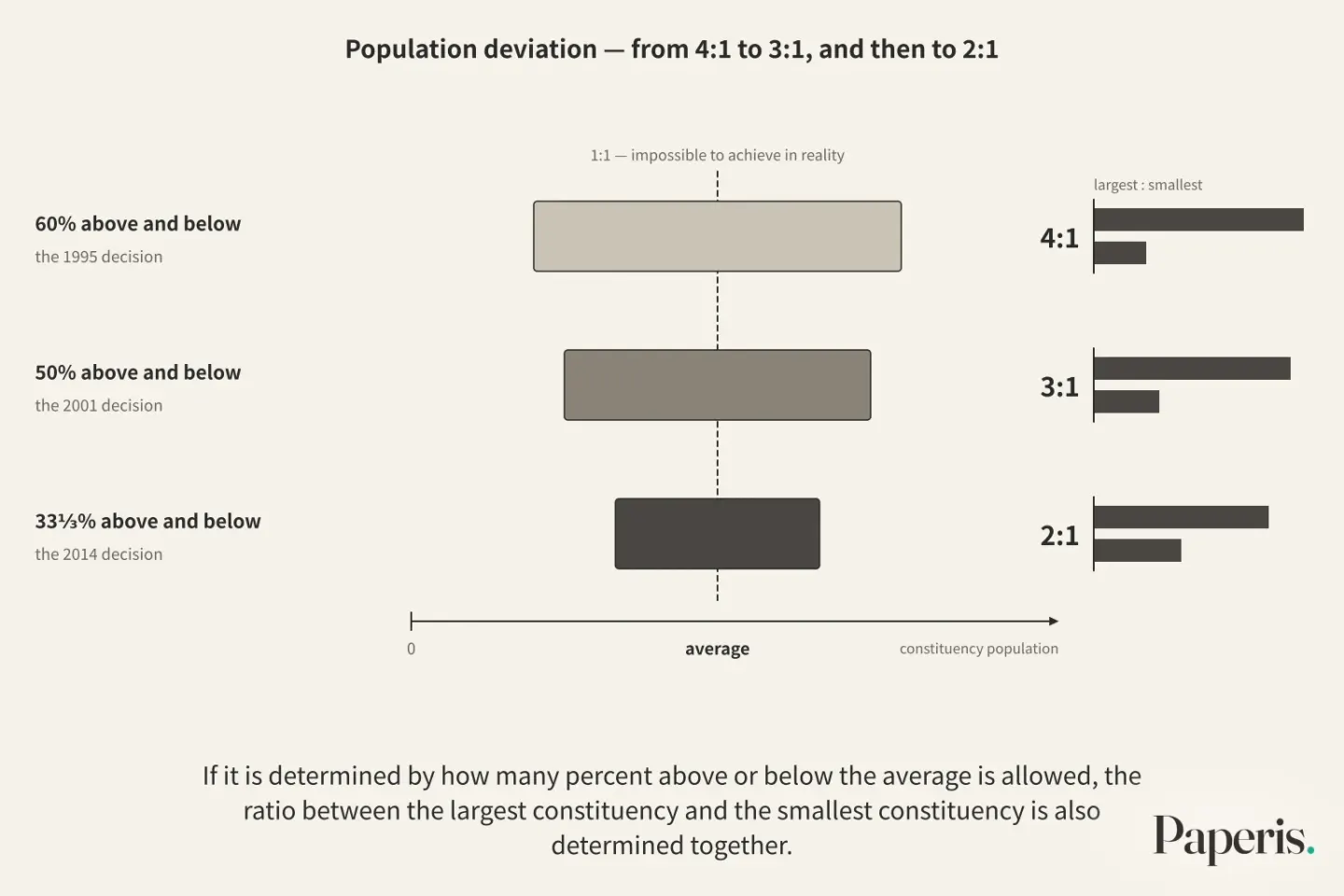
The most ideal state when drawing boundaries is for the population of every constituency to be identical, namely 1:1. However, the Constitutional Court also viewed that achieving this standard in reality is impossible (Constitutional Court 2012Hun-Ma192). People do not live evenly distributed, and the National Assembly is required to draw boundaries by considering not only population but also conditions such as administrative districts, topography, and transportation (Constitutional Court 2012Hun-Ma192). Therefore, the question becomes "How equal must they be?"
There is a scale to measure that degree. Population deviation is a value showing how much the population of a constituency deviates from the average population of constituencies nationwide. When the 2012 constituency table was created, the national average constituency population set by the National Assembly was 206,304 people, and the Gap constituency in Yongin-si, Gyeonggi-do had 47.7% more than that (Constitutional Court 2012Hun-Ma192). If it is determined by how many percent above or below the average is allowed, the ratio between the largest constituency and the smallest constituency is also determined together. If it is up to 50% above and below, that ratio does not exceed 3:1, and if it is up to 33⅓% above and below, it does not exceed 2:1 (Constitutional Court 2000Hun-Ma92).
From 4:1 to 3:1, and Back to 2:1
In its decision on October 25, 2001, the Constitutional Court considered it difficult to simply follow the upper-and-lower 60% (4:1) standard used in the 1995 decision, and stated that "this time, we will decide unconstitutionality based on a deviation of upper and lower 50% from the average population" (Constitutional Court 2000Hun-Ma92). According to that standard, it viewed one constituency with 57% more people than the average as infringing upon the complainant's right to vote and right to equality (Constitutional Court 2000Hun-Ma92). It acknowledged that an upper-and-lower 33⅓% (2:1) is closer to the ideal of electoral equality, but viewed that considering factors such as administrative districts and the fixed number of National Assembly members, there were not a few difficulties. Instead, it stated that "after a considerable period of time," it would make judgments based on an upper-and-lower 33⅓% or a stricter standard (Constitutional Court 2000Hun-Ma92).
This decision was not of one voice either. A dissenting opinion is an opinion where a judge who does not agree with the conclusion of a judgment writes down why their thinking is different. In the Constitutional Court, the judges are called Justices, and its rulings are called decisions rather than judgments. Two justices stated in their dissenting opinion that they agreed with the majority opinion that the population deviation should not exceed upper and lower 50% starting from the 2004 general election. However, they viewed that changing their attitude about five years after the previous decision and immediately declaring this constituency contrary to the Constitution was undesirable in terms of respecting the legislative power of the National Assembly. A concurring opinion is an opinion that joins the conclusion but states the reasoning differently. Another justice wrote in a concurring opinion that "saying 3:1 is okay and 4:1 is not is essentially making an issue of something with little difference," and stated that the work of representing local residents must be viewed on equal terms with the equality of voting value (Constitutional Court 2000Hun-Ma92).
Thirteen years later, on October 30, 2014, the Constitutional Court actually changed that standard to 2:1 (Constitutional Court 2012Hun-Ma192). The majority opinion is the opinion shared by the larger number of justices participating in the trial, which forms the ruling and its reasoning. We quote three of the reasons given by the majority opinion in the 2014 decision.
First, if the upper-and-lower 50% standard is applied, "cases arise where the voting value of one person has three times the value compared to the voting value of another, which is excessive inequality of voting value" (Constitutional Court 2012Hun-Ma192). Second, even considering the role of National Assembly members in representing local interests, it viewed that this "cannot take precedence over the equality of voting value." It also mentioned the point that as local autonomy has taken root, local matters are largely handled by local government heads and local councils (Constitutional Court 2012Hun-Ma192). Third, it viewed that the looser the standard, the greater the possibility that over-represented and under-represented regions will be created, and that such imbalance appears even among agricultural and fishing villages themselves. Buyeo-Cheongyang and Suncheon-Gokseong from Section 1 are examples given by the majority opinion (Constitutional Court 2012Hun-Ma192).
The conclusion was like this. Among the constituencies subject to review, it viewed that the right to vote and right to equality of complainants living in places exceeding upper and lower 33⅓% were infringed (Constitutional Court 2012Hun-Ma192). Since changing the boundary of one constituency causes neighboring constituencies to change in a chain reaction, the Constitutional Court declared that the entire table of constituencies, rather than just a few problematic places, did not fit the Constitution (Constitutional Court 2012Hun-Ma192).
However, it did not abolish the table immediately. A decision of nonconformity with the Constitution is a ruling where the court judges that a law runs counter to the Constitution, but without invalidating it on the spot, gives the National Assembly an opportunity to fix it. Because a vacuum arises where there is no basis to hold re-elections or by-elections if the table of constituencies disappears, the Constitutional Court allowed the current table to continue to be used until the National Assembly fixes it, with a deadline of December 31, 2015 (Constitutional Court 2012Hun-Ma192).
What the Three Justices Worried About
In the 2014 decision, the justices' opinions were also divided. Three of the nine justices wrote a dissenting opinion, and all the rest stood with the majority opinion (Constitution of the Republic of Korea, Article 111(2)) (Constitutional Court 2012Hun-Ma192).
The dissenting opinion also noted that it did not, in principle, disagree with the point that because members of the National Assembly are representatives of the people, it is important to elect them in proportion to the population (Constitutional Court 2012Hun-Ma192). What split them was how heavily they viewed other circumstances. Considering that the economic power and population gaps between cities and farming and fishing villages remain, and thinking about the difference in roles between the National Assembly and local councils, they saw that the work of members of the National Assembly representing regions is "still important, no less than the equality of voting value" (Constitutional Court 2012Hun-Ma192).
The dissenting opinion also worried about the results the 2:1 standard would bring. Since the population is clustered in cities, making the standard strict would only increase the lawmakers representing cities, and "it is self-evident that the number of lawmakers in farming and fishing villages, where regional representation is desperately demanded, will decrease" (Constitutional Court 2012Hun-Ma192). Also, they saw that while most countries that strictly apply population deviation have an upper house to represent regions, our country, which has only a single parliament, must handle that share within one National Assembly (Constitutional Court 2012Hun-Ma192).
There is also research with the same worry. One study compares the constituencies of past National Assembly elections and evaluates that if the 2:1 standard is applied all at once, rural and fishing constituencies would be merged excessively, making it highly likely that the imbalance between cities and rural areas would deepen rather than narrow (DOI: 10.18854/kpsr.2015.49.4.010). Meanwhile, there is research suggesting that the population deviation must be under 2:1, and that the National Assembly should set a specific upper limit within that by law and consider circumstances like regional representation within that upper limit (KCI ART002091819).
The majority opinion also wrote that this standard "may change according to changes in political and social conditions" (Constitutional Court 2012Hun-Ma192). 2:1 is the standard viewed as the outer limit the Constitution can bear where the weight of a single vote stretches up to double.
Who Draws the Line?
After the 2014 decision, it was the National Assembly that made the new constituency table. What the Constitutional Court set was the limit of tolerance, and the task of fixing the constituency table was left to the National Assembly until the deadline (Constitutional Court 2012Hun-Ma192).
The decision text notes the scope of this task in two pages. Setting constituencies is basically left to the discretion of the lawmaker, but "constituency delimitation cannot be free from constitutional control," and if the intention and effect of discriminating against voters in a specific region are clearly revealed, it is viewed as violating the Constitution (Constitutional Court 2012Hun-Ma192). In the same decision, the four constituency boundaries taken issue with by the petitioners were judged to have been attached by moving neighboring dongs to reduce population differences, and not to be arbitrary delimitations (Constitutional Court 2012Hun-Ma192).
The Constitutional Court viewed that the National Assembly receives a constituency draft from a committee composed of experts, but only references that draft and has no obligation to necessarily follow it (Constitutional Court 2012Hun-Ma192). Following the decision, the National Assembly redrew the constituencies under the strengthened 2:1 standard, and the constituencies for the next National Assembly election were finalized belatedly, right before the election (KCI ART002091819). The National Assembly draws the boundaries, and the Constitutional Court checks whether those boundaries keep the promise of the Constitution.
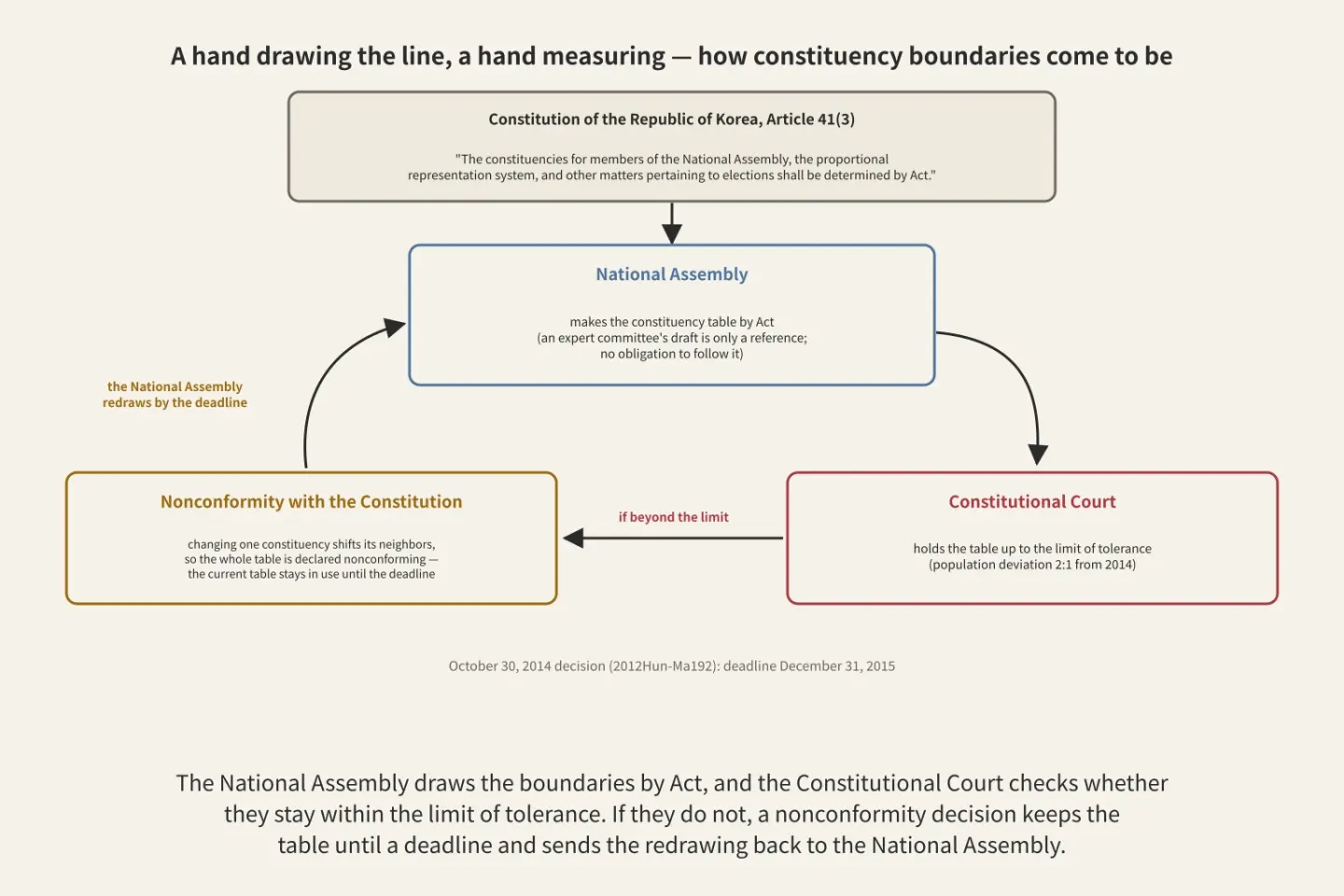
Figure: a diagram Paperis drew using only what the article says
Citizens Denied Ballot Papers
This time, we tackle a question that comes before the size of the slice: the very question of having a seat at the table. Overseas Koreans are citizens who maintain the nationality of the Republic of Korea while building the foundation of their lives abroad. Until a ruling in 2007, among these individuals, those without resident registration had no way to vote in presidential and National Assembly elections. This ruling also addressed cases where citizens who obtained permanent residency abroad, making them unable to maintain resident registration, lived within South Korea (Constitutional Court 2004Hun-Ma644). This article follows only the presidential and National Assembly elections among them.
The reason was resident registration. The Public Official Election Act at the time placed only people with resident registration in that local area onto the electoral roll, leaving citizens unable to register—such as those with foreign permanent residency—with no way to get on the roll (Constitutional Court 2004Hun-Ma644). Even citizens who went abroad temporarily for study or work had to return to South Korea to vote. This was because only people living domestically could file an absentee report (Constitutional Court 2004Hun-Ma644).
On June 28, 2007, the Constitutional Court ruled that these provisions were unconstitutional (Constitutional Court 2004Hun-Ma644). The Constitutional Court considered that these provisions infringed upon the voting rights and right to equality of overseas Koreans and also ran counter to the universal suffrage principle. It found it difficult to find a legitimate purpose in entirely stripping away voting rights solely on the grounds that someone is a citizen yet lacks resident registration (Constitutional Court 2004Hun-Ma644). It stated that concerns—such as North Korean residents faking their identities to vote or elections abroad being difficult to run fairly—could be mitigated through registration systems and identity verification, so voting rights could not be blocked due to such "vague and abstract" risks (Constitutional Court 2004Hun-Ma644).
The Constitutional Court also answered the argument that the votes of overseas Koreans could tilt the outcome in a close election. Because it is a premise of universal suffrage that any citizen of a certain age should be able to influence election results, "the argument that because one can influence the outcome of an election, one's right to vote should be prevented from being exercised is an improper argument that runs counter to the universal suffrage principle." (Constitutional Court 2004Hun-Ma644)
This was also a decision in which the Constitutional Court changed its stance. It declared that three 1990s decisions viewing the same provisions as constitutional were being modified to the extent that they conflicted with this ruling (Constitutional Court 2004Hun-Ma644). Once again, rather than immediately striking down the law, it issued a nonconformity decision and had the National Assembly amend it by December 31, 2008 (Constitutional Court 2004Hun-Ma644).
There was no dissenting opinion in this ruling, but there were two separate opinions that concurred with the conclusion while stating different reasons. In a separate opinion, one Justice wrote that a person who has long-established living foundations abroad and the intent and right to reside permanently may have a different attitude toward elections, and that restricting the voting rights of such citizens "is not always contrary to the principle of universal suffrage and constitutionally impermissible" (Constitutional Court 2004Hun-Ma644).
The old regulations continued to be used until that deadline (Constitutional Court 2004Hun-Ma644). On February 12, 2009, the Public Official Election Act was amended to establish an overseas Korean election system, and evaluations emerged that overseas Koreans who had been unable to participate in national elections simply because they were outside the country could now exercise their political rights (KCI ART001663252). One paper noted that full-scale overseas voting begins with the 19th National Assembly election and the 18th presidential election (KCI ART001581777). However, complaints were raised that the amended law also partially restricted the right to vote in local constituency National Assembly elections and limited voting methods to overseas diplomatic mission polling stations (KCI ART001581777). Voices worrying about election fraud or division within the expatriate community accompanied these concerns (KCI ART001581777).
Two Games with One Ballot
There is one more way to elect members of the National Assembly besides local constituencies. It is the proportional representation system we encountered earlier through legal clauses. Alongside local constituency members, South Korea maintains proportional representatives, who are chosen based on the level of support earned by parties from lists ordered and submitted by those parties (Constitutional Court 2000Hun-Ma91).
Until the 16th National Assembly election on April 13, 2000, voters cast a single ballot in National Assembly elections. The one-person, one-vote system was a method where voters cast a single ballot only for a local constituency candidate, and that vote was also counted as support for that candidate's party to distribute proportional representative seats. There was no separate vote for a political party (Constitutional Court 2000Hun-Ma91). A voter who liked a local constituency candidate but did not support that candidate's party had to give up one of the two (Constitutional Court 2000Hun-Ma91).
On July 19, 2001, the Constitutional Court ruled that this method violated the Constitution (Constitutional Court 2000Hun-Ma91). Alongside the principle of democracy that the will of the people must be properly reflected, the Constitutional Court based its decision on two of our promises (Constitutional Court 2000Hun-Ma91).
One is direct election. Because a proportional representation election is separate from a local constituency election, there should be a separate vote by voters for the party list, but since that vote was absent, who would become a proportional representative was ultimately decided by the parties drafting their lists (Constitutional Court 2000Hun-Ma91). The party's choice intervened between the voter and the winning candidate.
The other is equal election. Thinking of it in terms of pizza, it looks like this. A vote cast for a local constituency candidate belonging to a party had a share in both pizzas: one local constituency pizza and one proportional representation pizza. A vote cast for an independent candidate had a share in only one pizza: the local constituency pizza. The Constitutional Court noted that a vote cast for a party candidate held "dual value," and considered that a voter who had to vote for an independent candidate because their supported party did not field a candidate in their local constituency was, against their intention, saddled with inequality in the value of their vote (Constitutional Court 2000Hun-Ma91).
One caveat is attached. The Constitutional Court stated that if there were only local constituency elections without proportional representation, the one-person, one-vote method "itself has no unconstitutionality," but that it ran counter to the Constitution to the extent that it combined proportional representation while refusing to allow a separate vote for political parties (Constitutional Court 2000Hun-Ma91). What was deemed unconstitutional was the arithmetic of splitting a single ballot across two pizzas.
This decision was unanimous among all justices, and one justice added that this method forced voters into support and renunciation, thereby also conflicting with the principle of free elections (Constitutional Court 2000Hun-Ma91). The one-person, two-vote system is a method of casting one vote separately for a local constituency candidate and one vote for a political party. In the 17th general election held after the ruling, the one-person, two-vote system was introduced, and voting on party lists was implemented for the first time (KCI ART001009837). Evaluations since then have not converged on a single conclusion. One study assesses that even under the one-person, two-vote system, proportionality between the votes won by parties and their seats remains low (KCI ART002549584).
Looking at the Two Neighborhoods Again
Let us return to the two neighborhoods in Section 1, placing side by side a voter living in Buyeo and Cheongyang and a voter living in Suncheon and Gokseong in early 2012.
Both are citizens of a certain age, so they receive ballot papers. It is a universal suffrage. At the polling station, they each receive two ballot papers: one vote for a local constituency candidate and one for a political party. The 19th National Assembly election that year also used a two-vote system for individuals and parties (KCI ART001695221). No one else knows who they voted for. It is a secret ballot.
However, the former person shares a single contest for a local constituency National Assembly member with 106,086 people, while the latter shares it with 303,516 people. The majority opinion expressed this difference by stating that the former person's vote is approximately 2.86 times larger (Constitutional Court 2012Hun-Ma192). These two constituencies were not the subject of judgment in that case, and there is no sentence in the decision document comparing the two places against the 2-to-1 standard. The dissenting opinion noted that no constituencies fell outside the upper and lower 50% limit, which was the standard at the time (Constitutional Court 2012Hun-Ma192). If this article directly applies the 2014 scale—namely, an upper and lower 33⅓% range from the average of 206,304 people—to the two populations of 2012, both places fall outside that band.
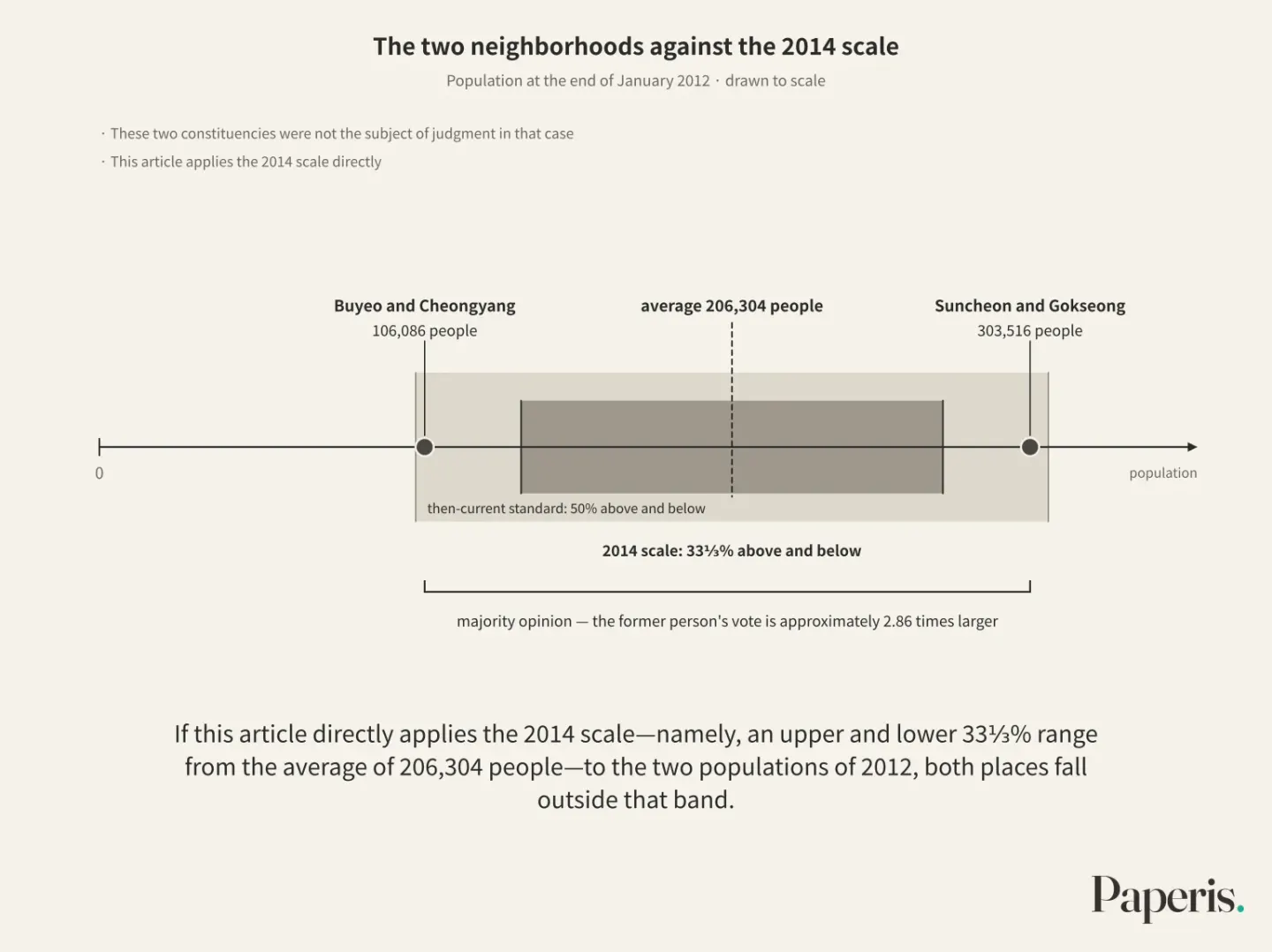
Even if they come within the 2-to-1 limit, the share of the two people can still differ by up to twofold. Where to draw that line divided the majority and dissenting opinions on how heavily they view the role of National Assembly members in representing local regions (Constitutional Court 2012Hun-Ma192).
The Rules for Electing Representatives
The pizza analogy has its limits. A National Assembly seat is not a slice that residents divide among themselves. The majority opinion viewed that even when elected from a local district, lawmakers must work for the benefit of the entire country, and the dissenting opinion also did not object to the fact that lawmakers are representatives of the people (Constitutional Court 2012Hun-Ma192). The pizza only shows "how many people are sharing," and cannot capture the question worried about by the dissenting opinion: "who represents the local situation?"
Putting the analogy aside, two things remain. One is that the weight of a vote is not always exactly equal. 1:1 is impossible in reality, and what the Constitutional Court set was the permissible limit. The other is that election rules are not up to the National Assembly's whim either. The rules of an election are determined by the National Assembly through law, but that law must be set within the constitutional promise of universal, equal, direct, and secret suffrage, and the Constitutional Court checks whether that promise was kept.
All three decisions judged the rules to be unconstitutional based on that promise, and the task of fixing them was left to the National Assembly. Each time, different thoughts remained in the decisions as well. Where to strike the balance between representatives proportional to population and representatives representing regions was divided even within the 2014 decision, and has not yet converged into a single answer in subsequent research.
Where to Look Further
How to read the majority opinions, dissenting opinions, and separate opinions introduced in this article directly from the decision text is covered in "How to Read a Court Judgment — A One-Line Answer and Its Reasons".
What kind of decision a nonconformity decision is is covered in more detail in "What Is a Constitution — The Wall You Cannot Simply Knock Down", and the yardstick for measuring laws that restrict fundamental rights in "Fundamental Rights and Their Limits — An Unmarked Scale". The procedure through which citizens directly ask the Constitutional Court for a judgment and the Constitutional Court's other trials are covered in "What the Constitutional Court Does — Five Windows and Six Votes".
Source Papers
- "Constitution of the Republic of Korea, Article 1" (enforced 1988) — Original statutory text — The Republic of Korea is a democratic republic, sovereignty resides in the people, and all state authority emanates from the people.
- "Constitution of the Republic of Korea, Article 24" (enforced 1988) — Original statutory text — All citizens have the right to vote under conditions prescribed by Act.
- "Constitution of the Republic of Korea, Article 41" (enforced 1988) — Original statutory text — Members of the National Assembly shall be elected by universal, equal, direct, and secret ballot, and the constituencies and proportional representation system shall be determined by Act.
- "Constitution of the Republic of Korea, Article 67" (enforced 1988) — Original statutory text — The President shall be elected by universal, equal, direct, and secret ballot.
- "Constitution of the Republic of Korea, Article 111" (enforced 1988) — Original statutory text — Matters under the jurisdiction of the Constitutional Court (review of constitutionality of statutes, constitutional complaints, etc.) and its composition of 9 justices.
- "Unconstitutionality Confirmation of Article 25, Paragraph 2 [Attached Table 1] of the Public Official Election and Election Prevention Act" (2001) — Constitutional Court 2000Hun-Ma92 — Ruling that it is difficult to mechanically follow the upper-to-lower 60% (4:1) standard, it adopted the upper-to-lower 50% (3:1) standard, declared the constituency with a deviation of +57% unconstitutional, and ruled the entire constituency demarcation table in nonconformity with the Constitution (deadline 2003.12.31), giving notice of 33⅓% after a considerable period. 2 dissenting opinions and 1 concurring opinion.
- "Unconstitutionality Confirmation of Article 25, Paragraph 2, Attached Table 1 of the Public Official Election Act" (2014) — Constitutional Court 2012Hun-Ma192 — Changed the allowable population deviation limit for National Assembly constituencies from upper-to-lower 50% (3:1) to upper-to-lower 33⅓% (2:1) and ruled the entire constituency table in nonconformity with the Constitution (provisional application until deadline 2015.12.31). 3 justices' dissenting opinions (concerns over regional representation and a decrease in rural and fishing village lawmakers, maintaining 50%).
- "Unconstitutionality Confirmation of Article 15, Paragraph 2, etc. of the Public Official Election and Election Prevention Act" (2007) — Constitutional Court 2004Hun-Ma644 — Ruled provisions that denied the voting rights of overseas Koreans and overseas residents by requiring resident registration in nonconformity with the Constitution (deadline 2008.12.31), based on the universal suffrage principle, changing the previous decision. 2 separate opinions (possibility of restricting permanent residents, etc.).
- "Unconstitutionality Confirmation of Article 146, Paragraph 2 of the Public Official Election and Election Prevention Act" (2001) — Constitutional Court 2000Hun-Ma91 — Decided that the allocation of proportional representation seats under the one-person, one-vote system violates the principles of democracy, direct election, and equal election (unanimous, 1 supplementary opinion).
- "National Assembly Constituencies and the Principle of Equal Suffrage" (2016) — KCI ART002091819 — Examines the reasons why the 20th-term constituencies were finalized late just before the election through the tightening to 2:1, and argues that the legislature should set a specific upper limit by law within below 2:1.
- "Fairness of Constituency Demarcation Viewed Through the Equivalence of Votes: Measurement and Implications" (2015) — DOI: 10.18854/kpsr.2015.49.4.010 — Measures the equivalence of votes in past general elections and evaluates that the blanket application of 2:1 is highly likely to deepen the urban-rural imbalance.
- "Effective Utilization Plan for the Overseas Election System" (2012) — KCI ART001663252 — Notes that overseas elections were introduced through the amendment of the Public Official Election Act on 2009.2.12 following the Constitutional Court's changed judgment, and covers the significance and fairness concerns of exercising overseas Koreans' suffrage.
- "A Study on Methods to Secure Convenience and Fairness in Overseas Korean Elections" (2011) — KCI ART001581777 — Discusses complaints regarding the amended law's partial restriction of constituency voting rights and confinement to diplomatic mission voting, concerns over election fraud and division in the expatriate community, and full-scale overseas voting in the 19th general election and 18th presidential election.
- "Introduction of the One-Person, Two-Vote System in the 17th General Election: Process and Content of Proportional Representation List Formation" (2006) — KCI ART001009837 — Party list voting was implemented for the first time in the 17th general election.
- "Conceptual Misuse and Consistency of the Electoral System: Focusing on Proportionality" (2019) — KCI ART002549584 — Evaluates that under the current one-person, two-vote system, the vote equivalence among lawmakers and proportionality among political parties are low, and suggests an alternative of reverting to one-person, one-vote while making the total seat ratio proportional to the parties' vote shares.
- "A Critical Review of South Korea's Proportional Representation Electoral System" (2012) — KCI ART001695221 — Summarizes that the one-person, two-vote party-list proportional representation system was applied to the 17th, 18th, and 19th National Assembly elections.
Sources (1)
- 표의 등가성을 통해 본 선거구획정의 공정성: 측정과 함의DOI 10.18854/kpsr.2015.49.4.010