
Paperis Articles
What Is a Constitution — The Wall You Cannot Simply Knock Down
A constitution is the wall that holds a country up. When a statute cuts into it, the Constitutional Court decides; moving the wall itself takes two-thirds of the National Assembly and a national referendum.
Your field's papers, as audio
Pick your fields and journals — Paperis summarizes the key papers and turns them into audio. Listen on your commute.
Start Paperis free →What Is a Constitution — The Wall You Cannot Simply Knock Down
The Law That Would Not Accept Marriage Registrations
In 1995, a case involving couples whose marriage registrations had been rejected was pending before the Seoul Family Court. There was only one reason for the rejection: the two people shared the same surname and ancestral origin. A legal provision enacted in 1958 stated that people with the same surname and ancestral origin, such as Kimhae Kims marrying Kimhae Kims or Jeonju Lees marrying Jeonju Lees, could not marry. The provision was this brief: "Persons who are blood relatives of the same surname and ancestral origin may not marry." (Constitutional Court 95Hun-Ga6)
This provision did not take into account the degree of kinship. Based on 1985 statistics, the Kimhae Kim clan alone numbered 3,892,342 people (Constitutional Court 95Hun-Ga6). Even if they were distant relatives whose degree of kinship could not be counted, they could not become a legal married couple if their surname and ancestral origin were the same.
In 1997, the institution that determines whether laws conform to the Constitution judged that this provision did not conform to the Constitution. Furthermore, this institution ruled that if the National Assembly did not amend it by the end of 1998, the provision would lose its effect starting January 1, 1999 (Constitutional Court 95Hun-Ga6). The body that decided this was not the National Assembly, which made the laws. Something above it had stepped in to halt a law made by the National Assembly.
This article follows that "something above" while examining the Constitution of the Republic of Korea. We will compare the Constitution to the load-bearing walls that support a building. The partitions inside a building can be remodeled, but if you mess with the load-bearing walls, the building shakes. That is why load-bearing walls cannot be torn down recklessly.
The Law Above All Laws
The Constitution is the fundamental framework of the country and sets the basic rights of the citizens; it is the highest law among all laws. The fundamental framework is what kind of country this is and where power comes from. The Constitution states that in its first clause. "The sovereignty of the Republic of Korea shall reside in the people, and all state authority shall emanate from the people." (Constitution of the Republic of Korea, Article 1(2))
The remaining half is human rights. Basic rights are the fundamental freedoms and rights guaranteed by the Constitution. The clause from which they start is "All citizens shall have human dignity and value, and have the right to pursue happiness." (Constitution of the Republic of Korea, Article 10). The kinds and limits of basic rights are covered in detail in "Basic Rights and Their Limits — A Scale Without Markings".
Beneath the Constitution are statutes. Statutes are laws made by the National Assembly in accordance with the procedures set by the Constitution. The Constitution notes that "Legislative power shall be vested in the National Assembly." (Constitution of the Republic of Korea, Article 40). That clause which blocked marriage was also a single clause of a statute called the Civil Act. Beneath statutes are orders and rules. For example, the President may issue presidential decrees regarding matters specifically delegated by statutes within a defined scope and matters necessary for enforcing statutes (Constitution of the Republic of Korea, Article 75). The Constitution provides that if whether an order or rule is contrary to "the Constitution or a statute" becomes an issue in a trial, the Supreme Court reviews it finally (Constitution of the Republic of Korea, Article 107(2)). The order that a law below cannot contradict a law above is embedded within the text of the Constitution.
To say that the Constitution is the supreme law means that whether it is a statute or a government order, if it contradicts the Constitution, ultimately it cannot be left as is. The Constitutional Court wrote this point in the family headship system decision, which we will look at again later, stating, "There can be no room for argument regarding the point that it possesses an effect that takes precedence over all other legal norms or values" (Constitutional Court 2001Hun-Ga9). It is like having to tear down a partition if, no matter how carefully it was installed, it cut into the supporting wall.
Why is the Constitution at the very top? Because the target the Constitution seeks to bind is state power itself. The family headship system decision went on to write as follows. "As the supreme norm of a state, the Constitution ensures not only that the exercise of all public powers such as legislation, administration, and adjudication is subject to constraints by the Constitution, but also that private law legal relations are directly or indirectly influenced by the Constitution." (Constitutional Court 2001Hun-Ga9) Constitutionalism is the idea of protecting the freedom and rights of citizens by making even state power operate only under prearranged rules called the Constitution. The National Assembly that makes statutes is also under those rules. Therefore, even a statute made by the National Assembly can be stopped if it contradicts the Constitution.
Here, I will acknowledge one limit of the analogy. A wall stands on its own even if no one is watching. The Constitution is not like that. Only when someone asks "This statute cut into the wall" and someone judges that does it finally gain power. The next section is the path of asking and judging that.
When a Law Collides with the Constitution
Unconstitutional means that a law or a state action violates the Constitution. Whether a law is unconstitutional is decided by the Constitutional Court. The Constitutional Court is the institution that decides whether laws align with the Constitution and resolves disputes surrounding the Constitution. The first duty assigned to the Constitutional Court by the Constitution is the "judgment on the unconstitutionality of a law upon a request by the court" (Constitution of the Republic of Korea, Article 111(1)).
The path works like this. When a court is hearing a case and the constitutionality of a law that must be applied to that case becomes an issue, the court requests a ruling from the Constitutional Court and conducts the trial in accordance with that judgment (Constitution of the Republic of Korea, Article 107(1)). A request for constitutional review of a law is a procedure in which the trial court asks the Constitutional Court to make a judgment, stating that the legal provision applied in the case appears to violate the Constitution. A constitutional review of a law is the trial in which the Constitutional Court determines whether the law requested in this manner violates the Constitution. In principle, the Constitutional Court decides only whether the requested law or legal provision violates the Constitution (Constitutional Court Act, Article 45).
How requests are made is covered in "What the Constitutional Court Does — Five Windows and Six Votes".
A case involving a couple sharing the same surname and ancestral origin took this exact path. When the couples objected to the refusal of their marriage registrations, the Seoul Family Court requested on May 17, 1995, that the Constitutional Court determine whether the provision complied with the Constitution (Constitutional Court 95Hun-Ga6).
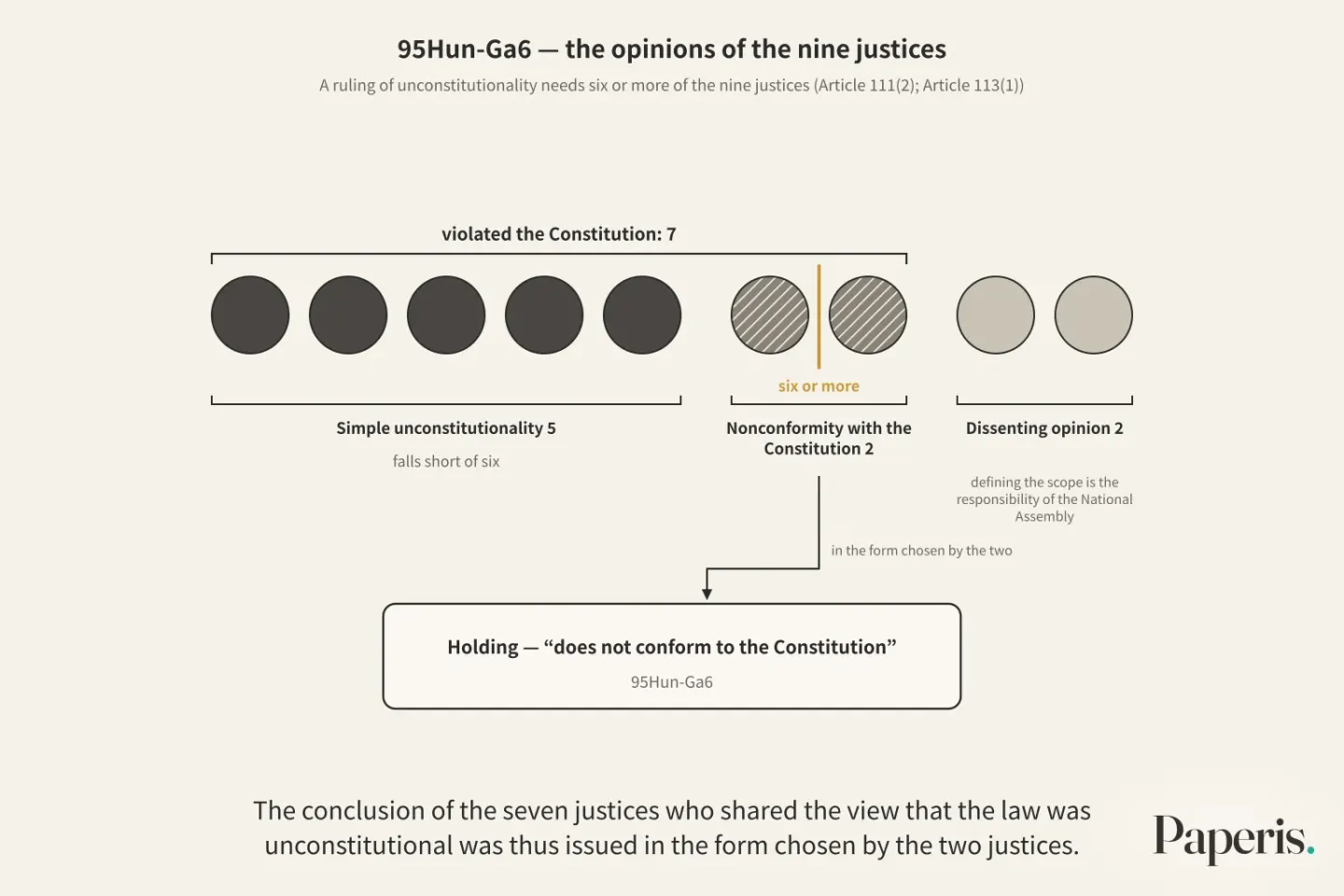
In the decision on July 16, 1997, five justices concluded that the provision violated the Constitution. Because of that provision, "same-surname blood relatives cannot marry, no matter how earnestly they love each other and no matter how distant their genealogical degree of relation is, making it impossible to even calculate their degree." (Constitutional Court 95Hun-Ga6) These five justices judged that this restricts the freedom to choose a marriage partner and discriminates based on gender by taking only the male lineage into account. They added: "We make it clear that viewing this as unconstitutional does not mean that the Constitutional Court encourages marriage between same-surname blood relatives, nor does it deny all existing universally valid ethics or moral concepts." (Constitutional Court 95Hun-Ga6) This means that a ruling of unconstitutionality is a judgment on whether a law complies with the Constitution, not a verdict on whether a custom is good or bad.
Let us look first at the structure of the decision. The holding (order) consists of the short sentences at the very beginning of a judgment document that state the conclusion of the trial. In a decision document, the justices' opinions are recorded as the reasoning alongside this holding.
In this case, the justices' thoughts did not converge into one. The majority opinion is the opinion held by the larger number of judges participating in the trial, which forms the holding and its reasoning. A dissenting opinion is an opinion recorded by judges who do not agree with the conclusion of the judgment, explaining why their thoughts differ. In the Constitutional Court, the judges are called Justices, and its rulings are called decisions rather than judgments. In this case, two justices filed a dissenting opinion. Their reasoning was that laws dealing with marriage are strongly tied to tradition and customs, so defining their scope is the responsibility of the National Assembly. "Which range of customs regarding family relations should be enacted into law and enforced falls within the realm of legislative policy, and unless the legislature's judgment is deemed clearly irrational, it cannot be pronounced unconstitutional." (Constitutional Court 95Hun-Ga6) Decisions of the Constitutional Court emerge through such debates among the justices, and the reasoning of the justices who did not stand with the conclusion remains recorded in the decision document just the same.
The remaining two justices agreed with the five that the provision violated the Constitution, but viewed the form of the decision differently. A simple unconstitutionality decision is a decision declaring that a legal provision violates the Constitution, causing it to immediately lose its legal effect. Five justices chose a simple unconstitutionality decision, while two chose a decision that gave the National Assembly an opportunity to amend the law (Constitutional Court 95Hun-Ga6).
However, for a law to be ruled unconstitutional, six or more out of the nine justices must vote in favor (Constitution of the Republic of Korea, Article 111(2); Article 113(1)). In the Constitutional Court, even if the unconstitutional side forms a majority, if it falls short of six votes, it cannot become the conclusion. This decision document also noted that "although the opinion of the five justices is the majority opinion," because it "did not reach the trial quorum" required for a ruling of unconstitutionality, a decision of nonconformity with the Constitution was pronounced (Constitutional Court 95Hun-Ga6). The conclusion of the seven justices who shared the view that the law was unconstitutional was thus issued in the form chosen by the two justices. The first line of the holding in this decision was: "Article 809, Paragraph 1 of the Civil Act (enacted on Feb. 22, 1958, as Act No. 471) does not conform to the Constitution." (Constitutional Court 95Hun-Ga6)
The Constitution does not stop at mere declarations. A provision created in 1958 was actually brought to a halt by this decision.
A Decision Not to Delete Right Away
A decision of nonconformity with the Constitution is a ruling that judges a law to be contrary to the Constitution, but rather than stripping it of its effect on the spot, gives the National Assembly an opportunity to fix it. (KCI ART003381591) It is like not tearing down a partition dug into a load-bearing wall right away, but giving some time until it is repaired.
The second line of the dispositive part of the same-name-same-surname decision was that deadline. "The above legal provision shall lose its effect on January 1, 1999, if the legislature does not amend it by December 31, 1998." And it said that the provision must not be used until it was fixed. "The courts, other state agencies, and local governments shall suspend the application of the above legal provision until the legislature amends it." (Constitutional Court 95Hun-Ga6) Although the provision formally remained until the deadline, during that time neither the courts, nor state agencies, nor local governments could use that provision to block marriage registration.
Nonconformity with the Constitution also has a reverse-direction aspect. On February 3, 2005, the Constitutional Court decided that the Civil Act provisions forming the head-of-family system did not conform to the Constitution. At the same time, it wrote this in the dispositive part: "The above legal provisions shall continue to apply until the legislature amends the Census Registration Act." (Constitutional Court 2001Hun-Ga9) It made provisions judged not to fit the Constitution continue to be used for a while.
The reason was the family registry. At the time, family registries were bundled by household based on the head of the family. If those provisions were abolished right away, the framework for noting down status relationships even if they changed would disappear. The decision text wrote that if that happened, "a large gap would occur in the official records that publicly disclose and certify status relationships" (Constitutional Court 2001Hun-Ga9). Even if it is a partition dug into a wall, if it is supporting one side of the roof together, it is like leaving it until a new pillar is erected. There were also dissenting opinions by three justices on this decision, and they viewed that all or part of the provisions subject to review were not contrary to the Constitution (Constitutional Court 2001Hun-Ga9). What kind of system the head-of-family system was is told as a story in the children's edition piece "The Mother Was Just Someone Living There".
Questions also emerge in academia regarding this decision format. "A law or provision of a law determined to be unconstitutional loses its effect from the day the decision is made." (Constitutional Court Act, Article 47(2)) Provisions concerning criminal penalties exceptionally retroactively lose effect. However, if they were previously determined to be constitutional, they retroactively lose effect only up to the day following that decision (Constitutional Court Act, Article 47(3)). One study views that in light of this provision, a nonconformity decision that halts application may fit this provision, but a nonconformity decision that makes continued use possible conflicts with this provision and can be used only in very exceptional cases (DOI: 10.35215/jcj.2024.11.2.011). There is also research stating that in order to continue using an unconstitutional law, it is not enough simply that a legal vacuum might occur, and one must actually weigh the disadvantage of the vacuum against the infringement of fundamental rights caused by continued use (KCI ART003381591). There is also a study that gathered 239 legal provisions for which nonconformity with the Constitution was declared from 1989 to 2024, and analyzed the time it took for the National Assembly to amend them (DOI: 10.33900/KAPS.2025.34.4.16).
To sum up, the Constitutional Court has separately determined the conclusion that something "runs counter to the Constitution" and "when to cut off its effect".

The Path to Moving a Wall
If a law does not conform to the Constitution, the law steps back. Then, what happens when you want to change the Constitution itself? Constitutional amendment is the act of revising the articles of the Constitution by following the procedures set forth by the Constitution. It is commonly abbreviated in Korean as gaeheon.
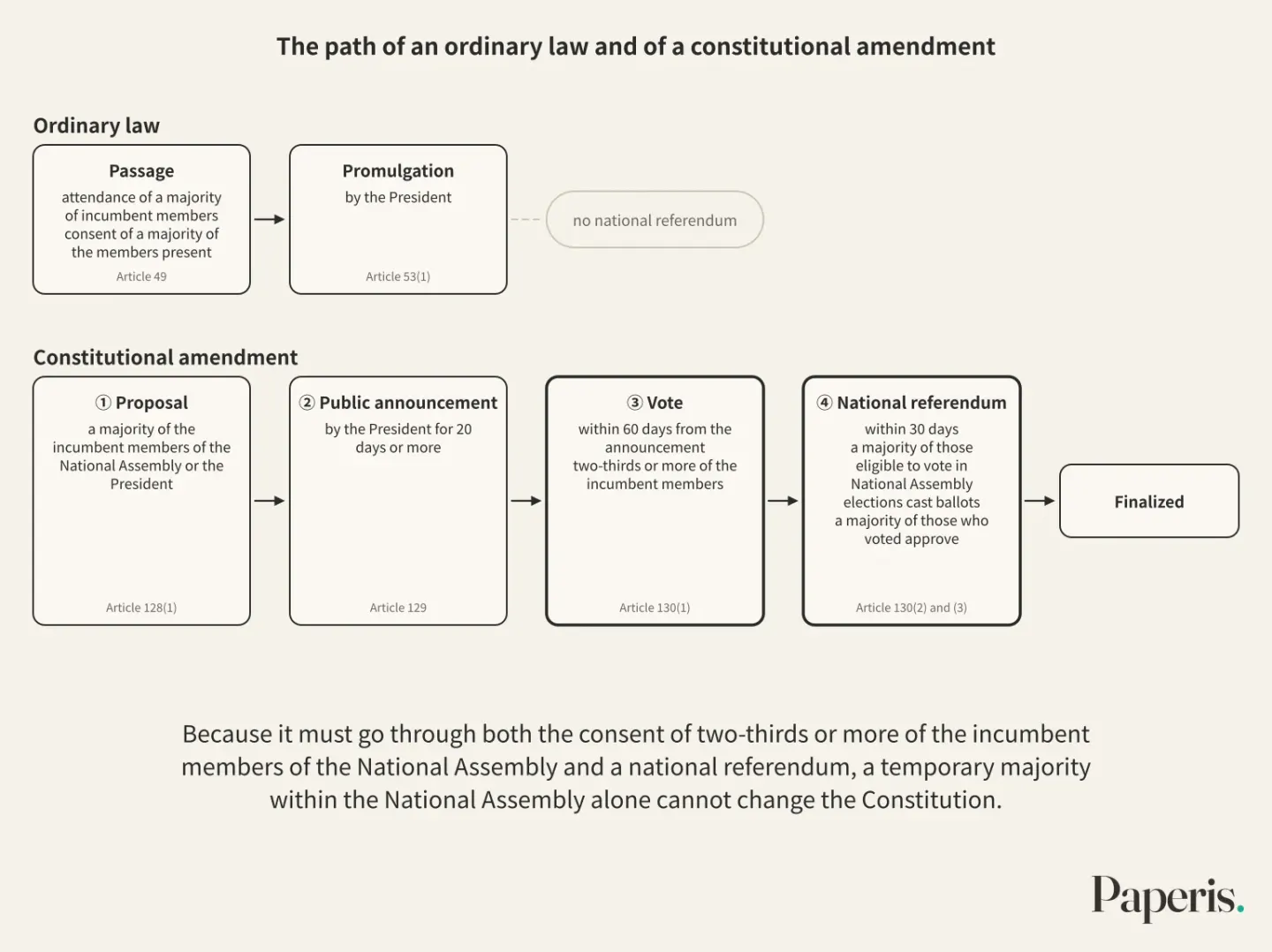
The procedure has four steps. First, a majority of the incumbent members of the National Assembly or the President proposes an amendment bill (Constitution of the Republic of Korea, Article 128(1)). Second, the President publicly announces that bill for 20 days or more (Constitution of the Republic of Korea, Article 129). Third, the National Assembly votes on it within 60 days from the date of public announcement, and two-thirds or more of the incumbent members must agree (Constitution of the Republic of Korea, Article 130(1)). Fourth, it is submitted to a national referendum within 30 days after the National Assembly passes it (Constitution of the Republic of Korea, Article 130(2)). A national referendum is a system where the citizens cast votes directly to decide important matters of the state. The amendment bill is finalized when a majority of those eligible to vote in National Assembly elections cast ballots, and a majority of those who voted approve it (Constitution of the Republic of Korea, Article 130(2) and (3)).
It is like saying that to move a load-bearing wall, the decision of the residents' representatives is not enough, and the entire body of residents must cast ballots. A bill for an ordinary law is passed by the National Assembly with the attendance of a majority of incumbent members and the consent of a majority of the members present, and is promulgated by the President, with no national referendum in that process (Constitution of the Republic of Korea, Article 49; Article 53(1)). A constitutional amendment must obtain the higher consent of two-thirds or more of the incumbent members and then go through a national referendum once more.
The Constitution also draws a line on the effect of an amendment. A constitutional amendment that extends the President's term or changes regulations regarding consecutive terms (holding office repeatedly) has no effect on the President in office at the time the amendment is proposed (Constitution of the Republic of Korea, Article 128(2)). One study suggests that the reason the current amendment procedure is this strict is the result of reflection on past amendment history. That reflection is that past constitutional amendments were largely carried out around power structures and the extension of a regime's hold on power (KCI ART003113377).
The current Constitution took its present shape through its ninth amendment in 1987, and has not been amended even once for a long time since then (DOI: 10.31536/jols.2023.20.2.008; KCI ART003113377). How to view this threshold is divided even among scholars. A 2007 study viewed that under the current procedure, constitutional amendment is very difficult, and in particular, securing a two-thirds consent from the National Assembly is realistically difficult (KCI ART001047445). Another study views that while the procedure is indeed strict and criticisms of rigidity are not unconvincing, to increase the possibility of constitutional amendment, the procedures for gathering public opinion and increasing citizen participation must be expanded (DOI: 10.33606/YLA.47.1).
Either way, the fact remains that the threshold is high. Because it must go through both the consent of two-thirds or more of the incumbent members of the National Assembly and a national referendum, a temporary majority within the National Assembly alone cannot change the Constitution (Constitution of the Republic of Korea, Article 130(1) and (2)).
A Wall Not on the Blueprint
Then again, is the Constitution only what is written in its articles? In 2004, this question came before the Constitutional Court. At the end of 2003, the National Assembly passed a special act to build a new administrative capital in the Chungcheong region, and the act was promulgated in January 2004. Some citizens filed a petition with the Constitutional Court, arguing that while the law contained a decision to relocate the capital, it bypassed the constitutional amendment procedure and thus infringed on their right to a national referendum (Constitutional Court 2004Hun-Ma554).
Nowhere in the constitutional text is it stated that the capital is Seoul. The ruling first confirmed this point. "There is no explicit provision in our constitutional text stating that 'the capital is Seoul.'" (Constitutional Court 2004Hun-Ma554) Customary constitution refers to constitutional norms that are not written down in constitutional articles but have solidified through long-standing practice. The issue was whether the fact that Seoul is the capital constitutes such a norm, and if so, whether it holds the same force as the written Constitution.
The majority opinion held that it does have the same force. Constitutional articles cannot record everything exhaustively, and if a practice regarding fundamental constitutional matters continues for a long time, has not been broken in the middle, has clear content, and the people believe in it as a binding norm, then a customary constitution is established (Constitutional Court 2004Hun-Ma554). The majority opinion judged that Seoul being the capital is such a customary constitution that has continued for some 600 years. And it wrote as follows. "Since the customary constitution is also a part of the Constitution and has the same effect as that of the written constitution, those legal norms can be amended at least by the method of constitutional amendment based on Article 130 of the Constitution." (Constitutional Court 2004Hun-Ma554) The conclusion was that moving the capital by means of a statute skipped the national referendum.
Justice Jeon Hyo-sook’s dissenting opinion held that it does not have the same force. While acknowledging that a customary constitution can exist, she argued that because a written Constitution is something the people have clearly expressed their will on through prescribed procedures, practice alone cannot generate that level of force. "Under a written constitution system, it must be viewed that a customary constitution has only a supplementary effect on the written constitution." (Constitutional Court 2004Hun-Ma554) The dissenting opinion saw a logical leap in deriving the norm that Seoul must be the capital from the long-standing fact that Seoul was the capital. Furthermore, she worried that because this law was passed by an overwhelming majority in the National Assembly, blocking it on the grounds of a customary constitution would mean using custom to deny the legislative power that the Constitution granted to the National Assembly (Constitutional Court 2004Hun-Ma554).
The conclusion was that "The Special Act on the Construction of a New Administrative Capital (Jan. 16, 2004, Act No. 7062) violates the Constitution." (Constitutional Court 2004Hun-Ma554) Out of the nine justices, eight stood by the conclusion of unconstitutionality, and one of them cited a different reasoning. The remaining one, Justice Jeon Hyo-sook, delivered a dissenting opinion arguing that the petition for adjudication was improper (Constitutional Court 2004Hun-Ma554).
In terms of a building, this is the question of whether a wall not drawn on the blueprint is also a load-bearing wall. The majority opinion viewed that if it is a wall that has supported the building from before the blueprint came into existence, it is a load-bearing wall; the dissenting opinion viewed that only the walls drawn on the blueprint carry that much weight. The question of what the Constitution is remains open to multiple answers even within the Constitutional Court.
Where to Look Next
If you want to read the ruling, majority opinion, and dissenting opinion from this post yourself, "How to Read a Court Judgment — A One-Line Answer and Its Reasons" will guide you through the reading order. Where the Supreme Court, which reviews orders and rules last, stands in a trial is covered by "Korea's Three-Tier Courts and the Supreme Court — The Three Steps a Case Climbs, and Sometimes Comes Back Down".
Other parts of this series follow. Rights guaranteed by the Constitution and the criteria for limiting them are covered in "Fundamental Rights and Their Limits — An Unmarked Scale", the way the National Assembly, the government, and the courts share power in "Separation of Powers — A Country That Splits Its Keys", the Constitutional Court's five types of trials and types of decisions in "What the Constitutional Court Does — Five Windows and Six Votes", and the constitutional principles of elections in "Elections and Representation — The Same Pie, Different Slices".
Source Papers
- "Constitution of the Republic of Korea, Article 1" (Effective 1988) — Original legal text — Democratic republic; sovereignty resides in the people, and all state authority emanates from the people.
- "Constitution of the Republic of Korea, Article 10" (Effective 1988) — Original legal text — Human dignity and worth, right to pursue happiness, and the state's duty to guarantee basic human rights.
- "Constitution of the Republic of Korea, Article 40" (Effective 1988) — Original legal text — Legislative power is vested in the National Assembly.
- "Constitution of the Republic of Korea, Article 49" (Effective 1988) — Original legal text — Decisions of the National Assembly require the attendance of a majority of the members enrolled and the concurrence of a majority of the members present.
- "Constitution of the Republic of Korea, Article 53" (Effective 1988) — Original legal text — Bills passed by the National Assembly are sent to the Executive, and the President promulgates them within 15 days (including requests for reconsideration).
- "Constitution of the Republic of Korea, Article 75" (Effective 1988) — Original legal text — The President may issue presidential decrees for matters delegated by statute and necessary for the enforcement of statutes.
- "Constitution of the Republic of Korea, Article 107" (Effective 1988) — Original legal text — The constitutionality of a statute is referred by the courts to the Constitutional Court for review; the Supreme Court has final review over orders, rules, and administrative dispositions.
- "Constitution of the Republic of Korea, Article 111" (Effective 1988) — Original legal text — Five types of adjudication handled by the Constitutional Court and its composition of 9 justices.
- "Constitution of the Republic of Korea, Article 113" (Effective 1988) — Original legal text — Decisions declaring a statute unconstitutional require the concurrence of 6 or more justices.
- "Constitution of the Republic of Korea, Article 128" (Effective 1988) — Original legal text — Subjects authorized to propose constitutional amendments; amendments to extend the presidential term or change consecutive term limits shall not be effective for the president in office at the time of the proposal.
- "Constitution of the Republic of Korea, Article 129" (Effective 1988) — Original legal text — Public announcement of a constitutional amendment proposal for 20 days or more.
- "Constitution of the Republic of Korea, Article 130" (Effective 1988) — Original legal text — Finalized by a vote of two-thirds or more of the members enrolled in the National Assembly, followed by a national referendum (requiring a majority of electors to vote and a majority of voters to concur).
- "Constitutional Court Act, Article 45 (Decision of Unconstitutionality)" (Effective 2026) — Original legal text — The Constitutional Court decides solely on the unconstitutionality of referred statutes or statutory provisions.
- "Constitutional Court Act, Article 47 (Effect of Decision of Unconstitutionality)" (Effective 2026) — Original legal text — Binding force of unconstitutionality decisions, loss of effect starting from the date of the decision, and retroactive loss of effect for penal provisions.
- "Referral of Unconstitutionality of Article 809, Paragraph 1 of the Civil Act" (1997) — Constitutional Court 95Hun-Ga6 — Nonconformity with the Constitution of the ban on marriage between same-surname and same-origin relatives (5 simple unconstitutionality, 2 nonconformity, 2 dissenting), loss of effect on Jan. 1, 1999, if not amended by the end of 1998, with application suspended until then.
- "Referral of Unconstitutionality of the Latter Part of the Main Text of Article 781, Paragraph 1 of the Civil Act, etc." (2005) — Constitutional Court 2001Hun-Ga9 — Supreme normative force of the Constitution (majority), nonconformity with the Constitution of the head-of-family system provisions, continued application until the Family Registration Act is revised to avoid a gap in family registration, with a dissenting opinion by 3 justices.
- "Confirmation of Unconstitutionality of the Special Act on the Construction of the New Administrative Capital" (2004) — Constitutional Court 2004Hun-Ma554 — Declared unconstitutional on the grounds that the capital city of Seoul is unwritten customary constitution and can only be changed through the constitutional amendment procedure (1 separate opinion); Justice Jeon Hyo-sook's dissenting opinion held that customary constitutions should only be recognized as having supplementary effect and that the petition was improper.
- "Legislative Improvement Obligations and Limits of Legislative Formation Following Nonconformity Decisions" (2026) — KCI ART003381591 — Nonconformity with the Constitution is a format that acknowledges unconstitutionality while deferring the loss of effect and providing an opportunity for remedial legislation; continued application requires weighing the infringement of fundamental rights against the disadvantages of a legal vacuum.
- "Does a Nonconformity Decision Nonconform to the Constitutional Court Act?" (2024) — DOI: 10.35215/jcj.2024.11.2.011 — While provisions declared unconstitutional lose effect from the date of the decision (Constitutional Court Act, Article 47(2)), the author concludes that a suspension-of-application-style nonconformity decision can align with this rule, whereas continued application conflicts with it.
- "‘Dialogue’ as an Agenda-Setting Process Through Interaction Between the Constitutional Court and the National Assembly: A Competitive Risk Analysis of Amendatory Legislation After Nonconformity Decisions" (2025) — DOI: 10.33900/KAPS.2025.34.4.16 — An analysis of the time taken to enact amendatory legislation for 239 statutory provisions declared nonconforming with the Constitution between 1989 and 2024.
- "A Study on Historical Changes in Constitutional Amendment Procedures and Ways to Improve Them" (2024) — KCI ART003113377 — Past constitutional amendments were largely centered around extending political power and ruling structures, and that self-reflection has led to the rigidity of the current procedure, with no amendments for roughly 40 years since the last revision.
- "A Study on Japan's Constitutional Amendment Procedure - Focusing on Japan's Diet Law and the National Referendum Act -" (2023) — DOI: 10.31536/jols.2023.20.2.008 — South Korea's Constitution has not been amended for roughly 40 years following its 9th amendment (1987).
- "Procedures for Constitutional Amendment and the Possibility of Constitutional Amendment" (2007) — KCI ART001047445 — Constitutional amendment is very difficult under the current procedures, and securing a two-thirds majority in the National Assembly is especially difficult in reality.
- "A Short Treatise on the Problems and Improvement Measures of the Current Constitutional Amendment Procedure" (2025) — DOI: 10.33606/YLA.47.1 — Amendment procedures must be strict yet also accommodate demands for change, criticisms of rigidity lack persuasive force, and increasing public opinion collection and participation is necessary to raise the likelihood of constitutional reform.
Sources (4)
- 헌법불합치 결정은 헌법재판소법에 불합치하는가?DOI 10.35215/jcj.2024.11.2.011
- 헌법재판소와 국회 간 상호작용을 통한 의제설정과정으로서의 ‘대화’: 헌법불합치결정 이후 개정입법에 대한 경쟁위험분석DOI 10.33900/kaps.2025.34.4.16
- 일본의 헌법개정절차에 대한 연구 - 일본의 국회법과 헌법개정절차법을 중심으로DOI 10.31536/jols.2023.20.2.008
- 현행 헌법개정절차의 문제점과 개선방안에 관한 소고DOI 10.33606/yla.47.1