
Paperis Articles
What the Constitutional Court Does — Five Windows and Six Votes
How cases reach Korea's Constitutional Court, and why six of nine justices are needed to strike down a law or remove an official
Your field's papers, as audio
Pick your fields and journals — Paperis summarizes the key papers and turns them into audio. Listen on your commute.
Start Paperis free →What the Constitutional Court Does — Five Windows and Six Votes
The Day We Couldn't Leave a Single Comment
In late 2009 and early 2010, three people tried to leave anonymous comments on the YouTube, OhmyNews, and YTN bulletin boards. The message boards required a verification step to confirm whether the writer was the person themselves, and in the end, the three people could not leave their comments. The board operators put that procedure in place because the law imposed a mandatory identity-verification duty on operators (Constitutional Court 2010Hun-Ma47).
On January 25, 2010, the three people filed a petition with the Constitutional Court, claiming that the law violated their freedom of expression and other rights. The decision came down two years and seven months later, on August 23, 2012 (Constitutional Court 2010Hun-Ma47).
Focusing on the Constitutional Court of Korea, this article follows how cases like this enter and who reaches a conclusion, and how. The Constitutional Court has five windows through which cases enter, and the parties who can bring a case are designated for each window. The spot where the three people stood was the window where a person who claimed to have suffered harm could stand directly.
Nine People and Five Windows
The Constitutional Court is the institution that decides whether laws align with the Constitution and resolves disputes surrounding the Constitution. Comparing a law against the Constitution is necessary because the two differ in rank.
The Constitution is the fundamental framework of the country and sets the basic rights of citizens, making it the highest of all laws. Statutes are laws made by the National Assembly according to the procedures set by the Constitution. Since statutes sit below the Constitution, a clash between the two creates a problem for the statute.
Basic rights are the fundamental freedoms and rights guaranteed by the Constitution. Unconstitutionality means that a statute or state action runs counter to the Constitution.
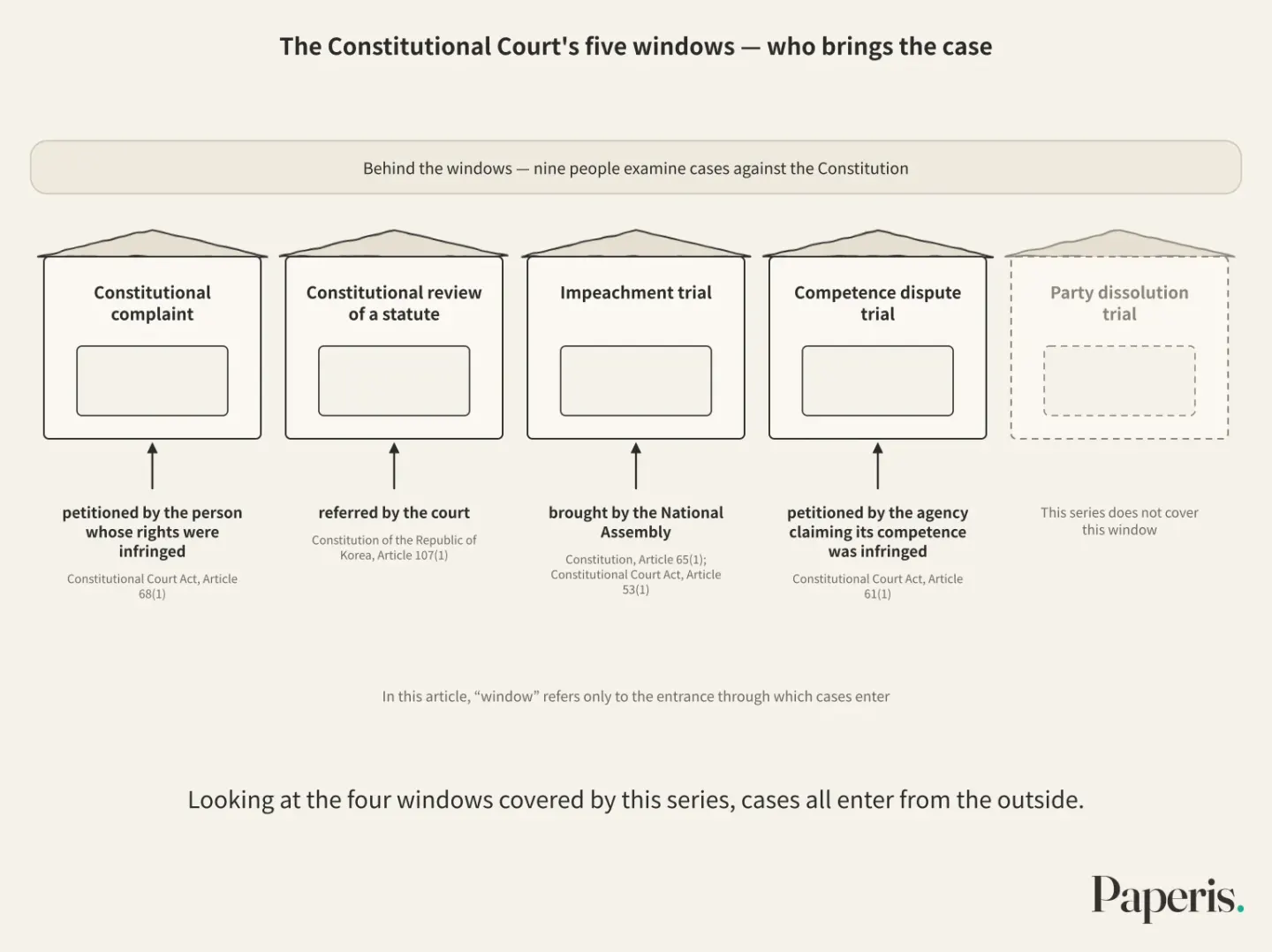
Article 111, Paragraph 1 of the Constitution lists five tasks handled by the Constitutional Court: "trial on the unconstitutionality of a statute upon a request by a court", "impeachment trials", "trials on the dissolution of a political party", trials on competence disputes between state agencies, between a state agency and a local government, and between local governments, and "trials on constitutional complaints as prescribed by statute" (Constitution of the Republic of Korea, Article 111(1)). Looking at these five windows from the perspective of the three people stationed at the beginning, they are as follows:
- A constitutional complaint is a trial where a person whose basic rights guaranteed by the Constitution have been infringed upon by an act or omission of state power directly petitions the Constitutional Court for relief. The party bringing the matter is the person whose rights were infringed (Constitutional Court Act, Article 68(1)).
- A referral for constitutional review of a statute is a procedure where a court handling a trial asks the Constitutional Court to rule on whether a statutory provision used in that trial appears contrary to the Constitution. A constitutional review of a statute is the trial where the Constitutional Court determines whether a statute referred in that manner violates the Constitution. The party bringing a case to this window is the court (Constitution of the Republic of Korea, Article 107(1)).
- An impeachment trial is a trial where, if the National Assembly demands the removal from office of a public official such as the President or a judge, the Constitutional Court decides whether to remove that official from office. Removal from office is the decision by the Constitutional Court in an impeachment trial to remove a public official from their public office. The party bringing the matter is the National Assembly (Constitution of the Republic of Korea, Article 65(1); Constitutional Court Act, Article 53(1)).
- A competence dispute trial is a trial where the Constitutional Court resolves disputes over who holds what authority when a conflict arises between state agencies, between a state agency and a local government, or between local governments. The party bringing the matter is the agency claiming its competence was infringed (Constitutional Court Act, Article 61(1)). "Separation of Powers — A Country That Splits Its Keys" looks at this in detail.
- A party dissolution trial is a trial where the Constitutional Court decides whether to dissolve a certain political party. This series does not cover this window.
Looking at the four windows covered by this series, cases all enter from the outside. The court refers them, the National Assembly accuses, and an agency or person petitions.
Behind the windows sit nine people. Justices are nine people with the qualifications of judges who examine and decide cases in the Constitutional Court. The President appoints all nine members, three of whom are chosen by persons elected by the National Assembly, three designated by the Chief Justice of the Supreme Court, and the remaining three picked directly by the President (Constitution of the Republic of Korea, Article 111(2) and (3)). The term of office for a justice is 6 years, and justices cannot join political parties or participate in politics (Constitution of the Republic of Korea, Article 112(1) and (2)).
Questions arising during a trial are divided as follows. If whether a statute fits the Constitution becomes a premise of the trial, the Constitutional Court decides it; if whether an order, rule, or disposition fits the Constitution or a statute becomes a premise of the trial, the Supreme Court reviews it finally (Constitution of the Republic of Korea, Article 107(1) and (2)). In the identity-verification system case at the beginning that entered via a constitutional complaint without going through a trial, the Constitutional Court declared that not only the statutory provision but also its enforcement decree provision violated the Constitution (Constitutional Court 2010Hun-Ma47).
The term "window" has its limits. A government office window hands over what you want if your paperwork is correct, but the Constitutional Court examines cases brought in by nine people against the Constitution and sometimes refuses to side with the petitioner. In this article, "window" refers only to the entrance through which cases enter.
The Counter Where the Injured Person Stands
The filing by the three people at the beginning is a constitutional complaint. The Constitutional Court Act opens this counter like this: "A person who has suffered an infringement of fundamental rights guaranteed by the Constitution due to the exercise or non-exercise of public power may file a constitutional complaint for trial with the Constitutional Court." A condition is attached right after: "However, if there is a remedy procedure under other laws, the request may be filed only after exhausting all such procedures." (Constitutional Court Act, Article 68(1))
A constitutional complaint is a final means that fills the empty space where other remedy procedures do not reach, and this condition writes that character into the law (KCI ART003215769). If another path is open, you must in principle walk that path first.
So at the counter, conditions are looked at before the substance. Dismissal is a decision that ends a case without examining the substance, viewing the request as improper because it lacks the conditions to receive a trial. In a constitutional complaint directly contesting a law, whether the fundamental rights infringement arose directly from the law itself is one of the conditions. If a law directly restricts freedom or imposes an obligation, this condition is met, and if an act enforcing the law sits in the middle, that enforcement act must usually be contested through an ordinary lawsuit first (DOI: 10.17248/knulaw..41.201302.453).
In the identity-verification system case, the Constitutional Court first determined what it would judge. Although an internet news outlet separately requested and raised issues even with sanction provisions for violating obligations, that company had never received a sanction and did not put forward reasons of unconstitutionality for that provision alone. The Constitutional Court excluded that provision from the scope of the trial (Constitutional Court 2010Hun-Ma47).
In the remaining issues, it heard from both sides. The claimants argued that the identity-verification system was prior censorship that blocked expressing opinions on the internet beforehand, infringed on the freedom to speak without revealing one's name, and discriminated only against people who write on the internet. The Korea Communications Commission, which enforces the law, submitted an opinion that this system aims to create a responsible public forum and "does not expose real names," thus not infringing on the freedom of anonymous expression (Constitutional Court 2010Hun-Ma47).
The Constitutional Court did not accept the argument that it was prior censorship. It viewed that the identity-verification system "does not regulate based on the content of posted articles" and cannot be seen as a system that screens and filters article contents in advance, so "it cannot be said to violate the principle prohibiting prior censorship." It did not separately judge the argument of discrimination, stating that it was the same as judging the freedom of anonymous expression (Constitutional Court 2010Hun-Ma47).
What was accepted was a violation of the principle of proportionality. The principle of proportionality is a principle that when the state restricts fundamental rights, the purpose must be justified, the means appropriate, not exceeding the strictly necessary degree, and the public interest to be protected must achieve balance with the private interest lost. The Constitutional Court acknowledged the purpose and means of the identity-verification system, but viewed that it stumbled on the strictly necessary degree and balance (Constitutional Court 2010Hun-Ma47). The law examining each step is covered by "Fundamental Rights and Their Limits — Scales Without Graduations".
The judgment was like this. It viewed that the purpose of a sound internet culture "can be sufficiently achieved even by other means that do not restrict" freedom of expression and the like, such as tracking internet addresses, deleting articles and temporary measures, damages claims, and criminal punishment. Even with the materials submitted by the Korea Communications Commission, it wrote that "no evidence can be found that, following the implementation of the system, defamation, insult, and slander posts decreased meaningfully enough to justify prior restriction of freedom of expression" (Constitutional Court 2010Hun-Ma47). It also pointed out that foreigners and overseas Koreans without resident registration numbers were virtually blocked from the path of posting articles on bulletin boards because of this verification method (Constitutional Court 2010Hun-Ma47).
Upholding is a decision where the Constitutional Court accepts a petition. The conclusion came out with the "unanimous opinion of all participating justices." The ruling consists of short sentences placed at the very front of the judgment document, stating the conclusion of the trial. In the Constitutional Court, the judges are called Justices, and its rulings are called decisions rather than judgments. The ruling of this decision was that those statutory provisions "violate the Constitution" (Constitutional Court 2010Hun-Ma47). The requests of the three people who directly contested the statutes were accepted.
Binding force is the power by which an unconstitutionality decision or upholding decision of the Constitutional Court binds the court, other state agencies, and local governments to follow that decision. A decision upholding a constitutional complaint binds all state agencies and local governments, and an unconstitutionality decision on a law binds the court and other state agencies (Constitutional Court Act, Article 75(1); Article 47(1)). This power is why decisions do not stay only on paper.
A 2016 study noted that the Supreme Court has consistently not recognized this binding force regarding decisions declaring "unconstitutional so long as interpreted this way" while leaving the statutory text as it is (DOI: 10.31779/plj.17.2.201605.004).
In this case, there was no justice who disagreed with the conclusion. The state's side of the logic can be read in the "Summary of the Korea Communications Commission's Opinion" in the decision text. From the request to the decision, this is a case that passed all the way through a single counter.
A Window That Opens During a Trial
Article 241 of the Criminal Act stipulated that "A person who has a spouse and commits adultery shall be punished by imprisonment for not more than 2 years" (Constitutional Court 2009Hun-Ba17). Two separate paths concerning this provision entered the Constitutional Court.
The first path is one opened directly by the court. Handling an appealed case in which a defendant was sent to trial for the crime of adultery and convicted in the first instance, the Uijeongbu District Court filed a request for a constitutional review of a statute ex officio on August 26, 2011 (Constitutional Court 2009Hun-Ba17). The law dictates that a court files such a request "by its own authority or by a decision upon the motion of a party" (Constitutional Court Act, Article 41(1)). A court may raise the question on its own initiative, or it may do so in response to a request from the person standing trial.
The second path is the one opened by a party to the case. Other claimants had filed requests in their own trials arguing that Article 241 of the Criminal Act was unconstitutional, but the courts did not accept those motions. Rejection means that a court does not accept a demand or request. The Constitutional Court uses the same term. When their motions were rejected, the claimants directly filed a petition for a constitutional complaint (Constitutional Court 2009Hun-Ba17).
A constitutional complaint regarding unconstitutionality is a constitutional complaint in which a party whose request for a statutory review was rejected by a court asks the Constitutional Court directly to review that law. This path is separately opened by the Constitutional Court Act (Constitutional Court Act, Article 68(2)). At the top of the 2015 decision document, the case filed by the court and the case petitioned by the party are bound together (Constitutional Court 2009Hun-Ba17). This means that even if the court does not ask, there is a path for the person on trial to ask directly.
The law stipulates that a statute determined to be unconstitutional "shall lose its effect from the day the decision is made" (Constitutional Court Act, Article 47(2)). A law prescribing punishment loses its effect retroactively, but if that same provision was previously determined to be constitutional, it only reaches back as far as the day after that previous decision. A person whose conviction under that law became final and conclusive may request a retrial (Constitutional Court Act, Article 47(3) and (4)). A past decision on the same law leaves a trace that affects the effect of a subsequent decision.
Six Votes
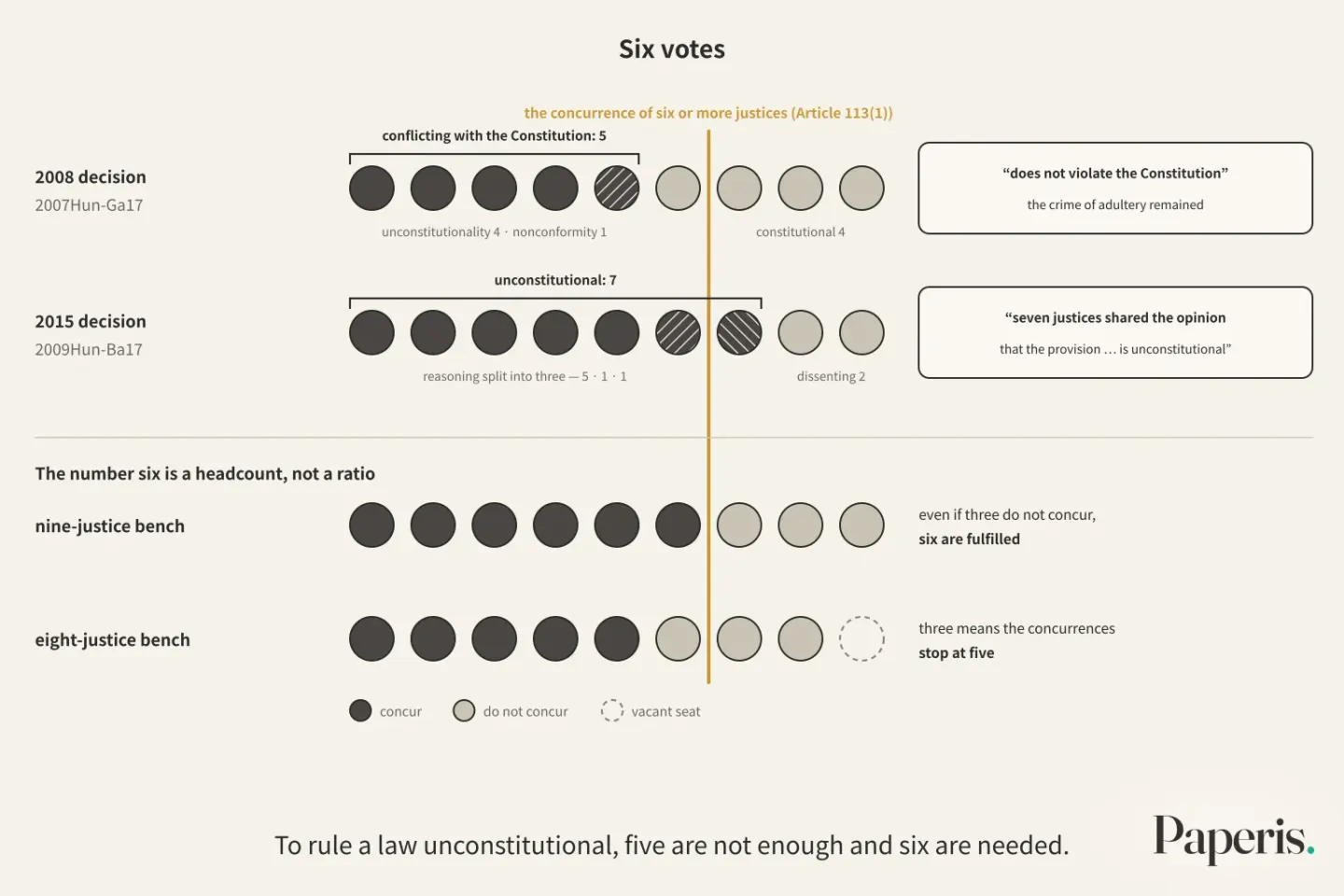
In October 2008, regarding the crime of adultery, four justices delivered unconstitutionality opinions and one delivered an opinion of nonconformity with the Constitution. A decision of nonconformity with the Constitution is a decision where a court judges a law to conflict with the Constitution but does not strike it down on the spot, instead giving the National Assembly a chance to fix it. That justice stated that the provision "needs to be applied provisionally" until the National Assembly fixes it. Four justices voted that the law was constitutional, and the ruling was that the provision "does not violate the Constitution" (Constitutional Court 2007Hun-Ga17). Five people were on the side that it conflicted with the Constitution, but the crime of adultery remained as it was.
A quorum is the minimum number of people who must be present to make a decision. The Constitution writes this number down directly. "When the Constitutional Court makes a decision of unconstitutionality of a law, a decision of impeachment, a decision of dissolution of a political party, or an acceptance decision regarding a constitutional complaint, the concurrence of six or more justices shall be required." (Constitution of the Republic of Korea, Article 113(1))
The Constitutional Court Act adds a few more things to this. Seven or more justices must attend to review a case, and other decisions are made by a majority of the participating justices, but even when the Constitutional Court changes a previous interpretation of the Constitution or a law, six or more must concur (Constitutional Court Act, Article 23(1) and (2)). Five out of nine is a majority. Even so, to rule a law unconstitutional, five are not enough and six are needed.
That is why when reading a Constitutional Court decision, people look at how many people were on which side just as much as who won. A majority opinion is an opinion forming the ruling and its reasoning, shared by the greater number of the judges who participated in the trial.
At the Constitutional Court, even if there are more opinions on the unconstitutional side, if they fall short of 6 people, it cannot become the ruling, so the majority opinion and the conclusion of the decision can diverge. The 2008 decision text wrote that "although the unconstitutionality opinions are a majority, they fall short of the quorum of 6 required for a declaration of unconstitutionality of a law," and therefore declared that the provision did not violate the Constitution (Constitutional Court 2007Hun-Ga17). The 2015 decision text also looks back on this event, stating, "although the opinions that it violated the Constitution were a majority, they did not reach the unconstitutionality quorum of 6" (Constitutional Court 2009Hun-Ba17).
The Constitutional Court viewed the crime of adultery as not violating the Constitution in a 1990 decision, and maintained that judgment in 1993 and 2001 as well. The 2001 decision also featured an unconstitutionality opinion by one justice (Constitutional Court 2009Hun-Ba17). That judgment changed on February 26, 2015. The conclusion of the decision text is: "Although their reasoning differs, seven justices shared the opinion that the provision subject to trial is unconstitutional, so we rule as stated in the text" (Constitutional Court 2009Hun-Ba17).
The reasoning of the seven people split into three. Five people viewed this provision as violating the ban on excessive restriction, thus infringing on the right to sexual self-determination and the privacy and freedom of private life. The opinion of these five people writes that "the maintenance of marriage and family should be entrusted to the free will and affection of the parties, and cannot be heteronomously forced through punishment." Two other justices arrived at the same conclusion for different reasons (Constitutional Court 2009Hun-Ba17). Even under the same conclusion, there can be multiple reasons.
A dissenting opinion is an opinion where a judge who does not agree with the conclusion of the judgment writes down why their own thought is different. In the 2015 decision, two justices issued dissenting opinions. These justices viewed that "our legal consciousness"—which considers adultery to damage social order and infringe on others' rights—"remains valid," and wrote, "We cannot help but worry about a situation arising if the crime of adultery is abolished, where countless family communities are destroyed and the human rights and welfare of the vulnerable and young children within the home are infringed" (Constitutional Court 2009Hun-Ba17).
A concurring opinion is an opinion that joins the conclusion while adding to the reasoning. In the same decision, one justice added in a concurring opinion that the problem with the crime of adultery could not be solved simply by substituting fines for prison sentences (Constitutional Court 2009Hun-Ba17).
The opinions that it conflicted with the Constitution grew from five in 2008 (four unconstitutional, one nonconformity) to seven in 2015, while the pro-constitution side remained as two dissenting opinions in 2015. The 2015 decision text even recorded that the 1990 decision had contained a nonconformity opinion from two justices and an unconstitutionality opinion from one as dissenting opinions (Constitutional Court 2009Hun-Ba17). Dissenting opinions remain in the decision text side by side with the conclusion, to be read again when the same question returns.
The number six is a headcount, not a ratio. During the presidential impeachment trial in 2017, one justice seat was vacant, so eight people made the decision. That decision text wrote that since 6 or more must concur, "the single justice in a vacant state has practically the same result as expressing an opinion not concurring with the impeachment" (Constitutional Court 2016Hun-Na1). On a nine-justice bench, even if three justices do not concur, six are fulfilled, but on an eight-justice bench, three means the concurrences stop at five.
What an Impeachment Trial Measures
Article 65, Paragraph 1 of the Constitution provides that when public officials such as the President, Prime Minister, members of the State Council, judges, or Justices of the Constitutional Court "violate the Constitution or statutes in the performance of their duties, the National Assembly may pass a resolution for impeachment" (Constitution of the Republic of Korea, Article 65(1)). An impeachment motion is a resolution by which the National Assembly refers a public official, such as the President or a judge, to the Constitutional Court for trial when they violate the Constitution or statutes while performing their duties.
A motion requires specific quorums within the National Assembly. Normally, at least one-third of the all members of the National Assembly must propose the motion and a majority must vote in favor, while a motion against the President must be proposed by a majority of all members and approved by a vote of two-thirds or more. A person against whom an impeachment motion has been passed has the exercise of their powers suspended until the impeachment trial takes place (Constitution of the Republic of Korea, Article 65(2) and (3)).
The scope of removal from office is prescribed by the Constitution. The Constitution notes that "An impeachment decision shall not extend further than removal from public office. However, this shall not exempt the person impeached from civil or criminal liability." (Constitution of the Republic of Korea, Article 65(4)). What an impeachment trial determines is whether to keep that person in that public office, while civil and criminal liabilities remain separate.
The Constitutional Court asks two questions in an impeachment trial. First, did the official violate the Constitution or statutes while performing their duties? Second, is that violation serious enough to justify removal from office? The 2004 presidential impeachment trial decision interpreted the phrase "when a petition for impeachment trial is well-founded" (Constitutional Court Act, Article 53(1)), which the Constitutional Court Act sets as a condition for removal from office, in this manner. That decision stated that a case where an impeachment petition is well-founded does not refer to every legal violation, but rather "to a 'serious' legal violation of a degree that justifies the removal of a public official from office." As the reason, it noted that "if removal from office had to be ordered for every minor legal violation resulting from official acts," it would run counter to the requirement for punishment commensurate with responsibility (Constitutional Court 2004Hun-Na1).
The 2017 presidential impeachment trial decision also used the same two questions. That decision stated that a case where an impeachment petition is well-founded means "when there is a violation of the Constitution or statutes serious enough to justify the removal of the President from office," and noted that the benefits of defending the Constitution gained through removal from office must be weighed against the national losses accompanying removal from office (Constitutional Court 2016Hun-Na1).
Both decisions also clarified what they do not measure using the same framework. The 2004 decision stated that the impeachment trial procedure "merely judges the existence or non-existence of grounds for impeachment from a legal perspective," and that "political incompetence or errors in policy decisions, such as whether duties were performed faithfully," cannot in themselves become grounds for a motion (Constitutional Court 2004Hun-Na1). The 2017 decision also inherited this judgment, stating that whether duties were performed faithfully does not in itself become the target of judgment in an impeachment trial (Constitutional Court 2016Hun-Na1). However, two Justices in that decision wrote in a concurring opinion that in cases where the Constitution or statutes specifically impose a duty of faithful performance of duties, the breach of that duty can become a violation of the Constitution or statutes and thus a ground for impeachment (Constitutional Court 2016Hun-Na1). What an impeachment trial measures is whether the Constitution and statutes were seriously violated, and it does not measure whether politics were done well.
The two decisions reached different answers to the two questions. Both decisions acknowledged some of the grounds for motion raised by the National Assembly and did not acknowledge others, and where they split was the second question (Constitutional Court 2004Hun-Na1) (Constitutional Court 2016Hun-Na1). The decision of May 14, 2004, rejected the trial petition on the grounds that "reasons justifying a decision to remove the President from office do not exist" (Constitutional Court 2004Hun-Na1). The decision of March 10, 2017, pronounced the President's removal from office on the grounds that it is "recognized that the benefit of defending the Constitution gained through removal from office is overwhelmingly large enough to outweigh the national losses accompanying the removal of the President from office" (Constitutional Court 2016Hun-Na1).
The two decisions also differed in the way they recorded the Justices' opinions. The 2004 decision text merely recorded that the trial petition was rejected because it "did not obtain the consent of the number of Justices required for an impeachment decision," and stated that the individual opinions of the Justices and their counts are secrets of deliberation and cannot be indicated. As the reason, it cited the point that under the Constitutional Court Act at the time, there was a basis to indicate opinions only in unconstitutionality trials of statutes, competence dispute trials, and constitutional complaint trials, but not in impeachment trials. However, the decision text included the sentence that "there was a view that opinions differing from the majority opinion could also be indicated" (Constitutional Court 2004Hun-Na1). The 2017 decision text stated that the conclusion "conformed to the unanimous opinion of all Justices, except for" two concurring opinions (Constitutional Court 2016Hun-Na1). The current Constitutional Court Act provides that "Justices who participated in the trial shall state their opinions in the decision document" (Constitutional Court Act, Article 36(3)).
The two decisions emerged upon the same two questions and the same six-vote standard. The two decisions, whose conclusions were opposite, left behind the same framework for what an impeachment trial measures.
Where to Look Next
How to read the ruling and reasoning, majority opinion and dissenting opinion of a decision is covered in "How to Read a Court Judgment — A One-Line Answer and Its Reasons". Which layers of court trials produce a referral for a constitutional review of a statute are found in "Korea's Three-Tier Courts and the Supreme Court — The Three Steps a Case Climbs, and Sometimes Comes Back Down".
Other parts of this series follow as well. Why the Constitution is the highest law and the meanings of unconstitutionality and nonconformity with the Constitution are covered in "What Is the Constitution — A Wall That Cannot Be Easily Torn Down", the steps of the prohibition of excessive interference used in the real-name verification decision in "Fundamental Rights and Their Limits — An Uncalibrated Scale", disputes over governmental powers in "Separation of Powers — A Country That Splits Its Keys", and Constitutional Court decisions surrounding electoral districts in "Elections and Representation — The Same Pie, Different Slices".
Source Papers
- "Article 65 of the Constitution of the Republic of Korea" (Enforced 1988) — Original Statute Text — Targets and grounds for impeachment (violation of the Constitution or laws while in office) and voting requirements, suspension of powers upon the passage of an impeachment motion, impeachment decisions being limited to removal from office without exempting civil or criminal liability.
- "Article 107 of the Constitution of the Republic of Korea" (Enforced 1988) — Original Statute Text — When the unconstitutionality of a statute becomes a prerequisite for a trial, the court refers the matter to the Constitutional Court; when whether an order, rule, or disposition conforms to the Constitution or laws becomes a prerequisite for a trial, the Supreme Court conducts final review.
- "Article 111 of the Constitution of the Republic of Korea" (Enforced 1988) — Original Statute Text — Five categories of jurisdiction for the Constitutional Court, nine justices holding judicial qualifications, three elected by the National Assembly and three nominated by the Chief Justice of the Supreme Court.
- "Article 112 of the Constitution of the Republic of Korea" (Enforced 1988) — Original Statute Text — Six-year term for justices, prohibition on joining political parties or engaging in political activities.
- "Article 113 of the Constitution of the Republic of Korea" (Enforced 1988) — Original Statute Text — Concurrence of six or more justices required for decisions of unconstitutionality, impeachment, dissolution of a political party, or acceptance of a constitutional complaint.
- "Article 23 of the Constitutional Court Act" (Enforced 2026) — Original Statute Text — Hearings conducted with the attendance of seven or more justices, decisions made by a majority, with six or more required for unconstitutionality, impeachment, party dissolution, acceptance of a constitutional complaint, and modification of previous precedents.
- "Article 36 of the Constitutional Court Act" (Enforced 2026) — Original Statute Text — Matters to be stated in final decision documents, justices participating in the adjudication must express their opinions in the decision document.
- "Article 41 of the Constitutional Court Act" (Enforced 2026) — Original Statute Text — Courts refer the adjudication of unconstitutionality ex officio or by decision upon a party's request.
- "Article 47 of the Constitutional Court Act" (Enforced 2026) — Original Statute Text — Binding force of unconstitutionality decisions, loss of effect from the date of the decision, retroactive loss for penal provisions limited to the day after the previous constitutional decision, retrial of final convictions.
- "Article 53 of the Constitutional Court Act" (Enforced 2026) — Original Statute Text — When a petition for impeachment adjudication is well-founded, a decision removing the respondent from the relevant public office is pronounced.
- "Article 61 of the Constitutional Court Act" (Enforced 2026) — Original Statute Text — Filing of competence disputes over jurisdictional conflicts between state agencies and local governments.
- "Article 68 of the Constitutional Court Act" (Enforced 2026) — Original Statute Text — Constitutional complaints by persons whose fundamental rights have been infringed by the exercise or non-exercise of public power (after exhausting other remedy procedures), and constitutional complaints by parties whose request for referral was rejected.
- "Article 75 of the Constitutional Court Act" (Enforced 2026) — Original Statute Text — Decisions accepting constitutional complaints bind all state agencies and local governments.
- "Confirmation of Unconstitutionality of Article 44-5, Paragraph 1, Subparagraph 2, etc., of the Act on Promotion of Information and Communications Network Utilization and Information Protection, Etc." (2012) — Constitutional Court 2010Hun-Ma47 — The internet bulletin board real-name verification system violates the principle of prohibition of excessive restriction and infringes on freedom of expression (the claim of prior censorship is rejected), ruled unconstitutional by the unanimous vote of all participating justices.
- "Referral of Unconstitutionality of Article 241 of the Criminal Act" (2008) — Constitutional Court 2007Hun-Ga17 — 4 constitutional, 4 unconstitutional, 1 nonconformity with the Constitution; opinions for unconstitutionality formed a majority but fell short of the 6 justices required for a declaration of unconstitutionality, resulting in a ruling of constitutionality.
- "Constitutional Complaint on the Unconstitutionality of Article 241 of the Criminal Act" (2015) — Constitutional Court 2009Hun-Ba17 — Unconstitutionality of the crime of adultery (7 justices, with reasoning divided into three paths), 2 dissenting opinions, 1 concurring opinion. Notes that the 2008 decision had a majority favoring unconstitutionality but failed to reach the unconstitutionality quorum of 6.
- "Impeachment of the President (Roh Moo-hyun)" (2004) — Constitutional Court 2004Hun-Na1 — Requirements for impeachment are a legal violation serious enough to justify removal from office, faithfulness in performing duties is not subject to assessment in itself, petition rejected on the grounds that there were no reasons justifying removal from office, and individual opinions were not indicated as there was no basis in the law at the time.
- "Impeachment of the President (Park Geun-hye)" (2017) — Constitutional Court 2016Hun-Na1 — Requirements for impeachment are a violation of the Constitution or laws serious enough to justify removal from office, faithfulness in performing duties is not subject to assessment in itself (concurring opinion: specific duties being imposed could make it a ground for impeachment), removal from office ordered on the ground that the interest in defending the Constitution outweighed national losses, unanimous except for two concurring opinions. Decisions can be made even with an 8-justice bench.
- "A Study on the Principle of Subsidiarity in Constitutional Complaint Adjudication" (2025) — KCI ART003215769 — Meaning of the subsidiarity principle requiring the exhaustion of other legal remedy procedures first, constitutional complaints serving as a last-resort, subsidiary remedy filling the blind spots of existing remedy procedures.
- "The Requirement of Directness of Fundamental Rights Infringement in Constitutional Complaint Adjudication" (2013) — DOI: 10.17248/knulaw..41.201302.453 — Directness arises when restrictions on freedom or the imposition of duties occur directly from the statute itself without enforcement acts; if an enforcement act mediates the process, general litigation against that act can be pursued for remedies, negating directness.
- "The Binding Force of Modified Decisions in Constitutional Adjudication" (2016) — DOI: 10.31779/plj.17.2.201605.004 — The Supreme Court has consistently refused to recognize the binding force of limited unconstitutionality decisions, making retrial remedies based on limited unconstitutionality decisions practically difficult.
Sources (2)
- 헌법소원심판에 있어서 기본권 침해의 직접성 요건DOI 10.17248/knulaw..41.201302.453
- 헌법재판에서 변형결정의 기속력DOI 10.31779/plj.17.2.201605.004