
Paperis Articles
Bonds — Why Does a Bundle of Dated Vouchers Rise and Fall in Price?
A bond is a promise to pay interest and principal on set dates. For a fixed-rate bond the amounts are set at issue, yet its price falls when market rates rise, and the interest it pays depends on who made the promise.
Your field's papers, as audio
Pick your fields and journals — Paperis summarizes the key papers and turns them into audio. Listen on your commute.
Start Paperis free →Bonds — Why Does a Bundle of Dated Vouchers Rise and Fall in Price?
Money Promised Back in a Year
Let's say you lent 1 million won to a friend and received a piece of paper. The paper says, "I will return 1.03 million won in a year," and has your friend's signature on it. If you wait a year, you get 30,000 won more.
However, about three months later, you suddenly need money. If you can pass this paper to someone else and get cash, how much would that person be willing to pay for it? The 1.03 million won written on the paper remains the same. But the amount a buyer is willing to pay depends on how much market interest rates have risen in the meantime, and whether your friend is truly someone who will pay it back.
The "bonds" you see on a bank or brokerage app are a larger version of this paper. This article follows bonds by comparing them to a bundle of exchange tickets stamped with dates. It is a bundle where you exchange one small ticket for money on each designated date, and one large ticket on the final day. The examples in this article are drawn from products commonly seen by Korean readers, while the concepts apply in any country.
A Certificate for Money Lent
A bond is a certificate issued by a borrower promising to repay principal and interest on a set date, and it can be bought and sold. The buyer of a bond is purchasing the future money written on that promise, and the moment they buy it, they stand on the side of lending money (OpenStax Principles Finance 2e 10.1). The issuer is the borrower who issues the bond and takes money, with governments and corporations standing in that place.
Three things are written on the stub. When it ends, how much is returned at the end, and how much interest is paid in between. Maturity is the day the bond's term ends, the day the issuer repays the final interest and principal together. Face value is the principal written on the bond, the amount the issuer promised to repay at maturity.
The size of the interest is written as a percentage. Interest rate is the cost of borrowing money, the percentage of interest attached to borrowed money.
A coupon is the interest a bond promises to pay on scheduled dates, determined by multiplying the face value by an annual percentage rate. That percentage is also called the coupon rate, and it usually does not change until the bond ends. A bond where this initially set percentage stays the same all the way through is called a fixed-rate bond, and all bonds in this article are fixed-rate bonds. Interest can be paid once a year, or split up and paid every six months or three months (OpenStax Principles Finance 2e 10.1).
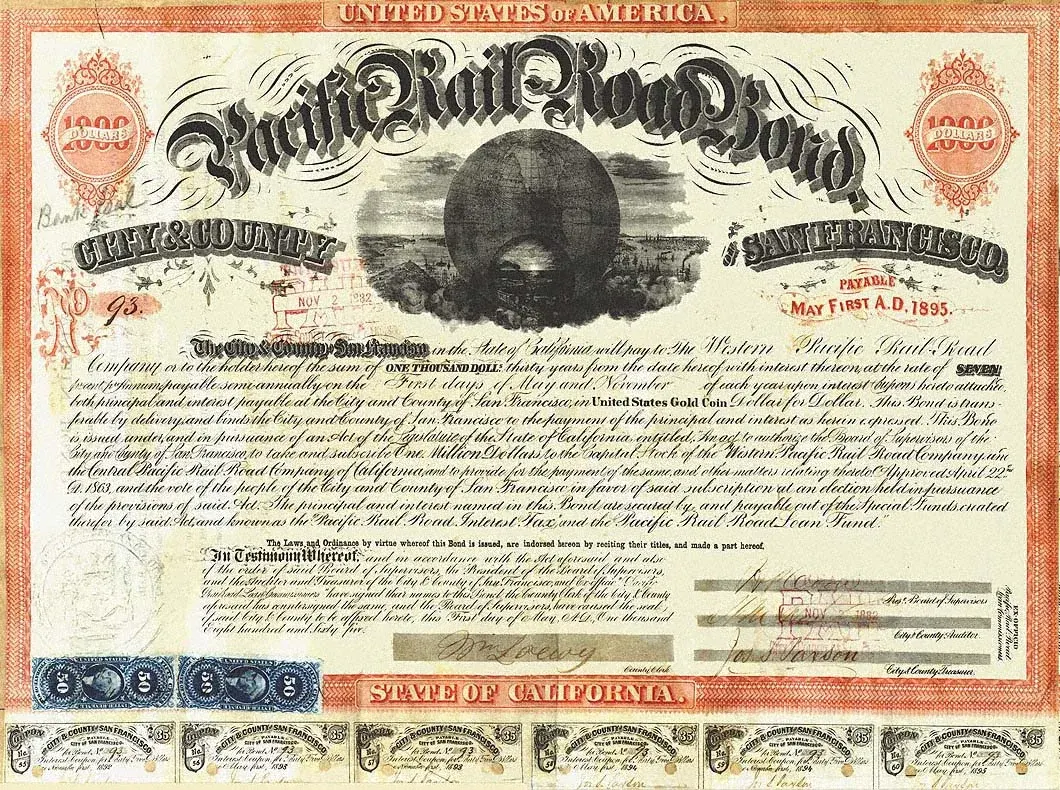
A 1865 San Francisco railroad bond, with detachable interest coupons along the bottom · City and County of San Francisco, 1865 · Wikimedia Commons (public domain)
Translating this to the paper from the beginning, the face value is 1 million won, the coupon is 30,000 won at 3% per year, and maturity is 1 year later. Because the size and date of the money to be received are predetermined, bonds are also called fixed-income securities (OpenStax Principles Finance 2e 10.1).
Compared to stocks, the position is different. When you buy a stock, you own a piece of the company, and the money you receive for that share varies depending on how much the company earns. When you buy a bond, you become a person who lent money, and the money you receive is just as much as written in the contract. The money a bondholder is scheduled to receive is a promise with a fixed date and amount.
Who Borrowed — Government Bonds and Corporate Bonds
Even with the same exchange voucher, who signed it matters. A government bond is a bond issued by a country's government to borrow money. A corporate bond is a bond issued by a company to borrow money. In South Korea, the government issues government bonds, and many companies issue corporate bonds.
Let us suppose that instead of your friend, the government signed the paper at the beginning. The government is generally considered to have a more stable standing than a company, which is why government bonds are classified as having a lower risk of failing to keep their promise (OpenStax Principles Finance 2e 10.4). The fact that when money to pay back falls short, the government has a way to raise taxes while a company does not is also why corporate bonds are generally viewed as riskier than government bonds. Even among corporate bonds, how risky they are and how much more interest they pay are divided by the company's credit (OpenStax Principles Finance 2e 10.1). We will look again later at how governments' circumstances are not all the same either.
That the side bearing more risk receives more is the principle of investing, and that is also why government bonds generally pay the lowest interest (OpenStax Principles Finance 2e 10.1) (OpenStax Principles Finance 2e 10.4). Depending on who signed, bonds with the same face value pay different interest.
Why the Price Moves Even Though the Interest Stays the Same
The paper at the beginning says 3% per year. Even after you receive the paper, the interest rates in the world keep moving. The market interest rate is the interest rate attached in the market when people borrow and lend money right now. The coupon rate written on the bond stays exactly as it was first set, but the market interest rate can change at any time (OpenStax Principles Finance 2e 10.4).
Let us calculate with the bond from the beginning. It has a face value of 1,000,000 won, a 3% coupon per year, and matures in 1 year, so it brings in 1,030,000 won 1 year later. For example, suppose the market interest rate rose to 4% per year right after you bought this bond. Now a new bond with the same risk gives 1,040,000 won 1 year later if you pay 1,000,000 won.
A person who wants to buy the old bond also wants to make 4%. To receive 1,030,000 won 1 year later and make 4%, they can only pay up to about 990,400 won, which is 1,030,000 won divided by 1.04 today. The price of the old bond drops from 1,000,000 won to about 990,400 won. This calculation of turning future money into today's value is covered in detail in another part of this series, "Compound Interest — A Snowball That Grows as It Rolls, and the Share That Melted Along the Way".
Conversely, if the market interest rate fell to 2% per year, a new bond gives only 1,020,000 won 1 year later. The old bond, which gives 1,030,000 won, rises in price up to about 1,009,800 won, which is 1,030,000 won divided by 1.02. When interest rates rise, the price of already issued fixed-rate bonds falls, and when interest rates fall, it rises. Floating-rate bonds, where the interest changes following the market interest rate, are an exception to this rule (OpenStax Principles Finance 2e 10.1). The amount written on the exchange ticket stays the same, and what changes is how much that amount is valued at today.
Then how much does the person who bought it for 990,400 won earn? They receive 1,030,000 won 1 year later, so it is about 4%. The yield to maturity is the rate of return you get if you buy the bond at the current price, hold it until maturity, and receive all the promised money. The coupon written at first was decided by the circumstances at the time of issuance, and the yield demanded by the person buying it now is the current yield to maturity (OpenStax Principles Finance 2e 17.2). If both the coupon rate and the yield are written in the bond information, the first number only determines the size of the interest you will receive, and the second number comes from the price traded in the market, so it also contains how risky that bond appears (OpenStax Principles Finance 2e 10.2). A bond whose coupon rate is higher than its yield is traded at a price higher than its face value, and a bond whose coupon is lower is traded cheaper, and the earlier bond traded at 990,400 won is an example of the latter (OpenStax Principles Finance 2e 10.2).
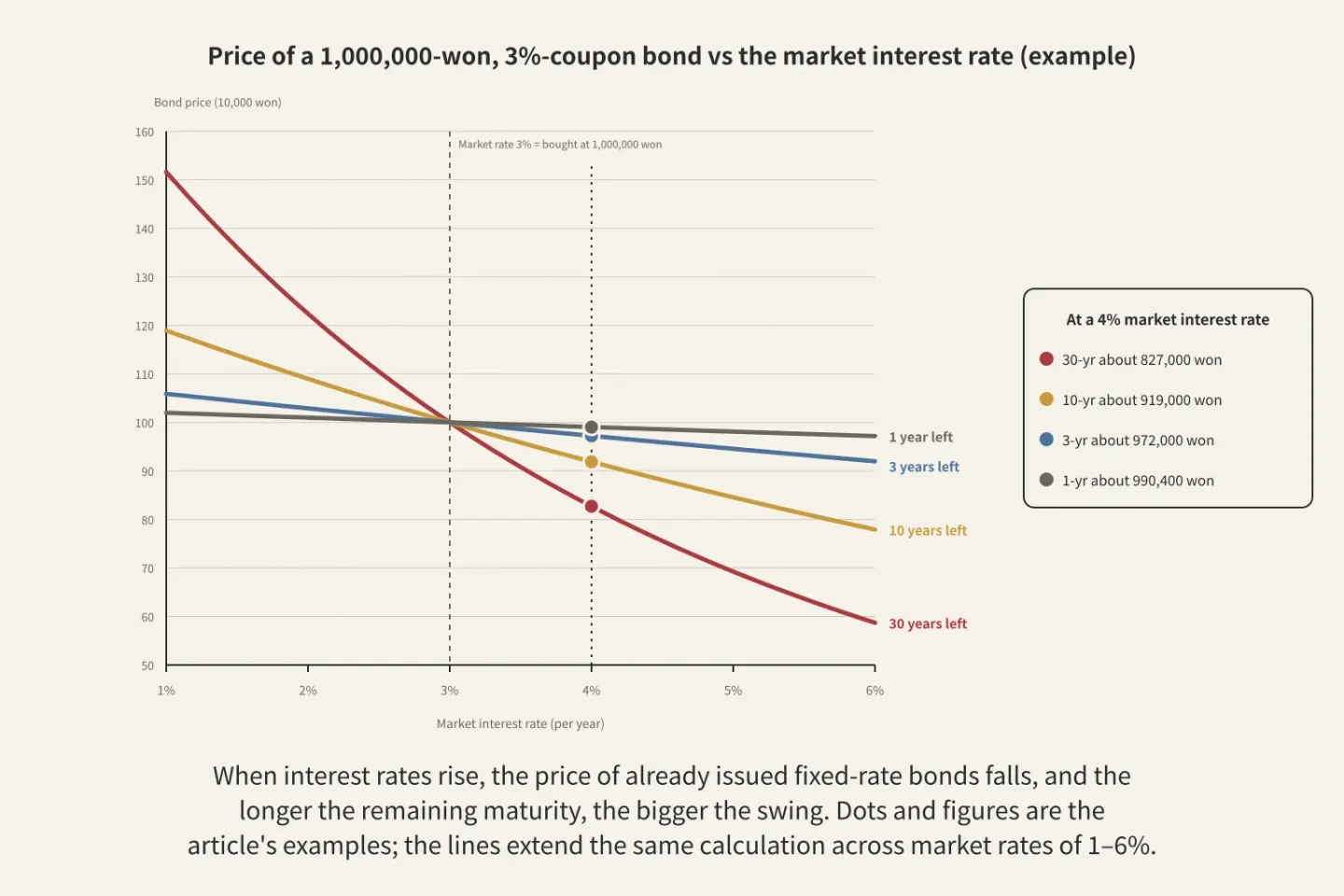
Figure: a diagram Paperis drew using only what the article says
The Further the Date, the Wilders the Swing
Now let us imagine that a person is holding three different bonds together. All three have a face value of 1,000,000 won, pay a 3% coupon each year, and were bought for 1,000,000 won each when the market interest rate was 3%. The only difference is their remaining maturity: 30 years, 10 years, and 3 years. For instance, if the market interest rate becomes 4% one day, the values of the three bonds on that same day are about 827,000 won for the 30-year bond, about 919,000 won for the 10-year bond, and about 972,000 won for the 3-year bond. This is a drop of about 17.3%, 8.1%, and 2.8%, respectively, from their purchase prices.
When we view them as bundles of voucher slips, the reason becomes clear. The 30-year bundle has many voucher slips stamped with distant dates, and money from more distant dates is discounted repeatedly over many years by the interest rate when converted to today's value. Interest rate risk is the risk of suffering a loss because bond prices fall due to a change in interest rates. That bond prices fall when interest rates rise is the core of interest rate risk, and other things being equal, the longer the remaining maturity, the more wildly the price swings (OpenStax Principles Finance 2e 10) (OpenStax Principles Finance 2e 20.4).
Duration is the measure of the magnitude of this swing in a single number. Duration is a yardstick that measures how drastically bond prices will move when interest rates shift, and the larger the number, the larger the swing. Other things being equal, the longer the maturity, the smaller the coupon, and the lower the market interest rate, the larger the duration (OpenStax Principles Finance 2e 10) (OpenStax Principles Finance 2e 20.4). Even if maturities are the same, a bond that pays a larger coupon brings money in earlier, so it behaves practically like a shorter bond (DOI: 10.4324/9781315145976-5) (DOI: 10.4324/9781315145976-2). This means you cannot fully know how much a bond will swing with interest rates by looking at the remaining years alone (DOI: 10.4324/9781315145976-2).
Other things being equal, the longer the maturity and the more voucher slips with distant dates there are, the more violently the bond swings with interest rates.
If You Hold It to the End
What happens if you do not sell a bond whose price has fallen, and instead hold it until maturity? The 10-year bond we looked at earlier, which pays interest once a year, sees its price drop to about 919,000 won when the market interest rate rises to 4%, but as long as the issuer keeps their promise, you receive 30,000 won every year until maturity, and the full 1,000,000 won on the final day.
Many bonds are bought and sold before maturity. If you need money and sell before maturity, you receive the price at that time, so you can make a profit by selling it for more than you bought it for, or lose money by selling it for less (OpenStax Principles Finance 2e 10.4). Even the person who holds it to the end loses something. That is because they are receiving 3% while the market interest rate is 4%. The value of the best alternative given up because of a choice is called opportunity cost. For the person who holds it to the end, that share is continuing to receive 3%, which is lower than the market interest rate.
Inflation also interferes. Because the coupon and principal are fixed amounts, if inflation and interest rates are high while you are holding it, what you can buy with that money decreases, which reduces the appeal of the investment (OpenStax Principles Finance 2e 10.4).
If you hold a bond until maturity, you receive the promised amount no matter how interest rates moved, but that is on the premise that the issuer keeps their promise, and the usefulness of that amount varies depending on inflation.
When a Promise Is Broken
The second risk of a bundle of exchange tickets lies in the person who signed it. Default is the failure of the issuer to repay promised interest or principal on time. Credit risk is the risk that the issuer will default, resulting in failure to receive interest and principal as promised. A default can range from interest arriving late to not being received at all (OpenStax Principles Finance 2e 10) (OpenStax Principles Finance 2e 10.4).
If rumors circulate that the friend from the beginning is having a hard time lately, anyone trying to buy that paper might figure they may not get the full 1.03 million won and try to bargain the price down further. In the bond market too, investors tend to demand higher yields from issuers whose ability to pay is in doubt. Because most corporate bonds carry some possibility of default and that degree varies from company to company, a large share of the extra interest corporate bonds pay over government bonds is the price of credit risk. The price of other inconveniences, such as how hard it is to sell, also goes into that markup (OpenStax Principles Finance 2e 10.4).
Differences in credit risk exist among government bonds as well. As the financial crisis spread from late July 2007 to the end of March 2009, higher expected fiscal deficit or national debt ratios in certain eurozone countries compared to Germany played a part in widening the yield gap against German government bonds. What the authors saw as more important was the government's announcement that it would rescue banks. Following that announcement, investors concluded that the risk of the banks had transferred to the government and repriced the credit risk of those countries' government bonds (DOI: 10.1177/152397211001000403).
The interest on a bond includes the price of lending money, plus a price placed on the possibility that the promise will be broken.
The Report Card Called Credit Ratings
It is difficult to comb through every single person who signed. So, to help investors, professional credit rating agencies have emerged that do the combing instead (KCI ART001978642) (OpenStax Principles Finance 2e 10.4). A credit rating is an evaluation by a professional credit rating agency of the risk that the issuer of a bond will fail to repay its debts now or in the future, expressed as a grade. The bond with the lowest probability of default receives AAA, followed by AA, A, and BBB in descending order. By the standards of US credit rating agencies, up to BBB is considered appropriate for investment, but some risk remains even at BBB (OpenStax Principles Finance 2e 10.4).
A rating is a judgment about future repayment ability, and there is no fixed formula for calculating a rating (OpenStax Principles Finance 2e 10.4). Judgments can be wrong. In the US bond market, securities known as structured securities—which bundle debts as collateral and divide them into multiple tiers—mostly received high ratings, and more than half of those rated by one major credit rating agency were AAA (DOI: 10.1086/648293) (DOI: 10.1111/j.1468-036x.2009.00515.x). In 2007 and 2008, the creditworthiness of these securities deteriorated sharply, leading 36,346 ratings issued by that agency to be downgraded, nearly one-third of which had been AAA (DOI: 10.1086/648293).
Research published in a Korean academic journal also shows a gap between ratings and credit measured by models. One Korean study noted that in the sample from 1998 to 2015, bond ratings assigned by credit rating agencies increasingly exceeded the credit levels predicted by credit models, and interpreted this as a result consistent with rating inflation (DOI: 10.26845/KJFS.2017.12.46.5.1089).
A credit rating is someone else's judgment used to read the risk of default, not a guarantee that promises will be kept.
How Far the Term "Safe Asset" Reaches
The news often calls government bonds "safe assets." If we divide that label by the two risks we've looked at so far, its scope becomes clear.
On the default risk side, government bonds are generally considered safe. However, as we saw in the euro area earlier, that degree varies depending on the state of national finances. The worry of not being able to sell when you want to is also usually small. Government bonds are among the easiest bonds to buy and sell in any given country, so this worry rarely blows up into a big issue unless there is a major economic crisis (OpenStax Principles Finance 2e 10.4). In a study examining euro area government bonds, most of the yield differences between countries were explained by credit ratings, but which country's government bonds a large amount of money rushed into was determined almost entirely by how easy they were to buy and sell, and when markets shook, investors chased that ease rather than credit ratings (DOI: 10.1093/rfs/hhm088).
On the interest rate side, the situation is different. In our earlier calculation, when the market interest rate rose by 1 percentage point, the price of a 30-year bond fell by about 17.3%. Since this calculation did not include a single default, the price drops by the exact same amount even if the person who signed is the government. Saying a government bond is safe means the risk of default is low, and the drop in price when interest rates rise happens just the same even to long-term government bonds.
How does it compare to stocks? Fixed-income bonds have the money to be received fixed in advance, so they are generally considered an investment with smaller price fluctuations than stocks (OpenStax Principles Finance 2e 10.2). This is an evaluation leaning on past movements, and past movements do not guarantee the future. Even within bonds, the range is wide, and the size and reason of the fluctuations differ depending on who signed and how much maturity is left.
Before maturity, bond prices fluctuate and issuers may fail to repay, but because the money to be received is fixed, they generally fluctuate less than stocks, and the shape of that risk varies depending on who signed and how far away the maturity is.
On the Day the Interest Rate News Breaks, Two Bundles of Vouchers
Let us imagine a person holding two bundles. One is a government bond with 10 years left until maturity that pays a 3-percent coupon once a year, and the other is a corporate bond from a single company maturing on the same day. The corporate bond offers a higher coupon, reflecting the price of credit risk. Suppose, for instance, that news of rising interest rates keeps coming, and the yield offered by new government bonds of the same risk has risen from 3 percent to 4 percent per year.
First, let us look at the prices. Both bundles keep their original coupon rates, but because newly issued bonds pay more interest, both generally move toward a drop in price. Following the previous example, the government bond falls to somewhere around 919,000 won. The fallen price is what you receive if you sell right now. If you hold it to maturity without selling, the government bond continues to deliver 30,000 won every year and 1 million won on the final day.
Next, let us look at the promises. The government bond’s promise is backed by the government, and that risk is considered low. The corporate bond’s promise is backed by a company. The statement that you receive the promised amount even if you hold to maturity holds true only under the assumption that the company pays it back to the very end, and the ratings that help judge that can also be wrong.
Faced with the same news, two questions hang over a bond: how its price changes when interest rates move, and whether the person who signed will pay it back to the end. The government bond bundle mostly carries the first question, while the corporate bond bundle carries both questions together.
The voucher analogy has its limits. The interest on actual bonds flows into your account without you needing to present a voucher, and a voucher does not set its own price. What sets the price is how much people buying and selling in the market value that bundle today.
Where to Read More
- Central banks and base rates, the major forces that move market interest rates, are covered in "Interest Rates and Central Banks — A Brake in the Engine Room, a Train That Slows Long After".
- Inflation, which cuts into the usefulness of a fixed coupon, continues in "Prices and Inflation — The Same Shopping Basket, Height Marks Drawn Every Year".
- The story of owning a piece rather than lending money is in "What You Actually Own When You Own a Share — And Where You Stand in Line".
- How to read the company debts and profits that credit rating agencies look into is covered in "Financial Statements — What Each of the Three Ledgers Is Asking".
- The calculation of the share you miss out on when you hold to the end leads into "Scarcity and Opportunity Cost: What Do You Give Up When You Choose?".
- The calculation that turns future money into today's value continues in another piece of this series, "Compound Interest — A Snowball That Grows as It Rolls, and the Share That Melts Along the Way", the story of mixing bonds with various other assets in "Risk and Diversification — The Mother Who Counted Her Umbrella Seller and Straw-Shoe Seller Together", and funds that gather and hold bonds in "Funds and Index Funds — The Ship That Sails With the Fleet, the Ship That Tries to Outrun It, and the Fare Paid Every Year".
Source Papers
- "Principles of Finance 2e — 10.1 Characteristics of Bonds" (2026) — OpenStax Principles Finance 2e 10.1 — Bonds are future cash flows promised by the issuer, covering the meanings of face value, coupon, and maturity, why corporate bonds are riskier than government bonds, and how fixed-rate bond prices and interest rates move in opposite directions while floating-rate bonds are an exception.
- "Principles of Finance 2e — 10.2 Bond Valuation" (2026) — OpenStax Principles Finance 2e 10.2 — The difference between the coupon rate and the yield to maturity, trading above face value when the coupon rate is higher than the yield and below it when lower, and fixed-rate bonds being generally considered lower in volatility than stocks.
- "Principles of Finance 2e — 10.4 Risks of Interest Rates and Default" (2026) — OpenStax Principles Finance 2e 10.4 — Credit, liquidity, interest rate, and default risks, the sequence of ratings (AAA to BBB) and that ratings are only judgments, capital gains and losses from trading before maturity, and the diminished appeal of fixed interest when prices and interest rates are high.
- "Principles of Finance 2e — Key Terms" (2026) — OpenStax Principles Finance 2e 10 — Definitions of maturity, default, credit risk, interest rate risk, and duration.
- "Principles of Finance 2e — 20.4 Interest Rate Risk" (2026) — OpenStax Principles Finance 2e 20.4 — Duration grows larger as maturity is longer, the coupon is lower, or the market yield is lower.
- "Principles of Finance 2e — 17.2 The Costs of Debt and Equity Capital" (2026) — OpenStax Principles Finance 2e 17.2 — Yield to maturity is the return when buying now and holding until maturity while collecting all promised money.
- "Bond Price Volatility and Term to Maturity: A Generalized Respecification" (2017) — DOI: 10.4324/9781315145976-5 — The volatility of a bond's price does not have a simple relationship with remaining maturity, and at the same maturity, a bond with a higher coupon moves like a shorter bond.
- "From 'Some Theoretical Problems Suggested by the Movements of Interest Rates, Bond Yield, and Stock Prices in the United States Since 1856'" (2017) — DOI: 10.4324/9781315145976-2 — "Years remaining until maturity" falls significantly short of measuring a bond's practical length, and the coupon must also be considered together.
- "What Explains the Surge in Euro Area Sovereign Spreads during the Financial Crisis of 2007–09?" (2010) — DOI: 10.1177/152397211001000403 — Between late July 2007 and late March 2009, larger expected deficits and debts than Germany in several euro area countries widened government bond yield gaps, and bank rescue announcements caused credit risk for government bonds to be repriced.
- "Flight-to-Quality or Flight-to-Liquidity? Evidence from the Euro-Area Bond Market" (2008) — DOI: 10.1093/rfs/hhm088 — Most of the euro area government bond yield gaps are explained by credit quality differences, but large capital rushing into the bond market during market stress followed liquidity almost exclusively.
- "The Credit Rating Crisis" (2010) — DOI: 10.1086/648293 — Most US structured securities held high ratings (accounting for 35% of US bond market debt in December 2008), 36,346 issues rated by one rating agency were downgraded in 2007-2008, and nearly a third of those were AAA.
- "부채 구성요소와 회사채 신용등급의 결정에 관한 연구" (2015) — KCI ART001978642 — Corporate bond credit ratings are graded evaluations by professional credit rating agencies of an issuing company's present or future default risk (Korean study).
- "Tranching and Rating" (2009) — DOI: 10.1111/j.1468-036x.2009.00515.x — An analysis showing that profits can arise when collateral-backed bonds are divided into junior tiers (tranches) and sold at yields corresponding to their ratings.
- "회사채 신용등급 괴리와 기업의 재무 의사결정" (2017) — DOI: 10.26845/KJFS.2017.12.46.5.1089 — In the 1998-2015 sample, credit rating agencies' bond ratings increasingly exceeded credit levels predicted by credit models (consistent with rating inflation), and that discrepancy influenced corporate debt financing and investment.
Sources (13)
- Principles of Finance 2e — 10.1 Characteristics of Bonds
- Principles of Finance 2e — 10.2 Bond Valuation
- Principles of Finance 2e — 10.4 Risks of Interest Rates and Default
- Principles of Finance 2e — Key Terms
- Principles of Finance 2e — 20.4 Interest Rate Risk
- Principles of Finance 2e — 17.2 The Costs of Debt and Equity Capital
- Bond Price Volatility and Term to Maturity: A Generalized RespecificationDOI 10.4324/9781315145976-5
- From 'Some Theoretical Problems Suggested by the Movements of Interest Rates, Bond Yield, and Stock Prices in the United States Since 1856'DOI 10.4324/9781315145976-2
- What Explains the Surge in Euro Area Sovereign Spreads during the Financial Crisis of 2007–09?DOI 10.1177/152397211001000403
- Flight-to-Quality or Flight-to-Liquidity? Evidence from the Euro-Area Bond MarketDOI 10.1093/rfs/hhm088
- The Credit Rating CrisisDOI 10.1086/648293
- Tranching and RatingDOI 10.1111/j.1468-036x.2009.00515.x
- 회사채 신용등급 괴리와 기업의 재무 의사결정DOI 10.26845/kjfs.2017.12.46.5.1089