
Paperis Articles
Compound Interest — A Snowball That Grows as It Rolls, and the Share That Melts Along the Way
Compound interest, interest earned on interest, looks much like simple interest for the first few years, then pulls further ahead over time. Run the same arithmetic backward and future money becomes today's value; inflation, fees and debt build up the same way.
Your field's papers, as audio
Pick your fields and journals — Paperis summarizes the key papers and turns them into audio. Listen on your commute.
Start Paperis free →Compound Interest — A Snowball That Grows as It Rolls, and the Share That Melts Along the Way
The Same 10 Million Won, Two Bank Accounts
Two people deposited 10 million won in the bank on the same day. To keep the explanation simple, let us assume both accounts pay 5% interest each year on the deposited money. The 5% is an example number used for calculation.
The first person takes the interest that comes in each year and keeps it separately in a drawer. The money in the drawer is not deposited again, so it earns no interest, and the bank account always has just 10 million won left in it. The second person leaves the interest in the account as it is without taking it out. The incoming interest also stays in the account and earns interest together starting the following year.
Thirty years later on the same day, the first person's drawer has accumulated 15 million won in interest, making a total of 25 million won including the 10 million won in the account. The second person's account has roughly 43.22 million won. They deposited the same amount under the same conditions, yet the difference measured on the same day exceeds 18 million won.
This article follows that difference by comparing it to a snowball rolling down a slope. As a snowball rolls, its surface area grows wider, so each rotation picks up more snow. There is also a portion that melts away together from that snowball. The examples in this article are drawn from the deposits and loans commonly seen by Korean readers, and the concepts apply in any country.
Interest on Interest
The difference between the two accounts arises from the basis on which interest is calculated.
The principal is the money itself that was initially deposited or borrowed. The principal in both accounts is identically 10 million won, and the interest for the first year is identically 500,000 won, calculated by multiplying the principal by the interest rate (OpenStax Principles Finance 2e 7.2).
Simple interest is a method of applying interest only to the initially deposited principal. The first person, who simply took out the interest and gathered it in a drawer, gets the same result as simple interest. The money in the drawer grows by 500,000 won every year, by the same amount for the entire 30 years.
Compound interest is a method of applying interest again not only to the principal but also to the interest that has already accumulated. At the end of the second year, the interest received by the second person is 525,000 won, which is 25,000 won more than the first person. That 25,000 won is the money earned again by the first year's interest left in the account, in other words, interest on interest (OpenStax Principles Finance 2e 7.2).
The rate of return is a value indicating what percentage the deposited or invested money has increased or decreased over a certain period. The annual return written on a bank or brokerage app is the return measured on a one-year basis. In products where the interest rate is predetermined, such as a deposit, the interest rate becomes the rate of return.
Future value is the amount after current money has grown at a set rate of return over a certain period. The future value of money growing with compound interest is obtained by multiplying the principal by "1 plus the rate of return" raised to the power of the number of years. The longer the period and the higher the rate of return, the larger the future value becomes (OpenStax Principles Finance 2e 7.2).
Comparing the two paths for 10 million won at 5% per year, which is our example, looks like this.
| Elapsed Years | Simple Interest | Compound Interest | Difference |
|---|---|---|---|
| 10 years | 15 million won | Approx. 16.29 million won | Approx. 1.29 million won |
| 20 years | 20 million won | Approx. 26.53 million won | Approx. 6.53 million won |
| 30 years | 25 million won | Approx. 43.22 million won | Approx. 18.22 million won |
The difference for the first 10 years is small, but by 30 years, it widens by more than tenfold. In compound interest, because the base on which interest accumulates grows every year, as time goes on, the magnitude by which it grows in a single year itself increases (OpenStax Principles Finance 2e 7.2). It is just like a snowball picking up more snow in a single roll the larger it is. The difference from compound interest looks small in the first few years, but widens significantly the longer time goes on.
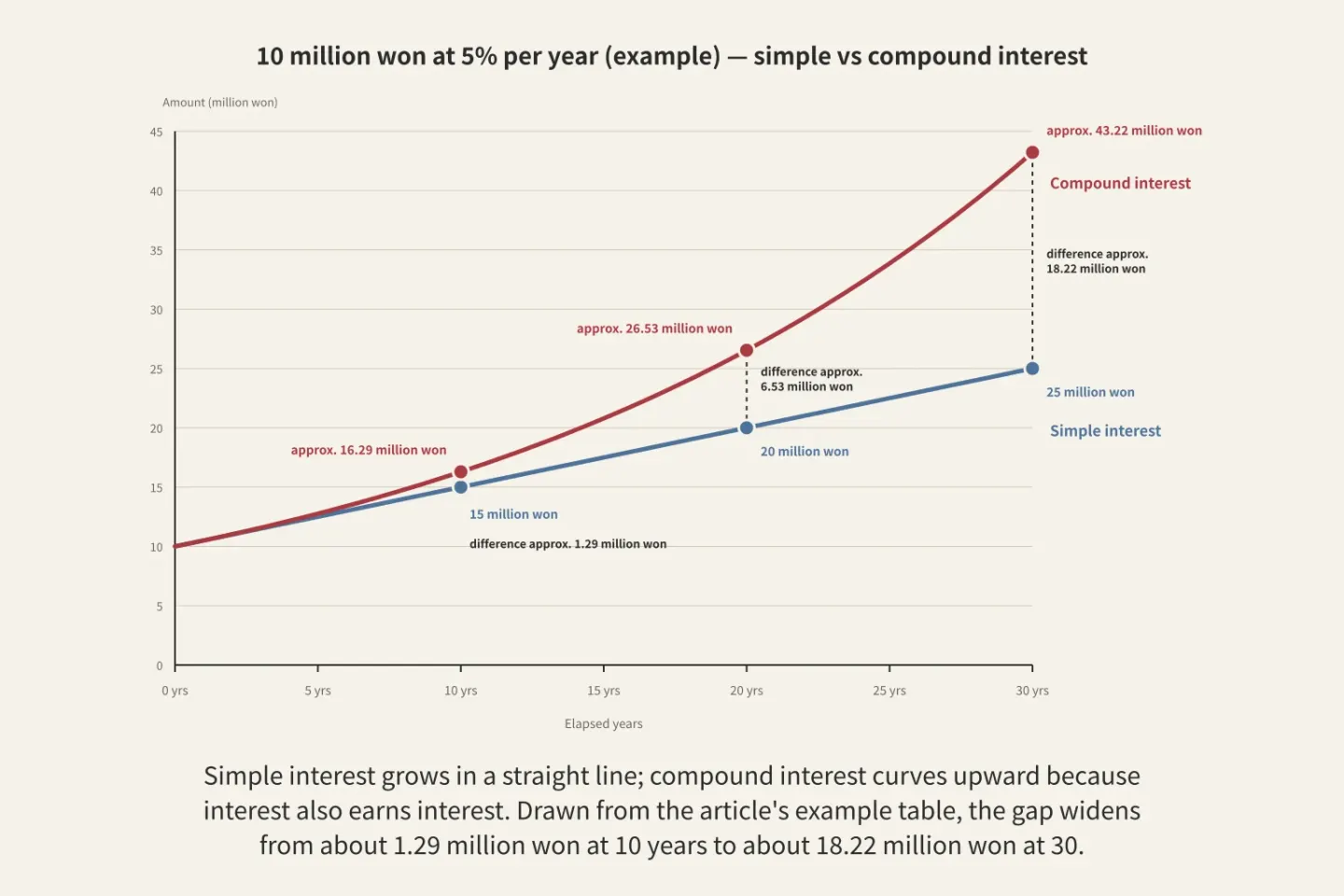
Figure: a diagram Paperis drew using only what the article says
The Time to Double
When does 10,000,000 won growing at 5% a year become 20,000,000 won? You can even estimate in your head how long it takes for money growing with compound interest to double.
The rule of 72 is a mental shortcut where you divide 72 by the annual return percentage to roughly get the number of years it takes for money to double. At 5% a year, it is about 14.4 years by dividing 72 by 5, and at 10% a year, it is about 7.2 years. You can use this shortcut for anything that grows at the same rate every year, not just money, like the price level (OpenStax Principles Finance 2e 7.4). Looked at through the shortcut, when the interest rate doubles, the number of years it takes to double is halved.
The interval for adding interest also changes the result. Even with the same annual interest rate, dividing it and adding it every month grows more after a year than adding it once a year, and the larger the amount and the longer the period, the greater that difference becomes (OpenStax Principles Finance 2e 7.4).
An Unguaranteed Slope
The table and estimates above are correct only on the assumption that the return stays the same for all 30 years.
Unless it is a product like a deposit that promises an interest rate, investments generally do not guarantee a set return. Most investments carry a risk of losing money, large or small, and the higher the return, the greater the risk is likely to be (OpenStax Principles Finance 2e 7.2). You may also lose part or all of the money you entrusted (OpenStax Principles Finance 2e 7.4). How much a return fluctuates is unpicked by another piece in this series, Risk and Diversification — The Mother Who Counted Her Umbrella Seller and Straw-Shoe Seller Together.
A similar problem arises when past returns are simply laid out straight into the future. The publisher's blurb for a book that compiles more than 100 years of investment returns across 16 countries notes that investors have too often extended recent experience into the future. The same blurb cites the fact that U.S. stocks grew by an average of about 9% per year minus inflation over the 50 years starting from the 1950s as a victory for optimists. The same blurb notes that leaving only surviving old indexes inflates long-term performance, and that focusing on periods that turned out well in hindsight leads to greatly inflated estimates of long-term stock returns in most countries (DOI: 10.1515/9781400829477). Past performance is no guarantee of future results.
This is also the limitation of the snowball metaphor. In reality, the slope is not predetermined, and a rolling snowball can break apart. Compounding is a calculation showing how money grows when a set return continues, and the promise that the return will continue is not contained within it.
Money in the Future, Priced Today
Let us say a friend asks you this. Would you take 9 million won right now, or 10 million won 3 years from now? Because the two amounts are received at different times, you cannot compare them just by looking at the numbers. Money from different times is compared after being moved to the value of the same time (OpenStax Principles Finance 2e 16.2).
The time value of money is the idea that even for the same amount, money today is worth more than money later. This is because money you have right now can earn interest if you put it away (OpenStax Principles Finance 2e 7.4).
Present value is the value expressed as how much a sum to be received later is worth in today's money. Discounting is the work of calculating a future amount back to its value today, which is running compound interest in reverse. Compound interest sends today's money into the future, and discounting brings future money into the present. If you divide a future amount by "1 plus the rate" repeatedly for the number of years, you get the present value (OpenStax Principles Finance 2e 7.4).
The discount rate is the rate trimmed down each year when moving a future amount to today's value, written as the growth rate in reverse. The discount rate is written on a yearly basis and acts in the opposite direction of the growth rate (OpenStax Principles Finance 2e 7.4). Just like the example in this article, you can set the interest rate you would receive if you took the money now and put it away as the discount rate and calculate. If you use 5 percent per year as the discount rate, 10 million won 10 years from now is worth about 6.14 million won in today's money. This is because if you put 6.14 million won away today at 5 percent compound interest for 10 years, it becomes roughly 10 million won.
Let us return to your friend's question. If the discount rate is 5 percent per year, the present value of 10 million won 3 years from now is about 8.64 million won, so 9 million won right now is larger. If the discount rate is 3 percent per year, the present value is about 9.15 million won, so 10 million won 3 years from now is larger. Both calculations are under the assumption that the promise is kept without fail. Even for the same two amounts, which one is larger depends on the discount rate you use.
Shares That Melt Together
A rolling snowball melts a little on the outside, too. The portions that melt from the snowball of money are prices and fees.
The inflation rate is the percentage by which prices have risen over a given period. Purchasing power is the amount of goods and services you can buy with the same amount of money. What prices are and how they are measured is explained in "Prices and Inflation — The Same Shopping Basket, Height Marks Drawn Every Year". Even if your balance grows, if prices rise faster, the amount you can buy with that money shrinks (OpenStax Principles Finance 2e 7.4). That is why the return minus inflation measures the grown portion better (OpenStax Principles Finance 2e 12.2).
The real return is the return viewed after subtracting the portion by which prices have risen, roughly calculated as the return minus the inflation rate. For example, while money grows at 5% per year, if prices rise by 3% each year, the real return is roughly 2% (OpenStax Principles Finance 2e 7.4). If we apply the example that prices rise by 3% each year to the second bank account from the beginning, about 43.22 million won 30 years later is worth about 17.81 million won in today's prices. By the same principle, adjusting interest rates for inflation connects directly to "Interest Rates and Central Banks — A Brake in the Engine Room, a Train That Slows Long After".
Fees chip away in the same way. Suppose your return is 6% per year, but after fees are deducted, 5% remains. If you invest 10 million won for 30 years, at 6% it becomes about 57.43 million won, and at 5% it becomes about 43.22 million won. As a result of deducting 1 percentage point each year, your balance 30 years later shrank by about 14.22 million won, which is roughly a quarter of the money you would have received if it had been 6%. This happens because the deducted portion also takes away the share that would have compounded further. Because the chipped-away portion also accumulates with compound interest, even a small percentage turns into a large sum after a long time. What fund management fees specifically are is explained in another part of this series, "Funds and Index Funds — The Ship That Sails With the Fleet, the Ship That Tries to Outrun It, and the Fare Paid Every Year".
Debt Rolling Down the Same Slope
Debt rolls down the exact same slope. If you leave unpaid interest to accumulate more interest, the snowball of debt grows in the exact same shape as the passbook we saw earlier.
The Rule of 72 we saw earlier applies to debt in the exact same way. Debt that accumulates without paying off the interest doubles faster the higher the interest rate is (OpenStax Principles Finance 2e 7.4).
Writing the interest rate on a daily basis makes the number look smaller. For example, let's say the daily interest is 0.1%. Multiplying 0.1% by 365 days gives 36.5% a year, and calculating it so that interest compounds on interest every day makes it roughly 44% a year. In an interview study covering online loans in Indonesia, interviewed people tended to be drawn to small numbers like daily interest and failed to convert the time units, and most had a strong tendency to estimate the interest burden in a straight line and underestimate the total amount of money they had to pay back (DOI: 10.69714/yvdqba47). The authors conclude that the capacity to use that calculation in judgment is more foundational than the ability to calculate. This is a qualitative study that interviewed three groups of people. On the side of debt, compounding works to inflate the money you have to pay back.
The Mind That Estimates in a Straight Line
Let us return to the two bank accounts at the beginning. If you estimate what the second account will become in 30 years by flattening it into a straight line where it grows by 500,000 won each year, you arrive at around 25 million won, just like the first person. That is the answer of simple interest.
Exponential growth bias is the tendency to flatten compounding—which grows multiplicatively—into a straight line when estimating it in your head. A study using household data reports that this tendency is widespread, and suggests that this bias can explain the common tendency to answer too low when given principal, interest rates, and time and asked for the grown amount, or to answer too low when given loan terms and asked for the interest rate. In the same study, even after controlling for various household characteristics, households with a stronger bias tended to borrow more, save less, and choose shorter maturities. The authors noted that there was little evidence this bias score merely stood in for overall financial literacy. This means the bias is captured separately from financial knowledge (DOI: 10.1111/j.1540-6261.2009.01518.x). Because this is a co-occurring tendency, the results do not go so far as to say that the bias caused those choices.
Financial literacy is the ability to know basic monetary concepts like interest and inflation, and to make judgments about money using that knowledge. A study surveying adults in multiple countries measures this ability with four basic questions asking about interest, compounding, inflation, and diversification (DOI: 10.1111/fima.12283). A working paper using a U.S. national sample found that only about a third of people appeared to understand the principle of interest earning interest or how credit cards work, and those with lower understanding tended to transact in ways with higher fees (DOI: 10.3386/w14808). A study using the Korea Retirement and Income Study found that 31% of respondents had a low understanding of the relatively simple concept of interest, and this literacy was related to enrolling in private pensions (DOI: 10.23842/jif.2022.33.3.001). Compounding involves nothing more than multiplication in its calculation, but it is hard to grasp by intuition. Just how much time widens the gap becomes visible only when you calculate it.
Where to Look Next
- What prices are and how they are measured continues in "Prices and Inflation — The Same Shopping Basket, Height Marks Drawn Every Year".
- How interest rates are set and why they rise and fall continues in "Interest Rates and Central Banks — A Brake in the Engine Room, a Train That Slows Long After".
- The act of choosing whether to spend now or later connects with "Scarcity and Opportunity Cost: What Do You Give Up When You Choose?".
- Where stock returns come from continues in "What You Actually Own When You Own a Share — And Where You Stand in Line".
- Other parts of this series: "Bonds — Why Does a Bundle of Dated Vouchers Rise and Fall in Price?" · "Risk and Diversification — The Mother Who Counted Her Umbrella Seller and Straw-Shoe Seller Together" · "Funds and Index Funds — The Ship That Sails With the Fleet, the Ship That Tries to Outrun It, and the Fare Paid Every Year".
Source Papers
- "Principles of Finance 2e — 7.2 Time Value of Money (TVM) Basics" (2026) — OpenStax Principles Finance 2e 7.2 — Multiplying the principal by the interest rate yields one period's interest, and starting from the second period, interest earns interest, making the future value (1+r)^n times larger through compounding, with the magnitude of growth accelerating over time, while most investments do not guarantee returns.
- "Principles of Finance 2e — 7.4 Applications of TVM in Finance" (2026) — OpenStax Principles Finance 2e 7.4 — Discounting is the inverse of compounding, present value is the future amount divided by (1+r)^n, money today is more valuable than money later because it can earn interest, the relationship among nominal rates, real rates, and inflation is covered (the Fisher equation), compounding more frequently increases future value, and the Rule of 72 is discussed.
- "Principles of Finance 2e — 16.2 Net Present Value (NPV) Method" (2026) — OpenStax Principles Finance 2e 16.2 — Money moving at different times cannot be compared as-is, so it is converted to present value for comparison.
- "Principles of Finance 2e — 12.2 Historical Picture of Inflation" (2026) — OpenStax Principles Finance 2e 12.2 — Returns adjusted for inflation measure wealth better, and if earnings fail to keep pace with inflation, purchasing power can drop even if the account balance grows.
- "Triumph of the Optimists: 101 Years of Global Investment Returns" (2002) — DOI: 10.1515/9781400829477 — Book (publisher description): Warning that investors too often extrapolate recent experiences, summarizing stock, bond, and inflation returns for 16 countries over roughly 100 years, noting that some historical indices were inflated by survivorship bias and that focusing on periods that succeeded ex post causes long-term stock returns in most countries to be significantly overstated.
- "ANALISIS ILUSI NUMERASI TERHADAP AKUMULASI UTANG MAJEMUK AKIBAT PERSEPSI RENDAH PADA BUNGA PINJAMAN ONLINE" (2026) — DOI: 10.69714/yvdqba47 — Qualitative interview study on online lending in Indonesia (three groups: mathematics majors, non-mathematics majors, and the general public): trapped in the small-number frame of daily interest, participants tended to linearly underestimate the total burden without varying the time horizon.
- "Exponential Growth Bias and Household Finance" (2009) — DOI: 10.1111/j.1540-6261.2009.01518.x — The bias toward intuitively linearizing exponential functions explains the underestimation of loan interest rates and investment future values, and households with greater bias borrow more, save less, and choose shorter maturities (after controlling for household characteristics), with little evidence that the bias is merely a proxy for overall financial literacy.
- "Debt Literacy, Financial Experiences, and Overindebtedness" (2009) — DOI: 10.3386/w14808 — Working paper (U.S. national sample): roughly one-third of people appear to understand compound interest or credit card mechanics, and lower debt literacy is associated with transacting in more expensive ways and paying more fees.
- "Financial literacy and financial resilience: Evidence from around the world" (2019) — DOI: 10.1111/fima.12283 — Financial literacy is measured using four concept questions on interest, compounding, inflation, and diversification; globally, about 1 in 3 adults understand at least three out of the four, with large gaps among women, those with lower incomes, and those with less education.
- "금융이해력, 거주지와 개인연금 및 보장성 보험 가입의 관계" (2022) — DOI: 10.23842/jif.2022.33.3.001 — 13th Panel Study on Household Finances and Living Conditions (Korea): 31% of respondents had low understanding of the interest concept, and financial literacy had a significant relationship with private pension subscription.
Sources (10)
- Principles of Finance 2e — 7.2 Time Value of Money (TVM) Basics
- Principles of Finance 2e — 7.4 Applications of TVM in Finance
- Principles of Finance 2e — 16.2 Net Present Value (NPV) Method
- Principles of Finance 2e — 12.2 Historical Picture of Inflation
- Triumph of the Optimists: 101 Years of Global Investment ReturnsDOI 10.1515/9781400829477
- ANALISIS ILUSI NUMERASI TERHADAP AKUMULASI UTANG MAJEMUK AKIBAT PERSEPSI RENDAH PADA BUNGA PINJAMAN ONLINEDOI 10.69714/yvdqba47
- Exponential Growth Bias and Household FinanceDOI 10.1111/j.1540-6261.2009.01518.x
- Debt Literacy, Financial Experiences, and OverindebtednessDOI 10.3386/w14808
- Financial literacy and financial resilience: Evidence from around the worldDOI 10.1111/fima.12283
- 금융이해력, 거주지와 개인연금 및 보장성 보험 가입의 관계DOI 10.23842/jif.2022.33.3.001