Paperis Articles
Composition and Gaze — Stepping Stones the Painting Lays, a Path the Eye Chooses
An eye looking at a painting stops and jumps, again and again. Composition partly decides where it will stop, but where it stops and in what order also varies with the viewer's question and experience. The balance rule of composition did not hold up as a law under strict tests.
Your field's papers, as audio
Pick your fields and journals — Paperis summarizes the key papers and turns them into audio. Listen on your commute.
Start Paperis free →Composition and Gaze — Stepping Stones the Painting Lays, a Path the Eye Chooses
30 Seconds Before a Painting
How long do people stand in front of a single painting in an art museum? In an exhibition featuring 28 paintings, there is a study that watched 225 visitors pass in front of six works in a series by one of the painters. The average time spent stopping once in front of a single painting was 32.9 seconds. More than half of the people returned to a painting they had already passed, and when adding the time spent looking upon returning, they stayed on a single painting for an average of about 50 seconds (DOI: 10.1177/2041669517694184).
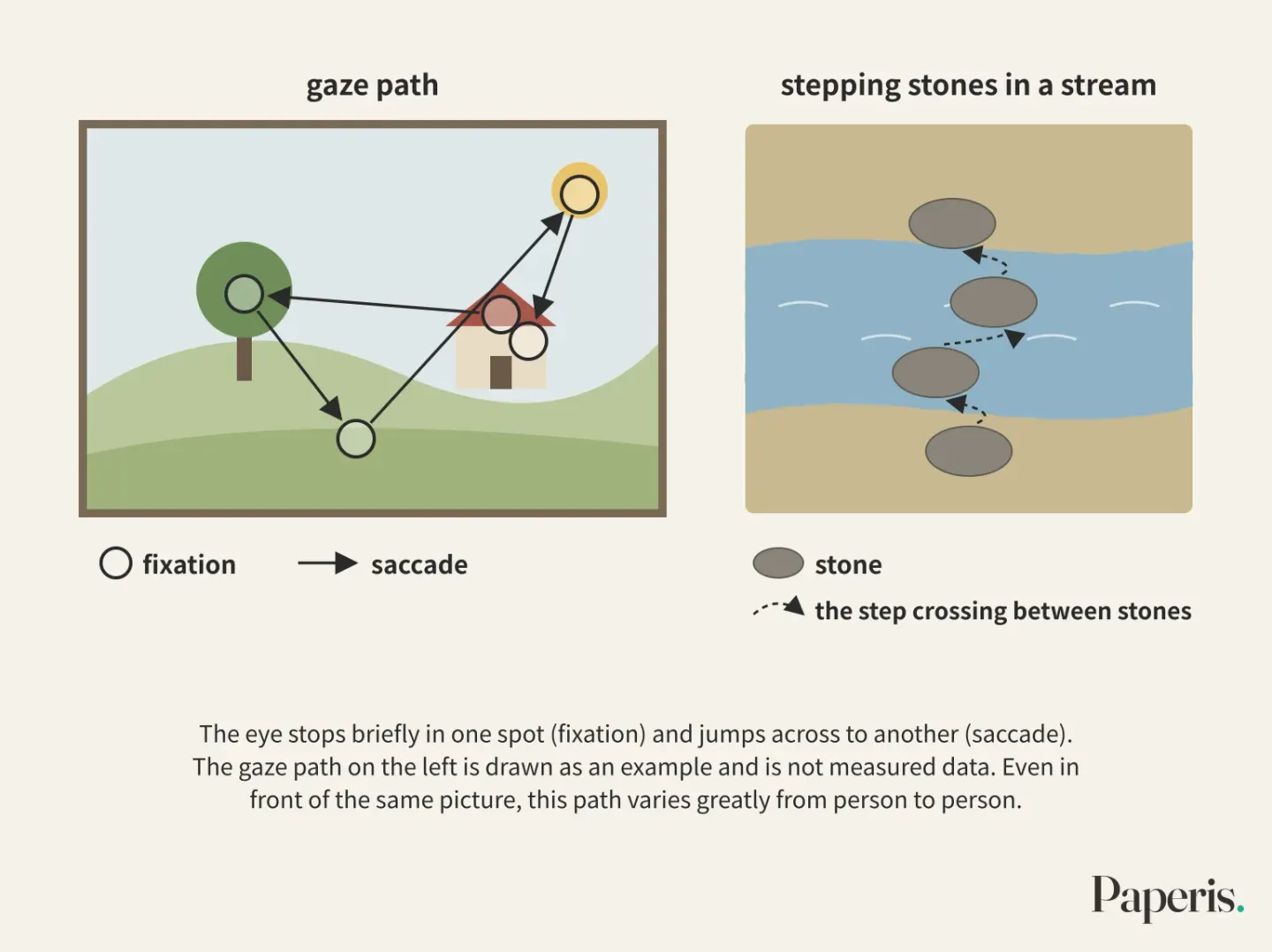
During those roughly 30 seconds, the eyes do not stay still on the painting. They briefly stop in one spot, jump across to another, and stop there again. It is similar to crossing stepping stones in a stream. The feet touch the stones, and the spaces between the stones are crossed over.
In this article, the stones are the spots where the eyes stop. A painting creates the spots where stones are likely to be placed to some extent, but which spots and in what order the eyes stop will differ for each person doing the crossing. This article follows the painting side and the eye side in turn.
The Eyes Stop and Cross Over
Where the eye passes while looking at a picture can even be captured in a photograph. In 1935, Guy Buswell, an educational psychologist at the University of Chicago, published a book recording photographs of the eye movements of 200 people looking at pictures (DOI: 10.16910/jemr.13.2.4). Eye tracking is a method of using machines to follow and record where and when a person looks. Today, it is also measured with devices that do not fix the head or devices worn on the body (DOI: 10.1080/13506280902793843) (DOI: 10.2190/em.29.1.d).
When measured this way, two kinds of eye movements alternate. Fixation is the moment the eye stops in one place briefly to look closely at that spot. Saccade is the movement where the eye quickly jumps from one fixation spot to the next. The phenomenon where seeing is suppressed during a saccade is also a basic concept in eye movement research (DOI: 10.3389/fpsyg.2025.1442623). To put it in terms of stepping stones, the stone is fixation, and the step crossing between stones is saccade.
Gaze path is the path connecting fixation spots in the order they occurred. Analyzing gaze paths has long been considered a window into the mind (DOI: 10.1145/2857491.2857503). Yet even in front of the same picture, this path varies greatly from person to person. Buswell also noted that differences among people are large (DOI: 10.16910/jemr.13.2.4).
Where the eyes stop becomes a clue to guessing what was seen. However, like the pointing finger we will see later, some things influence what we see even while receiving almost no fixations.
How a Picture Lays Its Stones
When we take a photograph, we choose what to place and where in the frame. A person making a picture does the same thing. Composition is how the elements within a picture—such as lines, shapes, and colors—are arranged across the frame. Art primers also separate the elements that make up a picture from the ways they are arranged and used (Sachant et al., Introduction to Art ch. 2.04). Let's look at through an experiment what catches the eye.
A focal point is a spot within a picture designed to draw the eye first and hold it the longest. Pictures with a clear focal point and pictures where the same pattern repeats evenly across the screen showed distinctly different viewer gaze patterns. This is the result of a conference presentation study using paintings from various art styles (DOI: 10.54941/ahfe1003700).
One tool for creating a focal point is the level of detail. In a computer-generated portrait modeled after Rembrandt's style using the same model, the eye drawn with more detail attracted gazes and held them longer. People made fewer fixations on the portrait than on a photograph of the same model (DOI: 10.1167/9.8.368). The researchers interpret that portraitists knew and used this principle intuitively. However, the experiment used a simulated picture rather than an actual Rembrandt painting, and the findings come from a conference abstract.
Art historians have long believed that a pointing finger in a painting leads the viewer's gaze straight to an important spot, but this idea had never been tested. So a research team created digitally erased versions of pointing fingers from fifteen 16th-to-17th-century paintings and compared them to the originals. The fingers themselves received almost no gaze. However, when the fingers were present, the objects they pointed to and the faces of the people pointing received more gazes, and people's ways of connecting the people and objects in the picture—as well as the stories they used to interpret the painting—changed. The magnitude of the effect varied by artist (DOI: 10.1037/aca0000835). To use stepping stones as an analogy, a finger is close to something that isn't the stone being stepped on, yet makes other stones get stepped on more often.
The power to draw the eye also includes factors unrelated to meaning. Saliency is the degree to which brightness, color, and line direction differ greatly from the surroundings, automatically drawing the eye regardless of what the object actually is. When viewing freely without any task, a map calculating saliency predicts the spots where people stop to some extent (DOI: 10.1167/9.14.11). However, in a dissertation study where seventeen people viewed thirty modern narrative paintings, what was drawn in the painting predicted gazes better than saliency did (DOI: 10.25365/thesis.9721). In a preprint study that has not yet undergone peer review, faces in paintings spanning five centuries received gazes within half a second more often than would be expected by chance (DOI: 10.48550/arxiv.2610.30481).
Stones do not land only on the spots prepared by the picture. In a study where four people viewed fourteen paintings in an actual art museum, some gazes gathered on narrative parts, but some also fell on evenly painted color fields, and where gazes stopped varied greatly depending on the person and the painting (DOI: 10.2190/em.29.1.d).
Composition somewhat determines the spots where the eyes will stop, but that power works together with what is actually drawn in the picture.
The First Few Seconds and What Follows
There are experiments that have timed what happens within a second or so of first standing in front of a painting. In one study that has not yet been peer-reviewed, faces received gazes within half a second (DOI: 10.48550/arxiv.2610.30481). In an experiment where 127 non-art majors viewed 40 modern paintings, out-of-place elements within the paintings caught the eye early, between 0.3 and 0.9 seconds, and title labels received their first gaze on average around 0.9 seconds. Eye movements while viewing paintings differed depending on whether titles were present or absent (DOI: 10.3389/fnhum.2022.808330). However, how much one lingered on faces varied by viewer, with art history experts and deaf individuals lingering less on faces (DOI: 10.1016/j.actpsy.2026.107953).
Looking longer also changes the pattern of steps. In an experiment where 10 people were shown eight abstract paintings by the painter Piet Mondrian for 20 seconds each, the duration of staying in one spot steadily increased throughout the viewing, even more so for paintings they liked (DOI: 10.1068/p6160). In the earlier museum study as well, the duration of a single pause in front of abstract paintings grew longer as time went on. However, in this study, no relationship was seen between how favorably people rated the paintings and the duration of their lingering (DOI: 10.2190/em.29.1.d). Both had small samples, so they merely show a tendency.
The stepping stones we tread in the first few seconds are not the same as the ones we tread when lingering longer. The stepping stones we tread also change depending on what we want to know.
The Same Picture, Different Paths
Does the way we look at the exact same picture change depending on what we want to know? A demonstration by eye movement researcher Alfred Yarbus is frequently brought up to answer this question (DOI: 10.1080/13506280902793843). Yarbus showed the same picture to a person while changing the questions he asked. He reported that the gaze paths were vastly different when simply looking at the picture versus when told to "remember the clothes worn by the people." However, there was only a single observer in this experiment, who looked at one picture for 21 minutes with a device attached to their eyes and their head bound tightly in place (DOI: 10.1080/13506280902793843).
Therefore, a research team tried it again with 17 ordinary people whose heads were not bound. The people looked at the picture for as long as they wanted to, and the viewing time was roughly ten times shorter than in Yarbus's time. The gaze patterns clearly changed following the task, but several of the differences were much less dramatic than Yarbus's famous record (DOI: 10.1080/13506280902793843). In one report published as a conference abstract, when people were prompted to look at the same image with different questions, their eyes diverged in their very first few fixations (DOI: 10.1167/4.8.741).
Conversely, can we guess what task a person received just by looking at their eye movements? One report stated that an attempt failed. The results from reanalyzing that data showed a correct classification rate of 34% versus 25% by chance, and a new experiment where 21 people viewed 15 natural scenes including Yarbus's picture across seven questions showed 24% versus 14% by chance. Both were higher than chance, and although the differences were not large, they were statistically significant (DOI: 10.1167/14.3.29). Buswell also noted that changing instructions significantly alters eye movements (DOI: 10.16910/jemr.13.2.4).
Even for the same picture, the stones the eyes step on change depending on what we want to know, but that difference is not as dramatic as the famous old demonstration.
The path also differs depending on experience. In one experiment where painters and art novices were left to freely look at abstract paintings, the painters' gazes were less drawn to visual saliency (DOI: 10.1371/journal.pone.0117696). However, in a short conference paper addressing the same question, this difference appeared only during free viewing and disappeared during a task to choose a preferred painting (DOI: 10.1109/apsipa.2013.6694282). There is also a result showing that people with art training stopped more frequently and longer on the spots indicated by the questions, and skipped less. That research team also noted that comparisons between experts and novices are inconsistent with one another (DOI: 10.3390/jemr19010014).
There are results pointing in the opposite direction as well. In one experiment viewing modern paintings, art expertise alone did not predict eye movements; rather, how difficult the viewer perceived the painting to be did (DOI: 10.1002/pchj.365). Differences in how we look do not stem solely from art education either. Thirty deaf individuals who lost their hearing in childhood and are fluent in sign language, despite having no art history education, looked at narrative paintings by old masters in a way similar to art history experts. They paused briefly to sweep broadly across the frame, looked more at symbols and gestures, and dwelled less on faces (DOI: 10.1016/j.actpsy.2026.107953). In a study comparing before and after a class, 21 students who took a photography creation class actively scanned the same photographs containing people or objects more thoroughly after the class. Because there was no control group, it cannot be concluded that this was due to the class, and the researchers also noted that further validation is needed (DOI: 10.3389/fpsyg.2016.01074).
How Far Do Balance Rules Hold Up?
When hanging a few picture frames on a wall, we move them around here and there so they do not look crowded on one side. Balance is the feeling that the elements within a picture are aligned without leaning to either side. Art theory has compared this feeling to a scale. Even in pictures where the two sides look different, it is thought that balance is achieved by matching elements as if balancing the weight of a mechanical scale based on an axis of symmetry (DOI: 10.1068/i0472). Art psychologist Rudolf Arnheim built this idea into the composition theory of Gestalt psychology. One research team unpacked that theory as "balance occurs when the center of gravity in a picture comes close to the horizontal, vertical, and diagonal axes" and tested it (DOI: 10.1068/i0445aap).
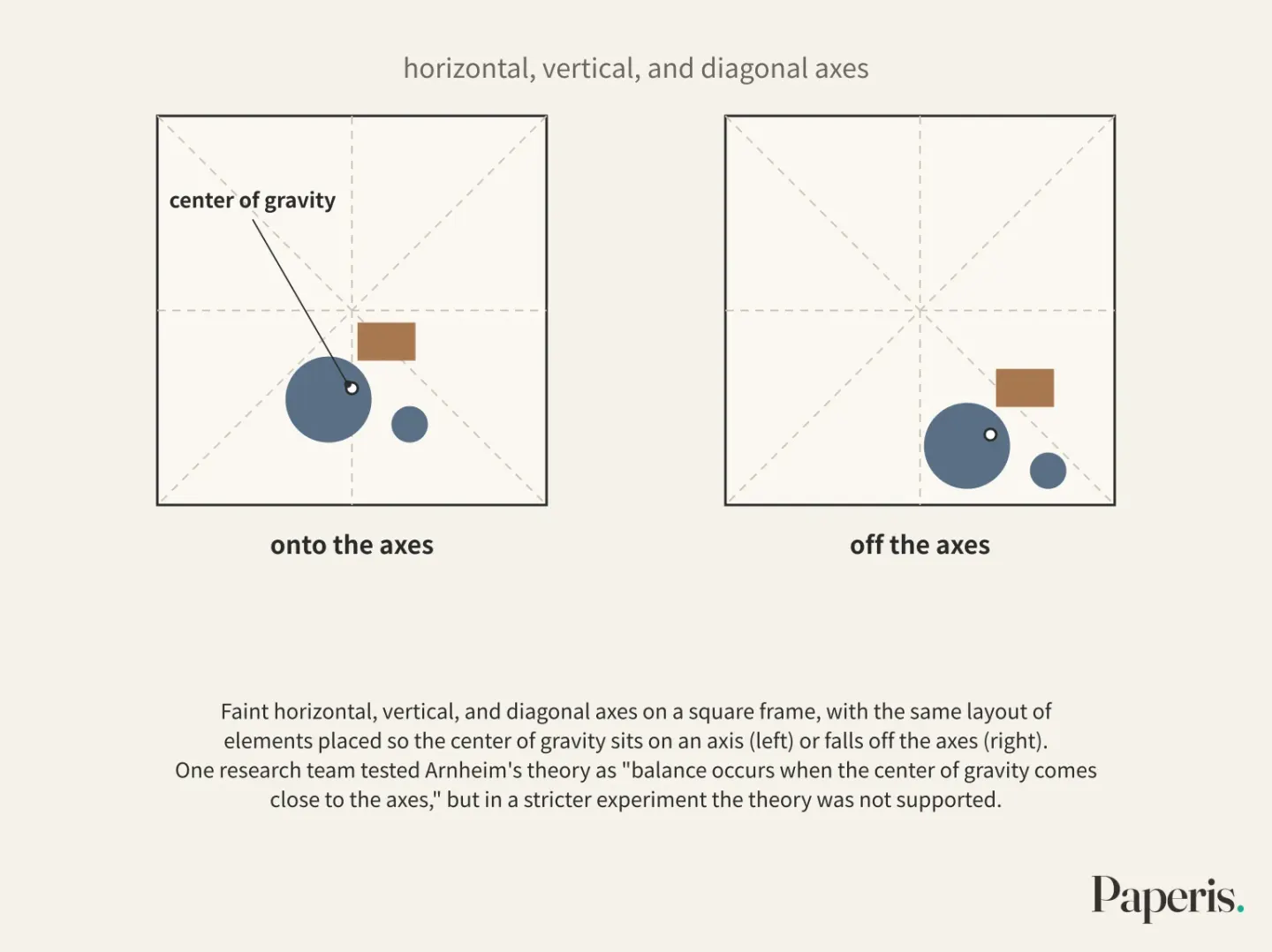
When this theory was tested with photographs, highly rated photographs had centers of gravity closer to the axes than comparison photographs. However, in a stricter experiment that compared the same photographs by moving their centers of gravity onto the axes and then back off the axes, the theory was not supported. The researchers noted that several meaningful results still remained that required explanation (DOI: 10.1068/i0445aap).
The formulas for calculating weight proved correct under some conditions and off under others. The formula that calculates weight based on an axis matched people's judgments of balance well when they viewed simple shapes with no time limit. However, when Japanese calligraphy works were viewed and judged only during an initial glance, it did not match well. When the works were turned upside down, the formula's value remained the same, but people's judgments changed significantly, especially among art experts. The researchers concluded that the balance of a first glance comes from the holistic process of grouping lines and shapes together (DOI: 10.1068/i0472).
Balance is connected to liking, but they are not the same thing. In an experiment asking people to evaluate simple pictures, balance judgments were better explained by how far the center of gravity deviated from the center than by axis-based formulas. The degree of liking depended not only on balance but also on how evenly the screen was filled, which was better explained by axis-based formulas (DOI: 10.3389/fpsyg.2016.00335). In an experiment where the compositions of 25 well-balanced pictures were disrupted in three stages and shown paired with the originals, the ability to recognize the originals overlapped only partially with art education, and both evaluations and eye movements varied depending on how familiar the pictures were (DOI: 10.3389/fnhum.2018.00087).
At the very least, balance rules did not stand as laws in strictly tested experiments. That does not mean composition has nothing to do with where our gaze goes. In one study that has not yet undergone peer review, composition rules extracted from the content of paintings predicted where people would look (DOI: 10.48550/arxiv.2610.30481). Just how far other composition rules hold up cannot be determined by the evidence in this article.
There is one more rule commonly heard when learning photography. The rule of thirds is a compositional rule of thumb stating that important things should be placed near lines that divide the screen into thirds horizontally and vertically, or near the four points where those lines intersect. Among the evidence gathered in this article, no study directly tested the rule of thirds. Experiments that asked where things look good when placed inside a frame are covered in "The Golden Ratio — Answers That Moved with the Question, a Different Rectangle for Each Person".
Standing Before the Painting Again
Now, taking what we have seen, we stand before a single painting once more. During a stay of just over 30 seconds, the eyes pause and leap across the canvas multiple times. If we follow several of the earlier experiments, faces or things that do not fit the picture may draw our gaze early, and our gaze may linger long where details are painted closely. Where and how long it lingers differs for each person.
Next comes the turn to take up a single question. Even a single question such as "Who is this person looking at?" or "Why is the empty space so wide?" can change the stepping stones we tread. Yet there is no need to expect that change to be dramatic. We may return to a painting we have passed. People who paid less attention at first in the preceding exhibition were often the ones who came back to it again (DOI: 10.1177/2041669517694184).
There are also experiments that tested looking slowly while receiving guidance. In one museum, people were made to look at four artifacts: two freely, and two with guidance in three 5-minute stages following sense, emotion, and meaning in turn. When they looked slowly following the guidance, they reported more beauty, compassion, and a feeling of absorption (DOI: 10.1080/17439760.2025.2552793). This is a single experiment that changed time and guidance together, and it was done with artifacts rather than paintings, so we do not yet know whether it will remain the same before a painting.
Where to Look Further
An experiment measuring gazes in front of an actual famous painting is found in Rembrandt's Night Watch — A Map of Paint, Drawn Inside a Glass Room. It follows where the glances of 21 people gathered and moved to over 5 minutes.
An article that examines the basis of compositional rules with the same eyes is The Golden Ratio — Answers That Moved with the Question, a Different Rectangle for Each Person. There were boards, questions, and people that picked near the golden ratio, but no rule was established that the golden ratio comes first for everyone.
Two of the other pieces in this series connect with the gaze. One study's interpretation of chiaroscuro as a device that gathers the gaze is in Light and Shadow — One Apple, and an Eye That Guesses First, and a study showing that the gaze lingering on the blank space of an ink-and-wash painting differed between Chinese and Western participants is in Perspective and Space — The One Footprint a Picture Is Calculated For.
Source Papers
- "Art Perception in the Museum: How We Spend Time and Space in Art Exhibitions" (2017) — DOI: 10.1177/2041669517694184 — Observed 225 visitors in front of 6 Richter series works out of 28 paintings in an exhibition; a single viewing averaged 32.9 seconds (median 25.4 seconds), which is longer than in a laboratory, with more than half returning (more so for those who looked less initially), averaging 50.5 seconds including return time.
- "Looking at Buswell's pictures" (2020) — DOI: 10.16910/jemr.13.2.4 — Buswell photographically recorded the eye movements of 200 people looking at pictures in 1935, noting that individual differences are large and that instructions have a dramatic effect on eye movement patterns.
- "Top-down control of eye movements: Yarbus revisited" (2009) — DOI: 10.1080/13506280902793843 — Yarbus used 1 observer, 21 minutes, an eye-tracking device, and a head fixed; replicating this with 17 ordinary people using free head gaze tracking, viewing times were single-digit seconds shorter and patterns followed the task, but some differences were much less dramatic.
- "Where Does One Look When Viewing Artwork in a Museum?" (2010) — DOI: 10.2190/em.29.1.d — 4 people viewed 14 museum paintings with a mobile eye tracker; some fixations were on narrative elements and some on even color fields, patterns varied greatly by person and painting, average fixation time on abstract paintings increased over time, and aesthetic judgment did not correlate with fixation time.
- "Scanpath EEG dynamic, a new perspective for neuroaesthetic connoisseurship in paintings" (2025) — DOI: 10.3389/fpsyg.2025.1442623 — A review of eye scanpaths during art appreciation, organizing basic concepts such as saccades and blink suppression, as well as saliency and semantic maps.
- "A new method for categorizing scanpaths from eye tracking data" (2016) — DOI: 10.1145/2857491.2857503 — Since Yarbus, scanpath analysis has been considered a window into the mind, and a method for extracting path trajectories from raw data is proposed.
- "Introduction to Art: Design, Context, and Meaning — 2.04 Form and Composition" (Pamela Sachant et al., University of North Georgia Press, LibreTexts) — Sachant et al., Introduction to Art ch. 2.04 — Divides the design of a painting into elements and the way those elements are arranged and used (principles = composition).
- "Ways of Seeing: an Eye-tracking Study of Natural Viewing Behavior Towards Paintings" (2023) — DOI: 10.54941/ahfe1003700 — Gaze behavior differed distinctly between paintings with clear focal points and paintings with even patterns and balance, reporting the correlation between focal points and gaze (conference presentation).
- "Following the masters: Viewer gaze is directed by relative detail in painted portraits" (2010) — DOI: 10.1167/9.8.368 — In non-photorealistically rendered portraits mimicking Rembrandt's style, finer eye regions attract gaze and hold it longer, paintings have fewer fixations than photographs, and the authors interpret this as implying portraitists' tacit understanding (conference abstract).
- "Brief glance, lasting effect: How pointing gestures influence the perception of paintings." (2025) — DOI: 10.1037/aca0000835 — Comparing 16th- to 17th-century paintings with plates where pointing fingers were erased, fingers receive less direct gaze, but gaze at the pointed-at object and the pointing figure's face increases, altering semantic connection and interpretation; the effect varies by painter.
- "Uncertainty reduction as a theory for fixation selection" (2009) — DOI: 10.1167/9.14.11 — The classical saliency model is a decent predictor of fixation locations in task-free situations, but the task plays a crucial role, and a local uncertainty rule predicts better in shape-learning tasks.
- "Visuell versus bedeutungsvoll - the Miracle of Art" (2010) — DOI: 10.25365/thesis.9721 — Eye tracking of 17 people on 30 contemporary paintings with stories; the content of the painting (importance map) predicted fixations better than the saliency map (thesis).
- "AVAtt: A Free-Viewing Eye-Tracking Dataset and Benchmark for Visual Attention on Paintings" (2026) — DOI: 10.48550/arxiv.2610.30481 — Free-viewing eye-tracking data from paintings across 16 art historical movements and five centuries; even when controlling for viewing biases, faces are gazed at more often than expected and within half a second, and compositional rules extracted from painting content predict where people look (preprint; abstract multiplier and sample size macros unrendered).
- "Titles and Semantic Violations Affect Eye Movements When Viewing Contemporary Paintings" (2022) — DOI: 10.3389/fnhum.2022.808330 — 127 non-experts and 40 contemporary paintings; titles change viewing habits, semantic violations attract attention early at 300–900 ms, and titles are fixated later than that.
- "Mondrian, Eye Movements, and the Oblique Effect" (2009) — DOI: 10.1068/p6160 — Mondrian paintings were preferred in their original orientation; in 20-second viewings by 10 people, fixation times increased linearly, even more so for liked paintings.
- "Yarbus lives: a foveated exploration of how task influences saccadic eye movement" (2004) — DOI: 10.1167/4.8.741 — People typically looked for only a few seconds, and differences in eye movements according to task appeared already in the first few fixations (conference abstract).
- "Defending Yarbus: Eye movements reveal observers' task" (2014) — DOI: 10.1167/14.3.29 — Reanalyzing data from a reported failure to decode tasks (2012) and conducting a new experiment with 21 people, 15 natural scenes, and Yarbus's seven questions, both managed to guess the task better than chance, moderately but significantly (34.12% vs 25%, 24.21% vs 14.29%).
- "Art Expertise Reduces Influence of Visual Salience on Fixation in Viewing Abstract-Paintings" (2015) — DOI: 10.1371/journal.pone.0117696 — In free viewing of abstract paintings, artists' gaze distribution differed more from saliency maps than novices', meaning they were less drawn to low-level features.
- "Visual fixation patterns of artists and novices in abstract painting observations" (2013) — DOI: 10.1109/apsipa.2013.6694282 — The gaze-saliency correlation for artists was lower than for novices in free viewing, but there was no difference in preference judgment tasks (4-page conference paper).
- "Visual Evaluation Strategies in Art Image Viewing: An Eye-Tracking Comparison of Art-Educated and Non-Art Participants" (2026) — DOI: 10.3390/jemr19010014 — Premising that comparisons between experts and novices are inconsistent, the art-educated group gazed more and longer at target areas and made fewer saccades in question-based tasks.
- "Perceived cognitive challenge predicts eye movements while viewing contemporary paintings" (2020) — DOI: 10.1002/pchj.365 — In free viewing of contemporary paintings, eye movements were not predicted by violations or art expertise alone, but were predicted by subjectively felt cognitive challenge.
- "Deaf signers exhibit expert-like gaze patterns when viewing Old Master paintings" (2026) — DOI: 10.1016/j.actpsy.2026.107953 — 30 Austrian Sign Language deaf individuals showed patterns similar to 28 art history experts when viewing Old Master narrative paintings (short fixations, wide exploration, reduced reliance on symbols, gestures, and faces).
- "Eye Movements during Art Appreciation by Students Taking a Photo Creation Course" (2016) — DOI: 10.3389/fpsyg.2016.01074 — 21 people before and after a photo creation course (no control group); exploration became more active in photos with recognizable subjects, and large saccades increased in classical photos, with the author noting that this may change and requires further validation.
- "Arnheim's Gestalt Theory of Visual Balance: Examining the Compositional Structure of Art Photographs and Abstract Images" (2011) — DOI: 10.1068/i0445aap — The center of gravity of art photographs was closer to the axis than in control images, but pairwise comparisons within the same image and original frame experiments did not support Arnheim-Ross theory, leaving significant results that require explanation.
- "Measuring Pictorial Balance Perception at First Glance using Japanese Calligraphy" (2011) — DOI: 10.1068/i0472 — Axis-based formulas (APB) matched balance ratings for geometric shapes and unlimited viewing, but calligraphy balance judgments during the first fixation agreed between tasks yet had low correlation with that formula, and rotation notably changed art experts' judgments, suggesting they emerge from a global process such as grouping.
- "Comparison of Objective Measures for Predicting Perceptual Balance and Visual Aesthetic Preference" (2016) — DOI: 10.3389/fpsyg.2016.00335 — Balance ratings were better explained by a center-of-gravity deviation measure, and preference depended not only on balance but also on homogeneity.
- "Eye Movement Correlates of Expertise in Visual Arts" (2018) — DOI: 10.3389/fnhum.2018.00087 — Pairwise comparisons of 25 balanced compositional paintings and disrupted plates (23 experts, 19 non-experts); the ability to recognize balanced originals overlapped only partially with art training, and familiarity had a significant effect on evaluation and eye movements.
- "Slow-looking enhances aesthetic experience" (2025) — DOI: 10.1080/17439760.2025.2552793 — Four artifacts from a pen museum, within-subject design comparing free exploration vs. guided three-stage slow looking of 5 minutes each; slow looking elicited greater feelings of compassion, awe, edification, and beauty.
Sources (28)
- Art Perception in the Museum: How We Spend Time and Space in Art ExhibitionsDOI 10.1177/2041669517694184
- Looking at Buswell's picturesDOI 10.16910/jemr.13.2.4
- Top-down control of eye movements: Yarbus revisitedDOI 10.1080/13506280902793843
- Where Does One Look When Viewing Artwork in a Museum?DOI 10.2190/em.29.1.d
- Scanpath EEG dynamic, a new perspective for neuroaesthetic connoisseurship in paintingsDOI 10.3389/fpsyg.2025.1442623
- A new method for categorizing scanpaths from eye tracking dataDOI 10.1145/2857491.2857503
- Introduction to Art: Design, Context, and Meaning — 2.04 Form and Composition
- Ways of Seeing: an Eye-tracking Study of Natural Viewing Behavior Towards PaintingsDOI 10.54941/ahfe1003700
- Following the masters: Viewer gaze is directed by relative detail in painted portraitsDOI 10.1167/9.8.368
- Brief glance, lasting effect: How pointing gestures influence the perception of paintingsDOI 10.1037/aca0000835
- Uncertainty reduction as a theory for fixation selectionDOI 10.1167/9.14.11
- Visuell versus bedeutungsvoll - the Miracle of ArtDOI 10.25365/thesis.9721
- AVAtt: A Free-Viewing Eye-Tracking Dataset and Benchmark for Visual Attention on PaintingsDOI 10.48550/arxiv.2610.30481
- Titles and Semantic Violations Affect Eye Movements When Viewing Contemporary PaintingsDOI 10.3389/fnhum.2022.808330
- Mondrian, Eye Movements, and the Oblique EffectDOI 10.1068/p6160
- Yarbus lives: a foveated exploration of how task influences saccadic eye movementDOI 10.1167/4.8.741
- Defending Yarbus: Eye movements reveal observers' taskDOI 10.1167/14.3.29
- Art Expertise Reduces Influence of Visual Salience on Fixation in Viewing Abstract-PaintingsDOI 10.1371/journal.pone.0117696
- Visual fixation patterns of artists and novices in abstract painting observationsDOI 10.1109/apsipa.2013.6694282
- Visual Evaluation Strategies in Art Image Viewing: An Eye-Tracking Comparison of Art-Educated and Non-Art ParticipantsDOI 10.3390/jemr19010014
- Perceived cognitive challenge predicts eye movements while viewing contemporary paintingsDOI 10.1002/pchj.365
- Deaf signers exhibit expert-like gaze patterns when viewing Old Master paintingsDOI 10.1016/j.actpsy.2026.107953
- Eye Movements during Art Appreciation by Students Taking a Photo Creation CourseDOI 10.3389/fpsyg.2016.01074
- Arnheim's Gestalt Theory of Visual Balance: Examining the Compositional Structure of Art Photographs and Abstract ImagesDOI 10.1068/i0445aap
- Measuring Pictorial Balance Perception at First Glance using Japanese CalligraphyDOI 10.1068/i0472
- Comparison of Objective Measures for Predicting Perceptual Balance and Visual Aesthetic PreferenceDOI 10.3389/fpsyg.2016.00335
- Eye Movement Correlates of Expertise in Visual ArtsDOI 10.3389/fnhum.2018.00087
- Slow-looking enhances aesthetic experienceDOI 10.1080/17439760.2025.2552793