Paperis Articles
From Jeong Do-jeon to the Sangpyeong Coin — The Family Motto on the Wall and the Household That Changed Beneath It
The founders of Joseon in 1392 made Neo-Confucianism the principle of the state and wrote it into the Gyeongguk Daejeon, in force from 1485. Beneath it, nobi were divided from everyone else, and the yangban stood above as the ruling class; nobi were property that could be bought and sold. In the 17th century taxes shifted to rice and trade to copper coins, and the number of nobi fell sharply. What Jeong Do-jeon had in mind and who made Hunminjeongeum are read differently by different scholars. The colonial-era stagnation theory, which cast late Joseon as a country standing still, was overcome by the sprouts-of-capitalism theory, yet some research now tries to move beyond that question altogether.
Your field's papers, as audio
Pick your fields and journals — Paperis summarizes the key papers and turns them into audio. Listen on your commute.
Start Paperis free →From Jeong Do-jeon to the Sangpyeong Coin — The Family Motto on the Wall and the Household That Changed Beneath It
The Code of Law of January 1, 1485
On January 1, 1485, Joseon fully implemented its foundational code of governance. King Sejo began compiling it in 1455, and it was completed in stages starting in 1460, following 25 years of revisions and additions across the reigns of three kings: Sejo, Yejong, and Seongjong (KCI ART002317138). This code recorded everything from who was eligible to take examinations for selecting officials, to the colors and patterns of clothing officials could wear according to their rank, down to the duration of mourning garments worn when a relative died (KCI ART003362298).
This article focuses on Joseon (DOI: 10.5040/9798881811709), which was established in Korean history in 1392 and lasted until 1910, covering the period from its founding to the first half of the 19th century. In the late 14th century before the Common Era of Joseon, Goryeo was plagued internally by powerful families seizing excessive amounts of land, endangering the state's livelihood, and externally by interference from the Yuan dynasty, frequent invasions by Japanese pirates and Red Turbans, and tensions with the newly established Ming dynasty. Jeong Do-jeon, a Confucian scholar and politician of that era, opened the new dynasty of Joseon alongside Yi Seong-gye (KCI ART002226425).
Many households used to hang a framed family motto on their living room wall. These are writings like "Honesty" or "Diligence" that state what a household takes as its principle. Once hung, the frame stays the same for a long time, but the household affairs beneath it change every year, and family members read those words in their own ways. The founders of Joseon also hung a family motto on the wall of the nation. This article follows that motto, the positions of the people beneath it, and the taxes, markets, and social statuses that changed after the 17th century. Those household affairs are pieced back together from fragments such as records compiled for each king's era, national ledgers listing household members, and letters and diaries of prominent families.
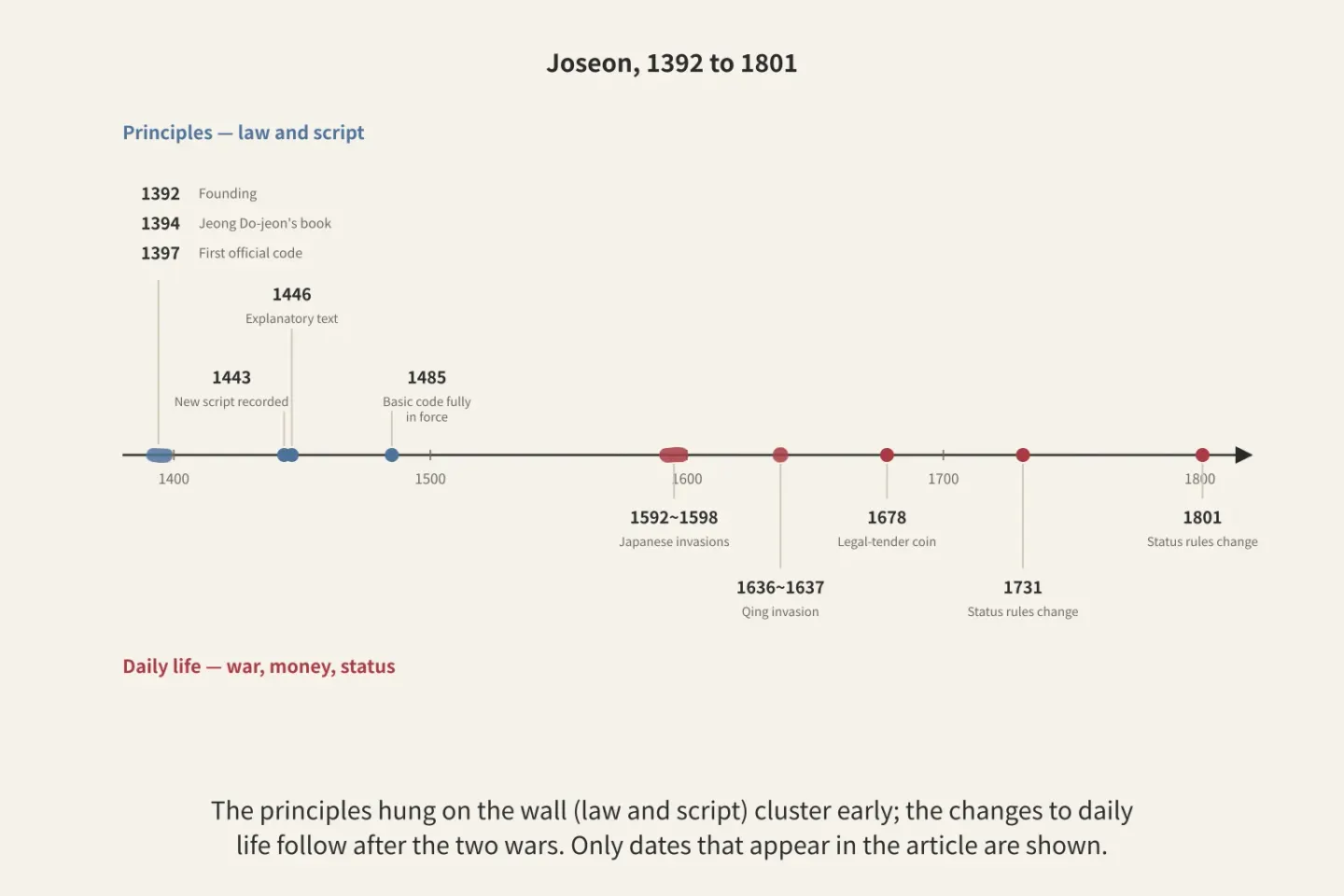
Figure: a timeline Paperis drew using only the dates in this article
Family Mottoes Hung on the Wall
In March 1394, Jeong Do-jeon presented Joseon-gyeonggukjeon, a book containing principles for governing the new country, to Taejo, the first king of Joseon. Taejo had this book stored in a golden chest, designating it as a major standard for politics (KCI ART002596103).
Neo-Confucianism is a branch of Confucianism refined by scholars of the Song and Yuan dynasties in China, which views that people must cultivate their minds to live in accordance with the principles of heaven, and that the country must be governed through such morality. Expecting that the king's mind should also follow the principles of heaven by relying on this learning, Jeong Do-jeon (1342–1398) emphasized education that cultivates the mind from the crown prince's youth (DOI: 10.22932/pkps.2023.110.3.31; DOI: 10.17999/sohe.2026.91.09).
Answers diverge on the vision of politics that Jeong Do-jeon drew. A common interpretation in existing research views it as a prime minister-centered politics where the king holds absolute power only in conception, while the actual power of politics is held by the prime minister (KCI ART001225733). Another study views that Jeong Do-jeon acknowledged the king as the supreme authority of the country. This argues that it was a blueprint in which the king's authority was not reduced, the officials' authority was raised to the same level as the king's, and the monarch and subjects governed together while keeping each other in check (DOI: 10.22932/pkps.2023.110.3.31). A 2008 study introducing the conventional view itself argues that Jeong Do-jeon's political ideology should be re-evaluated by re-examining the term "monarch and subjects governing together," which had been used within conventional views such as prime minister-centered theory (KCI ART001225733). This term is used as the name of an interpretation opposing the conventional view in a 2023 study. Although Jeong Do-jeon himself failed to transition to the period of solidifying the country after its founding, it is considered that the state system he envisioned was reflected in Joseon's political system in large part through the reigns of Taejong and Sejong (DOI: 10.33639/ptc.2024..45.006).
The day a family motto is hung and the day the family members actually start living by it are different. One study views that Neo-Confucianism became the country's official learning in 1392 and maintained that position until the dynasty ended in 1910 (DOI: 10.5040/9798881811709). Another study examining genealogies views that Neo-Confucianism spread gradually in the early Joseon period, and by the 17th century, Joseon gradually transformed into a Neo-Confucian society (DOI: 10.1163/9789004261150_015). What the two studies measure is different. One looks at the official learning of the country, while the other looks at family records and daily life.
The Gyeongguk-daejeon is Joseon's fundamental code of law fully implemented starting in 1485, which regulated state affairs by dividing them into six branches. Joseon's first official code of law was the Gyeongje-yukjeon promulgated in 1397, but because it was compiled by gathering the king's orders, conflicting orders accumulated over time as time passed. Therefore, Sejo began creating a code of law that unified all laws into one (KCI ART002317138).
Joseon put forward Neo-Confucianism as the principle of the country and wrote it down in law codes, but it took time for that principle to become people's daily lives.
The Place Under the Family Rules
In the state registers of Joseon, who lived in each home and their social standing were recorded. The household register was a ledger where Joseon recorded every household's family members, their social status, and their duties to the state. The household register was a ledger created to maintain the status order and the rule of the yangban (DOI: 10.1163/9789004261150_012).
The yangban were the ruling class of Joseon, often also called the literati-gentry. A case study examining Jangseong, Jeollanam-do, suggests that the most important way for yangban living in the provinces to maintain their standing in local villages was passing the civil service examination (DOI: 10.15299/jk.2015.8.56.185). The civil service examination system was a system to select officials through testing, first implemented in Goryeo in 958 during the reign of King Gwangjong. The examination provisions of the Gyeongguk daejeon (National Code) restricted eligibility, intertwining deeply with Joseon's social structure (KCI ART003362298).
Whether exam scores or family background determined success varied by period. According to a study analyzing career advancement through the lists of successful civil service examinees, neither factor had a prominently large impact in the early Joseon period (from Taejo to Seongjong), family background mattered more in the middle period (from Yeonsangun to Gyeongjong), and scores mattered more in the late period (from Yeongjo to Gojong). That study concludes that ability and social status worked in overlapping layers, and their relative weight varied greatly depending on the period (KCI ART002978762).
Nobi were people who were legally their owners' property, so they could be bought, sold, or passed on to others, and their status was passed down to their children. Nobi were traded within the personal networks established among yangban families. Owners exchanged prices through letters (DOI: 10.25024/jsg.2014..31.109).
Yangin were commoners who were not nobi, people who bore obligations to the state such as taxes and corvée labor. In household registers, the rule was to set up a yangin who could shoulder these obligations as the representative of a household (DOI: 10.18219/ddmh..110.202006.71).
One study views the Joseon period as a time when the nobi population grew significantly and the nobi system flourished most. The Goryeo-era rule that even if only one parent was a nobi, the child became a nobi was applied as-is, and marriages between yangin and nobi were frequent, severely eating into the population of yangin who bore state obligations. The government sometimes tried to stop this, but that study concludes that driven by the yangban's obsession with increasing their nobi, the Gyeongguk daejeon of 1485 applied this rule to all children between yangin and nobi (KCI ART001756817).
Life within that structure differed from person to person. In the 17th century, two nobi in Gurye, Jeollanam-do and Andong, Gyeongsangbuk-do inherited ancestral land and bought more land to become small landowners, even owning nobi of their own. A study examining them notes that while they were still nobi in their relationships with their owners, they lived comfortably in other domains, and asks whether the class system always operated across every part of life (DOI: 10.22943/han.2018..83.010). A study revisiting the late 17th-century great famine notes that while the famine's toll showed little difference between commoners and nobi, the famine was a time of death and bankruptcy for many, and nobi also suffered heavy damage (DOI: 10.31791/JKH.2026.06.213.371). Throughout the late Joseon period (1660–1897), contracts remain in which families, having left their hometowns in search of food due to droughts and floods, sold themselves or their family members as debt-nobi (DOI: 10.1353/seo.2026.a995424).
Joseon's family rules divided those who were nobi from those who were not, and erected the ruling class called yangban upon that division. Nobi were property that could be bought and sold by law.
Letters that Write Sounds
In December 1443, a Korean historical record noted that a new script had been created. Because there was no mention of this script in records before that, questions about how it was made remain to this day. The sounds of the letters and the principles behind their creation became known when a commentary came out in September 1446 (DOI: 10.32761/kjip.2025..75.006).
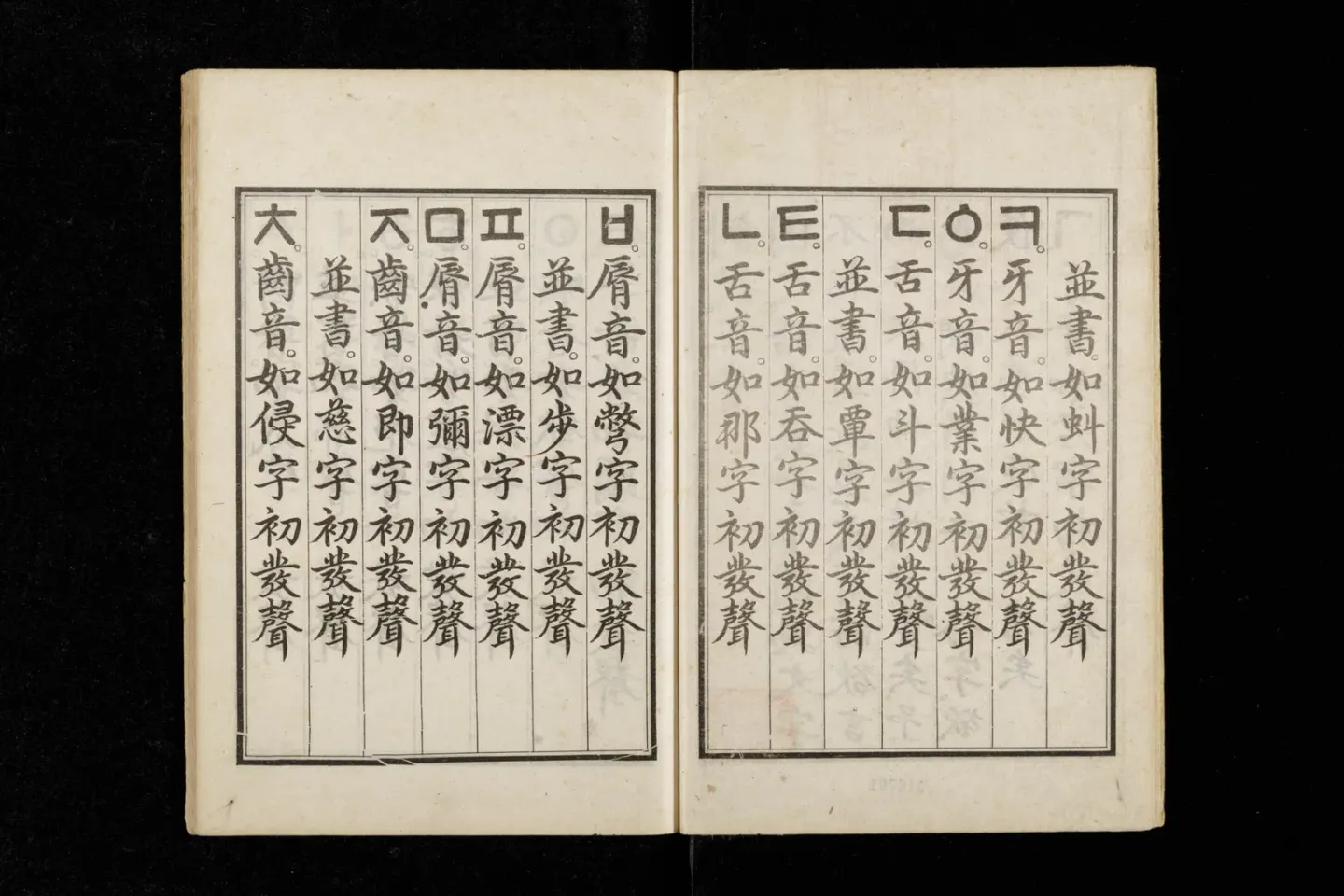
A page from a facsimile of the Hunminjeongeum explanatory text (1446) · Wikimedia Commons (public domain)
The Veritable Records of the Joseon Dynasty is a history of Joseon compiled in Classical Chinese for each king's reign, gathering records written by court historians and government offices. However, the Veritable Records were originally permanent archival records blocked from public view, and when they were compiled, the drafts used as their basis were discarded, leaving only the contents (KCI ART001051810).
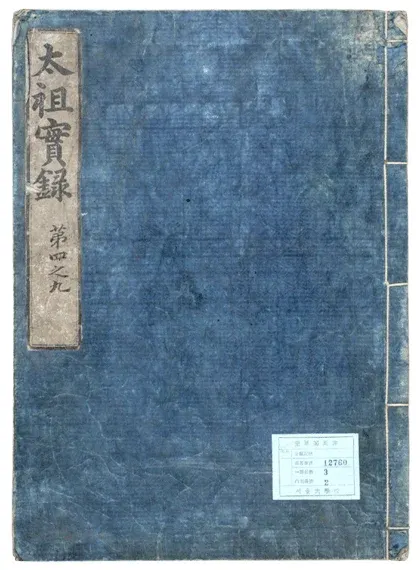
Cover of the Veritable Records of King Taejo · Wikimedia Commons (CC0)
Hunminjeongeum is a script made during the reign of King Sejong of Joseon to write down the sounds of the Korean language, which is today's Hangeul. The principles revealed by the commentary are as follows. A single syllable is divided into the initial sound, medial sound, and final sound; the basic letters were modeled on the shape of the speech organs and the shapes of heaven, earth, and people, and the rest were made by adding strokes or writing letters side by side (KCI ART001291691).
Studies place different weights on why it was made. A study that re-read the preface written by King Sejong views the efficiency of a policy to educate the common people and the problem that it was difficult to communicate with subordinates using a script centered on Chinese characters as the primary motives, and the legitimation of the dynasty and confusion in the sounds of Chinese characters as secondary motives (KCI ART001059280). A study that re-read the Veritable Records article containing the opposing writings of scholars like Choe Malli places more weight on the view that it was a writing policy intended to have royal authority recognized both internally and externally (DOI: 10.16876/klrc.2015..37.227).
Answers to the question of who made it diverge across the same question. One study reexamines the theory that it was made with the assistance of Jiphyeonjeon (Hall of Worthies) scholars, suggesting that King Sejong did not secretly make it alone, but consulted with scholars. The same study refutes the theory that Sejong's second daughter, Princess Jeongui, helped, on the grounds that the source material for it has problems (KCI ART000957642). A special contribution in an academic journal writes that the Hall of Worthies did not directly help in the making of the script but contributed to explaining the principles and writing commentaries, and that King Sejong made it with the help of a prince and a princess (DOI: 10.22943/han.2021..93.001).
Studies point to different roots for what it relied upon to be made. Chinese phonology and East Asian "right sound" thought (DOI: 10.35982/jcs.114.1), knowledge of writing that entered along with Buddhism and the tradition of reading Buddhist scriptures translated into Korean (DOI: 10.23033/inhaks.2026..80.005), and the sound system of Sanskrit (DOI: 10.32761/kjip.2025..75.006) are cited as those roots.
In the 17th century, people of the royal family and yangban (noble) households exchanged letters in Hangeul, and a study comparing 285 of those letters concludes that the letters from yangban households were close to everyday speech while the royal letters maintained formal etiquette (DOI: 10.14353/sjk.2025.33.2.06). One study criticizes that after the 19th century, Hunminjeongeum was re-read through the lens of Western linguistics and narrowed into the "national script of the Korean language," and proposes reading it as a project where the thought, politics, and knowledge of early Joseon met (DOI: 10.35982/jcs.114.1).
While the Veritable Records and the commentary tell us when Hunminjeongeum came out, who made it, why, and what it relied upon are still viewed differently across studies.
1592 and 1636
The Imjin War was a war that lasted from 1592 to 1598 when Japan invaded Joseon. Research dealing with the strategy of the Ming dynasty views that the Japanese hegemon Toyotomi Hideyoshi (1536–1598) tried to overturn the Ming-centered order, and the Ming sent troops to block it together with Joseon (DOI: 10.1017/9781108807401.007). One research book covering this war deals separately with the relations between Japan, Joseon, and the Ming in the 16th century and Joseon's domestic situation before the war as backgrounds of the war, and also divides chapters into the strategies of the navy, volunteer armies, and the Ming (DOI: 10.4324/9781315767208).
It is estimated that the Japanese forces dragged over 20,000 to 100,000 Joseon people to Japan, and only some returned while most lived as slaves in Japan or beyond. That research views that this kidnapping continued from the looting practices of the Japanese civil war period, and increased near the end of the war due to the failing expedition (DOI: 10.1353/jas.2021.0011).
The war changed many parts of the country. Joseon's military reform after the war was centered around matchlock guns and their training methods (DOI: 10.1353/jwh.2014.0000). Worried that trees might run short, the government put the military forward in the 17th century to expand pine forests on the southwestern coasts and islands into state-managed forests (DOI: 10.1017/s0021911817001322).
The ways of remembering the war were also various. One thesis views that the royal court turned people's attention away from the court's wrong politics by pushing forward the grace that the Ming dynasty reestablished the country (DOI: 10.25501/soas.00020305). Historical stories read among commoners in the late Joseon period portrayed the same war differently, as a clash between the will of heaven and meritorious subjects, or as the responsibility of King Seonjo (KCI ART002989694).
The Byeongjahoran was a war in 1636 when the Qing dynasty heavily invaded Joseon, and at the end of this war, Joseon became a vassal state of Qing. The invasion by the Manchurian side happened briefly in 1627 as well, and Joseon's defense collapsed in the invasion that continued from 1636 to 1637 (DOI: 10.5287/ora-zrdm7r7ga). Women who were dragged off as captives and returned after paying ransoms were abandoned by their in-laws on the grounds that they lost their chastity, and as generations went on, they were even erased from family records (DOI: 10.22941/hsdy.2023..48.187).
One thesis covering this period summarizes that opposite answers come out to the same question about how the two wars changed people's sense of belonging. The sides are that these wars created the "Korean nation" for the first time, and that such a concept could not have existed before the 20th century. That thesis criticizes both sides for cherry-picking only the theories that fit their own arguments, and suggests looking at how people of the era defined the king, the country, and the subjects themselves (DOI: 10.5287/ora-zrdm7r7ga).
The war also made people re-ask questions about the place under family precepts. As slaves increased since the 16th century, commoners bearing state duties decreased, and a critical awareness arose that this led to a weakening of national defense. To reflect on the defeat in the early Imjin War and face the threat of the newly rising Later Jin, discussions to reform the slave system emerged as one of the national defense measures in the 17th century (DOI: 10.52271/PKHS.2026.04.134.45).
The two wars are not summed up by a single person's story. They left behind the dragged-off people, changed militaries and forests, and different memories.
Taxes Paid in Rice
The Joseon government and royal court had each county apportion and pay for necessary goods. Entering the 16th century, operational problems such as the issue of unevenly assessing goods across counties came to light (KCI ART002919434), and because taxes were collected in physical commodities, transportation costs were excessively high and items not produced in that county were sometimes assessed (DOI: 10.22629/kabh.2026.41.1.008).
The Daedong Act is a system that changed the taxes previously paid as local goods from each county into being paid in rice, according to the size of the paddy and dry fields owned (the gyeolsu). One study assesses that by replacing the goods, which varied wildly by county, with a single item of rice, the taxes to be paid became clear, while citing as its limitation the fact that the same tax rate was applied regardless of whether it was a bountiful or poor harvest (KCI ART002007676). The government received necessary goods supplied in exchange for the collected rice. One study explains that the reason the government kept the Daedong Act—which received taxes in rice—alongside copper coins was because it did not abandon the ideology of treating farming as fundamental and suppressing commerce even as commerce grew, and viewed currency as a means to increase state finances (DOI: 10.22629/kabh.2026.41.1.008).
The Daedong Act began in Gyeonggi Province during the 17th-century reign of King Gwanghaegun, expanded to Gangwon Province immediately after King Injo's ascension, and to Chungcheong and Jeolla Provinces during the reign of King Hyojong, overcoming the crisis of abolition and fierce opposition along the way (KCI ART002528037). The Daedong Act in the three provinces, implemented simultaneously right after King Injo's ascension, was abolished in 1625, but it was maintained in Gangwon Province (KCI ART002919434).
Interests also diverged from county to county. In Jeolla Province, the Daedong Act was implemented first in coastal counties, which had heavy burdens because they had to take on tasks such as transporting goods by boat and naval vessel work. Mountainous counties, whose burdens had been light, opposed it on the grounds that the amount paid per unit of paddy and dry field size would actually rise, and the policy oscillated between implementation, suspension, and reinstatement (DOI: 10.31791/JKH.2026.03.212.215).
The Daedong Act sustained itself for a long time as a nationwide tax system with the support of many Confucian scholars in the late Joseon period (KCI ART002837644). Even so, miscellaneous burdens collected separately increased again in the 18th century, and the scholar Yu Su-won viewed the Daedong Act as a crude system that fell short of being a perfectly good law (DOI: 10.22899/hosuh..111.202407.41).
Coins and Markets
Among the belongings of Joseon castaways who drifted to Japan and returned, coins appear starting in 1694. People from Gyeongsang Province possessed metal currency, such as silver and coins, earlier and at a higher rate than people from other regions (KCI ART002183506).
The Sangpyeong Tongbo was a coin designated as Joseon's legal tender in 1678 and used until 1894. The government brought in most of the raw materials from Japan to mint the coins, and added those profits to the Hozo, which managed the nation's finances. The government offices that sent money to the Hozo grew from around five in the 18th century to more than ten in the early 19th century, with the minting offices providing 20 percent of that total. That study reads this increase as meaning that the financial condition of the Hozo steadily worsened (DOI: 10.22943/han.2017..79.008).
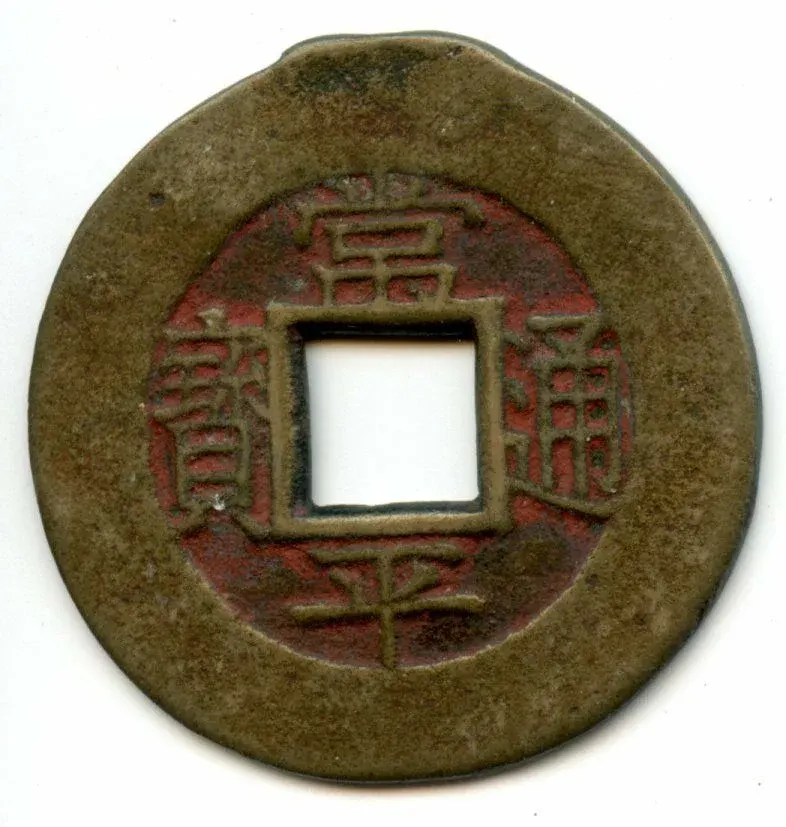
Sangpyeong Tongbo · a model coin used by the Government Tithe Office for casting, 19th century · Wikimedia Commons (public domain)
Jangsi were periodic markets held on designated dates, and merchants moved from market to market day by day. In roughly 25 to 70 percent of walled towns, jangsi were set up outside the walls. That study sees the primary reasons for this not as the perception that commerce was lowly, but rather the nature of the jangsi requiring merchants to move daily and the absence of safety threats (DOI: 10.22345/kjuh.2022.07.30.131). A study that corrected 18th- and 19th-century jangsi records confirmed that the proportion of standardized markets held every 5 days decreased, and critically reassessed the existing interpretation that jangsi developed across regions (KCI ART002753161).
Cities changed too. Seoul's population grew rapidly as people crowded in starting from the late 17th century (DOI: 10.1163/9789004261150_012). One study notes that "Hanyangga," which vividly depicts the Seoul market in the first half of the 19th century, leaves out the suffering lower classes, and argues that that scenery cannot be positively viewed solely as a transformation into a modern city (DOI: 10.17647/jss.2018.02.70.1).
Transactions and markets are said to have grown, but how much they grew and what that means are read differently depending on what is counted and how.
The King Takes Down the Family Motto Again
After the Sangpyeong Tongbo coin came into general use, government finances and the burden on residents actually worsened, and shortages of coins even occurred (DOI: 10.22629/kabh.2026.41.1.008).
Following these conflicts, from the 3rd to the 11th year of the 18th-century reign of King Yeongjo, debates over currency continued in the royal court. Hong Chi-jung and others viewed currency as originally intended for transactions and as a way to expand commerce and opportunities to build wealth. King Yeongjo, Yi Byeong-sang, and others argued that currency threatened the social order and a society rooted in agriculture, and thus wanted to abolish it (DOI: 10.22629/kabh.2026.41.1.008). The king was pointing back to the family motto on the wall.
However, because there was no realistic alternative, the court three times prohibited paying taxes in coins and accepted only rice and cotton cloth. Since coins had already spread, the demand for rice and cotton cloth surged each season, doubling the burden on residents. They tried revising the policy to paying half and half, using both together, or choosing whichever one wanted, but these measures were eventually abolished. Yeongjo also changed his policy to mint coins, and taxes gradually moved toward being collected in money (DOI: 10.22629/kabh.2026.41.1.008).
The family motto remained hanging on the wall, and the king used that motto to try to abolish the coins, but in the end, the king changed his policy.
Slaves Decrease, Yangban Rights Spread
Starting in 1731, the Joseon government permanently enforced a regulation making all children born between male slaves and commoner women into commoners. This was the result of agonizing efforts to increase the number of commoners who bore tax and labor duties. In 1801, government-owned slaves who paid annual tributes (state and government-office slaves) were freed into commoner status (KCI ART001756817).
An economic history study calculated from slave trade data between 1690 and 1894 estimates that slaves were economically efficient property to their masters in terms of return, productivity, and asset price during this period. The return on slaves was higher than the interest rate when lending farming capital. The same study views that after the regulatory change in 1731, surveillance costs rose noticeably due to slave flight, and this drove the dissolution of the slavery system (KCI ART003331063).
Slaves also found a way for themselves. During the severe famine in the late 17th century, wealthy slaves tried to escape their status by taking advantage of the state's financial difficulties or their masters' circumstances (DOI: 10.31791/JKH.2026.06.213.371).
There was a "Class Mobility Theory" holding that the status order of late Joseon collapsed because the number of yangban increased. According to a 2023 review paper, recent family-register studies reject this explanation. That paper also considers that this does not mean the yangban-centered order remained stable for long either. Rights enjoyed exclusively by the yangban continued to spread to other strata, non-yangban people closed the gap by imitating yangban culture, and the yangban tried to protect their status through discrimination and exclusion. As slaves plummeted, legal status was reorganized around commoners, and the paper concludes that this is a phenomenon that leads us to foresee the weakening of the order dividing yangban and commoners and the strengthening of the upper-lower order within commoners (KCI ART002978765).
The disappearance of the slavery system from the law takes place in the era of "Modern Times Arrive", another installment in this series.
According to a review paper, recent family-register studies reject the evidence that the number of yangban increased, but as yangban rights spread and slaves plummeted, the order dividing yangban and commoners weakened and legal status was reorganized around commoners.
Was it a Stagnant Country, or a Country Where Sprouts Were Growing?
In 1973, historian Kang Man-gil portrayed late Joseon society as a transitional phase moving toward a modern society in a book dealing with the development of commercial capital in the late Joseon period (KCI ART001403859).
The sprout theory of capitalism is a historical view holding that late Joseon society would have gradually progressed into a capitalist society even without the influence of foreign capitalism. This historical view emerged from the problem consciousness of historians after liberation who sought to move beyond the distorted historical view rooted in colonial rule, and a paper summarizing the sprout theory assesses that it contributed greatly to criticizing and moving beyond "stagnation theory," which viewed Joseon as having been stalled (KCI ART001403859).
Regarding the history of thought, a dissertation summarizes the same framework like this: Japanese imperialist historians emphasized the backwardness of Joseon Neo-Confucianism to justify colonial rule, while Korean nationalist historians searched for the seeds of modernity in the academic trends of the late Joseon period to refute this (DOI: 10.25501/soas.00020305).
Silhak means "practical learning," a name that later scholars gave to the academic currents of the late Joseon period. The aforementioned dissertation considers that it was these nationalist historians who attached this name, and that they portrayed Silhak as a current that stood against stagnant Neo-Confucianism (DOI: 10.25501/soas.00020305). In the 17th century, the scholar Yu Hyeong-won argued for radically reforming society with land as the foundation, and a study views that his argument did not conflict with Neo-Confucianism (KCI ART002926201).
Stagnation theory emerged from colonial historiography intended to justify colonial rule, and sprout theory emerged in response to it, moving past stagnation theory. Later, sprout theory lost ground as it faced criticism for being a Eurocentric historical view that assumes a single, linear path of development. Even so, the paper summarizing the sprout theory considers that it will not be greatly shaken because it is a historical view built upon broad empirical evidence, and summarizes that subsequent research on commercial history has critically inherited sprout theory by examining commercial structures such as distribution systems and transportation (KCI ART001403859).
In the history of thought, the aforementioned dissertation points out that colonial historiography and nationalist historiography, which had different goals, shared the premise that what Joseon needed was "modernization." That dissertation considers that while recent research has emerged to move beyond such predetermined questions, it still mostly remains limited to the trends of the late 18th century and a few school of thought (DOI: 10.25501/soas.00020305).
Stagnation theory, which viewed Joseon as a stagnant country, originated in colonial historiography and has already been moved past; as for sprout theory, which emerged in refutation of it, criticisms and succession continue today, and there is also research seeking to move beyond the question "was it heading toward modernity?" itself.
We look at the framed picture in the living room again. The family motto was hanging there just the same, but a few lines of household rules underneath it had been rewritten, and the family members still read this house differently from one another today.
Where to Look Next
How to read and trust records like the Annals or household registers is covered in more detail in the method articles of the "How Do We Know the Past?" series. What writing does in society continues in the writing part of "Big Words of History", and the organizations that collect taxes and govern people continue in the cities and states part and the empire part of the same series. Who ruled in Silla and Goryeo before Joseon can be seen in the earlier part of this series, "From the Bone-Rank System to the Military Coup".
Source Papers
- "The Establishment of the “Gyeongguk daejeon (Grand Code for State Administration)” and the Ideology of the “Rites of Zhou”" (2018) — KCI ART002317138 — Jeong Do-jeon privately authored the “Joseon gyeonggukjeon” in 1394, and the first official legal code, the “Gyeongje yukjeon”, was compiled in 1397; following an accumulation of royal edicts, King Sejo initiated the compilation of a unified legal code in 1455, which was revised over the reigns of Sejo, Yejong, and Seongjong for 25 years before taking full effect on January 1, 1485.
- "A Translation, and a Deeper Discussion on the Grand Canon of Administrating the State (經國大典), Canon on Rites, Section 1" (2026) — KCI ART003362298 — The examination clauses in the Canon on Rites of the “Gyeongguk daejeon”, completed in 1485, restricted eligibility for applicants, tying it into the social structure, and regulated the colors and patterns of officials' robes as well as periods of mourning.
- "Korean Confucianism: The Philosophy and Politics of Toegye and Yulgok" (2018) — DOI: 10.5040/9798881811709 — Neo-Confucianism became the official state learning in 1392 and persisted until the end of the dynasty in 1910.
- "A Study on Jeong Do-jeon's Literature - Focusing on Exile and Wandering Literature -" (2017) — KCI ART002226425 — In the late 14th century, Goryeo suffered from land monopolization, Yuan intervention, Japanese pirates, Red Turban incursions, and tensions with Ming, leading Jeong Do-jeon to found Joseon alongside Yi Seong-gye.
- "An Analysis of Sambong Jeong Do-jeon's View on Governing People" (2020) — KCI ART002596103 — The “Joseon gyeonggukjeon” was completed and presented to King Taejo in March 1394, and Taejo made it a major standard of governance, storing it in a golden chest.
- "A Study on the Theory of Joint Governance by the Monarch and Subjects (Gunsingongchiron) in the Political Thought of Sambong Jeong Do-jeon" (2023) — DOI: 10.22932/pkps.2023.110.3.31 — The thought of Jeong Do-jeon (1342–1398) is understood as joint governance by the monarch and subjects rather than minister-centric rule, representing a design to elevate ministerial power to the same level as royal power for mutual checks without weakening the monarchy.
- "Jeong Do-jeon's Neo-Confucian View of Monarchy and the Theory of the King's Mind" (2026) — DOI: 10.17999/sohe.2026.91.09 — Relying on Song and Yuan Neo-Confucianism, he sought to align the king's mind with heavenly principle and emphasized moral cultivation education for the crown prince.
- "A Re-examination of Jeong Do-jeon's 'Ministerial Supremacy Theory'" (2008) — KCI ART001225733 — This study argues that previous research's ministerial supremacy theory must be critically re-examined and Jeong Do-jeon's political ideology reassessed.
- "A Study on the Political Thought of Bureaucrat-Scholars in Early Joseon - Focusing on Jeong Do-jeon and Byeon Gye-ryang -" (2024) — DOI: 10.33639/ptc.2024..45.006 — Although Jeong Do-jeon failed in the transition to the consolidation period, his institutional design for the state was largely reflected across the reigns of Taejong and Sejong.
- "Did Fake Genealogies Exist?" (2014) — DOI: 10.1163/9789004261150_015 — By the 17th century, Joseon gradually transformed into a Neo-Confucian society, genealogies began recording only the yangban, and fake genealogies emerged.
- "When Did Joseon's Population Reach Ten Million?" (2014) — DOI: 10.1163/9789004261150_012 — Household registers were created to maintain the status order and yangban rule, and the population of Seoul grew rapidly from the late 17th century onward due to inward migration.
- "The Actual Condition of Local Literati as Seen Through Successful Civil Service Examination Candidates in the Joseon Dynasty - The Case of Jangseong, Jeollado -" (2015) — DOI: 10.15299/jk.2015.8.56.185 — Passing the civil service examinations was the single most important method for the local literati to maintain their status.
- "Was the Civil Service Examination the 'Great Equalizer'?" (2023) — KCI ART002978762 — Test scores were the most prominent factor in reaching prestigious sinecure posts, while family background was the most prominent factor in reaching senior official ranks; both were weak in the early period, family background dominated in the middle period, and test scores had the largest impact in the late period.
- "The Registration of Slave Households in 17th-Century Household Registers — From the Perspective of Joseon Dynasty Finance" (2020) — DOI: 10.18219/ddmh..110.202006.71 — The head of a household was principally registered as a commoner holding official corvée duties, and a large number of slave households were registered in household registers in the late 17th century.
- "The Transition of the Slave System in the Joseon Dynasty and the Existence Patterns of Slaves" (2013) — KCI ART001756817 — Joseon was the peak of the slavery system, where status inheritance through mother's status and intermarriage between commoners and slaves increased the slave population; the “Gyeongguk대전” of 1485 applied mother-status inheritance, followed by the emancipation into commoners of offspring born to male slaves and female commoners in 1731, and the redemption of palace slaves in 1801.
- "Joseon Dynasty Slave Markets and Transactions" (2014) — DOI: 10.25024/jsg.2014..31.109 — Slave markets served as human networks for yangban households and transactions were conducted through letters from masters and the mediation of household slaves.
- "Litigation Documents, the Litigation Scene, and the Lives of Slaves" (2018) — DOI: 10.22943/han.2018..83.010 — Two slaves from Gurye and Andong inherited land in the 17th century and purchased it to become minor landowners and slave owners, prompting the question of whether the status system operated over every aspect of life.
- "The Great Famine of 17th-Century Joseon and the Lives of Slaves" (2026) — DOI: 10.31791/JKH.2026.06.213.371 — Famine damage showed little difference between commoners and slaves, but the great famine was a period of death and bankruptcy for many, and wealthy slaves attempted status liberation.
- "Jamae Nobi: Climate Crises, Forced Migrations, and Self-Sale into Slavery during the Joseon Dynasty" (2026) — DOI: 10.1353/seo.2026.a995424 — This study analyzes self-sale and family-sale contracts into debt slavery by displaced families due to climate disasters between 1660 and 1897.
- "A Study on the Influence of the Sanskrit Phonetic System on the Creation of Hunminjeongeum - Compared with the Siddham System in Joseon Dynasty “Jinonjip (Collection of Mantras)” -" (2025) — DOI: 10.32761/kjip.2025..75.006 — There are no mentions prior to the Annals record of December 1443, the principles were made public through the Haeryebon commentary in September 1446, and the grapheme system is similar to the Sanskrit phonetic system.
- "Record-Keeping Regulations in the “Gyeongguk daejeon”" (2007) — KCI ART001051810 — The Annals of the Joseon Dynasty were compiled through the drafting of historical notes by historiographers and the compilation of chronological administrative records; the annals were permanently preserved records restricted from access, where the originals were discarded after their contents were finalized.
- "Phonological Theories of Sejong and Scholars of the Hall of Worthies and Hunminjeongeum" (2008) — KCI ART001291691 — Syllables were divided into initial, medial, and final sounds; basic letters were created by pictographically representing the organs of speech and heaven, earth, and humanity, while the rest were made through stroke addition and letter stacking; final sounds were treated as identical to initial sounds.
- "Sejong's Language Policy and the Motives for Creating Hunminjeongeum" (2015) — DOI: 10.16876/klrc.2015..37.227 — Choe Man-ri's memorial is read as an attempt to check royal power using submission to the greater power and Confucianism, and Hunminjeongeum is viewed as a language policy by which royal power sought external and internal recognition.
- "Multi-layered Discourses on the Motives and Purposes of Creating Hunminjeongeum" (2007) — KCI ART001059280 — The motives in Sejong's preface are divided into educational efficiency and communication issues with the lower classes (primary) versus early Joseon chaos, dynastic legitimation, and confusion in Chinese character pronunciation (secondary).
- "King Sejong's Creation of Hunminjeongeum and His Collaborators" (2004) — KCI ART000957642 — This re-examines the theory of sole royal creation with collaboration, arguing that Sejong did not secretly create it alone, and dismisses the theory of Princess Jeonghye's collaboration as untenable due to historical source problems.
- "[Special Contribution] King Sejong and the Hall of Worthies" (2021) — DOI: 10.22943/han.2021..93.001 — The Hall of Worthies did not directly assist in the creation but contributed to commentaries and annotations, with Sejong having created it with the help of princes and princesses.
- "Exploring Discourses on Correct Sounds (Jeong-eum) Prior to the Creation of Hunminjeongeum" (2025) — DOI: 10.35982/jcs.114.1 — This study takes East Asian correct sound discourses and Chinese phonological books as its background, and criticizes Western linguistic perspectives since the 19th century for reducing Hunminjeongeum to a mere ethnic script.
- "The Textual Background of the Creation of Hunminjeongeum: The Spread of Buddhist Scriptures and Korea's Tradition of Reading Buddhist Texts in Korean Translation" (2026) — DOI: 10.23033/inhaks.2026..80.005 — The spread of literacy driven by the propagation of Buddhism and the tradition of gugel gloss-reading contributed to the creation.
- "A Comparative Study of 17th-Century Royal Eungans (Vernacular Letters) and Yangban Eungans" (2025) — DOI: 10.14353/sjk.2025.33.2.06 — Among 285 vernacular letters from the 17th century, letters from yangban households are colloquial, whereas royal letters are formal.
- "Commercial Policies of the Late Joseon Dynasty and the Scenery of Hanyang Markets as Depicted in <Seongsicheondosi> and <Hanyang-ga>" (2018) — DOI: 10.17647/jss.2018.02.70.1 — The glamorous markets in the 1844 vernacular gasa poem “Hanyang-ga” marginalized the lower classes, meaning it cannot be positively appraised solely as modern urbanization.
- "Ming Grand Strategy during the Great East Asian War, 1592–1598" (2020) — DOI: 10.1017/9781108807401.007 — Toyotomi Hideyoshi sought to overturn the Ming-centered order, and Ming intervened out of tributary obligations, with the Ming-Joseon coalition halting him in the largest war of the 16th century.
- "The East Asian War, 1592-1598" (2014) — DOI: 10.4324/9781315767208 — A research volume covering the background of the war, navies, volunteer armies, Ming strategy, and postwar memories chapter by chapter.
- "Japan's Invasion of Chosŏn Korea and Abduction of Koreans" (2021) — DOI: 10.1353/jas.2021.0011 — Japanese forces abducted between 20,000 and over 100,000 people, most of whom lived as slaves, driven by plunder practices from the civil war period and a failing expedition.
- "A Korean Military Revolution?: Parallel Military Innovations in East Asia and Europe" (2014) — DOI: 10.1353/jwh.2014.0000 — Following the Imjin War, the core of Joseon's military reforms lay in matchlock muskets and training methods.
- "Postwar Pines: The Military and the Expansion of State Forests in Post-Imjin Korea, 1598–1684" (2018) — DOI: 10.1017/s0021911817001322 — Concerned about timber shortages due to the navy's role and postwar circumstances, the government used the military to expand state pine forests on the southwestern coasts and islands.
- "Intellectuals and the state: the resilience and decline of Neo-Confucianism as state ideology in Joseon Korea" (2014) — DOI: 10.25501/soas.00020305 — The repayment of China's benevolence served as propaganda to divert attention from court misrule, both colonial historiography and nationalist historiography presupposed modernization, and recent research attempts to move beyond teleological questions.
- "Narrative Methods and Meanings of Private Historical Works in the Late Joseon Period" (2023) — KCI ART002989694 — The same Imjin War was depicted differently across works, attributing it variously to the will of heaven, conflict between meritorious subjects, or responsibility falling on King Seonjo.
- "Socio-political identity in Chosŏn Korea during the Japanese and Manchu invasions 1567-1637" (2016) — DOI: 10.5287/ora-zrdm7r7ga — Due to the Manchu invasions of 1627 and 1636–1637, Joseon became a tributary state of Qing, and academia remains divided over whether these wars created a national identity.
- "Erasing the Existence of the Redeemed Women (Sokhwan-bunyeo) of the Byeongjahoran" (2023) — DOI: 10.22941/hsdy.2023..48.187 — Women who returned after ransoms were paid were abandoned by their marital families and erased from records.
- "Joseon's Defense Reality in the Early 17th Century and Jaam Yi Min-seo's Theory of Modifying the Slave System" (2026) — DOI: 10.52271/PKHS.2026.04.134.45 — The proliferation of slaves led to a decrease in the tax-paying commoner population, sparking national defense concerns, and 17th-century theories modifying the slave system were debated as national defense measures.
- "The Implementation and Operation of the Daedong Law in Gangwon Province in the Early 17th Century" (2022) — KCI ART002919434 — Unequal tribute allocations and the expansion of proxy tax payment formed the background for tribute system reform, and Gangwon Province's Daedong Law was sustained due to reduced burdens and few opposing factions.
- "Commercial Development and Changes in Monetary Views in the Late Joseon Dynasty – Focusing on the Currency Debates of King Yeongjo's Reign" (2026) — DOI: 10.22629/kabh.2026.41.1.008 — Currency debates in the 3rd to 11th years of Yeongjo's reign, three currency circulation decrees and double burdens, coin casting and tax payment in cash following abolition, and the government's retention of agriculture-first, commerce-suppressing ideologies.
- "The Historical Nature and Limitations of the Gongbeop and Daedong Law" (2015) — KCI ART002007676 — The Daedong Law standardized taxable items and clarified tax amounts by having taxes paid in rice according to land acreage (gyeol) instead of regional local products.
- "A Study on the King's Accession and the Implementation of the Daedong Law" (2019) — KCI ART002528037 — The Daedong Law under Gwanghaegun in Gyeonggi, Injo in Gangwon, and Hyojong in Chungcheong and Jeolla, alongside the crises of abolition and opposition encountered in each.
- "Aspects of Land-Tax (Jeon-gyeol-yeok) Imposition and the Implementation of the Daedong Law in the Honam Region in the 17th Century" (2026) — DOI: 10.31791/JKH.2026.03.212.215 — Implemented first in heavily burdened coastal towns, while mountainous counties opposed it due to increased labor service burdens, experiencing implementation, political faction shifts, and re-implementation.
- "Statecraft Discourses on 'Tribute' (Gong) That Sympathized with the Daedong Law" (2022) — KCI ART002837644 — The Daedong Law was a nationwide tax system supported by a majority of Confucian scholars that persisted over a long period.
- "Nongam Yu Su-won's Perception of the Daedong Law and His Proposals for Operational Improvement" (2024) — DOI: 10.22899/hosuh..111.202407.41 — Amid limitations such as the expansion of miscellaneous labor tax collections in the 18th century, Yu Su-won described the Daedong Law as crude and an imperfect just system.
- "Joseon Castaways Holding Sangpyeong Tongbo and Tsushima (1693-1862)" (2016) — KCI ART002183506 — Sangpyeong Tongbo was designated as legal tender in 1678 and used until 1894, appearing in castaways' belongings starting from 1694, with Gyeongsang Province natives showing the earliest appearance and highest proportion.
- "Casting Profits and Utilization of Sangpyeong Tongbo" (2017) — DOI: 10.22943/han.2017..79.008 — Most raw materials were imported from Japan, and through casting profits, roughly five or more government offices in the 18th century and over 10 offices in the early 19th century made up for shortfalls in the Ministry of Taxation, illustrating financial deterioration.
- "Population Composition and Commercial Agglomeration Characteristics of Walled County Towns in the Late Joseon Period" (2022) — DOI: 10.22345/kjuh.2022.07.30.131 — Periodic markets opened outside the walls in roughly 25 to 70% of county towns, with the periodic nature of markets and the absence of safety threats serving as primary factors rather than the disdain for commerce.
- "A Re-examination of Long-term Fluctuations in Markets and Commerce in Late Joseon: Focusing on 18th-19th Century Periodic Market Statistics" (2021) — KCI ART002753161 — Periodic market quantities were corrected and restored, and whether commerce developed was rejudged by simultaneously tracking the decline in the proportion of standardized 5-day markets alongside the equalization of the periodic market network.
- "A Study on the Efficiency of Slaves in the Joseon Dynasty, 1690-1894" (2026) — KCI ART003331063 — Slaves were efficient across profitability, productivity, and asset prices, but rising surveillance costs due to escapes after 1731 drove the dismantling of the slavery system.
- "After the Theory of Status Mobility in Late Joseon" (2023) — KCI ART002978765 — Recent household register research rejects the status mobility theory based on the increase in the yangban count, yet yangban order was not stable either, and with the sharp drop in slaves, legal status was reorganized around commoners.
- "The Theory of Capitalist Sprouting and Commercial Fluctuations in Late Joseon — Focusing on Kang Man-gil's ≪The Development of Commercial Capital in Late Joseon≫ —" (2009) — KCI ART001403859 — The sprouting theory contributed to overcoming stagnationist views and will not be greatly shaken by criticisms of Eurocentrism and unilinealism, while recent research has advanced toward the structure and operation of commerce.
- "Bangye Yu Hyeong-won's Land Theory and Understanding of the Daedong Law" (2021) — KCI ART002926201 — The reform theories of Yu Hyeong-won, a representative 17th-century practical learning scholar, did not conflict with Neo-Confucian first principles, differing from the perspective that treats Neo-Confucianism and practical learning as opposing forces.
Sources (33)
- Korean Confucianism: The Philosophy and Politics of Toegye and YulgokDOI 10.5040/9798881811709
- 삼봉 정도전(三峰 鄭道傳) 정치사상의 군신공치론(君臣共治論)에 관한 연구DOI 10.22932/pkps.2023.110.3.31
- Jeong Do-jeon's Neo-Confucian View of Monarchy and the Theory of the King's MindDOI 10.17999/sohe.2026.91.09
- 조선 초기 관료유학자의 정치사상 연구 -정도전과 변계량을 중심으로DOI 10.33639/ptc.2024..45.006
- Did Fake Genealogies Exist?DOI 10.1163/9789004261150_015
- When Did Joseon's Population Reach Ten Million?DOI 10.1163/9789004261150_012
- 朝鮮時代 科擧 合格者를 통해 본 在地士族의 實態-全羅道 長城 事例DOI 10.15299/jk.2015.8.56.185
- 17세기 奴婢戶의 호적등재 ― 조선왕조 재정의 관점에서DOI 10.18219/ddmh..110.202006.71
- 朝鮮時代 奴婢市場과 去來DOI 10.25024/jsg.2014..31.109
- 決訟立案과 소송 현장, 그리고 노비의 삶DOI 10.22943/han.2018..83.010
- 17세기 조선의 대기근과 노비의 삶DOI 10.31791/jkh.2026.06.213.371
- Jamae Nobi: Climate Crises, Forced Migrations, and Self-Sale into Slavery during the Joseon DynastyDOI 10.1353/seo.2026.a995424
- 훈민정음 창제에 끼친 범어음성체계의 영향 연구 - 조선시대 『진언집』의 범자체계와 비교하여DOI 10.32761/kjip.2025..75.006
- 세종의 문자정책과 훈민정음 창제 동기DOI 10.16876/klrc.2015..37.227
- [특별기고] 세종과 집현전DOI 10.22943/han.2021..93.001
- 훈민정음 창제 이전의 정음(正音) 담론 탐색DOI 10.35982/jcs.114.1
- 훈민정음 창제의 문자론적 배경: 불경 전파와 한국의 불경 석독 전통DOI 10.23033/inhaks.2026..80.005
- 17세기 왕실 언간과 양반가 언간의 비교 연구DOI 10.14353/sjk.2025.33.2.06
- <성시전도시>와 <한양가>에 나타난 조선후기 상업정책과 한양 시장의 풍경DOI 10.17647/jss.2018.02.70.1
- Ming Grand Strategy during the Great East Asian War, 1592–1598DOI 10.1017/9781108807401.007
- The East Asian War, 1592-1598DOI 10.4324/9781315767208
- Japan's Invasion of Chosŏn Korea and Abduction of KoreansDOI 10.1353/jas.2021.0011
- A Korean Military Revolution?: Parallel Military Innovations in East Asia and EuropeDOI 10.1353/jwh.2014.0000
- Postwar Pines: The Military and the Expansion of State Forests in Post-Imjin Korea, 1598–1684DOI 10.1017/s0021911817001322
- Intellectuals and the state: the resilience and decline of Neo-Confucianism as state ideology in Joseon KoreaDOI 10.25501/soas.00020305
- Socio-political identity in Chosŏn Korea during the Japanese and Manchu invasions 1567-1637DOI 10.5287/ora-zrdm7r7ga
- 병자호란 속환부녀(贖還婦女)들의 존재 지우기DOI 10.22941/hsdy.2023..48.187
- 17세기 초반 朝鮮의 國防 현실과 紫巖 李民寏의 奴婢制 變通論DOI 10.52271/pkhs.2026.04.134.45
- 조선후기 상업의 발달과 화폐관의 변화 – 영조대 화폐논쟁을 중심으로DOI 10.22629/kabh.2026.41.1.008
- 17세기 호남 지역 전결역(田結役) 부과 양상과 대동법의 실시DOI 10.31791/jkh.2026.03.212.215
- 농암 유수원의 대동법 인식과 운영 개선론DOI 10.22899/hosuh..111.202407.41
- 상평통보의 주전이익과 활용DOI 10.22943/han.2017..79.008
- 조선 후기 읍성의 인구 구성과 상업 집적 특성DOI 10.22345/kjuh.2022.07.30.131