Paperis Articles
From the Bone-Rank System to the Military Coup — The Family Record Handed In Beside the Exam
In Silla, the rank you were born into set a ceiling on office and even the size of your house. Goryeo began choosing officials by examination in 958, yet candidates handed in a record of their family along with their writings, and still needed a recommendation after passing. After the military coup of 1170, the people who controlled appointments changed. How rigid the bone-rank system was and when it took its known shape, how open the examinations really were, and how to judge the military regime are still read differently by different scholars.
Your field's papers, as audio
Pick your fields and journals — Paperis summarizes the key papers and turns them into audio. Listen on your commute.
Start Paperis free →From the Bone-Rank System to the Military Coup — The Family Record Handed In Beside the Exam
A Country That Even Decided House Sizes
In Silla, there were regulations that determined the size of houses people could build based on the rank of the family they were born into. The size of the stable was also regulated together, so as the rank went down, the houses and stables became smaller and the decorations decreased. For one of the highest ranks, no restriction on stable size was recorded, so they could keep as many horses as they wanted. Even for that rank, there were things that were forbidden, so pleated purple reindeer leather shoes could not be worn (DOI: 10.4324/9781315627403-6). The regulations regarding houses are passed down, recorded in the provisions on houses in the historical text Samguk Sagi (KCI ART001839562).
This article is written, focusing on Korean history from Silla after the unification of the Three Kingdoms to Goryeo in the 13th century, about what determined the people who would take charge of state affairs. Silla placed its capital in present-day Gyeongju (KCI ART001839562), and collapsed in 935 (DOI: 10.1353/jks.1979.0004). Goryeo, which succeeded it, began selecting officials through exams in 958 (KCI ART001807691). In 1170, military officials drove out the king, and for about 100 years thereafter, military dictators held real power (DOI: 10.17070/aeaas.2025.9.79.297; KCI ART002817132). If the previous article in this series, "From Gojoseon to the Three Kingdoms and Gaya", followed the process of countries first settling down, this article looks at who governed within those countries.
At one time, job application forms commonly had a family details section where one wrote their parents' names and occupations. No matter how well a person wrote their grades and self-introduction, the reader read that section together. In Silla, that section set the ceiling for the positions one could climb to. In Goryeo, test papers appeared, but family details were submitted alongside them, and after the military officials seized power, the people who read the applications changed. We piece these applications back together using fragments such as the regulations in Samguk Sagi, writings carved on stone, writings recording the lives of the dead, and the records of official posts in Goryeo-sa.
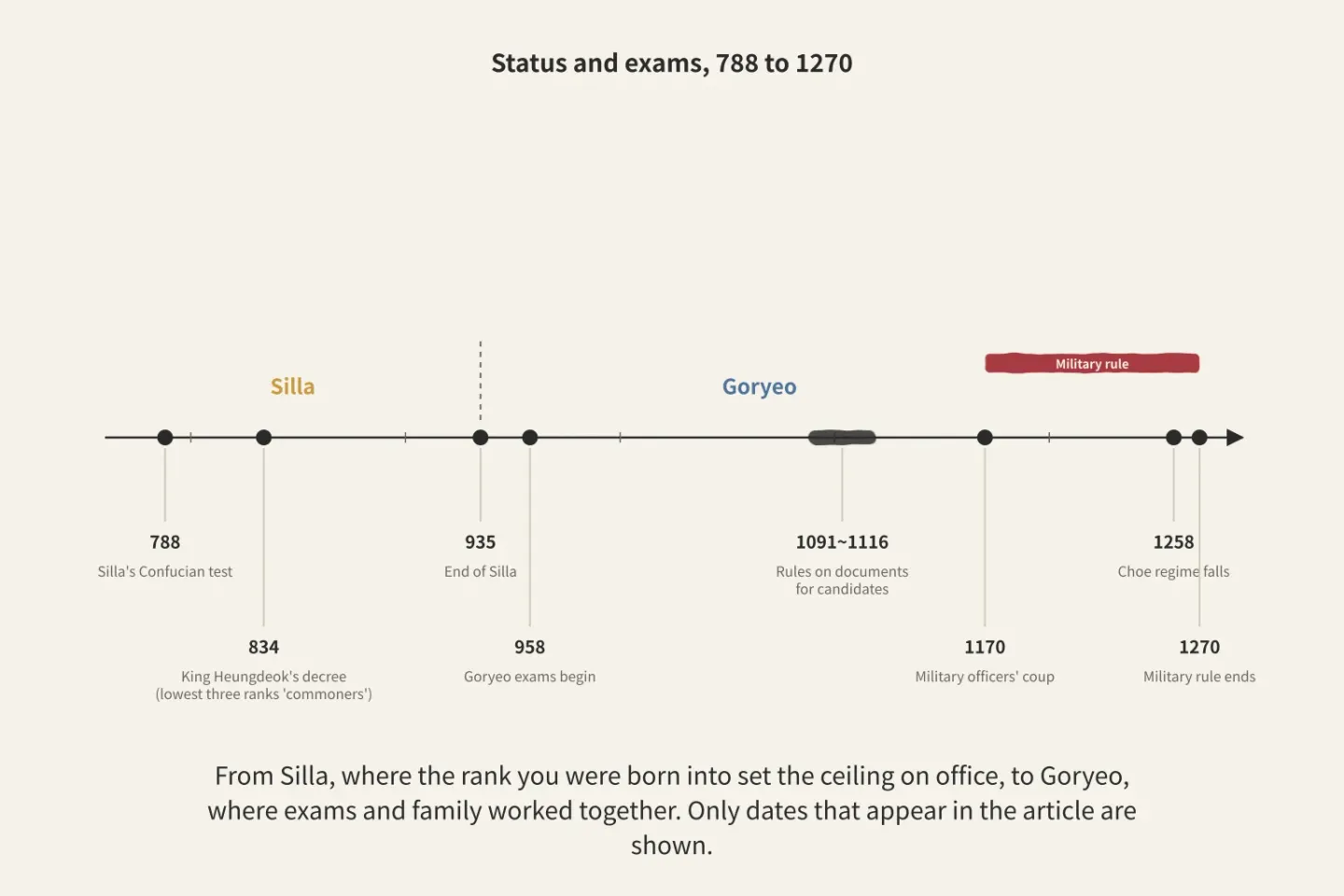
Figure: a timeline Paperis drew using only the dates in this article
Bone Ranks, Head Ranks
The bone rank system was a social stratification system in Silla that determined everything from the height of government posts a person born into a given household could attain to the scale of their domestic life, such as houses and clothes. The ranks were largely divided into "bone" and "dupum". Bone was the rank of the king and the royal family, while dupum consisted of the ranks below them. High government office ranks were open only to bone ranks, whereas dupum could only attain ranks up to that level (DOI: 10.18622/kher.2018.06.146.173). People were expected to marry within the same rank (DOI: 10.4324/9781315627403-6).
True bone was one of the bone ranks belonging to the royal family in the bone rank system, and it could climb to high government office ranks. The six dupum was the highest rank among the dupum grades, and while one could advance into government service, there was a ceiling on the height one could reach (DOI: 10.31791/JKH.2019.03.184.113; DOI: 10.18622/kher.2018.06.146.173). Speaking in terms of an application form, the highest position a person could reach was already written in advance in the family background section.
How rigid this ceiling was differs by study. A long-held view held that it was practically impossible for Silla people to break away from the rank they received at birth (DOI: 10.1353/jks.1979.0004). New studies since the 1980s suggest that new strata emerged to change the structure, that local people also entered the bone rank system, and that ranks could sometimes rise (KCI ART001362286). On the other hand, a study covering the 7th century argues that the bone rank ultimately remained closed to those of local origin, excluding an extremely small minority of local people and foreigners (DOI: 10.38080/crh.2019.05.127.210). There is also research suggesting that even after the unification of the Three Kingdoms, local people remained outside the bone rank system with extremely slim chances of becoming officials (DOI: 10.38080/crh.2019.05.127.263).
How to evaluate the bone rank system also does not converge on a single conclusion. One study views that this system granted privileges to a small ruling class while severely restricting the majority, thus requiring an ideology to justify it (KCI ART000918999). Another researcher views bone as an organization of the royal family and dupum as an organization of bureaucrats. He considers that people of bone ranks were fundamentally equal regardless of the height of their government posts, that dupum people were structured to rise by ability or merit, and that there were also mechanisms allowing them to cross the permitted height through lateral paths. He reads this not as a sign that Silla stood as a state founded on conquest, but as a trace of small countries gathering on equal terms (DOI: 10.18622/kher.2018.06.146.173).
When it took on the appearance known today is also viewed differently by various studies. One study considers that it was completed through law during the reign of King Beopheung of Silla (KCI ART000918999). Another study suggests that after about three social strata were institutionalized through decrees in the time of King Beopheung, the eight ranks known today were established under King Jinpyung and reorganized in the mid-7th century. In that process, the bottom three ranks were gradually pushed outside the bone rank system. They appear as "ordinary people" in King Heungdeok's ban of 834, and a stele erected after 890 records that "there are five ranks in the state" (DOI: 10.31791/JKH.2019.03.184.113). The researcher seen earlier considers the six dupum to have been a later-emerging rank, judging by the order in which lateral promotion mechanisms were applied (DOI: 10.18622/kher.2018.06.146.173).
There is a reason for these divisions. A paper reviewing bone rank research suggests that scholars define even the same terms differently, largely because they have fundamentally reinterpreted limited materials in their own ways. Therefore, new textual materials are desperately needed, and recently, the two characters for "true bone" were read in a stele fragment from the Heungjeonni temple site in Samcheok, adding one more historical source (DOI: 10.37331/JKAH.2017.09.87.87).
How were the major affairs of the state decided at the very top? Hwabaekhoeui is the name the academic community has given to the council where major affairs of the state were discussed and decided in Silla. What kind of meeting it was has been defined differently, such as a meeting between the king and subjects, an aristocracy council, or a clan leader council (KCI ART001076585). The academic community has long read this council as proof that aristocrats jointly governed the country (KCI ART001910038). One study views Hwabaek not as the name of a meeting, but as a Silla-specific unanimous method of discussion until everyone's intentions converge into one, and argues that the meeting on Mount Namsan, which has been cited as a representative example, was also held during emergencies—such as when a small number of high-minister-level subjects established a new king upon an emergency befalling the monarch. Therefore, it points out that there are problems in establishing a "noble confederated state" stage based on this (KCI ART001910038). Another summary views that the Hwabaek council originated from the council of the heads of the six administrative divisions, and that in Silla, meetings led by the king and meetings led by the high-minister level overlapped in layers (KCI ART001076585).
The bone rank system was a system where the rank one was born into determined the ceiling. Just how rigid that ceiling was and when it assumed its current appearance are still viewed differently by each study because so few fragments remain.
Exams Make Their Entrance
In 788, King Wongseong of Silla changed the way officials were selected (DOI: 10.37288/bukak.2026.24.1.445). Dokseo-sampum-gwa was a system created in 788 by King Wongseong of Silla to select officials by evaluating their level of reading Confucian texts. As recorded in the Samguk Sagi, before that, people were selected mainly through archery, so this was a major change (DOI: 10.31218/TRKH.2025.3.157.7). One study suggests that this system was modeled after a subject in the Tang dynasty's official selection exams (DOI: 10.31218/TRKH.2025.3.157.7).
King Wongseong tried to strengthen royal authority by granting eligibility to take the exam even to those who did not come from Gukhak, the national academy. However, those already from Gukhak sought to maintain their upper hand, and by the later reign of King Heondeok, the abuses of personnel administration became a major problem for the country. Because of this limitation, the number of young people leaving to study abroad in Tang China increased. That study suggests this problem was not unique to Silla at the time, as Japan also saw a phenomenon where specific aristocratic families monopolized official posts. If they passed the exams held by Tang for foreigners, they could receive official posts in Tang, but the students returned to Silla due to practical treatment issues (DOI: 10.31218/TRKH.2025.3.157.7).
In the ninth century, cracks formed even within the six-headrank class. Six-headranks with prestigious surnames like Kim or Park called themselves differently to distinguish themselves from six-headranks of other surnames, and by the late ninth century, this was accepted as a kind of social status. In official appointments and promotions, the Jingol and six-headranks with prestigious surnames were favored. One study suggests that as privileges became more concentrated among them, people of other headranks harbored strong grievances against the Silla government, which became one of several factors that brought down Silla's ruling system (KCI ART001799306).
Exams had already been introduced by the late Silla period. However, one study suggests that those exams could not overcome the advantage held by those from Gukhak (DOI: 10.31218/TRKH.2025.3.157.7).
Silla Shakes and Goryeo Rises
In the 9th century, people across Silla began refusing to pay tribute and taxes. One study reads this as an event that rejected the very framework of the tax system and local administration. It also views that the Silla government narrowed its view of these changes strictly to problems of natural disasters, throne struggles, and peasant uprisings, thereby missing the opportunity to rebuild the framework of the country (KCI ART001491317).
Local magnates (hojok) were forces in the local regions during the late Silla period that equipped themselves with military and financial power and led their own home regions. They built fortresses on the lands where they had lived for generations and fostered independent military power (KCI ART002917469), and they were able to accumulate wealth through farming alone (KCI ART001491317). There is also an interpretation that the military base forces in the local regions of late Silla wanted a new order rather than the old order leaning on the bone-rank system (DOI: 10.35160/sjekh.2015.08.20.109).
Gyeonhwon, of Silla military background, rose in the present-day Jeolla-do area hoisting the banner of avenging Baekje, while Gungye, of Silla royal family background, rose in the north hoisting the banner of avenging Goguryeo (DOI: 10.37924/JSSW.97.5). Wang Geon, hailing from a major local magnate family in the Songak region, built his power under Gungye, and when Gungye was ousted in a military coup, he was pushed up as king and founded Goryeo. Wang Geon unified the Later Three Kingdoms by treating surrendering local magnates well and binding them through marriage (KCI ART001299167). One study views the relationship between the king and the local magnates in early Goryeo as closer to a mutually beneficial alliance (KCI ART001299167). Silla ended in 935 when its last king, King Gyeongsun, handed the country over to Goryeo (DOI: 10.37288/bukak.2026.24.1.445; DOI: 10.1353/jks.1979.0004).
Tasks remained for the new dynasty. It was the work of drawing the local magnates, each holding power in their own regions, into the country's administration. There is an interpretation that Goryeo established various personnel systems precisely for this absorption (DOI: 10.15856/jakpah.2010..27.1).
958, Gwangjong's Exam
The civil service examination system was a system for selecting officials by taking tests, and it was first implemented in Goryeo in 958 during the reign of King Gwangjong (KCI ART001807691). Gwangjong was a king of early Goryeo who ascended to the throne after King Taejo Wang Geon, Hyejong, and Jeongjong (DOI: 10.22943/kyujg.2025..66.001).
Why Gwangjong held the examinations is explained in two directions. One study sees the first reason as wanting to suppress the meritorious retainers of powerful clan origins and obtain scholar-officials loyal to himself and Goryeo (KCI ART001807691). Another study looks alongside at the goal of "making the people comfortable," which had been put forward since King Taejo's time. It argues that he sought to select talents versed in various principles the era believed in—such as Confucianism, Buddhism, and geomancy—by changing them from one-time special exceptions into a fixed system (DOI: 10.22943/kyujg.2025..66.001). In fact, Goryeo's examinations included not only Confucianism, but also tests to select monks and fields like medicine and divination (DOI: 10.22943/kyujg.2025..66.001; DOI: 10.35863/jkmh.80.6).
The first exam was overseen by Ssang-gi, a scholar who naturalized into Goryeo. One study suggests that Goryeo society at the time was already quite familiar with the exam system, and Ssang-gi's role was less about designing the institution and more about elevating the authority and fairness of the exams (DOI: 10.35863/jkmh.80.6).
The same study notes that Goryeo called the examination fields "enterprise" (eop) instead of "subject" (gwa). The term eop contained the idea of passing down that work across generations, and looking at collected literary works and writings recording the lives of the deceased, the system in which passing the exam and the enterprise were handed down from generation to generation actually operated (DOI: 10.35863/jkmh.80.6). The conclusion of that study is that Gwangjong envisioned from the beginning a structure where passing the exam went down through generations. If this interpretation is correct, even the side that opened the examination envisioned passing the exam and the work in that field being handed down across generations.
Family Details Next to the Test Paper
An applicant in Goryeo typically submitted two documents to the responsible office at least two months before the exam. One was a bundle of poems and essays the applicant had written, and the other was a document listing key family members. This regulation is believed to have been established at some point between 1091 and 1116 and lasted until the end of the dynasty, with actual deadlines varying slightly by period. During those 60 days, examiners could read the applicant's family status alongside their skills. That research concludes that while the civil service exam was fundamentally a merit-based system, its actual operation favored renowned families (KCI ART001434521).
The social strata eligible to apply in the first place were also fixed (KCI ART001807691). There was another door next to the exam. Eumseo is a system that opened the door to government office for the children of officials of grade 5 or higher (KCI ART001807691). While the same study shows that Eumseo well illustrates the aristocratic character of Goryeo society, it notes through empirical research that those who entered via the civil service exam had multiple advantages in advancing to official posts over those who entered through Eumseo. Even those who entered through Eumseo used the civil service exam as a ladder to get promoted. Therefore, that study views the character of Goryeo's civil service exam system as "complex" (KCI ART001807691).
Passing the exam did not immediately mean getting an official post. Successful applicants had to receive official attire from the king to become formal bureaucrats, and they needed a recommendation to receive their first government post (DOI: 10.21490/jskh.2023.5.91.145). Cheonggeo is the act of a bureaucrat examining a person's qualities and abilities and recommending them for an official post suited to them. Depending on whose recommendation they received, the timing and position of their first government post differed, and successful applicants went about seeking government posts (DOI: 10.21490/jskh.2023.5.91.145).
Local districts also knocked on this door. Hyangni were the local native powers in Goryeo who handled the practical affairs of local districts. If a hyangni passed the civil service exam, he could pass through various offices to become a central government official, and once he became a central government official, he was freed from the obligation of taking charge of district affairs, as were his descendants. There were also ways to rise by taking on duties other than the exam. However, there were differences in eligibility and assigned positions depending on the applicant's family background. As more hyangni rose to the status of officials in this way, the hyangni remaining in their hometowns were increasingly looked down upon (DOI: 10.35865/YWH.2023.12.130.105).
Those who passed the exam were intertwined with one another. Myojimyeong are writings left behind detailing the deceased's life, career in government office, and personality. About 30 pieces of myojimyeong of people who passed the exam during the reigns of Kings Yejong and Injong of Goryeo in the 12th century survive. They were densely connected through marriage, passing the exam in the same year, the examiner-examinee relationships formed through the exam, and political cooperation (KCI ART003280911).
So, were Goryeo's ruling class aristocrats or bureaucrats? Munbeol-gwijok is a term scholars use when viewing the Goryeo early ruling class centered around renowned families (KCI ART001434521). There is research suggesting this stratum was formed in the 11th century (KCI ART001462672). Whether to view Goryeo's ruling class as centered around such aristocrats or centered around bureaucrats has been a long-debated question (DOI: 10.31791/jkh.2026.06.213.289). One study gathered and counted government office records from the History of Goryeo and collections of Goryeo myojimyeong one by one. The proportion that high-ranking government posts occupied in the records remained constant whenever politics changed significantly, but the families occupying those positions changed drastically each time. The correlation where households that produced high-ranking government posts in an earlier period later ascended to high-ranking posts was not clearly visible during the early Goryeo period and the period when military officials held power, and became stronger starting from the period of Mongol interference in Goryeo. That study proposes reading the aristocratic theory and bureaucratic theory not as mutually exclusive answers, but as explanations on different layers (DOI: 10.31791/jkh.2026.06.213.289).
Goryeo's exam opened another door beside the door determined solely by one's birth grade, and family details and recommendations were read together even in front of that door. How wide that door was is still debated today by recounting government office records and myojimyeong.
In 1170, Military Officials Overthrow the King
King Uijong of Goryeo ascended the throne at age 20 and, from a young age, enjoyed gyeokgu, a sport where players ride horses and hit balls. In 1150, he had a gyeokgu field built within the palace and ordered the military official Jeong Jung-bu to select horse-riding players (DOI: 10.17070/aeaas.2025.9.79.297). The Military Coup of 1170 is a coup d'état carried out in 1170 by military officials (military officers) such as Jeong Jung-bu, who drove Uijong into exile on Geoje Island and enthroned Myeongjong (DOI: 10.17070/aeaas.2025.9.79.297).
Why it happened cannot be explained by a single cause. One study examining gyeokgu suggests that the sport served as a ladder to promotion for military officers, but sometime between 1152 and 1164, the king distanced himself from gyeokgu, increasingly spent time composing poetry and holding banquets with civil officials, and as civil officials surrounded the king, the paths to advancement and wealth for military officers were blocked (DOI: 10.17070/aeaas.2025.9.79.297). There are also studies that view the breakdown of the public order surrounding the king as one of the major factors (KCI ART001749275). Against this backdrop, during the early Goryeo period, military officials faced more restrictions than civil officials in advancing to government posts, and even the highest military post, Sangjanggun, did not receive treatment befitting its status (DOI: 10.35863/jkmh.78.4; DOI: 10.17948/kcs.2024..105.181).
The military regime was a political system in which military dictators held real power instead of the king for about 100 years following the military coup (KCI ART002817132). At first, a council of high-ranking military officials wielded greater power than the king in military, police, and personnel affairs (KCI ART001810460). Afterward, Choe Chung-heon and his son Choe U (also written as Choe I) ruled for 53 years (DOI: 10.21794/ddhm.2026.86.185). Choe Chung-heon formed a separate private army organization to protect his regime (DOI: 10.35863/jkmh.77.6).
The authority over personnel appointments also moved to the dictator's home. Jeongbang was a personnel agency established by the Choe family dictator to keep the appointment of officials in his own hands (DOI: 10.29212/mh.2015..94.43; DOI: 10.22943/han.2008..43.013). During the times of Choe Chung-heon and Choe U, the dictators monopolized personnel authority, centering appointments around Jeongbang and their own homes, which caused the buying and selling of government posts to become widespread. Looking at the military regime period as a whole, those making personal favors and solicitations ranged from bureaucrats to local clerks, soldiers, commoners, and slaves (DOI: 10.21490/jskh.2026.5.103.153).
During his 24 years in power, Choe Chung-heon held poetry-writing gatherings six times, rewarding literary figures who composed writings fitting given titles with government posts and promotions (DOI: 10.35863/jkmh.83.2). One study suggests that in an era when passing the civil service examination did not guarantee appointment, poetry served as a "ladder to survival" for literary figures (DOI: 10.21794/ddhm.2026.86.185). Choe U directly performed tasks originally done by the king, such as issuing ceremonial goods to successful civil service examination passers (DOI: 10.35865/ywh.2022.12.126.165). The person reading the applications had changed from the king to the dictator.
The Choe family regime collapsed in 1258. With the elimination of the last military dictator, Im Yu-mu, in 1270, the 100-year-old military regime came to an end (KCI ART002817132).
This 100-year period cannot be read in just one way. One study suggests that while the military regime undermined publicness by monopolizing governance, it partly contributed to broadening the ruling class and creating an environment for subsequent reforms (KCI ART001749275). A study examining personnel favors suggests that although Goryeo had a more open bureaucracy than Silla, offering wider opportunities for government posts, competition intensified as government posts were limited while the population grew; furthermore, after the military coup, military officials used their personnel authority to take bribes and sell government posts, which caused solicitations to spread. Therefore, this is read not simply as moral corruption, but as a phenomenon demonstrating the changes in Goryeo society (DOI: 10.21490/jskh.2026.5.103.153).
An Application by a Successful Examinee
We retrace the path of a successful examinee following the writings of the literati Yi Kyu-bo during the military regime. Contrary to the common notion that literati of this period distanced themselves from power, some research suggests they aspired to power (DOI: 10.36274/hakrim.2019.44..7). Cases of people waiting for their first official post while studying at a temple also appear during this period, and such cases are seen only under the military regime (DOI: 10.31791/jkh.2026.09.214.33).
According to research that retraces the recommendation process through Yi Kyu-bo's writings, to obtain their first official post, successful examinees asked officials of rank 5 or higher, or officials who closely served the king, for recommendations. When making the request, they mainly composed poetry or prose to show their academic abilities, and also stated the official post they wished to take on. If the recommendation was not accepted by the king, it was difficult to receive another recommendation from someone else, and the official who made the improper recommendation was punished (DOI: 10.31218/TRKH.2023.9.151.97). The post of Registrar and Secretary (sarok geom jangseogi) of Jeonju-mok that Yi Kyu-bo took on belonged to the line of first local official posts given to past examination passers, and was responsible for collecting taxes and handling lawsuits (DOI: 10.35863/jkmh.79.6).
Now we place the applications of three eras side by side. Silla's head rank six advanced to official posts under the ceiling set by the family background section, and international students who passed the Tang dynasty examinations also returned to Silla due to realistic treatment issues. Examinees of the early Goryeo dynasty submitted documents detailing their families along with their test papers, and after passing, they had to receive letters of recommendation. Successful examinees during the military regime stood before the power holder's poetry gatherings and the Jeonbang holding the same test papers.
Even after examinations were introduced, family background, recommendations, and power guarded the gates together. How different that weight was in each era is still debated as surviving records are counted anew.
Where to Look Further
The methods this article relies on—specifically, how to trust and read later-compiled history books and inscriptions carved on stone—are covered in more detail in the method articles of the "How Do We Know the Past?" series. How organizations that collect taxes and govern people came to be continues in the "Cities and States" and "Empires" chapters of "Big Words of History". How countries preceding Silla and Goryeo established themselves can be seen in the earlier installment of this series, "From Gojoseon to the Three Kingdoms and Gaya".
Source Papers
- "Ranking and sumptuary rules" (2017) — DOI: 10.4324/9781315627403-6 — Silla's bone-rank system was a hierarchy where people of the same rank married each other, the sizes of houses and stables decreased according to rank, and even true bone (jingol) nobles were forbidden from wearing pleated purple reindeer leather shoes.
- "신라 골품제도와 屋舍에 관한 연구 - '唐瓦'와 '獸頭'를 중심으로-" (2013) — KCI ART001839562 — Comparing eaves tiles and demon-face tiles from Gyeongju building sites with the regulations by bone rank in the housing section of the Samguk Sagi, "Tang tiles" are interpreted as green-glazed tiles.
- "The Kolp'um System: Basis for Sillan Social Stratification" (1971) — DOI: 10.1353/jks.1979.0004 — Under the bone-rank system, it was practically impossible for any Silla person to escape the status they received at birth, Silla collapsed in 935, and primary sources dealing with the bone-rank structure are rare.
- "고려시대의 과거제와 공공성(公共性)" (2013) — KCI ART001807691 — King Gwangjong's civil service examination system in 958 had as its primary objectives the checking of powerful local clans (hojok) and securing loyal scholar-officials, and although the eligibility pool for applicants was limited and there was umseo (protection privilege) for the children of officials of grade 5 and above, those who entered through the examinations had an empirical advantage, making its character complex.
- "高麗 武臣政權의 탄생과 擊毬" (2025) — DOI: 10.17070/aeaas.2025.9.79.297 — King Uijong's obsession with gyeokgu (polo) and the subsequent shift to banquets centered on scholar-officials kicked away the stepping stones to success for military officers, and in 1170 Jeong Jung-bu and others exiled Uijong to Geoje Island and enthroned King Myeongjong.
- "고려무인정권 말기 무신 송송례(宋松禮)의 정변 참여와 무인정권 붕괴" (2022) — KCI ART002817132 — The Choe family regime collapsed through the Mubin coup of 1258, and the removal of Im Yu-mu in 1270 ended the 100-year military regime.
- "支配層 編制에 나타난 新羅의 國家形成 構圖" (2018) — DOI: 10.18622/kher.2018.06.146.173 — The "bone" division was for royalty and the "duput" (head-rank) division was for official grades, with high official posts open only to the bone ranks, while head ranks were promoted based on ability and merit and took side paths to promotion through the intermediate rank system; head-rank 6 was created later, and Silla was not a conquering state.
- "신라 중・하대 골품제의 변화상과 그 배경" (2019) — DOI: 10.31791/JKH.2019.03.184.113 — The three social strata were institutionalized by King Beopheung's statutes, and the eight grades were completed during the time of King Jinpyeong; following a reorganization in the early middle period, ranks 3 through 1 dropped out and appeared as commoners in the sumptuary laws of 834 and as "five official grades belonging to the state" on steles after 890.
- "신라 骨品制 연구의 새로운 傾向과 課題" (2009) — KCI ART001362286 — New studies since the 1980s point out the creation of new strata, the incorporation of local people, and the possibility of upward social mobility, which differs from older, rigid understandings.
- "7세기의 골품제와 관등제―주민의 편적(編籍)과 이주를 중심으로" (2019) — DOI: 10.38080/crh.2019.05.127.210 — The bone-rank system was implemented only for capital residents, and apart from a tiny fraction of local people or foreigners, it was not open to those from the provinces.
- "How Much Silla's Local Administrative System Changed After the Unification of the Three Kingdoms" (2019) — DOI: 10.38080/crh.2019.05.127.263 — Even after unification, local people were excluded from the bone-rank system, leaving them with extremely limited opportunities to become officials.
- "新羅 骨品制度 成立期의 思想的 基盤" (2003) — KCI ART000918999 — The bone-rank system was legally completed with the promulgation of statutes during the reign of King Beopheung, and because it granted privileges to a small ruling minority while restricting the majority, an ideology was needed to rationalize it.
- "신라의 '골품제', 그간의 논의와 약간의 전망" (2017) — DOI: 10.37331/JKAH.2017.09.87.87 — Definitions conflict and interpretations of limited data are repeated, while a single historical source has been added through the decipherment of "true bone" (jingol) on a fragment of the stele from Heungjeon-ri temple site in Samcheok.
- "新羅의 四靈地會議와 和白" (2014) — KCI ART001910038 — Hwabaek is not the name of a council body but a unanimous voting method, and the Ujiam meeting was an emergency meeting of the prime-minister level, making it difficult to use as evidence for an aristocratic confederation system.
- "신라화백회의 연구현황과 중층적 회의구조" (2007) — KCI ART001076585 — The Hwabaek Council has been variously defined as a monarch-retainer meeting, an aristocratic meeting, or a clan-chief meeting; it originated from the meeting of the six tribal chiefs, and there were multi-layered meetings consisting of one centered on the king at the apex and one centered on the prime-minister level.
- "新羅 下代 讀書三品科의 시행과 변화" (2025) — DOI: 10.31218/TRKH.2025.3.157.7 — A system that replaced archery-centered selection with Confucian learning evaluations and modeled after Tang Dynasty's Mingjing examination, but due to the limitation that graduates of the National Academy continued to hold the advantage, the number of students studying in Tang increased, and they returned home facing treatment issues.
- "A Study on the Crisis Management in the Process of Silla's Downfall" (2026) — DOI: 10.37288/bukak.2026.24.1.445 — Analyzing Silla's decline from King Wonseong's implementation of the Dokseo Sampumgwa in 788 to King Gyeongsun's surrender within a crisis-management framework.
- "新羅 下代 得難 신분의 擡頭와 骨品制의 變化" (2013) — KCI ART001799306 — As head-rank 6 people of noble lineage distinguished themselves and received preferential treatment alongside true bone nobles, dissatisfaction among other head-ranks grew, becoming one of several factors in the disintegration of the Silla system.
- "나말여초 사회변동과 후삼국" (2010) — KCI ART001491317 — The "failure to perform corvée labor" incident was a rejection of the taxation and administrative framework, and Silla narrowed this down to a problem of military discipline, losing its chance for reconstruction.
- "후삼국 강원지역 와전 문화 연구" (2022) — KCI ART002917469 — Hojok in the late Silla and early Goryeo periods established hereditary home bases and possessed independent military power.
- "A study on the rise of a Gunjin(military fortress) strength and the relaxation of a statute order in the later period of Silla dynasty" (2015) — DOI: 10.35160/sjekh.2015.08.20.109 — Gunjin forces wanted a new order rather than the old order based on the bone-rank system.
- "천년왕조 신라의 '대체'를 위한 논리의 '경합장'으로서 후삼국시대" (2025) — DOI: 10.37924/JSSW.97.5 — Gyeon Hwon, a former Silla soldier, put forward the revenge of Baekje, while Gungye, originating from a Silla prince, put forward the revenge of Goguryeo.
- "王建의 高麗建國 過程에 있어서 豪族勢力" (2008) — KCI ART001299167 — Wang Geon treated submitting hojok preferentially and co-opted them through marriage policies, and the relationship between royal authority and hojok in early Goryeo took on a heavily allied character.
- "고려와 조선왕조의 관리등용제도 변화 연구: 음서제를 중심으로" (2010) — DOI: 10.15856/jakpah.2010..27.1 — Goryeo implemented civil service examinations and umseo systems to absorb local hojok into the central aristocracy.
- "고려초 국가 지향점의 맥락에서 본 과거제 시행의 의미" (2025) — DOI: 10.22943/kyujg.2025..66.001 — The civil service examination system was a core institution aimed at building a "universal civilization state" that sought to regularly select elites in various universal principles, including even monk examinations, medical examinations, and divination examinations.
- "The Implementation of the Civil Service Examination in the Goryeo Dynasty and the Meaning of 'Eop(業)'" (2025) — DOI: 10.35863/jkmh.80.6 — Shuang Ji raised authority and fairness as the chief examiner, and "-eop" was connected to a sense of hereditary transmission, leading King Gwangjong to envision a structure from the beginning where passing grades could be inherited.
- "고려시기 科擧에서의 行卷과 家狀" (2010) — KCI ART001434521 — Applicants submitted bundles of poetry and prose and family documents two months before the exam (regulations between 1091 and 1116), and the operation favored prominent families.
- "고려전기 과거급제자의 初仕職 제수와 천거" (2023) — DOI: 10.21490/jskh.2023.5.91.145 — Successful exam candidates became officials by being bestowed official robes and received their first official posts through the recommendations of existing officials, engaging in recommendation-seeking activities that varied in timing and official posts depending on the recommender.
- "무신집권기 급제자의 初仕職 임명에 대한 천거 절차와 방식 -李奎報를 중심으로-" (2023) — DOI: 10.31218/TRKH.2023.9.151.97 — Successful candidates asked officials of grade 5 and above or close attendants to recommend them through poems or letters, recommenders who made wrongful recommendations were punished, and candidates whose recommendations were rejected had difficulty being re-recommended.
- "고려전기 향리의 입사(入仕)방식과 사(士)" (2023) — DOI: 10.35865/YWH.2023.12.130.105 — Local clerks (hyangni) could become officials through civil service exams or by performing corvée duties, though there were differences depending on their ancestral background, and remaining hyangni were gradually looked down upon.
- "고려 예・인종대 급제 묘주 묘지명 연구" (2025) — KCI ART003280911 — About 30 epitaphs of exam-passing tomb owners from the reigns of Kings Yejong and Injong show networks of intermarriage, same-year cohorts, examiner-disciple ties, and political cooperation.
- "高麗 後期 武臣政權과 禪宗의 연계성" (2010) — KCI ART001462672 — Following the formation of the aristocratic literary elite class in the 11th century, doctrinal sects (gyojong) coexisted, and after the military rebellion, the military regime supported meditative sects (seonjong) such as the Suseonsa.
- "Long-Term Trends in High-Ranking Officeholding and Lineage Turnover in Goryeo" (2026) — DOI: 10.31791/jkh.2026.06.213.289 — While the proportion of high-ranking office records was maintained, lineages changed at each transition, and the link between family background and reaching high office was unclear in the early and military periods but grew stronger starting from the Yuan intervention period.
- "Changes in the operation of Sangjanggun during the Goryeo period of military regime" (2024) — DOI: 10.35863/jkmh.78.4 — Military officers in early Goryeo had lower influence than scholar-officials due to restrictions on advancing to official posts.
- "고려 후기 상장군직의 활용" (2024) — DOI: 10.17948/kcs.2024..105.181 — The position of supreme general (sangjanggun) in early Goryeo was senior rank 3, but amidst the disdain for military officers, it did not receive treatment commensurate with it.
- "고려시대 무신정권과 공공성" (2013) — KCI ART001749275 — The collapse of publicness surrounding the monarch was one of the major factors in the military rebellion, and while the military regime harmed publicness, it also had some positive functions through the expansion of the ruling class.
- "고려 무신정권기(武臣政權期)의 경찰조직과 그 기능에 관한 연구" (2013) — KCI ART001810460 — Following the military coup, the Supreme Council (Jungbang) exercised power surpassing royal authority in military, police, judicial, and personnel matters, and the Night Patrol (Yabyeolcho) was organized by Choe U.
- "The Politics of Poetry Gatherings (詩會) under Ch'oe Ch'ung-hŏn" (2026) — DOI: 10.21794/ddhm.2026.86.185 — During the 53-year rule of the father-and-son pair Choe Chung-heon and Choe U, poetry gatherings served as a "survival ladder" for literary men whose exam passes did not guarantee appointments.
- "The Operation and Command System of Tobang during the Choi Regime in Goryeo" (2024) — DOI: 10.35863/jkmh.77.6 — The private guard unit (Tobang) established by Choe Chung-heon was the core of the Choe family regime's private military power.
- "崔氏 武臣政權과 門客集團" (2015) — DOI: 10.29212/mh.2015..94.43 — Choe U, succeeding Choe Chung-heon, organized the Night Patrol, the Directorate of Personnel (Jeongbang), and the Inner Secretariat (Seobang) to organize retainers.
- "Goryeo King Chungseon-wang's Political Reforms and Yuan-related aspects in them" (2008) — DOI: 10.22943/han.2008..43.013 — King Chungseon abolished the Jeongbang, which had been organized during the military regime and had abused personnel appointments.
- "The Prevalence of Personnel Solicitation during the Military Regime of Goryeo" (2026) — DOI: 10.21490/jskh.2026.5.103.153 — The trading of official posts spread through personnel appointments centered on the Jeongbang and private residences during the times of Choe Chung-heon and Choe U, and solicitation was a social phenomenon rather than mere corruption, driven by the overlap of limited official posts, heightened competition due to population growth, and the military's use of appointment powers for selling offices.
- "The Policy of Literati Officials and Choi Chung-heon's Political Status as seen through Poetry Gatherings" (2025) — DOI: 10.35863/jkmh.83.2 — Choe Chung-heon held six poetry gatherings during his 24-year rule and rewarded literary men who composed poems matching given poetic themes with official posts.
- "Political Power of Choi-U through Gifts to bureaucrats During Ganghwa Capital of Goryeo" (2022) — DOI: 10.35865/ywh.2022.12.126.165 — Choe U directly bestowed ritual goods to exam-passing graduates, a prerogative that had belonged to the king.
- "죽림고회를 통해 본 무신정권기 문인들의 네트워크와 古文論" (2019) — DOI: 10.36274/hakrim.2019.44..7 — Contrary to conventional wisdom, the literati of the Bamboo Grove Literary Club (Jukrim Gohwi) possessed power-oriented tendencies.
- "Cases and Aspects of Monastery Reading in the Goryeo Dynasty" (2026) — DOI: 10.31791/jkh.2026.09.214.33 — Cases of studying in temples while waiting for a first official post were limited to the military-rule period, and temple reading was primarily preparation for civil service examinations.
- "The operations and changes of Sarok-chamgunsa·Jangseogi in Goryeo Dynasty" (2024) — DOI: 10.35863/jkmh.79.6 — Sarok-chamgunsa and Jangseogi were the first local official posts for exam graduates, and Yi Gyubo served as Sarok-gyom-jangseogi in Jeonjumok, handling taxes and lawsuits.
Sources (31)
- Ranking and sumptuary rulesDOI 10.4324/9781315627403-6
- The Kolp'um System: Basis for Sillan Social StratificationDOI 10.1353/jks.1979.0004
- 高麗 武臣政權의 탄생과 擊毬DOI 10.17070/aeaas.2025.9.79.297
- 支配層 編制에 나타난 新羅의 國家形成 構圖DOI 10.18622/kher.2018.06.146.173
- 신라 중・하대 골품제의 변화상과 그 배경DOI 10.31791/jkh.2019.03.184.113
- 7세기의 골품제와 관등제―주민의 편적(編籍)과 이주를 중심으로DOI 10.38080/crh.2019.05.127.210
- How Much Silla's Local Administrative System Changed After the Unification of the Three KingdomsDOI 10.38080/crh.2019.05.127.263
- 신라의 '골품제', 그간의 논의와 약간의 전망DOI 10.37331/jkah.2017.09.87.87
- 新羅 下代 讀書三品科의 시행과 변화DOI 10.31218/trkh.2025.3.157.7
- A Study on the Crisis Management in the Process of Silla's DownfallDOI 10.37288/bukak.2026.24.1.445
- A study on the rise of a Gunjin(military fortress) strength and the relaxation of a statute order in the later period of Silla dynastyDOI 10.35160/sjekh.2015.08.20.109
- 천년왕조 신라의 '대체'를 위한 논리의 '경합장'으로서 후삼국시대DOI 10.37924/jssw.97.5
- 고려와 조선왕조의 관리등용제도 변화 연구: 음서제를 중심으로DOI 10.15856/jakpah.2010..27.1
- 고려초 국가 지향점의 맥락에서 본 과거제 시행의 의미DOI 10.22943/kyujg.2025..66.001
- The Implementation of the Civil Service Examination in the Goryeo Dynasty and the Meaning of 'Eop(業)'DOI 10.35863/jkmh.80.6
- 고려전기 과거급제자의 初仕職 제수와 천거DOI 10.21490/jskh.2023.5.91.145
- 무신집권기 급제자의 初仕職 임명에 대한 천거 절차와 방식 -李奎報를 중심으로DOI 10.31218/trkh.2023.9.151.97
- 고려전기 향리의 입사(入仕)방식과 사(士)DOI 10.35865/ywh.2023.12.130.105
- Long-Term Trends in High-Ranking Officeholding and Lineage Turnover in GoryeoDOI 10.31791/jkh.2026.06.213.289
- Changes in the operation of Sangjanggun during the Goryeo period of military regimeDOI 10.35863/jkmh.78.4
- 고려 후기 상장군직의 활용DOI 10.17948/kcs.2024..105.181
- The Politics of Poetry Gatherings (詩會) under Ch'oe Ch'ung-hŏnDOI 10.21794/ddhm.2026.86.185
- The Operation and Command System of Tobang during the Choi Regime in GoryeoDOI 10.35863/jkmh.77.6
- 崔氏 武臣政權과 門客集團DOI 10.29212/mh.2015..94.43
- Goryeo King Chungseon-wang's Political Reforms and Yuan-related aspects in themDOI 10.22943/han.2008..43.013
- The Prevalence of Personnel Solicitation during the Military Regime of GoryeoDOI 10.21490/jskh.2026.5.103.153
- The Policy of Literati Officials and Choi Chung-heon's Political Status as seen through Poetry GatheringsDOI 10.35863/jkmh.83.2
- Political Power of Choi-U through Gifts to bureaucrats During Ganghwa Capital of GoryeoDOI 10.35865/ywh.2022.12.126.165
- 죽림고회를 통해 본 무신정권기 문인들의 네트워크와 古文論DOI 10.36274/hakrim.2019.44..7
- Cases and Aspects of Monastery Reading in the Goryeo DynastyDOI 10.31791/jkh.2026.09.214.33
- The operations and changes of Sarok-chamgunsa·Jangseogi in Goryeo DynastyDOI 10.35863/jkmh.79.6