Paperis Articles
From Liberation to the June Democratic Struggle — Living Beside a Paused Screen
After liberation in 1945, separate governments rose in the South and the North; the war that began with North Korea's attack in 1950 was paused, not ended, by the 1953 armistice. Scholars still answer differently where the war came from. At the center of explanations for South Korea's rapid industrialization is the developmental state, in which the state led the market; other studies question how rational its planning was or add conditions outside the country. A study asking why labor movements were weak points to cheap, disciplined and productive labor, yet notes that Korean labor held a stronger position despite far stricter regulation. The April Revolution was followed by the May 16 coup, the Yushin system, and the May 18 Democratic Uprising in Gwangju and its suppression in 1980; the June Democratic Struggle of 1987 brought a constitution under which citizens once again elected the president directly.
Your field's papers, as audio
Pick your fields and journals — Paperis summarizes the key papers and turns them into audio. Listen on your commute.
Start Paperis free →From Liberation to the June Democratic Struggle — Living Beside a Paused Screen
The Signature of July 27, 1953
On July 27, 1953, a document was signed to halt the fight that had lasted for over three years on the Korean Peninsula. It was 747 days after the two sides began talks on July 10, 1951, recording the longest schedule among armistice talks in history (KCI ART002878722). The broad demilitarized zone of this agreement prevented another full-scale war, but the subsequent political talks yielded no results (DOI: 10.17331/kwp.2023.39.1.001). One history education study notes that this war remains in a paused state rather than having ended (DOI: 10.25232/ku.2020.54.299).
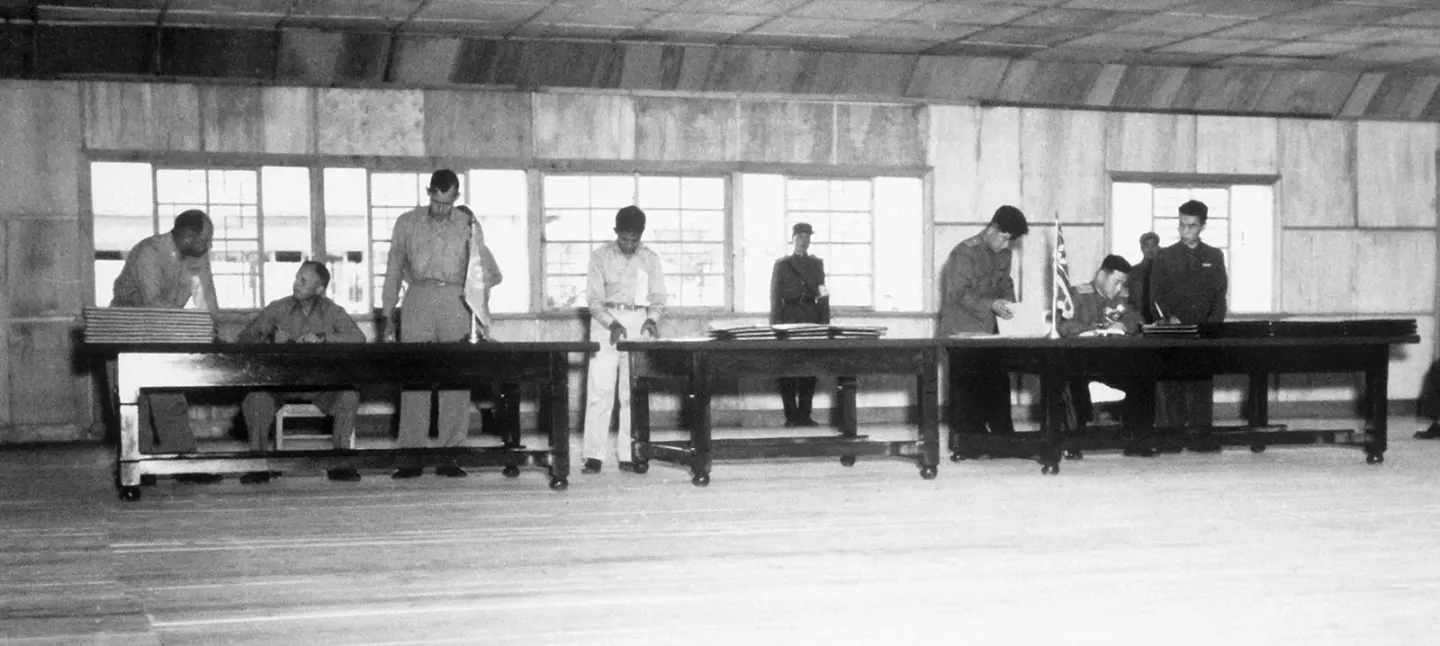
Signing the document to halt the fighting at Panmunjom, July 27, 1953 · U.S. Department of Defense photo, Wikimedia Commons (public domain)
This article is written about the Republic of Korea south of the Military Demarcation Line, from the liberation in 1945 to the early 1990s in Korean history. Japan's colonial rule, which had continued since 1910, ended in 1945. Immediately after liberation, the U.S. military entered the south of the Korean Peninsula and the Soviet military entered the north to govern each area, and separate governments were established in the south and north in 1948 (DOI: 10.18703/silj.2018.12.25.2.51; DOI: 10.23111/nsas.2010.10.3.005). The colonial period is covered by another piece in this series, "Modernity Arrives", and the history within North Korea is outside the scope of this article.
When you watch a movie at home and press the pause button on the remote control, the screen stops at that scene. The movie is not over, and meanwhile, people set the table, do homework, and get into arguments in the living room. What the signature of 1953 did resembles that button. This article follows what South Koreans experienced beside the paused screen.
This era is pieced back together using statistics and rosters left by the government, declassified U.S. government documents, testimonies of people who experienced it, and fact-finding investigations formed by the National Assembly and the government after democratization.
Two Armies, Two Governments
Before the U.S. military arrived in 1945, the Committee for the Preparation of Korean Independence and the People's Committees formed by Koreans right after liberation were actually running the administration in Jeollabuk-do (KCI ART002011727). The U.S. Army Military Government in Korea is the government of the United States military that actually ruled South Korea from 1945 to 1948. While rebuilding collapsed administration and public order, the U.S. military government broadly cracked down on assemblies and associations, and clashed while controlling the leftist forces that had been taking the lead until then (KCI ART002011727).
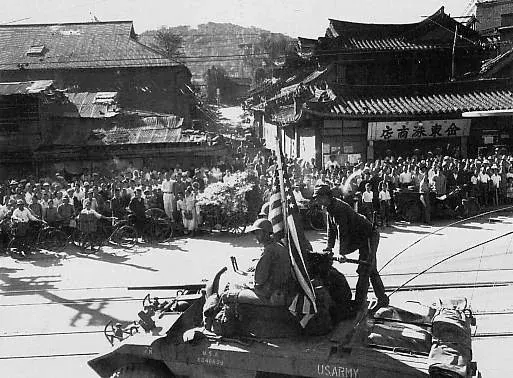
U.S. troops arriving in Seoul, September 1945 · U.S. military photo, Wikimedia Commons (public domain)
Studies vary on where to place the responsibility for the South and North failing to establish a single government. A study in a national security journal argues that the Soviet military administration in the North rejected the proposal to establish a single government under United Nations supervision (DOI: 10.23111/nsas.2010.10.3.005). A study dealing with Protestant history argues that the U.S. military government dissolved the Korean People's Republic established by Koreans and did not accept the Provisional Government as a government either, and that the left and right split amidst the debate surrounding the trusteeship proposal for major powers to take charge of and rule the Korean Peninsula for a time and the failure to purge pro-Japanese collaborators (DOI: 10.17301/tf.2012.69..005).
A general election was held only in South Korea on May 10, 1948 (KCI ART001358956), and the Government of the Republic of Korea was established in August of that year (KCI ART002242298). Syngman Rhee, the first president of the Republic of Korea, led the country starting in 1948 (DOI: 10.65959/eaa.1222).
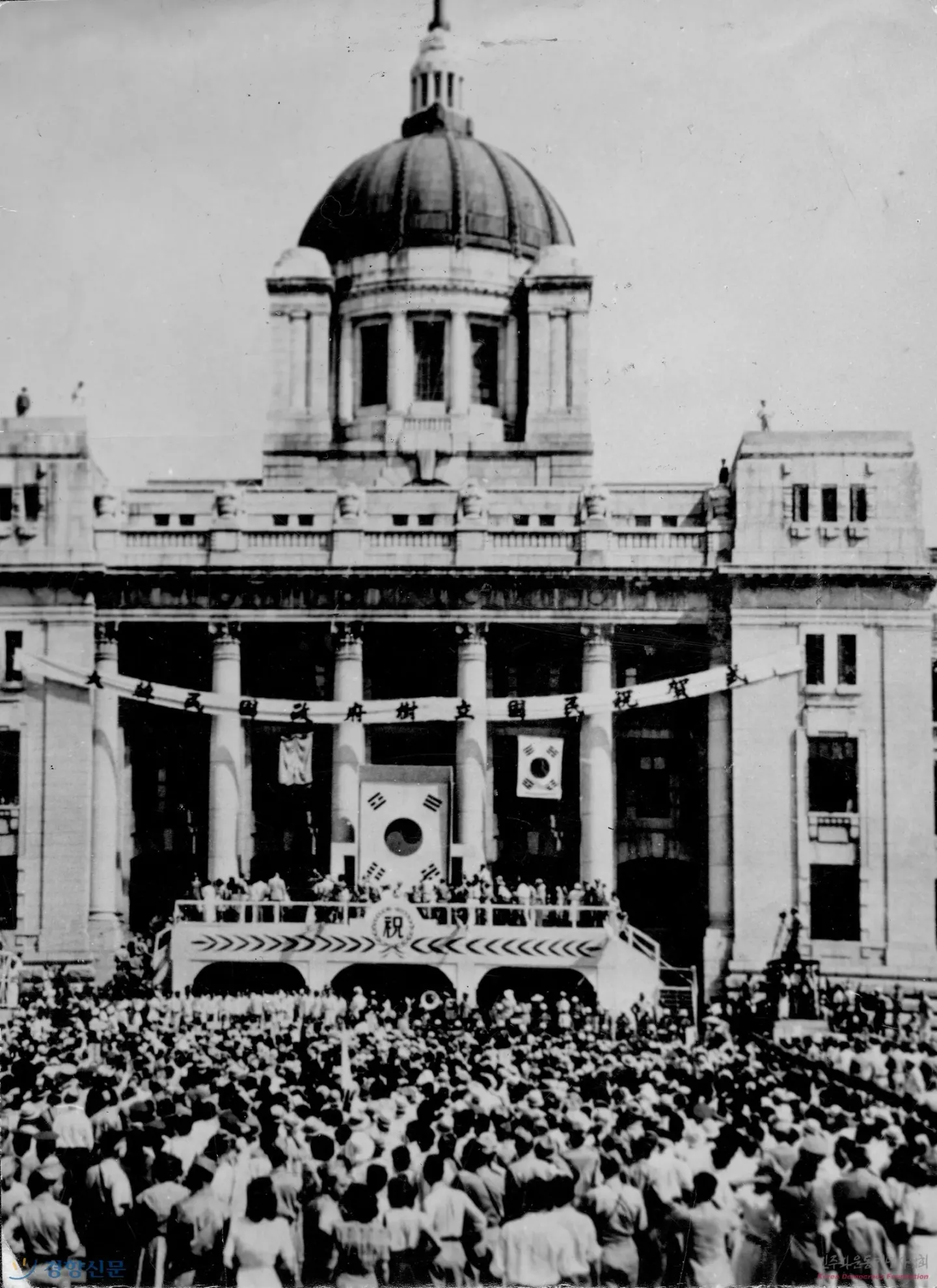
Ceremony marking the founding of the government of the Republic of Korea, August 15, 1948 · in front of the former Government-General building · Wikimedia Commons (public domain)
During the same period on Jeju, an uprising led by communists and suppression operations by the new anti-communist government continued from 1948 to 1954. An English-language paper from 2009 estimates that about 15,000 people died during that time. According to that paper, the civilian massacre was concealed for about 50 years, and following a movement that began after democratization in 1987, South Korea's first truth commission was formed in 2000 (DOI: 10.1093/ijtj/ijp014).
An international law study views the Jeju April 3 Incident as the event with the second largest loss of life after the war that would break out two years later, and notes that there were many civilian casualties caused by state power. In 2003, the president apologized to the citizens in accordance with the truth investigation report (KCI ART002242298).
Liberation did not lead directly to a single country, and separate governments were established in the South and the North in 1948.
June 25, 1950
The Korean War was a war on the Korean Peninsula that began on June 25, 1950, and stopped fighting on July 27, 1953, also called the 6.25 War. On this day, North Korean leader Kim Il Sung attacked the South with North Korean troops, receiving full support from the Soviet Union and a promise of support from China (DOI: 10.23111/nsas.2010.10.3.005). The fighting began at the 38th parallel (KCI ART001442932). Soviet leader Stalin had strongly stopped North Korea from trying to unify by force until the end of 1949, but suddenly changed his attitude in late January 1950 to support Kim Il Sung (DOI: 10.17331/kwp.2014.30.2.001).
Due to the quick intervention of the United States and the United Nations, the Communist side did not win easily, and a study views that it was only after China's full-scale entry into the war that they succeeded in regaining the border from before the war (DOI: 10.23111/nsas.2010.10.3.005).
The armistice agreement is an agreement made by the two fighting armies to stop fighting, and is different from a peace treaty that ends a war. The Syngman Rhee government and many Koreans opposed "a ceasefire without unification" (DOI: 10.23011/jnds.2013.56.3.005).
The war began with North Korea's attack in 1950, and stopped without ending in 1953.
Where Did the War Come From?
Why the war broke out is a question where answers diverge. The traditional interpretation that long dominated the West viewed this war as a clear communist aggression, holding international communism directed by Moscow responsible. Building on this interpretation, the 1964 historian David Rees praised U.S. participation. A 2010 study in a national security journal also views Kim Il-sung's attack, backed by Soviet and Chinese support, as the "naked" cause that encompasses all other causes (DOI: 10.23111/nsas.2010.10.3.005). A 1992 review article criticizing this interpretation points out that here Koreans are invisible except when Kim Il-sung attacked the South in June 1950 and when Syngman Rhee tried to obstruct the 1953 armistice (DOI: 10.1080/14672715.1992.10410636).
In The Origins of the Korean War, the historian Bruce Cumings moved the origins to inside Korea immediately following liberation. He argued that the war stemmed from a clash between the revolutionary nationalism of Koreans trying to escape colonialism and America's counterrevolutionary policy. A 2025 paper reevaluating Cumings acknowledges that he pioneered the analysis of the relationship between decolonization and the Cold War, but criticizes him for underaddressing the internal diversity among Koreans and simplifying North Korea into a victim (DOI: 10.38080/crh.2025.05.151.314).
A 2010 study noted that while scholars hold diverse views, a lack of reliable materials had prevented a clear answer on the origins until then (KCI ART001442932).
While scholars still diverge on the origins of the war, the point that North Korea was the side that launched the attack in June 1950 lies outside this divergence. Research examining Stalin's motives notes that he changed his stance in late January 1950 and agreed to Kim Il-sung's initiation of the war (DOI: 10.17331/kwp.2014.30.2.001).
The War Left Behind in Numbers and Testimonies
The casualties of war vary in number depending on who was counted and what was counted. One teacher's commentary note states that this war left behind more than 2 million deaths, but does not clarify who was counted (DOI: 10.65959/eaa.1222). Statistics from the Korean government's Office of Public Information in 1953 tallied South Korean civilian casualties as 244,000-plus deaths, 128,000-plus massacres, 229,000-plus injuries, 84,000-plus abductions, and 303,000-plus missing persons, totaling 990,968 people (DOI: 10.17792/kcs.2008.14..133).
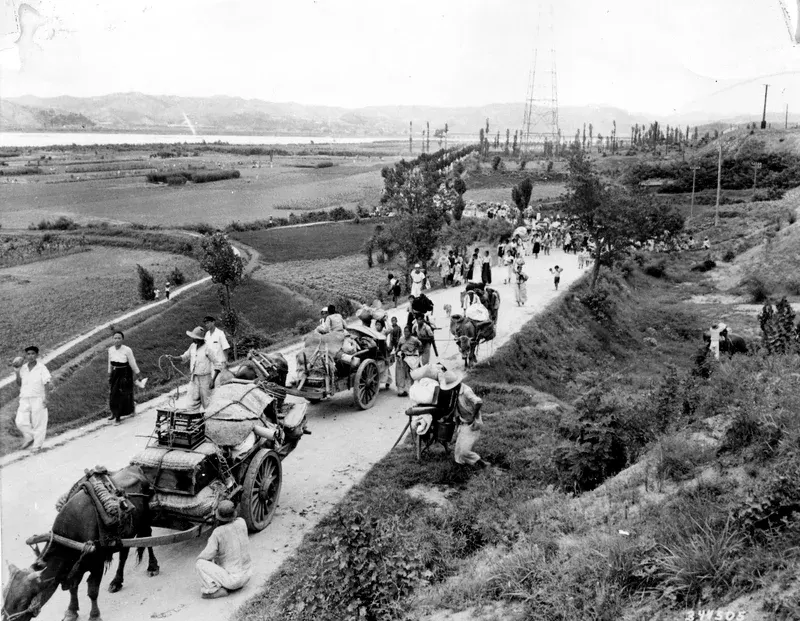
Refugees moving south, August 1950 · U.S. Army photo, Wikimedia Commons (public domain)
An enumeration by the same government in 1952 counted 142,923 South Koreans who were killed or taken away by North Korea and leftists for political and ideological reasons. A study analyzing these statistics suggests that more data must be found to bridge the gap between the two tallies (DOI: 10.17792/kcs.2008.14..133).
Oral history is a method that asks living people about what they experienced, records those words, and uses them as historical materials. A study analyzing war memoirs collected nationwide from 2012 to 2013 concludes that the state forced silence on massacres committed by the South Korean military, right-wing forces, and the U.S. military, while framing war damage solely as the responsibility of leftists to establish an official memory. The same study also records that massacres and damage occurred on a large scale by the People's Army and leftists alike, and notes that after democratization, memoirs challenging this official memory poured out (KCI ART001824974).
In July 1950, around Nogun-ri, Yeongdong-gun, Chungcheongbuk-do, many unarmed civilians were killed and injured by U.S. aerial bombing and ground attacks. The testimonies of victims who were teenagers at the time recount how injuries that did not receive proper treatment led to interruptions in schooling and, in severe cases, permanent disabilities (DOI: 10.17788/dbhc.2021..197.008). People whom the police and military identified as dangerous persons and rounded up in advance during the war did not merely face detention, but were led to massacres (KCI ART002831854).
The casualties of war are pieced together through government statistics, survivors' words, and belated investigations, and their numbers vary in range across each investigation.
Spring 1960 and May 1961
On February 28, 1960, high school students in Daegu took to the streets. The government and the ruling party tried to frame this as instigated by communists or backed by the opposition party, but it turned out to be a voluntary student movement. The protests led through the March 15 Democratic Uprising to the massive demonstrations of April (DOI: 10.15186/ikc.2021.12.31.27).
The April 19 Revolution was an event where students and citizens rose up against the rigged election of March 15, 1960, and brought down the Syngman Rhee government. University students played a leading role from April 17 to April 26 (DOI: 10.22743/kwr.2022.4.6.69), and Syngman Rhee stepped down from the presidency and went into exile in Hawaii. On June 15 of that year, a cabinet system was established under a new constitution, shifting executive power to Prime Minister Chang Myon (DOI: 10.65959/eaa.1222).
The May 16 Military Coup was an event where soldiers including Park Chung-hee used armed force to overthrow the Chang Myon government and seize power on May 16, 1961. This name follows research that writes it as the "May 16 Military Coup" (KCI ART002827154), while many studies also write it as the "May 16 Military Coup d'état" (KCI ART002053997). Park Chung-hee was a general who had been an officer in the Imperial Japanese Army (DOI: 10.11588/iqas.2021.3-4.16181). The officers who led the coup shared a common ground in criticizing the Democratic Party government and feeling discontented with military corruption and promotion stagnation, which led them to stage the coup (KCI ART002827154).
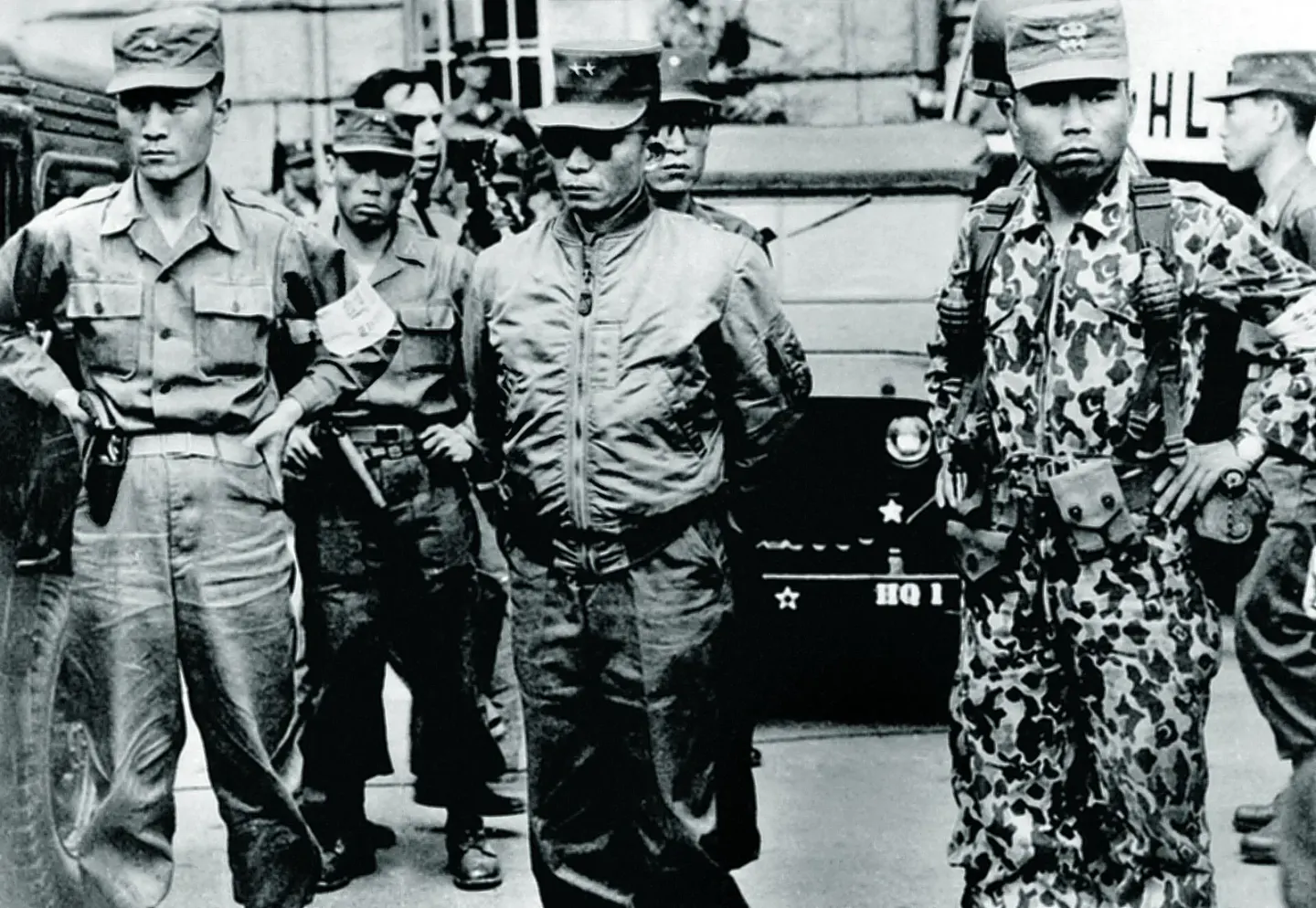
Park Chung-hee (center, in sunglasses) and other soldiers just after the military coup of May 16, 1961 · Wikimedia Commons (public domain)
The United States promised public support for the Chang Myon government but did not step in to stop the coup (KCI ART000875554). How to view that reaction varies among studies. One study suggests that because of modernization theory—which holds that political stability comes only after economic development—the U.S. Kennedy administration decided not to recklessly intervene (KCI ART000875554). Another study classifies it as "explicit approval" driven by realist diplomacy prioritizing anti-communism and military security (KCI ART001806951). Research examining declassified U.S. documents argues that the United States had intelligence on the coup early on yet did not stop it, and the stated rationale of supporting a constitutional government was soon pushed aside by the logic of anti-communism and regime stability (KCI ART002053997).
Martial law is a measure declared by the president during emergencies like war, allowing the military to take charge of public order and parts of administration. One study notes that martial law was used for political purposes starting from the Syngman Rhee administration, and its system was fully established during the Park Chung-hee administration (KCI ART003403646). Immediately after the coup, the coup forces proclaimed the eradication of "pro-communist elements" under emergency martial law and carried out large-scale preventive detentions, with police and military counterintelligence units illegally arresting and locking people up just as they had during the Korean War (KCI ART002831854).
Park Chung-hee later became president through elections (DOI: 10.11588/iqas.2021.3-4.16181).
From Aid to Export
It is often said that until the late 1950s, the South Korean economy achieved stability mainly through American aid, and one study confirms that foreign capital brought in as grant aid was vital for reconstruction (KCI ART001965812).
The Five-Year Economic Development Plans are economic plans in which the government sets growth targets and industries to foster in five-year units. Such plans were also drafted by the Chang Myon government after the April 19 Revolution. One study notes that while the Chang Myon government's blueprint showed improvements over the Syngman Rhee regime, this government—which tried to clear away a state-led economy and establish a free-market order—failed to gain public support and had no choice but to rely on American aid for financial resources (KCI ART002212377). After the May 16 coup, the military government aggressively pushed forward with the plans (KCI ART001965812), and in the process of drafting the first plan, the coup-initiating military faction, bureaucrats, and scholarly groups aligned their stances on whether the state or the private sector should take the lead, and whether to look to domestic or foreign markets (KCI ART002965831).
Export-led industrialization is a path that develops a country's industry by prioritizing manufacturing that makes goods to sell overseas. In the 1960s, the government selected export-specialized industries centered on light industry, and in the early 1970s, it selected and supported export-strategic industries that included heavy industry (KCI ART003164075). One study views this export policy, strongly driven by the government, as having laid the cornerstone for the subsequent high-speed growth (KCI ART001965812).
The plans were frequently revised. A study tracking the repeated revisions of the plans concludes that rather than being action plans that consistently guided policy, the Five-Year Plans were a means of symbolic politics modified according to immediate convenience, and what drove policy was an absolutized "will to growth" rather than the rationality of the plans (DOI: 10.18207/criso.2019..124.328).
Factories and Power in the 1970s
Heavy and chemical industrialization is a policy to foster industries that require large facilities, such as steel, shipbuilding, machinery, and chemicals. According to one study, South Korea's heavy and chemical industrialization began with President Park Chung-hee's directive on March 12, 1969, and was promoted by a planning group dedicated to that directive (KCI ART001667928). The planning group bypassed formal reporting and approval systems to become a conduit connecting industry demands directly to the Blue House, while the Economic Planning Board remained in a supporting role. That study views this direct connection as having brought forward the target dates for industrialization and exports while simultaneously causing the side effect of economic concentration (DOI: 10.15856/jakpah.2011..28.257).
Studies are divided on who and what drove this policy. The previous study sees the president's will and leadership as taking precedence over economic drivers (KCI ART001667928). Another study views economic purposes, such as comparative advantage in the international market and the integration of the defense industry, as overlapping with political purposes to resolve the president's third-term issue by linking security and growth, alongside coordination between South Korea and the United States (DOI: 10.23035/KAICS.2018.1.7.061). Yet another study suggests that this policy emerged from policy alternative competition among bureaucrats rather than politicians (KCI ART002708141).
The Yushin system is a system that concentrated powers exceeding the constitution—such as emergency measure authority and the power to dissolve the National Assembly—in the president without term limits through the Yushin Constitution of 1972, lasting until 1979. The earlier study on heavy and chemical industrialization views that policy as forming two sides of the same coin with the Yushin proclaimed in 1972 (KCI ART001667928). One study calls this system "legal-institutional authoritarianism," stating that while outwardly maintaining the forms of the constitution and laws, it suppressed political freedom and dismantled civil society, citing the People's Revolutionary Party Reconstruction Committee incident as an example of state violence where the judiciary was subordinated to power to eliminate opposition forces (DOI: 10.52271/PKHS.2025.08.132.1). Park Chung-hee promoted this system as "Korean-style democracy" rather than a Western style, and one study views this as a tool to justify authoritarianism by demanding strong leader-centered unanimity instead of checks and balances (DOI: 10.21807/JNAS.2021.06.99.045).
The paused war exerted its influence off-screen during this period as well. One study views the Cold War and division situation on the Korean peninsula as the structural conditions that made martial law politics possible. The same study notes that when the United States and China grew closer and South-North dialogue opened in the early 1970s, the regime instead used the crisis of détente to justify Yushin (KCI ART003403646).
The year 1979 saw the expulsion of opposition party leader Kim Young-sam and the Bu-Ma democratic protests in Busan and Masan. One study argues that the dual policy of the United States, which virtually approved the Park Chung-hee regime while pressing for human rights improvements at the South Korea-US summit that year, made both the regime and the opposition hardline (DOI: 10.31008/MV.38.3). The Yushin system collapsed with the October 26 incident on October 26 of that year, in which Park Chung-hee died (DOI: 10.21286/jps.2023.11.13.4.241).
How to Explain Rapid Growth
In the 1980s, it became clear that East Asian economies like South Korea, Taiwan, and Singapore were growing fast enough to soon become developed countries. Regarding the reasons why, mainstream economists saw it as the result of following Western-style prescriptions that opened markets and lifted regulations, while other scholars saw it as the result of the state leading the market (DOI: 10.1111/dech.12381). The same question yielded divided answers.
The developmental state refers to a country where economic growth is treated as the primary goal of the state, and an elite group of bureaucrats leads the market through industrial policy. This is an idea put forward by the scholar Chalmers Johnson in his 1982 pioneering study on Japan, subject to the conditions that there is a central agency within the bureaucracy to coordinate policies and that politicians grant the bureaucrats sufficient discretion. This industrial policy does not replace the market, but aligns with the long-term rationality of the market (DOI: 10.1057/9781137476128_1). A 2018 paper comparing the two explanations concludes that the developmental state side is correct regarding the period of rapid catch-up (DOI: 10.1111/dech.12381). However, a study examining the construction process of Okpo Shipyard concludes that the government was not unified internally, pushed policies with misguided judgments, and that corporations were also a major axis that coordinated policy, meaning the heavy and chemical industrialization of the 1970s cannot be explained by the state's "rationality of plan" alone (DOI: 10.22629/kabh.2021.36.3.005).
Some studies add external conditions to the developmental state explanation. One study attributes the success of South Korea's developmental state and modern conglomerates to the boost provided by US military procurement overseas during the Vietnam War, adding this dimension which is missing from explanations that look solely inside the nation (DOI: 10.1068/a130025p).
Other studies approach the question from the perspective of labor. A study comparing why labor movements were weak in South Korea, Taiwan, Singapore, and Hong Kong argues that their competitiveness was rooted in a cheap, disciplined, and productive labor force, and that political control came before rapid industrialization to preemptively block workers' organizations. The same study notes that South Korean labor was in a stronger position than elsewhere despite much stricter regulations (DOI: 10.1525/9780520326392). While female workers entered the Gumi National Industrial Complex in Gyeongsangbuk-do in large numbers during the 1970s, their records are hard to find, and a study suggests that figures like worker Kwon Young-sook, who staged labor movements there in 1979, were omitted from the "industrialization myth" (DOI: 10.29004/jkmch.2025.6.113.161).
Whether the heavy and chemical industrialization of the 1970s was excessive investment also yields divided answers to the same question. This policy was frequently criticized for producing massive inefficiencies through irrational industrial selection, and an English-language study introducing that criticism finds that explanations attributing this to the authoritarianism of the regime actually explain very little (DOI: 10.1017/s0026749x0400160x). Other studies argue that while it achieved striking results, it was not free from criticism for leaving precedents of over-investment, duplicated investment, and the concentration of economic power in the chaebol (KCI ART001667928). Conversely, a 2006 study argues that it is difficult to view over-investment as having occurred during this period, and that preemption competition among large corporations in the late 1970s and early 1980s merely created short-term, sector-specific duplicated facilities (KCI ART001097075). Regardless of whether it was excessive, some studies have measured the effects of the policy. A 2022 study analyzing corporate management data argues that the policy was effective, noting that thanks to 1970s support, heavy and chemical industries gained the scale to expand on their own in the 1980s, and their productivity growth rate was higher than that of light industries (KCI ART002875079).
South Korea's rapid industrialization is centered on the developmental state explanation that the state led the market through industrial policy, with studies questioning the rationality of that planning and studies adding external conditions modifying or broadening that explanation.
May 1980, Gwangju
Following the military coup on December 12, 1979, the faction that newly seized control of the military (the new military faction) led to the regime of President Chun Doo-hwan (KCI ART002886357). The May 18 Democratization Movement is a democratization movement that began in Gwangju on May 18, 1980, with citizens and students standing up against the martial law forces. The uprising lasted for ten days (DOI: 10.1080/07393140307196) and was ruthlessly suppressed (DOI: 10.1108/s0163-786x20210000045011).
The state later defined this event through law. The Special Act on the May 18 Democratization Movement, etc., amended in 2021, defines the May 18 Democratization Movement as a democratization movement waged by citizens against crimes destroying the constitutional order and crimes against humanity that occurred around December 12, 1979, and May 18, 1980 (DOI: 10.31536/jols.2023.20.1.008). According to a study analyzing military manuals, the military operation plan at the time defined the citizens of Gwangju not as citizens, but as armed irregular forces, namely "the enemy or guerrillas" (DOI: 10.62783/SHSS.6.6.48).
After the 1988 general election, the National Assembly, centered around the opposition parties, formed the "Special Committee on the Investigation of the Truth of the May 18 Democratization Movement" and led the investigation of the truth through hearings. One study considers that the Roh Tae-woo administration at the time created a countermeasure organization centering on the Ministry of National Defense, together with the Blue House, the ruling party, and intelligence agencies, to illegally and systematically block the investigation of the truth. The same study considers that response to have stood upon the self-justification of the new military faction that suppression by the military was inevitable due to student protests and the threat of a Southward invasion by North Korea (KCI ART002886357).
The damage is still being revealed through investigations. In 2022, roughly 30 years after the compensation act was enacted in 1990, the first fact-finding survey of victims commissioned by Gwangju Metropolitan City surveyed 2,009 out of the 4,417 May 18 democratic merit recipients registered with the Ministry of Patriots and Veterans Affairs. Afterward, as the most serious problem experienced, 56.4% of respondents cited mental suffering, and 54.0% cited physical injuries and lingering illness (DOI: 10.62082/JDHR.2023.09.23.3.39). In a study reanalyzing the same survey, the proportion corresponding to post-traumatic stress disorder was 47.1% (DOI: 10.62082/JDHR.2023.12.23.4.29).
June 1987
The memory of Gwangju created the next wave. Research collecting movement documents from 1980 to 1987 suggests that remembering and publicizing Gwangju completely turned participants away from a belief in the legitimacy of state power, and led them to take great risks due to moral shock (DOI: 10.1108/s0163-786x20210000045011).
The June Democratic Struggle was a democratization uprising fought by students and citizens nationwide against the military authoritarian regime in June 1987. Citizens voluntarily joined the non-violent struggle led by the National Movement Headquarters, and a new group called the "Necktie Brigade" also stepped forward (DOI: 10.22743/kwr.2022.4.6.117). Democratization proceeded amid the sacrifice of many students, such as university student Lee Han-yeol, who was called part of the "second generation" of Gwangju (KCI ART002475640). Following large-scale protests in the spring, the government of President Chun Doo-hwan stepped down in June (DOI: 10.2307/2644872).
Constitutional amendment for direct election is the revision of the Constitution so that citizens elect the president through a direct vote. The new Constitution was adopted in October of that year, and in December citizens once again elected a president through a direct vote (DOI: 10.2307/2644872).
Explanations vary in weight regarding what drove the transition of 1987. One quantitative analysis comparing the frustrated transition of 1980 and 1987 suggests that the number of protests and U.S. pressure had a clear impact on the 1987 transition (DOI: 10.1080/13510340008403677). Another study analyzing social movements from 1980 to 1987 starts from the premise that the resources of movement organizations and the solidarity of students, workers, dissidents, and the urban poor—in other words, the preparedness of civil society—was more decisive than any other factor, thereby refuting the theory that a transition occurs only when the regime splits internally (DOI: 10.1353/apr.1997.a921122). The two explanations overlap on the power of protests, but diverge on how heavily they weigh U.S. pressure.
One study views that after 1987, human rights began to be understood not merely as "resistance" against the state, but as universal rights across all spheres. The same study adds that there are many limitations to the reality of human rights because discrimination and oppression persist (DOI: 10.18207/criso.2017..114.52).
The pause button pressed in 1953 remained unchanged even by the early 1990s, where this article ends. Alongside it, South Koreans established a government, counted the damages of the war, built factories, and came to directly elect their president once again. However, unlike a movie, there is research suggesting that this screen exerted influence on the living room even while it was paused.
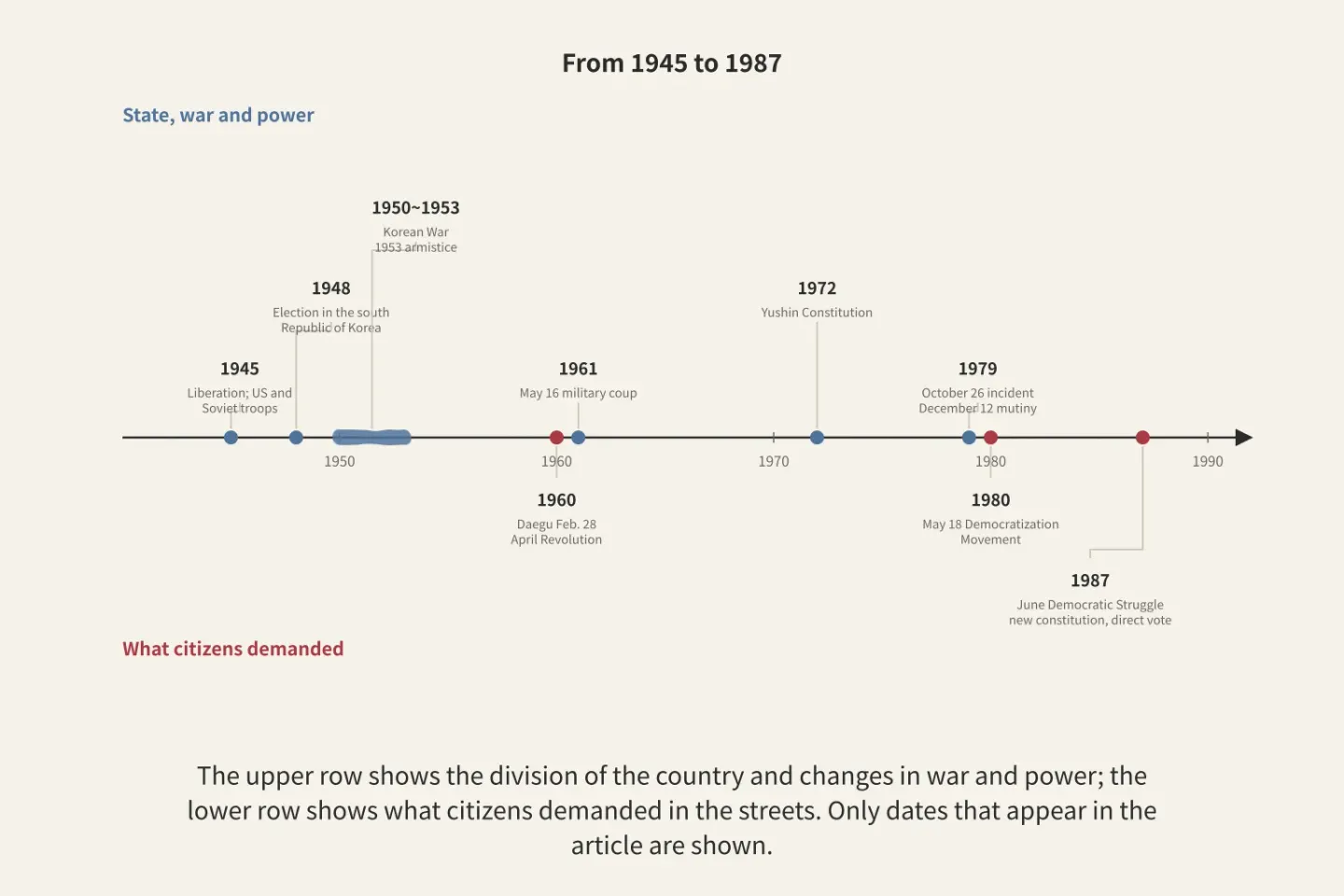
Figure: a timeline Paperis drew using only the dates in this article
Where to Look Next
The decisions of Stalin and Mao Zedong that determined the war in 1950 can be followed in more detail through documents in "Why Did Stalin Turn in January and Mao Send Troops in October?". How testimonies and memories are read as historical sources continues in the methodology parts of the "How Do We Know the Past?" series, and the process by which factories and labor changed society continues in the "The Industrial Revolution" part of "Big Words of History". The colonial era before liberation can be seen in the earlier part of this series, "From the Treaty of Ganghwa to Liberation".
Source Papers
- "An Analysis of the Process of Concluding the Korean War Armistice Agreement: Focusing on the Military Council Interim Secretariat's Armistice Negotiation Log" (2022) — KCI ART002878722 — The armistice agreement was signed on July 27, 1953, 747 days after talks began on July 10, 1951, and the momentum for a truce gathered steam as the Chinese intervention escalated the conflict into a war between the UN forces and China.
- "Meaning and Characteristics of the Korean War Armistice Agreement: Comparison with Armistice Agreements, Peace Treaties, and Regional Peace Processes" (2023) — DOI: 10.17331/kwp.2023.39.1.001 — The armistice agreement's expansive DMZ prevented further all-out war but failed to produce results in follow-up political talks.
- "Review of the Publication of the 2015 Revised Korean History Textbooks and Descriptions of Casualties and Civilian Massacres during the Korean War" (2020) — DOI: 10.25232/ku.2020.54.299 — The Korean War has not ended but remains in a state of pause, and history education must address the suffering inflicted by state violence in the form of civilian massacres.
- "The International Legal Nature of the US Military Government in Korea Immediately after Liberation: A Critical Approach to the Mainstream View" (2018) — DOI: 10.18703/silj.2018.12.25.2.51 — This paper examines the international legal nature of the experience of occupation, which ran consecutively through the Japanese colonial period (1910-1945), the US and Soviet military administrations (1945-1948), and the Korean War (1950-1953).
- "The Causes of the Korean War(1950-1953)" (2010) — DOI: 10.23111/nsas.2010.10.3.005 — The Soviet military government in North Korea rejected a single government under the United Nations, leading to the establishment of two separate governments; Kim Il-sung attacked the south with the full support of the Soviet Union and promises of backing from China; and after the intervention of the US and the UN and China's entry into the war, the conflict merely restored the pre-war boundary.
- "US Military Government Activities in the Jeonbuk Region after Liberation" (2015) — KCI ART002011727 — Before the deployment of US troops, the People's Committees and the Committee for the Preparation of Korean Independence exercised governing authority, and the US military administration re-established administration and public order, broadly restricting assemblies and associations through proclamations and controlling the left wing, which led to clashes.
- "An International Legal Review of the US Military Government Immediately after Liberation: Focusing on Korea's Statehood and the Jeju April 3 Incident" (2017) — KCI ART002242298 — The US military administration was a military occupation under the Hague Regulations while functioning more heavily in practice as a government authority; the Republic of Korea government was established in August 1948, and in 2003 the president issued an apology based on the April 3 Truth Investigation Report.
- "Liberation and Political Protestantism in Korea" (2012) — DOI: 10.17301/tf.2012.69..005 — This view holds that the US military administration dissolved the People's Republic and rejected the provisional government, while the debate over trusteeship split the political left and right and divided the peninsula into North and South.
- "Controversies and Direction of Revision in High School Korean Modern and Contemporary History Textbooks: Focusing on Descriptions of the May 10 General Election and the Legitimacy of the Republic of Korea" (2009) — KCI ART001358956 — This paper compares textbook descriptions of the background of the May 10 general election—a single election held in South Korea—and the inter-Korean negotiations.
- "An Unpromising Recovery: South Korea's Post-Korean War Economic Development: 1953-1961" (2013) — DOI: 10.65959/eaa.1222 — An article from the teacher resource magazine Education About Asia. The war left more than 2 million dead, and from 1953 to 1961 South Korea suffered from corruption, sluggish growth, and aid dependency while North Korea made impressive recoveries; Syngman Rhee passed the National Security Act and executed Cho Bong-am before fleeing to exile in Hawaii in April 1960, and a cabinet-responsibility constitution was established on June 15.
- "Seeking Truth after 50 Years: The National Committee for Investigation of the Truth about the Jeju 4.3 Events" (2009) — DOI: 10.1093/ijtj/ijp014 — An estimated 15,000 people died as a result of the Jeju uprising and suppression from 1948 to 1954; after roughly 50 years of concealment, a movement began alongside democratization in 1987, and the first truth commission was established in 2000.
- "Chapter 1: A Study on the Origin and Causes of the Korean War" (2010) — KCI ART001442932 — The war is generally recorded as having broken out due to clashes along the 38th parallel on June 25, 1950; scholars hold diverse views on its origins, but a clear answer remains elusive due to a lack of source materials.
- "Guarantees of Soviet Strategic Interests in the Far East: The Origins of the Korean War and Stalin's Policy-Making Motives" (2014) — DOI: 10.17331/kwp.2014.30.2.001 — Stalin blocked forced unification until late 1949 before supporting Kim Il-sung in late January 1950, and when the Sino-Soviet treaty threatened to cost the Soviet Union its warm-water ports, he agreed to the start of the war because it could secure his Far East strategic goals regardless of victory or defeat.
- "Is the South Korean Military a Party to the Korean War Armistice Agreement?" (2013) — DOI: 10.23011/jnds.2013.56.3.005 — The absence of a South Korean military commander's signature is due to the UN forces commander having been delegated command authority to sign on their behalf, making the South Korean military a party nonetheless, and both the South Korean government and a large portion of the public opposed a truce without unification.
- "Rediscovering history—new light on the Unknown War; …" (1992) — DOI: 10.1080/14672715.1992.10410636 — A review article criticizing traditional Western historiography for viewing the war as a communist aggression directed by Moscow (Rees 1964), and arguing that Koreans appeared in the narrative only during Kim Il-sung's June 1950 attack and Syngman Rhee's obstruction of the armistice.
- "Decolonization, the Cold War, and Third World Agency: Re-evaluating Bruce Cumings's “The Origins of the Korean War” (Volumes 1 and 2)" (2025) — DOI: 10.38080/crh.2025.05.151.314 — Cumings traced the origins of the war to the collision between revolutionary nationalism and American counter-revolutionary policy and pioneered an analysis of decolonization and Cold War relations, but underplayed internal diversity among Koreans and simplified North Korea into a victim.
- "Types and Characteristics of Investigations into Civilian Casualties in South Korea during the Korean War: Focusing on South Korean Government Statistics and Rosters" (2008) — DOI: 10.17792/kcs.2008.14..133 — Office of Public Information statistics from 1953 place total South Korean civilian casualties at 990,968, and 1952 figures record 142,923 politically or ideologically motivated killings and abductions, pointing to a need for further archival discovery to bridge the gaps.
- "Reconstruction of Left-Wing Victimhood Narratives during the Korean War: A Challenge to the State's Official Memory" (2013) — KCI ART001824974 — The state enforced silence regarding massacres committed by the South Korean military, right-wing groups, and the US military, but democratization gave rise to personal accounts challenging official memory, while massacres were also carried out on a large scale by the North Korean army and left-wing forces.
- "Wounds of War Imprinted on the Body and Healing: Disability and Gender in the Oral Histories of No Gun Ri Victims from the Korean War" (2021) — DOI: 10.17788/dbhc.2021..197.008 — Unarmed civilians were killed or wounded by US air and ground attacks in No Gun Ri in July 1950, and delayed medical treatment for teenage victims led to disabilities and the loss of educational opportunities.
- "The Historical Continuity of Preventive Detention Immediately after the May 16 Coup" (2022) — KCI ART002831854 — Preventive detentions during the Korean War led to mass killings, and large-scale preventive detentions were repeated under martial law immediately after the May 16 coup.
- "Changes in Perception of the February 28 Democratic Movement and Its Succession by the April 19 Revolution" (2021) — DOI: 10.15186/ikc.2021.12.31.27 — The student protest in Daegu on February 28, 1960, was distorted as being instigated or orchestrated from behind the scenes, but it was a spontaneous movement that led through March 15 to the April 19 revolution.
- "The Role of University Students in the Process of South Korea's Democratization Movement: Centering on the April 19 Revolution" (2022) — DOI: 10.22743/kwr.2022.4.6.69 — University students played a leading role in the process that led to the collapse of the First Republic between April 17 and April 26, 1960.
- "Economic Operating Principles of the First Five-Year Economic Development Plan" (2023) — KCI ART002965831 — The military figures behind the May 16 military coup, along with bureaucrats and academic groups, coordinated stances between the state and the private sector, and between outward-looking and inward-looking strategies, during the drafting of the first plan.
- "The Role of the United States in the April Revolution and the May 16 Military Coup" (2015) — KCI ART002053997 — Declassified documents show that the United States received advance intelligence about the coup but did not block it, and its stated reasons for opposing it—supporting a constitutional government—were immediately abandoned in favor of anticommunism and regime-stability logic (a pro-military-coup dual policy).
- "The 1960s in South Korea. Modernisation, Nationalism and the Pursuit of Democratisation" (2021) — DOI: 10.11588/iqas.2021.3-4.16181 — Park Chung-hee, a general formerly an officer in the Imperial Japanese Army, seized power in a coup on May 16, 1961, and was later elected president, concluding the Korea-Japan Basic Treaty in 1965 despite student opposition and deploying troops to the Vietnam War.
- "Factors in the Fragmentation of the Leadership Faction Behind the May 16 Military Coup" (2022) — KCI ART002827154 — The leadership faction staged the coup driven by criticisms of the Democratic Party government and discontent over military corruption and promotion bottlenecks.
- "Modernization Ideology and US Policy Toward Korea: The Kennedy Administration and the May 16 Coup" (2002) — KCI ART000875554 — Assessments of the political situation grounded in modernization theory influenced the Kennedy administration's judgment not to intervene and block the coup.
- "The May 16 Coup and US Policy Toward Korea" (2013) — KCI ART001806951 — The Kennedy administration's realist foreign policy ideology and priority on military security led to explicit approval of the May 16 coup.
- "The Cold War and Division Situation on the Korean Peninsula and the Yushin System" (2026) — KCI ART003403646 — The political use of martial law began under Syngman Rhee and its systematic framework was built under Park Chung-hee; the conditions of the Cold War and national division formed the structural backdrop for the politics of martial law, and the regime justified Yushin using the theory of a détente crisis.
- "The Korean Economy after Liberation and the Early Five-Year Economic Development Plans: Centering on Breaking Free from an Aid Economy and Adopting Export-Driver Policies" (2015) — KCI ART001965812 — Foreign capital arriving via grant aid was essential for reconstruction, and the military government actively implemented the five-year plans while adopting export-drive policies.
- "The Scene Administration's Economic Policy Vision and the Five-Year Economic Development Plan" (2017) — KCI ART002212377 — The Scene administration pursued the liquidation of government-controlled economics and a free-market economic order, but failed to win public support and relied unilaterally on US aid for financial resources.
- "Selection Systems for Export-Specialized and Export-Strategic Industries During the Export-Led Industrialization Era" (2024) — KCI ART003164075 — This paper compares the selection systems for light-industry-centered export-specialized industries in the 1960s and export-strategic industries that included heavy and chemical industries in the early 1970s.
- "A Study on Revisions to the Five-Year Economic Development Plans During the Park Chung-hee Government: Plan Rationality or Growth Worship?" (2019) — DOI: 10.18207/criso.2019..124.328 — The five-year plans served as an instrument of symbolic politics that were frequently revised and mobilized, and policies were driven less by planning rationality than by an absolutized will for growth.
- "Dysfunctions of the Industrial Rationalization and Heavy and Chemical Industrialization Policies of the Park Chung-hee Regime in the 1970s" (2012) — KCI ART001667928 — Heavy and chemical industrialization began on March 12, 1969, by presidential directive and was advanced by a planning team as two sides of the same coin with Yushin; the president's will and leadership mattered more than economic drivers, and despite visible achievements, the policy drew criticism for excessive overlapping investments and the concentration of economic power in the chaebol.
- "A Study on Administrative Agencies Promoting Heavy and Chemical Industrialization in the 1970s: The Heavy and Chemical Industry Promotion Committee and the Planning Team" (2011) — DOI: 10.15856/jakpah.2011..28.257 — The planning team bypassed the Economic Planning Board to directly link industry and the Blue House, which both shortened target timelines and spurred the concentration of economic power.
- "The Park Chung-hee Government's Promotion of Heavy and Chemical Industries in the Early 1970s" (2018) — DOI: 10.23035/KAICS.2018.1.7.061 — This initiative held four meanings: a comparative advantage over light industry, a linkage with the defense industry to boost inter-industry linkages and localization rates, a political objective to tie security and growth together to resolve the third-term dilemma, and a mix of conflicts and agreements in US-Korea relations.
- "A Study on the Formation Process of South Korea's Heavy and Chemical Industrialization Policy in the 1970s" (2021) — KCI ART002708141 — An industrial-complex approach to heavy and chemical industrialization policy emerged out of policy-alternative competition between bureaucrats at the Economic Planning Board and the Ministry of Commerce and Industry.
- "One-Man Rule and the Resistance of a Weak Civil Society: The Legal Authoritarianism of the Yushin System and the People's Revolutionary Party Reconstruction Committee Incident" (2025) — DOI: 10.52271/PKHS.2025.08.132.1 — The 1972 Yushin Constitution granted the president unlimited consecutive terms, emergency decree powers, and the authority to dissolve the National Assembly, and the People's Revolutionary Party Reconstruction Committee incident stands as an example of state violence in which the judiciary was subordinated to power.
- "Park Chung-hee's View of Democracy and the Justification of the Yushin System" (2021) — DOI: 10.21807/JNAS.2021.06.99.045 — Korean-style democracy served as an authoritarian justification tool that demanded unanimous consensus centered on a strong leader.
- "US-Korea Relations and Political Crisis at the End of the Yushin System: The Bu-Ma Democratic Uprising and the Political Sociology of Bedfellows with Different Dreams" (2018) — DOI: 10.31008/MV.38.3 — US dual policy in 1979 hardened the stances of both the regime and the opposition, leading to the political crisis of Kim Young-sam's expulsion and the Bu-Ma Democratic Uprising.
- "Shifts in US-Korea Relations and the Collapse of the Yushin System: Focusing on External and Internal Power Relations" (2023) — DOI: 10.21286/jps.2023.11.13.4.241 — This paper defines the October 26 assassination—which resulted in Park Chung-hee's death—as a structural transition event where internal and external power relations intertwined.
- "The Developmental State: Dead or Alive?" (2018) — DOI: 10.1111/dech.12381 — This paper compares two positions explaining East Asian rapid growth—following Western prescriptions versus the developmental state—and concludes in favor of the developmental state view regarding the catch-up phase.
- "The Asian Developmental State: Ideas and Debates" (2016) — DOI: 10.1057/9781137476128_1 — Chalmers Johnson's developmental state: growth prioritization, elite bureaucratic industrial policy, pilot agencies, and a political system granting bureaucratic discretion.
- "The Construction Process of the Okpo Shipyard of the Korea Shipbuilding Corporation in the 1970s: State and Enterprise Under the Heavy and Chemical Industrialization Policy" (2021) — DOI: 10.22629/kabh.2021.36.3.005 — The government was uncoordinated and at times pushed policies based on flawed judgments, making corporations a major axis of coordination and proving that heavy and chemical industrialization cannot be explained by planning rationality alone.
- "The Chaebol and the US Military—Industrial Complex: Cold War Geopolitical Economy and South Korean Industrialization" (2014) — DOI: 10.1068/a130025p — US military overseas procurement and incorporation into the military-industrial complex during the Vietnam War enabled the success of South Korea's developmental state and chaebols.
- "Beneath the Miracle" (1989) — DOI: 10.1525/9780520326392 — (Publisher's introduction) A book asking why the East Asian labor movement was weak. Export competitiveness was rooted in a cheap, disciplined, and productive workforce; political controls forestalled labor organization ahead of rapid industrialization; and South Korean labor occupied a stronger position despite facing much stricter regulations.
- "Young-sook Kwon's Women's Labor Movement in the Gumi Industrial Complex in 1979: Memories Excluded from the Industrialization Myth" (2025) — DOI: 10.29004/jkmch.2025.6.113.161 — Although female laborers poured into the Gumi industrial complex in large numbers, records are scarce, and Young-sook Kwon's labor movement brings to light a history excluded from the myth of industrialization.
- "The Political Economy of Heavy Industrialization: The Heavy and Chemical Industry (HCI) Push in South Korea in the 1970s" (2005) — DOI: 10.1017/s0026749x0400160x — Heavy and chemical industrialization was frequently criticized for generating inefficiency through irrational industry selection, and explanations attributing this solely to the regime's authoritarianism explain very little.
- "The Overinvestment Theory in the Heavy and Chemical Industrialization Policy of the 1970s" (2006) — KCI ART001097075 — Overinvestment is difficult to substantiate; rather, preemptive competition among large conglomerates in the late 1970s and early 1980s merely created short-term, sector-specific duplicate facilities.
- "An Evaluation of the Heavy and Chemical Industry Promotion Policy in the 1970s: Focusing on 'Business Management Analysis' Data" (2022) — KCI ART002875079 — Thanks to the promotion policy, the heavy and chemical industry attained sufficient scale for autonomous expansion by the 1980s, and its productivity growth rate outpaced that of light industry, making the policy effective.
- "The New Military Government and the Roh Tae-woo Regime's Perceptions of the May 18 Democratization Movement and the Gwangju Hearings" (2022) — KCI ART002886357 — The Roh Tae-woo regime mounted an illegal, organized response to the National Assembly's 1988 Special Committee Hearing on the Truth of May 18 via a parliamentary countermeasures special committee, underpinned by the self-justification of the new military leadership.
- "Collective Action and Organization in the Gwangju Uprising" (2003) — DOI: 10.1080/07393140307196 — This paper describes the course and organization of the 10-day Gwangju Uprising in May 1980.
- "Remembering Gwangju: Memory Work in the South Korean Democracy Movement, 1980–1987" (2021) — DOI: 10.1108/s0163-786x20210000045011 — The May 1980 Gwangju Uprising was ruthlessly suppressed, and memory work surrounding Gwangju radicalized participants and mobilized the 1987 movement by using moral shock to make them accept risks.
- "Legislative Commentary on the “Special Act on the May 18 Democratic Movement, Etc.”" (2023) — DOI: 10.31536/jols.2023.20.1.008 — The 2021 revised act defined May 18 as a democratization movement opposing the destruction of constitutional order and crimes against humanity surrounding December 12 and May 18.
- "A Study on Changes in Martial Law Force Manuals Applied During the May 18 Democratization Movement" (2024) — DOI: 10.62783/SHSS.6.6.48 — Military operation plans defined Gwangju citizens not as civilians but as “the enemy or guerrillas.”
- "Status and Improvement Measures of Welfare Support for May 18 Democratic Meritorious Persons: Regarding the Survey on Actual Conditions of Victims of the May 18 Democratization Movement" (2023) — DOI: 10.62082/JDHR.2023.09.23.3.39 — In the first survey on actual conditions (2022) following the 1990 compensation act, 2,009 out of 4,417 registered meritorious persons were surveyed, showing 56.4% suffering psychological distress and 54.0% physical aftereffects.
- "A Study on the Results of the Survey of Victims of the May 18 Democratization Movement: Centering on Psychological Health" (2023) — DOI: 10.62082/JDHR.2023.12.23.4.29 — A reanalysis of the 2022 survey data placed the prevalence rate of PTSD at 47.1%.
- "The June 1987 Democratic Uprising and Lee Han-yeol" (2019) — KCI ART002475640 — The student movement in 1986 reached its most radicalized peak alongside the most severe crackdowns, staging 2,000 protests a year, and democratization moved forward amid the sacrifices of countless students like Lee Han-yeol.
- "The Role of University Students in the South Korean Democracy Movement: Centering on the Case of the 'June Uprising'" (2022) — DOI: 10.22743/kwr.2022.4.6.117 — The June Uprising was a non-violent struggle led by the National Headquarters for the Democratic Constitution in which citizens voluntarily participated, giving rise to the 'white-collar brigade.'
- "South Korea in 1987: The Politics of Democratization" (1988) — DOI: 10.2307/2644872 — Ahead of the expiration of Chun Doo-hwan's term (February 1988) and the Olympics, spring protests culminated in the government backing down in June, the adoption of a new constitution in October, and direct presidential elections in December (the abstract's reference to “26 years” conflicts with the direct elections of 1963, 1967, and 1971 and is omitted).
- "Political protest and democratization in south Korea" (2000) — DOI: 10.1080/13510340008403677 — An OLS regression comparing 1980 and 1987 indicates that protests and American pressure exerted a significant influence on the 1987 transition.
- "Democratization in South Korea: Social Movements and Their Political Opportunity Structures" (1997) — DOI: 10.1353/apr.1997.a921122 — Operating on the foundational assumption that civil society preparation (movement organizational resources and solidarity among students, labor, dissidents, and the urban poor) was more decisive than any other factor, this study disputes elite-splitting theories.
- "The June Democratic Uprising and Human Rights" (2017) — DOI: 10.18207/criso.2017..114.52 — In the wake of the June Uprising, human rights began to be understood not as resistance against the state, but as universal rights.
Sources (41)
- 한국전쟁 정전협정의 의미와 특징: 정전협정, 평화협정, 지역 평화프로세스와의 비교DOI 10.17331/kwp.2023.39.1.001
- 2015 개정 한국사 교과서 발행과 6·25 전쟁 중 인명 피해와 민간인 학살에 대한 서술 검토DOI 10.25232/ku.2020.54.299
- 해방직후 주한미군정의 국제법적 성격: 주류적 견해에 대한 비판적 접근DOI 10.18703/silj.2018.12.25.2.51
- The Causes of the Korean War(1950-1953)DOI 10.23111/nsas.2010.10.3.005
- 해방과 한국의 정치적 개신교DOI 10.17301/tf.2012.69..005
- An Unpromising Recovery: South Korea's Post-Korean War Economic Development: 1953-1961DOI 10.65959/eaa.1222
- Seeking Truth after 50 Years: The National Committee for Investigation of the Truth about the Jeju 4.3 EventsDOI 10.1093/ijtj/ijp014
- 극동에서 소련의 전략적 이익보장: 한국전쟁의 기원과 스탈린의 정책결정 동기DOI 10.17331/kwp.2014.30.2.001
- 한국군은 6·25전쟁 정전협정의 당사자인가?DOI 10.23011/jnds.2013.56.3.005
- Rediscovering history—new light on the Unknown War; …DOI 10.1080/14672715.1992.10410636
- 탈식민과 냉전, 제3세계의 주체성―브루스 커밍스의 『한국전쟁의 기원』(1, 2권)을 재평가하며DOI 10.38080/crh.2025.05.151.314
- 한국전쟁기 남한 민간인 인명피해 조사의 유형과 특징-한국정부의 통계 · 명부를 중심으로-DOI 10.17792/kcs.2008.14..133
- 신체에 각인된 전쟁의 상처와 치유: 한국전쟁기 노근리 피해자 구술에서 나타난 장애와 젠더DOI 10.17788/dbhc.2021..197.008
- 2・28민주운동의 인식변화와 4・19혁명으로의 계승DOI 10.15186/ikc.2021.12.31.27
- 한국 민주화운동과정에서 대학생의 역할 : 4・19혁명을 중심으로DOI 10.22743/kwr.2022.4.6.69
- The 1960s in South Korea. Modernisation, Nationalism and the Pursuit of DemocratisationDOI 10.11588/iqas.2021.3-4.16181
- 박정희 정부시기 경제개발 5개년계획의 수정에 관한 연구: 계획 합리성인가, 성장 숭배인가?DOI 10.18207/criso.2019..124.328
- 1970년대 중화학공업화 추진 행정기관 연구: 중화학공업추진위원회와 기획단DOI 10.15856/jakpah.2011..28.257
- 1970년대 초 박정희 정부의 중화학공업 추진DOI 10.23035/kaics.2018.1.7.061
- 1인 지배체제와 약한 시민사회의 저항: 유신체제의 법제적 권위주의와 인혁당재건위 사건DOI 10.52271/pkhs.2025.08.132.1
- 박정희의 민주주의관과 유신체제 정당화DOI 10.21807/jnas.2021.06.99.045
- 유신 체제 말기의 한미 관계와 정치 위기: 부마민주항쟁과 동상이몽의 정치사회학DOI 10.31008/mv.38.3
- 한미관계 변동과 유신체제의 붕괴: 대외·대내 권력관계를 중심으로DOI 10.21286/jps.2023.11.13.4.241
- The Developmental State: Dead or Alive?DOI 10.1111/dech.12381
- The Asian Developmental State: Ideas and DebatesDOI 10.1057/9781137476128_1
- 1970년대 대한조선공사의 옥포조선소 건설과정 ‒ 중화학공업화 정책 하의 국가와 기업 ‒DOI 10.22629/kabh.2021.36.3.005
- The Chaebol and the US Military—Industrial Complex: Cold War Geopolitical Economy and South Korean IndustrializationDOI 10.1068/a130025p
- Beneath the MiracleDOI 10.1525/9780520326392
- 1979년 구미공단 권영숙의 여성노동운동 - 산업화 신화에서 배제된 기억DOI 10.29004/jkmch.2025.6.113.161
- The Political Economy of Heavy Industrialization: The Heavy and Chemical Industry (HCI) Push in South Korea in the 1970sDOI 10.1017/s0026749x0400160x
- Collective Action and Organization in the Gwangju UprisingDOI 10.1080/07393140307196
- Remembering Gwangju: Memory Work in the South Korean Democracy Movement, 1980–1987DOI 10.1108/s0163-786x20210000045011
- 「5・18민주화운동 등에 관한 특별법」에 대한 입법평론DOI 10.31536/jols.2023.20.1.008
- 5·18민주화운동 당시 적용된 계엄군 교범의 변화에 관한 연구DOI 10.62783/shss.6.6.48
- 5・18민주유공자 보훈 현황과 개선 방안: 5・18민주화운동 피해자 실태조사와 관련하여DOI 10.62082/jdhr.2023.09.23.3.39
- 5・18민주화운동 피해자 실태조사 결과에 대한 고찰: 심리건강을 중심으로DOI 10.62082/jdhr.2023.12.23.4.29
- 한국 민주화 운동에서 대학생의 역할 : '6월 항쟁' 사례를 중심으로DOI 10.22743/kwr.2022.4.6.117
- South Korea in 1987: The Politics of DemocratizationDOI 10.2307/2644872
- Political protest and democratization in south KoreaDOI 10.1080/13510340008403677
- Democratization in South Korea: Social Movements and Their Political Opportunity StructuresDOI 10.1353/apr.1997.a921122
- 6월 민주항쟁과 인권DOI 10.18207/criso.2017..114.52