
Paperis Articles
From Gojoseon to the Three Kingdoms and Gaya — Nameless Photographs, Names Written Later
The Dangun story is a tradition carried in books compiled in late-thirteenth-century Goryeo. What shows the age of the first states is objects in the ground — bronze daggers, dolmens, tombs — while the names come mostly from records written later by outsiders. Where Gojoseon's center lay, where the Han commanderies stood, how far to trust the early Samguk sagi, and why states arose are still debated.
Your field's papers, as audio
Pick your fields and journals — Paperis summarizes the key papers and turns them into audio. Listen on your commute.
Start Paperis free →From Gojoseon to the Three Kingdoms and Gaya — Nameless Photographs, Names Written Later
The Story of a Bear Turning into a Human
A bear and a tiger wanted to become human. The bear, having endured trials inside a cave, became a woman, while the tiger, failing to endure, did not. The story tells us that Dangun was born between that woman and Hwanung, and that Dangun founded a country (DOI: 10.18628/urimal.107..202512.415; KCI ART002865669).
When learning Korean history in school, many people start from this story. In school education, Dangun has been treated as the "progenitor of the nation" (DOI: 10.17326/jhsnu.81.4.202411.153). Yet what really happened in that era? And by what means do we know it?
This article is written about the time when countries first emerged on the Korean Peninsula and its north, in present-day northeastern China. Starting from the country in this story, it goes up to around the 4th century when Goguryeo, Baekje, and Silla—which we learn about as the "Three Kingdoms" in school—and the various small countries in the south settled into place. We follow along together to see what is known in each era, and what is still debated.
Stories, Notes, and Photographs
Let us suppose that an old photograph has come out of a drawer. The person in the photograph was definitely there at the time, but the photograph does not state their name. On the back, someone wrote the name with a pencil much later, and an elder of the household tells another story about that person. These three branches are also the basis for knowing the age of the first states.
First is the story told by the elder. We give names starting from the state in the story. Gojoseon is the early state of this region, whose name remains in Chinese texts. It is hard to state clearly when it was founded, and one study considers that the period from the 8th to 7th centuries BCE—when Gojoseon appears in Chinese texts—can be called the early Gojoseon period (DOI: 10.23024/pah.2023..72.107).
The Dangun myth is a story telling that Dangun founded Gojoseon, and in the most widely known version, Dangun is born between a bear that became human and Hwanung. Samguk Yusa is a history book compiled in Goryeo in the late 13th century, which collected and contained even the stories of old states preceding the Three Kingdoms. The Dangun story was also included in the Gojoseon section of this book (DOI: 10.23037/dyn.2022..76.004; DOI: 10.18496/kjhr.2023.5.80.131).
The Dangun story is passed down, included in Samguk Yusa and Jewang Ungi compiled in Goryeo in the late 13th century. Older sources like Gogi cited by the two books do not survive today, and remain only while included in other books (DOI: 10.23037/dyn.2022..76.004).
Even the same story differs from book to book. According to a genealogy organized by one study, in Gogi cited by Samguk Yusa, Dangun's mother is Ungnyeo who turned from a bear into a human, while in the records cited by Jewang Ungi, a "granddaughter" is placed in that spot (DOI: 10.18496/kjhr.2023.5.80.131). Dangun's position also changed with the eras. According to a study's organization, he was regarded as the founder who established the state during Gojoseon, as a local deity of the northwestern region until the early and middle Goryeo period, as the founder of the state in late Goryeo and Joseon, and as the ancestral founder of an ethnicity connected by blood since modern times (DOI: 10.23037/dyn.2022..76.004). The "2333 BCE" commonly memorized at school is the foundation year that has been handed down, and not a year measured from the ground.
Myths are neither factual records as they are, nor lies to be discarded. That study views each transmission as reflecting the circumstances of the region and era that wrote it (DOI: 10.23037/dyn.2022..76.004). The emergence of these books in the late 13th century is also explained as the result of Goryeo society—which had to split states and resist outside forces—looking back at its own history anew. That study adds that we must also look at the aspect of a response to the Yuan dynasty's demand to organize Goryeo history (DOI: 10.23037/dyn.2022..76.004).
Next is the note on the back, namely the record. Samguk Sagi is a history book compiled by Kim Bu-sik, recording the histories of Goguryeo, Baekje, and Silla year by year for each king. The records of Silla, Goguryeo, and Baekje were published separately by state (DOI: 10.1353/ks.1979.0005; KCI ART001388965). Writings noting the Gojoseon period remain in fragments in Chinese history books like Records of the Grand Historian (DOI: 10.23024/pah.2023..72.107; DOI: 10.23037/dyn.2017..55.002). However, old Chinese texts dealing with Gojoseon were mostly reorganized later, and many places concisely wrote down events that happened sparsely over a long period as if they were a single event (DOI: 10.35160/sjekh.2025.12.51.115). Notes telling the names were mostly written later by outsiders.
The last is the photograph, meaning artifacts excavated from the ground. Artifacts were made in that era, but they do not state their names by themselves. Among the major debates in the study of this era, many unfold over "Is this photograph the person of that name?"
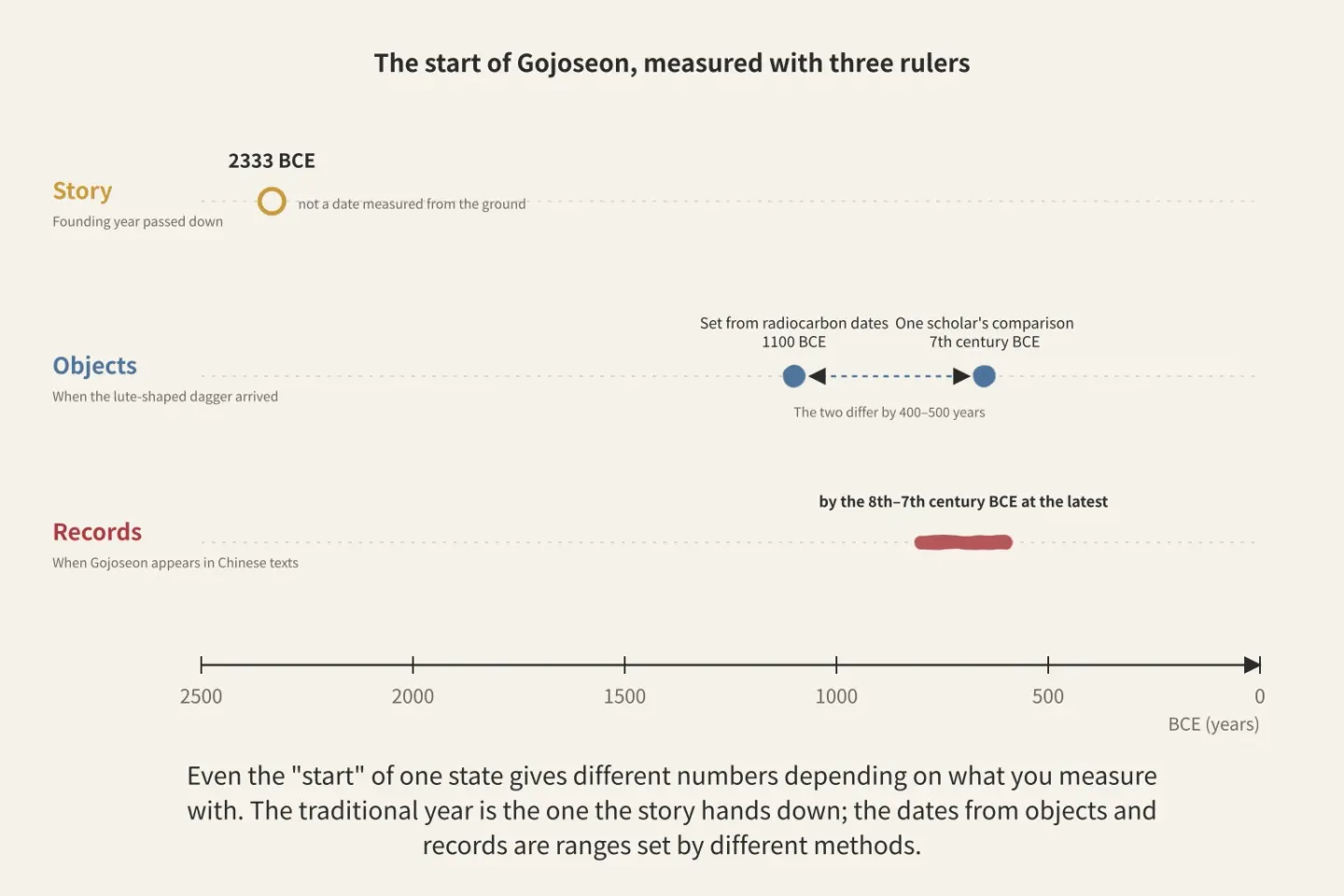
Figure: a diagram Paperis drew from the dates in this article (only the time axis is to scale)
Swords and Large Stones
An old-style bronze sword was found at a site near Shenyang in Liaoning Province, China. Judging by the molds and pottery found with it, it is read to be from around the 10th century BCE (DOI: 10.36274/hakrim.2024.53..7).
The Bronze Age is the period when people began making and using items like swords, mirrors, and axes out of a metal called bronze. The pipa-shaped bronze sword is a bronze sword with a blade shape resembling the traditional stringed instrument pipa, and is found ranging from northeastern China to the Korean Peninsula. The culture that used this sword spread across that vast land for a thousand years from 1000 BCE to around the Common Era (DOI: 10.17320/orient.2014..56.103). Where this culture first arose is also debated. One study suggests that this culture arose from around the 10th century BCE on the eastern plains of the Liao River, a large river flowing through northeastern China, as artisan groups and the ruling class made this sword using bronze-melting technology (DOI: 10.23024/pah.2021..66.45). Another study focuses most on the Shierdaiyingzi culture, which arose around the 9th century BCE further west, in the middle reaches of the Daling River (DOI: 10.17320/orient.2014..56.103).
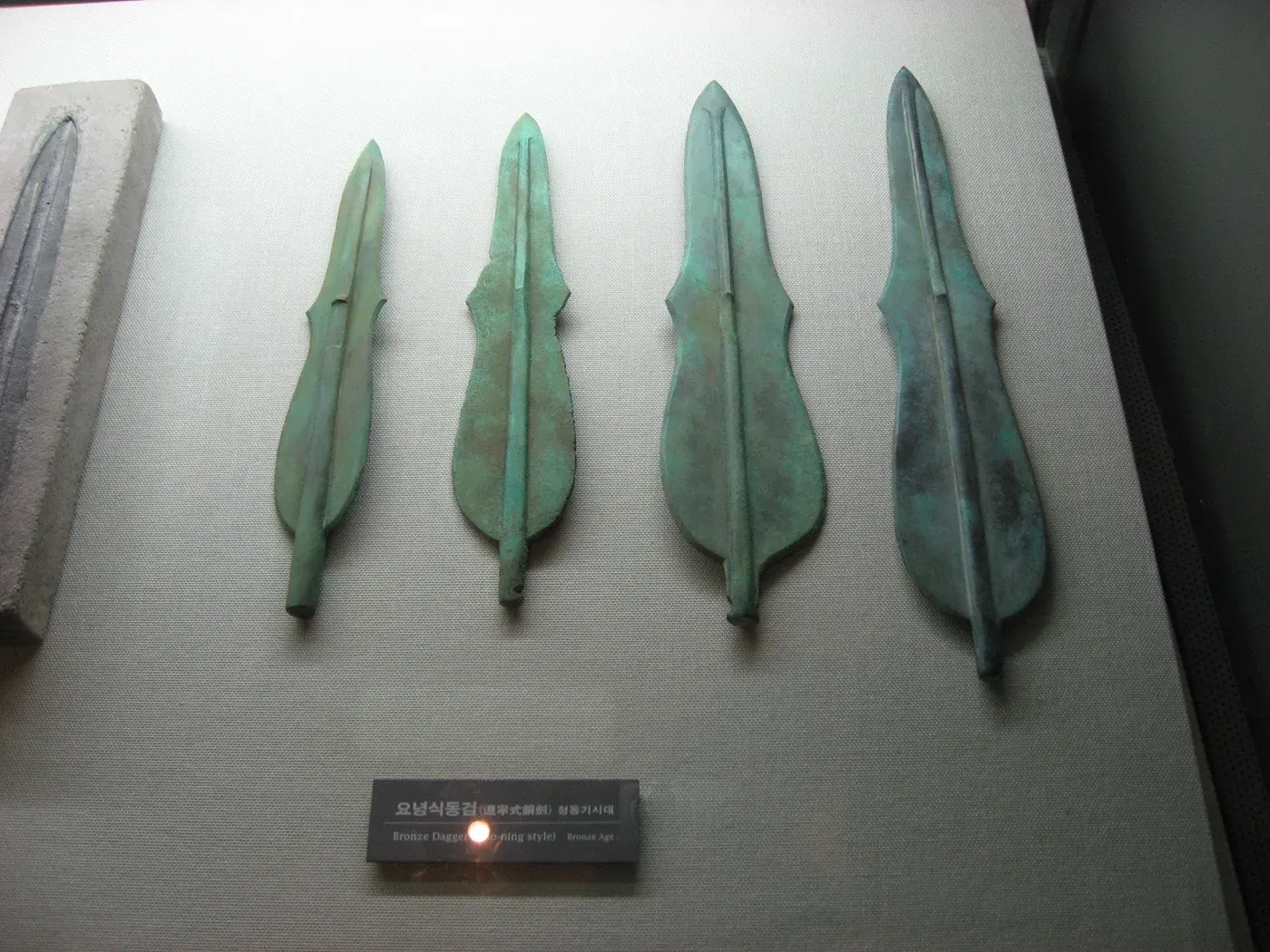
Liaoning-style (lute-shaped) bronze daggers · on display at the National Museum of Korea · photo via Wikimedia Commons (CC BY 2.0)
The time when this sword entered the south-central Korean Peninsula varies greatly depending on the measurement method. Relying on the results of the method of measuring age using carbon remaining in materials like charcoal (radiocarbon dating, covered in "How Do We Know the Past?"), recent academia places the time this sword entered at 1100 BCE. One researcher viewed it as the 7th century BCE by comparing it with bronze vessels found together on the Chinese side, and the two values differ by 400 to 500 years. He concludes that statistical scientific dates are not absolute either, and thus we should be more cautious when reflecting them in archaeological dates (DOI: 10.47417/yar.2018.80.45). The dates of this era should be read not as a single year, but as a range paired with a method.
Dolmens are tombs featuring a large capstone exposed above ground. In Northeast Asia, dolmens first appeared east of the Liao River, specifically in the southern part of Liaodong (DOI: 10.47735/odia.2019.25.1). Most dolmens on the Korean Peninsula are Bronze Age tombs and are concentrated in the west and south along the estuaries of large rivers flowing into the Yellow Sea and the East China Sea (DOI: 10.17746/1563-0110.2017.45.3.106-114). Their numbers vary by compilation. One article states that about 44,000 dolmens were surveyed on the Korean Peninsula alone (DOI: 10.17999/sohe.2022.80.08), while another article states that there are over 30,000 megalithic sites (DOI: 10.17746/1563-0110.2017.45.3.106-114).
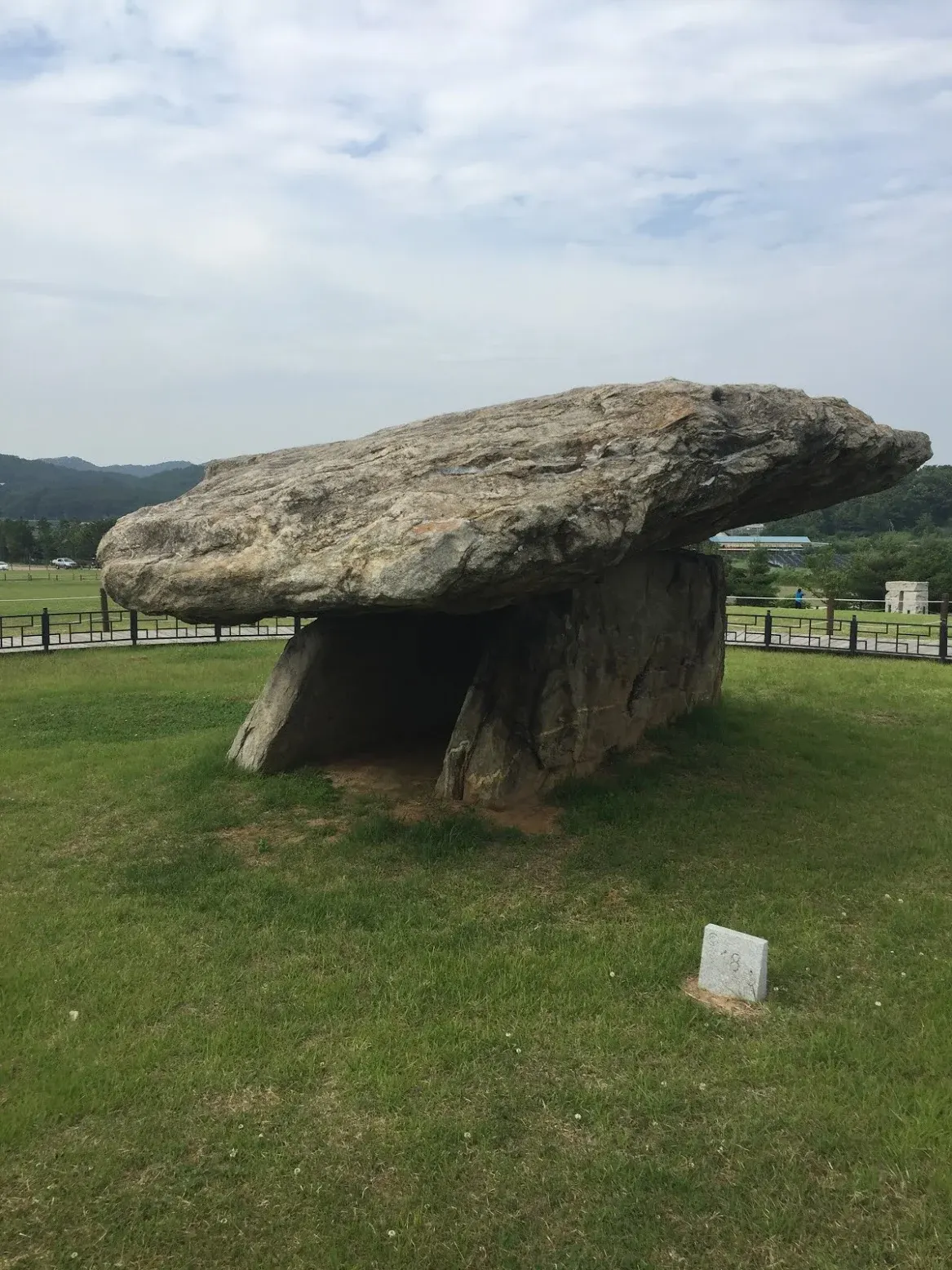
Bugeun-ri dolmen, Ganghwa, Incheon · photo ChongDae, Wikimedia Commons (CC BY-SA 3.0)
Whether dolmens were the tombs of chiefs is debated. One researcher who reviewed middle school textbook descriptions points out that it is difficult to interpret all these numerous dolmens as the tombs of rulers (DOI: 10.17999/sohe.2022.80.08). Another study looking at data from the Gyeongnam region views dolmens surrounded by large cemetery areas as tombs intended for a single chief (DOI: 10.15397/JKBC.2023.33.004.). Yet another study notes the absence of precious bronze goods in very large dolmen cemeteries in Gyeongsang-do, suggesting that rather than the emergence of a ruler, this may have been a community's choice to maintain an egalitarian order (DOI: 10.20457/SHA.69.4). A study that statistically measured dolmen sizes in a region of Gochang, Jeonbuk, read a moderate level of inequality where a few large dolmens stood out but were not overwhelming (DOI: 10.1111/arcm.70161).
Dolmens were not merely tombs. Regarding the concentration of dolmens around river mouths, fields, and pathways, one study interprets them as a device that bundled rice farming, exchange, and rituals into a single landscape (KCI ART003325630).
Signs That a State Emerged
Weapons found in Neolithic sites are bows, specifically stone arrowheads. In the early Bronze Age, stone knives were added to stone arrowheads, and around the 6th century BCE, pipa-shaped bronze spears appeared, forming a set of long-range weapons, close-range short weapons, and long weapons (KCI ART002601359). Relying on the anthropology of war, this researcher suggests that this combination points to warfare organized for shooting from a distance and clashing up close, and that such warfare is only possible in societies with a leader holding coercive power. Therefore, this weapon combination is read as a material sign of having entered the early stage of a state. This combination spread to Liaodong and the Korean Peninsula alongside the fine-dagger culture beginning in the 3rd century BCE (KCI ART002601359).
A state is an organization that governs people, collects taxes, and wields laws and armed force. We cannot directly see that organization in photographs of the underground. What we can see are traces that power concentrated on one side. From the later stage of the pipa-shaped bronze dagger culture, as burial grounds grew, extraordinary leader tombs appeared within them, and the practice of burying weapons and ritual tools together intensified. One study views this as a trace of the growth of leadership power that held both military force and ideology (DOI: 10.35160/sjekh.2025.12.51.115). In the pre-period of the Bronze Age in southern Korea, large houses and small houses were separated by ditches surrounding villages as boundaries, and tombs burying bronze weapons appeared. While viewing this period as a society where vertical ranks emerged, that study considers the upper positions to have been temporarily acquired statuses rather than being inherited (KCI ART003132340).
The researcher on weapon combinations writes that there is no particular disagreement that society entered a complex stage during the Bronze Age. However, they also write themselves that there are limits in proving which artifacts demonstrate this (KCI ART002601359).
Now we look for Gojoseon from the perspective of artifacts. Regarding the late period of Gojoseon, the Dongdaejangzi type in the Liaoxi region and the Zhengjiayaozi type in the Liaodong region receive joint attention (DOI: 10.23024/pah.2023..72.107). One study views the Zhengjiayaozi type, which stretched from the central Liaodong region around the 6th to 4th centuries BCE to present-day northwestern North Korea, as the material culture of Gojoseon (DOI: 10.35160/sjekh.2025.12.51.115). Around that time, swords and mirrors of that lineage suddenly increased in the North Korean region, and one study reads this as the appearance of a force like Gojoseon rising (DOI: 10.52557/tpsh.2024.129.45).
Where Was Gojoseon?
There are four major theories about where the center of Gojoseon was. They are the theory that it was in the Pyongyang area from beginning to end, the migration theory that it moved to Pyongyang from the west or east of the Liao River, the theory that it remained in northeastern China until the end, and the theory that while the Joseon Prefecture—the administrative district established by the later Han Dynasty—was in Pyongyang, Gojoseon's final capital was in Liaodong. During the Goryeo and Joseon periods, the Pyongyang theory was the majority view, but recently, driven by archaeological research, the migration theory has gained traction (DOI: 10.18706/jgds.2024.8.55.171).
The migration theory is based on the record that Jin Kai, a general of the Yan state in China, invaded Liaodong in the early 3rd century BCE, and views that the center moved to Pyongyang at that time. Counterarguments to this theory continue to be raised. One study judges that the invasion weakened Gojoseon but was unrelated to a shift in its center, noting that the record shows the place struck by Yan was the "west," not Gojoseon's center (DOI: 10.23037/dyn.2017..55.002). There are no direct textual materials indicating that the capital was moved, and it is merely guessed from the fact that the same river names appear in both regions (DOI: 10.23024/pah.2023..72.107).
Here, pictures and names clash. Various studies warn that it is academically incorrect to immediately view the entire range where pipa-shaped bronze daggers appear as Gojoseon's territory (KCI ART002062648; KCI ART001460018). This is because multiple groups that used the same knife cannot be assumed to have all belonged to a single state. A single photograph captures one person, but a single type of artifact may have been used together by multiple groups. The same 2015 study considers it unrealistic to pin down the Taedong River area as Gojoseon's western border, or to view it as having encompassed the entirety of Manchuria and the northern Korean Peninsula from beginning to end (KCI ART002062648). Another trap is the possibility that the final capital could be remembered and passed down as the first capital (DOI: 10.18706/jgds.2024.8.55.171).
Wiman Joseon refers to Gojoseon after Wiman, who crossed over from the Yan state, overthrew King Jun of Gojoseon and ruled. One study views that Wiman pulled in Chinese-origin exiles and indigenous Gojoseon factions to overthrow King Jun (DOI: 10.18040/sgs.2025.128.5). While its capital, Wanggeom-seong, is generally seen as present-day Pyongyang, definitive evidence to pin that down has not yet emerged (DOI: 10.23024/pah.2023..72.107).
One study views that Wiman Joseon received the status of an outer vassal from China's Han Dynasty and used that power to expand its influence over surrounding groups, and that this touched off Han's borders, providing the pretext for the war of 109 BCE (DOI: 10.17320/orient.2024..96.215). The Han Dynasty collapsed Gojoseon at the end of this war (KCI ART002782092).
A Ledger from a Tomb in Pyongyang
In 1990, Tomb No. 364 in Jeongbaek-dong, Pyongyang, yielded a copy of the Analects written on bamboo slips, alongside a wooden ledger. The owner of the tomb is presumed to be a low-ranking official of the local government (DOI: 10.15024/00002216). The wooden board was first made known in North Korea in 2006, and it was a household register recording the number of houses in each of the twenty-five counties of the Nakrang Commandery (DOI: 10.22372/ijkh.2017.22.2.5).
The Four Commanderies of Han is the collective name for the four commanderies established by the Han dynasty in that land across 108 BC and the following year after it overthrew Wiman Joseon. The Han dynasty set up the commanderies in 108 BC, and among them, the Hyeondo Commandery was established the following year (DOI: 10.1080/00438243.1992.9980182; KCI ART002782092). The Nakrang Commandery is one of those four. The Nakrang Commandery lasted for roughly 400 years until it fell to Goguryeo in 313 (DOI: 10.1080/00438243.1992.9980182; KCI ART000944436). Lumps of clay stamped with seal impressions of officials ranging from the commandery to county levels were also unearthed, and they encompass nearly every county of the Nakrang Commandery. One study views this as evidence that the commanderies and counties actually functioned (DOI: 10.1163/24689246-00402014).
The location of the Nakrang Commandery has long been disputed. A 1992 study ranks this as the most controversial topic in Korean archaeology and history, noting that despite an abundance of archaeological, textual, and epigraphic evidence, North Korean archaeologists and one South Korean historian reject a Nakrang Commandery inside the Korean Peninsula (DOI: 10.1080/00438243.1992.9980182). This side puts archaeological evidence and excavated documents forward. Researchers on the opposite side reread Chinese historical books and the records of the Samguk Sagi and Samguk Yusa, bring up the criticisms left there by Park Ji-won, who wrote the Jeohwa Ilgi in 1780, and view the idea that the Four Commanderies of Han were located inside the Korean Peninsula as a fixed perception that has bound ancient history research for over 100 years (KCI ART002894474).
Modern circumstances are entangled in both interpretations. During the Japanese colonial period, it was taught that the Nakrang Commandery, centered on Pyongyang, ruled the northern Korean Peninsula for some 420 years, and one study views this as education meant to make people accept colonial rule as their destiny. According to the same study, around 1950 the North Korean historical academic community adopted the hypothesis placing the Four Commanderies of Han in Liaodong as the established theory even though it was open to debate, and the researcher interprets this as stemming from an aversion to the idea that the new capital, Pyongyang, was the center of a former "colony." That study evaluates this as failing to escape the "territorial purism" of modern nationalism (DOI: 10.21490/jskh.2021.5.83.7). The location of the Four Commanderies of Han is a problem that requires examining both the evidence and the circumstances of the era in which that evidence was read.
The influence of the Nakrang Commandery is also disputed. From the late 2nd century BC to the early 1st century BC, a new culture appeared all at once in the southeastern land of the Korean Peninsula that later became the foundation of Silla, and past research generally viewed this as the influence of Nakrang. A recent study argues that iron-making technology and new pottery were brought down south by Gojoseon refugees who came down just before the Nakrang Commandery was established (DOI: 10.47417/yar.2026.106.103). After 313, when Nakrang and Daebang fell to Goguryeo, many people from those places came down to Baekje and lent strength to Baekje's growth (KCI ART000944436).
Buyeo and the Southern Countries
Buyeo is a country located in present-day northeastern China, in the middle reaches of the northward-flowing Songhua River. As early as the 2nd century BCE, it grew into an early state along the middle reaches of that river (DOI: 10.52557/tpsh.2026.134.5). Buyeo had a dual structure in which the king directly governed the capital and its surroundings, while the outer regions were shared among various influential figures along roads extending in all directions from the capital, with the central government handling tax collection and foreign relations (DOI: 10.37331/JKAH.2019.12.96.207). Wall-building technology, iron weapons, and horse harnesses demonstrate its power. Goguryeo and Baekje put forward Buyeo as the root of their lineage (DOI: 10.52557/tpsh.2026.134.5). The Buyeo royal family surrendered the country to Goguryeo in 494 (DOI: 10.36093/ks.2015..28.001).
Samhan is a collective term for Mahan, Jinhan, and Byeonhan in the southern part of the Korean Peninsula, each of which consisted of a collection of small countries. Gaya is a collective term for various small countries that grew up on the land of Byeonhan. Jinhan and Byeonhan each consisted of twelve countries, serving as the preceding stages and foundations for Silla and Gaya, respectively (DOI: 10.47417/yar.2026.106.143). Mahan is connected to Baekje (DOI: 10.17999/sohe.2022.80.08). China's "Records of the Three Kingdoms" records that the people of Jinhan were refugees who fled the Qin Dynasty, but one study views this as a China-centric misunderstanding. That study views that Gojoseon refugees descended south in the late 2nd century BCE when Wiman Joseon collapsed, that among them were many Chinese-origin refugees from the Yan and Qi regions, and that Jinhan was founded when these people combined with the natives (DOI: 10.47417/yar.2026.106.143).
The founding years commonly cited for Goguryeo, Baekje, and Silla—37 BCE, 18 BCE, and 57 BCE—are the years transmitted by the "History of the Three Kingdoms" (KCI ART001388965). Comparing them with other evidence adds to the picture. For Goguryeo, China's "Book of Han" records that in 12 CE, "Chumou, the Marquis of Goguryeo" was killed by a general sent by Wang Mang of China's Xin Dynasty, and one study views this Chu as the founder King Dongmyeong (DOI: 10.17751/DHR.140.1). For Baekje, archaeological interpretations date ruins and artifacts showing the emergence of a state in the Han River basin mostly to the 2nd century onward (DOI: 10.23024/pah.2007..27.5).
The founding stories were also polished later on. The story of Jumong, the founder of Goguryeo, appears on the Gwanggaeto Stele, a monument honoring King Gwanggaeto of Goguryeo from the 5th century, and one study views this as the official stance put forward by the country to revive weakened royal authority (KCI ART001335457). Just like the Dangun story, founding myths simultaneously show the circumstances of the time when they were put forward.
Gaya is commonly explained as a confederacy. A confederacy is a relationship in which multiple countries are tied together without merging into one. One study views that a confederacy exists only when a representative country leads foreign diplomacy and military affairs while keeping its hands out of the internal affairs of each country, and considers that records of having formed such a confederacy are absent from both domestic and foreign literature, with archaeological evidence also lacking. However, Geumgwan Gaya is viewed as having equipped a state system earlier than other places (DOI: 10.17842/jsa.2023..87.5). Conversely, there is a study that views Sogaya in the 5th and 6th centuries as a confederacy and divides the transition of tombs in the Goseong area into three stages (KCI ART002226151), as well as a study that views Geumgwan Gaya as having handled the external relations of the confederacy in the 3rd and 4th centuries (KCI ART001736063). Whether Gaya was a confederacy has not yet been settled.
How Far Can We Trust the Early Records of the Samguk Sagi?
According to a 2009 study, general histories of Korean history often skipped over Silla's history from its founder Hyeokgeose in 57 BC straight to King Naemul in the 4th century, skipped Goguryeo from its founder King Dongmyeong straight to the 6th king, King Taejo, and skipped Baekje from its founder King Onjo straight to King Goi. That study suggests this happened because distrust of the early records in the Samguk Sagi was accepted as established doctrine (KCI ART001388965).
One study arguing that we should actively trust the early records strongly criticizes the idea that this distrust stems from the Japanese historian Tsuda Sokichi's claim that records prior to King Naemul of Silla were fabricated (DOI: 10.35160/sjekh.2018.04.28.7). That 2009 study argues that this skepticism ultimately re-read the early records to match the "Records of the Dongyi" in China's Records of the Three Kingdoms, and insists that we should interpret the early records actively (KCI ART001388965).
There are also points raised from the opposite side. A study covering the founding of Baekje notes that there are clearly accounts that are hard to take at face value—such as reports that King On조's founder generation already moved the capital, set land boundaries, and incorporated Mahan—and views these as likely being later events pulled backward into the past (DOI: 10.23024/pah.2007..27.5). Therefore, regarding the founding of Baekje, it summarizes that one side shows deep trust while the other shows thick distrust, and no conclusion has been reached yet (DOI: 10.23024/pah.2007..27.5).
There is also the path of comparing records against other records. A 1979 study finds that Baekje accounts from the late 4th to early 5th centuries—which are later than the early records—largely match the Gwanggaeto Stele, Chinese history books, and Japan's Nihon Shoki, though questions remain regarding the reign dates of three kings in the early 5th century (DOI: 10.1353/ks.1979.0005). Rather than accepting or discarding the Samguk Sagi wholesale, this approach compares each individual account against other records and artifacts.
Why Did Countries Come to Be?
Looking at villages in the Han River basin and the Hwaseong area, a doctoral dissertation suggests that during the Mahan period (100 BCE to 300 CE), leadership roles were multiple and side-by-side, with few traces of inherited hierarchy (DOI: 10.17863/cam.53785). Moving into early Baekje, small groups that hosted feasts together appear in specific places, and that research suggests these groups grew as some local leaders took hold of long-distance trade with the Chinese mainland and diplomatic goods. Even so, the paper sees early Baekje not as a country expanded by a single boss, but as a loose net of multiple villages following one another of their own accord (DOI: 10.17863/cam.53785). Another study looking at the same region around 200–400 CE points to traces of villages building defensive facilities and preparing for war, suggesting that standing against hostile neighbors boosted the power of leaders. Those hostile forces are presumed to have been the Lelang Commandery and Goguryeo mentioned in records (DOI: 10.1515/opar-2022-0313).
On the Silla side, two studies examining the Yeongnam region cross-checked the war accounts in the Silla Annals of the Samguk Sagi (History of the Three Kingdoms) with weapons excavated from tombs in that area. They compared how the proportion and number of weapons changed between the 1st and 5th centuries against the war accounts, concluding that war played a very important part in Silla growing into a state (DOI: 10.1163/156852300760222100; DOI: 10.23024/pah.2006..25.623). This conclusion relies on weapon statistics from one region's tombs, and the 2006 study adds that we must pay attention not only to things brought in from the outside, but also to internal developments within native society (DOI: 10.23024/pah.2006..25.623).
There are other pictures, too. A study examining Silla's status system argues that such a status order would be hard to arise unless the various small countries of Jinhan federated on equal terms to found Silla, viewing Silla as a country not formed by conquest (DOI: 10.18622/kher.2018.06.146.173).
For the same villages of the Han River, trade-gripping leaders, a loose net, and outside threats are talked about side by side, and for the same Silla, war and equal union pull apart. The reasons why the first countries came to be do not converge into one. Returning to the photographs in the drawer, what we have are several nameless photographs, a few names written down later, and various interpretations connecting the space between them. Asking what each interpretation took as its evidence is the primer for listening to this era.
Where to Look Further
The methods this article relies on—namely, evaluating whether records are reliable and dating objects using carbon—are covered in more detail in the method guides of the "How Do We Know the Past?" series. When and how writing systems first appeared, what cities and states are, and how empires that bound multiple peoples under a single center operated continue through the writing, "Cities and States", and empire guides of the "Big Words of History" series.
Source Papers
- "Webtoon Adaptation of the Dangun Myth in Samguk Yusa and Its Significance: Focusing on the Ungnyeo Narrative" (2025) — DOI: 10.18628/urimal.107..202512.415 — The original Ungnyeo narrative features the humanization trial of the bear-tiger dichotomy and the transformation motif of a beast turning into a human.
- "A Study on the Social Philosophy of the Dangun Myth" (2022) — KCI ART002865669 — Hwanung sought to realize heaven on earth, and the bear-woman overcame herself in a cave, philosophically reading the narrative of the Dangun myth.
- "Rewriting the Dangun Myth on the Internet: Focusing on the 'Garlic Meme'" (2024) — DOI: 10.17326/jhsnu.81.4.202411.153 — In school education, Dangun is regarded as the "progenitor of the nation," and the garlic meme builds South Korean identity based on this.
- "Dangun, from Myth to History" (2022) — DOI: 10.23037/dyn.2022..76.004 — Dangun's status shifted from foundation progenitor -> local deity -> state progenitor -> modern national progenitor, transmission reflects the changing environment of the times, and the late 13th-century Samguk Yusa and Jewang Ungi transmit by citing materials that do not survive today.
- "Another Dangun Myth of Seoha and Biseogap" (2023) — DOI: 10.18496/kjhr.2023.5.80.131 — The lineages of the Samguk Yusa Gogi (Hwanung = Ungnyeo) and the Jewang Ungi citation record (granddaughter = Dansu god) differ from each other.
- "Notes and Questions Concerning the Samguk Sagi's Chronology of Paekche's Kings Chŏnji, Kuisin, and Piyu" (1979) — DOI: 10.1353/ks.1979.0005 — Kim Bu-sik's writing in the Samguk Sagi generally aligns with the Gwanggaeto Stele, Chinese historical books, and the Nihon Shoki, but questions remain regarding the chronology of the three kings in the early 5th century.
- "The Early Records of the Samguk Sagi and a Reexamination of Early Three Kingdoms History" (2009) — KCI ART001388965 — General introductions skipped early Three Kingdoms history due to skepticism toward early records, criticizing this skepticism as relying on the Sanguozhi Dongyi-zhuan and arguing for active interpretation.
- "An Exploration of Gojoseon's Material Culture and Identity: Focusing on Single-Lugs Bronze Dagger Culture and the Gojoseon Period Theory" (2025) — DOI: 10.35160/sjekh.2025.12.51.115 — Advanced literature related to Gojoseon was later rearranged and compressed, making a critical approach essential, and sees the development of weapon + ritual object elite tombs and the Zhengjiawazi type (circa 6th to 4th centuries BCE) as Gojoseon material culture (author's judgment).
- "New Materials on Early Pipa-Shaped Bronze Dagger Sites in the Liaodong Region: Focusing on the Status and Cultural Characteristics of the Shenyang Xinmin Beiwai Site" (2024) — DOI: 10.36274/hakrim.2024.53..7 — The early-style pipa-shaped bronze dagger from the Shenyang Xinmin Beiwai site dates to around the 10th century BCE based on associated artifacts.
- "Bronze Culture of the Northeast China Region and Changes in the Location of Gojoseon" (2014) — DOI: 10.17320/orient.2014..56.103 — Pipa-shaped bronze dagger culture was distributed from Northeast China to the Korean Peninsula during the 1000s BCE, with the Shierdaitaiyingzi culture in the middle Daling River valley around the 9th century BCE being of primary interest.
- "Bronze Networks and Exchange of Pipa-Shaped Bronze Dagger Culture in the Liaodong Region" (2021) — DOI: 10.23024/pah.2021..66.45 — Pipa-shaped bronze dagger culture was formed east of the Liao River plain from around the 10th century BCE through the smelting technology of artisan groups and elites.
- "A Rethinking of Radiocarbon Dates for the Bronze Age Based on the Appearance Date of Pipa-Shaped Bronze Daggers" (2018) — DOI: 10.47417/yar.2018.80.45 — Relying on radiocarbon dating places the inflow into the Korean Peninsula at 1100 BCE, whereas the author's cross-dating places it at the 7th century BCE, a discrepancy of 400 to 500 years, suggesting caution in reflecting scientific dates.
- "Representation of the Northeast Asian Dolmen -Tradition and Transformation -" (2019) — DOI: 10.47735/odia.2019.25.1 — Dolmens are tombs with capstones exposed above ground and first appeared in southern Liaodong in Northeast Asia.
- "The Megaliths of Korea and Japan: An Analysis of Origins and Functions" (2017) — DOI: 10.17746/1563-0110.2017.45.3.106-114 — Korean megalithic sites number over 30,000, concentrated in western and southern river estuaries, and are mostly Bronze Age tombs.
- "A Review of the Description of the Section ‘Prehistoric Culture and the Formation of an Ancient State’ in the Textbook “Middle School History 2” Published in 2020" (2022) — DOI: 10.17999/sohe.2022.80.08 — Rice farming evidence is abundant in the Neolithic, about 44,000 dolmens have been surveyed on the Korean Peninsula alone making it difficult to view all as ruler tombs, and the relationship between Mahan and Baekje should be described.
- "Review of Developmental Stages of Stratified Society in the Bronze Age: Focusing on Data from the Gyeongnam Region" (2023) — DOI: 10.15397/JKBC.2023.33.004. — Large tomb-area dolmens are individual tombs of single chiefs, symbolizing stratification.
- "The Transition Process from Bronze Age Society to Iron Age Society" (2019) — DOI: 10.20457/SHA.69.4 — Oversized dolmen tomb areas in Gyeongsang-do lacked bronze prestige goods, so they may have been a method to protect egalitarian order rather than the emergence of rulers.
- "Quantitative Assessment of Social Stratification and Inequality in the Late Bronze Age and Early Iron Age South Korea" (2026) — DOI: 10.1111/arcm.70161 — Dolmen volume distribution in southeastern Gochang shows moderate inequality (Gini ≈0.537).
- "Nature and Significance of Maritime Exchange in the Circum-Yellow Sea Region during the Bronze Age: Focusing on Paddy Rice Farming and Dolmens" (2026) — KCI ART003325630 — Dolmens served as a device linking production, exchange, and rituals.
- "Weapon Combinations, Warfare Types, and Social Types from the Bronze to Early Iron Age" (2020) — KCI ART002601359 — There is no disagreement on entry into a complex society, but representative materials have limitations, and the combination of ranged + close-range weapons from around the 6th century BCE is viewed as material representation of entry into the early state stage.
- "Social Structure of the Early Bronze Age in Southern Korea" (2024) — KCI ART003132340 — Upper and general classes are inferred from residential differentiation inside and outside the hwanho (ditched enclosures) and bronze weapon burial tombs, but upper status is a temporary achieved status.
- "Recent Perspectives on the Transition of Gojoseon's Center" (2023) — DOI: 10.23024/pah.2023..72.107 — Gojoseon's early period can be dated at least as early as the 8th to 7th centuries BCE when it appeared in Chinese literature, the Dongdaizhangzi and Zhengjiawazi types attract attention as late center candidates, arguments against the migration theory continue, there is no direct textual basis for a capital relocation, and Wanggeom-seong = Pyongyang is common but lacks definitive proof.
- "The Diffusion of Pipa-Shaped Bronze Dagger Culture in the North Korean Region and Its Background: From the Perspectives of Climate, Metal Civilization, and Exchange" (2024) — DOI: 10.52557/tpsh.2024.129.45 — The sharp increase in Liaozhong-style bronze daggers and mirrors reflects the rise of polities like Gojoseon.
- "Achievements and Tasks in the Study of Gojoseon's Center and Territory" (2024) — DOI: 10.18706/jgds.2024.8.55.171 — There are four theories on the center, Goryeo and Joseon texts mostly favor the Pyongyang theory, recent migration theories are influential, and the final capital may have been transmitted as the first capital.
- "Critical Review of the Gojoseon Migration Theory" (2017) — DOI: 10.23037/dyn.2017..55.002 — In the Weilüe, Yan's invasion target was Gojoseon's "West," so it is unrelated to the relocation of the center.
- "Issues and Tasks Regarding the Location Problem of Gojoseon's Center" (2015) — KCI ART002062648 — Viewing the entire pipa-shaped bronze dagger cultural sphere as Gojoseon's political territory is academically inappropriate, and neither the Daedong River western-system theory nor the entire Manchuria theory is realistic.
- "A Study on the Location and Center Problem of Gojoseon" (2010) — KCI ART001460018 — It is difficult to consider all sites within the range of pipa-shaped bronze dagger culture as belonging to Gojoseon.
- "The Relationship Between Gojoseon and Jin, and the Nature of Liaodong Outer Commandery" (2025) — DOI: 10.18040/sgs.2025.128.5 — Wiman absorbed Chinese refugees and Gojoseon indigenous forces, overthrowing King Jun and taking power.
- "The Driving Force of Buyeo's Foundation and Its Relationship with Gojoseon" (2024) — DOI: 10.17320/orient.2024..96.215 — Wiman Joseon expanded its power with the status of a Han vassal state, challenged Han's borders, and provided the pretext for the war of 109 BCE.
- "[Research Note] Historical Character of the Analects Bamboo Slips Excavated from the Pyongyang Jeongbaek-dong District" (2015) — DOI: 10.15024/00002216 — Analects bamboo slips were excavated in 1990 from Tomb No. 364 in Jeongbaek-dong along with Lelang Commandery household register wooden tablets, and the tomb owner was a low-ranking Lelang Commandery official.
- "A New Approach to the Household Register of Lelang Commandery" (2017) — DOI: 10.22372/ijkh.2017.22.2.5 — The Lelang Commandery household register disclosed in North Korea in 2006 contains the number of households in twenty-five prefectures.
- "Culture contact and culture change: The Korean peninsula and its relations with the Han Dynasty commandery of Lelang" (1992) — DOI: 10.1080/00438243.1992.9980182 — Established in 108 BCE and lasting for 400 years, Lelang Commandery is the most controversial topic, with North Korean archaeologists and Yoon Nae-hyun denying its presence on the Korean Peninsula despite much counter-evidence.
- "The Foundation of Goguryeo and Xuantu Commandery" (2021) — KCI ART002782092 — Xuantu Commandery was established in 107 BCE, one year after Gojoseon's fall, and the Samguk Sagi's foundation date of 37 BCE is likely related to the year Han elevated Guri to "King."
- "The Growth of Baekje and Trends in Relations with Chinese Commandery-Prefectures" (2004) — KCI ART000944436 — Lelang and Daifang were conquered by Goguryeo in 313 CE, and their migrants contributed to Baekje's development.
- "Using Excavated Slips to Look at Effective Governance of the Northern Frontier during the Han Dynasty—The Lelang Commandery in Han Slips" (2021) — DOI: 10.1163/24689246-00402014 — Official seal impressions spanning nearly all prefectures of Lelang Commandery show that commandery-prefecture administration actually functioned.
- "Consideration and Correction of Gojoseon and Goguryeo's Territories" (2022) — KCI ART002894474 — Criticizes the theory of Han commanderies existing within the Korean Peninsula as a fixed perception and cites Park Ji-won's criticism in Jeohang ilgi.
- "“Korean People’s History Lecture”(1950) in North Korea and History Education" (2021) — DOI: 10.21490/jskh.2021.5.83.7 — Japanese imperialism taught over 420 years of Lelang Commandery rule to make colonial rule seem fateful, and around 1950 North Korea adopted the Liaodong-Lelang theory as established fact.
- "The Formation of Jinhan and Migrant Groups" (2026) — DOI: 10.47417/yar.2026.106.103 — Jinhan's iron-making technology and soft pottery were not indirect influences from Lelang, but were brought by Gojoseon refugees who moved south just before the establishment of Lelang Commandery.
- "The Legacy of Buyeo and Its Succession" (2026) — DOI: 10.52557/tpsh.2026.134.5 — Buyeo was an early state in the middle Songhua River as early as the 2nd century BCE, featuring walled towns, iron weapons, and horse gear, which Goguryeo and Baekje put forward as the origin of their lineage.
- "Buyeo's State Structure and the Four Outlying Roads" (2024) — DOI: 10.37331/JKAH.2019.12.96.207 — A dual power structure of direct rule in the capital-centric region and local administration of the four outlying roads managed by high officials.
- "The Formation and Transformation of Goguryeo's Foundation Myth" (2015) — DOI: 10.36093/ks.2015..28.001 — The Buyeo royal family surrendered to Goguryeo in 494 CE.
- "Literary controversies regarding the Origins and Complexification of Jinhan and Byeonhan" (2026) — DOI: 10.47417/yar.2026.106.143 — Jinhan and Byeonhan were twelve states each and the precursors to Silla and Gaya, the theory that Jinhan originated from Jin refugees is a Sinocentric misunderstanding, and Jinhan was formed through the integration of Gojoseon refugees who moved south in the late 2nd century BCE (including many Chinese refugees of Yan and Qi origin) and indigenous people.
- "Reading Chinese Original Historical Sources Reflected in the Early Records of the Samguk Sagi" (2020) — DOI: 10.17751/DHR.140.1 — "Goguryeo Marquis Chu," who was executed by Yan Wu in 12 CE, is a real historical event and it is reasonable to view him as the founding monarch King Jumong.
- "The Foundation Period of Baekje and Its Main Ruling Forces" (2007) — DOI: 10.23024/pah.2007..27.5 — Early records contain retroactively applied accounts, sites of state emergence in the Han River basin are mostly from the 2nd century onward, and there likely was restraint from Lelang Commandery.
- "The Development and Transformation of Goguryeo's Foundation Myth" (2009) — KCI ART001335457 — The Jumong myth appears on the Gwanggaeto Stele in the 5th century and reveals the official stance to restore diminished royal authority.
- "A Study of the Gaya Confederation" (2023) — DOI: 10.17842/jsa.2023..87.5 — Records and archaeological evidence that Gaya formed a confederation are lacking, and Geumgwan Gaya completed a state system early.
- "A Study of the 5th-6th Century Sograeya Confederation through Burial Systems" (2017) — KCI ART002226151 — Identifies three stages of transition in the Sograeya confederation through burial systems.
- "Neutrality of Ancient Trading Markets and the Formation of a Confederation: Focusing on the 3rd-4th Century Gaya Confederation" (2012) — KCI ART001736063 — Geumgwan Gaya controlled the confederation's external negotiations and guaranteed the neutrality of trading markets.
- "Perspectives on Silla's Early Park Clan King Era" (2018) — DOI: 10.35160/sjekh.2018.04.28.7 — Tsuda Sokichi claimed the records in the Silla Annals prior to King Naemul were fabrications, and the author criticizes this view.
- "A TEST OF INCREASING WARFARE IN THE SAMGUK SAGI AGAINST THE ARCHAEOLOGICAL REMAINS IN YONGNAM, SOUTH KOREA" (2000) — DOI: 10.1163/156852300760222100 — Weapon statistics from Yeongnam tombs and Samguk Sagi war accounts strongly support the premise that warfare was a core factor in Silla state formation.
- "Silla's State Formation as Seen through Samguk Sagi's Silla Annals and Archaeological Data from the Yeongnam Region: Focusing on the Role of Warfare" (2006) — DOI: 10.23024/pah.2006..25.623 — Discusses the important role of warfare by linking the ratio and number of weapons from the 1st to 5th centuries with war accounts, while also calling for attention to the indigenous population's internal development.
- "The Framework of Silla's State Formation Reflected in Ruling Class Organization" (2018) — DOI: 10.18622/kher.2018.06.146.173 — The bone-rank system would be difficult to establish unless Jinhan minor states confederated on equal terms to found Silla, meaning Silla was not a state formed by conquest.
- "Worlds of Authority, Communities of Practice, and State Formation in Early 1st Millennium Central Korea" (2019) — DOI: 10.17863/cam.53785 — (Ph.D. dissertation) Mahan (100 BCE–300 CE) featured coexisting roles among multiple leaders, and early Baekje grew as a feasting community of leaders who monopolized long-distance trade and diplomatic goods, but appears to be a voluntary decentralized network.
- "Leadership in the Emergent Baekje State: State Formation in Central-Western Korea (ca. 200–400 CE)" (2023) — DOI: 10.1515/opar-2022-0313 — Hostile interactions amplified social differentiation, and communities reorganized into a state system in the face of external threats (likely Lelang Commandery and Goguryeo).
Sources (41)
- 『삼국유사』속 단군 신화의 웹툰화와 그 의미 - 웅녀 서사를 중심으로DOI 10.18628/urimal.107..202512.415
- 인터넷상의 단군신화 다시 쓰기-‘마늘 밈’을 중심으로DOI 10.17326/jhsnu.81.4.202411.153
- 단군, 신화에서 역사로DOI 10.23037/dyn.2022..76.004
- 서하와 비서갑의 또 다른 단군신화DOI 10.18496/kjhr.2023.5.80.131
- Notes and Questions Concerning the Samguk Sagi's Chronology of Paekche's Kings Chŏnji, Kuisin, and PiyuDOI 10.1353/ks.1979.0005
- 고조선의 물질문화와 정체성에 대한 탐색 -단경식동검문화와 고조선시대론을 중심으로-DOI 10.35160/sjekh.2025.12.51.115
- 요동지역 초기 비파형동검유적의 신자료 -신민 북외유적의 현황과 문화성격을 중심으로-DOI 10.36274/hakrim.2024.53..7
- 中國 東北地域의 靑銅器文化와 古朝鮮의 位置 變動DOI 10.17320/orient.2014..56.103
- 요동지역 비파형동검문화의 청동 네트워크와 교류DOI 10.23024/pah.2021..66.45
- 비파형동검 출현연대로 본 청동기시대 탄소14연대 재고DOI 10.47417/yar.2018.80.45
- Representation of the Northeast Asian Dolmen -Tradition and TransformationDOI 10.47735/odia.2019.25.1
- The Megaliths of Korea and Japan: An Analysis of Origins and FunctionsDOI 10.17746/1563-0110.2017.45.3.106-114
- A Review of the Description of the Section ‘Prehistoric Culture and the Formation of an Ancient State’ in the Textbook 『Middle School History 2』 Published in 2020DOI 10.17999/sohe.2022.80.08
- 청동기시대 계층사회의 발전 단계 검토 -경남지역 자료를 중심으로DOI 10.15397/jkbc.2023.33.004
- 청동기사회에서 철기사회로의 진행과정DOI 10.20457/sha.69.4
- Quantitative Assessment of Social Stratification and Inequality in the Late Bronze Age and Early Iron Age South KoreaDOI 10.1111/arcm.70161
- 고조선 중심지의 변천을 바라보는 최근 시각DOI 10.23024/pah.2023..72.107
- 북한지역 비파형동검문화의 확산과 그 배경 -기후‧금속문명‧교류 관점에서DOI 10.52557/tpsh.2024.129.45
- 고조선 중심지 및 강역 연구의 성과와 과제DOI 10.18706/jgds.2024.8.55.171
- 고조선 이동설에 대한 비판적 검토DOI 10.23037/dyn.2017..55.002
- 고조선과 진의 관계와 요동외요의 성격DOI 10.18040/sgs.2025.128.5
- 부여 건국의 動因과 對고조선 관계DOI 10.17320/orient.2024..96.215
- [研究ノート] 平壌楽浪地区出土『論語』竹簡の歴史的性格DOI 10.15024/00002216
- A New Approach to the Household Register of Lelang CommanderyDOI 10.22372/ijkh.2017.22.2.5
- Culture contact and culture change: The Korean peninsula and its relations with the Han Dynasty commandery of LelangDOI 10.1080/00438243.1992.9980182
- Using Excavated Slips to Look at Effective Governance of the Northern Frontier during the Han Dynasty—The Lelang Commandery in Han SlipsDOI 10.1163/24689246-00402014
- Korean People’s History LectureDOI 10.21490/jskh.2021.5.83.7
- The Formation of Jinhan and Migrant GroupsDOI 10.47417/yar.2026.106.103
- The Legacy of Buyeo and Its SuccessionDOI 10.52557/tpsh.2026.134.5
- 부여의 국가구조와 四出道DOI 10.37331/jkah.2019.12.96.207
- 고구려 건국신화의 형성과 변용DOI 10.36093/ks.2015..28.001
- Literary controversies regarding the Origins and Complexification of Jinhan and ByeonhanDOI 10.47417/yar.2026.106.143
- 『삼국사기』 초기기록에 반영된 중국계 原典 사료의 讀法DOI 10.17751/dhr.140.1
- 백제의 건국 시기와 주체세력DOI 10.23024/pah.2007..27.5
- 가야 연맹체의 연구DOI 10.17842/jsa.2023..87.5
- 신라 초기 박씨왕 시대를 보는 눈DOI 10.35160/sjekh.2018.04.28.7
- A TEST OF INCREASING WARFARE IN THE SAMGUK SAGI AGAINST THE ARCHAEOLOGICAL REMAINS IN YONGNAM, SOUTH KOREADOI 10.1163/156852300760222100
- 삼국사기 신라본기와 영남지역 고고학 자료를 통해 본 신라의 국가형성:전쟁의 역할을 중심으로DOI 10.23024/pah.2006..25.623
- 支配層 編制에 나타난 新羅의 國家形成 構圖DOI 10.18622/kher.2018.06.146.173
- Worlds of Authority, Communities of Practice, and State Formation in Early 1st Millennium Central KoreaDOI 10.17863/cam.53785
- Leadership in the Emergent Baekje State: State Formation in Central-Western Korea (ca. 200–400 CE)DOI 10.1515/opar-2022-0313