
Paperis Articles
Jury Trials — Twelve Chairs
The American jury and Duncan v. Louisiana, the vanishing trial, Europe's mixed tribunals, and South Korea's citizen participation trials
Your field's papers, as audio
Pick your fields and journals — Paperis summarizes the key papers and turns them into audio. Listen on your commute.
Start Paperis free →Jury Trials — Twelve Chairs
The Trial with an Empty Jury Box
On October 18, 1966, 19-year-old Gary Duncan was driving down Route 23 in Plaquemines Parish in southern Louisiana. On the side of the road, two of his younger cousins were talking with four white boys. The two cousins, who were Black, had recently transferred to a previously all-white high school and had stated that there had been racial issues at the school. Duncan stopped his car, walked over, and tried to get his cousins into the car to leave (391 U.S. 145).
The dispute arose the very next moment. The white side testified that just before getting into the car, Duncan had struck one of the boys on the elbow, while the Black side testified that he had not struck him, merely touched him. Duncan was put on trial for simple assault. Louisiana law classified this offense as a misdemeanor and set a maximum penalty of two years in prison and a 300-dollar fine (391 U.S. 145).
Duncan requested a trial where citizens decide whether a person is guilty, and the judge refused. This was because the Louisiana Constitution at the time allowed such trials only in cases involving the death penalty or hard labor imprisonment. The judge alone listened to the testimony and determined him guilty, and Duncan was sentenced to 60 days in prison and a 150-dollar fine (391 U.S. 145). This case made its way up to the US Supreme Court in 1968.
What was empty in Duncan's courtroom was the seats where citizens sit. This article follows those seats, the twelve chairs. This article is written from the perspective of November 2026. It focuses on the United States and covers the system in which citizens determine the outcome of a criminal trial, while comparisons with other methods in Europe and South Korea's system will be examined in the final two sections. This article explains the structure of the system, and it is not a text that argues which country's method is better or guides what to do in any specific case.
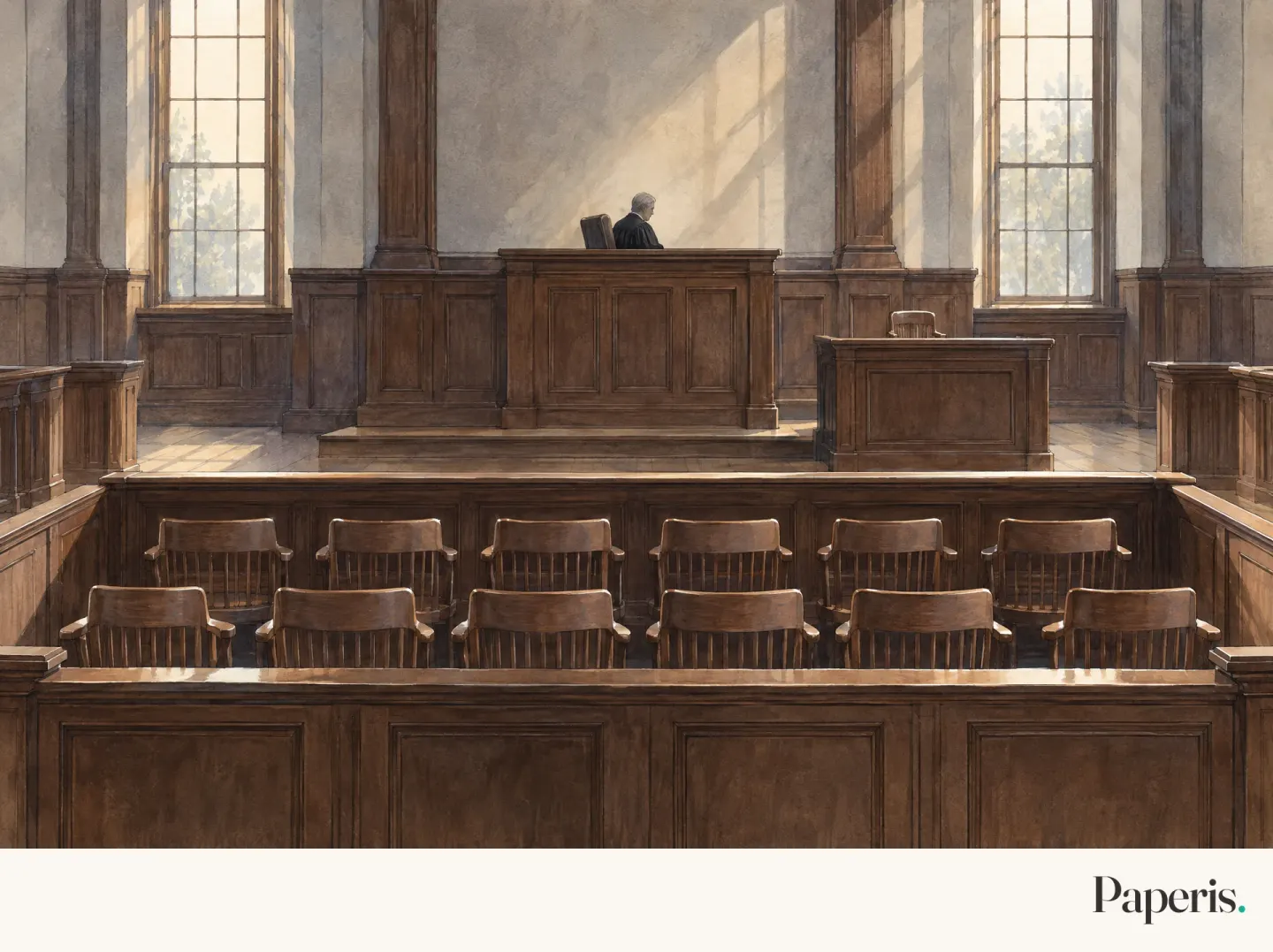
Figure: A courtroom with the citizens’ seats empty
What Twelve People Do
In the 18th century, English jurist Blackstone called the requirement that twelve unbiased neighbors chosen from the community must all agree for an accusation to be confirmed as fact a barrier placed between the people's liberty and the king's power. The US Supreme Court copied that very passage into its opinion in the Duncan case (391 U.S. 145). Twelve chairs are seats from that long ago.
Figure: English jurist William Blackstone, painted by Thomas Gainsborough (1774) · Public domain, via Wikimedia Commons
A juror is a person chosen from among citizens who do not practice law as a profession, who listens to evidence and arguments in a trial and renders a judgment on the facts (whether someone is guilty or not in a criminal trial). The jury system is a trial method in which a number of citizens who do not practice law as a profession listen to evidence and arguments in the courtroom and decide separately from the judge whether there is guilt.
Jurors gather by themselves after listening to all the testimony and evidence in the courtroom. Deliberation is the process in which jurors gather after hearing all the evidence to discuss and debate a conclusion. A verdict is the conclusion the jurors produce at the end of deliberation.
There are also established rules for rendering a verdict. Unanimity is a system where a verdict is valid only when the opinions of all jurors are the same.
The archetype of an American criminal jury consists of twelve jurors who judge guilt or innocence independently of the judge, render a verdict by unanimity, and a judge who is bound by that verdict. However, even in the United States, some flexible operation that allows exceptions to the number of jurors or the effect of the verdict is accepted (KCI ART002343201). Whether someone is guilty or not is decided not from the judge's bench, but from the twelve chairs.
This seat was in the body of the US Constitution from the very beginning. Article III, Section 2 of the Constitution writes, "The Trial of all Crimes, except in Cases of Impeachment, shall be by Jury" (OpenStax American Government 4e). This means that the trial of all crimes, except impeachment cases, shall be by jury. When objections arose that the Constitution lacked a bill of rights, the Bill of Rights was immediately submitted and adopted, and the Sixth Amendment was included in it. This provision establishes that in all criminal prosecutions, the accused enjoys the right to a speedy and public trial by "an impartial jury," meaning an unbiased jury (391 U.S. 145).
Why did they entrust this work to citizens? The Supreme Court wrote that the right to a jury trial was granted "in order to prevent oppression by the Government," meaning to prevent oppression by the government. The defendant obtains a safeguard against a corrupt or overly zealous prosecutor, and a judge who is compliant with superiors or biased. The Supreme Court has read the jury clause as a fundamental decision reluctance to leave absolute authority over a citizen's life and liberty in the hands of a single judge or a few judges (391 U.S. 145).
The Duncan Decision — Juries in State Courts Too
The issue in the Duncan case was not whether a jury is a good system. It was whether the Sixth Amendment applies to state courts as well. The US Bill of Rights initially bound only the federal government. In the words of Justice Harlan, who wrote the dissenting opinion, the primary responsibility for running criminal justice has always belonged to each state (391 U.S. 145).
Building the bridge is the Fourteenth Amendment, added after the Civil War. This clause prevents states from depriving anyone of life, liberty, or property without due process of law. Incorporation is the process by which the Supreme Court applies the rights in the Bill of Rights—which originally bound only the federal government—to the states through the due process clause of the Fourteenth Amendment. Other rights of the Sixth Amendment, such as the right to the assistance of counsel, were already being applied to the states through this path before the Duncan decision (391 U.S. 145). What the Bill of Rights looks like is covered in another piece in this series, “The US Constitution and the Supreme Court — The Margins of a Hard-to-Amend Text”.
On May 20, 1968, the majority opinion written by Justice White viewed jury trials in criminal cases as "fundamental to the American scheme of justice", meaning the foundation of the American judicial system. Therefore, it determined that in all criminal cases where the Sixth Amendment would guarantee a jury trial in federal court, the states must also guarantee a jury trial (391 U.S. 145).
Not all crimes fall within it. Petty offenses are crimes with light penalties that can be tried by a judge alone without a jury. The judgment confirmed earlier precedents that crimes carrying sentences of up to 6 months may not require a jury trial, and noted that at the time of the ruling, the federal government defined petty offenses as up to 6 months of imprisonment and a $500 fine. It did not draw the exact boundary line, and only determined that a crime carrying a 2-year prison sentence is a serious crime with the right to a jury (391 U.S. 145).
The standard was not the 60 days Duncan actually received, but the maximum of 2 years set by the law. The court viewed the punishment set by the law as a yardstick showing how heavily society views that crime (391 U.S. 145).
The majority opinion drew one more line. It noted it was not arguing that criminal trials opened by a judge alone are all unfair, or that a defendant can never receive treatment from a judge as fair as a jury. It stated that even the practice of defendants waiving jury trials raises no constitutional questions (391 U.S. 145). The ruling defended the seat of the jury, but did not disparage the seat of the judge.
There was also a dissenting opinion. Justice Harlan, who wrote the dissent (joined by Justice Stewart), pointed out that Louisiana already guaranteed jury trials for all serious felonies, and wrote that the due process clause demands fundamental fairness, but does not demand that procedures across the country be made identical just for the sake of uniformity (391 U.S. 145). How far to permit different procedures in different states remained a point of contention thereafter.
Unanimity is a good example. At the time of the Duncan decision, Oregon and Louisiana were the only states where a non-unanimous jury could determine guilt for crimes with a maximum sentence exceeding 1 year (391 U.S. 145). In the 1972 Apodaca v. Oregon decision, the Supreme Court viewed majority verdicts by states as constitutional, but then required unanimity in all states with the 2020 Ramos v. Louisiana decision (DOI: 10.16960/jhlr.26.3.202509.261). In academia, arguments have clashed between advocates maintaining that unanimity prevents miscarriages of justice and respects minority opinions, and critics arguing that it causes trial delays and hung verdicts (DOI: 10.16960/jhlr.26.3.202509.261).
Do Juries and Judges Reach the Same Conclusion?
Critics of juries have long argued that citizens do not understand evidence and that their conclusions are like rolling dice. However, the Duncan decision noted that this debate has primarily been waged over civil juries (391 U.S. 145). The American researchers Harry Kalven and Hans Zeisel put that criticism to the test against large-scale data.
A 1999 paper summarizes the two researchers' study like this. The two men asked the judges in 8,000 civil and criminal cases sampled from across the United States how they would have decided if they had tried the case alone without a jury. When they compared those answers to the actual jury verdicts, the rate at which judges and juries reached the same conclusion in personal injury cases was 79%. When the two disagreed, the juries were not siding with plaintiffs more often than the judges, and the agreement rates were the same in easy and difficult cases. The one noticeable difference was that when juries recognized liability, they awarded an average of 20% more in damages than the amount the judge stated (DOI: 10.2307/1290315).
The two researchers also studied criminal case juries. Citing that study, the Duncan decision summarized that in most cases, juries understand the evidence and arrive at valid conclusions, and when they disagree with a judge, it is usually because the jury is fulfilling the very reason for its existence (391 U.S. 145). As the Duncan decision saw it, disagreements between judges and juries were usually because the juries were doing their job.
How to read the degree of agreement varies by researcher. A 2007 paper records that criminal case data surveyed by the National Center for State Courts also showed that the agreement between judges and juries was "only modest"—in other words, not all that high—just like the Kalven and Zeisel study. Nor does the same conclusion mean a correct conclusion. This study did not treat the judge's judgment as the correct answer, but instead retroactively estimated jury accuracy using the agreement rate between judges and juries. In those criminal cases, the study's estimate was that the jury verdict was likely correct at most 87% of the time, and the author added that those cases were not a representative sample for measuring accuracy (DOI: 10.1111/j.1740-1461.2007.00090.x). Because it is an estimate drawn from the agreement rate (which the author considered likely to come out higher than reality), it is more accurate to read it as meaning that both judges and juries can be wrong, rather than as a single number.
There is also the question of whether jurors are swayed by things outside the evidence. In a review gathering 206 jury studies from 1955 to 1999, things like pre-trial publicity, evidence ruled inadmissible in court, the defendant's criminal history, and the degree of similarity between the juror and the defendant consistently affected verdicts along with the strength of the evidence (DOI: 10.1037/1076-8971.7.3.622). In a meta-analysis gathering 272 studies, the correlation between 11 characteristics of jurors and defendants and judgments of guilt ranged between 0 and .22, with the strongest being how much the juror trusted the judicial system (.22). The authors concluded that several characteristics were related enough to be noteworthy (DOI: 10.1037/law0000006). Another meta-analysis gathering mock jury studies found that the bias in which jurors treat defendants of a different race than themselves differently appears small, but is statistically significant (DOI: 10.1007/s10979-005-8122-9).
These three studies only looked at the judgments of jurors (including mock jurors) and did not measure judges together in the same way. Therefore, these studies alone do not allow us to say that jurors are more easily swayed by things outside the evidence than judges are. A study from Korea that seated shadow juries in 20 actual trials and observed them also shows both sides. While the jurors mostly understood and remembered the judge's explanations and evidence, there were quite a few instances where they voted early before fully examining the facts or where one or two people dominated the discussion, and they even admitted themselves that emotions played a role in their judgments (KCI ART001822495).
The Emptying Chair — Plea Bargaining
Compilations of literature from the late 1990s show that over 150,000 jury trials, combining civil and criminal cases, were held annually in the United States (DOI: 10.1037/1076-8971.7.3.622). Looking at criminal cases alone, the picture changes. The text of the U.S. Constitution promises a jury trial for all criminal cases, but as one Korean researcher summarizes, cases that actually go through a jury trial fall short of 5% of all criminal cases (DOI: 10.46751/nplak.2025.21.1.177). Most of the rest end in plea bargains.
A plea bargain is a deal between the defendant and the prosecutor regarding charges or sentences, where the defendant pleads guilty instead of standing trial. In England and the United States, the standard way most criminal cases conclude is a guilty plea following a plea bargain, making jury trials a rare exception (DOI: 10.1017/s0021223700015284).
Cost is cited as the reason the chairs are emptying. The jury trial envisioned by the framers of the Constitution was a short and simple proceeding, but after the law of evidence was refined and adversarial procedures took root, jury trials became proceedings that consume massive amounts of people, money, and time. One Korean researcher judges that trying every criminal case before a jury would paralyze the criminal justice system (DOI: 10.46751/nplak.2025.21.1.177).
Most literature addressing plea bargaining is highly critical. There are voices lamenting "our vanishing jury"—the disappearing jury—and even federal justices who defend plea bargaining tend to view it not as an ideal procedure, but as a "necessary evil" to cope with surging caseloads (DOI: 10.1017/s0021223700015284). In a 2016 paper, an American researcher argues that the decline in trials over the preceding 40 years is linked to rising incarceration rates. Viewing the U.S. Supreme Court's insistence on holding jury trials for misdemeanors and most felonies as a mistake, and contrasting it with Canada and England which maintain non-jury trials alongside them, he concludes that the problem was equating a fair trial with a jury trial (DOI: 10.1525/fsr.2016.28.5.330). This is the argument of a single author.
In Korea, plea bargaining is viewed in tandem with the jury. One researcher concludes that because the Korean Constitution does not guarantee a jury trial for all criminal cases, there is no desperate need for a means to weed out cases, making an American-style plea bargain unnecessary (DOI: 10.46751/nplak.2025.21.1.177). Another researcher points out that if a pure American-style jury system were to be introduced, logic would dictate introducing plea bargaining alongside it (DOI: 10.16960/jhlr.13.2.201206.273).
The Chair Beside the Judge's Bench — The Lay Judge System
In France, although it is called a jury trial, the judge and jurors decide together whether the defendant is guilty and what the sentence should be. The judge's role is also relatively larger than in Anglo-American jury trials (DOI: 10.46751/nplak.2024.20.3.341). A citizen's chair is placed right next to the judge's bench rather than set apart. This arrangement, where judges and citizens sit together on the same panel, is called the lay judge system.
The lay judge system is a trial method in which professional judges and citizens sit together on the same panel to determine guilt and sentencing. Sentencing is the process of deciding what punishment to give a person found guilty and for how long. In the lay judge system, citizens also cast a vote on sentencing. American juries are also granted some avenues to participate in sentencing (KCI ART002343201). Germany is cited as a model for the lay judge system, and a researcher proposing to introduce the system to Korea also points to Germany as an example (KCI ART001558620).
One point where the two legal traditions diverge is the reasoning behind a judgment. To preserve the complete independence of jurors, the Anglo-American tradition does not attach reasons to verdicts, keeps deliberations secret, and appellate courts do not look inside that black box. Civil law countries have viewed the reasoning of judgments as the core of the rule of law, considering it a mechanism that establishes the legitimacy of a judgment, protects the defendant's right to a defense, and enables appellate review (DOI: 10.46751/nplak.2025.21.3.71). How these two legal families differ is covered in another part of this series, "Common Law and Civil Law — The Book a Judge Opens First".
This difference has clashed inside a courtroom. In the 2010 case of Taxquet v. Belgium, the European Court of Human Rights held that the mere absence of reasons in a jury verdict does not constitute a violation of the Convention, but there must be procedural safeguards allowing the defendant to understand why they were found guilty. Afterward, France and Belgium amended their criminal procedure codes to require reasons for jury verdicts (DOI: 10.46751/nplak.2025.21.3.71). Austria, which operates both jury and lay judge trials, does not require reasons for jury verdicts, and the Austrian Constitutional Court upheld this method as constitutional in 2017 (DOI: 10.46751/nplak.2025.21.3.71). What the European Court of Human Rights does is covered in another part of this series, "Europe's Two Courts — Who Has the Last Word?".
Korea's Citizen Participation Trials
On January 1, 2008, a law took effect in Korea allowing citizens to join criminal trials as jurors (KCI ART002212788). This law states its purpose as "to enhance the democratic legitimacy and trust of the judiciary" (Act on Citizen Participation in Criminal Trials, Article 1). Korea's citizen participation trial is a system where citizens take part in criminal trials as jurors, rendering a verdict on guilt or innocence and offering an opinion on sentencing.
Not all cases qualify. The law specifies that certain cases under the jurisdiction of a collegiate division (a trial panel consisting of multiple judges) as defined by the Court Organization Act, along with attempts, instigation, and abetment related to them, are eligible, while citizen participation trials are not held if the defendant does not want one or the court decides to exclude it (Act on Citizen Participation in Criminal Trials, Article 5). In the US, a jury is a right guaranteed by the Constitution, but Korea's citizen participation trial is not a system directly grounded in the Constitution; rather, it is established by statute (KCI ART002343201). And it does not open unless the defendant wants it.
The order of deliberation is written in the law. Once the arguments close, the presiding judge explains to the jurors in the courtroom the summary of the public prosecution, the applicable legal provisions, the summaries of the arguments made by the defendant and defense counsel, and the admissibility of evidence. After listening to that explanation, the jurors deliberate on guilt or innocence, and if all opinions are unanimous, they render a verdict accordingly. If opinions are divided, they must hear the opinion of the judge involved in the trial before rendering a verdict, after which they vote by majority. Judges may enter deliberations to state their opinions, but they cannot participate in the verdict. Once a guilty verdict is reached, jurors discuss sentencing together with the judge and submit their opinions (Act on Citizen Participation in Criminal Trials, Article 46).
And a single sentence follows. "The verdicts and opinions under paragraphs 2 through 4 shall not bind the court" (Act on Citizen Participation in Criminal Trials, Article 46). Advisory effect is the effect whereby the jurors' verdict and sentencing opinion do not legally bind the court and instead act as a recommendation. Korea's jurors render a verdict on guilt or innocence much like those in the US, but that verdict does not bind the judge.
A constitutional sentence stands in the way of arranging it otherwise. Article 27, Paragraph 1 of the Constitution provides the right to be tried by judges determined by the Constitution and the law, and whether the judges here mean only professional judges, and thus whether a system involving citizens in trials (such as a lay assessor system) fits the Constitution, sparked a clash between the unconstitutionality theory and the constitutionality theory (KCI ART001160788). During its initial implementation period from 2008 to 2012, the law put this debate to rest by giving verdicts only an advisory effect (KCI ART001921392). The current provision, which takes effect in October 2026, also states that the verdict does not bind the court (Act on Citizen Participation in Criminal Trials, Article 46). One study views this Korean system as a hybrid blending Anglo-American juries, continental European lay assessor systems, and Korea's own unique setup, evaluating it as an attempt to ease the tension of citizen adjudication (DOI: 10.5131/ajcl.2009.0049).
Then, how often do jurors and judges reach the same conclusion? In a study analyzing 406 judgments delivered between 2018 and 2020, looking at 731 individual determinations within them (guilt/innocence and whether to grant dispositions or orders), the judgments of the juries and the courts matched 95.6% of the time. The mismatched judgments were cases where the jury leaned toward acquittal and the court toward a guilty verdict, and mismatches occurred more frequently in cases where the jury reached a verdict by majority vote. The authors concluded that these results provide empirical grounds for the argument to grant binding force to verdicts (KCI ART002887260).
Another study analyzing 181 mismatched cases from 2008 to 2021 also found that 91.7% were "jury acquittal-bench conviction." While reading this as a signal that jurors apply the principle of "proof beyond a reasonable doubt" more strictly than judges, the authors analyzed that the so-called "CSI effect" or prejudices regarding "what a victim should look like" played a meaningful role in the jurors' determinations (DOI: 10.18189/isicu.2025.32.3.437). Reasonable doubt refers to a doubt that can be entertained in light of common sense, and in a criminal trial, finding someone guilty requires proof to the point that no such doubt remains. The direction of sentencing varies across studies. The earlier study noted that cases where the court was stricter than the jury were frequent, whereas the latter study observed a tendency for jurors to demand heavier punishments when guilty (KCI ART002887260) (DOI: 10.18189/isicu.2025.32.3.437). Because the two studies rely on different samples (all cases versus mismatched cases), direct comparison is difficult.
At least until the early 2020s, studies pointed out that the chairs frequently sit empty. Among 1,490 applications for citizen participation trials from 2008 to 2011, only 574 actually proceeded to a jury trial (38.5%), while the rest saw defendants withdraw their applications or courts decide they were inappropriate (DOI: 10.36999/kjc.2012.24.3.9). Low application rates, high withdrawal rates, and high appeal rates have been consistently highlighted ever since (DOI: 10.21795/kcla.2020.32.2.297). One researcher points to the lack of incentives for defendants to maintain their applications as the reason for the low implementation rate (KCI ART002812383).
How much power to give to a verdict remains a subject of debate today. One side argues that giving verdicts full binding force aligns with the purpose behind introducing the system (DOI: 10.35867/ssulri.2018.40..003). The other side views the advisory effect as reasonable given Korea's history and circumstances, and while suggesting that binding force may need to be prescribed for cases like unanimous acquittals, sees no need to rush into granting binding force (DOI: 10.16960/jhlr.13.2.201206.273). There is also the view that limits should be set, such as granting binding force exclusively to unanimous verdicts (DOI: 10.46751/nplak.2025.21.1.177).
If You Place the Chairs of the Three Courtrooms Side by Side
Imagine the same case standing in three courtrooms. All three have chairs for citizens to sit in, but the power resting on those chairs differs. The table below places only the contents cited earlier side by side.
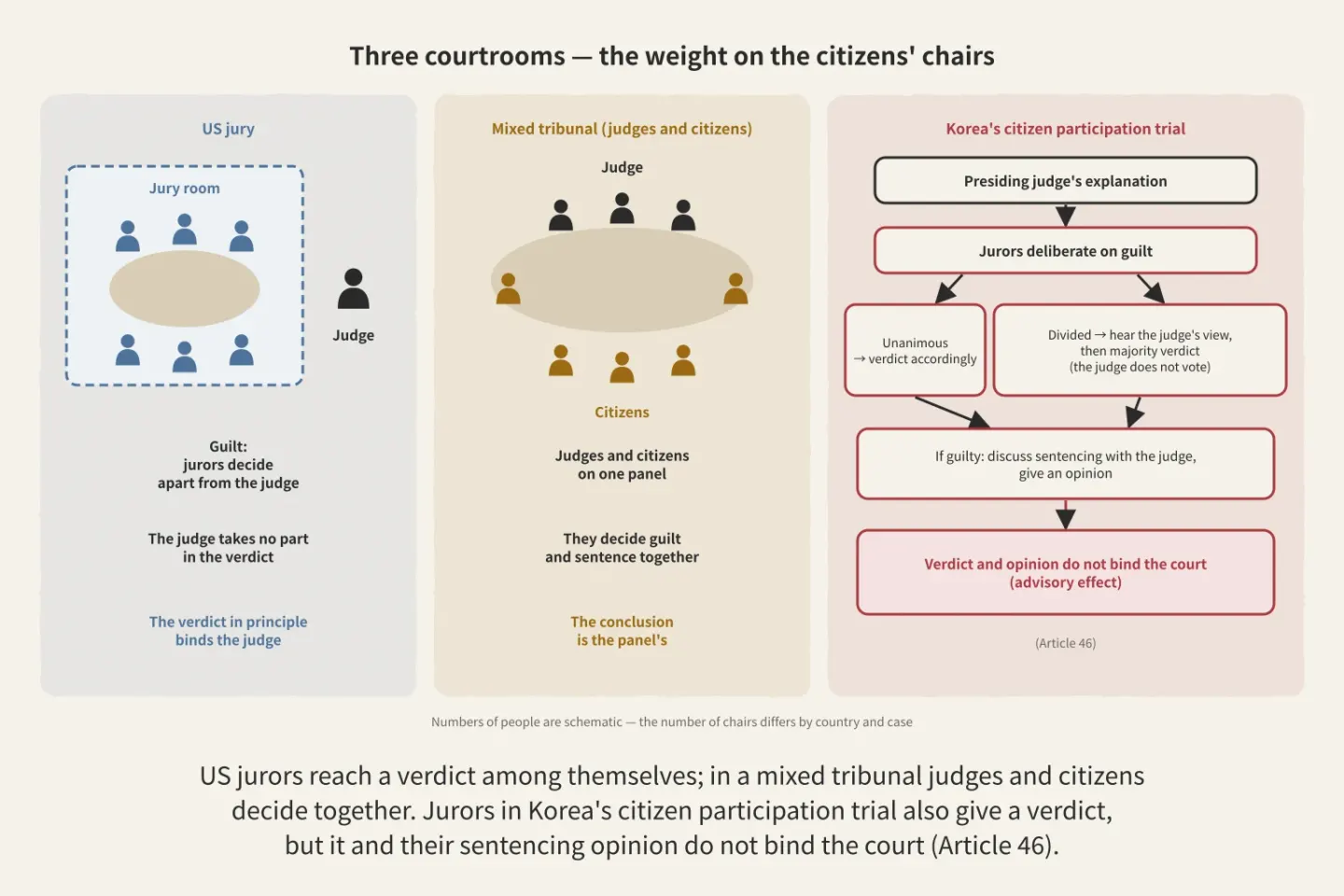
Figure: a diagram Paperis drew using only what the article says
| American Jury | Trial Where Judges and Citizens Sit Together (Lay Judge System) | Korean Citizen Participation Trial | |
|---|---|---|---|
| Who Determines Guilt or Innocence | Citizen jurors separately from the judge | Judges and citizens together | Citizens render a verdict, and the court, not bound by that verdict, makes the final judgment |
| The Judge's Seat | Does not participate in the verdict | One member of the panel, with heavy weight | If opinions split, states opinions in deliberation, but does not participate in the verdict |
| The Power of the Conclusion | In principle binds the judge (exceptional exclusion recognized) | The conclusion of the court | Does not bind the court |
| Sentencing | Juror involvement is partially recognized | Decided together | Citizens discuss with the judge and voice opinions |
Metaphors have limits. The chairs are not always twelve. At the time of the Duncan case, the Louisiana Constitution alone provided for juries of 5 or 12 depending on the case (391 U.S. 145). And even if the number of chairs is the same, the power resting in those chairs varies by country. The American chair in principle binds the judge, while the Korean chair recommends to the court. Rather than counting chairs, we must look at how far the conclusions coming from those chairs travel.
Where to Look Next
Where jurors and judges part ways, the standard of proof in a criminal trial hangs in the balance. What a prosecutor must prove and how much is covered in "The Presumption of Innocence — The Threshold the Prosecutor Must Cross". How a criminal trial differs from a civil trial is in "How Is a Civil Case Different from a Criminal One? — One Incident, Two Courtrooms", and the stages of trial that follow a first-instance verdict are in "Korea's Three-Tier Courts and the Supreme Court — The Three Steps a Case Climbs, and Sometimes Comes Back Down". Why the reasoning behind a judgment matters can be read further in "How to Read a Court Judgment — A One-Line Answer and Its Reasons".
Among the other parts of this series, "The US Constitution and the Supreme Court — The Margins of a Hard-to-Amend Text" covers the Bill of Rights and the federal Supreme Court, "Common Law and Civil Law — The Book a Judge Opens First" covers the differences between the two legal families, and "Europe's Two Courts — Who Has the Last Word?" covers the European Court of Human Rights.
Source Papers
- "Duncan v. Louisiana" (1968) — 391 U.S. 145 — Because criminal jury trials are fundamental to American justice, the Fourteenth Amendment guarantees a jury trial in state courts within the scope of the Sixth Amendment, and a crime carrying a two-year sentence is not a petty offense.
- "Act on Citizen Participation in Criminal Trials, Article 1" (Current) — Statutory text — The purpose of citizen participation trials, which is to increase the democratic legitimacy and trust of the judiciary.
- "Act on Citizen Participation in Criminal Trials, Article 5" (Current) — Statutory text — Cases subject to participation; it is not held if the defendant does not want it or if an exclusion decision is made.
- "Act on Citizen Participation in Criminal Trials, Article 46" (Current) — Statutory text — The presiding judge's explanation, deliberation, verdict (unanimous, or majority vote after listening to the judge's opinion in case of disagreement), and sentencing discussion; verdicts and opinions are not legally binding on the court.
- "American Government 4e — Appendix B The Constitution of the United States" (2025) — OpenStax American Government 4e — The original text of the jury trial clause in Article III of the US Constitution.
- "The US Jury System and Its Implications" (2018) — KCI ART002343201 — The US criminal jury consists of 12 people who are independent of the judge and determine guilt or innocence unanimously, binding the judge; South Korea's citizen participation trial is based on this model but was modified amid debates over constitutionality.
- "Precedent Changes Regarding the Unanimous Jury Verdict Principle and Incorporation Theory in the US – In Relation to the Verdict of Citizen Participation Trials –" (2025) — DOI: 10.16960/jhlr.26.3.202509.261 — From the constitutionality of non-unanimous verdicts in Apodaca (1972) to the requirement for absolute unanimity in Ramos (2020), with advocates and critics in opposition.
- "Decisionmaking about General Damages: A Comparison of Jurors, Judges, and Lawyers" (1999) — DOI: 10.2307/1290315 — The introduction of a 1999 paper summarizing the Kalven and Zeisel study (8,000 judge surveys, 79% agreement in personal injury cases, no plaintiff bias, award amounts averaging 20% higher).
- "Estimating the Accuracy of Jury Verdicts" (2007) — DOI: 10.1111/j.1740-1461.2007.00090.x — Estimating accuracy using judge-jury agreement rates, the accuracy of jury verdicts in National Center for State Courts cases is at most 87% (not a representative sample, model estimate).
- "Jury decision making: 45 years of empirical research on deliberating groups." (2001) — DOI: 10.1037/1076-8971.7.3.622 — A review of 206 studies from 1955 to 1999 showing that evidence strength, pre-trial publicity, excluded evidence, and prior convictions consistently affect verdicts, with US jury trials exceeding 150,000 per year.
- "Do they matter? A meta-analytic investigation of individual characteristics and guilt judgments." (2014) — DOI: 10.1037/law0000006 — Across 272 studies, the correlation between 11 juror and defendant characteristics and guilt judgments is 0 to .22, with large moderating effects.
- "Racial Bias in Mock Juror Decision-Making: A Meta-Analytic Review of Defendant Treatment." (2005) — DOI: 10.1007/s10979-005-8122-9 — Mock jury research overall shows a small but significant racial bias effect, which increases depending on moderating variables.
- "A Study on the Rationality of Jury Deliberation - Analysis of Shadow Jury Deliberations in Citizen Participation Trials" (2013) — KCI ART001822495 — Observation of shadow juries in 20 actual trials showed that explanations and understanding of evidence were generally good, but there were premature voting, minority dominance, and emotional influences.
- "The Meaning and Changes of Criminal Jury Trials under the US Constitution - In Relation to South Korea's Citizen Participation Trial -" (2025) — DOI: 10.46751/nplak.2025.21.1.177 — US criminal jury trials account for less than 5% of all criminal cases, plea bargaining prevents system gridlock, and South Korea does not need to introduce US-style plea bargaining.
- "Legal Complexity and the Transformation of the Criminal Process: The Origins of Plea Bargaining" (1997) — DOI: 10.1017/s0021223700015284 — The standard processing of Anglo-American criminal cases is pleading guilty through plea negotiation, with most literature being critical and even advocates viewing it as a "necessary evil."
- "The Effects of the 'Vanishing Trial' on Our Incarceration Rate" (2016) — DOI: 10.1525/fsr.2016.28.5.330 — The author argues that the decline in trials pushed up incarceration rates and that the Supreme Court's stance requiring most misdemeanors and felonies to be tried exclusively by jury was a mistake.
- "The Effect of Juror Verdicts in Citizen Participation Trials" (2012) — DOI: 10.16960/jhlr.13.2.201206.273 — Advisory effect is appropriate given South Korea's circumstances, and it is necessary to grant binding force only to unanimous not-guilty verdicts, etc., while a purely US-style system would also require plea bargaining.
- "Procedures and Recent Issues in the French Jury System" (2024) — DOI: 10.46751/nplak.2024.20.3.341 — In French jury trials, the judge's role is significant, and judges and jurors jointly decide guilt, innocence, and sentencing.
- "A Study on the Problems of the Citizen Participation Trial System and Alternative Ways to Introduce a Lay Judge System — Through a Comparative Legal Review with the German Lay Judge System —" (2011) — KCI ART001558620 — Arguing for the introduction of a German-style lay judge system and proposing guaranteed powers for lay judges, such as a 4- to 5-year term and the right to review case records.
- "Reasoned Jury Verdicts and the Right to a Fair Trial: In Light of the Case Law of the European Court of Human Rights and the Austrian Constitutional Court" (2025) — DOI: 10.46751/nplak.2025.21.3.71 — The Taxquet judgment (2010) did not view unreasoned verdicts themselves as a violation but required safeguards; France and Belgium introduced requirement statements, while the Austrian Constitutional Court upheld unreasoned verdicts as constitutional in 2017.
- "The Globalizing Jury Trial: Lessons and Insights from Korea" (2010) — DOI: 10.5131/ajcl.2009.0049 — Juries spread across the world in three waves, and South Korea represents a mixed design blending Anglo-Saxon juries, lay judges, and indigenous devices.
- "A Brief Study on the Amended Bill for the Citizen Participation Trial Act - Focusing on the Critical Review of the Binding Force of Juror Verdicts -" (2017) — KCI ART002212788 — The Participation Trial Act took effect on January 1, 2008, and the bill is critically reviewed focusing on the principle of respecting juror verdicts.
- "The Constitutional Compatibility of the Lay Judge System" (2005) — KCI ART001160788 — Views are divided into unconstitutional and constitutional theories regarding whether the "judge" in Article 27, Paragraph 1 of the Constitution is limited to professional judges.
- "Improvement Measures for the Amendment to the Citizen Participation Trial Act: Focusing on the Binding Force of Juror Verdicts" (2014) — KCI ART001921392 — The enacted statute settled the controversy for the first phase of implementation (2008–2012) by recognizing only an advisory effect, and the amendment's "de facto binding force" has broad exceptions.
- "Comparison of Legal Judgments Between Juries and Courts in Citizen Participation Trials: Focusing on Cases Sentenced from 2018 to 2020" (2022) — KCI ART002887260 — Analyzing 406 judgments, categorical decision agreement was 95.6%, disagreements involved jury not-guilty vs. court guilty, disagreements were frequent with majority votes, courts were harsher in sentencing more often, and empirical grounds were provided for claims of binding force.
- "A Study on Enhancing Trust in Citizen Participation Trials: Analysis of Discrepancies Between Juror Verdicts and Court Judgments and Measures for Institutional Improvement" (2025) — DOI: 10.18189/isicu.2025.32.3.437 — Among 181 discrepancies from 2008 to 2021, 91.7% were jury not-guilty versus trial division guilty, jurors tended toward harsher punishments in sentencing, and CSI effects and victim-blaming biases had an impact.
- "A Review of the Binding Effect of Juror Verdicts in Citizen Participation Trials" (2012) — DOI: 10.36999/kjc.2012.24.3.9 — Out of 1,490 applications from 2008 to 2011, 574 (38.5%) proceeded as jury trials, with over 90% result agreement, suggesting a "weak binding force."
- "A Korean-Style Model for Juror Deliberation and Verdicts" (2020) — DOI: 10.21795/kcla.2020.32.2.297 — High withdrawal rates, low application rates, high appeal rates, and advisory effects have been reviewed as major problems, and controlling the presiding judge's intervention in the deliberation room is proposed.
- "Measures to Revitalize Citizen Participation Trials" (2022) — KCI ART002812383 — Pointed out high post-application withdrawal rates and lack of incentives to maintain applications as causes of low implementation rates.
- "A Study on the Effect of Citizen Participation Trial Juror Verdicts" (2018) — DOI: 10.35867/ssulri.2018.40..003 — Legislation recognizing full binding force—neither advisory nor "de facto binding"—is appropriate.
Sources (18)
- American Government 4e — Appendix B The Constitution of the United States
- 미국의 만장일치제 배심 평결 원칙과 편입(incorporation) 이론에 관한 판례의 변천 – 국민참여재판의 평결과 관련하여DOI 10.16960/jhlr.26.3.202509.261
- Decisionmaking about General Damages: A Comparison of Jurors, Judges, and LawyersDOI 10.2307/1290315
- Estimating the Accuracy of Jury VerdictsDOI 10.1111/j.1740-1461.2007.00090.x
- Jury decision making: 45 years of empirical research on deliberating groupsDOI 10.1037/1076-8971.7.3.622
- Do they matter? A meta-analytic investigation of individual characteristics and guilt judgmentsDOI 10.1037/law0000006
- Racial Bias in Mock Juror Decision-Making: A Meta-Analytic Review of Defendant TreatmentDOI 10.1007/s10979-005-8122-9
- 미국 헌법상 형사배심재판의 의미와 그 변화 - 한국의 국민참여재판과 관련하여DOI 10.46751/nplak.2025.21.1.177
- Legal Complexity and the Transformation of the Criminal Process: The Origins of Plea BargainingDOI 10.1017/s0021223700015284
- The Effects of the 'Vanishing Trial' on Our Incarceration RateDOI 10.1525/fsr.2016.28.5.330
- 國民參與裁判에 있어서 陪審員 評決의 效力DOI 10.16960/jhlr.13.2.201206.273
- 프랑스 배심제의 절차와 최근의 쟁점DOI 10.46751/nplak.2024.20.3.341
- Reasoned Jury Verdicts and the Right to a Fair Trial: In Light of the Case Law of the European Court of Human Rights and the Austrian Constitutional CourtDOI 10.46751/nplak.2025.21.3.71
- The Globalizing Jury Trial: Lessons and Insights from KoreaDOI 10.5131/ajcl.2009.0049
- 국민참여재판의 신뢰 제고를 위한 연구 : 배심원 평결과 판결의 불일치 사례 분석 및 제도 개선 방안DOI 10.18189/isicu.2025.32.3.437
- 국민참여재판에서 배심원 평결의 기속적 효력에 관한 검토DOI 10.36999/kjc.2012.24.3.9
- 배심원 평의와 평결의 한국형 모델DOI 10.21795/kcla.2020.32.2.297
- 국민참여재판 배심원 평결의 효력에 대한 고찰DOI 10.35867/ssulri.2018.40..003